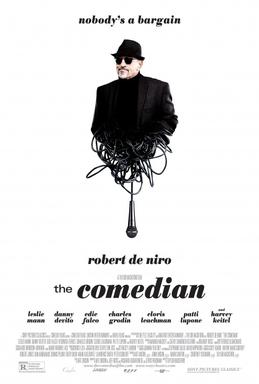
Insomnia File #33: The Comedian (dir by Taylor Hackford)


What’s an Insomnia File? You know how some times you just can’t get any sleep and, at about three in the morning, you’ll find yourself watching whatever you can find on cable? This feature is all about those insomnia-inspired discoveries!

http://www.youtube.com/watch?v=gLQXUmzXuEo

If you were having trouble getting to sleep around two in the morning last night, you could have turned over to Starz and watched the 2016 film, The Comedian.

It probably wouldn’t have helped.  It’s not that The Comedian is a particularly interesting movie or anything like that.  Abysmally paced and full of dull dialogue, The Comedian would be the perfect cure for insomnia if it just wasn’t so damn loud.  Robert De Niro plays an aging comedian named Jackie Burke and, in this movie, being an aging comedian means that you shout out your punch lines with such force that you almost seem to be threatening anyone who doesn’t laugh.  However, the threats aren’t necessary because everyone laughs at everything Jackie says.

Actually, it’s a bit of an understatement to say that everyone laughs.  In The Comedian, Jackie is such a force of pure, unstoppable hilarity that all he has to do is tell someone that they’re fat and literally the entire world will shriek with unbridled joy.  The thing with laughter is that, in the real world, everyone laughs in a different way.  Not everyone reacts to a funny joke with an explosive guffaw.  Some people chuckle.  Some people merely smile.  But, in the world of The Comedian, everyone not only laughs the same way but they also all laugh at the same time.  There’s never anyone who doesn’t immediately get the joke and, by that same token, there’s never anyone who can’t stop laughing once everyone else has fallen silent.  The Comedian takes individuality out of laughter, which is a shame because the ability to laugh is one of the unique things that makes us human.

Anyway, The Comedian is about a formerly famous comedian who is now obscure.  He used to have a hit TV show but now he’s nearly forgotten.  Why he’s forgotten is never made clear because nearly everyone in the movie still seems to think that he’s the funniest guy in the world.  Jackie’s an insult comic and people love it when he tells them that they’re overweight or when he makes fun of their sexual preferences.  This would probably be more believable if Jackie was played by an actor who was a bit less intense than Robert De Niro.  When De Niro starts to make aggressive jokes, you’re natural instinct is not so much to laugh as it is to run before he starts bashing in someone’s head with a lead pipe.

Anyway, the plot of the film is that Jackie gets into a fight with a heckler.  The video of the fight is uploaded to YouTube, which leads to a scene where his manager (Edie Falco) stares at her laptop and announces, “It’s going viral!”  Later on, in the movie, Jackie forces a bunch of old people to sing an obnoxious song with him and he goes viral a second time.  I kept waiting for a shot of a computer screen with “VIRAL” blinking on-and-off but sadly, the movie never provided this much-needed insert.

In between beating up the heckler, ruining his niece’s wedding, and hijacking a retirement home, Jackie finds the time to fall in love with Harmony Schlitz (Leslie Mann), a character whose name alone is enough to The Comedian one of the most annoying films of all time.  Harmony’s father is a retired gangster (Harvey Keitel) and you can’t help but wish that Keitel and De Niro could have switched roles.  It wouldn’t have made the movie any better but at least there would have been a chance of Keitel going batshit insane whenever he took the stage to deliver jokes.

I’m not sure why anyone thought it would be a good idea to cast an actor like Robert De Niro as a successful comedian.  It’s true that De Niro was brilliant playing a comedian in The King of Comedy but Rupert Pupkin was supposed to be awkward, off-putting, and not very funny.  I’m not an expert on insult comics but, from what I’ve seen, it appears that the successful ones largely succeed by suggesting that they’re just having fun with the insults, that no one should take it personally, and that they appreciate any member of the audience who is willing to be a good sport.  Jackie just comes across like a cranky old misogynist.  Watching Jackie is like listening to your bitter uncle play Vegas.  I guess it would help if Jackie actually said something funny every once in a while.  A typical Jackie joke is to refer to his lesbian niece as being a “prince.”  Speaking for myself, when it comes to Robert De Niro being funny, I continue to prefer the scene in Casino where he hosts the Ace Rothstein Show.

Perhaps the funniest thing about The Comedian is that, when it originally released into theaters, it was advertised as being “The Comedian, a Taylor Hackford film,” as if Taylor Hackford is some type of Scorsese-style auteur.  Taylor Hackford has been making films for longer than I’ve been alive and he has yet to actually come up with any sort of signature style beyond point and shoot.  The second funniest thing is that The Comedian was billed as a potential Oscar contender, up until people actually saw the damn thing.

Though it may have failed at the box office, The Comedian seems to show up on Starz quite frequently.  They always seem to air it very late at night, as if they’re hoping people won’t notice.  

Previous Insomnia Files:

  1. Story of Mankind
  2. Stag
  3. Love Is A Gun
  4. Nina Takes A Lover
  5. Black Ice
  6. Frogs For Snakes
  7. Fair Game
  8. From The Hip
  9. Born Killers
  10. Eye For An Eye
  11. Summer Catch
  12. Beyond the Law
  13. Spring Broke
  14. Promise
  15. George Wallace
  16. Kill The Messenger
  17. The Suburbans
  18. Only The Strong
  19. Great Expectations
  20. Casual Sex?
  21. Truth
  22. Insomina
  23. Death Do Us Part
  24. A Star is Born
  25. The Winning Season
  26. Rabbit Run
  27. Remember My Name
  28. The Arrangement
  29. Day of the Animals
  30. Still of The Night
  31. Arsenal
  32. Smooth Talk

Insomnia File #32: Smooth Talk (dir by Joyce Chopra)


What’s an Insomnia File? You know how some times you just can’t get any sleep and, at about three in the morning, you’ll find yourself watching whatever you can find on cable? This feature is all about those insomnia-inspired discoveries!

If you were having trouble getting to sleep around one in the morning last night, you could have turned over to This TV and watched Smooth Talk, a disturbingly creepy coming-of-age film from 1985.

Connie Wyatt (played by Laura Dern in one of her first film roles) is fifteen years old and ready to discover the word.  It’s the summer and, for Connie and her friends, that means going to the mall, trying to capture the attention of the cute boys who go to their school, and lying to her parents about where she goes at night.  (She tells them that she and her friends have been going to the same movie, night-after-night.)  She likes it when the boys in the mall smile at her but not when the stranger honk their car horn at her whenever she walking at night.  Connie thinks of herself as being an independent adult, even though she’s not sure what that means.

Connie does know that she doesn’t want to be like her mother (Mary Kay Place).  Her mother, who claims that she was once a great beauty herself, complains that all Connie does is indulge in “trashy daydreams.”  Her mother tells Connie to be careful about who she flirts with and constantly demands that Connie stay home and help to paint the house.

Connie also doesn’t want to be like her older sister, June (Elizabeth Berridge).  June is obviously her mother’s favorite.  June never sneaks out.  June never rebels.  Whenever Connie and her mother argue, June always take their mother’s side.

In fact, the only member of her family that Connie’s close with is her father (Levon Helm).  Her father is always cheerful and always in a good mood.  Somehow, the constant tension in the house never seems to get to him and he never seems to be worried about anything.  He’s nice but he’s hardly an authority figure.

And then there’s an older man (Treat Wiliams).  When we first see him, he’s sitting outside of a diner and casually watching all of the teenage girls as they walk by.  (We all know the type.)  When he sees Connie and her friends, he looks over at Connie and tells her, “I’m watching you.”  Later, when Connie is alone at her house, the man pulls up in front of her house and starts to talk to her.

His name, he explains, is Arnold Friend.  “A. Friend,” he puts it.  That’s what he wants to be to her.  When she asks how old he is, he says that he’s 18, though he’s clearly closer to 30.  He’s handsome and he’s charming but there’s something off about him.  He shows Connie his car.  “Arnold Friend” is written on the side.  “33, 19, 17,” is written on the back.  Written next to a dent: “A woman driver did this.” Sitting in the car is a friend of Arnold’s, a man who hides his face behind a portable radio.

“He’s strange,” Arnold explains with a sly smile, before suggesting that Connie get in the car with them…

Smooth Talk is based on a short story by Joyce Carol Oates and, oh my God, is it ever creepy!  The first half of the movie plays out like a typical coming-of-age teen film but then Arnold shows up in that car and the film turns into a nightmare.  I spent almost the entire movie cringing, mostly because I once was Connie Wyatt, the only real difference being that I was even younger when I decided that I understood how the world worked better than my parents and I started rebelling.  As I watched the movie, I found myself wondering what I would have done if Arnold Friend had pulled up in front of my house.  Would I have gotten in the car or what I would have run back into the house, locked the door, and called the police?  I’d like to think I would have done the smart thing but … no.  Doing the smart thing would have meant admitting that the adults were right and there were situations that I couldn’t control or even really understand.

Laura Dern was 18 years old when she played 15 year-old Connie and she gave an amazing and naturalistic performance.  When Treat Williams first appeared as Arnold, I thought that he was overacting but, as the film progressed, I came to see that he was actually perfectly cast and giving exactly the type of performance that the movie’s story needed.  Arnold Friend, who speaks in outdated slang and always seems to be trying just a little bit too hard, has to be a slightly ridiculous figure because otherwise, no one would drop their guard enough to get into his car.  As I watched the movie, I realized that it was a mistake to think of Arnold as being a human being.  Instead, he’s a nightmare come to life.

Smooth Talk was a deeply unsettling film about growing up in an increasingly dangerous world.  It’s right up there with Out of The Blue, Christiane F, and Blue Velvet among nightmarish coming-of-age stories.

Previous Insomnia Files:

  1. Story of Mankind
  2. Stag
  3. Love Is A Gun
  4. Nina Takes A Lover
  5. Black Ice
  6. Frogs For Snakes
  7. Fair Game
  8. From The Hip
  9. Born Killers
  10. Eye For An Eye
  11. Summer Catch
  12. Beyond the Law
  13. Spring Broke
  14. Promise
  15. George Wallace
  16. Kill The Messenger
  17. The Suburbans
  18. Only The Strong
  19. Great Expectations
  20. Casual Sex?
  21. Truth
  22. Insomina
  23. Death Do Us Part
  24. A Star is Born
  25. The Winning Season
  26. Rabbit Run
  27. Remember My Name
  28. The Arrangement
  29. Day of the Animals
  30. Still of The Night
  31. Arsenal

Insomnia File #31: Arsenal (dir by Steve C. Miller)


What’s an Insomnia File? You know how some times you just can’t get any sleep and, at about three in the morning, you’ll find yourself watching whatever you can find on cable? This feature is all about those insomnia-inspired discoveries!

http://www.youtube.com/watch?v=G_Qq2DWiTCw

If you were having trouble getting to sleep last night around midnight, you could have turned over to Showtime and watched Arsenal, a film that had a brief theatrical run in January and which has now made its way to cable.

Arsenal tells the story of two brothers.  When we first meet them, they’re kids and they’re living with their uncle.  But then their uncle kills himself and the two brothers find themselves going down very different paths.  JP (who is played, as an adult, by Adrian Grenier) turns a part-time job mowing lawns into a full-time job as the owner of a construction company.  Meanwhile, Mikey (played, as an adult, by Jonathon Schaech) stumbles across gangster Eddie King (Nicolas Cage) while Eddie is busy killing a man.  JP heads for a life of respectability.  Mikey heads for a life of crime.  Much like the Bulger brothers, they remain close despite their differing lifestyles.

But who cares about the brothers?  Adrian Grenier and Jonathon Schaech both do the best that they can with these two underwritten parts but ultimately, neither JP nor Mikey is that interesting.  If anything, they’re like the guys who you keep around as backups in case the guy you really like never works up the courage to talk to you.  Instead, let’s discuss about Eddie King.

As I said before, Eddie King is played by Nicolas Cage.  As you can probably guess, Cage does not exactly show anything resembling restraint when he plays King.  That may not be surprising but what is surprising that, after twenty years or going totally overboard in almost every role that he’s played, Cage can still surprise audiences by just how far he’s willing to go.  Every time that you think Cage’s performances can’t get any more bizarre, something like Arsenal comes out and proves you wrong.

There is so much to love about Cage’s batshit crazy performance as Eddie King.  For one thing, it makes absolutely no sense.  If you look at real-life mobsters, one thing that becomes clear very quickly is that the best ones may have been sadistic but they were usually smart enough to know when to lay low.  Eddie, on the other hand, never lays low.  He’s so crazy that he might as well be wearing a shirt that reads, “I kill people and then laugh about it.”  So, not only do you have Cage giving one of his most over-the-top performances but, for some reason, he’s also wearing this extremely fake nose and the movie doesn’t really make much of an effort to disguise the fact that it’s a fake nose.  I mean, you can literally see the glue that’s holding the fake nose over the old nose.  And then there’s Cage’s haircut, which would appear to suggest that Eddie King shares a barber with every pervy humorist who has ever had a job working for Minnesota public radio.  When we first see Eddie, he’s gruesomely killing a man and Cage gets so into it and there’s so much blood flying that I was half-expecting Eddie to then turn into Pennywise the clown.  Eddie gets another scene where he writes a letter to his dead brother.  Cage acted the Hell out of that scene.  It’s as if he was saying, “You thought my Left Behind performance was strange?  CHECK THIS OUT, DAMN YOU!”

Of course, Cage isn’t the only good actor acting weird in Arsenal.  John Cusack plays a cop.  He always wears sunglasses and a cap and he also keeps his shoulder slouched.  Was it a character thing or was Cusack sincerely hoping no one would recognize him in the movie?  I’m not really sure but it’s still fun to try to figure out.

Anyway, Arsenal is your typical low-budget gangster film, where there’s a lot of yelling and people getting shot and tortured and all the rest of the usual crap.  There are thousands of these films and they tend to blend together into one tedious mass of pointless mass of sadism.  One of the brothers gets kidnapped.  The other one has to shoot a lot of people.  Bleh.  Boring.  Outside of the people who need something to watch while at the Russian mafia sleepover, who cares?  WAKE ME WHEN THE BULLETS HAVE STOPPED FLYING AND IT’S ALL OVER!  But at least Cage and Cusack are around to keep things kind of interesting.

Previous Insomnia Files:

  1. Story of Mankind
  2. Stag
  3. Love Is A Gun
  4. Nina Takes A Lover
  5. Black Ice
  6. Frogs For Snakes
  7. Fair Game
  8. From The Hip
  9. Born Killers
  10. Eye For An Eye
  11. Summer Catch
  12. Beyond the Law
  13. Spring Broke
  14. Promise
  15. George Wallace
  16. Kill The Messenger
  17. The Suburbans
  18. Only The Strong
  19. Great Expectations
  20. Casual Sex?
  21. Truth
  22. Insomina
  23. Death Do Us Part
  24. A Star is Born
  25. The Winning Season
  26. Rabbit Run
  27. Remember My Name
  28. The Arrangement
  29. Day of the Animals
  30. Still of The Night


A Suspenseful Insomnia File #30: Still Of The Night (dir by Robert Benton)


What’s an Insomnia File? You know how some times you just can’t get any sleep and, at about three in the morning, you’ll find yourself watching whatever you can find on cable? This feature is all about those insomnia-inspired discoveries!

If last night, at 1:30 in the morning, you were having trouble getting to sleep, you could have turned on the TV, changed the channel to your local This TV station, and watched 1982’s Still Of The Night.

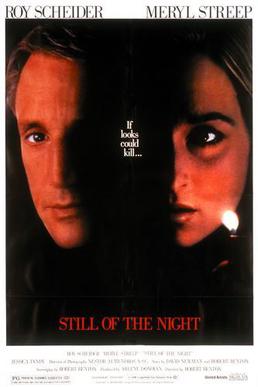
Still of the Night actually tells two stories.  The first story  deals with Dr. Sam Rice (Roy Scheider), a psychiatrist who is living a perfectly nice, mild-mannered, upper class existence in Manhattan.  His patients are rich and powerful and his sessions with them provide him with a view of the secrets of high society.

One of Sam’s main patients is George Bynum (Josef Sommer), who owns an auction house and who is a compulsive cheater.  George tells Sam that he’s haunted by strange nightmares and that he is also worried about a friend of his.  George says that this friend has murdered in the past and George fears that it’s going to happen again.  When George is murdered, Sam wonders if the murder was committed by that friend.  He also wonders if that friend could possibly have been one of George’s mistresses, the icy Brooke Reynolds (Meryl Streep).

The second story that Still of the Night tells is about our endless fascination with the films of Alfred Hitchcock.  Still of the Night is such an obvious homage to Hitchcock that it actually starts to get a little bit silly at times.  Almost every scene in the film feels like it was lifted from a previous Hitchcock film.  At one point, there’s even a bird attack!  (Add to that, Scheider’s mother is played by Jessica Tandy, who previously played Rod Taylor’s mother in The Birds.)  Meryl Streep is specifically costumed and made up to remind viewers of previous Hitchcock heroines, like Grace Kelly, Kim Novak, Eva Marie Saint, and Tippi Hedren.

Unfortunately, considering the talent involved, Still of the Night never really works as well as it should.  Both Scheider and Streep seem to be miscast in the lead roles.  If Still of the Night had been made in the 50s, one could easily imagine James Stewart and Grace Kelly playing Sam and Brooke and managing to make it all work through screen presence along.  However, Scheider and Streep both act up a storm in the lead roles, attacking their parts with the type of Actor Studios-gusto that seems totally out-of-place in an homage to Hitchcock.  Scheider is too aggressive an actor to play such a mild character.  As for Streep, she’s miscast as a noir-style femme fatale.  Streep’s acting technique is always too obviously calculated for her to be believable as an enigma.

That said, there were still some effective moments in Still of the Night.  The majority of the dream sequences were surprisingly well-done and effectively visualized.  I actually gasped with shock while watching one of the dreams, that’s how much I was drawn into those scenes.

According to Wikipedia, Meryl Streep has described Still of the Night as being her worst film.  I think she’s being way too hard on the movie.  It’s nothing special but it is an adequate way to kill some time.  Certainly, I’d rather watch Still of the Night than sit through Florence Foster Jenkins.

Previous Insomnia Files:

  1. Story of Mankind
  2. Stag
  3. Love Is A Gun
  4. Nina Takes A Lover
  5. Black Ice
  6. Frogs For Snakes
  7. Fair Game
  8. From The Hip
  9. Born Killers
  10. Eye For An Eye
  11. Summer Catch
  12. Beyond the Law
  13. Spring Broke
  14. Promise
  15. George Wallace
  16. Kill The Messenger
  17. The Suburbans
  18. Only The Strong
  19. Great Expectations
  20. Casual Sex?
  21. Truth
  22. Insomina
  23. Death Do Us Part
  24. A Star is Born
  25. The Winning Season
  26. Rabbit Run
  27. Remember My Name
  28. The Arrangement
  29. Day of the Animals

A Horror Insomnia File #29: Day of the Animals (dir by William Girdler)


What’s an Insomnia File? You know how some times you just can’t get any sleep and, at about three in the morning, you’ll find yourself watching whatever you can find on cable? This feature is all about those insomnia-inspired discoveries!

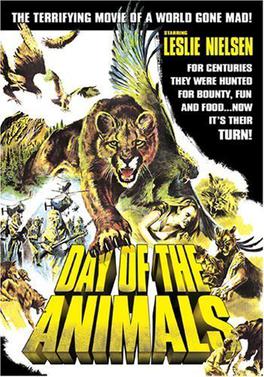
Last night, if you were having trouble sleeping around 2:30 in the morning, you could have turned on your television, changed the station to Movies TV, and watched the 1977 nature-goes-crazy horror film, Day of the Animals!

Now, I should admit that I was not suffering from insomnia last night.  Jeff and I are currently up at beautiful Lake Texoma and we just happened to be up late last night and flipping through the stations.  I should also admit that, unlike most of the other movies reviewed for this feature, Day of the Animals was not one of “those insomnia-inspired discoveries.”

No, we had both seen Day of the Animals before.  The thing with Day of the Animals is that it’s one of those films that, if you see that it’s on TV, you simply have to stop what you’re doing and watch it.  Considering that the man had a long career in the movies and I haven’t seen every film that he made, I could be wrong on this but I am fairly certain that Day of the Animals is your only opportunity to see Leslie Nielsen wrestle a grizzly bear.

Leslie Nielsen plays Paul, a businessman who is part of a group of hikers.  Shortly before he wrestles with the bear, Paul stands, bare-chested, in the middle of a rainstorm and attempts to taunt God.  “Melville’s God, that’s the God I believe in!” Paul shouts, “You want something!?  YOU TAKE IT!”  Then he turns to one of the hikers and says, “I know what I want and I’m taking it!  I killed a man for you!”

Now, at this point, I should probably make it clear that Day of the Animals is not a comedy, though it’s always inspired a lot of laughter whenever I’ve watched it.  Day of the Animals attempts to be a very serious horror movie.  It even has an environmental message.  Because of the hole in the ozone layer, solar radiation is driving all of the mountain animals crazy.  Mountain lions attack campers.  A grizzly bear wrestles Leslie Nielsen.  A group of rats attempt to kill a policeman.  German shepherds tear a man apart.  And it’s not just the wild animals that are being affected.  Leslie Nielsen goes crazy too.

Of course, Leslie Nielsen isn’t the only hiker.  Genre vet Christopher George plays the leader of the tour and Lynda Day George is along for the ride as well.  If you’ve seen the movie Pieces, you’ll remember Christopher George as the tough cop and Lynda Day George as the tennis pro who, at one point, dramatically screams “BASTARD!” into the wind.  Susan Backlinie, who was the first victim in Jaws, also has a role in this film and that seems appropriate.  Director William Girdler found quite a bit of success in ripping off Jaws.  Before Day of the Animals, he directed Grizzly.

But good ole Leslie Nielsen is pretty much the entire show here.  He tries really, really hard to give an intense and frightening performance.  In fact, he tries so hard that you almost feel guilty for laughing at times.  But then you see that head of perfect silver hair and you hear that deadpan voice saying, “Come here, you little punk!” and you just can’t help yourself.

Anyway, Day of the Animals may be bad but I defy anyone not to watch it.

Previous Insomnia Files:

  1. Story of Mankind
  2. Stag
  3. Love Is A Gun
  4. Nina Takes A Lover
  5. Black Ice
  6. Frogs For Snakes
  7. Fair Game
  8. From The Hip
  9. Born Killers
  10. Eye For An Eye
  11. Summer Catch
  12. Beyond the Law
  13. Spring Broke
  14. Promise
  15. George Wallace
  16. Kill The Messenger
  17. The Suburbans
  18. Only The Strong
  19. Great Expectations
  20. Casual Sex?
  21. Truth
  22. Insomina
  23. Death Do Us Part
  24. A Star is Born
  25. The Winning Season
  26. Rabbit Run
  27. Remember My Name
  28. The Arrangement

Insomnia File #28: The Arrangement (dir by Elia Kazan)


What’s an Insomnia File? You know how some times you just can’t get any sleep and, at about three in the morning, you’ll find yourself watching whatever you can find on cable? This feature is all about those insomnia-inspired discoveries!

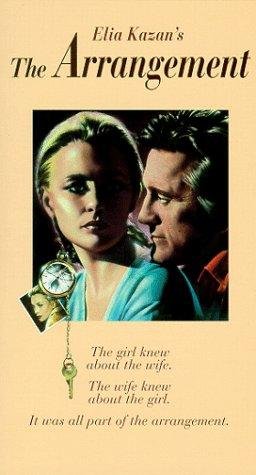
If, on Saturday you were having trouble sleeping at three in the morning, you could have turned on TCM and watched the 1969 film, The Arrangement.

The Arrangement is one of those films where a rich guy gets hit by a sudden case of ennui and, as a result, spends the entire movie acting like a jackass.  However, as often happens in films like this, The Arrangement makes sure that we understand that it’s not the guy’s fault.  Instead, it’s his wife’s fault for not being as much fun as his mistress.

In this case, the guy is an ad executive who goes by the name of Eddie Anderson (Kirk Douglas).  His original name was Evangelos Arness but he changed his name when he was younger because he apparently didn’t want anyone to know that he came from a Greek family.  When we first meet Eddie, he’s attempting to commit suicide by driving his car into an 18 wheeler.  If he had died, the movie could have ended quickly.  However, since Eddie survived, the audience is now required to spend two hours watching Eddie as he tries to figure out what it all means.

Eddie’s father (Richard Boone) is dying.  His long-suffering wife (Deborah Kerr) just doesn’t understand that Eddie needs more than a big house and a nice pool to feel like a man.  Eddie’s mistress is Gwen (Faye Dunaway), whose new baby may or may not be Eddie’s.  Who could blame Eddie, the film demands to know, for being disillusioned with his comfortable life?

The Arrangement was one of the last films to be directed by Elia Kazan, who was a big deal in the 40s and the 50s and whose goal with The Arrangement was apparently to prove that he should still have been a big deal in the 60s and 70s.  Kazan’s way of doing this is to fill The Arrangement with all types of tricks that were designed to make young filmgoers say, “Man, that Eliza Kazan may be old but he’s one of us!”

Freeze frames?  Kazan’s got them!  Flashback after flashback?  Kazan spreads them all throughout the movie, even when they don’t really have anything to show us.  Scenes where the action is sped up for no identifiable reason?  Just watch Kirk Douglas trot down that hallway!  Rack focus shots?  Zoom shots?  A scene where the young Kirk Douglas argues with the old Kirk Douglas?  Casual nudity that’s still filmed in such a way that it feels oddly reticent, as if the filmmaker was just including it to try to establish his rebel credentials?  The Arrangement has it all!

It also has a lot of close-ups of Kirk Douglas.  In far too many scenes, he’s just sitting around with this blank look on his face and it doesn’t quite work because, as an actor, Douglas has never exactly come across as the type to get trapped in an existential crisis.  We’re supposed to view Kirk as being depressed and conflicted but, in all of his films, Kirk has always come across as someone who hasn’t known a day of insecurity in his entire life.

There are also a few scenes of Kirk just laughing and laughing.  For some reason, movies in the late 60s and early 70s always seemed to feature at least a handful of closeups of people laughing uncontrollably.  I’m not sure why.  (If you want to see the most extreme example of this, check out Getting Straight.)  These scenes are always kind of annoying because there’s only so much time you can spend watching someone laugh at the absurdity of it all before you want them to just close their damn mouth.  Especially when the person in question is a middle-aged man.  I mean, shouldn’t have Kirk figured out that the world is absurd before his 50th birthday?

Anyway, The Arrangement is a pretentious mess.  Of course, most films from the 60s are pretentious.  The problem with The Arrangement is that it’s also boring.  If you’re going to be pretentious, at least have some fun with it, like The Graduate did.  The Arrangement goes on forever and it’s never quite as profound as it seems to think that it is.  I once read a short story that a former friend of mine wrote.  She explained that writing the story had caused her to realize that, the longer you know someone, the more likely your initial impression of that person is going to change.  “You had to write an entire short story to figure that out?” I replied.  (That’s one reason why she’s a former friend.)  But that’s kind of how The Arrangement is.  For all the drama and the technique and the pretension, it has nothing to teach us that we shouldn’t already know.

Previous Insomnia Files:

  1. Story of Mankind
  2. Stag
  3. Love Is A Gun
  4. Nina Takes A Lover
  5. Black Ice
  6. Frogs For Snakes
  7. Fair Game
  8. From The Hip
  9. Born Killers
  10. Eye For An Eye
  11. Summer Catch
  12. Beyond the Law
  13. Spring Broke
  14. Promise
  15. George Wallace
  16. Kill The Messenger
  17. The Suburbans
  18. Only The Strong
  19. Great Expectations
  20. Casual Sex?
  21. Truth
  22. Insomina
  23. Death Do Us Part
  24. A Star is Born
  25. The Winning Season
  26. Rabbit Run
  27. Remember My Name

Insomnia File #27: Remember My Name (dir by Alan Rudolph)


What’s an Insomnia File? You know how some times you just can’t get any sleep and, at about three in the morning, you’ll find yourself watching whatever you can find on cable? This feature is all about those insomnia-inspired discoveries!

If you were having trouble sleeping last Tuesday, around one in the morning, you could have turned over to TCM and watched Remember My Name, an odd and sometimes frustrating little thriller from 1978.

Remember My Name opens with Emily (Geraldine Chaplin) showing up in a small town in California.  From the minute we first see and hear Emily, something seems to be off about her.  She views the world through suspicious eyes.  Whenever anyone talks to her, you’re never quite sure whether she’s going be friendly or if she’s going to lash out.  When she speaks, there’s something weird about her vocal inflection, as if she’s always struggling to figure out what she’s supposed to say.  She seems to be separated from the world, almost as if she’s walking through a living dream and only talking to figments of her imagination.  There’s nothing about her that feels at all authentic.

She moves into a small apartment and enters into a relationship with her handyman (Moses Gunn), a relationship that seems to be largely defined by her refusal to open up about herself.  She gets a job at a grocery story that’s managed by a Mr. Nudd (Jeff Goldblum).  Mr. Nudd mentions something about Emily knowing his mother.  Apparently, they met in prison.

Soon, Emily is stalking a construction worker named Neil Curry (Anthony Perkins).  When Neil spots her, he calls out her name and Emily runs away.  And yet, Neil doesn’t bother to tell his wife, Barbara (Berry Berenson), about Emily.  Soon, Emily is even breaking into the Curry home, silently shadowing Barbara as she walks through the house.

I described Remember My Name as being a thriller and I guess that, technically it is.  There are a few moments of tension, especially when Emily is stalking Barbara.  However, the film itself is directed in a detached manner by Alan Rudolph.  Rudolph was a protegé of director Robert Altman (who also produced Remember My Name) and Rudolph’s approach is very Altmanesque, often to the detriment of the film.  (Chaplin and Jeff Goldblum had both appeared in several Altman films, most famously in Nashville.)  Though the film is dominated by Chaplin and Perkins, it’s still very much an ensemble film and the action plays out in a deceptively casual, almost random manner.  It tries so hard to be Altmanesque that Remember My Name gets a bit frustrating, to be honest.  Chaplin gives such a good and memorable performance and she works very hard to make Emily a character who is both frightening and, at times, surprisingly sympathetic but, for the most part, Rudolph’s technique makes it difficult to get emotionally involved in any of the action unfolding on-screen.  Rudolph observes the action but refuses to comment on it.  As a result, Remember My Name is occasionally intriguing but, just as often, it’s rather boring.  Just like real life, I suppose.  And, just like real life, it’s not for everyone.

That said, it was interesting to see Anthony Perkins playing a role other than a knife-wielding inn manager.  Without resorting to any of the familiar tics or the neurotic speech patterns that typecast him forever as Norman Bates, Perkins plays Neil as just being a regular, blue collar guy and he actually does a pretty good job.  Watching the film, I got the feeling that this was perhaps Perkins’s attempt to change his image.  (Whenever Neil appears shirtless, both the film and Perkins seem to be saying, Check out this physique!  Would someone only capable of playing a psycho have abs like this?)  Neil’s wife, Barbara, was played Perkins’s wife, Berry Berenson.  Neither one of them is with us any longer.  Perkins died of AIDS in 1990 while Berry Berenson was on one of the planes that flew into the World Trade Center on 9-11.  They both did good work in this film, as did Chaplin and Goldblum and, really, the entire cast.  It’s just a pity that the film itself isn’t as good as the performances. 

Previous Insomnia Files:

  1. Story of Mankind
  2. Stag
  3. Love Is A Gun
  4. Nina Takes A Lover
  5. Black Ice
  6. Frogs For Snakes
  7. Fair Game
  8. From The Hip
  9. Born Killers
  10. Eye For An Eye
  11. Summer Catch
  12. Beyond the Law
  13. Spring Broke
  14. Promise
  15. George Wallace
  16. Kill The Messenger
  17. The Suburbans
  18. Only The Strong
  19. Great Expectations
  20. Casual Sex?
  21. Truth
  22. Insomina
  23. Death Do Us Part
  24. A Star is Born
  25. The Winning Season
  26. Rabbit Run

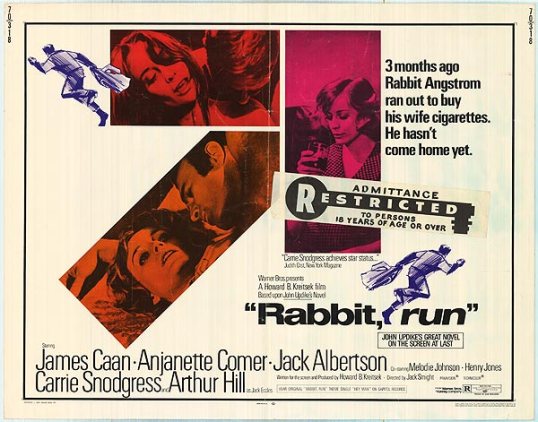
Insomnia File #26: Rabbit Run (dir by Jack Smight)


What’s an Insomnia File? You know how some times you just can’t get any sleep and, at about three in the morning, you’ll find yourself watching whatever you can find on cable? This feature is all about those insomnia-inspired discoveries!

If, at one in the morning on Wednesday, you were suffering from insomnia, you could have turned over to TCM and watched the 1970 film, Rabbit Run.  That’s what I did.

Rabbit Run is the epitome of a dumb lug film.  In a dumb lug film, a male character finds himself living an unfulfilling life but he can’t figure out the reason.  Why can’t he figure it out?  Because he’s a dumb lug, with the emphasis on dumb.  Usually, the viewer is supposed to sympathize with the dumb lug because he doesn’t mean to hurt anyone and everyone else in his world is somehow even more annoying than he is.  Typically, the dumb lug will have an emotionally distant wife who refuses to have sex with him and who is usually portrayed as being somehow at fault for everything bad that has happened in the dumb lug’s face.  (Want to see a more recent dumb lug film than Rabbit Run?  American Beauty.)  Ever since the silent era, there have been dumb lug films.  In particular, male filmmakers and critics seem to love dumb lug films because they allow them to pat themselves on the back for admitting to being dumb while, at the same time, assuring them that everything is the fault of the wife or the girlfriend or the mother or the mother-in-law.

In Rabbit Run, the dumb lug is named Harry Angstrom (James Caan), though most people still remember him as Rabbit, the high school basketball star.  Harry’s life peaked in high school.  Now, he’s 28 and he can’t hold down a job.  He’s married to Janice (Carrie Snodgress), who spends all of her time drinking and watching TV.  He has a son and another baby is on the way.  One day, when the pregnant Janice asks him to go out and get her a pack of cigarettes, Harry responds by getting in his car and driving all the way from Pennsylvania to Virginia.

When he returns to Pennsylvania, Rabbit doesn’t go back to his wife.  Instead, he drops in on his former basketball coach (Jack Albertson) and begs for advice on what he should do.  The coach, it turns out, is more than little creepy.  He also has absolutely no practical advise to give.  He does introduce Rabbit to a part-time prostitute named Ruth (Anjanette Comer).  Rabbit quickly decides that he’s in love with Ruth and soon, he’s moved in with her.

Meanwhile, there’s all sorts of little things going on.  Rabbit gets a job working as a gardener.  Rabbit befriends the local Episcopal minister (Arthur Hill), even while the minister’s cynical wife (Melodie Johnson) tries to tempt Rabbit away from both his wife and his mistress.  Rabbit both resents and envies the sexual freedom of the counter culture, as represented by his younger sister.  And, of course, Janice is pregnant…

Rabbit Run is based on a highly acclaimed novel by John Updike.  I haven’t read the novel so I can’t compare it to the film, beyond pointing out that many great works of literature have been turned into mediocre movies, largely because the director never found a way to visually translate whatever it was that made the book so memorable in the first place.  Rabbit Run was directed by Jack Smight, who takes a rather frantic approach to the material.  Since Rabbit Run is primarily a character study, it needed a director who would be willing to get out of the way and let the actors dominate the film.  Instead, Smight overdirects, as if he was desperately trying to prove that he could keep up with all the other trendy filmmakers.  The whole movie is full of extreme close-ups, abrupt jump cuts, intrusive music, and delusions of ennui.  You find yourself wishing that someone had been willing to grab Smight and shout, “Calm down!”

(On the plus side, as far as the films of 1970 are concerned, Smight’s direction of Rabbit Run still isn’t as bad as Richard Rush’s direction of Gettting Straight.)

James Caan actually gives a likable performance as Rabbit, which is good because Rabbit would be totally unbearable if not played by an actor with at least a little genuine charisma.  There’s nothing subtle about Caan’s performance but he makes it work.  You never like Rabbit but, at the same time, you don’t hate him.

Unfortunately, there’s nothing subtle about the rest of the cast either.  Something rather tragic happens about 80 minutes into the film and, as much as I knew I shouldn’t, I still found myself giggling because Carrie Snodgress’s performance was so bad that it was impossible for me to take any of it seriously.  Even worse is Arthur Hill, as the minister who won’t stop trying to help Rabbit out.  I eventually reached the point where, every time that sanctimonious character started to open his mouth, I found myself hoping someone would hit him over the head and knock him out.  Among the major supporting players, only Anjanette Comer is allowed a chance to be something more than just a sterotype.  Like Caan, she does the best that she can but ultimately. this is James Caan’s movie.

It’s a disappointing movie but it did not put me to sleep.  Give credit for that to James Caan, who is the only reason to see Rabbit Run.

Previous Insomnia Files:

  1. Story of Mankind
  2. Stag
  3. Love Is A Gun
  4. Nina Takes A Lover
  5. Black Ice
  6. Frogs For Snakes
  7. Fair Game
  8. From The Hip
  9. Born Killers
  10. Eye For An Eye
  11. Summer Catch
  12. Beyond the Law
  13. Spring Broke
  14. Promise
  15. George Wallace
  16. Kill The Messenger
  17. The Suburbans
  18. Only The Strong
  19. Great Expectations
  20. Casual Sex?
  21. Truth
  22. Insomina
  23. Death Do Us Part
  24. A Star is Born
  25. The Winning Season


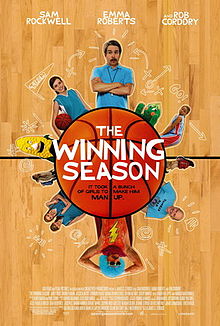
Insomnia File #25: The Winning Season (dir by James C. Strouse)


What’s an Insomnia File? You know how some times you just can’t get any sleep and, at about three in the morning, you’ll find yourself watching whatever you can find on cable? This feature is all about those insomnia-inspired discoveries!

http://www.youtube.com/watch?v=K_rwcbZA0ds

If, last night, you were up at 11:45 then … well, you were probably like most people.  To be honest, I don’t know if The Winning Season, which aired on Cinemax last night, really counts as an insomnia file.  Being up at midnight probably doesn’t qualify as insomnia.

That said, The Winning Season is an extremely sweet and likable movie that, until I came across it last night, I had previously heard nothing about.  Even if it wasn’t directly inspired by insomnia, this was a film that I was happy to discover and I’m going to recommend that, if you haven’t seen it, you discover it too.

Of course, I guess I shouldn’t be too shocked that I loved this film because it stars Sam Rockwell.  Sam Rockwell is one of my favorite actors.  It’s not just that he’s talented and that he frequently takes risks and chooses interesting projects, though all of that is certainly true.  There’s a sincerity to Sam Rockwell’s performances.  He’s one of those actors who, when you watch him, you feel as if he’s literally opening up his heart and soul to you.  There are few actors who can make me cry quite as effectively as Sam Rockwell.  That he didn’t win an Oscar for Moon (and has, in fact, never even been nominated) remains one of the most glaring mistakes in the history of the Academy Awards.

Sam Rockwell is at the center of The Winning Season and it’s hard to imagine the film working with anyone other than him in the leading role.  Sam plays Bill, a former high school basketball star who is now a divorced alcoholic with a 16 year-old daughter that he struggles to communicate with.  Like many of Rockwell’s character, Bill is irresponsible but he means well.  Bill spends most of his time drinking and working as a busboy at a restaurant.

One night, Bill is approached by his former teammate, Terry (Rob Corddry).  Terry is now a high school principal and he has an offer for Bill.  Terry needs a new coach for the Girls’ Basketball Team.  Even though Bill doesn’t consider Girls’ Basketball to be a real sport, he accepts the position.

And you can guess what happens.  When Bill is first hired, no one takes the team seriously.  There’s only six players on the team and none of them — not even the ones played by Emma Roberts and Rooney Mara — believe that they have a chance at a winning season.  In fact, their best player breaks her ankle before the season even begins.  After a rough start, Bill and the girls bond and soon, they start to win games.

Again, it’s not surprising but it is incredibly sweet.  And, as predictable as it may be, the film still throws in a few unexpected twists.  One thing that I liked is that, even after they started to get good, the team still struggled and lost the occasional game.  They didn’t all magically become the best basketball players ever and, for that matter, Sam didn’t magically become the best coach in the world.  This is an unapologetic crowd pleaser that still keeps one foot in reality.  Everyone, in the film, fully commits to their roles.  In particular, Margo Martindale is great in the role of Bill’s assistant.  It’s always a pleasure to watch two good actors play off of each other and Martindale’s scenes with Sam Rockwell are fun to watch.

But really, the entire film belongs to Sam Rockwell.  Sam Rockwell can take the most predictable dialogue imaginable and make it sound like poetry.  About halfway through the film, Bill loses his driver’s licence and is reduced to showing up at the games on bicycle.  There’s little that is more adorable than Sam Rockwell pedaling across the screen.

The Winning Season is an incredibly sweet and likable movie.  I’m glad that I discovered it.

Previous Insomnia Files:

  1. Story of Mankind
  2. Stag
  3. Love Is A Gun
  4. Nina Takes A Lover
  5. Black Ice
  6. Frogs For Snakes
  7. Fair Game
  8. From The Hip
  9. Born Killers
  10. Eye For An Eye
  11. Summer Catch
  12. Beyond the Law
  13. Spring Broke
  14. Promise
  15. George Wallace
  16. Kill The Messenger
  17. The Suburbans
  18. Only The Strong
  19. Great Expectations
  20. Casual Sex?
  21. Truth
  22. Insomina
  23. Death Do Us Part
  24. A Star is Born

Insomnia File #24: A Star is Born (dir by Frank Pierson)


What’s an Insomnia File? You know how some times you just can’t get any sleep and, at about three in the morning, you’ll find yourself watching whatever you can find on cable? This feature is all about those insomnia-inspired discoveries!

If you found yourself awake and unable to sleep at 2:30 this morning, you could have always turned over to TCM and watched the 1976 film, A Star is Born. 

A Star is Born gets off to a good start by having Gary Busey give Kris Kristofferson a hit of cocaine.  As I pointed out on twitter, no movie that starts with Gary Busey offering cocaine to Kris Kristofferson can be all bad.

Anyway, Kris is playing John Norman Howard.  John Norman Howard is a big 70s rock star, which means that he has a beard and a bad case of ennui.  Despite all of the cocaine and whiskey, his career is on a downward spiral.  Part of the problem appears to be that he only sings one song and, half the time, he still can’t bring himself to remember all of the lyrics.  The song opens with John growling, “Are you a figment of my imagination or am I one of yours?” and John always ends up storming off stage before we can hear the rest of it.

Anyway, John ends up at this club in Hollywood that looks a lot like the place that Ryan Gosling opened up at the end of La La Land.  While at the club, John gets into a fight with Robert Englund (who I assume was playing a young Freddy Krueger) and totally interrupts the performance of the Oreos.

Who are the Oreos?   They’re a folk-singin’ power trio.  There’s One (Venetta Fields) and Two (Clydie King).  (According to the credits, that’s actually their names.)  And then there’s Esther Hoffman, who has a truly horrid perm and who is played by Barbra Streisand.  One and Two are black.  Esther, who stands right in the middle whenever they perform, is white.  And they’re called The Oreos!

Uhmmm, yeah…

Anyway, we really don’t learn anything about One or Two, beyond the fact that they are totally and completely devoted to Esther.  When Esther gets them fired from recording a cat food jingle, they just smile and laugh.  Sure, why not!?  After all, it’s not like struggling musicians need money or anything.  When Esther interrupts a performance to yell at John, One and Two smile and laugh.  When Esther, under John’s tutelage, becomes a big star and basically abandons the Oreos, One and Two show up at a recording session and smile and laugh.

Last night was my first time to actually see A Star is Born, though I had heard and read quite a bit about it.  Of all the versions of A Star is Born, this one made the most money at the box office but it also got the worst reviews.  Reportedly, the film’s production was a trainwreck with Barbra Streisand and then-boyfriend Jon Peters fighting with … well, everyone.

And yet, like so many cinematic trainwrecks, you simply cannot look away from it.  This version of A Star is Born gets so many things wrong that it becomes rather fascinating to watch.  Perhaps the scene that epitomizes A Star is Born comes when John refuses to perform his one song at a benefit concert and instead, brings out Esther and has her perform her songs.  First off, John’s hard rock band suddenly transforms into a Broadway orchestra and John’s audience — who presumably had paid money to hear that growling song about imagination — is overjoyed to instead have to listen to Esther’s style of lite pop/rock.  (Actually, to even call it rock is to needlessly stretch the definition of rock to its breaking point.)  Making the scene even more bizarre is that 1) John is basically exploiting a benefit concert to launch Esther’s career and 2) since the concert was being performed to support the American Indian Movement, the disembodied head of a Native American woman keeps appearing over Esther’s shoulder while she’s performing songs that have absolutely nothing to do with the cause that the concert is supposedly supporting.  It’s kind of the cinematic equivalent of that Kendall Jenner Pepsi commercial.

Anyway, things get even better when John buys an empty field and, in a ten minute montage, John and Esther literally build a house.  Seriously, I’m not kidding.  At no point do we see anyone other than John and Esther working on that house and yet, within a matter of minutes, they have an adobe mansion to live in.  I had no idea it was so easy to build a house.  It makes me wonder why people waste money buying houses when they can just buy an empty field and build their own.

(Maybe they’re scared of the poltergeists.  Imagine how different this version of A Star Is Born would have been if it ended with Esther grabbing John and screaming, “YOU MOVED THE HEADSTONES BUT YOU LEFT THE BODIES, DIDN’T YOU!?  YOU LEFT THE BODIES!”)

Kris Kristofferson is well-cast as John Norman Howard but the film is pretty much centered around Barbra.  That, in itself, wouldn’t be a problem if not for the fact that Barbra is completely miscast.  She’s a great singer but she’s not a rock singer.  You never believe that the same people who want to hear John sing his one song would also want to hear any of Esther’s songs.  The fact that the film is basically 140 minutes of everyone insisting that Esther is the future of music only reminds us of the fact that she’s not.  Her style is throwback to the past, which is one reason why everyone’s grandmother loves Barbra Streisand.

This wouldn’t be such a big deal if Barbra and Kris actually had any chemistry but they really don’t.  There’s a scene where Barbra and Kris take a bath together and Barbra puts makeup on Kris’s face.  Between two people who have chemistry, that would be sexy and sweet.  Between Kris and Barbra, it’s just kind of icky and you find yourself wondering who took the time to light the hundreds of candles surrounding them.  Whenever Barbra and Kris kissed, I worried for her just because all I could think of was the stubble burn that Esther would have to deal with later.

Yet, in the end, the film makes so many mistakes that it becomes one of the most watchable movies ever made.  It may not be good but it sure is entertaining.

Previous Insomnia Files:

  1. Story of Mankind
  2. Stag
  3. Love Is A Gun
  4. Nina Takes A Lover
  5. Black Ice
  6. Frogs For Snakes
  7. Fair Game
  8. From The Hip
  9. Born Killers
  10. Eye For An Eye
  11. Summer Catch
  12. Beyond the Law
  13. Spring Broke
  14. Promise
  15. George Wallace
  16. Kill The Messenger
  17. The Suburbans
  18. Only The Strong
  19. Great Expectations
  20. Casual Sex?
  21. Truth
  22. Insomina
  23. Death Do Us Part