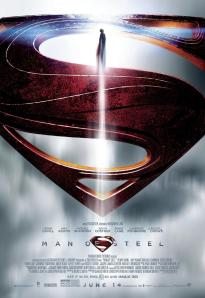
Film Review: Man of Steel (dir. by Zack Snyder)


New%20Man%20of%20Steel%20PosterHere the short of it, for anyone looking to make a decision based on what’s being written here (spoiler free part): 

Man of Steel is a great film, though has it’s flaws. The film is a coming of age story of an individual who knows what he’s capable of, but in fearing the world’s reaction to his existence, keeps it at bay until he can discover who and what he is. Where Marvel celebrates the removal of the Masked Hero (with Iron Man), DC looks towards giving the audience a reason why Superman has to be Clark Kent, which I thought worked very well. Carried by some fantastic casting, the film manages to raise the stakes for Superman (and the damage level of anywhere there’s a fight – I’m talking Dragonball Z levels of damage) in a way that up until now really wasn’t depicted well. Rather than taking the lazy route of Superman Returns (which just took Superman II’s ending and ran with it, saying that III and IV just didn’t happen), Man of Steel tries to re-invent things a little, which works on some levels, but not on all.

The faults of the film lie in the same problems that plagued the entire Dark Knight Trilogy. There’s a scene or two that ends without “closing the loop” and work within a bubble of action – a catastrophe occurs for one or two people, but before you can wonder how everyone else in the area fared, you’re left to believe “Well, let’s just assume they’re all okay and everything was fixed.” It’s the same as the Joker throwing Rachel Dawes out of a window and leaving the audience to believe that the Joker’s crew just left the way they came with no fuss or muss. The film also suffers from the physical fight issues of “Batman Begins”. It all moves so fast that in some cases, you’re left with this shaky-cam feel. It almost warrants a second viewing just to try to see the punches / kicks you may have missed the first time around. And the last act has a lot of that. This is the thing that may hurt the film with older movie goers. Imagine having something you’ve grown up with for who knows how long displayed at a speed so fast, it moves like a video game? That could be jarring.

And for those of you want to read more (it may get just a little – very little – on the spoilery side here): 

I’ll start with this. I’m not a huge fan of Superman overall. Although I’ve seen all of the previous film (many of them at the movies), I’ve always thought of Superman as a seriously overpowered character. With the pieces of his own planet being the only thing that could hurt him, what were the chances anyone could find that stuff? For this, I found the Marvel characters more interesting and relatable. How many stories can you really write about the Hulk, or Namor / Aquaman for that matter? That’s where I put Superman in the scheme of things.

That said, Zack Snyder’s Man of Steel did manage to invoke an emotion in me that I’ve never felt for the character in all these years – Sadness. It was like watching a Bond film and actually worry about Bond, imagine that. You figure this guy has all these powers, he can frickin fly, dammit. He has heat vision, x-ray vision and freezing breath. One could choose, with all that power to just dominate humanity. It’s Clark’s parents – all of them – that give him the power of choice. To decide as he grows to become who he wants to be and how to use those abilities.  That has to be pretty difficult. One scene hit home for me, involving Clark learning an ability. It’s short, but reflects the isolation of someone who is considered very different from those around him.

I loved Man of Steel. It’s does have its issues, but for me it’s such a step in a better direction for the Superman franchise. That isn’t to say that the films before it were terrible or horrid (save for Quest of Peace, which was utter crap), but Man of Steel brings so much more action and love for the character overall. Where Superman Returns was more of a drama with slices of action, perhaps Man of Steel is best consider a reversal.

When it comes to the story – penned by Christopher Nolan and David Goyer, and with Goyer doing the screenplay – I liked where it went. It didn’t try to recreate anything from the first two movies, nor did it sway so far away from it that you wondered what it was all for (Amazing Spider Man, with its thousands of radioactive spiders that could make any scientist Spider-Man with a well timed bite). The origin parts are delivered piecemeal though flashbacks, which allowed the whole story to flow pretty evenly. It’s when the movie gets into the third act – the “Hero has to face said Event” sequence that Goyer loves so much that it starts turning right back into the Batman Begins train sequence. At least the level of the event is big enough so that only Superman could really deal with it, but personally, I’ll admit that I wanted a bit more for what was done.

Casting wise, I don’t think they could have done much better than this. Henry Cavill, who I remember from 2002’s The Count of Monte Cristo and Showtime’s The Tudors, is damn near perfect as the Man of Steel, though he has so much seriousness to him that you wanted to say…”Hey, Hakuna Matata, dude. It’ll all work out. Just lighten up a little.” There’s very little playing around here.  Then again, given the way the character was written this time around, he doens’t have all that much to laugh about, I suppose.

Amy Adams really isn’t the Lois Lane I expected. She’s not written in the style of the intrepid reporter that has to get herself in trouble, but still manages to find herself facing problems in the pursuit of a good story. She wasn’t bad at all, really, but one smart thing the story does is forces her to have to be in the mix of this in less of a spectator role and more of a participant. That I enjoyed.

I gave Michael Shannon a lot of flak for his performance in last year’s Premium Rush, but I owe him an apology. All that craziness in that film is just gone here, his General Zod is subdued and even. I also enjoyed that they gave him something more to work with other than “Dominate the creatures of this planet because we hate the son of Jor-El”. His Villain has a fully plausible reason for what he’s doing, so much so that you could almost empathize with it. He’s not very different from Magneto against the X-Men in that fashion, and I felt it added quite a deal to this story. Don’t get me wrong. Terrence Stamp was great, and his “Kneel Before Zod” was always cool, but the premise in Superman II was a little odd. I figure they’d get bored with us kneeling after a while and just leave the planet once discovering our love for reality tv (Pawn Stars for me).

Someone pointed out online that both of Kal-El’s parents were Robin Hood. Both Russell Crowe and Kevin Costner do indeed play Clark’s fathers and both are used better in this than in previous versions. Each character has a view in what Clark can be become, and both individuals seem to be right, but between the two I thought Costner fared better. One thing about Crowe, he’s given quite a bit to do in this film, which surprised me. I did really didn’t expect to see much of him in this.

Diane Lane is a sweet Martha Kent. While I love Lane in her movies, I don’t know. I kind of feel anyone could have played that. She performs the role well, though. Laurence Fishburne makes for a good Perry White, channelling his character from Hannibal, as does Christopher Meloni as a Military General. I really want to see more from Meloni, actually. The scene stealer, by far (and future Hottie of the Day, if I can find enough pictures of her) is Pandorum’s Antje Traue as Zod’s henchwoman, Faora. Every scene she’s in makes her to be that Darth Maul /   Hellboy kind of supporting baddie, providing as much of a challenge to Superman as Zod. And for the time she has on screen, Ayelet Zurer sells it totally as Lara, siding with her husband to send their child away for a chance at a better life. That can’t be an easy decision for anyone or anything, but I could at least feel she was bothered by it.

Personally, I didn’t want another origin tale. The way I view it, some of these characters are so burned into our minds that we really don’t need to know the back story. However, Man of Steel does provide an origin tale that seems to make sense with the way things are today. We don’t trust what we don’t understand and unless we can catalog and easily reference it to something comparable, we usually consider it something bad. As this story tells it, Superman may or may not have the luxury to openly say “Hey, I’m Kal-El, from Krypton, let me walk among you.” as easily as Tony Stark could proclaim he was Iron Man.

As for the DC Cinematic Universe, if this is the first film that’s going to lay the groundwork, it’s a nice start. It doesn’t leave any breadcrumbs for audience expectation for a Justice League movie, but if  DC is smart, they’ll get whatever the next movie they want to do started right after this. That’s the hope, anyway.

With a new direction in tone also comes a new score. Hans Zimmer knocks the soundtrack out of the ballpark with this one. Bringing together nearly 12 drum legends for percussion (including Sheila E. And Jason Bonham), Zimmer creates a theme for the hero that will undoubtedly be reused in sports venues for years to come. It’s uplifting in places and creepy in others. Some themes borrow a little bit from his own Angels & Demons, but this is something Zimmer is known for. Having listened to the score for most of the week, I’m already humming it off and on.

And what about the kids? The kids should be fine seeing this. There’s a childbirth sequence in the very beginning that may require some explaining to the littlest of viewers, and there’s violence all over the place, but all it’s worth, there’s not a whole lot of blood and very little gore. Nothing anyone who plays Call of Duty on the regular couldn’t handle.

Oh, one more thing. The 3D is good here, particularly in the flight sequences, but you’re not really missing anything if you happen to catch it in 2D. Note that there isn’t anything after the credits with this film.
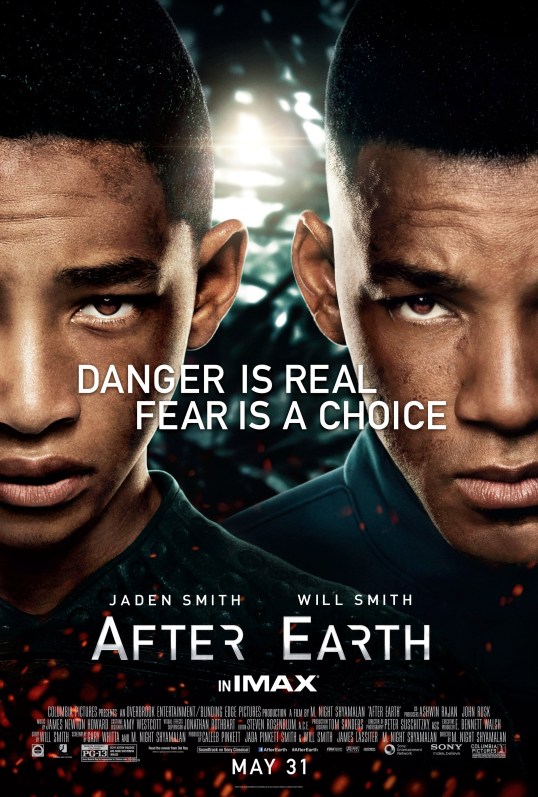
Film Review: After Earth (dir by M. Night Shyamalan)


After Earth is the latest of many forgettable films to have been released in 2013.

The film’s plot — which will be familiar to anyone who has seen Oblivion or any other science fiction film — deals with a father (Will Smith) and his son (Jaden Smith). The father is a great military leader but is emotionally distant.  (Will Smith, who is probably one of the most openly emotional actors working today, deals with being miscast by refusing to smile.)  The son is desperate to prove himself to his father.  When the two of them return to Earth (which was deserted a thousand years ago because of — you guessed it — pollution), their ship crashes.  The father is critically injured and, of course, the son has to save both of their lives, deal with his past guilt, and become a man.

Or something like that.

Did you know that M. Night Shyamalan directed After Earth?  If you didn’t, don’t feel bad.  In the advertising campaign leading up to this film’s release, Columbia Pictures has treated Shyamalan’s involvement like a dirty secret.  It’s understandable, really.  After all, Shyamalan’s last two films were The Happening and The Last Airbender and you can only refer to him as being “the director of The Sixth Sense” for so long.  That said, Shyamalan’s work here isn’t that bad.  It’s not that memorable either.  Instead, it’s the epitome of adequate and bland.  Some scenes (like the crash landing on Earth) actually come close to being exciting but there’s little sense of wonder or surprise to the film’s version of the future and, while the majority of the film is about Jaden Smith trying to survive and conquer the cruelty of nature, the environment of After Earth never truly feels alive.  Perhaps an Ang Lee or a Werner Herzog could have brought After Earth to life but all Shyamalan can do is keep the action plodding forward.

However, it’s unfair to put blame for After Earth on M. Night Shyamalan.  If anybody can truly be considered the auteur of After Earth, it is Will Smith.  Smith produced the film, came up with the film’s storyline, and gave the film’s lead role to his son.  Thematically, After Earth fits into Smith’s feel-good, good-for-you brand of cinema.  The problem, however, is that for an action film like this to work, you need a charismatic hero and, to judge from this film, Jaden Smith has inherited little of his father’s onscreen prowess.  Fairly or not, it’s impossible to watch Jaden in this film without being aware that he (as opposed to an actor who doesn’t have a famous father) got the role solely because he was the producer’s son.  As such, it’s far more difficult to forgive Jaden’s awkward screen presence than it might be otherwise.

After Earth is only 100 minutes long.  It’s considerably shorter than both Iron Man 3 and the latest Star Trek film.  However, when the film’s lack of surprise is combined with Jaden Smith’s bland lead performance, the end result is a film that feels a lot longer than it actually is.

When all I said and done, the only real question about After Earth is whether or not it’s worse than Oblivion.  It’s hard to say because After Earth and Oblivion are both oddly forgettable sci-fi films with similar premises.  In fact, while watching After Earth, I kept expecting Tom Cruise to pop up and say, “I thought I was the only man left on Earth!”

I guess the question really comes down to which film is more annoying and again, there are no easy answers.  Considering how bland both Oblivion and After Earth really are, it’s interesting that both of them manage to feature some overdone accent work.  It’s hard to know how to describe Will Smith’s vaguely Aruban (?) accent in After Earth but honestly, nothing could be more annoying than Melissa Leo’s butchering of the Southern accent in Oblivion.  So, as far as bad accents are concerned, Oblivion has to be considered the winner.

(Add to that, as weird as Smith’s accent was, it could at least be justified by the fact that After Earth was meant to be taking place in the far future.  There was absolutely no justifiable reason for Melissa Leo in Oblivion to sound like Cate Blanchett in Hanna.)

However, After Earth has a tacked-on environmental message, the type that makes Shyamalan’s The Happening seem subtle and intelligent by comparison. Don’t get me wrong.  I’m not objecting to After Earth (or any other film) having a subtext.  What I do object to is when a film uses an obvious and heavy-handed subtext to try to hide the fact that the movie itself isn’t that good.  In the case of After Earth, the environmental message feels lazy and predictable.  It almost feels as if, by paying lip service to a noble cause, Shyamalan is attempting to blackmail us into liking this film.

So, what’s worse?  A bad accent or an insincere message?

Ultimately, that’s a decision that everyone must make on their own.

Or you could just ignore both After Earth and Oblivion altogether and instead make the effort to see and support truly unique films like Upstream Color.

The choice is yours.

Guilty Pleasure No. 8: Paparazzi


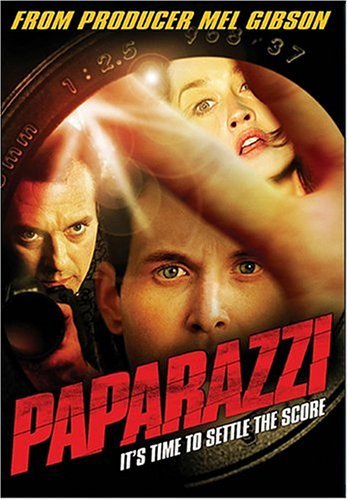
259791_ori

I once got into an argument with a friend of mine about whether or not a film could actually be so bad that it was good.

His argument was that bad, by its very definition, was the opposite of good and therefore, nothing bad could be good and vice versa.

My argument was Paparazzi.

First released back in 2004, Paparazzi tells the story of Bo Laramie (Cole Hauser).  Bo is an up-and-coming super star.  As the film begins, we’re told — by a breathless correspondent from E! News — that Bo has arrived.  He’s starring in what promises to be “the world’s biggest action franchise.”  Bo has a wife (Robin Tunney), a son, and a beautiful house on the beach.  Whenever he goes jogging, huge groups of women magically materialize so that they can giggle as he runs by.

However, not everything is perfect in the world of Bo Laramie.  Like far too many defenseless celebrities, he’s being harassed by the paparazzi.  At first, Bo attempts to be polite.  However, a demonic photographer named Rex (Tom Sizemore) refuses to stop trying to take pictures of Bo at his son’s soccer game.  Things escalate until eventually, Bo’s son is in a coma and Bo is coming up with ludicrously elaborate ways to kill all of Rex’s colleagues.

The thing that distinguishes Paparazzi is not that it’s a revenge film.  What distinguishes Paparazzi is that it seems to seriously be arguing that celebrities have the right to kill people who annoy them.  Rex and his colleagues are portrayed as being pure evil (one even laughs maniacally after snapping a picture) while Bo is the victim who has to deal with the issues that come from being a multimillionaire.  Even the homicide detective played by Dennis Farina seems to be continually on the verge of saying, “Right on!” while looking over the results of Bo’s handiwork.

It’s so ludicrous and stupid and over-the-top that it can’t help but also be a lot of fun.

Don’t get me wrong.  Paparazzi is a terrible film.  In fact, it’s so terrible that, if a group of aliens ever somehow saw Paparazzi, they would probably hop in their spaceship and come to Earth specifically to wipe out the human race.  However, as bad as the film is, it’s also one of those films that you simply cannot look away from.  Watching this film is like witnessing a tornado of pure mediocrity coming straight at you.  You know that you should just stop watching and get to safety but it’s such an unexpectedly odd sight that you can’t look away.  Once you’ve seen it, you’ll never forget it and it becomes impossible not to become fascinated by the fact that such a terrible film could actually exist.

Consider the following:

1) When he’s not busy killing photographers, Bo Laramie is filming a movie called Adrenaline Force 2.  Seriously, that title is so generic that I couldn’t help but smile every time it was mentioned.  Can you imagine anyone saying, “I want to see that new movie, what’s it called, uhmm… Adrenaline Force 2?”

2) Speaking of generic, do you think that anyone named Bo Laramie could ever possibly become the biggest film star in the world?

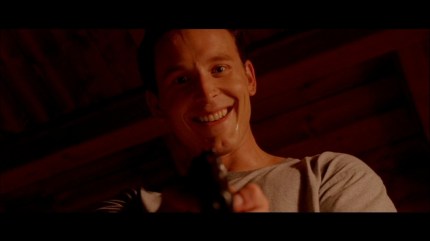
3) In the role of Bo Laramie, Cole Hauser seems like he’s as confused by this movie as everyone else.  However, towards the end of the film, he starts to flash a psychotic little grin and the contrast between that grin and Laramie’s previously stoic facade is oddly charming.

Hauser-in-Paparazzi-cole-hauser-12392470-853-480

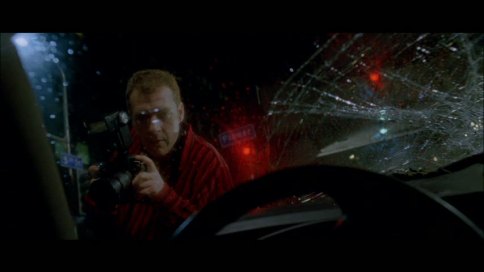
4) You haven’t lived until you’ve seen Tom Sizemore play the world’s sleaziest photographer.

5) Vince Vaughn has a cameo as himself!  He’s co-starring in Adrenaline Force 2.

6) Mel Gibson has a cameo as himself!  He’s seen sitting in a psychologist’s office.  (No, seriously…)

7) Matthew McConaughey has a cameo as himself!  He shows up out-of-nowhere, tells Bo that it’s a pleasure to meet him, and then goes, “Alright, alright…”

8) Chris Rock has a cameo as a …. pizza deliveryman!  At first, I assumed that Chris Rock was playing himself and I kept waiting for him to explain why he was delivering a pizza to Bo Laramie’s house.  However, according to the end credits, Vaughn, McConaughey, and Gibson were playing themselves while Rock was playing the role of “Pizza Guy.”

9) Plotwise, this film invites the viewer to play a game of, “What if everyone in this film wasn’t a total and complete idiot?”  For all the effort that Bo puts into plotting his revenge, it’s hard not to feel that he just got extremely lucky.

10) The film manages to be both silly and completely humorless at the same time.  As a result, it’s a good for more than a few laughs.

11) There’s a scene where, out of nowhere, Bo recites an inner monologue about the price of fame that will remind observant viewers of Tony Bennett’s classic narration from The Oscar.

12) At one point, Tom Sizemore says, “I am going to destroy your life and eat your soul. And I can’t wait to do it.”

13) The film’s director used to be Mel Gibson’s hairdresser.

14) Finally, the film was produced by Mel Gibson and that probably means that the film actually is making a sincere case for murdering members of the paparazzi.

If ever a film has deserved the description of being so bad that it’s good, it is Paparazzi.  Between the sense of entitlement, the feverish fantasies of revenge, and the out-of-nowhere celebrity cameos, Paparazzi is a film that has earned the title of guilty pleasure.

Tom-in-Paparazzi-tom-sizemore-26901287-853-480

Previous Guilty Pleasures:

  1. Half-Baked
  2. Save The Last Dance
  3. Every Rose Has Its Thorns
  4. The Jeremy Kyle Show
  5. Invasion USA
  6. The Golden Child
  7. Final Destination 2

Is It Too Late To Hate On Movie 43?


Originally,  I wasn’t planning on ever seeing Movie 43.

Remember Movie 43?  That’s the comedy with the huge ensemble cast that came out in January and stayed in theaters for about a week.  The trailers looked terrible, the commercials looked terrible, and finally, the reviews were terrible.  In fact, the reviews were so terrible (Richard Roeper called it the Citizen Kane of bad movies) that, at first, I was perfectly content never to see it.

However, as time passed, I continually heard Movie 43 referred to as being one of the worst films ever made.  Every 12 months, I post my picks for the 26 worst films of the year and I knew that Movie 43 was one of those films that would either appear on that list or, if it didn’t, I would have to be willing to defend the title’s absence.

I realized that before I could either defend or condemn, I would have to sit through the movie.  After all, I figured, it’s only 90 minutes of my life.

90 minutes that I’ll never get back, I might add.

Movie 43 is an anthology film in which 13 separate comedic sketches are loosely linked together by one overarching story.  For the most part, this is a film that was presumably made both for adolescent boys and for men who still think like adolescent boys.  Most of the humor is derived from bodily functions and there’s a real strain of misogyny running through the entire film.  However, the film’s problem is not that it’s crude and misogynistic but that it manages to be so dull about being crude and misogynistic.  If you think its hilarious when Meg is insulted on Family Guy or when Seth McFarlane smirks after making an anti-Semitic comment, you might enjoy Movie 43 but the rest of us are going to find far less to enjoy.

Oddly enough, there are actually two different versions of Movie 43 in circulation.  In the version that was released in U.S. theaters, the various vignettes are tied together by a story in which an insane director (Dennis Quaid) pitches scene after scene to a callous movie executive (Greg Kinnear).  In the version that was released in the UK, they’re linked together by a story about 3 teenagers searching for the most offensive film ever made.  To be honest, both versions are pretty stupid but I prefer the one about the 3 teenagers, if just because that way I can pretend that neither Dennis Quaid nor Greg Kinnear had anything to do with this movie.

As for the sketches themselves, there’s 13 of them and they are a mixed bag as far as both humor and quality are concerned:

1)      The Catch (dir by Peter Farrelly)

Kate Winslet and Hugh Jackman go on a blind date.  Jackman has testicles hanging from his neck and only Winslet thinks this is an odd thing.  This skit goes on forever.

2)      Homeschooled (dir by Will Graham)

Liev Schreiber and Naomi Watts explain how they’re making sure that their teenage son is getting the full high school experience despite the fact that he’s being homeschooled.  They do this through a combination of hazing and incest.  This skit worked pretty well, mostly because of the dedication that Schreiber and Watts brought to their absurd roles.

3)      The Proposition (dir by Steve Carr)

Uhmm…yeah.  So, this is the skit that opens with Anna Faris asking Chris Pratt to defecate on her.  I skipped over it because, quite frankly, life is too short.

4)      Veronica (dir by Griffin Dunne)

Neil (Kieran Culkin) is working the night shift at a depressing grocery store when his ex-girlfriend Veronica (Emma Stone) comes in.  They argue about who infected who with an STD.  Little do they realize that Neil has accidentally turned on the intercom and everyone in the store can hear them.  I actually kind of liked this short skit.  Culkin and Stone had a lot of chemistry and it was well-directed by Griffin Dunne.  Plus, it only lasted 2 minutes and, therefore, ended before the joke got old.

5)      iBabe (dir by Stephen Brill)

The iBabe is an MP3 player that happens to look like a life-size nude woman.  Unfortunately, a fan was built into the iBabe’s vagina and now, teenage boys are being dismembered while fingering and fucking iBabe.  Richard Gere plays the President of the company that makes iBabe.  I’ve never thought of Richard Gere as being a comedic actor and his performance here does nothing to change that.

6)      Superhero Speed Dating (directed by James Duffy)

Robin (Justin Long) goes speed dating and Batman (Jason Sudekis) tries to mess things up for him.  This skit – which also features (and wastes) Uma Thurman, Kristen Bell, and Bobby Cannavale – is so incredibly bad that I don’t even know where to begin.  Between this film and his appearance in last year’s The Conspirator, I’m having to rethink my slight crush on Justin Long.

7)      Machine Kids (directed by Jonathan Von Tulleken)

This commercial parody asks us to consider the children who work inside copiers and vending machines and how they are effected when we criticize those machines for not accepting our dollar.  This was actually so weird that I couldn’t help but love it.

8)      Middleschool Date (dir by Elizabeth Banks)

7th grader Amanda (Chloe Moretz) is having her first “middle school” date with Nathan (Jimmy Bennett) when she starts her first period.  In response, Nathan and his older brother (Christopher Mintz-Plasse) panic.  Believe it or not, this was actually one of the better parts of Movie 43, if just because the scene’s humor comes not from Amanda getting her period but instead from how every male around her descends into histrionics as a result.   It helps that this was the only part of Movie 43 that was both written and directed by women.  It also helps that director Elizabeth Banks is so clearly on Amanda’s side.  The end result is one of the few moments in Movie 43 that doesn’t feel misogynistic. 

9)      Tampax (dir by Patrik Forsberg)

This is another fake commercial.  Two girls are at the beach.  One uses tampax tampons and the other doesn’t.  Guess which one gets eaten by a shark?  As opposed to the previous skit, this bit of menstrual humor was obviously written and directed by a man (and the message, not surprisingly, is “Ewww!  Girls are scary and dangerous!”) but I’m going to have to admit that this one made me laugh if just because, like Middleschool Date, it reminded me of some of the period horror stories that I used to hear (and believe) back when I was younger.  (Though I was raised to be more concerned about bears than sharks…)

10)  Happy Birthday (dir by that noted comedian, Brett Ratner)

Pete (Johnny Knoxville) kidnaps an angry leprechaun (Gerard Butler) and gives it to Brian (Seann William Scott).  The leprechaun’s equally angry brother (also played by Gerard Butler) shows up and violence ensues.  Watching this skit was like being told a joke by someone who has no sense of humor.

11)  Truth or Dare (dir by Peter Farelly and Patrik Forsberg)

Halle Berry and Stephen Merchant are on a first date and Merchant has testicles on his neck…oh wait.  Sorry, that was Hugh Jackman and Kate Winslet’s skit.  In this skit, Berry challenges Merchant to game of truth or dare.  It escalates as the dares get continually more and more outrageous.  Whoops?  Did I say outrageous?  I meant to say stupid and oddly dull.  Watching this skit was like listening to a someone who has no sense of humor continue to tell a joke even though everyone else has already guessed the punchline.

12)  Victory’s Glory (dir by Rusty Cundieff)

In this parody of “inspirational” sports movies, Coach Jackson (Terrence Howard) speaks to his basketball team before they play their first game against an all-white team.  The gist of the speech is that Jackson’s team is going to win because they’re black and the other team is white.  This skit started out strong but, like a lot of Movie 43, it ran on for a bit too long.

13)  Beezel (dir by James Gunn)

This was actually my favorite part of Movie 43.  Unfortunately, since Beezel shows up in the middle of the end credits, I get the feeling that a lot of disappointed audience members had probably already walked out of the theater before it even began.  Beezel is a cartoon cat who has an unhealthy obsession with his owner (Josh Duhamel).  When Duhamel’s girlfriend (played by Elizabeth Banks) catches Beezel masturbating to pictures of Duhamel in a swimsuit, Beezel responds by plotting her demise.  Beezel was actually the only part of Movie 43 that truly felt edgy and unpredictable.  This is largely because this segment was directed by James Gunn, one of the few truly transgressive artists currently working in mainstream film.

So, here’s the question: is Movie 43 the worst film of 2013 as so many critics have claimed?  A few isolated moments aside, Movie 43 is pretty bad.  Even the parts of the film that do work can’t hope to compete with the pure horrifying incompetence of that parts that don’t.  However, thanks largely to James Gunn and Elizabeth Banks, it’s still a smidgen or so better than Tyler Perry’s Temptation.  (For all of its failings, Movie 43 never suggests that AIDS is God’s way of punishing wives who stray.  Nope, for that message, you have to go to Tyler Perry.)

Movie 43 is not the worst film of 2013.

It just seems like it.

Trash Film Guru Vs. The Summer Blockbusters : “Iron Man 3”


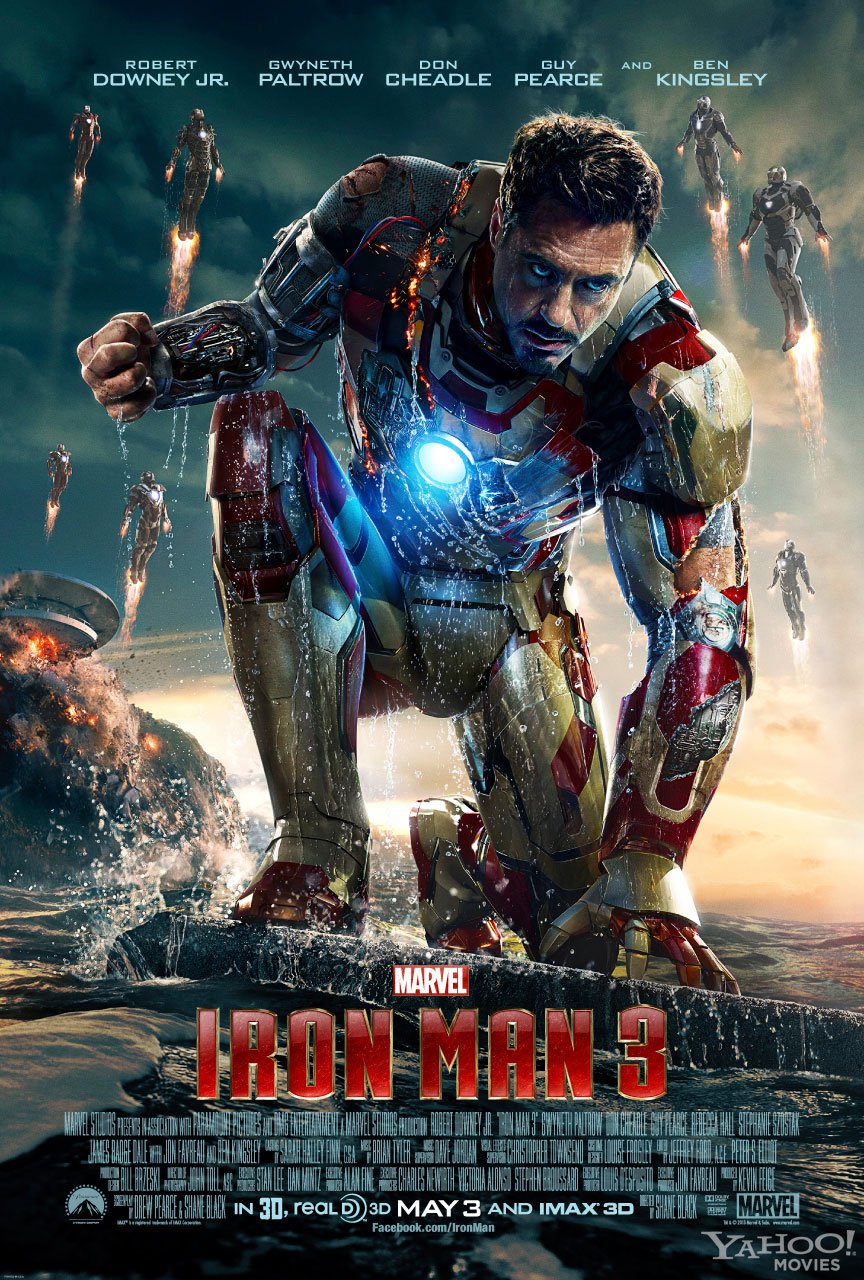
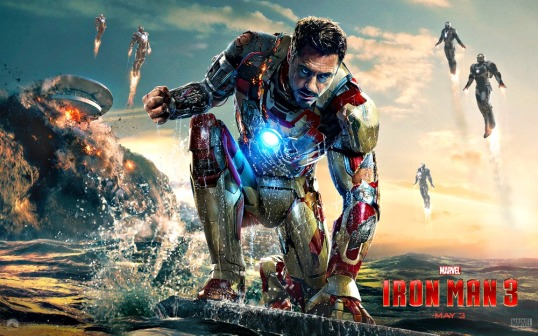
iron man 3 poster


I’m not sure one can entirely, or even adequately, separate how one feels about Marvel’s latest bloated billion-dollar blockbuster, Iron Man 3, from how one feels about their last one, The Avengers — excuse me, Marvel’s The Avengers — since Joss Whedon’s flick has been positioned, story-wise, as a thematic and consequential lead-in to director Shane Black’s first crack at the cinematic exploits of Tony Stark and his super-suit. After all, it’s Stark himself who solemnly informs us that “nothing’s been the same since New York,” and the events he “endured” there are supposedly the catalyst for a new, darker, more somber and “mature” phase of his life that’s now begun.

Right off the bat, then, you’ll have to forgive me if I just don’t “buy in” to that whole scenario. I know, I know — I’m one of only about ten people on the entire planet who was less than blown away by Marvel’s The Avengers (got it right this time), but let’s leave that aside for a moment, because the fact is that even if I did love it to pieces, it’s essentially nothing more than a fairly light-hearted, superheroes-save-the-world romp. It didn’t even try to have some kind of “heavy,” far- reaching resonance. It was a popcorn movie. You might feel it was a particularly good, or even terrific, popcorn movie, but come on — if you think it was a work of lasting emotional depth and impact, I think you’re kidding yourself, friend.

Still, that’s the hook we’re being told to swallow in order to fully “appreciate” the baseline Iron Man 3 is starting from. And things only get more quasi-resonant from there, as we see Stark (Robert Downey Jr. doing a fine job essentially playing himself, as usual) inadvertently create a rival/enemy for himself in Guy Pearce’s Aldrich Killian before taking on a genuinely big menace in the form of mysterious international terrorist The Mandarin, superbly brought to life by a genuinely menacing Ben Kingsley. Flat-as-cardboard side characters “Pepper” Potts (Gwyneth Paltrow, who as always probably deserves more to do), James “Rhodey” Rhodes (Don Cheadle, clearly in it for the paycheck) and Maya Hansen (Rebecca Hall) essentially aren’t given much to do apart from complicate things here and there for Stark/Iron Man, and help him out when he needs it in various forms, whether that be in the boardroom, bedroom, or battlefield (depending on which of the three we’re talking about), but Black and co-writer Drew Pearce are clearly interested in putting some of their eggs in the baskets marked ” Stark’s struggle against himself”  and “where does the man end and the armor begin?,” as well.

And hey, kudos to them for at least trying to give this superhero property some heft and gravitas of some sort — and if the Shane Black who gave us Kiss Kiss Bang Bang and scripted The Monster Squad were the one running the show here, maybe it would have worked out fine, but his work this time around hews more closely to his efforts as screenwriter on such middling testosterone-laced fare as The Last Boy Scout and the Lethal Weapon movies than anything else.  Which is to say that this is certainly a competent-enough film in terms of its execution, but doesn’t offer a whole lot beyond that, despite its director’s best intentions.

Maybe the die was cast from the  outset. Maybe the Iron Man franchise is such a juggernaut at this point that it’s propelled forward by nothing but its own apparently-unstoppable momentum and all attempts at interjecting some personality into things are bound to fail. I give Black points for at least wanting, apparently, to vary things up from the Jon Favreau/Joss Whedon formula, and for doing something radically different with the character of The Mandarin that probably not all fans of his comic book appearances will appreciate and/or approve of, but in the end it feels like he put up a fight for some kind of individualistic vision for a minute there, knew he was beaten, threw in the towel, and just decided to go with the flow. His bank account will surely thank him — as will, I’m willing to bet, the majority of viewers — but for my part, I was left feeling more than a bit underwhelmed by the whole spectacle.

For those who are only in it for that, though — for spectacle for spectacle’s sake alone — Iron Man 3 will probably have you smiling from start to finish, and that’s fine. It’s kinda what these summer blockbusters are all about, after all. But for those of us who were hoping for something maybe a little bit more radically divergent from the pre-set path, it’s pretty fair to say that this Black and company seem content to lead us on, then leave us hanging.

Trash Film Guru Vs. The Summer Blockbusters : “Star Trek Into Darkness”


StarTrekIntoDarknessEnterprisePoster

There are those who have argued online — and in print, as well, I’d imagine — that once you cross the invisible threshold from merely “liking” a recurring or serialized entertainment property/artistic venture (I’ll leave you, dear reader, to decide which of those categories the Star Trek franchise falls into) into becoming a full-fledged “fan” of it that you’re basically fucked, because while “liking” something means you appreciate it for what it does, being a “fan” of it means you like it for what it’s already done, and are quite happy to just have the folks behind it serve you up more of the same. Hell, you might even get pretty upset if they don’t!

I’m not sure I’m willing to go so far as to agree with that sentiment in its entirety — many fans of various works of genre entertainment actually appreciate being offered something new and unique on occasion, in my experience — it certainly applies to a very large segment of most of the various fandoms out there. You know the kind of folks I’m talking about — those who get worked into a mouth-foaming frenzy at the slightest changes or tonal shifts in a given installment of the film, TV, novel, or comic book series and feel the need to shout about what a “blasphemy” has taken place at the top of either their lungs or, as is more often the case these days with computer keyboards and such, fingertips. It gets pretty old pretty fast and I’ve learned to tune most of it out, but anyone who denies the existence of fans such as these is flat-out delusional — the more level-headed among us might like to ignore them, sure, but we can’t admit that they don’t exist. At least not with a straight face.

My point here being, you rightly ask? Uber-conservative fans such as this are bound to be happy with Star Trek Into Darkness (there’s no colon in the title, I checked), J.J. Abrams’ second foray into Gene Rodenberry’s venerable sci-fi universe, because, despite all its superficial “differences” to what has come before, this is really just more of the same.

Which isn’t my half-hearted and/or half-assed way of saying it’s a bad flick — all in all it’s reasonably well-executed and keeps the average audience member more or less interested throughout — it’s just that we’ve seen more or less all of this done before, and unlike with his first go-round, this time Abrams doesn’t even really expend any effort into tricking you into believing (at least on first viewing) that you’re witnessing some bold new take on things here.

And that should suit the stick-in-the-mud types just fine, I would think, since these are folks who go beyond simply being able to see the creaks and joins in a given structure and actually and actively like seeing them, pointing them out, and analyzing them ad nauseum.  In short, I think these people are gonna absolutely love the fact that this film’s big, supposedly-emotionally-resonant “turning point” is just a mirror-image inversion of the same exact scene in Star Trek II : The Wrath Of Khan. They’ll probably also enjoy the fact that, for all their supposed “added depth,” characters like Simon Pegg’s Scotty and Zoe Saldana’s Uhura are still essentially one-dimensional ciphers who just have a few more lines now, and that Karl Urban’s Dr. “Bones” McCoy still speaks in nothing but utterly predictable one-liners rather than , you know, actual, honest-to-goodness dialogue. And I think they’ll also dig the fact that Abrams has quickly established recurrent patterns of his own here — gotta have a Leonard Nimoy cameo, gotta have at least one hot-chick-in-underwear scene, etc.

No doubt about it — if you’re one of these “don’t rock the boat too much or I’m really gonna bitch about it” types of fans, Star Trek Into Darkness  is bound to be right up your alley. In fact, it’s probably likely to make you feel pretty clever, as well, since you’ll be utterly convinced that the poor schmuck in the seat next to you isn’t going to see this movie’s “big revelations” coming.

Guess what, though? He (or she) probably is, since it only takes the most minimal amount of working knowledge of Star Trek lore to have a pretty solid guess as to the real identity of Benedict Cumberbatch’s pseudonymous “John Harrison” villain, the way things are bound to play out once Chris Pine’s Captain Kirk leads leads his crew — uhmmmm — “into darkness” is essentially a foregone conclusion, and shit, your “this guy’s bound to die” radar is guaranteed to be  ringing at top volume from the get-go in relation to one of the story’s semi-principal characters (the oldest Trek trick in the book).

Again, none of which is to say this is in any way an actively bad film — the main cast all acquit themselves pretty well, especially Zachary Quinto as Spock, the CGI effects are uniformly just fine (heck, they always are these days), and the principal narrative is by and large plenty entertaining enough.  It’s just a thoroughly predictable one. If you’re in the mood to kick back, shut your brain off, and just sit through a fairly standard Star Trek romp, this’ll do the job just fine. Just don’t go in expecting anything more — or at the very least anything other — than that.

I have no idea where the Trek franchise is headed from here. Abrams has, as everyone knows, recently been handed the reigns over on Star Wars, as well, so whether or not he intends to do both I couldn’t say. It sounds to me like it would be an awful lot of work  to juggle them both, and maybe now would be a good time to walk away from this one and pass the buck  to somebody else. He’s clearly out of ideas here, anyway, so it wouldn’t be too big a loss.

One last time now, in unison — which is not me saying that this sucked ! It’s just an acknowledgement that it only took two films for the “new” Star Trek to become as safe and stagnant as the “old” version and that a genuinely fresh take on things might be for the best going forward.

Film Review: Trance (dir by Danny Boyle)


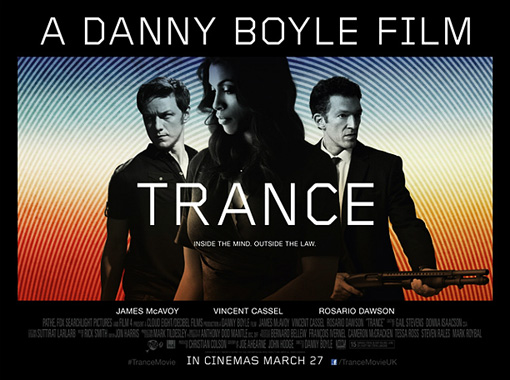
trance

Trance, the latest film from Danny Boyle, is an enjoyable mess.  The film makes little sense, the characters are rarely consistent, and tonally, Trance is all over the place.  At the same time, it’s also a lot of fun.

Seeking to do for hypnosis what Inception did for dreams, Trance opens with Simon (an excellent James McAvoy), a fine art auctioneer who has gotten into trouble with online gambling.  Desperately needing money, Simon agrees to help the criminal Franck (Vincent Cassel) steal a painting.  However, during the robbery, Simon attacks Franck.  Franck responds by whacking Simon on the head.

As a result of the blow to his head, Simon ends up with amnesia and can’t remember anything that happened immediately after the robbery.  Unfortunately for Franck, Simon was attempting to steal the painting for himself when he got hit on the head.  As a result, neither Simon nor Franck have the painting and Simon can’t remember where he hid it.  After unsuccessfully attempting to restore Simon’s memory through physical torture, Franck then decides that Simon should see a hypnotist.

Simon goes to see Dr. Elizabeth Lamb (a surprisingly effective Rosario Dawson).  In several hallucinogenic and increasingly surreal scenes, we watch as Elizabeth leads the hypnotized Simon through the twists and turns of his own troubled subconscious.  While Simon initially lies about why he’s undergoing hypnosis, Elizabeth quickly reveals that she knows what’s going on.  However, to Franck’s surprise, Elizabeth agrees to continue to treat Simon and help him remember the location of the painting.  Soon, both Simon and Franck find themselves falling in love with Elizabeth, little suspecting that Elizabeth has an agenda of her own…

Judging from some of the reviews and other online comments that I’ve come across, I may be in a minority but I actually really enjoyed Trance.  Seriously, how can you not enjoy a film that’s so unapologetically over-the-top?  I loved the film for its lush cinematography.  I loved the fact that everyone’s apartment appeared to decorated exclusively with neon.  I loved the fact that all three of the main characters came across like they were continually on the verge of having a nervous breakdown.  In the end, I even loved the fact that Boyle didn’t even attempt to make the film realistic.  Trance is a celebration of pure style, a collection of barely connected set pieces that come together to make Trance into a pure cinematic experience.

Danny Boyle is one of those directors that people tend to either love or hate.  If you don’t like Danny Boyle, you probably won’t enjoy Trance.  However, if you’re like me and you’re an unapologetic fan, you’ll appreciate Trance for what it is, a pure triumph of style over substance.  Like many other Boyle films, the visuals are so strong, the music is so propulsive, and camerawork is so kinetic that you can forgive the fact that the film’s plot doesn’t make much sense.  Boyle may be a messy filmmaker but it’s often a beautiful mess.

Review: Iron Man 3 (dir. by Shane Black)


IronMan3

“You can take away my suits, you can take away my home, but there’s one thing you can never take away from me: I am Iron Man.” — Tony Stark

[WARNING: SPOILERS WITHIN]

Iron Man 3 review by Leonard Wilson

That line above would make such a great send-off for what could be the final Iron Man film. In a perfect world, having Shane Black’s Iron Man 3 as the final one in the franchise wouldn’t be such a bad thing. This doesn’t mean that Iron Man will not appear in any future Marvel Studios endeavors, but as a solo franchise a series couldn’t have found a better way to fly into the Malibu sunset. I say this because in over 5 years Marvel Studios has created a trilogy that took a character in Tony Stark and put him through a character journey encompassing four major film releases and one cameo. They did so in such a way that we saw the character grow from a rich genius dilletante, to a desperate asshole trying to find his identity as Iron Man to finally realizing that he’s the hero with or without the Mark suits he’s has created.

Iron Man 3 is the culmination of what Jon Favreau began with Iron Man in 2008 and Joss Whedon expanded on in 2012’s Marvel’s The Avengers. It took a writer of renown such as Shane Black (who also replaced Favreau as director) to get to the heart of what makes Iron Man ticks. It helped that the returning cast led by Robert Downey, Jr. as Tony Stark and Iron Man once again did a great job in their roles with some characters even getting to do some surprising heroic stuff on the screen.

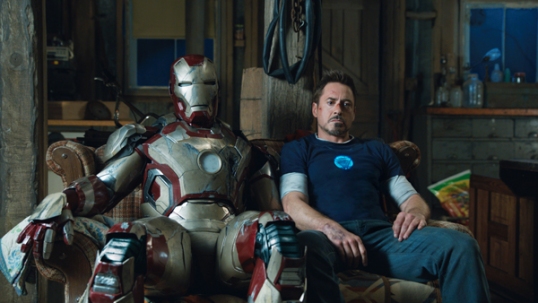
IronMan3

Iron Man 3 starts off with a flashback scene just hours before the arrival of the new millennium. This is just Tony Stark before he becomes Iron Man so we see the character in full charming asshole mode. This sequence is important in that it sets up the whole plot of the film and, in my opinion, the overall story for the entire trilogy. We’re introduced to the geeky Aldritch Killian (played with equal amounts of geeky desperation and overconfident megalomania by Guy Pearce) who sees in Stark the mentor he needs to get his think tank going. With only sex with brilliant scientist Maya Hansen (played by Rebecca Hall) on his mind Killian is soon forgotten and humiliated by Stark.

The rest of the film sees Tony Stark having to pay a steep price for his behavior towards Killian in that flashback and, in conjunction, with his days and nights haunted by the events in New York with the invading Chitauri invasion having given him a case of the PTSD the film looks to bring Tony Stark at his most vulnerable and lowest. It’s a return to the proverbial “Cave” for Tony Stark as he must contend not just with the elusive terrorist mastermind The Mandarin, but also solve the mystery of who or what’s causing the inexplicable explosions and bombings occurring around the nation. All this he must do through most of the film without the use of his Iron Man suits and relying mostly on his own genius intellect and skill with making weapons and gadgets out of anything readily available.

Speaking of The Mandarin (in an excellent performance by Sir Ben Kingsley), Shane Black and co-writer Drew Pearce made a controversial decision (for comic book fanboys at least) to make the iconic Iron Man villain more than he appears to be. It’s a decision that won’t sit well with the more vocal and rabid comic book fans who sees any deviation from Iron Man lore as an affront worth of loud, vociferous rabble, rabble, rabbling that would make Randy Marsh and the people of South Park proud.

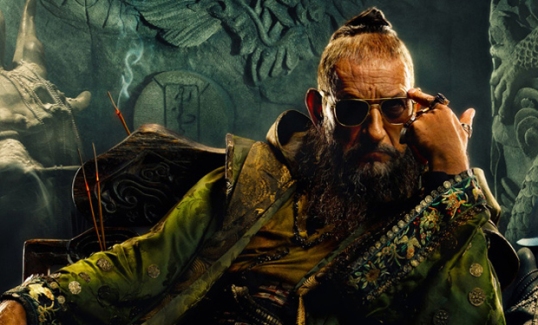
mandarin-iron-man-3

To say that the twist in the story that explains who The Mandarin was such a surprise would be quite the understatement. The most important and iconic nemesis of Tony Stark comes out with both barrels of deliberate menace and sociopathic showmanship. We’re meant to see this character as the face of all the evils and troubles that has plagued Tony Stark since the first film. Kingsley plays this part of the character in the film to the hilt. Yet, it’s not until the second half of the film when we find out just who exactly The Mandarin really was and is that Black and Pearce finally put to rest whether the producers and writers would be able to handle a character that’s been seen as a racial caricature from a less than enlightened time.

Whatever howls and apoplectic ravings fanboys might be having about changing the traiditional character of The Mandarin into the pill-popping, drunk British wanna-be actor Trevor Slattery as a bait-and-switch was a brave move on the parts of Black and Pearce. To find out that The Mandarin was just a conjuration by Aldritch Killian to keep the eyes of the world’s governments and superheroes on someone else was very Bond-like. The fact that Killian himself is the true Mandarin and the Ten Rings terrorist organization his creation to have his revenge on Stark for humiliating him on the even of the new millennium closes the circle on what was begun all the way back in the first Iron Man.

This so-called “twist” was so unexpected (the internet scouring for any tidbits about the film’s plot having found nary a hint of this change) that it seemed like some sort of gimmick but as the film barreled on through the second half into it’s explosive conclusion one had to admire the massive stones by Black and Pearce to change such an iconic character knowing how it could easily alienate and anger fans of comic book. It’s this thinking outside the box by this franchise’s new director and screenwriter which makes me feel like Marvel Studios (especially studio head Kevin Feige) have their Phase 2 plan set to spring surprises on comic book and non-comic book fans alike as it marches on towards Avengers 2.

originalIron Man 3 was a definite improvement over the bloated second film in the series. It also manages to reach the high bar set by the first film, though as an origin story it still comes away as being the best of the trilogy, but not by much. There was much trepidation from fans of the film franchise when Favreau was replaced by Marvel Studios as director by one Shane Black. While Black was well-known for being a top-notch screenwriter who literally redefined the buddy cop genre his work as a filmmaker was just still only the suprise film Kiss, Kiss, Bang, Bang. While this third film still had some holes in it’s plot that was explained rather conveniently by some brief bits of dialogue it still managed to tell a compelling story of actions and consequences and the discovery that our hero finally makes about just who is the hero of the saga: the man or the machine.

If there’s to be another film bearing the title of Iron Man I would surely hope that Feige and the powers-that-be over at Marvel Studios and Walt Disney just speed-dial Shane Black’s name and to also bring back his co-conspirator Drew Pearce. The franchise is well and good in their keeping. As the final moments of the end credits tick by we’re promised that Tony Stark will return. I sure hope so.

Is The Great Gatsby Great Or Is It Simply Ghastly?


(Special thanks to frequent TSL reader and commenter Dr. Jim for inspiring the title of my review.)

Gatsby

Do you remember when everyone was predicting that Baz Luhrmann’s adaptation of The Great Gatsby would battle it out with The Dark Knight Rises and The Master for Best Picture at the 2012 Academy Awards?

It may be hard to remember but, at this time last year, that’s what a lot of self-styled film divas were predicting.  And who could blame them?  The Great Gatsby was adapted from a great book, Baz Luhrmann was an A-list director, and the film featured actors like Leonardo DiCaprio, Tobey Maguire, and Carey Mulligan.  The flashy first trailer came out and people, like me, were very excited.

And then, suddenly, Warner Bros announced that The Great Gatsby would not be released in December of 2012.  No, instead, it would be released in May of 2013.  This led to a lot of speculation.  Some film bloggers claimed that Warner Bros was just worried that the Great Gatsby would struggle to find an audience if it was released at the same time as other prestige pictures like Lincoln and Les Miserables.  However, I think most people just assumed that the film probably wasn’t that good.  Suddenly, the opulence of that first trailer was no longer something to be celebrated but, instead, it was taken as evidence that Luhrmann had emphasized style over substance.

Last Friday, The Great Gatsby finally premiered on movie screens across the country and we finally got a chance to discover whether Lurhmann’s film was great or simply ghastly.

Before I started writing this review, I debated with myself whether or not I should include a spoiler warning.  You see, I am a F. Scott Fitzgerald fanatic.  I have read and I have loved almost all of his books (even the unfinished Last Tycoon) and I even went through a period where I identified (perhaps a bit too strongly) with Zelda Fitzgerald.  The Great Gatsby is one of my favorite books of all time and it’s hard for me to imagine a world where anyone hasn’t read it.

Unfortunately, judging from the reactions of some of the people in the audience at the showing that I attended, apparently I was giving the rest of the world a little bit too much credit.  So, if you haven’t read The Great Gatsby, then you really should stop reading this review and go pick up a copy.

And, if you’re still reading this review, here’s your SPOILER WARNING.

gatsby3

With the exception of a few unnecessary scenes that feature Nick Carraway (Tobey Maguire) is a sanitarium, Luhrmann’s film closely follows the plot of Fitzgerald’s novel.  Nick, a recent Yale graduate, moves to New York City in the 1920s.  He has abandoned his earlier plans to be a writer so that he can concentrate on making money as a bonds salesman.  Needing a place to live, Nick ends up renting out a small cottage.  Living across the bay is Nick’s cousin Daisy (Carey Mulligan) and her extremely wealthy and crude husband, Tom Buchanan (Joel Edgerton).  And living right next door to Nick, in a gigantic castle, is the mysterious Jay Gatsby (Leonardo DiCaprio).

While the Buchanans are a part of the old rich and the American establishment, Gatsby is a much more enigmatic figure.  As Nick discovers, nobody seems to be sure who Gatsby is, where he came from, or how he has made his money.  He seems to devote most of his time to throwing massive parties where he is often nowhere to be found.  However, through the cynical golfer Jordan Baker (Elizabeth Debicki), Nick learns that Gatsby used to know Daisy and that he’s still madly in love with her.  Gatsby befriends Nick, attempting to use him as a way to get to Daisy.  Meanwhile, Nick also finds himself unwillingly in the position of being Tom’s confidante, accompanying him when he drives into New York to meet with his mistress, Myrtle Wilson (Isla Fisher).

gatsby4

To answer the obvious question, The Great Gatsby is not the disaster that so many of us feared but, at the same time, it’s not the triumph that so many of us had hoped for.  Instead, it’s somewhere in the middle.  As with most of his past films, Luhrmann unapologetically embraces style over substance and as such, the film is a lot of fun to watch even though it’s never as intellectually challenging or emotionally captivating as Fitzgerald’s novel.  Whereas Fitzgerald’s novel viewed Gatsby and Daisy with a captivating ambivalence, Luhrmann’s film is content to be a big, glossy soap opera.  As someone who loves the novel, I was frequently annoyed to see how interesting characters like Jordan Baker and Tom Buchanan were simplified for the film version.  But, as someone who loves on-screen spectacle, I enjoyed watching The Great Gatsby even if I could never quite bring my heart to fully embrace it.

One thing that The Great Gatsby definitely gets right is the casting of Leonardo DiCaprio as Jay Gatsby.  DiCaprio’s gives one of his best performances here, perfectly capturing Gatsby’s allure while hinting at the insecurity that lies underneath the confident façade.  Carey Mulligan is well cast in the difficult role of Daisy and Tobey Magurie makes for the perfect Nick Carraway.  (That said, you have to wonder if Maguire and DiCaprio are ever going to start aging or do they both have a picture of Dorian Gray hidden away in a closet somewhere.)

Unlike Fitzgerald’s novel, Luhrmann’s The Great Gatsby is not quite great.  But it’s not exactly ghastly either.  If anything, perhaps it will inspire a few more people to read Fitzgerald’s classic novel.

LIBRARY IMAGE OF THE GREAT GATSBY

Film Review: Body Shots (dir. by Michael Cristofer)


(Spoilers)

Recently, I saw a 1999 film called Body Shots on the Fox Movie Channel.  If you look at the poster at the top of this review, you’ll see that Body Shots was apparently advertised with the boast: “There are movies that define every decade…”  That’s true.  It’s also true that, every decade, there are movies that define self-importance and pretension.  Can you guess what Body Shots defines?

Since Body Shots claims to be a film that exposes what secretly goes on in American society, I figured I would start this review by sharing a secret of my own.

Ready?

I love over-the-top morality tales.  I love movies that attempt to expose 20something for being the shallow, terrible people that older people believe us to be.  Every decade sees at least a handful of these films.  Typically, they are made by male filmmakers in their 50s and they attempt to paint an accusing portrait of the foibles of youth.  These films assure the older generation that their children have all grown up to be a bunch of drug-abusing, heavy-drinking, over-sexed degenerates.  It’s a proud of tradition of American cinema and television, one that includes everything from the crazed pot smokers of Reefer Madness to The Newsroom’s Jeff Daniels announcing that my generation is the “WORST.  GENERATION.  EVER.”

Typically, dreadfully earnest filmmakers who think that they are making an important statement about the future of human society are responsible for these films.  That the filmmakers often turn out to be so totally out-of-touch and histrionic just adds to the campy charm.

Body Shots is a part of this tradition.  According to the imdb, director Michael Cristofer (who is currently appearing on Smash) was 54 years-old when he made this film about 8 decadent 20-somethings who spend a decadent night at a Los Angeles nightclub and then have to deal with the consequences in the morning.

For the first part of Body Shots, we’re introduced to the 8 main characters (4 men and 4 women, which works out nicely as far as pairing off is concerned).  While they’re all generically attractive (and, at times, interchangeable), they are also each meant to represent a different take on sexuality and relationships.

body-shots-645-75

The men:

Rick (played by Sean Patrick Flannery) is a lawyer.  He doesn’t have much of a personality but he’s in the most scenes so I guess he’s supposed to be the protagonist.  Flannery is required to awkwardly deliver the line, “Hey, Penorisi, have another cocktail, why don’t you?” not once but three time.

Mike Penorisi (played by Jerry O’Connell) is a professional football player who drives a Mercedes and who spends almost the entire movie struggling to keep his hair out of his eyes.  We know he’s a jerk because Jerry O’Connell plays him and he does things like shout, “If pussy’s on the menu, I’m there!”  (Seriously, Body Shots?)

Shawn (played by Brad Rowe) is a friend of Rick’s.  He’s a nice guy and he says things like, “Sex without love equals violence.”  (And, again, seriously?  Agck!  If a guy ever said that to me, I would be out the door so quick…)

Trent (played by Ron Livingston) is Shawn’s roommate.  We’re continually told that Trent is a loser but, since he’s played by Ron Livingston, he’s also one of the only likable people in the entire film.  Trent is crude and obsessed with sex but, as opposed to everyone else in the film, he’s at least honest about it.  Unlike the rest of the cast, Livingston is intentionally funny.

The women:

Jane (played by Amanda Peet) is kind of Rick’s girlfriend.  Like Rick, she really doesn’t have much of a personality and she’s mostly distinguished by being an absolutely terrible dancer.  (Unfortunately, the filmmakers don’t seem to realize just how awkward Peet looks out on the dance floor.)

Sara (played by Tara Reid) is Jane’s best friend.  She’s blonde, drinks to excess, and is open about her sex life.  So, naturally, the filmmakers go out of their way to punish her during the film’s second half.

Whitney (played by Emily Proctor, from CSI: Miami) is another blonde who drinks to excess and is open about her sex life.  In order to keep us from confusing her with Sara, the filmmakers have Whitney sodomize one of the men with a dildo.

Emma (played by Sybil Temchen) is depressed and worries that people can tell that she “hasn’t gotten laid in months” just by looking at her.

Anyway, these eight characters spend the first part of the movie getting ready to go out, going out, meeting up, hooking up, and occasionally telling us their thoughts on sex and relationships.  And by telling us, I mean that, in a technique beloved by first-time playwrights who have yet to learn anything about being subtle or allowing characters to reveal themselves organically, they literally look straight at the camera and deliver monologues about what they’re looking for in life.  I suppose this is all supposed to make us feel as if we’re getting an intimate look into the inner angst and secret loneliness of these characters but the monologues are all so awkwardly written that they just make the characters seem even more shallow than before.  Trust me, I could have happily lived my entire life without having Jerry O’Connell staring straight at me while discussing oral sex.  (“No teeth!” Jerry grins.  BLEH!)

And yet, I still enjoyed the first part of Body Shots, precisely because the characters were so shallow and the movie was so unintentionally over-the-top in its efforts to paint the Los Angeles nightlife as the equivalent of Sodom and Gomorrah.  The scenes where the women were getting ready to go out for the night all had a ring of truth of them and Ron Livingston (who appeared to be the only member of the cast to understand just how silly a film Body Shots would ultimately turn out to be) was a lot of fun.

Even better, once everyone gets to the club, Michael Cristofer decides to earn his auteur credentials by tossing in every trick he can think of.  Scenes where the action is needlessly sped up follow scenes that play out in slow motion.  The camera glides through the club, focusing on all the neon while a generic beat blasts in the background.  The walls are covered with graffiti that reads, “Swim At Your Own Risk” and “No Diving” and you better believe that the camera lingers over every letter.  Meanwhile, Amanda Peet dances awkwardly while trying to give Sean Patrick Flannery a come hither look while Emily Proctor passes out shots and Jerry O’Connell keeps tossing back his hair.  And then Ron Livingston shows up, straight from a golf course and – you’ve got it! – still dressed for his game.

Seriously, it’s all so stupid and silly and over-the-top unbelievable.  And, of course, while all this going on, the characters still find the time to stare straight at the camera and tell us their feelings about bondage and whether or not true love actually exists.  Cristofer is trying so hard to say something profound and he fails so completely that it’s actually a lot of fun to watch.

Unfortunately, during the second part of the film, Body Shots falls apart.  The next morning, Sara shows up at Jane’s apartment and says that Penorisi raped her.  Penorisi is arrested and claims that the sex was consensual and that Sara was just upset because he accidentally called her “Whitney.”  We get flashbacks to both Mike and Sara’s version of the events.  While they each tell a different story, Cristofer seems to be implying that, regardless of who is telling the truth, it wouldn’t have happened if Sara had not been out drinking and flirting.

To be honest, it’s pretty fucking offensive.

If the first part of Body Shots appeared to have been made by an out-of-touch guy with good intentions, the second part is the work of a moralistic hypocrite.  What makes it even worse is that the film ends without resolving the case.  I’m sure that Cristofer would argue that the open ending was meant to make the audience think about what they had just seen but, ultimately, it feels like a cop out.  It’s almost as if Cristofer reached a point where he said, “Okay, I’m tired of making this movie.  Let’s just quit.”

And considering how the second half of the movie plays out, you can’t really blame him.  Still, the first part of Body Shots is unintentionally hilarious and a lot of fun.  Just don’t watch past the 45-minute mark.