Trash Film Guru Vs. The Summer Blockbusters : “The Lone Ranger”


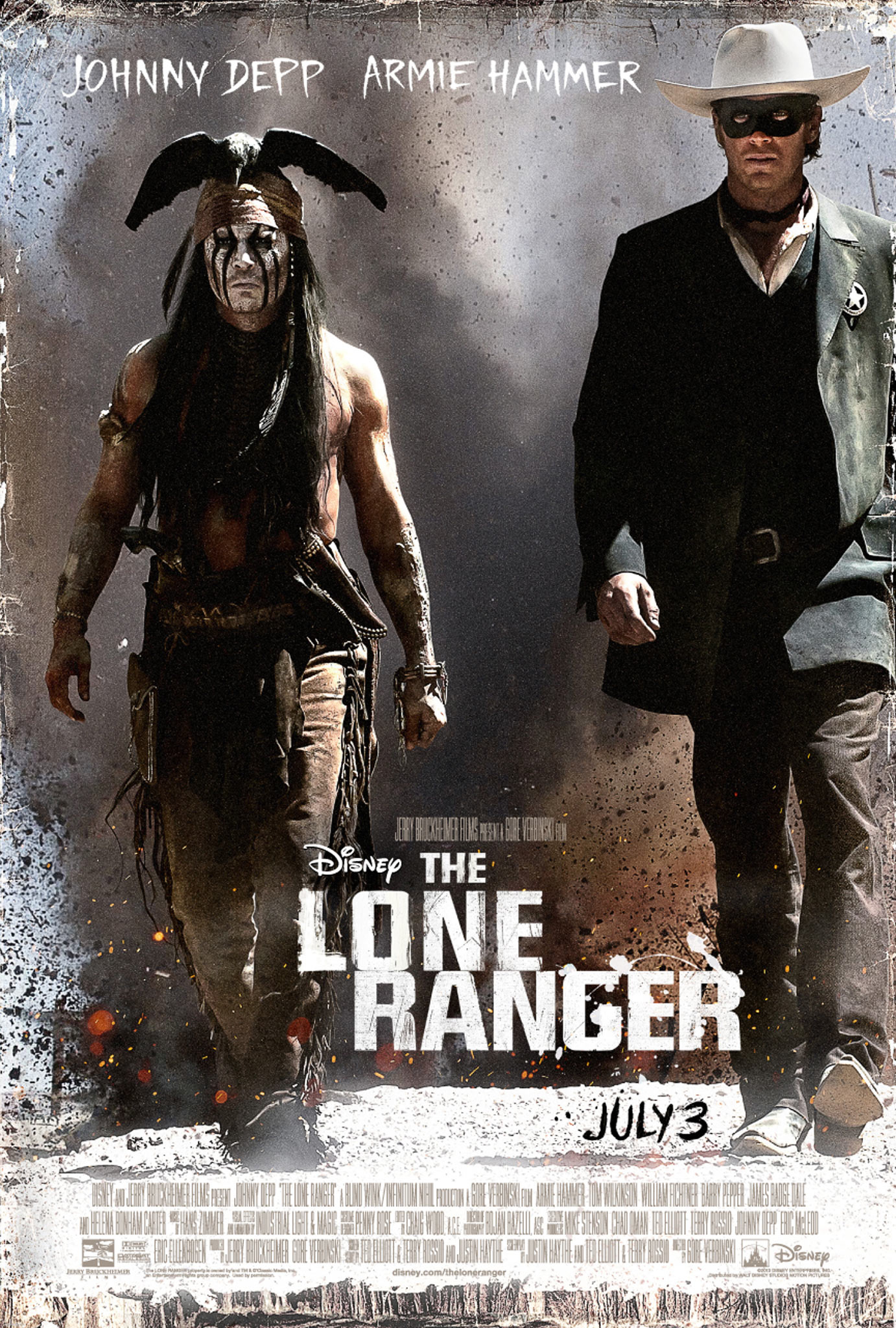
poster1


It all seemed like such a no-brainer, didn’t it?

Disney snaps up the cinematic rights to the most famous Western hero of them all — one that hasn’t been “rebooted” since 1981’s disastrous Legend Of The Lone Ranger — and turns it over, naturally enough, to Jerry Bruckheimer, who “gets the band back together,” so to speak, by hiring Gore Verbinski to direct and Johnny Depp to star as Tonto. Pirates Of The Caribbean Goes West, anyone?

It goes without saying that budget wouldn’t be a concern here — special effects, production values, sets and costumes — all would be state-of-the-state-of-the-art. Turn it loose on the public over the extended July 4th holiday weekend, sit back, and collect all that cold, hard cash. What could possibly go wrong? This was fool-proof.

Except for the fact that, well, it hasn’t been. The Lone Ranger has landed at the box office with a thud — not as big a thud as it did back in ’81, but a thud nonetheless. The critics seem to despise it, and while audiences have been considerably kinder in their appraisal of the film, they haven’t been large enough for Disney to come anywhere close to recouping their considerable investment in this rapidly-unfurling boondoggle.

All of which is kind of a shame because, as with last year’s panned (but considerably more successful at the box office) Men In Black 3, I honestly can’t figure out where all the hate is coming from. Simply put, The Lone Ranger is a damn fun movie, full of exactly the kind of kick-ass, jaw-dropping CGI, solid “out for justice” storytelling, tight, pacy plotting, and charismatic acting that makes for a sure-fire crowd-pleaser. Even if the crowds aren’t proving to be all that big.

Not exactly a “revisionist” take on the legend of John Reid (confidently played by Armie Hammer), a Texas Ranger who, when his life is turned tragically upside-down, dons a mask and adopts a new persona. this flick nevertheless provides a different spin on things by telling the tale from the point of view of an older, wiser, and maybe even somewhat broken-down Tonto (Johnny Depp in, quite honestly, one of the finest performances of his career), who earlier in life threw his lot in with Reid to bring to justice the source of all our hero’s troubles, renegade quasi-militia leader Butch Cavendish (William Fichtner, who makes for a terrific bad guy) and ,more generally, to put a stop to all the various shenanigans this good-for-nothing had a hand in.

If this sounds like your idea of a simple-minded, non-stop thrill ride full of all the excitement, adventure, humor, and yes, even human drama that you want in summertime popcorn fare, rest assured — it is. Good supporting turns from the likes of Helena Bonham Carter, Tom Wilkinson, and Ruth Wilson don’t hurt matters any, either.

Yeah, there are some gaping plot holes large enough for an entire herd of cattle to stampede through, but has that stopped folks from liking, say, World War Z or Man Of Steel, both of which are at least as guilty of counting on you to put your suspension of disbelief completely on hold for a couple of hours? If you can do it for them, surely you can do it for this, right?

Look, I won’t kid you — some small, petty, vengeful little corner of my dark and twisted soul is always happy to see a mega-budget Disney project end up costing the studio untold millions in losses. They’re bastards and they deserve it. But truth be told, if you join the legions of people who have already evidently decided to take a pass on The Lone Ranger, you’re not hurting the evil empire much — they’ve already got Monsters University to more than compensate for any bite this takes from their corporate balance sheet. The only thing you’re really doing by skipping it, then,  is robbing yourself of a good time.

It’s summer! Get out there and have some fun — by sitting on your ass in a cool, air-conditioned mega-plex and catching what’s most likely the best action-adventure film of the year so far.
Trash Film Guru Vs. The Summer Blockbusters : “World War Z”


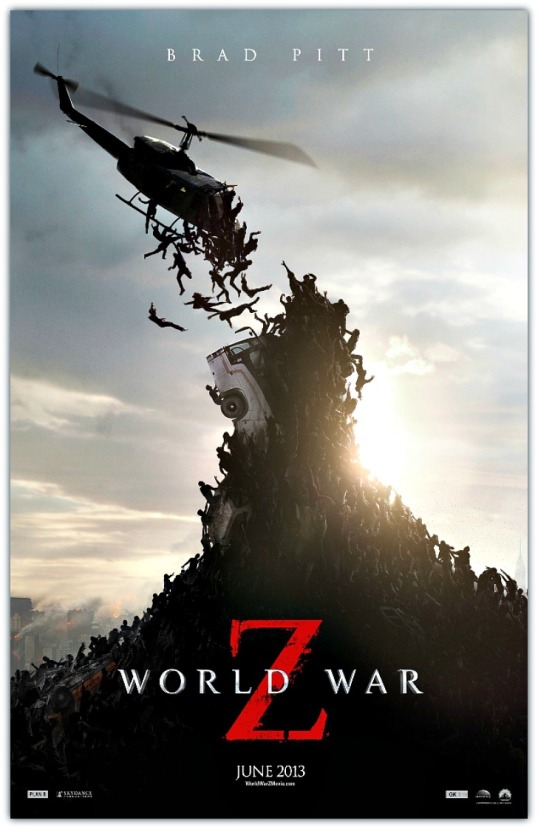
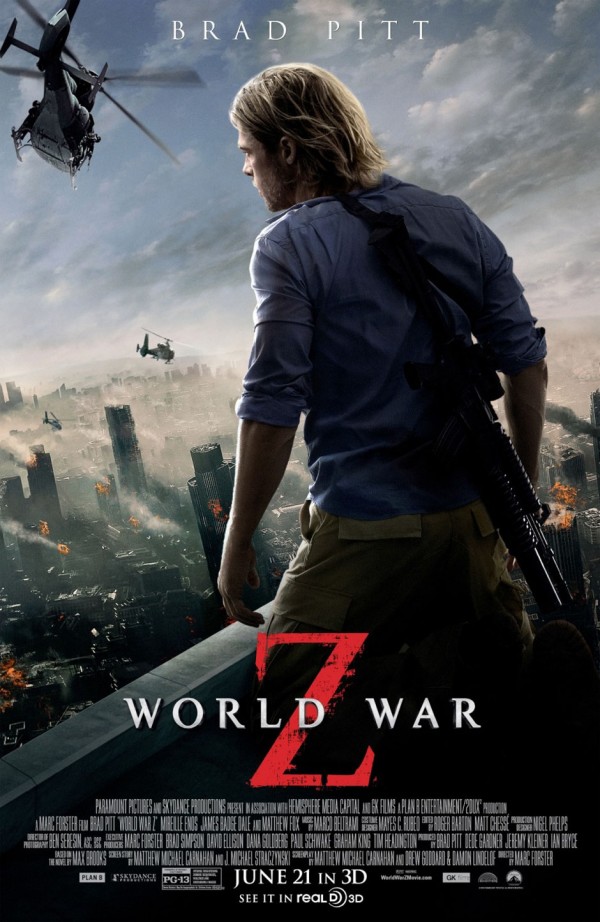
World-War-Z-2013-Movie-Poster3-600x922


Okay, I get it — fans of Max Brooks’ best-selling “zombie apocalypse” novel World War Z are pissed off about director Marc (Monster’s Ball, Quantum Of Solace) Forster’s big-budget, big-screen “adaptation” of it because the finished product bears essentially no recognizable similarity to its printed-page predecessor. Heck, some are even going so far as to say that they actually like the film, they just feel that it should be called something else.

On the other hand, it seems that more or less everyone who hasn’t read the book loves the movie.

Much as I’d enjoy picking a side in this, the latest great “genre geek debate,”  I honestly can’t, simply because I don’t really fit into either of the “warring” camps, seeing as how I neither read the novel nor loved the film with the kind of awestruck wonder its most fervent partisans seem to be brimming over with.

Oh, sure, it was pleasantly entertaining enough — United Nations bad-ass-for-hire Gerry Lane (Brad Pitt — who, let’s face it, is probably contractually obligated to always play somebody at least a little bit cooler than the Average Joe) races against the clock, and around the globe, to keep his wife, Karin (Mireille Enos of TV’s The Killing) and their kids safe from a massive viral plague that essentially mashes together elements of the scenarios George Romero laid out in both The Crazies and his seminal “Living Dead” flicks, only with a much larger budget that enables the filmmakers to give us a more international perspective on the goings-on. Governments are strained to breaking point and/or collapse entirely, WHO and the world’s various military forces struggle to get a handle on things, no area is left unaffected, no one is safe —you get the picture.

The script went through four sets of hands — Babylon 5 creator and frequent comics scribe J. Michael Straczynski gave way to former Lost head honcho and occasional comics scribe Damon Lindelof who in turn gave way to Drew Goddard who in turn gave way to Matthew Michael Carnahan — and, as you can imagine, is something of a mess as a result. Fortunately, it never slows down long enough for you to fully realize that fact, and instead keeps you on the edge of your seat with its PG-13-level action and semi-violence (notice I don’t say anything about gore — sorry, die-hard zombie-holics) from the time it clocks in to the time it knocks off and heads for the bar around the corner.

The end result is something of a hustle — it’ll slowly dawn on you as you make your way home from the theater that what you just saw really wasn’t anything too special, but what the hell — you were too busy having fun to notice.

And that was probably the whole point, really. I don’t think Forster and his literal army of screenwriters set out to reinvent the wheel here or overturn the sacred “Romero Rules” permanently. They were just the guys brought in to make something of a damn popular book that Paramount bid a fortune to obtain the rights to and if, at the end of the day, all that survived of World War Z as most folks knew it was the title, well — that’s pretty much all they were paying for, anyway. Beyond that the only edicts from the studio “suits” were probably to land a huge star, load up on the CGI, and deliver a product that the average summertime movie-goer would find to be a reasonable enough investment of ten bucks and (roughly) two hours.

Judging it on that scorecard, you’d have to say they can all pat themselves on the back, say “mission accomplished,” and go home. Those hoping for a movie that would revolutionize the genre on celluloid the same way the book did in print are bound to be left feeling a bit disappointed, as is anyone who bothers to actually think about what they’re seeing while they’re seeing it, but for anyone and everyone else, hey — it’s a decent enough little thrill ride. Grab some popcorn, sit back, and please don’t struggle against your inner 12-year-old.

Now, as to the other raging debate splitting the internet about whether or not this is actually a horror movie or just a “thriller” with some genre trappings —

Forget it. I’m sooooo not going there. One nerd-controversy per review is my limit.

Trash Film Guru Vs. The Summer Blockbusters : “Now You See Me”


now_you_see_me_xlg

Maybe it’s unfair to saddle director Louis (Transporter) Leterrier’s new-ish “caper” drama Now You See Me with the “blockbuster” label, since it obviously doesn’t have the budget (or hype machine surrounding it) of an Iron Man 3 or a  Man Of Steel, but its surprisingly healthy take at the box office in recent weeks has it hedging into “blockbuster” territory in terms of its gross ticket receipts, it’s got a “blockbuster”-caliber cast, and it definitely falls into the category of lightweight, fun, summer entertainment, so — let’s just roll with it.

And let’s not take that “lightweight, fun, summer entertainment” statement as a jab, either, please, because Now You See Me is a solid little piece of film-making that anyone associated with it can (and should) be damn proud of. It’s just not particularly “deep” in any thematic sense.

But so what? It’s been awhile since Hollywood served us up a good “caper”-style thriller — the last genuinely superb one that comes to mind is Roger Donaldson’s criminally-underappreciated The Bank Job, and that’s getting to be a good few years ago now — and even though this is a film that doesn’t aim for the same level of “ooh”s and “aah”s of the latest Marvel or DC celluloid comic-book adaptation, it’s got more genuine heroics than most of them, and is every bit as finely-calculated a crowd-pleaser as anything they’ve sent down the pipeline in recent years, as well.

The all-star cast definitely helps to elevate a script that at times belabors its points with admittedly necessary but occasionally clumsy “info-dump” scenes and features a smattering of dialogue that can best be described as “clunky,” and while none of the actors involved are exactly stretching their abilities into new and unexplored territory, there’s something to be said for knowing what the folks you hire are best at doing and then getting out of the way and letting them do it.

To that end, Jesse Eisenberg tackles his role as fast-talking, arrogant illusionist J. Daniel Atlas with aplomb; Woody Harrelson delivers a solid, workman-like piece of acting as mentalist Merritt McKinney; Isla Fisher gives us a nice turn as former-magician’s-assistant-turned-headliner Henley Reeves; Dave Franco projects cool confidence as safe-cracker/lock-picker/con artist extraordinaire Jack Wilder; Mark Ruffalo gives another “believable everyman” performance as Special Agent Dylan Rhodes, the man tasked with somehow getting some charges to stick on our intrepid foursome, who have come together and billed themselves as “The Four Horsemen,” after they apparently rob a bank in front of a Las Vegas show audience (or do they?); Michael Caine gives it his usual grade-A “go” as the group’s  multi-millionaire benefactor/promoter/future victim; Morgan Freeman essentially plays himself in his guise as Through The Wormhole host, albeit with quantum physics being replaced with magic trick “debunking” as his gig; Melanie Laurent cuts a satisfying European-woman-of-mystery figure as Alma Dray, Ruffalo’s reluctant Interpol partner/potential love interest — heck, there are even notable minor performances here from Michael Kelly and Common as two of the cops who are down a few rungs on the investigative totem pole.

It’s not like the film doesn’t have any sort of statement to make about the general state of the world, either — to the contrary, “The Four Horsemen” take great pride in ripping off those who have ripped off society, and represent the kind of folk heroes the world could surely use in the wake of the mortgage crisis and the atrocious Wall Street bailout it gave birth to. Think of them as modern-day Robin Hoods with a flair for the dramatic and plenty of  flat-out amazing tricks up their sleeves.

Still, the art of deception being the constant theme here, don’t be shocked if the reasons for our protagonists’ “crimes” turn out to be a lot more personal than they first appear to be (hey, I did say this movie wasn’t particularly “deep,” remember? Not even when it looks like it might be.) . I think I’ll just leave it at that, which might even be saying a little too much already.

Leterrier, as we’ve come to expect, keeps things moving at a fairly expert clip, throws in some nifty little visual tricks along the way, and most definitely delivers the goods in the film’s more action-heavy scenes, and while he handles the script’s quasi-trippy/metaphysical conclusion quite nicely in my view, I think a lot of folks will still find it a bridge too far, and frankly, for a movie that’s all about sleight of hand, you’ll still most likely see the “surprise character revelation” at the end coming from a mile off.

But ya know what?  This is such an expertly-crafted piece of populist entertainment that I don’t think you’ll mind its admittedly-glaring weaknesses, simply because you’ll be too busy smiling from ear to ear. And that, perhaps, is its greatest trick of all.

There will surely be better films than Now You See Me released in 2013. Heck, there already have been. But I doubt there will be any that are more fun.

What Lisa and Erin Watched Last Night #85: Fab Five: The Texas Cheerleader Scandal (dir by Tom McLaughlin)


Last night, my sister Erin and I watched the 2008 Lifetime Movie, Fab Five: The Texas Cheerleader Scandal.

Why Were We Watching It?

This is my fourth favorite Lifetime movie, coming in right behind Confessions of a Go Go Girl, The Babysitter’s Seduction, and Mother, May I Sleep With Danger.  It comes on every few weeks and, if I’m at home, I’ll usually end up watching it.  I forced my sister Erin Nicole to watch it with me because she actually was a Texas cheerleader and I figured she would have some insight into the film that I might otherwise miss.  Plus, it’s just fun to watch movies with Erin!

What Was It About?

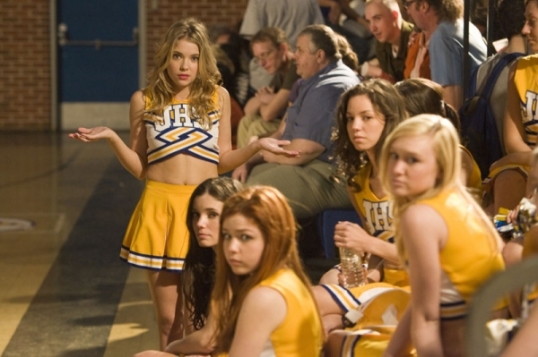
Emma Carr (Jenna Dewan, who would later become Jenna Dewan-Tatum) is the new cheerleading coach at a small Texas high school.  She views cheerleading as being the most important part of a young girl’s life and she quickly proves to be an inspirational and beloved teacher.  However, five mean girls — the Fab Five of the title — are determined to do what they want, regardless of whether it’s good for the cheerleading squad, the school, or Coach Carr’s marriage.  Making things especially difficult is the fact that the leader of the Fab Five (played by Amber Benson) is the daughter of the school principal (Tatum O’Neal).  While Coach Carr tries to instill a sense of teamwork and self-esteem into the rest of the squad, the Fab Five spend their time drinking, hanging out in sex shops, and posting racy videos on YouTube.

Needless to say, this film is credited as being “based on a true story.”

What Worked?

Though the film was undoubtedly exaggerated, it still did manage to capture just what it’s like to go to an athletics-obsessed school in small town and suburban Texas.  Seriously, it’s a world that only makes sense when you’re actually a part of it.  Once you leave and think back, it all looks like a silly Lifetime movie.

Everytime after I see this movie, I find myself occasionally clapping my hands while chanting, “Pump, pump, pump it up/Pump that spirit, keep it up!”  Seriously, it’s fun!

What Did Not Work?

Both Erin and I were occasionally amused and often annoyed by how seriously Coach Carr took cheerleading.  Every time that Jenna Dewan started to give a speech about the importance of cheerleading (“You represent your school!”), Erin and I started laughing.  She was just so serious about it that I found it hard to believe that her character wasn’t being played for laughs.  Imagine my shock as I realized that the film meant for us to take her seriously.

(However, Erin has assured me that there are coaches out there who really do view cheerleading as being a mission from God.)

“Oh my God!  Just like us!” Moments

As we watched the film, I continually asked my sister if this movie was an accurate portrayal of what it was like to be a scandalous high school cheerleader in Texas.  According to Erin, the film was accurate but exaggerated.  She said that she had known girls like the ones portrayed in this film but, even at their worst, they weren’t “as demonic” as the Fab Five.  Erin also asked me to make clear that she was certainly never one of those girls.  And I can vouch for that!  There’s a reason why Erin’s nickname is “the nice one.”

When I first started high school, quite a few people told me that I needed to follow my sister’s example and try out for cheerleader and I have to admit that I was occasionally tempted to do so.  However, I never did because I already had ballet and drama club, I wanted to establish my own identity, and Erin told me that being cheerleader meant that I had to be perky all the time and, quite frankly, I’ve always needed my time to sulk.  So, I’ve never regretted not following the cheerleader route but I still found it amusing that the evil redheaded cheerleader in Fab Five was named Lisa.

Lessons Learned

My home state is the best!  Seriously, would anyone ever want to watch a movie called The Vermont Cheerleader Scandal?  I think not.

600full-fab-five_-the-texas-cheerleader-scandal-screenshot

“Seriously, what the Hell’s the point of Vermont?”

Film Review: Maniac (dir. by Franck Khalfoun)


Maniac

By all logic, Maniac has no right to be as good a film as it is.

A remake of William Lustig’s notoriously sleazy (if grimly effective) 1980 film, Maniac tells the story of Frank Zito (Elijah Wood, taking on a role previously played to repulsive perfection by Joe Spinell).  Frank is a twitchy young man who sells mannequins for a living, has frequent conversations with his dead mother, suffers from intense migraines, and relieves stress by scalping strangers.  Much like the original Maniac, the remake is largely plotless.  Frank stalks women.  Frank yells at his mannequins.  Frank pursues an unlikely romance with an incredibly naive photographer (played here by the very sympathetic Nora Arnezeder).  Much blood is spilled and the film eventually comes to a conclusion that’s even darker than Lustig’s original.

One thing that does distinguish this remake from the original Maniac is that director Franck Khalfoun and producer (and screenwriter) Alexandre Aja attempt to truly put the viewers in Frank’s disturbed mind.  With the exception of a few isolated moments, the entire film is a collection of p.o.v. shots.  While we hear Frank talk throughout the film, the only time that we actually see him is during the rare moment that Frank takes the time to look at his reflection.  That may sound gimmicky (and it is) but, at the same time, it actually works surprisingly well.  Much like Frank, the audience spends the film trapped in his disturbed mind and often unsure about whether they’re seeing something real or having another hate-fueled hallucination.

It helps that Elijah Wood gives a surprisingly credible performance in the role of Frank.  While we only actually get to see his face a handful of times, Wood makes every one of those moments count.  Unlike the original’s Joe Spinell (who gave a performance that was so incredibly sleazy that he almost seemed to be surrounded by a cloud of grime whenever he showed up on screen), Elijah Wood uses his youthful face and his deceptively gentle voice to turn Frank into a disturbingly plausible threat.  With his nervous eyes and rather befuddled expression, Wood makes Frank into the murderer next door  One reason why serial killers are so scary is because the majority of them look more like Elijah Wood than Joe Spinell.  Director Khalfoun uses Wood’s passive screen presence to put the audience at ease, just as surely as Frank uses his innocent face to fool his victims.  As a result, the viewers keep expecting Frank to show some shimmer of humanity.  That’s make it all the more disturbing to watch as the film reveals just how much of a monster Frank truly is.

Playing the role of Frank’s love interest, Nora Arnezeder also deserves a lot of credit.  While the original film definitely suffered because you never believed that Caroline Munro’s classy photographer would actually be attracted to Joe Spinell, the relationship between Wood and Arnezeder is a lot more plausible and hence, it also has the potential to be a lot more tragic.  Without Arnezeder’s empathetic performance, Maniac would just be a numbing collection of scenes of people being murdered.   However, Arnezeder creates a character that viewers will actually care about.    We worry about her as we watch her relationship with Frank develop but, at the same time, we can understand what she thinks she sees in this shy and eccentric man.  As opposed to the original film and despite all of the graphic violence (and it is graphic, make no mistake), the remake of Maniac never feels misogynistic and that’s largely due to the work of Nora Arnezeder.  Arnezeder gives us something that the original never bothered to do, a character to sympathize with.

Finally, you can’t talk about the remake of Maniac without mentioning the film’s excellent score.  Composed by a French composer who goes by the name of Rob, the synth-heavy score has a wonderfully retro feel to it that pays homage to both the old grindhouse films and also adds a propulsive element of menace to every scene.  Much like the electronic score of the far different Upstream Color, the score of Maniac becomes a character all of its own.  I would even go as far to say that it’s perhaps one of the best horror score that I’ve ever heard.

I wasn’t expecting much of Maniac.  In fact, the only reason I saw it was out of curiosity.  I was expecting to be a typical horror remake, a cynical film made solely to exploit the notoriety of its source.

Was I ever wrong!

Maniac is not a pleasant film.  It’s a dark and gore-filled movie but, in its disturbing way, it’s also oddly effective and compelling.  It’s a film that probably has no right to be good and yet, that’s exactly what it is.

Review: World War Z (dir. by Marc Forster)


WorldWarZ

I’ll get this out of the way and just say it: World War Z the film pretty much has nothing in common with the acclaimed novel of the same name by author Max Brooks (reviewed almost at the very beginning of the site). Ok, now that we have that out of the way it’s time to get to the important part and that’s how did the film version turn out on it’s own merits.

World War Z was a film that took the long, winding and rough road to finally get to the big-screen. Whether it was the five different writers brought in to work on the script (J. Michael Straczynski of Babylon 5 fame came onboard first with Christopher McQuarrie coming unofficially to help tighten a few scenes in the end) to the massive changes made to the original source material that was bound to anger the fans of the novel, the film by Marc Forster had an uphill climb to accomplish even before the final product even came to market.

I was as surprised as man others were that the finished product was better than I had anticipated. Some had very low expectations about World War Z coming in due to the rumors and news reports coming in about the problems during production, but it doesn’t change the fact that the unmitigated disaster predicted by every film blogger and critic beforehand never came to fruition.

World War Z might not have been what fans of the novel had wanted it to be, but when seen on it’s own merit the film was both exciting and tension-filled despite some flaws in the final script and use of well-worn horror tropes.

The film begins with a visual montage interspersing scenes of nature (particularly the swarming, hive-like behavior of certain animals like birds, fish, and insects), alarmist news media reporting and the mindless celebrity-driven entertainment media that’s so big around the world. From there we’re introduced to the main protagonist of the film in one Gerry Lane (played by Brad Pitt) and his family. We see that the Lane family definitely love and care for each other with his wife Karin (Mireille Enos in the supportive wife role) and their two young daughters, Rachel and Constance. The film could easily have spent a lot of time establishing this family and their relationship towards each other, but we move towards the film’s first major sequence pretty much right after the opening. It’s this choice to not linger on the characters too long that becomes both a strength and a weakness to the film’s narrative throughout.

WorldWarZPhilly

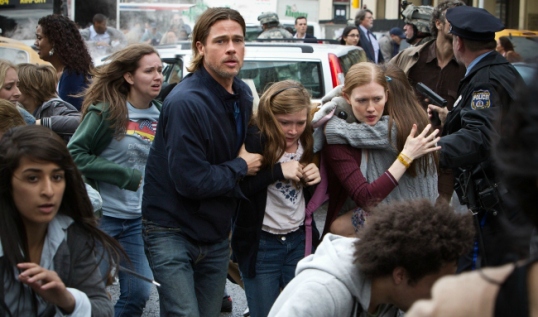
World War Z finally shows why it’s not your typical zombie film with it’s first major sequence in the center of downtown Philadelphia as Gerry and his family sees themselves in bumper-to-bumper traffic. As they wait there are some subtle hints that something might just be somewhat awry ahead of them as we see more and more police racing towards some sort of emergency ahead of the family and more and more helicopters flying overhead. There’s a brief lull in the scene before all hell breaks loose and the film’s zombie apocalypse aspect goes from 0 straight to 11 in a split second.

It’s this sequence of all-encompassing chaos overtaking a major metropolitan city seen both on the ground through the eyes of Gerry Lane and then on flying overhead wide shots of the city that gives World War Z it’s epic scope that other zombie films (both great and awful) could never truly capture. It’s also in this opening action sequence that we find the film’s unique take on the tried-and-true zombie. While not the slow, shambling kind that was described in the novel, these fast-movers (owes a lot more on the Rage-infected from 28 Days Later) bring something new to the zomgie genre table by acting like a cross between a swarm of birds or insects with the rapidly infectious nature of a virus.

These zombies do not stop to have a meal of it’s victims once they’ve bitten one but instead rapidly moves onto the next healthy human in order to spread the contagion it carries. We even get an idea of how quickly a bitten victim dies and then turns into one of “Zekes” as a soldier has ended up nicknaming them. It’s this new wrinkle in the zombie canon that adds to the film’s apocalyptic nature as we can see just how the speed of the infection and the swarm-like behavior of the zombies could easily take down the emergency services of not just a city and state but of entire nations.

WorldWarZJerusalem

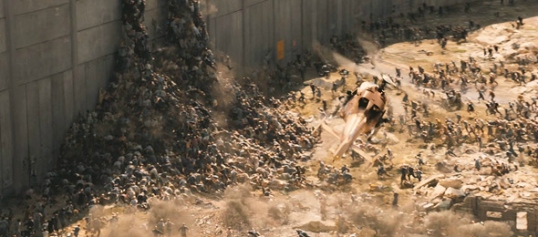
World War Z works best when it doesn’t linger too long between action sequences. Trying to inject some of the themes and ideas that made the novel such a joy to read only comes off as an uncomfortable attempt to try and placate fans of the novel. When we get scenes like Philadelphia in settings like Jerusalem and, in smaller scales but no less tense, like in South Korea and on a plane, the film works as a nice piece of summer action fare. This works in the first two thirds of the film but a sudden shift in the final third in Cardiff, Wales could be too jarring of a tonal shift in storytelling for some.

While the change from epic and apocalyptic to intimate and contained in the final third was such a sudden change this sequence works, but also shows just how bad the original final third of the film was to make this sudden change. It proves to be somewhat anticlimactic when compared to the epic nature of the first two-thirds of the film. We get a final third that’s more your traditional horror film. In fact, one could easily see World War Z as two different films vying for control and, in the end, the two halves having to try to co-exist and make sense.

World War Z doesn’t bring much of the sort of societal commentaries and themes that we get from the very best of zombie stories, but it does bring the sort of action that we rarely get from zombie films. The film actually doesn’t come off as your traditional zombie film, but more like a disaster story that just happened to have zombies as the root cause instead of solar flares, sudden ice age or alien invasion.

So, while World War Z only shares the title with the source novel it was adapting and pretty much not much else, the film wasn’t the unmitigated disaster that had been predicted for months leading up to it’s release. It’s a fun, rollercoaster ride of film that actually manages to leave an audience wanting to know more instead of being bombarded with so much action that one becomes desensitized and bored by it. There’s no question that a better film, probably even a great one, lurks behind the fun mess that’s the World War Z we’ve received, but on it’s own the film more than delivers on the promise that most films during the summer fails to achieve and that’s to entertain.

Finally! It’s time for Six More Trailers!


PCAS

It’s been about two weeks since our last edition of Lisa Marie’s Favorite Grindhouse and Exploitation Film Trailers.  Personally, I blame the trailer kitties!  It’s difficult to find good help nowadays, especially when your help insists on sleeping for 12 hours a day.

However, despite taking way too long to do so, the trailer kitties have returned with six more trailers!

1) Sex Kittens Go To College (1960)

2) Girls Town (1959)

3) Vice Raid (1960)

4) Gun Girls (1956)

5) The Cool and the Crazy (1958)

6) Common Law Wife (1963)

What do you think, Trailer Kitty?

Lazy Trailer Kitty

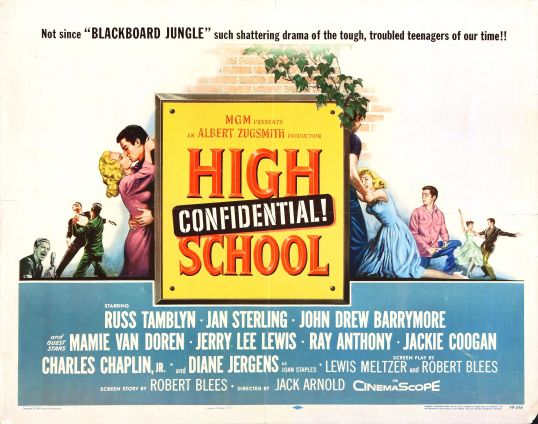
Scenes That I Love: “Tomorrow Is A Drag” from High School Confidential


high_school_confidential_poster_03Tonight, TCM has been showing a marathon a Mamie Van Doren films.  I just sat through The Beat Generation, a 1959 film where Mamie is among the many women to fall victim to a crazed beatnik known as the Aspirin Kid.

Now, to be honest, The Beat Generation is not a very good film.  In fact, it’s probably one of the most anti-female movies that I’ve ever seen.  Watching it, I found myself very happy that I was not alive during the 50s.

However, it did remind me of the far superior High School Confidential, another film that featured a bunch of faux Beatniks and Mamie Van Doren in a supporting role.  Released in 1958 and directed by Jack Arnold, High School Confidential is a lot of fun.

And that brings us to tonight’s scene that I love.  In the scene below, “beatnik” poetess Philippa Fallon recites a poem while secret drug dealer Jackie Coogan plays the piano.  I love this scene because it’s just so typical of the way that exploitation films from the 50s tended to portray the beat generation.

I have to admit that whenever I see one of these old films that attempted to cluelessly portray (and mock) the beatniks of the 50s, I’m reminded of the similarly clueless way that bloggers are portrayed in most current films and Aaron Sorkin-penned television series.

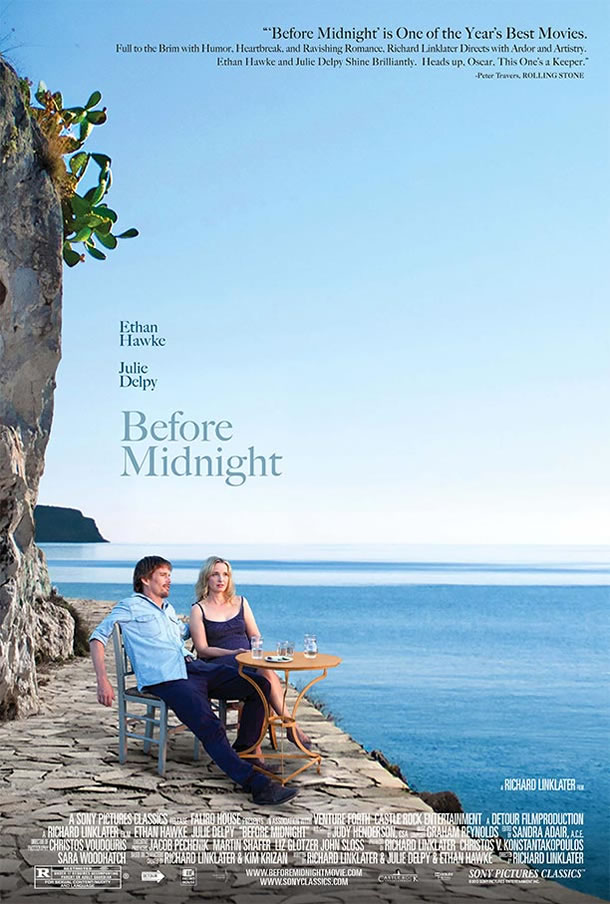
Before You See Anything Else — “Before Midnight”


before-midnight-poster


So, this is it. You can keep your Man Of Steels, your Iron Man 3s, your Star Trek : Into Darknesses, and your Pacific Rims — fun popcorn fare some of those may be, but for me summer 2013 at the movies is all about the third installment in Richard Linklater, Ethan Hawke, and Julie Delpy’s long-running cinematic romance, Before Midnight. I won’t rehash the details of how and why this unlikeliest of indie “franchises” has meant so much to this armchair critic on a personal level over the years — hell, over the decades now! — as my reviews of Before Sunrise and Before Sunset last week covered that ground pretty damn thoroughly already, suffice to say that the chance to see Jesse and Celine living happily ever after is, at the risk of sounding hopelessly corny, a little bit of a celluloid dream come true for yours truly. And so here it is — and here they are, doing just that.

Or are they? Okay, sure, they’re together — and have been, apparently, since the conclusion of Before Sunset nine years ago. They’ve got twin daughters, successful careers (Jesse as a novelist and English professor, Celine as an environmental activist) in Paris, and are just winding up spending a magical summer at a writer’s retreat in the Greek Islands. Sounds ideal, right?

But all is not, of course, well in paradise — Jesse’s torn about the son he left behind in the US and wants to be a more active part of his life, Celine feels stifled by the apparently-tranquil domesticity of her situation and has no desire to move back to America for Jesse to be near his kid, and both are struggling with the the ever-narrowing possibilities life offers up as we age and our thousands of dreams get whittled down to a more concrete set of responsibilities. The passing years have seen “must do”s replace “want to”s in their lives, and one of the running themes of all of these Before pictures is that of  somehow finding a way for love and passion and the sheer wonder of being with another person who understands and accepts us for who we are to survive amidst all that.

They seem to be doing their best. Their sex life is still refreshingly healthy for a cinematic couple on the cusp of middle age, they still walk and talk like the two young lovebirds who met on the train to Vienna, and they still show a genuine affection for one another that can give all of us some small measure of hope. But half the film is consumed by a fairly heated and wide-ranging argument in a hotel room that lays bare the many fault lines underpinning in their relationship. The only question, it seems, is whether they’ll continue to navigate those together or choose to go their separate ways.

Linklater, Delpy, and Hawke, who collaborated on the screenplay together once again (though it’s still nice to see them share character-creation credits with Linklater’s friend, the late Kim Krizan), strike a very delicate balance here between presenting the “heaviest” material we’ve yet to see in this series with the most lighthearted, comedic  sequences to date, as well, and the end result is a film that’s not just a joy to watch, but to absorb, from its first frame to its last.

My long-standing group of friends I’ve seen all these films with waited until we could all see it together, and over the customary after-movie drinks last night we all agreed on two things — we loved it to pieces, even though it was, in many instances, the most difficult of  the bunch to take in; and we couldn’t wait to see it again. It’s just a bit too early to figure out where we’d rank this is the entire — uhhmmmm — “pantheon,” I guess, after only one viewing, ya see.

Now, if you’ll indulge me, I’d like to unceremoniously transition into a personal plea here — rumors are swirling that this might be the final Before of the bunch, and if that’s the case, I think it’s well past time for Oscar to show it a little respect. Yes, this series enjoys a deeply passionate and committed following, but it sure would be nice if Hollywood’s establishment paid some attention to this evolving little piece of wonderment that’s been happening under their noses for nearly two decades. Hawke and Delpy have both affected subtle body-language shifts over the years to delineate their characters’ evolving personalities (he walks with more swagger than ever, for instance, while she exudes an air of peace-that’s-looking-for-any-excuse-to-erupt resignation) that perfectly complement their maturation on paper and each is deserving of a Best Actor/Actress in a Leading Role nomination, and if the three collaborators aren’t recognized with a nod for Best Original Screenplay, there seriously ought to be an investigation. Hell, unless something else comes along that completely knocks our collective socks off, there ought to be an investigation if they don’t win it. Let’s get the email, blog, forum, etc. pressure campaign started right here — who’s with me on this?

Before Midnight is the most authentically human picture to come down the pipeline in ages, and traverses a rocky yet rewarding emotional terrain with grace, warmth, and yes, even charm. It shows how love endures when initial , lustful ehuberance ages into a kind of occasionally- resplendent ardor, and how it finds its level and holds us aloft even when we get everything we’ve ever wanted only to find out it’s still not exactly what we were yearning for (humans, we’re so picky). It’s the “happily ever after” we’ve always wanted for Jesse and Celine — and for ourselves — warts and all. And I’m so completely in love with the cinema, and even with life,  again it damn near hurts. If this is, indeed, the end — and I sincerely hope it’s not, I want to grow old with these characters — it couldn’t be more perfectly imperfect, more gloriously flawed, more tragically comedic, more uneasily blissful.


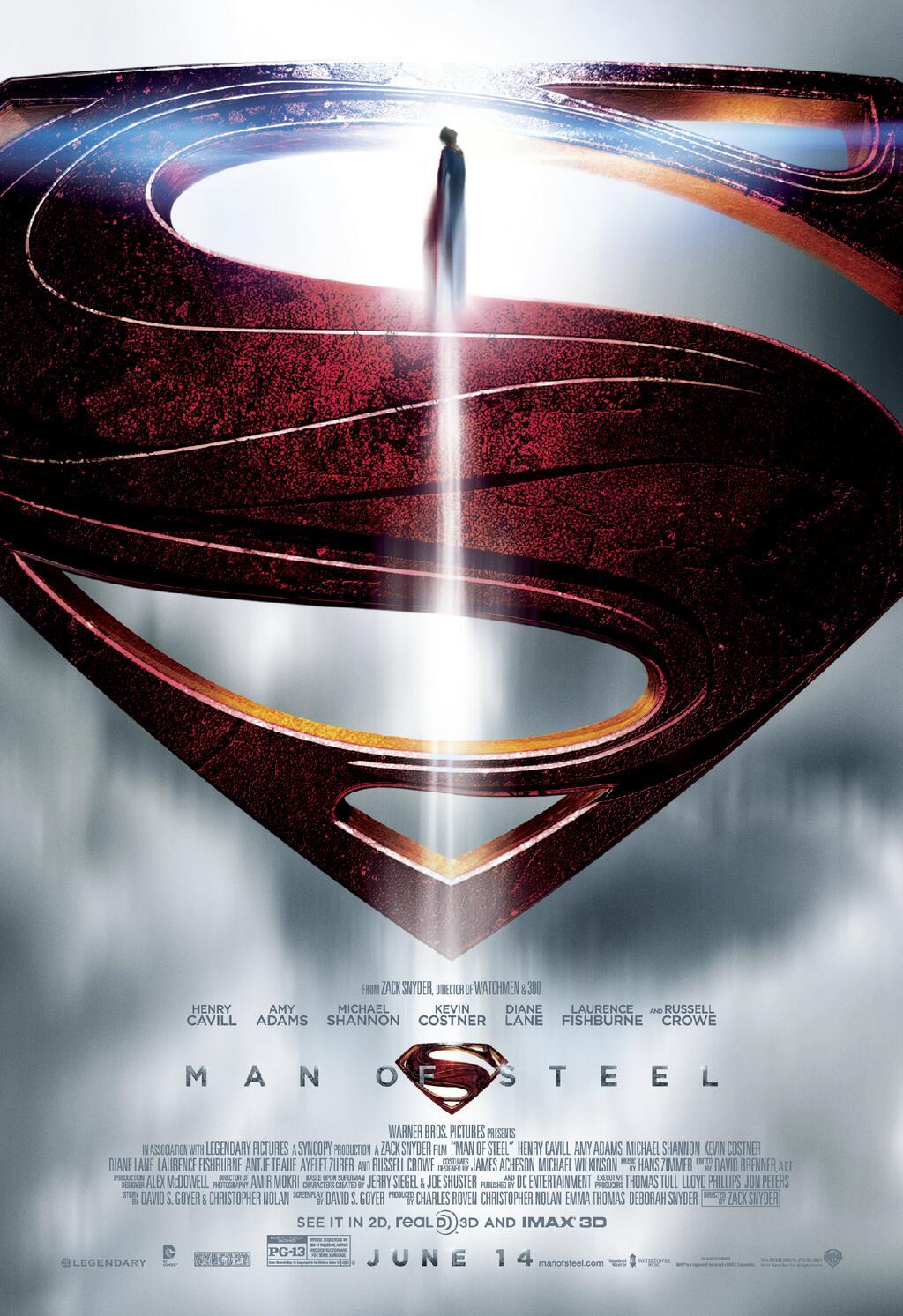
Trash Film Guru Vs. The Summer Blockbusters : “Man Of Steel”


New Man of Steel Poster

I know that, in this day and age, we as a society seem to get off on tearing down our myths and legends and “humanizing” them, but seriously — when did Superman develop a split personality?

Before you jump to any conclusions based on that admitted “gotcha” of an opening line, allow me to state for the record that I didn’t actively dislike Zack Snyder’s Man Of Steel, it’s just that it spends its first half or so rather half-heartedly trying to portray its title character in more human terms than we’ve seen in previous iterations before finally throwing all that out the window and deciding that it actually wants to tell a story about a God who walks (and flies) among us, and the film definitely suffers as a result of this abrupt shift in tone.

But first the “plus” side of the ledger : Man Of Steel is pretty much the most awesome visual spectacle the movies have ever produced. I’m no fan of CGI as a general rule, but damn if every single effects shot in this flick isn’t enough to take your breath away, particularly the sequences on Superman’s home planet of Krypton, which Snyder and his WETA-employed staff depict in a markedly new and exciting “biotech on steroids” fashion. When the action goes earthbound, the optical awesomeness continues, never fear, so if spectacle is what you’re after, you’ll walk away from this well pleased indeed.

Pitch-perfect (with one notable exception which we’ll get to in a moment) casting doesn’t hurt matters any, either — Henry Cavill makes an immediate impression in both his Superman and Clark Kent personas; Russell Crowe is suitably above it all as his Kryptonian father, Jor-El; Kevin Costner and Diane Lane are almost too spot-on for words as his adopted human parents; Laurence Fishburne’s Perry White is old-school newspaper vet all the way (even with the pierced ear); and the always-underrated Michael Shannon oozes psychotic menace as lead villain General Zod. Watching all these people at work is a genuine joy.

Granted, the script — by Dark Knight veteran David S. Goyer (from a story co-plotted with the head honcho of this whole enterprise, Christopher Nolan) — doesn’t do any of them any favors dialogue-wise (apparently Kryptonians have evolved beyond good, old-fashioned conversation and speak entirely in grandiose pronouncements — but it’s not like the mere humans in this film are any less prone to dull, dry, wooden,  faux-poetic waxings themselves), but the players by and large manage to rise above the material they’ve been handed.

I say “by and large” (and here comes that exception I talked about a moment ago) because, sadly, one has been dealt such a losing hand that I’m not sure what she could really have done about it — I’m speaking, of course, about Amy Adams’ Lois Lane. Goyer does some brave and interesting things in terms of shaking up the established Clark-Lois backstory ( let’s just say she won’t be sneaking glimpses of him at sly angles when his glasses are off to see how much he might or might not look like Superman), but the cold, emotionally distant nature of this particular big-budget beast means that the whole love story angle falls pretty flat. By the time Goyer, Nolan, and Snyder decide they want to play the Nietzchean uberman card for all it’s worth, the independent, confident journalist we meet at the outset is reduced to becoming more awestruck than she is lovestruck, and rather than being “Superman’s girlfriend” she comes off more as his disciple. Who just so happens to kiss him. I mentioned the abrupt tonal shift in the film at the outset of this review, and poor Lois definitely suffers the brunt of it.

The messianic poses Cavill is forced into during all the flight and battle sequences get pretty old pretty fast as well, it’s gotta be said, and with no real transition period in the way the story is structured between its “simple farm boy from Kansas”  and its “demi-god here to save us all from the evil forces originating from his own homeworld” (that he inadvertently brought here himself, but hey, let’s not dwell on that) segments, well — let’s just say not much thought apparently went into how jarringly that would all play out. Hans Zimmer’s typically percussive, insistent musical score only augments the problem, and while there’s no way anybody was gonna have fans forgetting about John Williams, a “stripped-down,” “less over the top” orchestral accompaniment really doesn’t work when you’re trying to portray Superman as a fucking deity.

Superman purists, for their part,  may also find themselves semi-outraged by more than the snakeskin-fetish-wear take on his costume. There’s no Jimmy Olsen here, no Lex Luthor (although the “Lexcorp” logo appears here and there on props throughout — as do the logos for Sears, 7-11, and an unending and highly annoying litany of corporate sponsors), and “Metropolis” is never mentioned by name even though the entire final act takes place there. So be ready for at least some “nerd-rage” on the internet. Still, if those were the only things that bugged me about Man Of Steel, I’d be feeling a little bit better about it as a whole right about now. Not that I’m all that pissed or disappointed —-just, well, kinda perplexed.

I can’t say that Man Of Steel isn’t a fun movie to watch, because it is — hell, it’s an absolute visual marvel, and if you want to shut your brain off and just be taken along for a wild adventure ride, you’re not gonna do much better this (or any other) summer  Still —my mind kept drifting back to the famous first-encounter-between-Supes-and-Lois scene in Richard Donner’s Superman : The Movie (still the gold standard for all superhero flicks as far as I’m concerned) : when Lois asks him “who are you?,” and he replies, simply and with a smile, “a friend,” that told us all we needed to know right there. Sure, he was faster than a speeding bullet, more powerful than a locomotive, and able to leap tall buildings in a single bound, but at the end of the day , Superman as envisioned by Richard Donner, Mario Puzo, and Christopher Reeve was one of us.

By contrast, Superman a la Snyder, Nolan, Goyer and Cavill is above us. He’s not here to help humanity, but to redeem it. He’s not our hero anymore, he’s our savior — whether we want one or not.