The Things You Find On Netflix: XOXO (dir by Christopher Louie)


xoxo

I just watched XOXO, the latest Netflix original film and what can I say?  Well, I better figure out something to say because otherwise, this is going to be an extremely short review.

XOXO is the latest attempt to capture the American EDM scene on film and, if nothing else, it’s better than We Are Your Friends.  In the style of Richard Linklater, the film takes place over one night at the XOXO Music Festival (which should not be confused with the real-life annual festival that takes place in Portland) and follows the adventures of several different characters, all of whom are linked together by their love of a track called All I Ever Wanted.  In real-life, All I Ever Wanted is the work of Michael Brun.  In XOXO, it’s the work of a YouTube sensation named Ethan Shaw.

Krystal (Sara Hyland) comes to XOXO specifically so she can meet Jordan, a boy that she has previously only talked to online.  Despite having never met him face-to-face, Krystal is convinced that she is in love with Jordan and she wants to hear All I Ever Wanted with him by her side.  While her friends run off without her, Krystal wanders around the festival, trying to meet up with the continually elusive Jordan.

(Should I mention that Jordan was also the name of the online predator who attempted to molest Emma in the first episode of Degrassi: The Next Generation?  I guess I might as well…)

And then there’s Neil (Chris D’Elia).  Neil is old.  Neil is burned out, almost as if he spent two years co-starring in a sitcom with Whitney Cummings.  Despite having rented a party bus to take people to the festival, Neil claims that he hates the whole scene.  Neil, it turns out, is still stuck in the 90s.  Is it possible that, after making a lot of cynical comments and wandering around looking glum, Neil will eventually start to dance and get caught up in the redemptive spirit of PLUR?  (If you already know what PLUR stands for, you’ll probably enjoy XOXO more than someone who doesn’t.)

Shannie (Hayley Kiyoko) and Ray (Colin Woodell) are attending their final festival together.  Shannie will soon be moving away and she and Ray are going to have to try to do the dreaded long distance thing.  When they lose their tickets and then discover that the festival is sold out, they don’t riot like everyone else.  Instead, they duck into the sewers and try to sneak into the festival.  Of course, they get lost along the way but that gives them a chance to talk about their relationship.  Shannie and Ray didn’t get as much screentime as some of the characters but I liked them.  I related to their relationship and you know what?  I also would have found a way to sneak into the concert and hear All I Ever Wanted too.

DJ Avilo (Ryan Hansen), who is hopefully not meant to be a stand-in for the real DJ Avilo, is a superstar but he’s also a jerk.  He and his manager (LaMonica Garrett) are notorious for cheating up-and-coming young artists.  Fortunately, Avilo does get punched in the face at one point.  He deserves it.

And finally, there’s Ethan Shaw (Graham Phillips)!  Ethan has suddenly been given a chance to perform at XOXO but he only has 8 hours to get there and get prepared to perform!  Will Ethan make it and, once he arrives, will he be tricked by Avilo?  Ethan, of course, is an idealist whereas Avilo brags about how he just views everyone in the audience as being a dollar sign.  But, Avilo also says that he can make Ethan a star.  It doesn’t help that Ethan’s current manager, Tariq (Brett DelBuono) shows up late for the festival and is then kissed by a random girl who just happens to have a tap of LSD on her tongue.  While Tariq trips, Ethan struggles to maintain his integrity.

XOXO has been getting a lot of negative reviews but I actually kind of liked it.  It’s not a great film by any means but it does a good job of portraying an admittedly exaggerated version of American EDM culture.  (If you go to the film’s imdb page, you can find all the usual dismissive comments from Europeans bitching about American and western culture.  Any film that pisses off a snooty European can’t be all bad.)  The film’s totally predictable but the cast is pretty and the music’s great and really, isn’t that all that really matters?

As one character says, “I created this festival because I like to dance.  Dancing is important.”

I couldn’t have said it better myself!

Back to School Part II #16: The Karate Kid (dir by John G. Avildsen)


320px-Karate_kid

Finally, I am getting a chance to continue my series of Back to School reviews!

Earlier today, we had a pretty big storm down here in Texas and it knocked out the electricity for three and a half hours!  There I was, sitting in the dark and wondering if I would ever get a chance to review the 16th movie in this 56-film review series.

(Originally, I was planning on being done by this weekend but, as always seems to happen whenever I do a review series, I’m currently running behind so it’ll probably won’t be until the weekend after next that I post my final Back to School review.)

Fortunately, the Oncor truck eventually showed up in the alley.  I, of course, ran out into the back yard and started to shout at them, “I need power!  I have movies to review!”  They must have heard me because, suddenly, the power came back on.  And now, I can finally get around to sharing a few thoughts on the original, 1984 version of The Karate Kid!

Up until last night, believe it or not, I had never seen The Karate Kid before.  Certainly, I knew about it.  Much like Star Wars and Star Trek, The Karate Kid is one of those cultural landmarks that everyone knows about even if they haven’t actually sat down and watched the movie.  Even before I watched the film, I knew about Mr. Miyagi.  I knew about “wax on” and “wax off.”  I knew about the crane.  I even knew about “You’re alright, LaRusso!”

But I hadn’t actually seen the film and I have to admit that I was a little bit hesitant about doing so.  Everything I had heard about The Karate Kid made it sound like a thoroughly predictable and excessively 80s sports film.  I was expecting the film to be all about power ballads and training montages and uplifting dialogue and certainly, The Karate Kid had a lot of that.

But what took me by surprise is what a genuinely sweet movie The Karate Kid is.  Yes, it’s predictable and it’s full of clichés but dammit, it all works.  It still brought tears to my mismatched eyes.

The karate kid of the title is Daniel LaRusso (Ralph Macchio), who moves, with his mother, from New Jersey to California.  Daniel’s a nice kid who has learned a little karate from reading books but he’s still no match for the bullies at his new high school.  Daniel does get a girlfriend, Ali Mills (Elisabeth Shue, giving a performance that feels far more genuine than any of her more recent work), but even that leads to him getting in trouble.  It turns out that Ali’s ex-boyfriend is Johnny (William Zabka), the top student at Cobra Kai.  Oddly enough, Johnny’s teacher is also named John.  John Kreese (Martin Kove) is a Vietnam veteran who decorates his dojo with pictures of himself looking threatening.  Kreese, we soon discover, is a total psychopath.  “NO MERCY!” he shouts at this students.

When Johnny and his fellow Cobra Kai students beat up Daniel on Halloween, Daniel’s life is saved by Mr. Miyagi (Pat Morita).  Mr. Miyagi may appear to just be a simple maintenance man but he’s actually a total badass.  He teaches Daniel not only the moves of karate (“Wax on…wax off…”) but the philosophy as well.  He explains to Daniel that there are “No bad students.  Just bad teacher.”  In short, he is the exact opposite of Kreese.

Who is the better teacher?  That’s a question that will be answered when Daniel faces off against the Cobra Kai bullies at the Under-18 All-Valley Karate Tournament.  Can Daniel defeat Johnny, win Ali’s love, and earn the right to live free of harassment?

Well, it would be a pretty depressing movie if he didn’t…

Anyway, The Karate Kid turned out to be a really sweet and likable movie.  I was never surprised by the movie’s plot but I still found myself being drawn into the story and hoping that everything would work out for Daniel and Ali.  The character of Mr. Miyagi has been parodied in so many other films that I was a bit surprised to see just how good Pat Morita was in the role.  Yes, Morita gets to say a lot of funny lines but he also gets a rather harrowing dramatic scene where talks about how his wife and child died while he was away, serving in the army.

It’s interesting to note that, at the end of the film, even Johnny got to show a glimmer of humanity, suggesting that even the worst jerk in the world can be redeemed by a good ass-kicking.  That said, Kreese is pure evil from beginning to end and Johnny’s friend, Dutch (played by Chad McQueen), is about as scary a high school bully as I’ve ever seen.  But at least Johnny is willing to admit the truth.

LaRusso?

He’s alright.


Back to the Beach: MUSCLE BEACH PARTY (AIP 1964)


gary loggins's avatarcracked rear viewer

muscle1

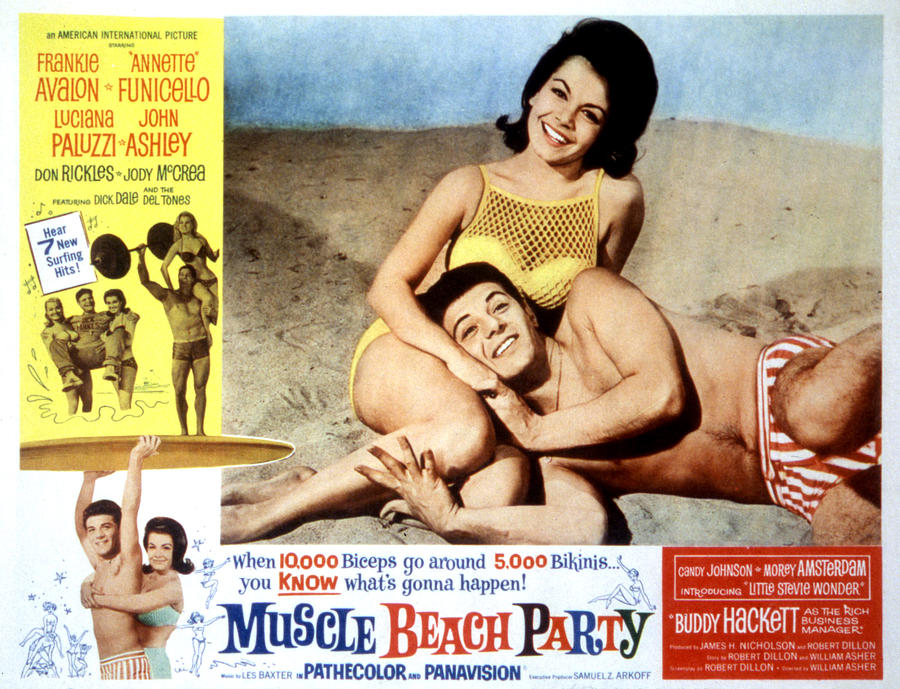
The “Beach Party ” gang’s back and so’s the familiar formula in MUSCLE BEACH PARTY, second in the American-International series. It’s Easter vacation and Frankie Avalon is still horny, Annette Funicello’s still waiting for marriage, and a beautiful foreign woman is again coming between them. This time it’s Lucianna Paluzzi as Countess Julie, a rich heiress who wants to make Frankie a singing star and her personal property.

muscle3

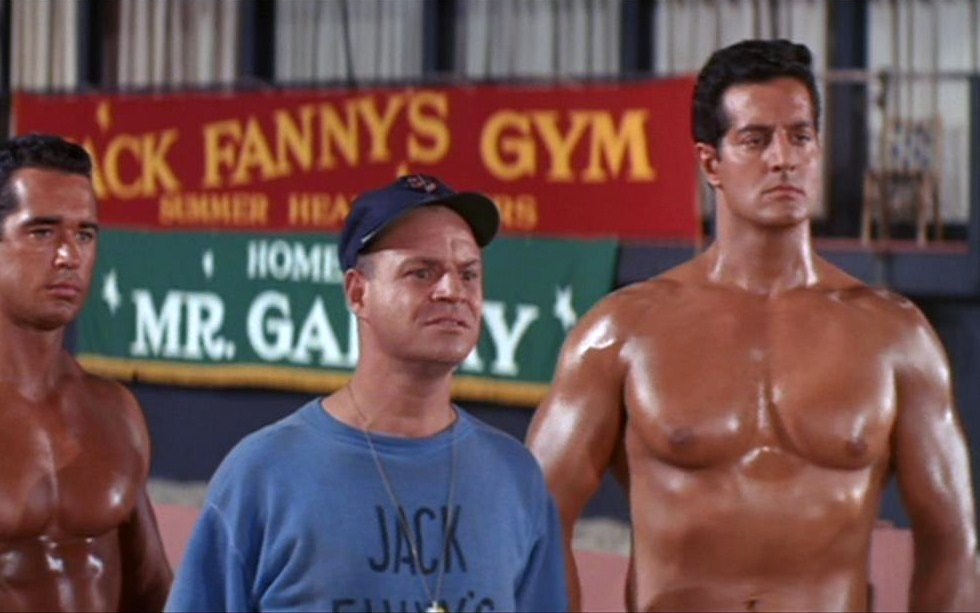
Eric Von Zipper and his Rats aren’t around this time, replaced by a bunch of bodybuilders led by trainer Jack Fanny (the inimitable Don Rickles). Julie first sets her sights on “Mr. Galaxy” Flex Martian, but dumps him when she spies Frankie. This leads to war between the surfers and the musclemen, with the inevitable slapstick melee. Flex is played by Rock Stevens, a real-life bodybuilder who muscled his way through a few Italian peplum films before reverting to his real name of Peter Lupus and…

View original post 338 more words

Film Review: The Sea of Trees (dir by Gus Van Sant)


The_Sea_of_Trees

Nobody wants to admit it but there was a time when all of us self-styled award divas were convinced that Gus Van Sant’s latest film, The Sea of Trees, would be a huge Oscar contender.

Can you blame us?

Sure, you can!  But, before you do, look at it from our point of view.  Gus Van Sant is an acclaimed director who has split his time between Oscar-baity mainstream movies (Good Will Hunting, Milk) and deliberately obscure art films (Elephant).  Two of Van Sant’s films have been nominated for best picture and he has twice been nominated for best director.  The Sea of Trees stars two Oscar nominees (Naomi Watts and Ken Watanabe) and an Oscar winner (Matthew McConaughey).  Much like the 2003 best picture nominee Lost in Translation, The Sea of Trees dealt with an American in Japan.

Yep, The Sea of Trees definitely looked like a contender but then it premiered at the Cannes Film Festival and everything went downhill.  The audience laughed.  The critics booed.  The negative reaction to the film quickly became legendary.  Suddenly, it looked like this former Oscar contender would be lucky to even get an American release.  Both Lionsgate and Roadside Attractions acquired the U.S. distribution rights and both companies dropped the film.

As a result, I found myself growing fascinated with The Sea of Trees.  How bad could it be, I wondered.  The fact that I might never get a chance to actually see the movie only added to my interest.

Well, fortunately, A24 eventually acquired the distribution rights to The Sea of Trees and they have now given the film a limited release in the States.  I saw it last night and…

Meh.

Seriously, after all the publicity and drama, I was expecting that The Sea of Trees would be a total and complete fiasco, one of those train wreck movies that you just can’t look away from.  But, to be honest, The Sea of Trees is not an artistic fiasco in the style of Batman v Superman, nor is it unintentionally amusing like April Rain.  Instead, it’s just a really boring film.

When I heard the plot of the film, I thought it would be an unofficial companion piece to Van Sant’s acclaimed Death Trilogy.  In many ways, the plot sounded a lot like the plot of Gerry.  Arthur Brennan (Matthew McConaughey) is a widowed professor who goes to Japan and visits Aokigahara Forest, the famous suicide forest at the foot of Mt. Fiji.  Brennan is planning to end his life but he’s distracted by a Japanese man, Takumi Nakamura (Ken Watanabe), who claims to be lost in the forest.  However, Nakamura has deep cuts on his wrists.

Brennan tries to help Nakamura find his way out of the forest but soon, the two of them discover themselves to be lost.  Brennan spends a lot of time talking about life philosophy and I have to admit that I had a hard time following what he was saying because I was bored out of my mind.  (It doesn’t help that McConaughey delivers his dialogue in the same style that he used for his infamous car commercials.)  Nakamura doesn’t say much at all.

We also get several flashbacks to Brennan’s former life with his wife (played by Naomi Watts).  The scenes all have a definite Nicholas Sparks feel to them.  And yet, the flashbacks were the best part of the film because of the chemistry between McConaughey and Watts.  The flashbacks are openly and unapologetically sentimental, without any of the pretension that mars the scenes between Brennan and Nakamura.

On a positive note, the film’s cinematography is often striking and the opening, with Brennan walking past random corpses while looking for the perfect place to end his life, is nicely done.  Otherwise, almost the entire film is a misfire.  Matthew McConaughey is one of those actors who is naturally so full of life that it’s hard to buy him as a suicidal academic and the film, which is already overlong at nearly two hours, drags.  This is one of those films that has about a dozen false endings before the final credits finally roll.  Meanwhile, as the action slowly plays out, the original score pounds you over the head.  Important Important Important, the score demands even as the film fails to deliver.

And so, that’s The Sea of Trees.  

It’s not exactly a fiasco but it is unforgivably forgettable.

You gotta keep livin', man! L-I-V-I-N!

You gotta keep livin’, man! L-I-V-I-N!

Back to School Part II #15: Joy of Sex (dir by Martha Coolidge)


Joy_of_Sex_Movie_Poster

Let’s say one positive thing about the 1984 “comedy” Joy of Sex.

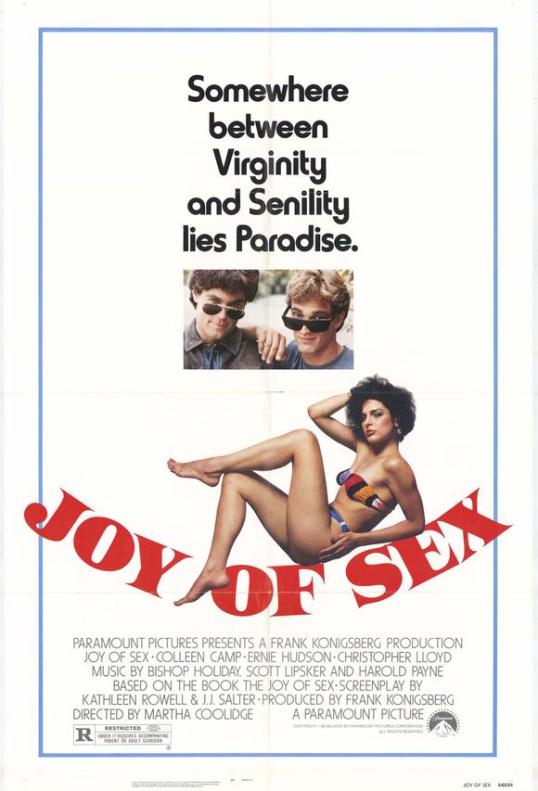
The tag line on the poster: “Somewhere between virginity and senility, lies paradise,” is brilliant.  Whoever came up with it deserves a lot of credit because it sounds a lot better than anything that’s actually heard in the movie.

Let’s say something else good at Joy of Sex.  The two stars of the movie — Cameron Dye and Michelle Meyrink — both gave good and likable performances, even if their characters got a little bit annoying at times.  (Then again, just about everyone in Joy of Sex gets annoying.)  Also, there’s a subplot about an undercover cop (played by Colleen Camp) that predates 21 Jump Street and which occasionally shows off a few hints of genuine wit.

Otherwise, this is probably one of the worst of the 80s teen comedies that I’ll be reviewing for this series of Back to School reviews.  Joy of Sex is officially credited as being an adaptation of a sex manual that was popular back in the 70s.  According to the imdb and Wikipedia, Joy of Sex went through a rather tortured development.  At one point, it was going to be an anthology film, starring John Belushi and co-produced by National Lampoon.  However, Belushi died of a drug overdose, National Lampoon abandoned the project, and the final film turned out to be another high school film.  Imagine Fast Time At Ridgemont High … but really, really bad.

Leslie Hindenberg (Michelle Meyrink) is a student at Richard Nixon High School.  She’s the daughter of the school’s phys ed coach (Christopher Lloyd, playing what was probably meant to be the Belushi role) and, as a result, she is viewed as being untouchable, even by the sex-crazed boys of Nixon High.  The problem is that Leslie has recently discovered a mole on chest and is convinced that she has skin cancer.  Believing that she only has 6 weeks to live, Leslie sets out on a mission to lose his virginity.  However, she wants to lose it to the perfect guy and there aren’t many of those at her school.  (Can you really afford to be picky when you’ve only got 6 weeks to live?)  Add to that, everyone’s terrified of the coach…

Leslie’s lab partner is Alan (Cameron Dye), who is a nice guy.  He not only has a huge crush on Leslie but he’s also desperate to lose his virginity as well!  Problem solved, right?  Well, no.  See, Alan has been led astray by the new girl in school.  Liz (Colleen Camp) is tough, outspoken, and no-nonsense.  As soon as she shows up in school, she lets everyone know that she’s obsessed with two things — sex and drugs.  In fact, she’s especially interested in drugs…

A lot of students, of course, are suspicious of Liz.  She seems to be older than everyone else and speak in out-of-date slang.  “Could she be a narc?” some students wonder.  Well, actually, she is.  She is working undercover at Nixon High and is convinced that Alan knows who is supplying drugs to all of the students.  And, it must be said, that Colleen Camp really throws herself into the role.  As happens with most of the film’s subplots, the undercover narc storyline doesn’t really go anywhere but at least Camp made the effort.

Meanwhile, Leslie’s best friend has been kicked out of school because she’s pregnant.  Leslie approaches a local reporter, hoping to convince him to do a story about what’s happened.  And, while getting her best friend back into school, Leslie starts to wonder if maybe she’s found the right man to take her virginity…

(But wait!  We know she’s meant to be with Alan!  So, surely, the reporter will turn out to be a sleaze, right?)

But that’s not all!  Someone is running around the school and using superglue to play pranks.  Who could it be?  Will the crazy principle (Ernie Hudson) be able to maintain order until the big dance?  And will the portrayal of the school’s frequently confused foreign exchange student manage to get any more racist?

And what about Tom Pittman (Robert Prescott)?  Pittman is the most popular guy in school.  Pittman doesn’t really do a lot.  To make an undeserved comparison to Animal House, he’s kind of the Bluto character, just not as interesting.  Whereas Bluto smashed guitars and beer cans and gave inspiration speeches, Pittman tries to light his farts on fire and is something of a bully.  (There is a kinda funny scene where he’s suddenly nice to Leslie and everyone’s shocked.)  The most memorable thing about Pittman is that he wears thick black glasses which are held together by tape.  So, if nothing else, Joy of Sex is important chapter in the history of myopia in film.

Anyway, Joy of Sex has remarkably little joy and next to no sex.  I imagine that were riots in the theaters after this movie came out, as thousands of angry teenagers chanted, “We want joy!  We want sex!  When do we want them!?  NOW!”

There were a lot of great teen films released in the 80s.  Joy of Sex is not one of them.

Back to School Part II #14: Grease 2 (dir by Patricia Birch)


Grease_2


So, the whole reason that I watched Grease last week was so I would be prepared to watch the 1982 sequel Grease 2 over the weekend.  As I’ve mentioned many times on this site, I absolutely hate Grease and I know what you’re probably asking yourself:

“But Lisa, if you hate Grease so much, why did you want to see Grease 2?”

Well, there’s a very good answer to that question but I’m not going to reveal it.  I’m going to encourage you to learn to love the mystery.  For whatever reason, I wanted to watch Grease 2.  Perhaps it was because I’ve heard that Grease 2 is the worst sequel ever made.  I really didn’t see how that was possible.  How, I wondered, could a film be any worse than the original Grease?

And, so, I watched Grease 2 on Netflix and yes, it was really, really bad.  But you know what?  It was so bad that it became almost compulsively watchable.  Unlike the first Grease, which is full of slow spots, Grease 2 is oddly exciting in its mediocrity.  I watched much of it in open-mouthed horror, wondering if things could possibly get any worse.  And, with each scene, it did get worse.  It was so overwhelmingly and shamelessly bad and so thoroughly misguided that, strangely enough, I really want to rewatch it.

Grease 2 takes place in 1961.  There’s a whole new gang of students at Rydell High!  Well, actually, Frenchy (Didi Conn) has returned.  You may remember that, in the previous film, Frenchy dropped out of high school and went to beauty school.  (She was also visited by Satan, who came to her disguised as the Teen Angel.)  But now Frenchy is back, trying to pass a chemistry class so she can … well, I’m not really sure what the whole deal with Frenchy was.  I imagine that Didi Conn was probably free for a weekend.

The T-bird and the Pink Ladies are still around but they have a whole new membership.  The head of the Pink Ladies is Stephanie Zinone (played, in her film debut, by Michelle Pfeiffer).  Her boyfriend, Johnny Nogorelli (Adrian Zmed), is the chain-smoking leader of the T-birds.  Actually, Johnny is now her ex-boyfriend.  He cheated on her over the summer.

And there’s a new boy at Rydell!  He’s originally from England and he’s Sandy’s cousin!  His name is Michael Carrington (superhandsome Maxwell Caulfield, who is perhaps fated to always be best known for playing Rex Manning in Empire Records) and, when we first meet him, he’s getting off a school bus and he’s wearing a suit!  Michael really likes Stephanie but you have to be a T-bird if you’re going to date a Pink Lady and…

AGCK!

Sorry, that was a primal scream.  Trying to describe the plot of Grease 2 inspires a lot of primal screams.

Anyway, this is a film is also a musical but apparently, none of the original Grease composers were involved with the sequels.  All the songs kinda sound like something you would hear in a parody of Grease, as opposed to a sequel.  Also adding to bizarre feel of this sequel is that everyone delivers their lines as if they’re appearing in a stage production, projecting to the back of the theater and overenunciating every single syllable.  This may have made sense for Grease, which was adapted from an actual stage show and, despite efforts to open up the action, was still deliberately stagey.  Grease 2, meanwhile, is an adaptation of a stage show that never actually existed.

The film starts with a 7 minute production number called Back To School Again.  As the Pink Ladies and the T-birds and all the other students show up outside of Rydell, they sing, “Woe is me!  The Board of Education took away my parole.”  And the scene just keeps going and going, until you start to wonder if Rydell High is a cult compound.

This is followed by a song about bowling (!) that’s called “Score Tonight.”

And it just keeps getting worse from there.  The film becomes sickly fascinating as you find yourself trying to predict how much more worse it can possibly get.  You may be tempted to give up but you’ll definitely want to stick around for the scene in which Michael discovers that Stephanie wants a “cool rider.”  How does he know that?  She sings a song about it!

Naturally, Michael gets a motorcycle, a helmet, and pair of goggles and he starts to romance Stephanie.  Stephanie doesn’t know who that Michael is the mysterious motorcyclist, despite the fact that Michael is just wearing a helmet and a pair of goggles.  Though you have to admire Pfieffer’s commitment to her role (and she gives a fairly good performance, considering the material she was working with), you can’t help but feel that Stephanie might not be the smart.  Especially after she sings, “Who’s that guy?”

Uhmmm … it’s Michael.  It’s not like he’s dressed up like a bat or wearing the Iron Man armor.  He’s just got a helmet and goggles on.  Add to that, while Maxwell Caulfield doesn’t give a bad performance (he seems to be doing the best he can with what he’s been given to work with), he also doesn’t attempt to act any differently when he’s the mysterious motorcyclist than when he’s Michael.

There are other things going on as well.  The film is full of vignettes about life in 1961, all featuring the students and teachers at Rydell High.  For instance, former teen idol Tab Hunter shows up as a substitute teacher and sings a song about reproduction.

And again, it’s so bad that you can’t look away and you watch knowing that you’ll never get the images and the songs out of your head.  So compulsively watchable is this bad movie that I may have to watch it again after I finish this review.  (Then again, I’ll probably just rewatch the fifth season of Degrassi…)

(That said, I would actually argue that Grease 2 is a better directed film than the first Grease.  Grease 2 was directed by Grease‘s choreographer and, as opposed to the first film, the dance numbers are actually framed with modicum of care.)

(By the way, I’ve always wanted to use the phrase “modicum of care” in a review.)

Anyway, Grease 2 apparently bombed at the box office and, as a result, there have been no further Grease films.  It’s a shame because you so know that Grease 3 would have taken place in 1967 and featured hippies.

Oh well.

We’ll survive…


Listen Close; You’ll never get it out of your head #Earworm


earworn

Writer and Director: Tara Price

Stars: Ernest Thomas

Production: Dirigo Entertainment

Have you ever woken up one morning with a song stuck in your head, just bouncing around, like you can never get it out?

Yeah?….Well, this is not the song you want to wake up to tomorrow!

In Tara Price’s new short film Earworm, that is what it is all about. What can you take? The relentless, unending things on (in) your mind can take everything out of you.

Preview:

For a short film (Thomas)  gives everything, literally, everything. And Tara knows how to write, direct and tell the story she wants!

After watching the trailer, I went to bed with my earholes tightly closed!

If you would like to see a trailer for Earworm movie you can here!


Hammer Time!: KISS ME DEADLY (United Artists 1955)


gary loggins's avatarcracked rear viewer

kissme1

Mickey Spillane’s Mike Hammer novels have long been one of my favorite Guilty Pleasures. Spillane’s books were the literary equivalent of knocking back shots of Jack Daniels with no chaser. The misanthropic Mike Hammer’s Sex & Violence filled adventures are rapid paced, testosterone fueled trips through a definitely un-PC world where men are men, women are sex objects, and blood and bullets flow freely through a dark, corrupt post-war world.  Spillane turned the conventional detective yarn on its ear and, though critics hated his simplistic writing, the public ate up his books by the millions.

kissme2

The film version of Spillane’s KISS ME DEADLY turns film noir on its ear from its opening shot of Christine Bailey (a young Cloris Leachman) running down a lonely highway, almost getting run over by Mike Hammer. The PI picks her up and the opening credits roll backwards to the strains of Nat King Cole crooning “Rather Have The Blues”. This beginning set-up lets…

View original post 844 more words

Back to School Part II #13: The Last American Virgin (dir by Boaz Davidson)


The_Last_American_Virgin_movie_poster

(SPOILERS BELOW!)

For the past week, I have been doing a chronological review of films about high school, college, and teenagers.  I started things off on Monday by taking a look at Teenage Devil Dolls, a film from the 1950s.  From there, I moved on to the 60s and then the 70s and now, finally, I am now ready to start in on the golden age of teen films — the 1980s!

I started things off by watching The Last American Virgin, a low-budget film from 1982 and oh my God!  Seriously, The Last American Virgin has got to be one of the strangest films that I’ve ever seen.  I can only imagine what teen audiences in 1982 must have thought when they went to see the latest sex comedy and discovered that it was actually one of the darkest and most depressing films ever made.

Actually, The Last American Virgin is two films in one.  The first film is pretty much a typical teen comedy.  Three friends — awkward but sweet Gary (Lawrence Monoson), handsome but shallow Rick (Steve Antin), and funny fat guy Dave (Joe Rubbo) — try to get laid and survive their senior year in high school.  They pick up three girls by pretending to have cocaine.  (They offer them sweet-n-low instead, which leads to a lengthy scene of the girls snorting the artificial sweetner and then saying stuff like, “This is the best Colombian that I’ve ever had.”)  They meet a lonely housewife who had sex with two of them before her husband arrives home.  (As usual, Gary misses out.)  They have sex with a crude hooker and all end up with crabs as a result.  It’s a typically crude teen comedy, distinguished only by the fact that Monoson, Antin, and Rubbo are a lot more believable as teenagers than the usual 25 year-old actors who often starred in these films.  (According to the imdb, Monoson was only 16 when The Last American Virgin first went into production.)

But, right there in the middle of the usual teen movie shenanigans, there’s this other movie taking place.  Gary is in love with Karen (Diane Franklin, who appeared in several teen films in the 80s, including Better Off Dead) but Karen is dating Rick.  When Gary finds out that Karen has lost her virginity to his best friend, he ends up sitting alone in a diner while Just Once (“I did my best … but I guess my best wasn’t good enough…”) plays on the soundtrack.  In fact, that song shows up several times during the movie.  Basically, whenever Gary tries to do anything, we suddenly hear: “I did my best … but I guess my best wasn’t good enough….”

I mean, seriously, poor Gary!  Even the soundtrack is implying that he’s a loser!

Eventually, Karen discovers that she’s pregnant.  Rick refuses to help out and promptly leaves on a ski trip.  Gary and Karen tell their parents but they’re going on the ski trip as well but instead, they go to an empty house that once belonged to Gary’s late grandmother.  Gary points out a huge, old-fashioned radio sitting in a corner and says that Karen can listen to it if she wants.  Karen starts to cry.  Gary starts to cry and swears that he’ll never abandon her.

Karen gets an abortion.  Shots of Karen at the clinic are mixed in with scenes of Gary desperately trying to raise the money to pay for her abortion.  He begs his boss for an advance on his salary.  He pawns his stereo.  All the while, U2’s I Will Follow plays on the soundtrack.

At this point, the film had gotten so serious that I was half-expecting for Gary to come to the clinic to pick up Karen, just to be told that she had died during the procedure.  But no, Karen survives.  They go back to grandma’s house.  Karen thanks Gary for all that he’s done for her.  Gary cries and says that he loves her.  Karen invites Gary to her birthday party.

Gary goes to the birthday party, bringing with him the gift of a ring.  But, as soon as Gary steps into the kitchen, what’s the first thing he sees?

Karen hugging Rick.  Both of them have tears in their eyes.  They look back at Gary.

Gary stumbles out of the party.  He gets in his car and drives away.  We get a close-up of Gary sobbing in the car…

I did my best …. but I guess my best wasn’t good enough…

AND THEN THE MOVIE ENDS!

I mean … MY GOD, HOW DEPRESSING CAN A MOVIE BE!?

And yet, that depressing ending is what sets The Last American Virgin apart.  I mean, it’s not a happy ending but it definitely elevates this low-budget and rather crude movie.  If nothing else, it feels more realistic than having Lawrence Monoson punch out Steve Antin and then live happily ever after.  Sometimes, stories don’t end with love and smiles.  Often times, they end with an awkward teenager sobbing as he drives home.

So, that’s The Last American Virgin.  It’s an odd little movie.  It was also a remake of a film that the same director had previously made in Israel and the film’s mix of low humor and high drama feels more European than American.  This is definitely a film made by an outsider, trying to imagine what American teenagers are like.  It makes for a movie that, though it may appear to be a typical teen sex comedy, is actually something else altogether.

Seriously, this is a weird one.  I’m as surprised as anyone to say that I recommend it.

Back to School Part II #12: Breaking Away (dir by Peter Yates)


Has Indiana changed much since 1979?

I ask because I just watched Breaking Away, a 1979 nominee for best picture.  Breaking Away was shot on location in Bloomington, Indiana and on the campus of Indiana University.  And though the film doesn’t go out of its way to idealize either the state, the town, or the university –in fact, the title refers to the desire of several characters to break away from their life in Bloomington — it still manages to make Indiana look like the nicest place on Earth.  Add to that, Indiana University is home to the Eskenazi Museum of Art, which I will someday visit.

Breaking Away is actually a film about a lot of things: it’s a comedy, it’s a quasi-love story, it’s bittersweet coming-of-age story, it’s a sports film, and it’s a sweet, good-natured film that made me cry.  At the heart of the film is Dave Stoller (Dennis Christopher), who has just graduated from high school and whose cheerful and eccentric exterior hides the fact that he appears to have no real future.  Dave is obsessed with bicycle racing and idolizes that the Italian cycling team.  In fact, he idolizes them so much that he decides to be Italian.  He rides around Bloomington, greeting people with a merry “Ciao!”  At home, he listens to opera and renames the family cat “Fellini.”  While his mother (Barbara Barrie) is understanding, his father (Paul Dooley) cannot understand what’s happening to his son.  Of course, Dave doesn’t truly believe that he’s Italian.  He just desperately wants to be something other than who he is.

And who is Dave?  He’s a citizen of Bloomington, a town that is divided between the upper class students at Indiana University and the blue-collar townies.  The students call Dave and his friends “cutters,” because the only real industry in town is working in the quarry, cutting stone.  The students look down on the cutters and the cutters resent the students.

Dave has three close friends, all of whom were big in high school and who are now facing an uncertain future of anonymity.  Cyril (Daniel Stern) is the funny and quirky one, the former basketball player who talks about how he would like to be a cartoon character.  Moocher (Jackie Earle Haley) is usually easy-going but loses his temper whenever anyone mentions that he’s short.  (At one point, Moocher’s boss orders him to, “Punch the time clock, Shortie!”  Moocher literally does just that.)  And finally, there’s Mike (Dennis Quaid).  Mike is their leader, a former high school quarterback who idolizes the Marlboro Man and who knows that he’s destined to spend the rest of his life in Bloomington, going from “20 year-old Mike” to “mean old man Mike.”

When Dave meets a student named Katherine (Robyn Douglass), he pretends to be an Italian exchange student and, soon, he’s serenading her on the lawn of her sorority house.  That doesn’t make Katherine’s boyfriend, Rod (Hart Bochner), happy.  Rod and his friends beat up Cyril, which leads to another fight at a bowling alley.  (Cyril, for his part, gets his finger stuck in a bowling ball.)  Seeking to broker some sort of peace and understanding between the students and the town, the university president (played by John Ryan, who was the real-life President of Indiana University at the time) announces that the cutters will be invited to take part in the annual Little 500 bicycle race at Indiana University.

And you can probably guess how the race turns out.  It’s a feel-good sports film so you already know who is going to win and that he’s going to have to win after initially falling behind and sacrificing a big lead.  You know all that but it doesn’t matter.  Breaking Away is such a sweet and well-acted movie that it still brought tears to my eyes even if the ending didn’t surprise me.

And really, the film does have a few surprises.  For one thing, Rod turns out to be not as bad a guy as you initially think he’s going to be.  Over the course of the film, he gets two small reaction shots, both of which hint that he’s not as much of a jerk as he often appears to be.  It’s a minor detail and it’s easy to miss but what’s important that it’s there and it’s one of the many small details that makes Breaking Away feel alive.  After watching the movie, I feel like I could go to Bloomington and still find all these character hanging out at the quarry.

There’s another scene that I want to mention.  This is the scene that made me cry.  Dave and his father walk around the university and his dad talks about how he and the fathers of all of Dave’s friends helped to cut the stone that was used to build campus.  His dad admits that, even though he helped to build it, he’s never felt comfortable on the campus and then tells his son that he doesn’t have to be a cutter.  And it’s such a heartfelt scene and so beautifully performed by Paul Dooley and Dennis Christopher that I started to cry.  Perfectly acted, perfectly directed, and perfectly written, what a great scene!  Fantastico!, as Dave might say.

I loved Breaking Away and I bet you would to.

Breaking Away