IO, Review By Case Wright


io 1

New beginnings and adventure versus intimacy and connection is the theme of Netflix’s latest straight to stream scifi think piece- IO.  It makes sense that human connection is the main theme because this movie was written by a team.  Rule of thumb: if you see Writer 1 and Writer 2 that was rewritten because writer 1 kinda sucked, BUT, if you see Writer 1 & Writer 2, this was written as a creative team.  In this case, there were three writers working together: Clay Jeter, Charles Spano, & Will Basanta.  I can’t imagine how challenging that would be for a film script mostly because I’m very solitary as a writer.  I’m an extrovert in every other way, but my ideal writing space is a well-lit isolation cave.  What is impressive to me  is that Netflix took a chance on these writers because it was their first real feature.  Normally, I would make a parenthesis next to the writers’ names, but here they haven’t really done anything prior.    The director, Jonathan Helpert, has done short films, never a feature. Despite this being everyone’s first feature, they executed well and attracted some real talent to their piece: Margaret Qualley (The Leftovers) and Anthony Mackie (Captain America: Winter Soldier).

The film takes place in just two locations, has two principles, and essentially just a cameo by a third actor.  The special effects were so minimalist that it made Another Earth (Lisa’s Review) look like Star Wars.  90% of the film takes place on a campsite, 5% in an empty neighborhood, and 5% in a museum. This film really ratchets up the intimacy and nothing can make two people closer than not having any other human beings around to distract them.

At first, I thought I was in for some Al Gore environmentalist porn because the film begins with a mass exodus of humanity from earth to an outpost to IO because runaway pollution changed our air to ammonia.  Obviously, there’s not enough fabreeze in the world to get rid of that smell.  Our heroine, Sam (Margaret Qualley) is up on a mountain campsite where the air is still breathable.  She is working alone to further her father’s research to adapt bees and plants to the new atmosphere in order to make the world habitable for humans again.  She makes trips down to the city below to scavenge for parts and to finally get decent tickets to see Hamilton.  This sounds like it would be dull, but it’s totally engaging because Margaret Qualley is such a talent that she plays the claustophic loneliness so you can feel it yourself.

Sam has a REALLY long distance relationship with Elon her engineer boyfriend who is determined to find humanity a new home.  His life is in the unknown and the stars; whereas, Sam’s is one earthbound and lonely.  Her loneliness is ended with the arrival of Micah (Anthony Mackie) a much older man than she, but there are obvious sparks.  They share an interest in the humanities and mourn our lost paradise.  Micah followed Sam’s father’s advice and attempted to stay on earth and survive and adapt, but doing so cost him his wife’s life and anyone else’s who listened to him.  He spent years floating around earth on a hot air balloon, seeing humanity’s fall from above.  When Micah met Sam, their age difference, the poisoned earth, or the uncertain future didn’t matter because they made a connection and developed concern for one another.

A lot has been discussed about the quasi-ambiguous ending because I suppose people are really good at missing the point.  It never was about whether humanity retook the earth or colonized a new home beyond the stars; it was about humans rediscovering their humanity.  In fact, the last lines of the film discussed exploration, coming to where you began, and re-discovering your starting point as if it were new because it is: you have changed, you have grown, the meaning has evolved.  By the end of the film, Sam and Micah had learned that they were still human.  These connections are why we fight a Trojan War to bring our loved ones home because we are connected to them, they matter, and because we are human.  The end was not about whether she survived and lived on earth on not; it was heartbreaking because alive or dead, we knew that the roads Micah and Sam would walk would not be together.


Fever Dreams: Fritz Lang’s THE WOMAN IN THE WINDOW (RKO/International Pictures 1944)


gary loggins's avatarcracked rear viewer

Back in 2016, I did a post expounding on one of my favorite films noir, 1945’s SCARLET STREET . This dark masterpiece of corruption starred the titanic trio of Edward G. Robinson, Joan Bennett, and Dan Duryea in a sordid tale directed by German legend Fritz Lang, with moody cinematography courtesy of Milton Krasner. Recently, I viewed a film this team made the year previous, THE WOMAN IN THE WINDOW, with a screenplay by producer Nunnally Johnson. Comparisons were inevitable, but though there are certainly similarities between the two films, this one stands on its own as a powerful entry in the film noir canon. With all that talent, would you expect anything less?

Robinson plays college professor Richard Wanley, an intellectual lecturing on the psychology of homicide to his students. He’s a happily married father of two kids, left alone while the fam visits relatives. Whaley goes to his…

View original post 405 more words

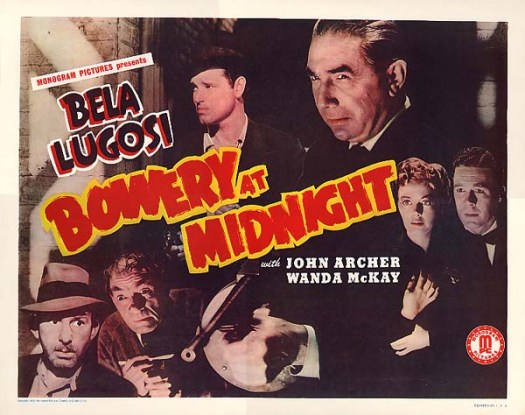
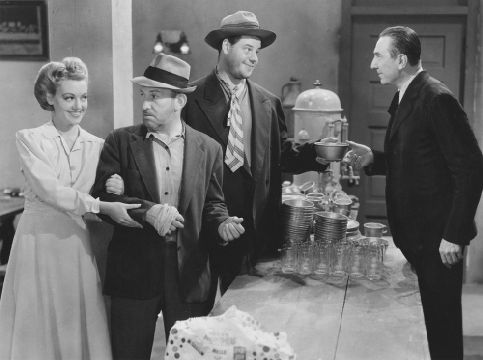
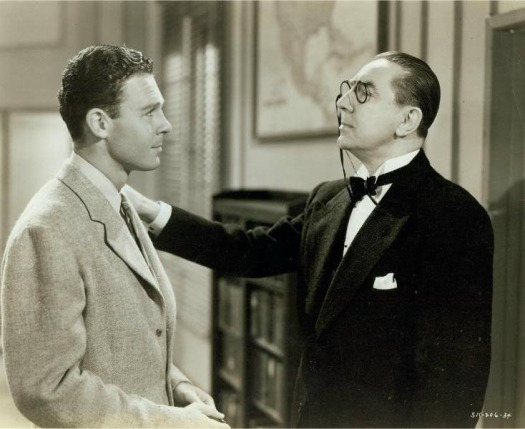
Diamond Among the Coal: Bela Lugosi in BOWERY AT MIDNIGHT (Monogram 1942)


gary loggins's avatarcracked rear viewer


I’ve written about Bela Lugosi’s infamous ‘Monogram 9’ before, those ultra-cheap spectacles produced by the equally ultra-cheap Sam Katzman for low-budget Monogram Pictures. These films are all Grade Z schlock, redeemed only by Lugosi’s presence, giving his all no matter how ludicrous the scripts or cardboard the sets. BOWERY AT MIDNIGHT is a cut above; still schlock, but the pulpy premise is different from the rest, and Bela gives what’s probably his best performance out of the whole trashy bunch.

Lugosi plays kindly Karl Wagner, a benevolent soul who runs the Friendly Mission down on the Bowery. But wait – it’s all a front for recruiting down-on-their-luck criminals into Wagner’s gang of thieves. And when he’s done with them, he bumps them off and gives the corpses to ‘Doc’, a dope fiend ex-medico who uses the bodies for his own nefarious purposes!

But wait again! Wagner’s not really Wagner, he’s…

View original post 479 more words

Film Review: White Boy Rick (dir by Yann Demange)


Last night, as a part of my attempt to get caught up with the films of 2018, I watched White Boy Rick.

As you might guess from the title, this film is about a white boy named Rick.  It’s based on the true story of Richard Wershe, Jr., who grew up on the streets of Detroit.  His father sold guns out of the trunk of his car and, by the time he turned 14, Rick was running with drug dealers and street gangs.  (The fact that he was white while all of his friends were black is what led to him getting his nickname.)  Rick became an informant for the FBI and, according to Wershe, the government helped him build up his reputation by supplying him with the drugs that he would then sell on the streets.  When the FBI eventually decided that Wershe was no longer a useful asset, he was arrested for dealing and sentenced to life in prison.

The story seems like one that has the potential to say a lot that needs to be said about not only the economic realities of life in a dying city but also about the role that race plays in America’s often misdirected “war on drugs.”  Unfortunately, the film falls flat because, with the exception of a few scenes, it never really convinces us that Rick was really worthy of being the subject of a film.  While the film surrounds him with interesting supporting characters, Rick himself remains something of a cipher.  Rick is played by a young actor named Richie Merritt.  Merritt’s has the right look for the character but you never get the feeling that there’s anything going on underneath the surface.  Rick comes across as just being a moron who got lucky and then, eventually, not so lucky.

The supporting cast fares a bit better.  For instance, Matthew McConaughey plays Rick’s father with just the right amount of manic energy and Bel Powley has a few harrowing scenes as Rick’s drug addicted sister.  Bruce Dern and Piper Laurie don’t get to do much as Rick’s grandparents but it doesn’t matter because they’re Bruce Dern and Piper Laurie.  (All Bruce Dern has to do to make a character interesting is look at the camera.)  Jennifer Jason Leigh plays one of Rick’s FBI handlers with the perfect hint of subversiveness.  You’re never quite sure whether she’s messing with Rick’s life because she’s incompetent or because she’s enjoying it.  Unfortunately, the supporting characters are often so interesting that Rick often gets overshadowed.  He’s a bystander in his own story, which may have been the film’s point but, from a storytelling point of view, it hardly makes for compelling viewing.

Admittedly, there are a few memorable scenes to be found in White Boy Rick.  At one point, Rick goes to a wedding at the mayor’s mansion and he’s a sight to behold in his blue tuxedo.  In another scene, it’s explained to Rick why, when it comes to being arrested, charged, and incarcerated, the stakes are very different when you’re black than when you’re white.  In scenes like that, you kind of get a hint of White Boy Rick could have been if it had been centered around a more compelling character.

As it is, though, White Boy Rick is well-made but kind of dull.  It’s definitely a missed opportunity.


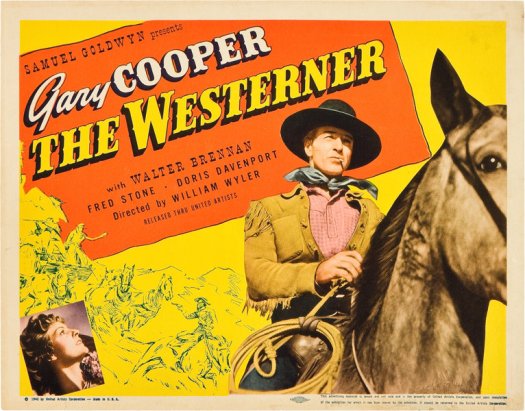
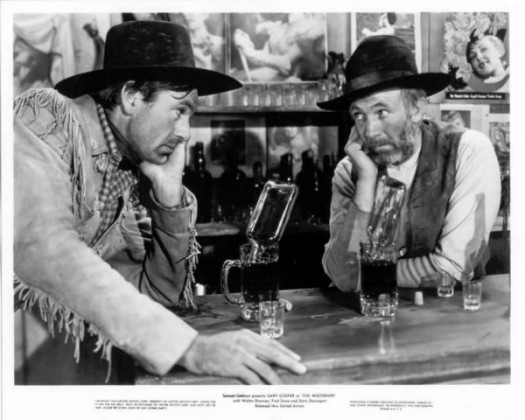
Wild Wyler West: Gary Cooper is THE WESTERNER (United Artists 1940)


gary loggins's avatarcracked rear viewer

It’s hard to believe that, except for two films in which he cameoed, I haven’t covered any movies starring my namesake, Gary Cooper . Nor have I written anything about any of major Hollywood director William Wyler’s works. So let’s kill two birds with one stone and take a look at 1940’s THE WESTERNER, one of the best Westerns ever. It’s a highly fictionalized account of the life and times of Judge Roy Bean (1825-1903), played by Walter Brennan in his third and final Oscar-winning role, with Cooper as a drifter at odds with “The Law West of the Pecos”.

That “law” is Bean, who sides with the open range cattlemen against the homesteaders who’ve moved into the area. Into the town of Vinagaroon rides Coop as Cole Harden on his way to California. Unfortunately for Cole, he rides in on a horse stolen from one of Bean’s cronies, and…

View original post 548 more words

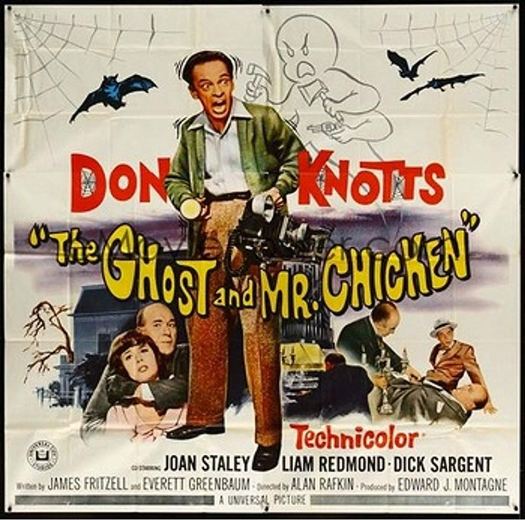
Attaboy, Luther!: Don Knotts in THE GHOST AND MR. CHICKEN (Universal 1966)


gary loggins's avatarcracked rear viewer

When the conversation turns to great screen comedians, Don Knotts doesn’t get a lot of respect among the cognescenti. Talk to his loyal fandom, including celebrities like Jim Carrey and John Waters, and you’ll hear a different tune. They all agree – Knotts was a talented and funny comic actor, the quintessential Everyman buffeted about by the cruelties of fate who eventually triumphs against the odds. Following his Emmy-winning five-year run as Deputy Barney Fife on THE ANDY GRIFFITH SHOW , Knotts signed a movie contract with Universal, and his first feature for the studio was the perfect vehicle for his peculiar talents: a scare comedy titled THE GHOST AND MR. CHICKEN.

Knotts plays Luther Heggs, a meek typesetter for his local newspaper in the small town of Rachel, Kansas. He’s also somewhat of the town laughing-stock, bullied by the paper’s ace reporter Ollie, his rival for the affections…

View original post 614 more words

Film Review: Holmes & Watson (dir by Etan Cohen)


Will Ferrell is Sherlock Holmes!

John C. Reilly is John Watson!

Together, they get really bad reviews!

Well, that and solve crimes and protect royalty.  Holmes & Watson, which came out this previous Christmas, features Sherlock and John attempting to prevent Professor Moriarty (Ralph Fiennes) from assassinating Queen Victoria.  Watson, being the proud Englishman that he is, is an obsessive fan of Queen Victoria.  In fact, he’s such a fan that, upon meeting her, he insists that she pose for a “self-photography” with him and Holmes.  Of course, cameras back then were a lot bigger and more bulkier than cameras today so Watson ends up bashing the Queen in the head.  Watson and Holmes are terrified that they’ve killed the Queen.  But then she wakes up.  That’s the joke.

Holmes & Watson isn’t so much a parody of the original Sherlock Holmes stories as much as it’s a parody of the Guy Ritchie films that almost everyone has already forgotten about.  Of course, it can be argued that the Guy Ritchie films were, themselves, parodies which makes Holmes & Watson a parody of a parody.  (Now, we just need someone to parody Holmes & Watson so that the universe can collapse in on itself.)  As a result, the film opens with a young Sherlock Holmes being tricked into kissing a donkey’s ass and then it progresses to an adult Holmes using his deductive powers to deduce that a man is a compulsive masturbator.  The film never seems to be quite sure if its version of Holmes is meant to be an eccentric genius or an overrated bungler and Will Ferrell’s inconsistent performance doesn’t help matters.  When Holmes starts to incorrectly suspect that Watson has betrayed him, we don’t know if we’re supposed to share Watson’s feeling of betrayal or if this is just another case of Holmes being a brilliant idiot.  The film doesn’t seem to know either.

In the role of Watson, John C. Reilly is expected to do most of the dramatic heavy lifting.  He gets several scenes in which he discusses how difficult it is to always be the sidekick.  It’s a role that Reilly has played in several other films and perhaps that explains why he seems so bored in this movie.  We’re all kind of used to Will Ferrell being an inconsistent performer but it’s far more depressing to see John C. Reilly sleepwalking through a film.

Anyway, Holmes & Watson is not a film that I normally would have wasted my time seeing but, with so many people proclaiming it to be not only the worst film of 2018 but the worst film of all time, I felt that I had a certain obligation to do so.  After all, I’ll be posting my worst of and best of lists over this upcoming week and Holmes & Watson seemed like it would be a legitimate contender for one of those lists.  Having now seen the film, I can say that it’s pretty bad.  Unfortunately, unlike some other bad films, it’s also rather dull and forgettable.  It’s certainly far more dull than any film featuring John C. Reilly, Ralph Fiennes, Rebecca Hall, Hugh Laurie, Steve Coogan, and Kelly MacDonald has any right to be.  It’s a comedy where so many of the jokes fall flat that even the jokes that do work kind of suffer just by association.  Usually, I would have laughed at the film’s Billy Zane cameo but I was still annoyed by the film’s unnecessary musical number so I merely chuckled.

If Holmes & Watson has a saving grace, it is that it’s just a silly comedy.  It’s not really pompous enough to justify the claim that some have made that it’s the worst film of all time.  It’s neither as smug as Vice nor as pretentious as Life Itself.  In fact, it’s not even the worst comedy of the year.  (That honor would belong to The Happytime Murders.)  What Holmes & Watson is, is a huge disappointment.  With all the talent involved, you would hope that the film would be a bit more memorable.

Film Review: Flashdance (dir by Adrian Lyne)


Instead of getting any sleep last night, I decided to stay up and watch the 1983 dance film, Flashdance.  As a result, I’m not only very tired but everyone I see today, I’m just like, “You’re not really a welder, are you?”

In the film, that question is asked by bitchy Katie Hurley (Belinda Bauer) to 18 year-old Alex (Jennifer Beals) and the answer, by the way, is yes.  Alex is a welder.  Judging by the way the film handles the topic, it appears that audiences in 1983 were really stunned that a woman could be a welder.  (I kept expecting to hear someone say, “She’s one of those lady welders, like you read about in the Reader’s Digest.”)  Myself, I’m more amazed that an 18 year-old in Pittsburgh could get a high-paying union job.  Then again, we never really see any evidence that Alex is really doing much as a welder.  We do see her at a construction site holding one of those torch things but that’s pretty much it.  Last night, I started Flashdance with no idea what a welder does and I ended the movie with even less of an idea but then again, the movie really isn’t about welding.

Instead, it’s about dancing!  And love!  And holding onto your dreams!  And living in a big warehouse with a dog and a handsome boyfriend!  As one character puts it, when you give up your dreams, you die.  Of course, most people have multiple dreams so what happens if you only give up one but hold onto the others?  I guess you just lose a toe or something.  But anyway….

Actually,  before we move on, how much money did welders make back in 1983?  Because seriously, Alex lives in a gigantic and very nicely decorated building and her only roommate is a dog.  As Alex explains to her boss and boyfriend, Nick (Michael Nouri), the building was an abandoned warehouse before Alex moved in.  So, does Alex own the building?  Does she just rent it?  It’s a great place and I love what Alex does with it but seriously, it’s hard to believe that any 18 year-old — even one who is working two jobs — could afford it.

Yes, Alex has two jobs.  Such is the price of independence.  When she’s not welding, she’s dancing at a dive bar.  Her routines are amazingly filmed and a lot of fun to watch but they’re also so elaborate it’s hard to believe that they could be performed in such a run-down establishment or that the bar’s blue collar clientele would have much patience for them.  She’s an exotic dancer, which means she doesn’t take off her clothes.  The sleazy owner of local strip club (Lee Ving) keeps trying to encourage Alex and her friend, Jeanie (Sunny Johnson), to come dance at his place but Alex has no interest in that.  Jeanie, on the other hand, accepts the offer.  Fortunately, Alex is there to run into the club and yank her off stage and then yell at her.  Alex spends a lot of time yelling at people.  She also throws a rock through one of Nick’s windows when she sees him talking to his ex-wife.  One could argue that Alex has rage issues but no one in the film seems to take them personally.  How could they?  Alex is pursuing her dreams and the good thing about pursuing a dream is that you can do whatever you want while doing so.

(Interestingly, you can tell that the filmmakers were a little bit concerned that audiences in the early 80s might view Alex as being a bit too independent and confrontational.  In between the scenes of Alex yelling at people and casually reaching underneath her sweatshirt to remove her bra while Nick watches, there are also scenes of Alex going to confession.  It’s as if the film’s saying, “Yes, she welds!  Yes, she has a temper!  Yes, she’s flirty!  But fear not, she’s a good girl!  So, it’s okay for you to be on her side….”)

For a film that was shot on the streets of Pittsburgh, there’s not a gritty moment to be found in Flashdance.  This is the type of film where Alex rides her bicycle across the city and it never once gets stolen, despite the fact that she never actually locks it up.  In the world of Flashdance, all conflicts are easily resolved, all insecurities are ultimately conquered, and all dreams come true.  It’s a world where Alex can become a great dancer despite having never had any formal training just because, as she puts it, she’s “watched TV and read books.”  (My old dance teachers probably hated this movie.)  It’s a fairy tale and, like most fairy tales, it’s deeply silly and yet oddly compelling at the same time.  Never once do you buy that Alex is a welder and it’s pretty obvious, from all the quick cuts and the skewed camera angles, that Jennifer Beals did not do her own dancing.  But it doesn’t matter because it’s hard not to get pulled into the film’s glitzy fantasy.  Flashdance may technically be a bad movie but I dare you not to cry a little when Alex leaves her audition and finds Nick waiting for her.  Not only does Alex achieve her dreams, but she also get a rich, older boyfriend, the type who gives her flowers and puts a bow on her dog.

It’s interesting to note that the two films that practically define the early 80s cinematic aesthetic, Flashdance and Scarface, were both released in 1983.  (Not only was Flashdance initially offered to Scarface director Brian DePalma but Al Pacino was also offered the role of Nick.  Pacino, of course, turned it down and played Tony Montana instead.)  To be honest, I think you can argue that Flashdance and Scarface are essentially the same film.  They’ve both got neon opening credits.  They’ve both got a score from Giorgio Moroder.  They’re both elaborate fantasies about someone who won’t surrender their dream.  Just replace all the cocaine that Tony Montana snorted with Alex’s love of dancing.

Finally, I have to mention Flashdance‘s music.  The score and the song may be totally 80s but it still sounds good in 2019.  The theme song won an Oscar and let me tell you, if you can listen to this song without dancing around your house in your underwear, then you obviously have a lot more self-control than I do.

A Pirate’s Life For Me!: THE SPANISH MAIN (RKO 1945)


gary loggins's avatarcracked rear viewer

Today we celebrate the birthday of classic actor Paul Henreid (1908-1992)  


THE SPANISH MAIN is one of those films where the acting is cranked up to 11 and tongues are held firmly in cheek. That’s not a bad thing; this is a fun, fast-paced romp that doesn’t require much thinking, a colorful piece of mind candy that doesn’t take itself too seriously and features a great cast. It’s not what you’d normally expect from director Frank Borzage, usually associated with weightier matters like 7TH HEAVEN, A FAREWELL TO ARMS, THREE COMRADES, STRANGE CARGO , and THE MORTAL STORM. Maybe after all that heavy drama, the veteran needed to lighten up a bit!

Paul Henreid  stars as our hero Laurent Van Horn, a Dutch captain whose ship is wrecked in the Caribbean waters near Cartagena. The Spanish Viceroy there, Don Juan Alvarado (Walter Slezak ), is a tyrant who holds the…

View original post 415 more words

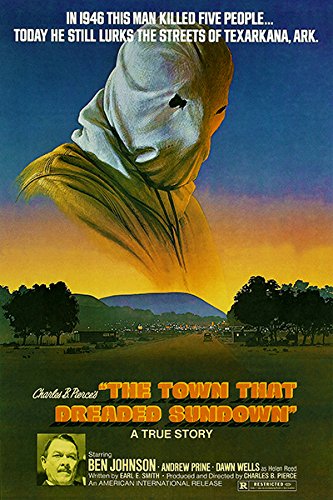
Southern Fried Slasher: THE TOWN THAT DREADED SUNDOWN (AIP 1976)


gary loggins's avatarcracked rear viewer

In 1946, the town of Texarkana, on the Texas-Arkansas border, was rocked by a series of brutal attacks on its citizens from February to May that left five people dead and three seriously wounded. The psycho, who wore what seemed to be a white pillowcase with eyeholes cut in it, caused quite a panic among the townsfolk, and the local and national press had a field day sensationalizing the gruesome events. The case was dubbed “The Texas Moonlight Murders”, and the mysterious maniac “The Phantom Killer”. Famed Texas Ranger M.T. “Lone Wolf” Gonzaullus was brought in to lead the investigation and rounded up a few suspects, but no one was ever formally charged with the grisly crimes. To this day, the case has never officially been solved.

Forty years later, Texarkana native Charles B. Pierce produced, directed, and costarred in THE TOWN THAT DREADED SUNDOWN, a film based on those…

View original post 670 more words