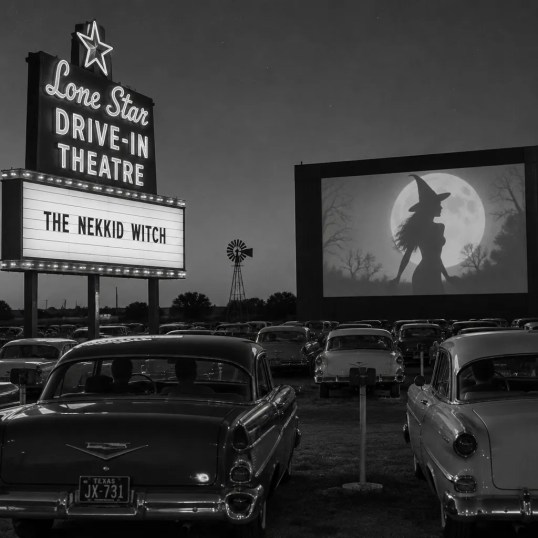
Today’s Horror on the Lens come to us for director Larry Buchanan.
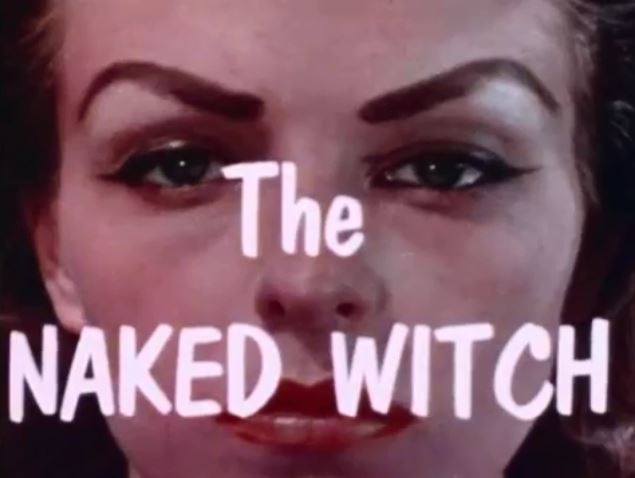
Larry Buchanan was not only born in Texas but he made most of his films here too. In 1964’s The Naked Witch, a college student is doing a research project on the German-speaking villages in Central Texas. It’s while visiting one such village that this idiot accidentally brings an ancient witch back to life. In many ways, this is a typical Buchanan film. The budget is low and the plot is sometimes incoherent. But the film is also fairly atmospheric. In my case, it helps that I’ve actually spent time in Central Texas and I know how creepy things can sometimes get out there.
In this 1967 film from venerable B-movie director Larry Buchanan, a psychic con artist uses hypnosis to bring back into existence a prehistoric, humanoid amphibian.
Wait?
What?
Okay, so the story doesn’t make much sense. In fact, I would be lying if I said that I fully understood the film, despite the fact that I sat through all 88 minutes of it on Saturday night. Basically, Dr. Basso (Les Tremayne) is a hypnotist and an occult historian. He’s bitter about the fact that the world doesn’t appreciate him or take him seriously, despite the fact that he spends almost the entire film wearing a tuxedo and he has a head of silver hair that would have made even the great Criswell jealous. So, Basso decides that the best way to prove his powers would be start predicting when people are going to die. And the way he does that is by hypnotizing his assistant, Doreena (Pat Delaney).
Somehow, hypnotizing Doreena causes this prehistoric humanoid monster thing to rise out of the nearby lake so that it can kill whoever Dr. Basso wants dead. It’s interesting that Dr. Basso could figure out how to bring an extinct creature back to life but he could come up with a less destructive way to prove his powers. This is just my opinion but it seems like he could have just displayed the prehistoric monster and that would have proven his powers far more effectively than committing murders. Dr. Basso’s plan is needlessly complicated. Neither Dr. Basso nor the film ever seem to consider what would happen if he was asked to prove his powers while performing somewhere that wasn’t conveniently located near a lake. If Dr. Basso ever plays Vegas, he’s in trouble.
Anyway, it falls of Lt. Blake (Roger Ready) and Captain Dell (Aron Kincaid) to figure out how to stop Dr. Basso. Captain Dell is not just an expert on the occult but he’s also an Air Force psychiatrist, so he goes through the entire movie wearing his uniform. Dell being in the Air Force doesn’t really figure into the plot otherwise. He could just as easily be in private practice. One gets the feeling that he was made an Air Force captain just because someone had the uniform and it looked good on Aron Kincaid.
Creature of Destruction is a fairly confusing film. Unfortunately, it’s also a rather boring film. Larry Buchanan was a prolific director but he was never a particularly good one. Some directors knew how to take advantage of a low budget and less than compelling actors. Unfortunately, Buchanan really wasn’t one of them. Still, the lake scenery is nice and it’s kind of fun to watch the monster waddle across the screen. As well, there are two musical interludes that come out of nowhere but which are amusing in a late 60s beach movie sort of way. So, the film has that going for it. Otherwise, not even hypnosis will help you get through Creature of Destruction.
Today’s Horror on the Lens come to us for director Larry Buchanan.
Larry Buchanan was not only born in Texas but he made most of his films here too. In 1964’s The Naked Witch, a college student is doing a research project on the German-speaking villages in Central Texas. It’s while visiting one such village that this idiot accidentally brings an ancient witch back to life. In many ways, this is a typical Buchanan film. The budget is low and the plot is sometimes incoherent. But the film is also fairly atmospheric. In my case, it helps that I’ve actually spent time in Central Texas and I know how creepy things can sometimes get out there.
The 1964 film, The Naked Witch, opens with a prologue that explains the role of witchcraft throughout the ages. That, in itself, is not surprising. A lot of supernaturally-themed films opens with a prologue that’s designed to give the film some sort of historical basis. It’s one of the oldest tricks in the book. Give your cheap film some credibility by claiming that it’s “based on a true story.”
What sets The Naked Witch apart is that the prologue just goes on and on. For ten minutes, we stare at Bosch paintings while an officious sounding narrator discusses the history of witchcraft. The paintings are effectively macabre but it all goes on for so long that you can’t help but get the feeling that the prologue was mostly added to pad out the running time. It’s almost as if director Larry Buchanan was basically admitting that he didn’t really have enough of an actual story to justify a feature-length running time. Of course, this shouldn’t come as a shock to anyone who is familiar with Larry Buchanan’s filmography.
Once the narration finally ends, we find ourselves watching The Student (Robert Short) as he drives through central Texas. The Student suddenly takes over the narration, telling us that he’s driving through the Texas German Counties. He’s visiting towns and counties that were founded by German settlers. The townspeople all have German names. Most of them still speak German in private. They all dress like they’ve just returned from a night at a Munich beer hall. Interestingly enough, these counties and towns do actually exist, though I’ve never seen anyone casually wearing lederhosen or a dirndl in Central Texas. Of course, this film was made a bit before my time so maybe that used to be a tradition back in 1964. Maybe people stopped doing it after The Naked Witch came out. Or, even more intriguingly, maybe people stopped doing because The Naked Witch came out. We’ll probably never know for sure.
Anyway, the Student is kind of an idiot because he manages to run out of gas while driving out in the middle of nowhere. I guess it didn’t occur to him to fill up the tank before trying to drive through a largely empty stretch of land. Leaving his car behind, he manages to walk to the real-life town of Luckenbach, Texas. He’s shocked to discover the none of the townspeople want to talk about long-dead witch that was supposedly buried in town. Why, it’s almost as if the people of Luckenbach understand that it’s not a good idea to brag about living under the threat of a supernatural curse.
Largely due to the Student’s stupidity, the Witch (played by Libby Hall) comes back from the dead. She’s naked, which I imagine was probably the film’s main selling point back in 1964. The Witch wants revenge on the descendants of the people who put her to death. The Students just wants to hook up with The Witch.
And that’s really pretty much it. Even by the admittedly low standard set by Larry Buchanan’s other films, the plot of The Naked Witch is pretty much impossible to follow. It’s incoherent and yet, strangely enough, that incoherence sometime works in the film’ favor. The atmospheric Texas landscape, when combined with the overly theatrical performance of Libby Hall, gives the film a dream-like feel. Even the fact that the film features three separate narrators all contribute to the movie’s surreal style. At its best, The Naked Witch is an existential mood piece. At its worst, it’s just a really bad, zero-budget drive-in movie.
The Naked Witch is an odd film but, if you’re looking for a ten minute history on witchcraft followed by a Texas travelouge, the film might be for you.
By most accounts, Charles A. Floyd — better known by the nickname “Pretty Boy” Floyd — was one of the nicer of the Depression-era outlaws. Though he robbed his share of banks, he was usually described as being rather polite and sensible while he did so. He didn’t steal from the poor. While he did kill a few men, they were all law enforcement officers who were also shooting at him. And while that may not sound like a good thing, with murder being murder and all, it’s still a marked contrast to Bonnie and Clyde, who were known for being as deliberately violent as possible. Pretty Boy Floyd reportedly had a strong dislike for Bonnie and Clyde and even told his relatives in Oklahoma not to help the Barrow Gang hide from the police.
The most violent thing that Floyd was ever accused of was taking part in the killing of four law enforcement officers in Kansas City. (This was the so-called Kansas City Massacre.) Since one of the victims was an FBI Agent, Floyd quickly became public enemy number one and was eventually gunned down in a cornfield in Ohio. (Some accounts say that Floyd was initially only wounded and was executed by the FBI after he surrendered.) Most modern historians agree that Floyd was not involved in the Kansas City Massacre. Even after he had been shot and told that he was dying, Floyd reportedly vehemently denied having had any involvement in what happened in Kansas City. In the view of most historians, Pretty Boy Floyd was a polite country boy who just happened to rob banks.
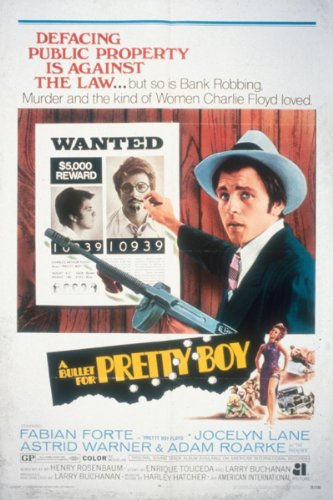
That’s certainly the way that he’s portrayed in the 1970 film, A Bullet For Pretty Boy. Though this low-budget movie from Texas-born filmmaker Larry Buchanan opens with a title card telling us that we’re about to see a true story, it’s highly fictionalized. Singer Fabian Forte plays Charles A. Floyd, who goes from getting married to going to jail on a manslaughter conviction in record time. (It was all because someone was making trouble at the wedding reception so really, you can’t blame Floyd for anything that happened.) Floyd is supposed to serve six years but he decides to break out after only serving three and a half. Again, you really can’t blame Floyd for doing that. No one wants to work on a chain gang. Eventually, Floyd ends up hanging out at a brothel, where he falls in with a gang of bank robbers and a prostitute named Betty (Jocelyn Lane) ends up falling for him. After several bank robberies and gunfights, Floyd ends up working with an outlaw named Preacher (Adam Roarke). Everyone does not live happily ever after.
While watching A Bullet For Pretty Boy, it’s pretty easy to see the influence of the 1967 film, Bonnie and Clyde. There’s a lot of sudden bursts of violence (though never quite as bloody as the violence from Bonnie and Clyde) and the film is clearly on the side of Pretty Boy Floyd as opposed to the cops trying to catch him. However, whereas Bonnie and Clyde presented its title characters as being rebels against the establishment, A Bullet For Pretty Boy is content to portray Floyd as just being someone who ended up in a bad set of circumstances and who did what he felt he had to do to survive. As played by Forte, Floyd is good at robbing banks but he doesn’t seem to really enjoy doing it. That, of course, is a polite way of saying that Fabian Forte is credible but slightly boring in the lead role. He’s likable enough but he’s not exactly compelling and he often finds himself overshadowed by more energetic performers like Adam Roarke.
That said, I enjoyed A Bullet For Pretty Boy. Certainly, this film is better than the typical Larry Buchanan film. There aren’t any slow spots and the film does a good job of capturing the feeling and atmosphere of rural Texas and Oklahoma. (Undoubtedly it helped that the film was directed by a Texan who actually knew something about the communities that he was portraying.) The shoot outs and the bank robberies are just well-staged enough to hold your attention and that’s really the main thing that one can ask from a film like this. A Bullet From Pretty Boy doesn’t exactly make a lasting impression but it’s entertaining enough while you’re watching it.
Look, I get it. Not everyone is as crazy about watching the Oscars as I am. Some of you have absolutely no interest in watching the Oscar tonights and right now, you’re saying, “If only there was something else to watch!” I hear you and I’m here for you.
And fear not!
There is something else for you to watch! Just go to YouTube and look up Zontar, The Thing From Venus! You can watch the whole movie three times in a row while everyone else is watching the Oscars. Don’t ever say that I didn’t do anything for you.
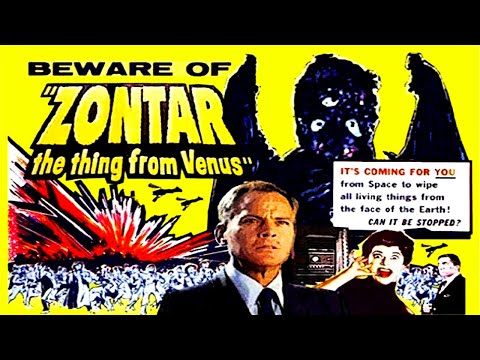
What is Zontar, The Thing From Venus? It’s a film from 1966 and it was directed by Texas’s own Larry Buchanan! It tells the story of what happens when a creepy scientist named Keith (Tony Huston) manages to contact a big, three-eyed bat named Zontar. Zontar’s from Venus and it wants to rule the world. Keith thinks that humanity could benefit from being conquered by a ruthless alien warlord. So, Kieth arranges for Zontar to come to the Earth. While Zontar hides out in a cave, it manages to shut down everyone’s electricity and, using a bunch of smaller, flying bats, it also possesses almost an entire town. Keith thinks it’s great but that’s because Keith is an idiot with fascist tendencies.
You know who isn’t impressed by Zontar and all of his high-and-mighty rhetoric? Another scientist named Dr. Curt Taylor (John Agar). Dr. Taylor knows that Zontar is up to no good but how can he stop him? Well, he’s not going to do it by driving a car because Zontar’s knocked out America’s electrical systems. So, instead, he rides a bike from location to location. Seeing John Agar awkwardly trying to balance himself on a bike is more than worth the price of admission.
(Of course, since this is on YouTube, the price of admission is only your immortal soul and your internet privacy.)
Anyway, if all of this sounds familiar, that’s because Zontar is a remake of an earlier Roger Corman film called It Conquered The World. For some reason, in the 60s, American International Pictures gave Larry Buchanan a handful of money and told him, “Go direct some crappy remakes of some of our best films.” Zontar is probably the best known of Buchanan’s remakes and it’s also probably the most fun.
I mean, don’t get me wrong. It’s nowhere near as good as It Conquered The World but, at the same time, it doesn’t have the slow spots that show up in most of Buchanan’s other films. The story moves fairly briskly and Buchanan keeps the picture in focus and, considering some of Buchanan’s other movies, that’s a bit of a minor triumph. Zontar is an impressive monster. In fact, I’d say that batty Zontar is probably a more effective creation than the smiling crab that showed up in It Conquered The World. Finally, you get to see John Agar trying to ride a bicycle and that’s always an entertaining sight.
Zontar is enjoyably dumb. If you want to kill 80 minutes but you don’t want to have to do any thinking, watching Zontar is definitely one way to do it.
Today’s horror on the lens is 1966’s Curse of the Swamp Creature!
Probably the best thing about Curse of the Swamp Creature is that it was filmed in the town of Uncertain, Texas, which is right near the Texas/Louisiana border. Uncertain, which sits on the shores of Caddo Lake, was incorporated in 1961. Reportedly, when filling out the paperwork, the town’s founders wrote “Uncertain” in the blank for the name because they genuinely hadn’t come up with a name. And …. well, you know what happens when you try to make a joke on an official document.
Anyway, this film was directed by Larry Buchanan and that’s really all you need to know about it. Buchanan specialized in making low-budget remakes of other films, though he always claimed that Curse of the Swamp Creature was a totally original idea on his part. The film is about a mad scientist who lives in the swamp and is trying to reverse evolution. Things don’t always work out the way that they should and occasionally, the mad scientist has to feed his alligators. John Agar’s in the movie, of course.
1965’s Attack of the Eye Creatures is an odd little movie.
It starts, as so many bad sci-fi movies do, with Peter Graves narrating about how the government has been keeping an eye on a flying saucers that’s apparently been hovering over the Earth for quite some time. However, a quick visit to Project Visitor reveals that the soldiers assigned to protect us are more interested in using their monitoring equipment to spy on teenagers making out in their cars!
Agck!
EWWWWWW!
Total invasion of privacy!
Of course, what’s particularly sad about the whole thing is that you know that’s totally what would happen in real life as well. Give a group of people the power to spy on anyone in the world? Of course they’re going to end up spying on people fooling around in cars! That’s one reason why Earth is just as doomed today as it was in 1966.
Anyway, the flying saucer does eventually land. Unfortunately, our government is too incompetent to do anything about it. The aliens inside turn out to be …. well, not that impressive. For one thing, they don’t speak. There are none of the grandiose threats to conquer the world that we’ve come to expect from aliens. At the same time, we also don’t have to hear about how the rest of the universe is disappointed in us for polluting our planet and blowing each other up so that’s a good thing. So often, intergalactic visitors can be so judgmental! Anyway, these aliens are lumpy and gray and they’ve got several eyes. They don’t really look that impressive. Seriously, check this jerk out:
As I said, the government turns out to be pretty useless when it comes to battling the aliens and the local police are skeptical that any intergalactic visitors would bother to land in their crappy little town. Fortunately, as always happens whenever the controlling legal authorities fail to do their job, there are teenagers and they’re willing to do what needs to be done to protect the world!
Of course, if Stan (John Ashley) and Susan (Cynthia Hull) are going to rally the troops against the aliens, they’re going to have to borrow someone’s phone. That’s going to mean convincing the local old man to let them use his phone. The old man, who has had enough of those crazy kids with all their kissing and the jazzy lingo, is more interested in using his shotgun to keep people off his lawn.
Meanwhile, two drunks decide that they want to get in on all this alien business. They both later die and no one in the movie seems to care. That’s just the type of movie that this is….
….and if it sounds familiar, that’s probably because you’ve seen the 1957 drive-in classic, Invasion of the Saucer Men! Basically, in the mid-60s, American International Pictures commissioned Texas filmmaker Larry Buchanan to remake some of their most successful drive-in films. Apparently, the plan was to sell them to television. So, Buchanan took the script for Saucer Men, tossed in some scenes of the government spying on people (Buchanan was a noted conspiracy theorist who previously directed The Trial of Lee Harvey Oswald), and called his film Attack Of the Eye Creatures!
Yet, while Invasion of the Saucer Men was a genuinely clever sci-fi satire, Attack of the Eye Creatures is done in by Buchanan’s inability to keep his story moving at a steady pace and it doesn’t help that the iconic Saucer Men have been replaced by men who appear to be wearing trash bags. Attack of the Eye Creatures is an unfortunate remake and one that should be viewed only after you’ve watched Invasion of the Saucer Men and maybe every other public domain sci-fi film that’s currently on YouTube.
Serenity is the setting for the 1963 film, Common Law Wife. It’s a small country town, one with a modest downtown and a quaintly innocent feel to it. As soon as the movie started, I recognized Serenity and that’s not just because I’m a Texan. No, I recognized it because Common Law Wife was filmed in Forney, Texas. Forney is known as being the “antique capital of Texas” and apparently, it hasn’t changed much over the past 55 years. I always like seeing old films that were made locally, even if they’re held in as little regard as Common Law Wife.
Just as small Texas towns rarely ever changed, the same can be said for the way that exploitation and grindhouse films were advertised. Just look at the poster at the top of this review. Judging from the poster, you would think that this film is not only dealing with the most important issue ever but that it’s also a realistic look at what it means to be a common law wife.
“You don’t have to say ‘I DO’ to be married!” the poster shouts, “Do you know the law in your state? Are you a common law wife? If you’re not old enough for marriage, you should not see this movie.”
On top of that, we’ve got the scales of justice and a key for a room at the State Line Motel. Nothing good ever happens at a State Line Motel!
Of course, the film itself has very little to do with anything to be found on the poster. Don’t get me wrong. There is a common law marriage in the film. Rich, old Shugfoot Rainey (George Edgley) has lived with Linda (Anabelle Weenick) for so long that they are now legally considered to be married. Linda and Shug have the type of relationship where Shug keeps himself entertained by throwing darts at Linda’s head. However, Shug now wants Linda to move out of his house. His niece, a stripper named Baby Doll (Lacey Kelly) is moving from New Orleans to Serenity and she’s going to need a place to live. Shug wants Baby Doll. Baby Doll wants Shug’s money. Unfortunately, for her, Linda also wants Shug’s money.
While Shug tries to get Linda to move out, Baby Doll gets to know all of the other men in Serenity. Fortunately, there aren’t many of them. There’s the sheriff and then there’s a moonshiner. It turns out that Shug loves his moonshine so what better way to get rid of him than to serve him some poisoned moonshine? Shug is just dumb enough to fall for Baby Doll’s act but not Linda. It all leads to an appropriately fatalistic ending.
As in the case of many grindhouse film, the story behind Common Law Wife is more interesting than the story that appears on screen. In 1960, the notorious Texas-based director Larry Buchanan started to work on a film called Swamp Rose. For whatever reason, Swamp Rose was abandoned but, three years later, a director named Eric Sayers shot some additional footage and mashed it to together with Buchanan’s footage. The end result was Common Law Wife. The majority of the footage is taken from Swamp Rose but all of the dialogue was overdubbed to change Swamp Rose‘s plot. Whereas the Sayers footage is bleak and harshly lit, the Swamp Rose footage is notably grainy. Obviously, it makes for a disjointed viewing viewing experience, though it’s really not as disjointed as any other movie that Buchanan was involved with over the course of his long career.
Common Law Wife is currently available of YouTube. Even by the standards of Larry Buchanan, it’s definitely a lesser film but if you’re a fan of grindhouse and exploitation films — especially ones that have a hillbilly feel to them — you might get a laugh or two from it.
Tomorrow, we continue to embrace the melodrama with the 1968 drug epic, More!
While I was researching The Trial of Lee Harvey Oswald last week, I came across another film directed by Larry Buchanan. Beyond the Doors (also known as Down On Us) sounded like one of those truly odd films that I simply had to see for myself. Fortunately, it turned out that this rare and hard-to-find movie was available (in 13 parts!) on YouTube.
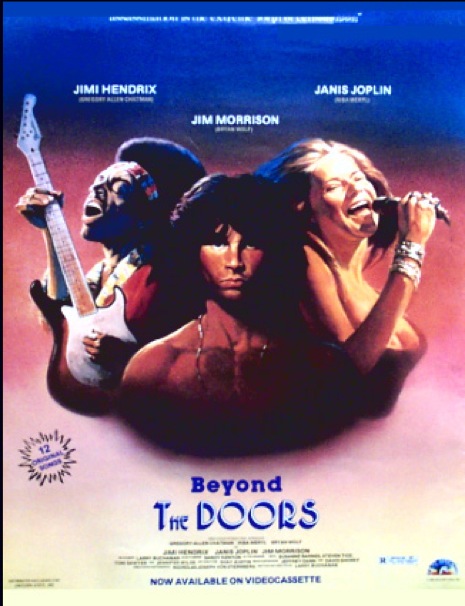
First released in either 1983 or 1984 (sources vary), Beyond the Doors tells the story of a FBI agent who, as the film begins, is out hunting with two friends who proceed to gun him down. Staring down at the agent’s dead body, one of the assassins sneers, “Rock and Roll is dead. Long live Rock and Roll.” The agent’s son then goes through his father’s files and discovers that, during the late 1960s and early 70s, his father was responsible for murdering “the three pied pipers of rock and roll” — Jimi Hendrix, Janis Joplin, and Jim Morrison. The film then enters into flashback mode and we discover both why the U.S. government was determined to kill Hendrix, Joplin, and Morrison and how exactly they attempted to do it.
What can I say about Beyond the Doors? If The Trial of Lee Harvey Oswald seemed oddly respectable for a Larry Buchanan film, Beyond the Doors reminds us of why Larry Buchanan remains a cult figure for bad film lovers. Everything that Buchanan is known for is present in this film: unknown actors playing real-life characters, melodramatic dialogue, one set continually redecorated to look like a dozen different rooms, and plenty of conspiracy theories. As is typical of a Larry Buchanan film, it was shot with a lot of ambition but next to no money or actual talent. Hendrix, Morrison, and Joplin are played by lookalikes who give performances that don’t so much resemble their real-life counterparts as much as they seem to literally be Wikipedia entries brought to life. Hendrix worries that he’s sold out to the man, Joplin questions what fame’s all about, and Morrison makes pretentious observations. Buchanan couldn’t actually afford the rights to any songs from Joplin, Hendrix, or the Doors so instead, the soundtrack is full of music that’s designed to sound as if it could have been written by one of the “three pied pipers of rock and roll” even though it wasn’t. (And yes, the end result is just as silly as it sounds.) In short, Beyond the Doors is one of those films (much like Tommy Wiseau’s The Room) that is so amazingly bad and misguided that it becomes perversely fascinating.
In short, it’s a film that, like me, you simply have to see for yourself.