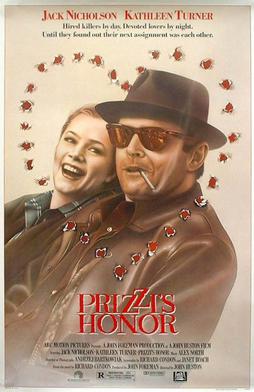
Lisa Reviews An Oscar Nominee: Prizzi’s Honor (dir by John Huston)


First released in 1985, Prizzi’s Honor tells the story of Charley Partanna (Jack Nicholson), a blue collar guy who lives in Brooklyn and who is a hard-working hit man for the Prizzi crime family.  Charley is the son of Angelo (John Randolph), who is the right-hand man to the family’s elderly but still ruthless Don (William Hickey).  In the past, Charley came close to marrying the Don’s daughter, Maerose Prizzi (Anjelica Huston), and he is almost as much a member of the family as the Don’s two sons, Eduardo (Robert Loggia) and Dominic (Lee Richardson).

While attending a family wedding, Charley meets and is immediately infatuated with a woman named Irene Walker (Kathleen Turner).  Later, when Charley is sent to California to kill a man who robbed one of the family’s Vegas casinos, he is shocked to discover that the man is Irene’s husband.  Irene swears that she didn’t have anything to do with the casino theft and, after a whirlwind courtship, Charley and Irene get married in Mexico.  What Charley doesn’t know (but eventually discovers) is that Irene is herself a professional killer.  While Charley and Irene try to balance work and love, Maerose conspires to turn the family against Irene and win Charley back.

Directed by the legendary John Huston, Prizzi’s Honor is pitch black comedy about two hard-working people who kill for a living.  (The film’s big set piece is an extended sequence in which Charley and Irene’s attempt to pull a job together goes wrong in every way and they end up arguing about their relationship while dragging dead bodies from one room to another.)  Though Prizzi’s Honor was released long before the series premiered on HBO, the film feels almost like a companion piece to The Sopranos, full of mobsters who are not as clever as they think they are and who struggle to uphold the old ways in an increasingly complicated world.  Particularly when compared to the gangster who populate a film like The Godfather, the Prizzis are defined by their pettiness.  If Don Corleone epitomized wisdom and honor, Don Prizzi epitomizes someone who holds onto power solely for power’s sake.

Prizzi’s Honor is one of those films that probably seemed a bit more revolutionary when it was first released than it does today.  At this point, we’ve seen so many films about hired killers who have quirky conversations while carrying out their work that the mix of violence and dark humor can feel almost like a cliché.  As well, there are certain parts of the film, like the opening wedding sequence, that feel as if they go on for just a few minutes too long, as if John Huston himself was not always comfortable with the balance between the dark drama and the comedy of mob manners.  That said, Jack Nicholson, Kathleen Turner (who gives a performance worthy of the great femme fatales of film noir), Anjelica Huston, John Randolph, and especially William Hickey all give strong enough performances to hold the audience’s attention and the film’s finale cuts to the point in such a way that it leaves you reconsidering everything that you’ve previously seen.  Prizzi’s Honor has its flaws but Nicholson and Turner have such chemistry that the film’s ending sticks with you.

Prizzi’s Honor was nominated for 8 Oscars, including Best Picture, Best Director, Best Actor, and Best Supporting Actor for William Hickey.  (Oddly, Kathleen Turner was not nominated for playing Irene.)  In the end, it only won one Oscar that year, for supporting actress Anjelica Huston.  The Oscars that year were dominated by a far more convention love story, Out of Africa.
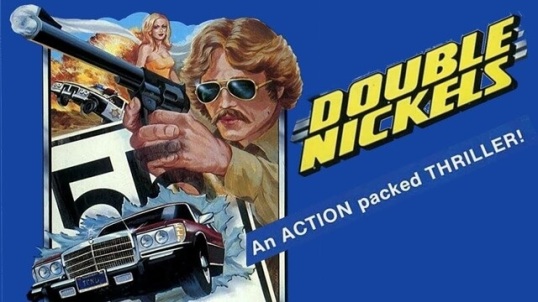
The TSL Grindhouse: Double Nickels (dir by Jack Vacek)


First released in 1977, Double Nickels tells the story of two California highway patrolman.  Smokey (Jack Vacek) and Ed (Ed Abrams) have been tasked with enforcing the speed limit but they’re usually too busy chasing each other up and down the highway to worry about doing their job and, in fact, they even have a friendly relationship with the local street racers.

Now, you may think Smokey and Ed are just wasting the tax payer’s money by taking such a casual attitude towards their work and technically, you’re right.  But let’s be honest.  Nobody likes the speed limit.  There’s a reason why it’s usually the rural speed limit signs that end up getting used for target practice.  Smokey and Ed are a part of the system for the paycheck but, deep down, they hate the system just as much as the rest of us do.  They’re fighting the Man by taking his money and refusing to enforce his rules.

Anyway, one day, Smokey and Ed pull over George (George Cole).  George explains that he’s got a pretty good thing going as a repo man.  He and his associates drive up and down the California highways, repossessing cars for non-payment.  George says that he could always use some help and Smokey and Ed decided to take him up on the offer.  The only problem is that, as employees of the Highway Patrol, they’re not allowed to moonlight.  So, when they repossess a car, they have to do it without getting caught by either the local police or the car’s former owners.

Double Nickels establishes its pattern early on.  Smokey and Ed stake out a house and see the car that they’re repossessing.  They repossess the car.  They end up getting chased around by either the cops or the car’s owner or both.  Smokey and Ed trade a few lame quips and then flirt with their waitress girlfriends.  Eventually, George realizes that the people who have hired him are actually car thieves and Smokey and Ed have to break up the car theft ring but, regardless of any individual complications, the pattern pretty much remains the same throughout the film, with mild comedic moments followed by an elaborate car chase.

As long as the film focuses on the cars, it’s fine.  The cars are the true star of the film.  Jack Vacek and several other members of the cast and crew were previously involved with the production of the original Gone In 60 SecondsDouble Nickels never comes anywhere close to being as entertaining as Gone In 60 Seconds but the car chases are still exciting enough to hold the viewer’s attention.  Where Double Nickels struggles is whenever the focus shifts to the guys driving the car, as neither Jack Vacek nor Ed Arbams were particularly charismatic actors and neither really had the comedic timing necessary to pull off the film’s humor.

Despite its flaws, Double Nickels does have something of a following.  Its popularity actually makes sense.  Because the film’s plot is so simple, you can literally start watching the film at any point and automatically know exactly what’s going on.  The makers of Double Nickels understood that, above all else, audiences love to watch fast cars do their thing.

Retro Television Reviews: The Bait (dir by Leonard J. Horn)


Welcome to Retro Television Reviews, a feature where we review some of our favorite and least favorite shows of the past!  On Sundays, I will be reviewing the made-for-television movies that used to be a primetime mainstay.  Today’s film is 1973’s The Bait!  It  can be viewed on YouTube!

Tracey Fleming (Donna Mills) is the widow of a cop and an undercover detective herself.  Unfortunately, her superior, Captain Maryk (Michael Constantine), is not convinced that Tracey has what it takes to be in a dangerous situation and, as a result, Tracey spends most of her time riding the bus and busting perverts and low-level drug dealers.  When four woman are raped and murdered by the same serial killer, Tracey writes up a report on what she thinks is motivating the killer.  Captain Maryk is, at first, skeptical about Tracey’s claim that the killer is fueled by a puritanical rage but, when it turns out that the killer has been wiping off his victims’s lipstick (just as Tracey speculated that he was), Maryk starts to think that Tracey might have something to offer the investigation.

Tracey becomes the bait in an operation to lure out the killer.  Leaving behind her son and her mother, Tracey moves into an apartment in the neighborhood that is believed to be the center of the killer’s activities.  Tracey is given a job as a survey taker and soon, she’s walking around the neighborhood and asking random men for their opinions on current events and women’s liberation.  A local waitress (Arlene Golonka) recognizes Tracey as a detective but Tracey lies and say that she’s no longer with the force.  When the killer makes the waitress his next victim, Tracey becomes even more determined to capture him but will she able to get Marsyk and the rest of the force to give her the room to investigate the murders?

This may sound like an intriguing whodunit but, for some reason, The Bait reveals early on that the murderer is a bus driver named Earl Stokely (played, in a very early performance, by William Devane).  There’s really nothing to be gained by revealing the killer’s identity as early as the film does.  Perhaps if the film was split between scenes of Tracey investigating the neighborhood and Earl stalking Tracey, that would have generated some sort of suspense but, with the exception of one bus ride, Tracey and Earl barely even interact before he comes after her at the film’s end.  Devane does give a good performance as a homicidal lunatic but, when viewed today, it’s impossible to watch him in this film without spending most of the time thinking, “Hey, that’s the usually Kennedyesque William Devane, playing a killer bus driver!”

I was not surprised to learn that The Bait was intended to be a pilot for a weekly television series that would have followed the future investigations of Tracey Fleming.  Donna Mills was likable in the lead role and she had a good chemistry with the other actors playing her colleagues so it’s easy to imagine a series in which Tracey solved a new case every week while Marsyk continually underestimated her.  Ultimately, though, that series never happened and The Bait would be the sole televised adventure of Detective Tracey Fleming.

A Blast From The Past: Ace Hits The Big Time (dir by Robert C. Thompson)


Made in 1985 for CBS, Ace Hits The Big Time is a seriously strange little film.

It tells the story of Horace Hobart (Rob Stone, a likable actor), a 16 year-old kid from New Jersey who has just transferred to a new high school in New York.  He’s paranoid about going to his new school because it’s supposedly populated by gang members.  The school is so notorious for gang activity that the members of the gang even make an appearance on the front page of the paper of record, The New York Freaking Times!  Looking at the newspaper makes Horace Hobart so paranoid that he has musical fantasies in which the members of a gang known as the Purple Falcons surround him, start singing, and then beat him up while doing an interpretive dance.

Horace does eventually find the courage to go to his new high school but he insists on calling himself “Ace,” he wears a jacket with a fearsome dragon embroidered on the back of it, and he wears an eye patch because he’s got …. ewwww …. pink eye.  (Remember when Bob Costas got pink eye at the Olympics and traumatized thousands of viewers by insisting on going on the air every night and talking about snowboarding while struggling to keep his eye from popping out of its socket?  Those were crazy times!)  Ace looks so tough that the real Purple Falcons mistake him for being an associate of a notorious New Jersey gang (no, not the Sopranos) and they recruit him to be a member of their gang.  Ace is so convincing as a tough guy that a film crew decides to use him and his friends as extras in a movie!  (Interestingly, the director is really involved in picking and working with the extras.  There’ll be no second unit crap for Ace and the Purple Falcons!)  Unfortunately, another gang insists on trying to make the Purple Falcons look bad.  Fortunately, Ace is able to defuse the tension by baking a cake.  What?

This is like the dorkiest version of West Side Story ever made and I can’t really figure out what the message is supposed to be.  On the one hand, Ace is totally paranoid about any sort of gang violence and goes out of his way to try to prevent a gang war.  On the other hand, even before Ace shows up and starts quoting John Lennon, neither one of the show’s gangs are particularly violent or even intimidating.  The Purple Falcons are pretty much impossible to take seriously because they’re called “the Purple Falcons.”  (They all wear purple, as well.  I guess some other gang had already claimed all the cool falcon colors.)  They really don’t do any sort of “gang” stuff.  Instead, they eat a lot of pizza and appear in a movie.  That sounds like a pretty good deal, actually.  With its mix of dorky humor, random dance numbers, and “tough” gang talk, this is one of those old time capsules that simply has to be seen to be believed.

And here it is!

Retro Television Review: The Astronaut (dir by Robert Michael Lewis)


Welcome to Retro Television Reviews, a feature where we review some of our favorite and least favorite shows of the past!  On Sundays, I will be reviewing the made-for-television movies that used to be a primetime mainstay.  Today’s film is 1972’s The Astronaut!  It  can be viewed on YouTube!

NASA has successfully landed a man on Mars!  The entire world watches as Col. Brice Randolph (Monte Markham) makes his way across the Martian surface.  However, suddenly, the signal goes out.  Viewers are assured that this is the sort of thing that happens all the time with interstellar travel.  What they don’t know is that the signal went down because Brice suddenly died.  While the surviving members of the mission return to Earth, NASA tries to figure out how to keep anyone from finding out what happened to Brice.  NASA director Kurt Anderson (Jackie Cooper) knows that the President wants to cut the budget and the death of an astronaut would probably provide the perfect excuse for taking money away from NASA and canceling the Mars program.

Anderson’s solution is to recruit a substitute.  Eddie Reese (Monte Markham) has a slight resemblance to Brice, one that can be perfected through plastic surgery.  While the mission returns from Mars, Eddie goes through a crash course to teach him how to talk, walk, and think like Col. Brice Randolph.  Eddie is told that he’ll have to be Brice until the NASA scientists can figure out what led to Brice’s death.  Once they do know what went wrong with the mission, Eddie will have to go into NASA’s version of the witness protection.

Eddie proves to be a quick learner and it helps that he, like so many others, looked up to Brice.  However, while Eddie can fool almost everyone else, he cannot fool Brice’s wife, Gail (Susan Clark).  When Eddie actually treats Gail with kindness and shows sympathy for her nervous condition, she realizes that there’s no way that Eddie is actually her husband.  Apparently, Brice was not quite the saintly figure that the public believed him to be.  Eddie and Gail soon fall in love for real but when NASA finally discovers what led to Brice’s death, it looks like their new life together might be over as abruptly as it begun.

The Astronaut is a low-key conspiracy …. well, I hesitate to call it a thriller.  There’s little of the things that one typically associated with a conspiracy thriller.  There’s no black helicopters.  There’s no shadowy assassins.  There’s no army of men walking around in black suits.  Instead, there’s just a bunch of nervous bureaucrats who are desperate to keep the rest of the world from discovering just how much they screwed up.  As played by Jackie Cooper, the head of NASA isn’t so much evil as he’s just way too devoted-to-his-job for his own good.  In many ways, this is probably one of the most realistic conspiracies ever portrayed on film.

In the end, The Astronaut is a portrait of two lonely people who find love in the strangest of circumstances.  Susan Clark and Monte Markham make for a likable couple and the viewer really does hope that things will work out for them.  What this film lack in conspiracy thrills, it makes up for in human drama.  It appealed to both my romantic and my rabid anti-government sides.  What more could one ask?

Guilty Pleasure No. 62: Backtrack (dir by Dennis Hopper)


Sometimes, you see a film that is just so weird and incoherent that you can’t help but love it.

Of course, it also helps if the film has a once-in-a-lifetime cast of actors who you would never expect to see acting opposite each other.

For me, that’s certainly the case with 1990’s Backtrack.  Directed by Dennis Hopper, Backtrack is a film about an artist (Jodie Foster, channeling Jenny Holzer) who witnesses a mob murder committed by Joe Pesci, Dean Stockwell, Tony Sirico, and John Turturro.  An FBI agent played by Fred Ward suggests that the artist should go into the witness protection program but she doesn’t want to give up her life as a New York sophisticate who creates challenging LED displays and who can eat Sno Balls whenever she gets the craving for one.  (Yes, this is a plot point.)  Turturro and Sirico break into the artist’s apartment and kill her boyfriend, who is played by a wide-eyed Charlie Sheen.  The artist puts on a blonde wig and goes on the run, eventually getting a job in advertising.

Realizing that his men can’t get the job done, mob boss Vincent Price decides to hire a legendary hitman played by Dennis Hopper (who also directed this film) to track down the artist.  However, the hitman becomes fascinating with the artist’s work, finds pictures of her posing in black lingerie, and immediately falls in love with her.  Not only does he wants to save her life but he wants her to wear the same lingerie exclusively for him.  (Yes, this is a pretty big plot point.)  At first, the artist refuses and views the hitman as being some sort of pathetic perv.  But then she discovers that he’s covered her bed with Sno Balls….

Meanwhile, a young Catherine Keener shows up as the girlfriend of a trucker who briefly considers giving the artist a ride to Canada.

And then Bob Dylan shows up, handling a chainsaw.

And there’s Helena Kallianiotes, the outspoken hitch-hiker from Five Easy Pieces, yelling at Joe Pesci!

And there’s Dennis Hopper’s The Last Movie co-star, Julie Adams!  And there’s Toni Basil!  And there’s director Alex Cox!

Dennis Hopper not only starred in Backtrack but he also directed and it’s obvious that he placed a call into just about everyone he knew.  In fact, one could argue that the only thing more shocking than Vincent Price showing up as a mob boss is that Peter Fonda, Karen Black, Elliott Gould, Robert Walker Jr., and Kris Kristofferson are nowhere to be found in the film.  Hopper’s first cut of Backtrack was reportedly 3 hours long but the studio cut it down to 90 minutes, renamed it Catchfire, and Hopper insisted on being credited as Alan Smithee.  Later, Hopper released a two-hour version with the Backtrack title and his directorial credit restored.

Regardless of which version you see, Backtrack is an odd film.  It’s hardly the first film to be made about a hit man falling for his target.  What distinguishes this film is just how bizarre a performance Dennis Hopper gives in the role of the hitman.  It’s as if Hopper gave into every method instinct that he had and the end result was a mix of Blue Velvet‘s Frank Booth and the crazed photojournalist from Apocalypse Now.  Jodie Foster’s cool intelligence makes her the ideal choice for a conceptual artist but it also makes it hard to believe that she would fall for a jittery hitman and, in her romantic scenes with Hopper, Foster often seems to be struggling to resist the temptation to roll her eyes.  Somehow, their total lack of romantic chemistry becomes rather fascinating to work.  They are two talented performers but each appears to be acting in a different movie.  What’s interesting is that I think a movie just about Hopper’s spacey hitman would be interesting (and, if you’ve ever seen The American Friend, it’s hard not to feel that such a movie already exists) but I think a movie about just about Foster’s artist and her life in New York would be just as fascinating.  Taken as individuals, the artist and the hitman are both compelling characters.  Taken as a couple, they don’t belong anywhere near each other.

But let’s be honest.  This is a film that most people will watch for the parade of character actors delivering quirky dialogue.  Even if one takes Hopper and Foster out of this mix, this is an amazingly talented cast.  One need only consider that John Turturro did Do The Right Thing before appearing in this film while Joe Pesci and Tony Sirico did Goodfellas immediately afterwards.  This film features a once-in-a-lifetime cast, made up of actors who were apparently told to do whatever they felt like doing.  Turturro plays up the comedy.  Sirico plays his role with cool menace.  Stockwell barely speaks above a whisper.  Fred Ward plays the one sane man in a world of lunatics. Vincent Price delivers his line as if he’s appearing in one of Roger Corman’s Poe films and somehow, it makes sense that, in the world of Backfire, an Italian gangster would have a snarky, mid-Atlantic accent.

It’s an odd little film, an example of 80s filmmaking with a 70s sensibility.  While it’s not touched with the lunatic genius that distinguished Hopper’s The Last Movie, Backtrack is still something that should be experienced at least once.

Previous Guilty Pleasures

  1. Half-Baked
  2. Save The Last Dance
  3. Every Rose Has Its Thorns
  4. The Jeremy Kyle Show
  5. Invasion USA
  6. The Golden Child
  7. Final Destination 2
  8. Paparazzi
  9. The Principal
  10. The Substitute
  11. Terror In The Family
  12. Pandorum
  13. Lambada
  14. Fear
  15. Cocktail
  16. Keep Off The Grass
  17. Girls, Girls, Girls
  18. Class
  19. Tart
  20. King Kong vs. Godzilla
  21. Hawk the Slayer
  22. Battle Beyond the Stars
  23. Meridian
  24. Walk of Shame
  25. From Justin To Kelly
  26. Project Greenlight
  27. Sex Decoy: Love Stings
  28. Swimfan
  29. On the Line
  30. Wolfen
  31. Hail Caesar!
  32. It’s So Cold In The D
  33. In the Mix
  34. Healed By Grace
  35. Valley of the Dolls
  36. The Legend of Billie Jean
  37. Death Wish
  38. Shipping Wars
  39. Ghost Whisperer
  40. Parking Wars
  41. The Dead Are After Me
  42. Harper’s Island
  43. The Resurrection of Gavin Stone
  44. Paranormal State
  45. Utopia
  46. Bar Rescue
  47. The Powers of Matthew Star
  48. Spiker
  49. Heavenly Bodies
  50. Maid in Manhattan
  51. Rage and Honor
  52. Saved By The Bell 3. 21 “No Hope With Dope”
  53. Happy Gilmore
  54. Solarbabies
  55. The Dawn of Correction
  56. Once You Understand
  57. The Voyeurs 
  58. Robot Jox
  59. Teen Wolf
  60. The Running Man
  61. Double Dragon

Film Review: The Old Way (dir by Brett Donowho)


“Oh my God!  A Nicolas Cage western!?  This is going to be great!”

That was my initial reaction when I heard about The Old Way, a film in which Nicolas Cage plays a former gunslinger who returns to his old ways while seeking revenge for the murder of his wife.  Who knew which Nicolas Cage would show up for The Old Way?  Would we get the wild, unpredictable Cage?  Would we get the soulful and haunted Cage?  Would this be one of the films that Cage cared about or would this be one of the films that Cage clearly just made for the money?  Hearing that Nicolas Cage walked off the set because of an accident with one of the guns did not fill me with confidence.  (The armorer who worked on The Old Way was the same one who went on to work on Rust and again, that did not exactly fill me with confidence.)  Still, I was definitely curious to see The Old Way for myself.

Unfortunately, The Old Way is neither Cage at his best nor Cage at his most eccentric.  Instead, Cage gives a quiet and emotionally restrained performance as Colton Briggs.  When Briggs is first seen, he’s taking part in an extrajudicial execution and then coldly killing a man who first shoots him in the back.  Jump forward 20 years and, much like Clint Eastwood in Unforgiven, Colton Briggs is now a married man and a somewhat uptight shop owner who rarely shows a hint of emotion.  His 10 year-old daughter (Ryan Kiera Armstrong) is as rebellious as Colton once was and she has no idea about Colton’s past.  However, when the nephew of the man that Colton killed at the start of the film, murders Colton’s wife, Colton sets out for revenge.  His daughter follows him, along with Marshal Jarret (Nick Searcy, giving the film’s best performance).  Jarret is a former friend of Colton’s but both men make it clear that they will kill the other if they have to.  That’s the old way.

It’s a typical western and, on a purely technical level, it’s not a bad one.  The cinematography is frequently gorgeous and the members of the rival gang are made up of memorable character actors like Clint Howard and Abraham Benrubi.  Obviously, a certain amount of care went into recreating the old west.  As I said before, Nick Searcy is ideally cast as Marshal Jarret and he gives a performance that will keep you guessing as to whether or not Jarret should be trusted.  Nicolas Cage is adequate in the lead role, even if he’s never quite as eccentric as most of his fans would probably prefer him to be.  When he first shows up, he’s wearing an obviously fake mustache but that’s about as odd as his performance gets.

But, in the end, The Old Way just isn’t a particularly memorable film.  It’s one of those films that you watch with the hope that it will suddenly spring an unexpected detail or a bizarre moment on the audience but it never happens.  The Old Way is way too formulaic for its own good, borrowing liberally from True Grit and Unforgiven without ever really establishing its own identity.

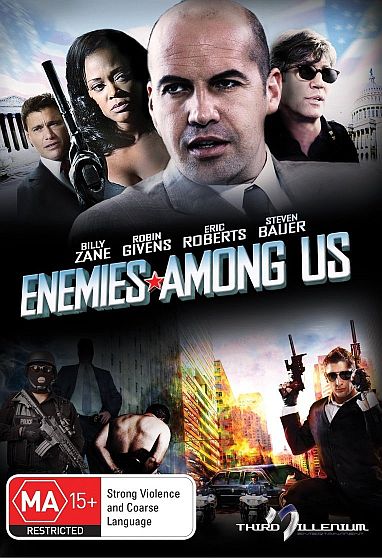
The Eric Roberts Collection: Enemies Among Us (dir by Dan Garcia)


Normally, I’d never celebrate the idea of the hero of a movie being wrongly sent to prison in a state that is rather aggressive in its use of the death penalty but Devin Taylor (Griffin Hood), the hero of 2010’s Enemies Among Us, was so annoying that I found myself hoping he would never get out of jail.

Enemies Among Us is a low-budget film about many different things.  Sen. Fred Edmonds (Steven Bauer) of North Carolina is about to accept his party’s presidential nomination and most of the polls show him far in the lead.  Senator Edmonds is planning on naming Louisiana Governor Chip Majors (James DuMont) as his running mate because this film takes place in a world where presidential nominees don’t try to balance their ticket by picking someone from a different region or from a swing state.  When we see Sen. Edmonds, he’s being interrogated by a journalist named Gretna (Tammi Arender), who is upset over campaign finance laws.  We’re meant to dislike Edmonds but Gretna is written and performed as being such a caricature of a shrill left-winger that we actually start to feel bad for Sen. Edmonds.  LEAVE HIM ALONE, GRETNA!

Meanwhile, Gov. Majors has just murdered the prostitute that he was visiting in the same hotel where, in a few hours, he’s supposed to host a major fundraiser.  The prostitute tried to kill the governor first but still, murder is murder.  However, the governor offers to pay off two members of his security details, Devin and Cobbs (Eric Roberts).  Cobbs is enthusiastic about the idea and seems to find them whole thing to be rather amusing.  Devin is conflicted but he goes with the plan …. for a while.

Meanwhile, Cobb’s ex-wife Goloria (Robin Givens) is a CIA interrogator who is torturing a terrorist named Jassim (Armando Leduc) in an effort to lean when the next big terrorist attack is planned.  Jassim taunts her, saying that Americans don’t understand why the rest of the world hates them.  The torture leads Jassim to have a bizarre hallucination, in which he makes out with Gloria and rambles on about the sorry state of humanity.

Meanwhile, Agent Graham (Billy Zane) hangs out in bars and …. well, he really doesn’t do much beyond act like Billy Zane.

Wow, what an annoying movie.  Enemies Among Us is one of those films that wants to tackle all of the important subjects but it approaches politics with all of the nuance and imagination of a college freshman who has just read Howard Zinn for the first time and is now convinced that he has all the answers.  There’s not a subtle moment to be found in Enemies Among Us and the scene where Devin starts yelling about how Americans deserve honesty is so clumsily handled that you’ll find yourself laughing more than nodding along.

That said …. Eric Roberts is in this!  Roberts doesn’t get a lot of screentime and his character is given an unceremonious exit from the film but he’s still the film’s highlight.  Roberts spends the entire film smiling.  Even the discovery that the governor has murdered the prostitute cannot wipe that smile off of Roberts’s face.  It’s a bizarre performance but at least it’s entertaining.  It’s the type of performance that will remind viewers of why they love Eric Roberts, even in films like this.

Previous Eric Roberts Films That We Have Reviewed:

  1. Star 80 (1983)
  2. Blood Red (1989)
  3. The Ambulance (1990)
  4. The Lost Capone (1990)
  5. Love, Cheat, & Steal (1993)
  6. Love Is A Gun (1994)
  7. Sensation (1994)
  8. Dark Angel (1996)
  9. Doctor Who (1996)
  10. Most Wanted (1997)
  11. Mr. Brightside (2004)
  12. Six: The Mark Unleased (2004)
  13. Hey You (2006)
  14. In The Blink of an Eye (2009)
  15. The Expendables (2010) 
  16. Sharktopus (2010)
  17. Deadline (2012)
  18. Miss Atomic Bomb (2012)
  19. Lovelace (2013)
  20. Self-Storage (2013)
  21. This Is Our Time (2013)
  22. Inherent Vice (2014)
  23. Road to the Open (2014)
  24. Rumors of War (2014)
  25. Amityville Death House (2015)
  26. A Fatal Obsession (2015)
  27. Stalked By My Doctor (2015)
  28. Joker’s Poltergeist (2016)
  29. Stalked By My Doctor: The Return (2016)
  30. The Wrong Roommate (2016)
  31. Stalked By My Doctor: Patient’s Revenge (2018)
  32. Monster Island (2019)
  33. Seven Deadly Sins (2019)
  34. Stalked By My Doctor: A Sleepwalker’s Nightmare (2019)
  35. The Wrong Mommy (2019)
  36. Free Lunch Express (2020)
  37. Her Deadly Groom (2020)
  38. Top Gunner (2020)
  39. Just What The Doctor Ordered (2021)
  40. Killer Advice (2021)
  41. The Poltergeist Diaries (2021)
  42. A Town Called Parable (2021)
  43. My Dinner With Eric (2022)

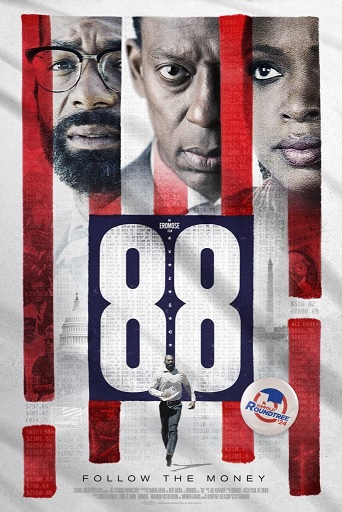
Icarus File No. 10: 88 (dir by Eromose)


Femi Jackson (Brandon Victor Dixon) is a recovering alcoholic with a pregnant wife and a past-due mortgage who totally and completely believes in a presidential candidate named Harold Roundtree (Orlando Jones).  A former baker-turned-politician, Roundtree is running for the 2024 Democratic presidential nomination on a platform of small government and personal responsibility.  That really doesn’t sound like a platform for success in a Democratic primary but whatever.  Let’s just go with it.

Femi has been hired as financial director for a SuperPAC that is raising money for the Roundtree campaign.  Femi notices that many of the donations are being submitted in numbers that add up to 88.  When he takes this news to his friend Ira Goldstein (Thomas Sadoski), Ira reveals that 88 is a code that Neo-Nazis use to identify each other.   Femi and Ira do more digging and they discover that, throughout his entire life, Roundtree has been receiving financial aide from various rich men, all of whom sent Roundtree’s sums of money that all add up to 88.  Femi questions why Neo-Nazis would do something that makes it so easy to identify them.  Ira replies that they’re marking their territory.

While Howard Roundtree records an interview with a left-wing commentator (William Fichtner), Femi tracks down and meets with an elderly and repentant Neo-Nazi (Jonathan Weir), who now needs an oxygen tank to breathe and who lives in an isolated house with his black wife.  Femi is later approached by a volunteer in the SuperPAC’s office, who informs him that the only way that White Supremacy can survive is by latching onto a black politician like Harold Roundtree.  Femi and Ira prepare to meet with Rountree, with Femi still convinced that he has no idea who is secretly funding his campaign.

While this is going on, Femi’s wife (Naturi Naughton) tries to help an ex-con achieve a bank loan despite the opposition of her sister (who also works for the bank) while Femi’s son, Ola (Jeremiah King), gets in trouble at school for showing his classmates a video of a school shooting.  It turns out that Femi’s brother-in-law is not only a cop but he’s also white and he agrees to drive Ola to school so that Ola can see that not all cops are bad.  Ola’s obvious fear as he walks out to the squad car indicates that the experiment, no matter how well-intentioned, is probably not going to work.

88 is certainly an ambitious film and the opening minutes, which features Femi’s wife explaining why Black Panther is not the empowering and progressive film that Femi believes it to be, suggest that the film has the potential to be interesting.  And throughout the film, there are little moments that do work, like the scene where Femi tells his son how to react if he’s ever pulled over by a cop.  Unfortunately, the majority of the film is a clumsily-acted and talky mix of melodrama and heavy-messaging, one that tries to duplicate the style of Spike Lee’s agitprop but instead ends up feeling more like a secular and politically progressive version of the God’s Not Dead films than anything else.  The film drags on for 2 full hours with Brandon Victor Dixon’s nerdy blandness failing to provide the narrative momentum to keep the action interesting.  As well, Orlando Jones is perhaps the least convincing presidential front runner that I’ve ever seen in a film, speaking a cadences that appear to be specifically patterned on Barack Obama but suggesting none of the charisma that would be necessary to captivate a nation.  Again, the film deserves some praise for having the ambition to actually be about something more than just selling toys and comic books but, in the end, it’s earnest dullness and heavy-handed messaging fails to hold one’s attention.

Previous Icarus Files:

  1. Cloud Atlas
  2. Maximum Overdrive
  3. Glass
  4. Captive State
  5. Mother!
  6. The Man Who Killed Don Quixote
  7. Last Days
  8. Plan 9 From Outer Space
  9. The Last Movie

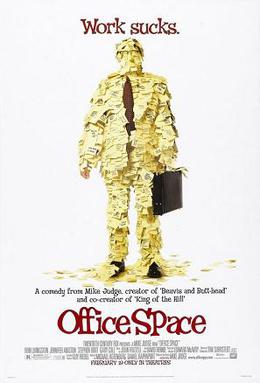
The Unnominated: Office Space (dir by Mike Judge)


Though the Academy of Motion Picture Arts and Sciences claim that the Oscars honor the best of the year, we all know that there are always worthy films and performances that end up getting overlooked.  Sometimes, it’s because the competition too fierce.  Sometimes, it’s because the film itself was too controversial.  Often, it’s just a case of a film’s quality not being fully recognized until years after its initial released.  This series of reviews takes a look at the films and performances that should have been nominated but were, for whatever reason, overlooked.  These are the Unnominated.

The other night, Erin and I started a new Labor Day weekend tradition of watching the 1999 comedy, Office Space.

As we watched Mike Judge’s first live-action film, it occurred to me that Office Space is a film that unites all of my friends.  It doesn’t matter whether they work in an office like Peter (Ron Livingston), Samir (Ajay Naidu), or Michael Bolton (David Herman) or if they work in a restaurant like Joanna (Jennifer Aniston) or even if they’re an independent contractor like Peter’s loud neighbor, Lawrence (Diedrich Bader).  It doesn’t matter if they would rather be fishing like Peter or watching reruns of Kung Fu like Joanna.  Everyone that I know has said that they can relate to Office Space.  Everyone has had to deal with a passive-aggressive jerk of a boss like Bill Lumbergh (Gary Cole).  Everyone has known a crazy co-worker like the red stapler-obsessed Milton (Stephen Root).  Everyone dreads the arrival of consultants like the Bobs (John C. McGinely and Paul Willson).  Everyone resents being told that doing the bare minimum is not enough, whether it’s just sitting in your cubicle or wearing 15 pieces of flair.  Everyone dreams of sleeping late and not stressing about TPS reports.  Everyone dreams of screwing over their company in a way that’s so clever that they’ll never be caught.  (And I think everyone secretly knows that they would screw it up by putting a decimal point in the wrong place.)  Everyone wants to destroy the oldest and least reliable piece of equipment at work.  Everyone wants to feel like they can just announce that they’re going to quit and spend the rest of their life doing what they would do if they had a million dollars.

Considering the fact that the film has now become universally beloved, it’s interesting that Office Space opened to mixed reviews and middling box office.  The studio wasn’t sure how to sell a live action film from the director of Beavis and Butt-Head and King of the Hill and many critics focused on the film’s rather loosely-constructed, episodic narrative and overlooked the fact that the film captured all of the small details that drive people crazy about their work.  Audiences, though, discovered the film on video and undoubtedly enjoyed watching it after a long day of dealing with their own annoying boss.  The film’s star, Ron Livingston, has said that many people have approached him and told him that he inspired them quit their jobs.  “That’s kind of a heavy-load to carry.”

For a film that centers around office workers updating data so that computer systems don’t cash in 2000, Office Space has aged remarkably well.  Ron Livingston, David Herman, and Ajay Naidu are an instantly sympathetic and likable trio of nerdy heroes.  Stephen Root’s panic as he realizes that he will be the only employee not to get a piece of cake remains both poignant and funny.  Gary Cole is still the boss from Hell.  I still laugh at John C. McGinley’s rage when his praise of Peter as a “straight-shooter with upper management potential” is dismissed by Peter’s boss.  We can all relate to Jennifer Aniston’s dislike of flair and her hatred for Brian (Todd Duffey).  The jump to conclusion mat would probably be even more popular today than back in 1999.

Of course, Office Space was not nominated for any Oscars.  That’s not really a shock.  It’s an episodic comedy that was directed by a Texas filmmaker who was, at the time, best-known for a cartoon about two brain-dead teenagers.  Obviously, it wasn’t going to be nominated for anything, even though I think more people have probably watched Office Space over the past few days than have watched American Beauty.  Oscars aren’t everything, though.  Office Space remains both a great work film and a great Texas film.

Previous entries in The Unnominated:

  1. Auto Focus 
  2. Star 80
  3. Monty Python and The Holy Grail
  4. Johnny Got His Gun
  5. Saint Jack