Horror Review: In the Mouth of Madness (dir. by John Carpenter)


“There are things in this world that go beyond human understanding.”

John Carpenter’s reputation as one of the great American horror directors rests on his ability to merge the cinematic with the philosophical—to craft films that stay frightening not because of what they show, but because of what they suggest. Yet by the early 1990s, Carpenter’s once unshakable relationship with audiences had weakened. His influence remained undeniable, but several of his later films seemed to miss the spark that defined Halloween, The Fog, or The Thing. Then arrived In the Mouth of Madness (1995), a work that signaled a late creative resurgence. It paid intelligent homage to two pillars of horror literature—Stephen King and H. P. Lovecraft—while offering a disturbing reflection on authorship, sanity, and the power of belief. The film reasserted Carpenter’s command not only over frightening imagery but also over the psychological territory that underpins enduring horror.

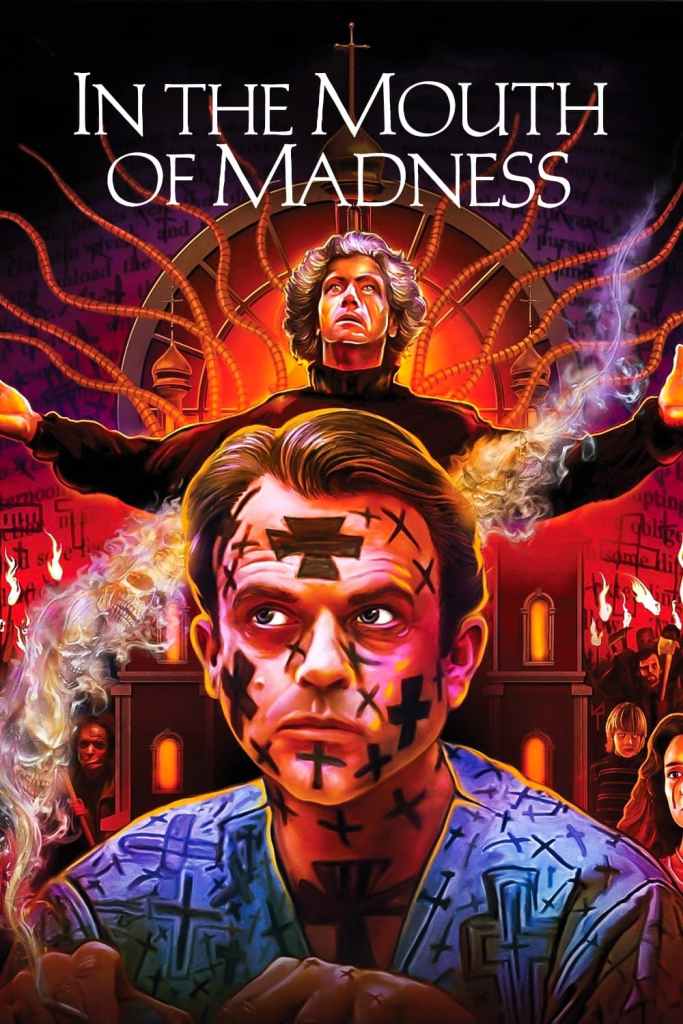
At a narrative level, In the Mouth of Madness follows John Trent (Sam Neill), an insurance investigator known for exposing fraud and deception. His skepticism becomes both his strength and undoing. Trent is hired by publishing executive Jackson Harglow (played by the legendary Charlton Heston) to locate Sutter Cane, a best-selling horror novelist whose disappearance threatens both the company’s finances and the stability of Cane’s obsessed fanbase. Every sign points to something far stranger than a publicity stunt. Cane’s readers are exhibiting troubling behavior, as though the author’s new book has triggered more than just entertainment—it has become contagion.

Carpenter crafts Trent’s descent into uncertainty with meticulous pacing. At first, Neill’s character regards the assignment as routine, dismissing the hysteria surrounding Cane’s novels as marketing excess. But when his investigation hints that the locations and events in Cane’s fiction may correspond to real places and real disturbances, the film begins to twist the rational into the uncanny. The story’s sense of unreality builds with deliberate restraint—incidents grow progressively stranger, but never so overt that Trent can confidently identify what’s madness and what’s truth. Carpenter thrives on this ambiguity, pulling both protagonist and viewer into an atmosphere where logic erodes and fiction itself seems to rewrite reality.

Accompanying Trent on his search is Linda Styles (Julie Carmen), the publisher’s editor assigned to ensure the investigation runs smoothly. While her performance has sometimes been considered subdued, Styles functions as the audience’s second perspective: observant, mildly skeptical, and gradually aware that the world around her no longer behaves according to its former rules. Carpenter positions her as a necessary counterpoint to Trent’s brittle rationalism, highlighting the conflict between recognizing patterns and succumbing to fear. As they move closer to locating Cane, their surroundings take on the familiar haunted quality of an archetypal New England town—Hobb’s End—built from the shared DNA of King’s Castle Rock and Lovecraft’s Arkham. The town becomes more than setting; it is a physical embodiment of literary influence and psychological instability.

The choice of Sam Neill proves essential to the film’s success. His trademark combination of intelligence and emotional vulnerability allows Trent’s transformation from calculating skeptic to disoriented seeker to feel natural rather than theatrical. Few actors could portray a man so evidently rational who nonetheless finds himself seduced by forces his disciplined mind cannot resist. Neill’s body language carries much of the horror; his expressions shift between dry disbelief and quiet terror, suggesting that intellect offers no protection once perception itself begins to betray you. Carpenter exploits this performance with close framing and asymmetric compositions, visually trapping Trent in spaces that subtly curve or distort. The director’s technical command ensures that even ordinary scenes seem charged with quiet wrongness.

While In the Mouth of Madness never references the mythos of Lovecraft by name, its influence saturates the film. Lovecraft’s hallmark—cosmic indifference—exists here not through tentacled gods but through the crumbling borders between fiction and the human mind. The suggestion is that the very act of creating and consuming stories might awaken something ancient and uncontrollable. When Trent confronts the nature of Cane’s work, Carpenter’s direction avoids overstatement. Instead of grand confrontations, he conveys horror through disorientation—the feeling that language, images, and even memory are slipping toward incoherence. Reality itself becomes a character, unstable and untrustworthy.

Jürgen Prochnow’s portrayal of Sutter Cane adds another layer of unease. His calm, confident manner diverges from standard portrayals of deranged genius. Prochnow makes Cane unnerving precisely because he appears so certain of his vision. The author views himself not as a mere storyteller but as a conduit, claiming that what he writes merely reveals a preexisting truth. Through him, Carpenter explores a potent question that haunts all creators: does imagination serve human purpose, or is it an independent force that uses human minds as tools? Cane’s conviction blurs that line, turning the creative process into possession. To audiences familiar with the concept of “mad artists” in literature, his belief offers both fascination and dread.

Carpenter imbues this theme with visual invention. The cinematography and set design combine the mundane with the surreal—painted walls pulse, corridors bend, horizons vanish. Rather than relying on excessive gore or digital spectacle, the director emphasizes textures and shadows, creating optical unease rather than overt shock. The town of Hobb’s End seems perpetually detached from time, its streets looping back on themselves. By employing low, creeping camera movements and deliberate color desaturation, Carpenter evokes a dreamscape decaying from within. The film’s sound design—especially Carpenter’s own pulsating score, co-composed with Jim Lang—heightens that tension with rhythmic basslines reminiscent of a heartbeat slowing to a stop. Every technical choice reinforces the narrative’s central sensation: uncertainty.

Michael De Luca’s screenplay deserves particular credit for its clever structure. The film is framed as a story told from inside an asylum, immediately hinting that the perspective may be unreliable. This framing allows Carpenter to shift between psychological thriller and cosmic horror without losing cohesion. As viewers, we are made complicit in Trent’s investigation but warned not to trust his perceptions. The resulting experience is disorienting yet coherent—a cinematic maze where each turn feels inevitable once taken. The writing never lingers long on exposition, instead suggesting connections through implication and repetition. In this way, De Luca’s script succeeds in translating Lovecraftian dread into visual terms: a fear of knowledge itself.

Very few directors have managed this particular tone as successfully. Lovecraft’s fiction often resists cinematic adaptation precisely because its greatest horror lies in what cannot be shown. In the Mouth of Madness solves this problem by making the act of storytelling itself the subject of terror. By focusing on an author whose imagination reshapes reality, Carpenter transforms literary horror into filmic language. In doing so, he edges close to achieving what decades of other attempts had failed to capture—a true Lovecraftian mood rendered on screen, grounded not in spectacle but in existential dislocation.

Despite its craftsmanship and intelligence, In the Mouth of Madness struggled at the box office upon release. Its ambiguity, self-reflexivity, and intellectual leanings proved challenging for mid-1990s audiences who expected more conventional scares. Yet over time, the film’s reputation has flourished. Today, it is often regarded as the concluding entry in Carpenter’s loosely connected “Apocalypse Trilogy,” following The Thing (1982) and Prince of Darkness (1987). All three films share a fascination with humanity confronting forces it cannot comprehend—scientific, metaphysical, or divine. In each, Carpenter presents apocalypse not as fiery destruction but as revelation: the moment when human understanding collapses under greater cosmic truth. That philosophical core links these works across more than a decade of filmmaking.

Revisiting In the Mouth of Madness now, one is struck by how prophetic it feels. Its concerns about cultural contagion and media-induced madness anticipate contemporary conversations surrounding viral misinformation, fandom extremism, and the blurring between online identity and reality. The “disease” in the film—ideas that rewrite perception—mirrors our present anxiety about the stories and images that shape collective belief. Carpenter’s horror, always grounded in social awareness, here expands into a warning about a world unable to distinguish narrative invention from lived experience.

Even limited in budget, Carpenter demonstrates confident control of visual tone and rhythm. His filmmaking reminds viewers that suggestion often unsettles more deeply than spectacle. Rather than overwhelming audiences with jump scares, he leads them through gradual disintegration, where each logical step seems to justify the next until coherence itself fractures. The film invites reflection rather than relief, leaving viewers haunted by the possibility that the boundaries between art and life are far thinner than comfort allows.

While Carpenter would go on to direct more films after 1995, In the Mouth of Madness stands as one of his last profoundly accomplished achievements. It encapsulates the elements that made his earlier works enduring: tight pacing, minimalist storytelling, and ideas that resonate beneath genre tropes. The film’s legacy continues among filmmakers who explore metafictional or cosmic horror, from Guillermo del Toro’s long-sought adaptation of At the Mountains of Madness (a feat that may never come to fruition outside of concept art and videos) to the psychological labyrinths of contemporary horror auteurs. Though Carpenter’s film never directly adapts Lovecraft, it succeeds where many literal adaptations fail—by preserving the essence of incomprehensible terror rather than translating it into spectacle.

Ultimately, In the Mouth of Madness remains a rare horror film that asks not just what we fear, but why we need fear in the first place. Its central notion—that imagination itself can undo reality—strikes at the heart of storytelling. Carpenter’s mastery lies in letting that idea linger long after the credits roll. What begins as an investigation grows into a philosophical nightmare, compelling viewers to question how much of their world is built from collective belief. In that sense, the film transcends its genre to become one of Carpenter’s most unsettling reflections on human perception. Decades later, its message still resonates: the stories we consume may shape us more profoundly than we realize.

Del Toro and Cameron to Climb “The Mountains of Madness”


It looks like the unnamed horror project Guillermo Del Toro was quite coy about during this past week’s San Diego Comic-Con may turn out to be one of his dream projects finally getting a chance to be up on the big-screen. Mike Fleming over at Deadline has reported that Del Toro’s next directing project since leaving The Hobbit will indeed be his long-gestating project to adapt H.P. Lovecraft’s classic scifi novella, At The Mountains of Madness.

He will not be going alone in this project as best buddy and confidant James Cameron has also joined Del Toro on his dream project as producer. Fresh off of the humngous success of Avatar has made Cameron the King of Hollywood once again and his name and clout should be able to give Del Toro the necessary muscle to get Universal not just to move the project forward but give Del Toro the budget he wants and the hands-off treatment he works best under.

Fleming also reports that the film will be in 3D which makes sense with Cameron being on-board and someone who can give Del Toro all the assistance he needs with the 3D tech Cameron has developed from his work with Avatar. The fact that Cameron will let his name be used in the promoting of the film speaks volumes as Cameron is known to be very choosy as to which projects he lends his name out to that he doesn’t direct.

There will be some moans and groans to the mention of 3D. Del Toro has never dismissed 3D, but didn’t see himself as having a particular project that worked best with it. Like any visually-gifted filmmaker, Del Toro knows how to use the tools of his trade both new and old so I don’t think Cameron’s 3D film-tech will be something he wouldn’t want to try out. Plus, if there was ever a story to be adapted onto the big-screen that would not just work well with Cameron’s 3D tech but also look beautiful it would have to be a Lovecraft tale and especially one with a setting and plot that’s not just epic but cosmic in scale. From the massive vistas of the non-Euclidean structures of the Elder Gods to the Plateau of Leng which may or may not have been the base for Cthulhu and his Star-spawns. Plus, we can’t forget the amorphous beings the “Shoggoths” which definitely would become even more terrifying in 3D.

I really hope that this project moves forward and with the speed with which Del Toro works I won’t be surprised if during San Diego Comic-Con in 2011 we get to see good footage of the film as a sneak-peek for a 2012 release.

Source: Deadline

The Walking Dead Comic-Con Bootlegged Trailer


It may be weeks before AMC puts up a much more high-quality version of this trailer, but until then this is the only one non-Comic-Con goers can watch. The trailer definitely shows enough of what Darabont and his writers are going for to assuage any fear I have that they’re straying too far away from Kirkman’s laid out plans and that they may be staying too loyal to the original source.

I really like how the trailer shows enough scenes from the comic book’s first couple issues that fans have memorized. This series (6 episodes in total) will definitely be the show to watch this coming tv season. That scene with the zombies swarming in, around and over the tank sent chills up my spine.

I also love how loud and well the panel attendees received the trailer. Now time for the series to impress the non-fans. If the series does that then The Walking Dead will join Mad Men and Breaking Bad in creating a trifecta of the best shows on basic cable and probably tv in general.

Sucker Punch Trailer (HD)


While I wasn’t able to attend San Diego Comic-Con 2010 I did try to follow it on-line as much as possible. From what I read through Twitter updates, film blog sites and everything in-between it looks like one of the highlights of the Con was Zack Snyder’s follow-up to Watchmen. His “Alive in Wonderland with machine guns” has been gaining major league hype and buzz since more details were released and shown during it’s panel.

An earlier posting I made showed the beautiful painted character posters for the cast of Sucker Punch. This follow-up post will now show the first trailer for this film which is set for a March 25, 2011 release. From what I could see in the trailer it looks like Snyder hasn’t lost his ability to put on film some gorgeous looking set-pieces. This is a man who definitely has a flair and talent for visuals. The question now (which the trailer didn’t answer in any way) is whether Sucker Punch can match it’s amazing visuals with a worthwhile story.

This film is Snyder’s first project not based on an adapted source. Maybe we’ll see his storytelling skills blossom with Sucker Punch.

Highschool of the Dead: Episode 3 – First Impressions


We’re now up to Episode 3 of Madhouse’s anime adaptation of Sato Shouji’s  and Sato Daisuke’s very popular manga, Highschool of the Dead. The first two episode have been mostly about introducing the main characters of the anime and the basic premise of the series. We now know that the surviving highschool students like Kohta Hirano, Saya Takagi, Saeko Busujima, Rei Miyamoto and Takashi Kimuro are not the only survivors still left alive in the school. Now joined by school nurse Shizuka Marikawa, these band of students and one adult are slowly finding out that it’s not just Tokyo or Japan that the zombie crisis has hit upon.

There’s a great sequence early in this third episode where we see news footage from other countries having a similar outbreak with places like Beijing and Moscow having been hit even harder by the undead plague. We learn that the United States, Europe and the rest of the world are also in chaos. I like how this sudden flood of news reports sink in for the students. For some their reaction is to try and reach their parents, while for some the cold, calculating need to survive kicks in.

One other thing this episode does well that actually improves on the manga source is setting up the rules of how the zombies themselves behave. While in the manga its mentioned that the zombies do hunt by sound. In this episode we see in one harrowing sequence just how true such an assumption was which leads to one exciting action sequence once an inadvertent sound echoes through the school courtyard.

It’s during this particular section of the episode we’re introduced to one character who will become a sort of a “foil” to our main characters. I speak of the douchebag teacher, Shido-san. We see him cruelly leave an injured student to the zombies to help him get away. He also tries to appoint himself leader of the smal group of survivors once they escape the confines of the school in one of the buses. While the zombies themselves still remain the primary danger for the series’ main characters Shido looks to be a “Manson-type” character looking to take advantage of the crisis to put himself above everyone else whether others want him to or not.

For fans of the manga the introduction of Shido-san and the bus means that it may only be an episode or two before the infamous “bus-orgy” scene shows up in the series. One wonders if Madhouse will go through with that particular scene from the manga or will they just skip over it. If they did skip over it there will definitely be many fans who will be seriously disappointed.

To close things off the series finally hits it’s stride with this third episode and it looks like it will just keep on-going full throttle from now on. As an aside for fans of Shaun of the Dead they would get a kick for a brief “cameo” late in the episode.

Highschool of the Dead manga has been licensed


The relatively successful airing of the anime adaptation of the very popular manga title Highschool of the Dead seems to have had a major consequence. The original manga has now been announced as having been licensed from Monthly Dragon Age (title’s original Japanese publisher) by North American manga publisher Yen Press. This is great news for the new fans of the anime (still just 3 episodes in but having impressed with those so far) and for the veteran manga readers who have been relegated to reading fan-translated versions of the series.

Yen Press has licensed some very solid titles from Japan and they’ve actually done a good job at bringing over these titles with as little censoring and changes to the artwork and dialogue as possible unlike some other NA publishers. I hope they do the same for Highschool of the Dead once they start releasing the first couple volumes over here in the US and Canada.

Highschool of the Dead has gore and violence aplenty which should appeal to the teenage and young men demographic the title has been targetting from the onset. The title also happens to be quite ecchi (fan-service) which makes American publishers of licensed manga nervous of late. It’s interesting to note that these very ecchi images wouldn’t be seen as too much of a problem over in Japan but here in NA where there are more puritanical groups lobbying to censor or outright ban these kind of titles then manga such as Highschool of the Dead will always have a harder time of coming over to these shores unedited.

Here’s to hoping that Yen Press does a very  hands-off approach in their handling of this popular title. It would be a shame for the title to finally be licensed but only to get the Tenjho Tenge treatment which would definitely get the title’s fans in an uproar. Hopefully, Yen Press saw what happened when CMX did that with Tenjho Tenge and just leave things well enough alone.

Source: Anime News Network

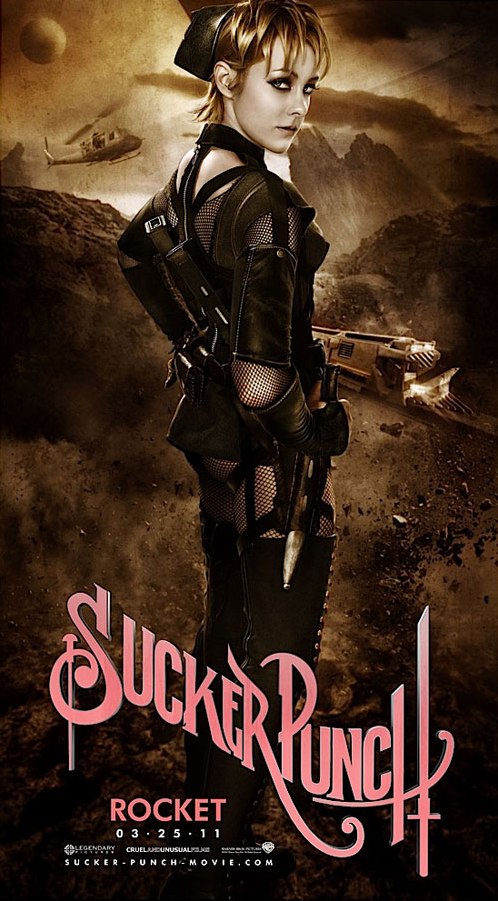
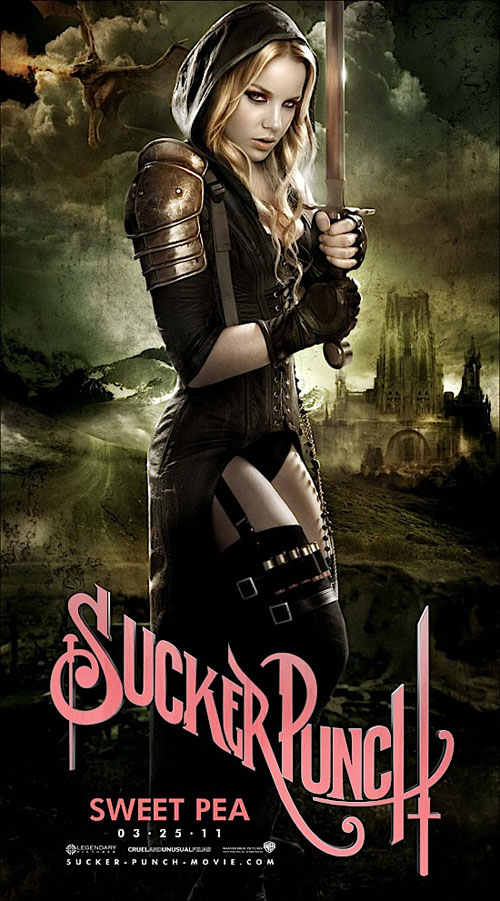
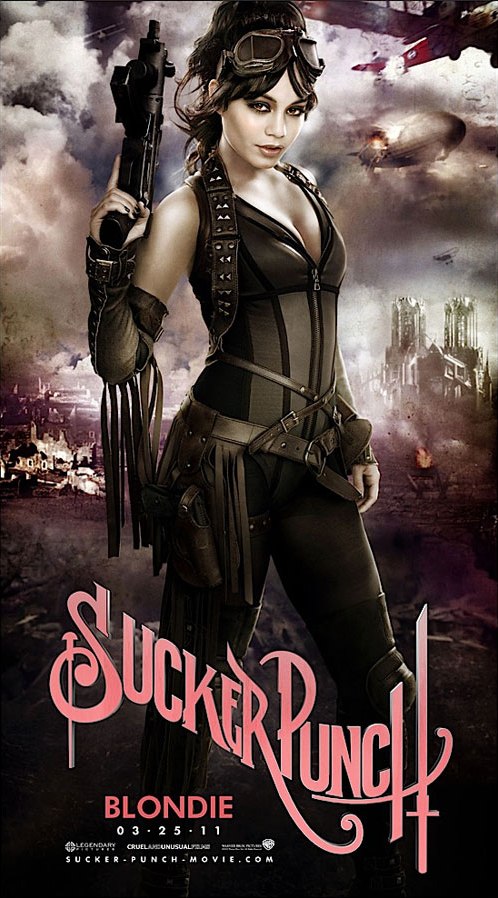
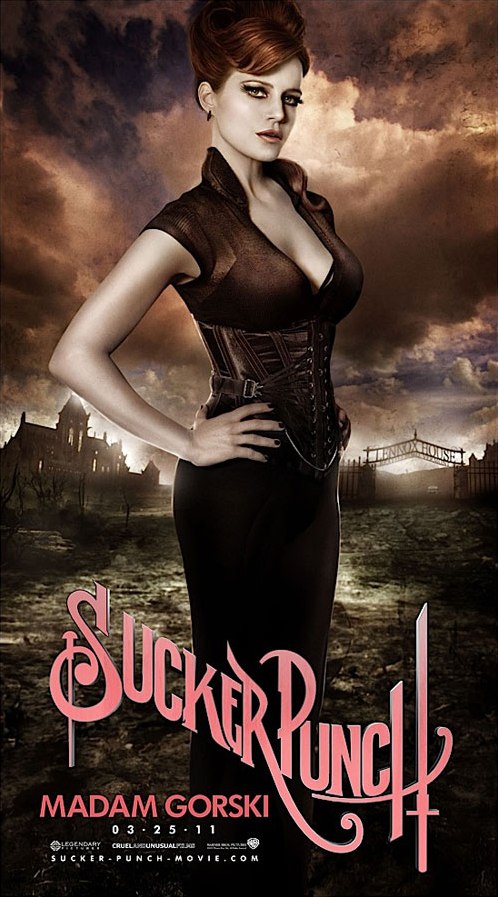
SDCC Exclusive: Zack Snyder’s Sucker Punch Cast Photos


Zack Snyder’s upcoming dark urban fantasy called Sucker Punch seems tailor-made for the Comic-Con crowd. It stars some of Hollywood’s loveliest young women like Emily Browning, Jena Malone, Abbie Cornish, Vanessa Hudgens and Jamie Chung. It also stars fanboy favorite Carla Gugino who in past genre flicks wasn’t averse to baring it all for the sake of her art.

Sucker Punch has been described by Snyder himself as Alice in Wonderland but with machine guns, not to mention B-52 bombers, dragons, brothels. From some of the sneak-peeks into the production this particular Alice-themed flick also has zombie soldiers, a mecha-suit with a pink bunny painted on the armor not to mention some steampunk added into the mix.

Just in time for this year’s Comic-Con, Warner Brothers has released for this event some very great and stunning character posters. I am actually very curious as to which artist painted and created these character posters since they’re truly gorgeous. If I only had room in my room’s walls to frame and put them up.I also like the little details in the posters. I had to stifle a silly grin after I noticed the charms hanging off of Babydoll’s automatic pistol.

Take a gander at the posters below.

Emily Browning as Babydoll

Jena Malone as Rocket

Abbie Cornish as Sweet Pea

Vanessa Hudgens as Blondie

Jamie Chung as Amber

Carla Gugino as Madam Gorksi


Drew Struzan Does Walking Dead plus Cast Photos


Drew Struzan.

That name alone will bring big smiles and goofy grins to film geeks and comic book fanboys the world over. Struzan has been one of the go-to artists when a studio wants a beautifully painted poster for their film. He’s done poster artwork for some of the most iconic films of the last 50 years. He’s done all the poster work for the Indiana Jones and Star Wars franchise. Of late he’s done some great work on film posters for the Harry Potter and Hellboy franchises.

In 2007 he created some wonderful poster art for a scene early in Frank Darabont’s film adaptation of the Stephen King novella, The Mist. Struzan also created a poster for that film. He and Darabont have been close friends so it wasn’t much of a surprise that Struzan would end up creating a film-style poster for Darabont’s tv adaptation of the fan-favorite and critical darling comic book series, Robert Kirkman’s The Walking Dead. The poster below is being premiered and given out by AMC at SDCC (San Diego Comic-Con) 2010 as part of their promotion for the series to premiere this October on AMC. To see the image below in its HQ glory then head on over to AICN which got the exclusive to show it before SDCC.

In addition to the Struzan poster AMC has also released individual photos of each cast member as their characters in the show plus two pictures of zombies who will populate the series. The actors really do a good job of becoming like their characters in these photos. The zombie pictures really show just why Greg Nicotero and his KNB Effects are the preeminent people when it comes to creating zombie make-up effects. These zombies look great and definitely reinforces the point that AMC will not waterdown the comic book for tv. Andrew Lincoln as Rick Grimes for some reason really resembles Viggo Mortensen in his character photo.

Song of the Day: And Then There Was Silence… (by Blind Guardian)


The latest pick for Song of the Day is one that is, quite literally, worshipped by some people I know. For them, this is the greatest song ever committed to record — or, if not the absolute pinnacle, something so close to it that the distinction barely matters. Today’s selection is Blind Guardian’s “And Then There Was Silence,” and if you’ve never heard it, you are about to understand what the word “epic” actually means.

The song runs a staggering fourteen minutes long and comes from this German power metal band’s 2001 album, A Night at the Opera. The lyrical foundation draws from two of the greatest works in the Western literary canon: Homer’s The Iliad and Virgil’s Aeneid. Let that sink in for a moment. A heavy metal song rooted in ancient Greek and Roman epic poetry. Specifically, “And Then There Was Silence” chronicles the final days of Troy — the fall of a city, the collapse of a civilization, and the human cost of a decade-long war — all rendered in the language of power metal. The ambition alone is enough to demand respect.

There is a persistent and deeply unfair misconception about metal as a genre — the idea that it is nothing more than formless noise, guttural bellowing, and musicians who wouldn’t recognize a melody if it knocked them flat. “And Then There Was Silence” will dismantle that notion within its first minute. Blind Guardian frontman Hansi Kürsch doesn’t merely carry a tune; he commands the music with a vocal range and precision that rivals the most accomplished operatic tenors and sopranos working today. His voice soars through passages of genuine beauty, then plunges into something more urgent and desperate, perfectly mirroring the emotional arc of the story being told. This is singing in the most demanding and traditional sense of the word.

This is also the song that finally pulled me headlong into the world of power metal — a subgenre I have affectionately and unapologetically taken to calling “nerd metal.” The label is meant as the highest of compliments. Power metal draws its lyrical DNA from fantasy novels, mythology, folklore, medieval history, science fiction, and the great legends of human civilization. It is music made by and for people who stayed up past midnight reading Tolkien, who know the difference between the Trojan War and the Peloponnesian War, and who see no contradiction between loving heavy guitars and loving great literature. Blind Guardian, in particular, have built an entire career on this premise, and “And Then There Was Silence” represents the form at its absolute peak.

What makes the song especially remarkable is its narrative perspective. Rather than presenting the fall of Troy from a broad, panoramic viewpoint, Blind Guardian tells the story through the eyes of Cassandra — the Trojan princess cursed by Apollo to speak true prophecies that no one would ever believe. She saw every catastrophe coming and was powerless to prevent any of it. It is one of the most haunting figures in all of classical literature, and the choice to center the song on her experience gives the music a quality of grief and inevitability that the straightforward historical account could never achieve.

The structure of the song itself echoes that of an ancient epic poem. It builds, recedes, transforms, and builds again. I have compared its finale to the ending of Peter Jackson’s The Return of the King — the one famously criticized for having too many endings. Just when you feel certain the song has reached its emotional peak and is preparing to close, another movement begins, and rather than feeling excessive, each new section deepens and enriches everything that came before it. The song earns every one of its fourteen minutes.

Here is the honest truth: even people who are entirely indifferent to metal — who would not voluntarily put on a heavy guitar record under any ordinary circumstances — tend to find something in this song that reaches them. Something in the melody, the storytelling, the sheer scale of it connects across the usual genre boundaries. It asks only fourteen minutes of your time and, in exchange, offers something genuinely unlike almost anything else in popular music. That seems like a reasonable trade.

And Then There Was Silence

Turn your head and see the fields of flames

He carries along
From a distant place
He’s on his way
He’ll bring decay
(don’t move along cause things they will go wrong
the end is getting closer day by day)
in shades of grey
We’re doomed to face the night
Light’s out of sight

Since we’ve reached the point of no return
We pray for starlight
We wait for the moon
The sky is empty
Alone in the unknown
We’re getting nowhere

We have been betrayed
By the wind and the rain
The sacred halls empty and cold
The sacrifice made should not be done in vain
Revenge will be taken by Rome

We live a lie
Under the dying moon
Pale faced laughs doom
Indulges in delight

It’s getting out of hand
The final curtain will fall
Hear my voice
There is no choice
There’s no way out
You’ll find out

We don’t regret it
So many man have failed
But now he’s gone
Go out and get it
The madman’s head it shall be thine
We don’t regret it
That someone else dies hidden in disguise
Go out and get it
Orion’s hound shines bright

Don’t you think it’s time to stop the chase
Around the ring
Just stop running, running
Round the ring
Don’t you know that fate has been decided
By the gods
Feel the distance, distance
Out of reach

Welcome to the end…
Watch your step, Cassandra
You may fall
As I’ve stumbled on the field
Sister mine
Death’s a certain thing
Find myself in darkest places
Find myself drifting away
And the otherworld
The otherworld appears

Find myself, she dies in vain
I cannot be freed
I’m falling down
As time runs faster
Moves towards disaster
The ferryman will wait for you
My dear

And then there was silence
Just a voice from the otherworld
Like a leaf in an icy world
Memories will fade

Misty tales and poems lost
All the bliss and beauty will be gone
May my weary soul find release for a while
At the moment of death I will smile
It’s the triumph of shame and disease
In the end
Iliad

Raise my hands and praise the day
Brake the spell, show me the way
In decay
The flame of Troy will shine bright

The newborn child would carry ruin to the hall
The newborn’s death will be a blessing to us all

Good choice?
Bad choice?
Out of three
You’ve choosen misery
Power and wisdom
You deny
Bad choice

War is the only answer
When love will conquer fear
So the judgment’s been made
To the fairest
The graceful says
Badly he fails

Warning
Fear the heat of passion, father king
Don’t let him in
Don’t let her in
Desire, lust, obssession
Death they’ll bring
We can’t get out
Once they are in

She’s like the sunrise
Outshines the moon at night
Precious like starlight
She’ll bring in a murderous price

In darkness grows the seed of man’s defeat
Jealousy
I can clearly see the end now

The thread of life in spun
The coin’s been placed below my tongue
Never give up
Never give in
Be on our side
So we can win
Never give up
Never give in
Be on our side

Old moon’s time is soon to come

Nowhere to run
Nowhere to hide
Nothing to lose
Like one we’ll stand
We’ll face the storm
Created by man

Troy, Troy, Troy, Troy

And as the lion
Slaughters man
I am the wolf
And you’re the lamb

Hallowed Troy shall fall
Round the walls
Faith is shattered, bodies fall

Nowhere to run
Nowhere to hide
Nothing to lose
Like one we’ll stand
It’s all for one and one for all
All we live for will be wiped out

I feel that something’s wrong
Surprise, surprise they’re gone
Full moon your time goes by
And new moon’s still kept out of sight

We live
We die

Misty tales and poems lost
All the bliss and beauty will be gone
May my weary soul find release for a while
At the moment of death I will smile
It’s the triumph of shame and disease
In the end
Iliad

Raise my hands and praise the day
Brake the spell, show me the way
In decay
The flame of Troy will shine bright

Roam in darkness
Spread the vision
We will be lost if you truly believe
Troy in darkness
There’s a cold emptiness in our hearts
That they’ve gone away
And won’t come back

They’ll tear down the wall to bring it in
They’ll truly believe in the lie
With blossoms they’ll welcome the old foe

The vision’s so clear
When day and dream unite
The end is near
You’d better be prepared

The nightmare shall be over now
There’s nothing more to fear
Come join in our singing
And dance with us now
The nightmare shall be over now
There’s nothing more to fear
The war it is over, forevermore

No hope
The blind leads the blind
Carry on
Though future’s denied
Mare or stallion
There’s far more inside
We are in at the kill
We’ll cheerfully die

Misty tales and poems lost
All the bliss and beauty will be gone
May my weary soul find release for a while
At the moment of death I will smile
It’s the triumph of shame and disease
In the end
Iliad

Raise my hands and praise the day
Brake the spell, show me the way
In decay
The flame of Troy will shine bright

Its holy light shines on
So the judgement’s been made
We’re condemned though the trial’s far ahead
The crack of doom
Father
Your handsome son is heading home

Heading home

Still the wind blows
Calm and silent
Carries news from a distant shore

Out of mind
Can’t get it
Can’t get it out of my head

Sorrow and defeat
Sorrow and defeat

Continue reading →

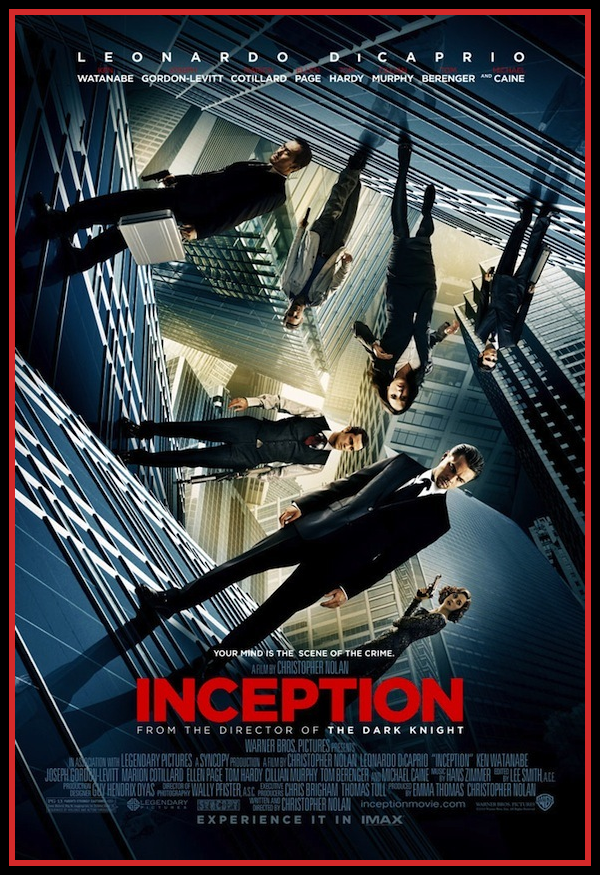
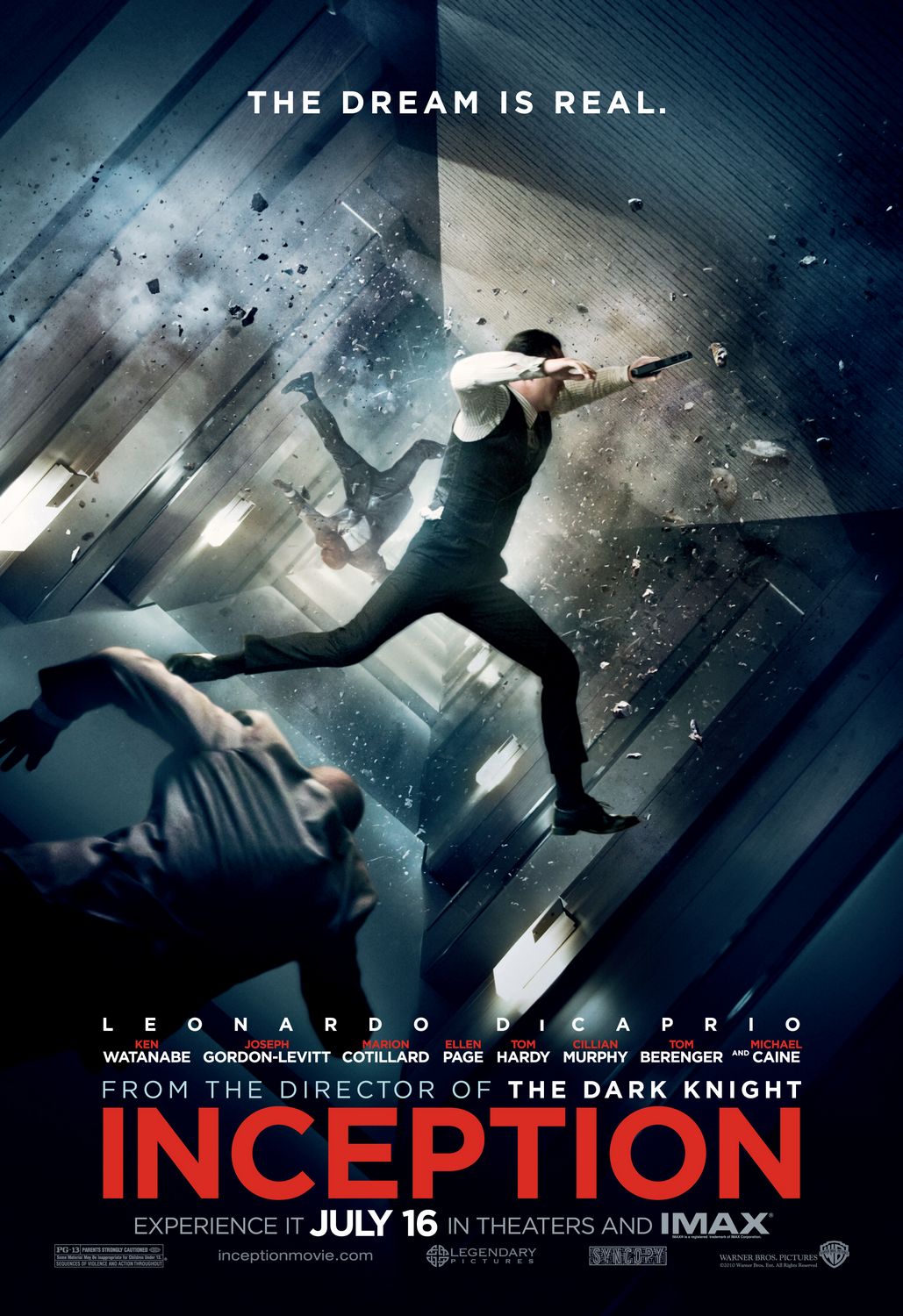
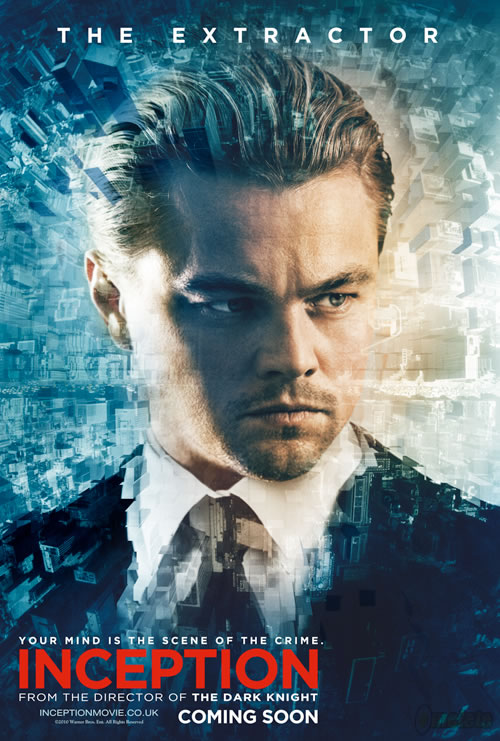
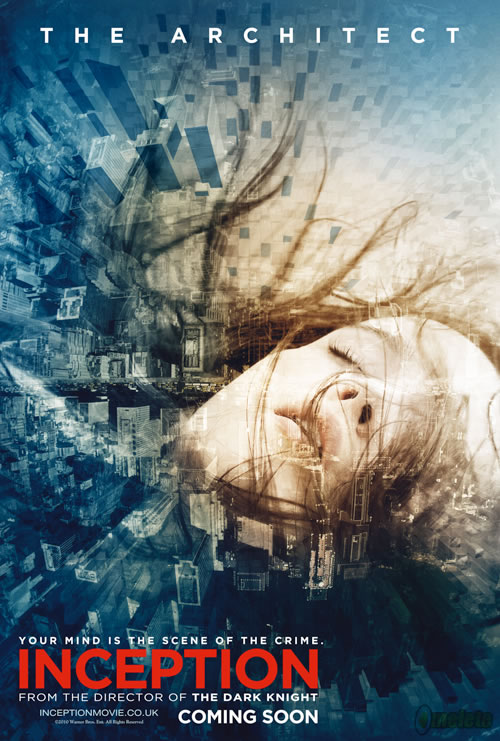
Review: Inception (dir. by Christopher Nolan)


The summer of 2010 has been quite a disappointment. While the films released during this major blockbuster season has been good most have not been able to be that one stand-out which defines a summer season. We’ve had the typical tentpole sequels like Iron Man 2 (good but not great) and Toy Story 3 (also good but not great) to remakes like The Karate Kid to The A-Team. To say that the 2010 summer blockbuster season has been lackluster would be an understatement. Even original films like Splice hasn’t taken in the audience. It now falls to one of the biggest titles for the summer to try and save the season. Whether it will do so financially is still in doubt, but critically the latest from Christopher Nolan may just become the event film of the summer to actually deliver on its hype and the promise of an audience seeing something new, fresh and daring in a sea of mediocrity. Inception comes into the 2010 summer season and delivers on its promises and more than lives up to the hype heaped upon it by critics and fans alike.

A film almost a decade in the making, Christopher Nolan’s epic and sweeping tale of dreams and reality wrapped around a heist film brings the filmmaker one-step closer to becoming the genius filmmaker some of his most ardent followers have dubbed him to be. Nolan as a filmmaker and, more importantly, as a storyteller has always had a fascination with shattered reality and how the subconcious directly affect his protagonists’ sense of the real. We’ve seen this in his film-style of using a disjointed and non-linear structure to his films which goes to creating a sense of confusion in the inattentive viewer. Some have called this style of his as being a gimmick to make a simple story more complex than it really is. I disagree with these individuals and say that Nolan has never done anything to trick an audience with his storytelling style and choices. His films have all the facts laid out before the audience, but in a way that asks the audience to participate in putting the jumbled pieces together. I’ve never seen a red herring used by Nolan in his more personal projects and even in the populist titles he’s done under the rebooted Batman franchise.

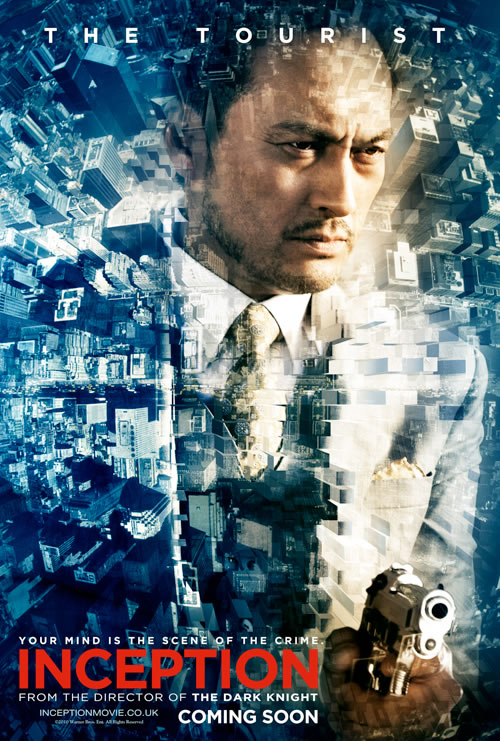
In his latest film, Nolan has refined his non-linear style and used it to successfully create the main setting of the film. Inception is set mostly in the dream world shared by the characters and those they’ve targeted. It is in this shared dream state that the audience learn the rules governing the world of Inception. It is in this dream state that we’re introduced to the first people who would make up an incredible ensemble cast put together by Christopher Nolan and his casting crew. We first meet dream extractor Dom Cobb (played by Leonardo DiCaprio) and his pointman Arthur (Joseph Gordon-Levitt) as they attempt to steal something valuable and important from within the dream of their Japanese-industrialist mark in Saito (Ken Watanabe). We see hints of the rules that will become important for the audience to help them follow the film’s main story as it unfolds. We learn that Saito has already known in advance that he’s in a dream constructed and being shared by Dom and Arthur in their contracted heist by parties unknown. As good as Dom and Arthur are at their job os stealing ideas from a mark through their dreams they have no chance when someone from Dom’s past inserts herself in their plans to sabotage what they’ve worked to accomplish.

It’s in this introductory sequence that we learn of the backstory of Dom and why his latest heist-job didn’t work out too well and has now endangered not just himself but those he has been working with. Saito gives Dom and Arthur a way out of their problems after failing in this job to steal from him by doing a job for him. But unlike previous dream heists Dom and Arthur have done in the past this time Saito doesn’t want something stolen from someone’s mind but to have an idea planted so deep within a mark’s subconscious that the mark believes it to be their very own and not one planted by an outsider. The job doesn’t require Dom to be an extractor of ideas. He’s now to find a way to successfully plant an idea. A job known as “inception” which Arthur and others deem near-impossible to pull off and one quite dangerous not just to the mark but to those involved in the process.

To say anymore about the plot of the film would be to spoil it. Inception works best when as little as possible about the film is known going in. The surprise and awe of the story unfolding is half the fun. It’s like an intricate puzzle or game one tries to solve. It’s ok to know ahead of time how to solve things, but not as fun. While for some people the way Nolan uses non-linear storytelling can be confusing all he asks his audience is to pay attention to the details and clues he’s planting in every scene and piece of dialogue. Let’s be honest this film is not for the inattentive. I won’t say stupid since that implies having low intelligence. It doesn’t take intelligence to pay attention and I’ve known that some of the more intelligent people have a tendency to let their attention wander.

Inception is a film about big ideas and grandiose themes. While the story in of itself when broken down to its simplest common denominator is just a heist film done in a new way, the film allows for layers upon layers of ideas to wrap itself around this simplistic premise. Nolan doesn’t just play with disjointing time for audience. He’s gone and went towards manipulating reality within the subconscious thought to ask the audience a simple question.

Are what we seeing a dream or is it reality?

The film doesn’t trick us using red herrings to make us think one way or another. Everything Nolan has put up on the screen is quite literal and remembering the rules he had set-up in the first hour lays the groundwork for each individual audience to answer that question for themselves. There’s no right or wrong answer to the question, but for some who have seen the film their disappointment seem less to do with the quality of the film, the acting and the direction but more on some of the ambiguous nature of the ending which becomes a dealbreaker for some. Again while I respect their take on this film I find their reasoning for negative criticism to be grounded on thin to non-existent ground. I will get to that ending soon.

While some have called Inception as the anti-Avatar I believe the two filmmaker share similar traits not just in how they create their film, but also in their two latest film. Both Nolan and Cameron are quite known to be very controlling of how their films are made to the point they dabble in every aspect of it. In their latest films they’ve also gone a long way into building a world for their story and characters to inhabit and play around in. While Cameron’s latest was an otherworldly kind in the most literal sense the same could be said for Nolan’s latest but instead inhabits the mind and how anything is possible. From the look of things both film will also share the same sort of near-universal acclaim from the film-going audience with a small, albeit very loud, minority calling Nolan’s film unoriginal, boring and, a word I have loathed for its overuse when something becomes very popular, overrated.

Where the two filmmakers diverge is the way they go about their films. Where Cameron leans heavily in pulling at the emotional strings of the audience through narrative and film sequences in his films, Nolan plies the audiences intellect instead. Cameron for all his technical genius both within the filmmaking sphere and outside of it can be quite the sappy filmmaker and all his films have shown this whether it’s The Terminator or Avatar. For Nolan his films have always felt like an intellectual exercise. An exercise everyone was invited to participate in no matter their level of intellect. He’s been able to marry both his indipendent arthouse sensibilities with the blockbuster the masses seem to crave year in and year out. With Inception he has moved one-step closer to achieving a perfect meshing of the two. This film has all the makings of a great heist and sci-fi thriller wrapped around so many pieces of profound and thoughtprovoking ideas that even after several viewings an audience will find something new to think about. Only one other film I can think of in the last decade or so has accomplished this and that was 1999’s The Matrix by The Wachowski Brothers. While that film was a kick-ass sci-fi action film it also dared to mix in a liberal dose of philosophy both Eastern and Western not to mention subjecting it’s audience to rethink how they see reality.

Christopher Nolan has gone beyond just trying to question the nature of reality. His goal with this film is to deconstruct the nature of the subconscious itself and show how such a thin line separates the dream from the real that at first and, even several glances, one cannot tell the difference. It’s a good thing for the audience watching Inception that Nolan has given them the tools and the rules to follow if they dare. And that’s where I think Nolan will disnguish himself apart from other great directors of his generation and put him up on the level of the true masters in film history. He doesn’t just make films that has worldwide appeal but able to do them while still able to engage his audience to open up their minds to the infinite possibilities his stories offer. While this does make his film a tad cold and distant for some that shouldn’t detract from the high-quality of his work, especially with Inception. The film has heart. It just doesn’t pluck on those particular beats to engage the audience.

I think filmblogger Devin Faraci said it best on his Twitter feed while discussing the film with others. While not exactly verbatim what I got out of it was that he thought it was always easy to engage and/or manipulate the audience through emotional factors, but much harder to engage their intellect. While some have accomplished the former to a great extent and vice versa I think with Inception Nolan has stepped closer than anyone to engage both the heart and the mind of the audience.

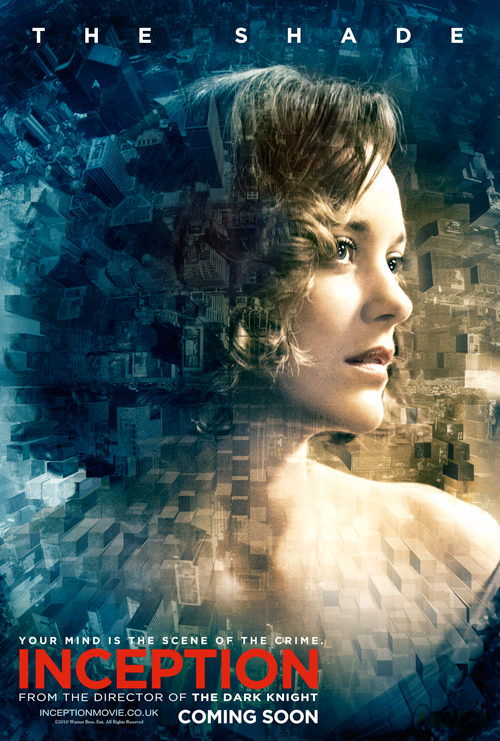
This review cannot be too much of a review if I just spoke about the ideas, themes and the inner workings of Nolan’s mind. The film is actually very good. Good enough to that’s close to being perfect. Pick any aspect of the film and those involved have done some of their best work and grown in their craft. As I stated earlier the film sports one incredible ensemble cast. I’ve already mentioned Leonardo DiCaprio and Joseph Gordon-Levitt who both do very great work in their roles. DiCaprio continues to be the go-to-guy when it comes to playing the tortured individual. Similar to his other role in Scorsese’s Shutter Island, DiCaprio as Cobb was quite believable in his personal-made hell in regards to a past event which involved his wife Mal (played with beautiful elegance and malice by Marion Cotillard). But unlike Scorsese’s film Nolan doesn’t reveal this personal issue through a twist in the plot, but let’s it come out naturally with the help of another cast member providing the impetus for Cobb to come clean. This individual is the team’s new dream architect in the form of Ariadne (Ellen Page in her most mature role to date and one that should go a long way from helping her shed the label of being Juno-esque).

Ariadne becomes the proxy by which the audience learns the in’s and out’s of Cobb’s job as a dream extractor and, very soon, inceptor. Through some inventive use of CGI and practical effects we see throught Ariadne’s eyes how the shared dream-state behaves. How specific rules actually exist within this state no matter how many levels of dreams an individual or group goes down into a mark’s subconscious. Some of these scenes people have seen glimpses of in the trailers and tv spots, but even seeing some of them in advance doesn’t detract from how incredible they look when seen on the bigscreen, especially for those lucky enough to see them on IMAX.

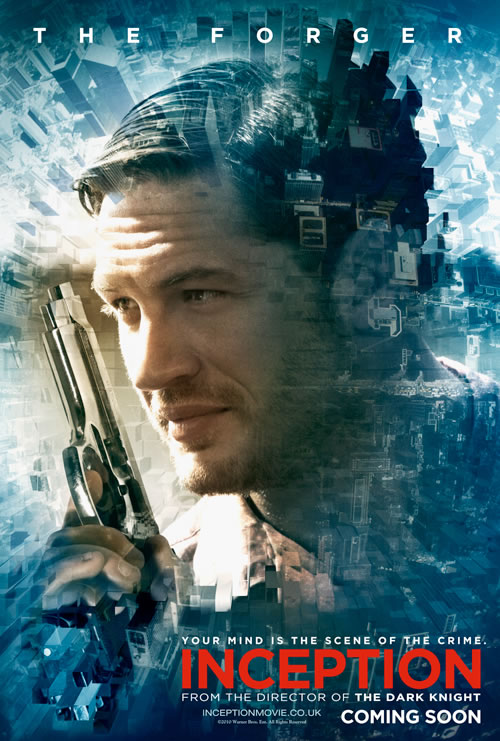
The rest of the cast rounded out by Tom Hardy as Eames the team’s Forger, Dileep Rao as the Chemist in charge of fabricating the compounds needed for the team to enter their mark’s subconscious. Cillian Murphy (starting to become one of Nolan’s regulars) plays Robert Fischer, Jr. their target and mark throughout the film with veteran actors Tom Berenger, Michael Caine and Pete Postlethwaite providing the wise-men roles in the film. It’s Tom Hardy as Eames which stood out in a cast full of extraordinary young and veteran performers. His recent fame as an actor due to his brutal and daring performance in Bronson has made Hardy a hot commodity in Hollywood. His playful character of Eames serves to provide some levity in an otherwise very serious film which allows the audience to come closer to the characters and story instead of remaining distant as Nolan’s detractors like to point out. He nearly pulls off stealing the film from everyone everytime he’s on-screen. It’s a testament to all the actors that he doesn’t as each and everyone have their moments to shine without overshadowing their fellow co-stars.

It would be difficult to review this film without pointing out how beautiful it looks and sounds. The visual part of the film has to go to Walter Pfister who works his magic behind the cameras on this film. Every shot is clear, concise and free of tricks some cinematographers these days have come to rely on too often to make their shots look more dynamic than it really should be. The editing by Lee Smith makes sure that Nolan’s style doesn’t confuse the audience and keeps the non-linear narrative structure easy to comprehend. As for the score one has to look to Hans Zimmer’s growing rapport with Nolan. He’s scored two of Nolan’s film and it looks that Zimmer has tapped into what Nolan wants his film score to sound like. not to dominate or overemphasize particular scenes or beats, but to act as an accompaniment. All three individual do their part as does the actors into making Nolan’s vision of Inception come to life. As great a filmmaker as Nolan is turning out to be these support players have made sure his path towards that goal is done so on smoother ground than not.

Now, there’s going to be some heated and long debates as to the nature of the film because of the final shot. The final shot is of a metal dreidel spinning in the foreground with the camera panning to it. The dreidel is spinning and spinning and looks to keep on doing so. The dreidel is shown earlier in the film as acting as some sort of anchor to tell Cobb whether he is in the real world or in a dream. If it continues to spin and not tip over and fall then he’s still in one. If it spins but ultimately tips over onto its side then he’s out of it. The film ends with the dreidel spinning and for a split second before the film suddenly fades to black we see it wobble.

Many have seen this final shot as being a cop-out by Nolan to play with the audience’s mind. I happen to disagree.  I see it as a part of the story itself. nolan has been asking throughout the film what is real and what is a dream. This last shot just emphasizes this question and leaves it up to the audience to decide whether the dreidel continues to spin or eventually tips over. While I lean to the latter in the end it doesn’t detract from the film. The fact that some people have grabbed hold of this scene to negatively criticized the film as a whole tells me just how well-crafted a film Nolan has made that one little sequence lasting no less than 10 seconds becomes a dealbreaker for some when it should stimulate the mind into thinking what it actually means. I see that as the mark of an excellent storyteller.

In the end, Inception has done something this year which most film have so far been unable to do. It has delivered on its high-minded promises of a film that would challenge the audience and not just entertain them. It’s a film which has been overhyped for the last six month but has more than lived up to it and for some surpassed the hype itself. Inception looks to be one of those films which would forever define a filmmaker and this one will definitely define Nolan moving forward no matter what other projects he has in the future. This is a film that dares to appeal not just to the arthouse cineaste crowd but to the general audience who yearn to watch something exciting and original. I won’t say this is Nolan’s best film since he has years upon years to continue making films. Maybe one of those will be his masterpiece, but Inception definitely could be counted as being a nominee for that honor. If nothing else this film has saved what has been a very ordinary and lackluster 2010 summer film season.