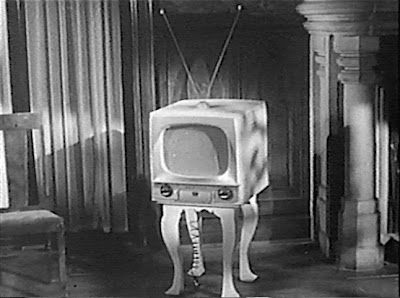
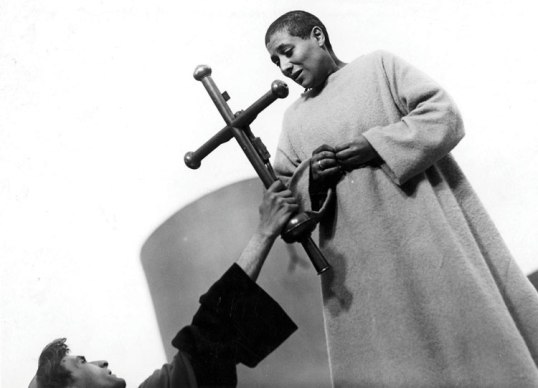
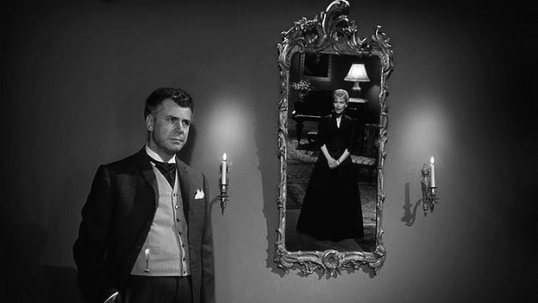
Welcome to Retro Television Reviews, a feature where we review some of our favorite and least favorite shows of the past! On Sundays, I will be reviewing the made-for-television movies that used to be a primetime mainstay. Today’s film is 1987’s After the Promise! It can be viewed on YouTube!
Mark Harmon is, in many ways, the ideal television actor. He’s handsome in a distinguished but not overwhelming sort of way. He projects a pleasant personality. He’s likably low-key. He’s a talented actor but he’s also a bit of a safe and predictable actor. It’s been said that the difference between a TV star and a movie star is that a movie star combines charisma with danger whereas a TV star combines a likable screen presence with reliability. Mark Harmon’s been a reliable TV presence for longer than I’ve been alive.
In 1987’s After the Promise, Harmon plays Elmer Jackson, a carpenter who is just trying to survive day-to-day in Depression-era California. Though his wife (who is implied to be a Christian Scientist) begs him not to take her to the hospital when she gets ill, Elmer goes against her wishes. When he gets her to the hospital, he is treated rudely by the staff. A cop approaches him in the waiting room and brusquely orders him to move his car. When a doctor finally does approach Elmer, he calmly explains that Elmer’s wife has did of TB and that she should have been brought to the hospital weeks ago.
Now a widower, Elmer is determined to keep the last promise that he made to his wife and give his four sons the best life that he possibly can. Unfortunately, the government is determined to keep Elmer from doing that. When Elmer goes to the government to try to get temporary financial assistance, the government reacts by taking his children away from him and forcing them into foster care. When Elmer, during one of his weekly visits, tries to take the children for a ride, the government bans him from having any contact with his children. When Elmer’s sons try to escape from the foster home, they’re separated and sent to separate facilities.
Informed that he can only get his children back if he proves that he’s financially stable, Elmer becomes an itinerant worker. It’s only after he meets and marries Anna (Diana Scarwid) that Elmer finally gets a chance to be reunited with his sons but, after years of abuse, his sons have their own traumas to deal with before they can accept Elmer as being their father.
This is a movie that really pulls at your heartstrings! There’s nothing subtle about it but, at the same time, its portrait of bureaucrats without empathy is one that feels very real and contemporary. Over the course of the film, Elmer learns that the rules are not being written to help out a blue collar worker who doesn’t have a lot of money and, watching the film, it’s hard not to consider that the rules haven’t really changed that much over the years. Elmer isn’t just fighting to reunited his family. His fighting to save them from a system that is designed to dehumanize. It’s an ideal role for a television star like Mark Harmon, as Elmer isn’t a terribly complex man but he is a very determined one. It’s a role that demands a lot of sincerity and Harmon certainly delivers. For that matter, so does this simple but emotionally resonant film.
I watched quite a bit. Let’s see what I can remember about it.
Accused (Tuesday Night, FOX)
This week’s episode was actually pretty good. It has an enjoyably macabre ending and was well-directed by Jonathan Mostow.
The Amazing Race 5 (Netflix)
The fifth season of The Amazing Race is on Netflix! I watched a few episodes this week. I’m glad that Colin and Christie were given a second chance to compete on the show because they really were the strongest competitors during the fifth season. After getting used to the mellow Colin who appeared the second time, it was interesting to be reminded just how intense and ultra-competitive he was the first time he appeared on the show. I know that Colin and Christie were meant to be the fifth season’s “villains” but, honestly, it’s impossible not to like them. I respect the fact that they consistently refused to yield or U-turn anyone.
American Auto (Tuesday Night, NBC)
Anna Gasteyer’s character went on the Seth Meyers show to try to soften her image and convince everyone that she really wasn’t the country’s most hated CEO. I understand that the whole point here was to reunite Gasteyer and Meyers, as I assume they were on Saturday Night Live at the same time. But I don’t know. Gasteyer had a few funny moments but Meyers has never really appealed to me a a talk show host. And really, if you were a CEO trying to improve your image by appearing on a talk show, would you go on the one that most people don’t watch? She should have held out for Fallon.
Football Game: Bengals vs Chiefs (Sunday Evening, CBS)
I watched this game with Jeff and Erin. I guess I’m glad the Chiefs won. The Bengals uniforms were a kind of silly looking.
Football Game: Eagles vs 49ers (Sunday Afternoon, FOX)
Was it on FOX? I honestly can’t remember. Anyway, I watched this game with Jeff and Erin and they were a lot more into it than I was. I decided that I would root for the 49ers because Philadelphia is the city of Parking Wars but I changed my mind once it became obvious that the 49ers weren’t going to win.
Hell’s Kitchen (Thursday Night, FOX)
I’m not sure if I agree with Chef Ramsey’s decision to keep Dafne over Sommer. Sommer may have been abrasive when she was put in charge of the Kitchen but she was still a lot less scatter-brained and more effective than Dafne was. That said, we all know that Alex is going to win this season.
Kids Behind Bars: Life or Parole? (Hulu)
This show originally aired on A&E. I watched an episode on Monday morning and I was immediately reminded of why I never particularly cared for this show. Not only does it exploit real-life tragedy but it’s also so biased and heavy-handed that it’s not really worth watching as a work of journalism.
Law & Order (Thursday Night, NBC)
This week, the murderer was a prosperity preacher. Nolan Price used a bunch of shady legal tricks to convince a judge to force a minister to break his sacred oath. This show is always at its most cringey when it tries to deal with religion. As I watched this week, I noticed that the show is now playing up the whole “relationship” angle between Price and Maroun. They’re a cute couple but I kind of want to see Maroun handle a case without Price hovering over her shoulder.
I know I watched the episode because I jotted it down in my notes for the week but I can’t remember a thing about it. That’s kind of a recurring problem with Night Court. I’ve seen every episode so far and I still can’t really tell you anything about the show or its characters.
Night Flight (Night Flight Plus)
I watched an episode from the 80s. It was all about the use of animation in music videos.
Survivor: Philippines (Hulu)
There are several old seasons of Survivor on Hulu. I watched a bit of the Philippines season, which featured the unbelievably hot Malcolm and the unbelievably obnoxious Abi-Maria. Along with Penner, RC, Russell, and a few others, this season featured some of the least likable castaways ever but it also featured Malcolm so it all worked out.
TV Party (Nightflight Plus)
I watched an old episode of this 80s public access program on Friday night. Chris Stein, of the band Blondie, led a small band in playing medieval music. Then a bunch of drunk people called the studio and threatened to beat him up.
Welcome to Retro Television Reviews, a feature where we review some of our favorite and least favorite shows of the past! On Saturdays, I will be reviewing California Dreams, which ran on NBC from 1992 to 1996. The entire show is currently streaming on YouTube!
Let’s see what was happening in California back in 1994.
Episode 3.14 “Boyz R Us”
(Dir by Patrick Maloney, originally aired on December 17th, 1994)
When Tony’s old friend Darren comes to visit, it’s revealed that Tony and his family are apparently form South Central. Over the course of nearly three seasons, this has never once been mentioned by Tony or anyone else on the show but, in this episode, everyone acts as if they’ve always known that Tony comes from the hood and that his family moved away to keep Tony from falling in with the wrong crowd. In fact, it’s treated as being such common knowledge that it actually seems a little bit offensive, as if everyone just assumed that Tony grew up in a crime-ridden neighborhood because of the color of his skin.
Darren comes bearing grim news. Their friend, JR, has fallen in with the gangs. When JR is ordered to rob a liquor store, he refuses to do it. The gang retaliates by beating him up and leaving JR with permanent brain damage. (We don’t actually see JR. Instead, Tony just spends the episode answering questions about how JR is doing.) Tony thinks that he and Darren should go to the police. Darren thinks a better solution would be to kill the guys who beat up JR. Tony returns to South Central and literally stands in front of two gang members to keep Darren from shooting them. The gang members say that they’re going to repay the favor by killing Tony and Darren. But then a bunch of older people show up in the alley and announced that they’re taking their neighborhood back. The gang members run off and apparently, that’s all it takes to deal with the gang problem.
I have no doubt that this episode was written, directed, and acted with the best of intentions but Peter Engel-produced sitcoms were always at their worst whenever they tried to deal with the issue of race. The need to neatly wrap everything up in 22 minutes did not exactly lend itself to examining serious issues. The whole episode felt a bit heavy-handed and I didn’t buy the episode’s conclusion for a second. The episode suggested that the best way to deal with gangs was to just stand up to them as you would to any other group of bullies. It worked in this episode but that’s because there was only two gang members and neither one of them was armed when they were confronted.
In the B-plot, the Dreams were broke so they got jobs delivering singing telegrams. Lorena got a job as well because, even though she was rich, she wanted to see what it was like to be poor. Lorena was so cool.
Episode 3.15 “Junior Achievement”
(Dir by Patrick Maloney, originally aired on December 24th, 1994)
For their Business class, the Dreams set up a corporation and attempt to make a profit. Jake and Mark try to succeed by giving music lessons. The rest of the group decides to exploit Sam’s cold remedy, which has apparently been in her family for centuries. At first, Sam is reluctant to sell out her heritage but then she’s told that she could become a millionaire so….
If this sounds familiar, that’s because this is the same basic plot as the Saved By The Bell episode where Zack and the gang try to sell Screech’s Spaghetti Sauce. For that matter, it also has a lot in common with the infamous “buddy band” episode. Just as Zack did for the spaghetti sauce, The Dreams even air a commercial for the cold remedy on public access TV. Tony directs the commercial. Sly plays a cold germ. Sam plays her grandmother. The commercial seems like it runs way too long but whatever. Jake and Mark make no money teaching music while the other Dreams initially make a fortune. But then, in order to save on production costs, Sam cuts a few corners and the medicine goes from curing colds to causing hiccups. Sam tells the teacher the truth about what happened and is praised for being ethical.
So, in other words, there’s no actual consequences for anything that Sam may have done wrong. That’s the advantage of being one of the main characters, I suppose.
This wasn’t a bad episode as much as it was just a totally silly one. The storyline was predictable but the cast certainly seemed to be having fun. This is one of those episodes that worked almost entirely due to chemistry between the actors. Though the episode focuses on Jennie Kwan, Michael Cade also gets his share of good lines. Any episode that features Sly being totally immoral and greedy is usually a good one.
As some of our regular readers undoubtedly know, I am involved in a few weekly live tweets on twitter. I host #FridayNightFlix every Friday, I co-host #ScarySocial on Saturday, and I am one of the five hosts of #MondayActionMovie! Every week, we get together. We watch a movie. We tweet our way through it.
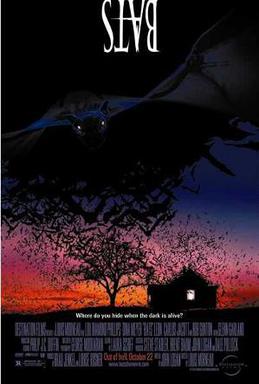
Tonight, for #ScarySocial, ArtAttackNYC will be hosting 1999’s Bats!
If you want to join us on Saturday night, just hop onto twitter, start the film at 9 pm et, and use the #ScarySocial hashtag! The film is available on Prime, Tubi, and a few other streaming sites. I’ll be there co-hosting and I imagine some other members of the TSL Crew will be there as well. It’s a friendly group and welcoming of newcomers so don’t be shy.
4 Shots From 4 Films is just what it says it is, 4 shots from 4 of our favorite films. As opposed to the reviews and recaps that we usually post, 4 Shots From 4 Films lets the visuals do the talking!
Today would have been George Romero’s 83rd birthday.
Now, those of you who have been reading us since the beginning know how important the work of George Romero has been to this site. A mutual appreciation of Night of the Living Dead is one of the things that first brought many of us together. It’s a film that we watch ever Halloween and Arleigh’s review of the original remains one of our most popular posts. If this site had a patron saint, it would probably be George Romero.
And yet, Romero wasn’t just a director of zombie films. He made many films, dealing with everything from hippie lovers (There’s Always Vanilla) to wannabe vampires (Martin) to government conspiracies (The Crazies) and eccentric bikers (Knightriders). George Romero was one of the pioneers of independent films and today, on his birthday, we should all take a minute to consider and appreciate the man’s cinematic legacy. It’s not just horror fans who owe George Romero a debt of gratitude. It’s lovers of cinema everywhere.
With that in mind, here are….
4 Shots From 4 George Romero Films
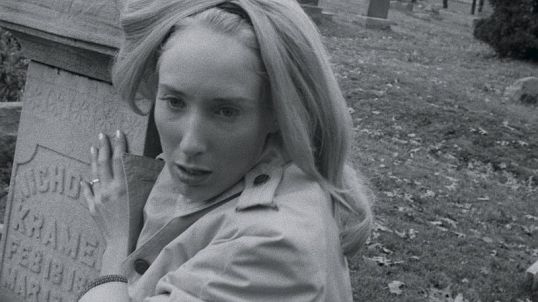
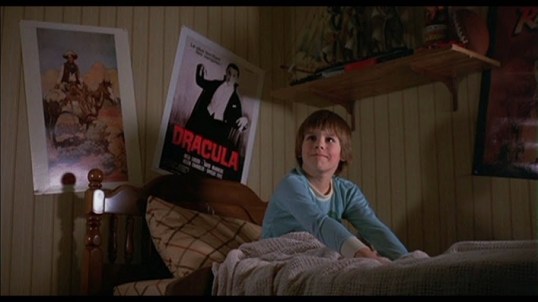
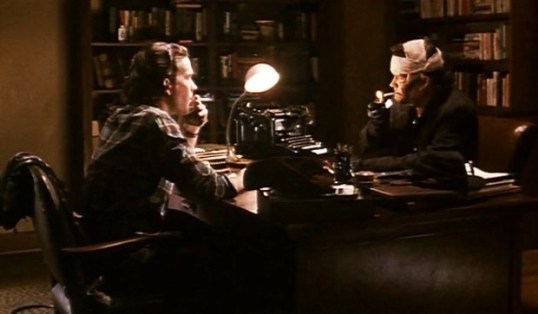
Night of the Living Dead (1968, dir by George Romero, DP: George Romero)
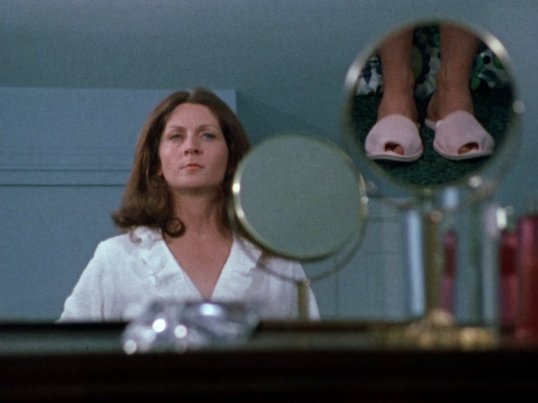
Season of the Witch (1973, dir by George Romero, DP: George Romero)
Creepshow (1982, dir by George Romero, DP: Michael Gornick)
The Dark Half (1993, dir by George Romero, DP: Tony Pierce-Roberts)
Welcome to Retro Television Reviews, a new feature where we review some of our favorite and least favorite shows of the past! On Fridays, I will be reviewing The Brady Bunch Hour, which ran on ABC from 1976 to 1977. All nine episodes can be found on YouTube!
Join me as I watched episode 3 of …. *shudder* …. The Brady Bunch Hour!
Episode 1.3
(Dir by Jack Regas, originally aired on February 27th, 1977)
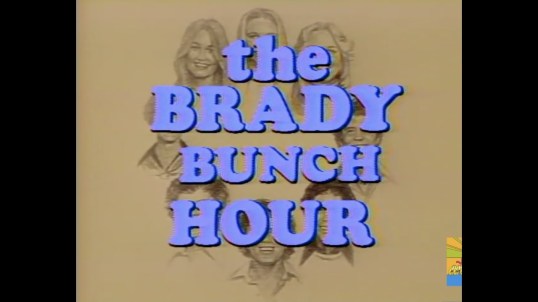
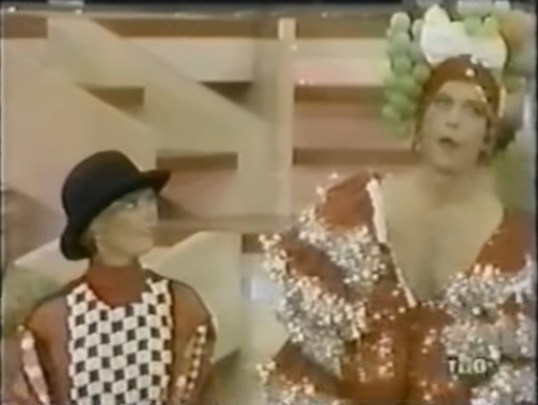
As always, the episode opens with pictures of the Bradys being flashed across a screen as the announcer shouts out everyone’s names. One thing I immediately notice is that Christopher Knight is now referred to as being “Chris Knight,” which sounds less like the name of the actor who played Peter Brady and more like the secret of identity of a cheesy super hero. The crowd goes crazy for each Brady but they really go nuts when the announcer reveals that tonight’s special guest star will be Milton Berle.
That’s right, Milton Berle. I honestly have to imagine that, even in the 70s, Milton Berle probably seemed like a rather quaint guest star. The Bradys were hardly on the cutting edge of …. well, anything. But, even for them, Milton Berle feels a little bit past his prime.
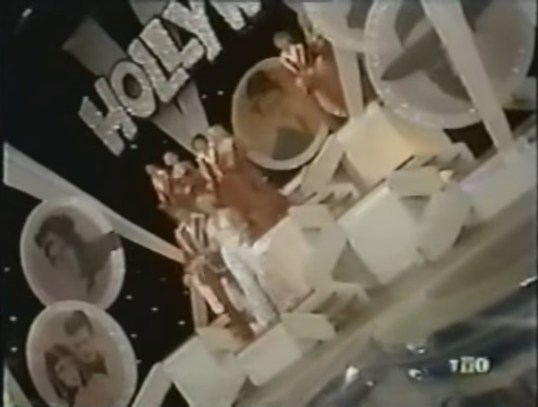
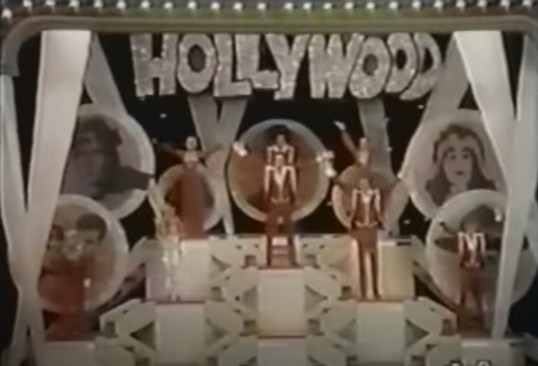
The Bradys come out and sing Hooray for Hollywood, which I’m sure was the song that all the kids were listening to in 1977.
Having finished singing, the Bradys banter. Everyone gets super excited when Carol says that their special guest is the “one and only Milton Berle!” And then it’s time for the family to once again sing Hooray for Hollywood. Hollywood may be a great thing but another great thing is being able to carry a tune and, unfortunately, that’s something that half of the Bradys apparently never managed to master.
(It’s okay, I can’t sing either.)
Obviously looking to punish the viewers even further, Hooray for Hollywood is followed by Mike, Carol, Greg, Marcia, and Pete singing Make ‘Em Laugh. Is tonight’s theme Broadway songs that are largely adored by people who have never actually seen a Broadway show? Alice and Rip Taylor — who I guess is still playing the Bradys landlord, Jackie Merrill — come out on stage after the performance and sing their own version of Make ‘Em Laugh. From the start of the performance, it’s pretty clear that Ann B. Davis would rather be anywhere other than sharing a stage with Rip Taylor. It’s actually painful to watch as two mismatched performers, neither one of whom appears to like the other, sing a song about making the audience laugh.
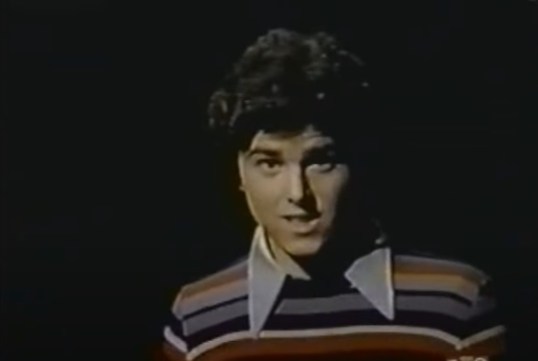
Mercifully, we then cut to Peter Brady. Because of the way the scene is lit, my first thought upon seeing Peter is that he’s going to confess to killing a bunch of co-eds.
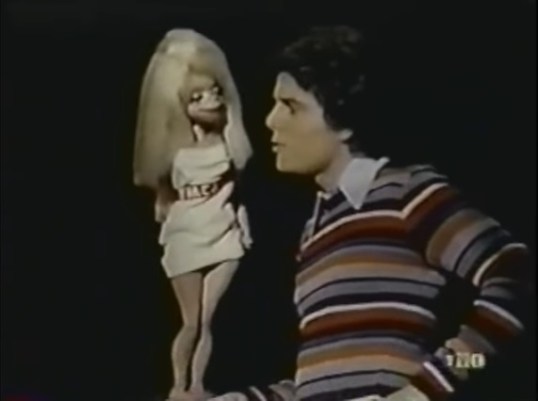
Instead, Peter explains that it’s time for him to do a song but no one in his family wants to introduce him. Wow, Peter! Your family sucks! Fortunately, a weird little puppet shows up and duets with Peter on Sing. It’s weird, dude.
We cut to Bobby, who complains that his family doesn’t know what’s funny. “This is funny,” Bobby says, before getting hit in the face with a pie. The audience agrees. Personally, I hate the whole pie-smashing thing because I know it’s probably a mess to clean up afterwards.
We go to the Brady House, where Alice is talking on a CB radio that has been set up in the kitchen. Mr. Merrill is in the kitchen for some reason. Carol, Mike, and Bobby come into the kitchen. Bobby thinks that the show isn’t funny enough. Mike and Carol think that Bobby is being a brat. “Compared to us,” Bobby says, “Donnie and Marie are Cheech and Chong!” Mike argues that they do more than comedy but he says that he’ll consider Bobby’s suggestions. Who died and made Mike the producer of the show?
After Carol, Alice, and Mike leave, the CB radio comes to life. It’s Milton Berle looking for someone to talk to! Bobby and Mr. Merrill talk to Berle. Berle insults Bobby, saying that he sounds like he belongs on Sesame Street. Bobby tells Berle that he’s funny and asks him if he wants to be a on a TV show. “A TV show? WHERE!? WHERE!?” Berle shouts in reply and I’ll admit that I actually did kind of laugh at that.
We go to commercial and, when we return, Rip Taylor welcomes us to the second half of the show. We then cut to Bobby and the Brady kids waiting for Milton Berle to show up at the house. They wonder why he’s late. “Maybe he’s watching The PartridgeFamily,” says Cindy. “Maybe he saw our show!” Bobby replies. When did Bobby become the smartest member of the family?
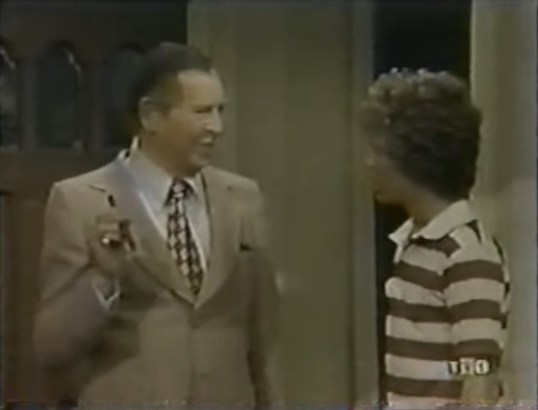
Anyway, Milton eventually rings the doorbell and enters the house, smoking a cigar.
It quickly becomes obvious that Milton Berle doesn’t know who the Bradys are and the Brady kids aren’t sure who Milton is. Fortunately, Carol and Mike return home and Carol explains that Milton Berle is a television pioneer and “the funniest man in the world.”
“Mr. Berle,” Mike says, “why are you here?”
“Bad luck, I guess,” Berle replies and again, I will admit that I laughed because Berle obviously meant every word.
Bobby says that Milton can make the show funnier. When Mike says that they don’t need the show to be funnier, Milton gets angry and says that he’s going to write for the show just to make Mike look bad. I’m really starting to like Milton Berle. Milton agrees to take over but he says that the family has to understand that they are to do everything that he says. He’s in charge now, not Mike. It’s about time!
Milton’s first act is to try to teach Peter how to enunciate. When Peter struggles, Milton Berle SLAPS him. Then he attempts to show Greg how to walk like a television star.
We cut to commercial. When we return, the announcer tells us that we are now watching “The Milton Berle Brady Bunch Hour, created by Milton Berle, produced by Milton Berle, written by Milton Berle….” You get the idea. The Bradys, who are now all wearing silly costumes, come out and sing Hooray for Hollywood again. Mike is not happy with his outfit.
Milton comes out on stage and yells at the Bradys to “sell the comedy.” The kids tells a few old vaudeville jokes. Milton runs out on stage with a fake plant and refers to Carol as being “Mrs. Bunch.” Mike complains about having to wear makeup. “What do you do when you and your wife have a fight?” Milton asks. “We make up,” Mike says, which leads to him being attacked by a makeup artist. Realizing that things aren’t going well, Milton resigns and apologizes. Okay, I guess that’s the end of that. It’s typical of this show that the one successful skit ends on a totally random note.
We go to commercial and when we return, Greg and Peter are standing next to the pool. Greg says that Peter is nervous because this is the part of the show where he always gets shoved into the pool. Considering the fact that Peter could die if he hits the water the wrong way, he has every right to be nervous. Greg says that, this week, he’ll let Peter push him in. Peter doesn’t believe him and jumps in the pool to escape his cruel older brother.
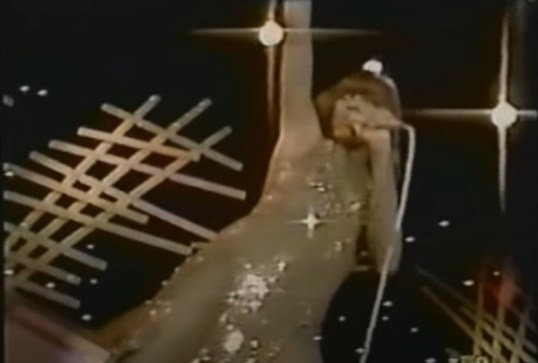
This is followed by Tina Turner who …. wait. What? The stupid pool gag is followed by TINA TURNER!? What a weird show! Needless to say, Tina’s great but it’s still hard not to feel that the Bradys shouldn’t be allowed anywhere near her. As a general rule, if you’re a singer who can’t carry a tune and who can’t dance and who is visibly uncomfortable performing on stage, don’t put yourself in a position to be compared directly to Tina Turner.
After Tina performs, we cut to more Brady nonsense as Carol, Mike, and Bobby inform Milton Berle that he’s been fired from the show. Wait a minute? What? I thought Milton made a big deal about stepping down as producer? I guess I must have misinterpreted that previous scene but honestly, I refuse to go back and rewatch it. If the show’s writers and performers couldn’t make this stuff clear, that’s on them.
“You’re giving me the pink slip?” Milton asks.
“We’re giving you all the costumes back,” Bobby says. The audiences goes nuts.
(By the way, I’m wearing a pink slip right now.)
With Milton gone (again), Carol comes out and sings Evergreen, the theme from A Star is Born. It’s a good song for her voice and I actually enjoyed listening to her version.
It’s time for the big finale! All the songs are about stars. I can’t even begin to describe it. Just watch, if you dare.
To my surprise, this episode was not terrible. Milton Berle’s obvious disdain for the family generated some laughs and Tina Turner’s performance was a definite highlight. Even Florence Henderson’s musical performance was effective. It was hardly perfect and both the opening and the finale reminded me of how tone deaf most of the Bradys were but still, this episode was probably about as good as anyone could expect from The Brady Bunch Hour.
As some of our regular readers undoubtedly know, I am involved in a few weekly live tweets on twitter. I host #FridayNightFlix every Friday, I co-host #ScarySocial on Saturday, and I am one of the five hosts of #MondayActionMovie! Every week, we get together. We watch a movie. We tweet our way through it.
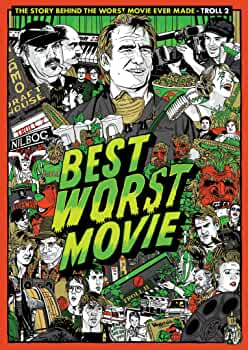
Tonight, at 10 pm et, I will be hosting the third #FridayNightFlix of 2022! The movie? 2009’s Best Worst Movie!
If you want to join us this Friday, just hop onto twitter, start the movie at 10 pm et, and use the #FridayNightFlix hashtag! It’s a friendly group and welcoming of newcomers so don’t be shy.
Best Worst Movie is available on Prime and Tubi! See you there!
4 Shots From 4 Films is just what it says it is, 4 shots from 4 of our favorite films. As opposed to the reviews and recaps that we usually post, 4 Shots From 4 Films lets the visuals do the talking!
Today, we honor the great Danish filmmaker, Carl Theodor Dreyer, born 134 year ago today. He directed his first film in 1919 and made his final one in 1964. It’s time for…
4 Shots From 4 Carl Theodor Dreyer Films
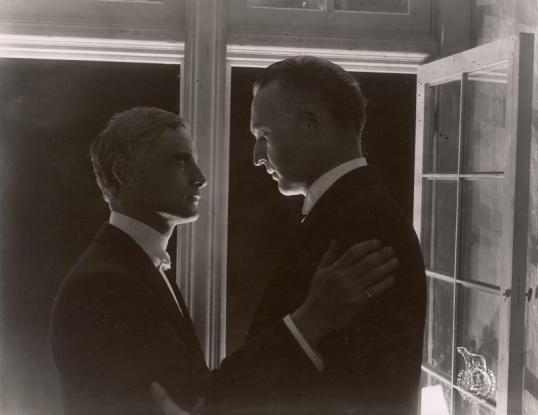
The President (1919, dir by Carl Theodor Dreyer)
The Passion of Joan of Arc (1928, dir by Carl Theodor Dreyer, DP: Rudolph Mate)
Vampyr (1932, dir by Carl Theodor Dreyer, DP: Rudolph Mate)
Gertrud (1964, dir by Carl Thedor Dreyer, DP: Henning Bendtsen)