Film Review: The Fallout (dir by Megan Park)


The Fallout, which premiered on HBOMax way back in January, opens with a scene of a sandwich being made.  It’s a peanut butter sandwich but the person making it is putting way too much peanut butter on the bread.  The kitchen counter is a mess.  The knife looks dirty.  To be honest, it’s kind of sickening to watch.

No, the film is not about the sandwich.  In fact, the sandwich never appears again.  But I have to admit that sandwich represents the entire film to me.  That scene, I think, is meant to tell us that we’re watching a film about real people and sometimes, real people prepare disgusting food in a cluttered kitchen.  And that’s true.  Then again, sometimes they don’t and that’s something that some filmmakers don’t want to acknowledge.  Indeed, there’s something rather condescending about the cinematic belief that being authentic is the equivalent of being a slob.  It’s an interesting phenomena how a film can try so hard to be “real” that it instead becomes the opposite.

The Fallout certainly deals with an important subject.  Vada Cavell (Jenna Ortega) goes to high school on a day like any other day and, without warning, finds herself in the middle of a school shooting.  The shooting itself is handled well.  We don’t see the shooter nor do we learn anything about him.  We just hear the gunshots while Vada, Mia Reed (Maddie Ziegler — yes, of Dance Moms fame), and Quinton (Niles Fitch) hide in a bathroom stall.  It’s a terrifying scene and it immediately reminded me of what it was like when I was in high school and I would see stories about school shootings and wonder if my school was going to be next.

The rest of the film deals with the emotional, political, and mental fallout of the shooting.  Quinton struggles with the death of his brother.  Vada’s best friend, Nick (Will Ropp), becomes a self-righteous David Hogg type.  And Vada starts spending all of her time with Mia, a dancer and influencer whose Dads are in Europe and apparently can’t even be bothered to come back to the States even after their daughter is involved in a school shooting.  Vada, who has a total crush on Mia, starts hanging out at Mia’s mansion.  Mia is happy to finally have a friend that she can talk to, even if Vada is kind of annoying.

(The whole thing with the Dads being in Europe and Mia living alone in her mansion feels a bit too convenient, to be honest.)

The film is dealing with important issues, which is one reason why it’s gotten so many good reviews.  This is one of those films that many people feel obligated to like because otherwise, they might run the risk of being told that they don’t care about school shootings.  But, honestly, the film doesn’t really have that much to say.  It hits all of the expected beats and, as much as the film tries to make everything messy and real, it often seems like it’s trying too hard.  Of course, Vada is going to use drugs to get through her first day back at school.  Of course, Vada’s father is going to encourage her to shout out her frustrations at the top of her lungs.  Of course, Vada’s mother is going to be remote and controlling.  Of course, her little sister is going to have a breakdown.  Of course, her best friend is going to get mad at her for not wanting to get involved with his nascent political career.  Of course, there’s going to be an absolutely cringey moment where Vada starts talking a mile a minute just because she smoked one joint.  To be honest, I’ve never seen anyone react to weed quite the way that Vada does.  She’s like the person who gets drunk off half a beer and then won’t stop talking.  It’s freaking annoying.  Throughout the film, there are occasional moments that work but, ultimately, it’s never quite as insightful as it obviously believes itself to be.

Jenna Ortega does give a good performance as Vada.  As written, the character is often annoying but, then again, the same can be said of most people and one can only imagine what Vada would have been like without Ortega’s likable screen presence.  The film is pretty much stolen, though, by Maddie Ziegler.  Ziegler reveals the lonely reality behind the influencer façade.  Since Ziegler is herself a dancer and an influencer, she brings a lot of her own persona to Mia but, at the same time, she also makes Mia into a believable character who has a life and an existence that’s separate from the actress playing her.  After The Book of Henry and Music, The Fallout actually gives Ziegler a chance to prove that she can act as well as she can dance.

As opposed to Gus Van Sant’s Elephant or Fran Kranz’s Mass, which both that the courage to acknowledge that violence and its consequences can never be truly understood or easily defined, The Fallout tries too hard to find definitive meaning in an incomprehensible tragedy.  For all of its good intentions and its attempts to be realistic, there’s a shallowness at the heart of The Fallout that keeps it from working.

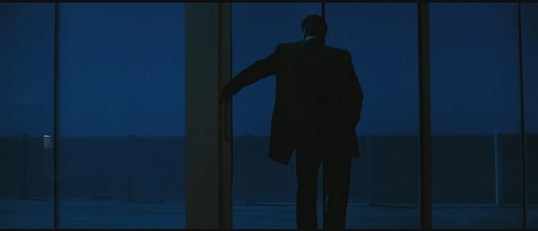
6 Shots From 6 Films: Special Alfred Hitchcock Edition


4 Or More Shots From 4 Or More Films is just what it says it is, 4 shots from 4 of our favorite films. As opposed to the reviews and recaps that we usually post, 4 Shots From 4 Films lets the visuals do the talking!

123 years ago, the master of suspense was born in England.  Today, we honor the career and legacy of the great Alfred Hitchock with….

6 Shots From 6 Alfred Hitchcock Films

The Lodger (1926, dir by Alfred Hitchcock, DP:Gaetano di Ventimiglia )

Shadow of a Doubt (1943, directed by Alfred Hitchcock, DP: Joseph A. Valentine)

Vertigo (1958, dir by Alfred Hitchcock, DP: Robert Burks)

North by Northwest (1959, dir by Alfred Hitchcock, DP: Robert Burks)

Psycho (1960, dir by Alfred Hitchcock, DP: John L. Russell)

The Birds (1963, dir by Alfred Hitchcock, DP: Robert Burks)

Book Review: Mike Nichols: A Life by Mark Harris


Mike Nichols.

That’s a name that should be familiar to anyone who claims to be a student of film or a lover of Broadway.  Originally born Mikhail Igor Peschkowsky in Berlin, Germany, the rise of the Hitler led to Nichols and his family immigrating to the United States in 1939.  By that time, the seven year-old Nichols had already been completely bald for three years, the result of a bout of whooping cough.  Like many who have had first-hand experience with trauma, Nichols developed an appreciation for the absurdity of life and a rather dark sense of humor.  After studying to be an actor, Nichols found fame as a satirist and a comedian, performing with Elaine May.  He would later go on to become not only an important theatrical director but also an important film director.  With his directorial debut, Who’s Afraid of Virginia Woolf?, he helped to destroy what was left of the production code.  With The Graduate, he helped to define the generation gap.  With Carnal Knowledge, he explored sexual frustration and ennui.  With Catch-22, he proved that even a great director can struggle to adapt an unfilmable book.

Mike Nicholas was an important director but, because his work was never quite as flashy as some of his contemporaries and because he spent as much time directing for the stage as for the movies, it always seems as if he runs the risk of being overlooked by film lovers.  Luckily, Mark Harris’s biography, Mike Nichols: A Life, not only presents the details of his life and career but it also makes a convincing case that Nichols is a director who, despite all of his awards and the admiration of those who worked with him, has been a bit underrated.  Harris convincingly argues that, while Nichols’s films dealt with timeless issues, they also often defined the era in which they were made.  Who’s Afraid of Virginia Woolf? and The Graduate are both definitive films of the 60s.  Carnal Knowledge is a film that captures the disillusionment of the early 70s, with Jack Nicholson and Art Garfunkel playing men destined to never escape their self-imposed mental prisons.  Working Girl captured the greedy atmosphere of the 80s while Primary Colors epitomized America in the 90s and Closer captured the confused morality of the aughts.

To his credit, Harris doesn’t make the mistake of idealizing Nichols.  Harris is just honest about the Nichols films that don’t work as he is about the ones that do.  The failure of Catch-22 was as due to Nichols’s new-found cockiness as a director as it was to the unwieldy source material.  On What Planet Are You From?, Nichols develops an almost instant and somewhat irrational dislike of comedian Garry Shandling, which is a bit unfortunate as Shandling was not only the star of the film but also in need of a director who would work with him to conquer his insecurities.  This biography is honest about both Nichols’s strengths and his weaknesses and, as such, it becomes a fascinating look at one artist’s creative process.

It also become a look at how American culture changed from the 1960s to the first decade of the 21st Century.  Nichols made his directorial debut in 1965 and directed his final film in 2007.  For 42 years, Nichols recorded the cultural transformation of America, from scandalizing America by having Elizabeth Taylor and Richard Burton curse at each other to making a film about the policy decisions that would eventually contribute to 9-11 and the new America that was formed as a result of that tragedy.  Mike Nichols: A Life isn’t just about Mike Nichols.  It’s about how American culture, for better and worse, has developed and changed over the last century.

If you’re looking for a good and in-depth biography about a director who deserves to be rediscovered, Mike Nichols: A Life is the one to go with.

Film Review: Operation Mincemeat (dir by John Madden)


Based on a true story, Operation Mincemeat takes place in 1943, during the second World War.  The British are planning an invasion of Sicily, both to break Hitler’s hold on Europe and to also knock Italy out of the war.  The problem is that the attack on Sicily makes so much strategic sense that the Germans have spent months preparing for it and, even if successful, the invasion will cost an untold number of British lives.  Somehow, British intelligence must trick the Germans into thinking that the British are planning to invade Greece instead.

With the help of Lt. Commander Ian Fleming (Johnny Flynn), Ewen Montagu (Colin Firth) and Charles Cholmondeley (Matthew McFayden) come up with the plan to fool the Germans.  A dead body will be disguised as a British officer.  The body will be transported, via submarine, to Spain, which was technically neutral during the war.  The body will wash up on shore and, when the body is examined, a note detailing Britain’s invasion of Greece will be discovered and passed along to the Germans.  Because the Germans have been fooled by a similar trick in the past, Montagu and Cholmondeley create a fake backstory for “Maj. William Martin” and soon start to think of him as being a someone who truly did live.  Joining them to create a life for Major Martin is Jean Leslie (Kelly MacDonald), a secretary in the office who volunteers a photo of herself to be placed in Martin’s wallet.

Of course, things get complicated.  While plotting out the operation, Jean starts to fall in love with Montagu, whose marriage is currently strained by Montagu’s obsession with his work.  (Because he knows what will happen to a Jewish family in the UK if Germany invades, Montagu has sent his wife and his children to the U.S.)  Cholomondeley is in love with Jean and soon finds himself growing jealous of the man that he’s been assigned to work with.  Meanwhile, the head of British Intelligence (Jason Isaacs) wants to investigate Montagu’s brother for being a communist.  As for Ian Fleming, he keeps himself busy by writing a book.  In fact, so many members of British Intelligence are identified as being aspiring novelists that it becomes a bit of a running joke.

I have always appreciated a good World War II film and I enjoyed Operation Mincemeat.  It’s a bit of an old-fashioned film, of course.  The F-word is used exactly once (which makes this a rarity amongst modern British films) and there’s one scene in which a member of British intelligence discreetly gives an informant a handjob in return for information.  Otherwise, this is pretty much a film that you could safely show your grandma without having to worry about her getting depressed over how much movies have changed since her day.  Old-fashioned or not, it’s a well-made film, full of good performances and sharp dialogue.  It’s not a flashy film but it’s very nicely put together and it’s hard not to admire the craftsmanship responsible for it.  Operation Mincemeat is all the more interesting for being, more or less, true.  While the love triangle was invented for the film, it is true that Ian Fleming was a part of Operation Mincemeat and the film’s use of him as a character works surprisingly well.  The scene where a young Fleming tours the World War II version of Q Branch provides some nice comic relief, particularly when Flemings comes across a wristwatch that doubles as a mini-saw.

What elevates Operation Mincemeat is its theme of loss.  Almost all of the major characters have lost someone or something to the war.  Jean Leslie is a widow.  Cholomendely’s brother was killed in action and his body is still in Europe.  Montagu has had to send his family away for their own safety.  For them, the Major Martin becomes a stand-in for all of the people that they’ve lost.  The effort to make Martin into a real person allows all of them one final chance to honor their loved ones.  Major Martin becomes a stand-in for all British soldiers and civilians who sacrificed their lives to battle Hitler’s war machine.  Operation Mincemeat becomes about more than just fooling the Germans.  It becomes about being worthy of the sacrifice that it took to defeat them.

As is shown in the film, the real Major Martin was a vagrant named Glyndwr Michael, who died after eating rat poison.  The film suggests that Michael deliberately killed himself but no one will ever know for sure what led to him eating that poison.  After his death, he was given the uniform of a British officer and his pockets were filled with things that would identify him as being Major William Martin.  Though he never knew it, Glyndwr Michael become one of the greatest heroes of World War II.  Operation Mincemeat serves a worthy tribute to both Glyndwr Michael and Major William Martin.

Scenes That I Love: Norma Desmond visits Cecil B. DeMille in Sunset Boulevard


Today, the Shattered Lens observes the 141st birthday of filmmaker Cecil B. DeMille.

Today, if Cecil B. DeMille is known at all, it’s for directing Biblical epics like The Ten Commandments.  However, there was much more to DeMille’s career than just that one film.  DeMille got his start during the early silent era and he quickly established himself as one of Hollywood’s first superstar directors.  Unlike many of his contemporaries, he survived the transition to sound and he remained a force in Hollywood at a time when many of the other silent directors were fading into obscurity.  DeMille played a key role in the founding of what would become the American film industry.  He began his career in 1914 and he made his last film in 1958.  That’s quite a legacy.

In 1950, when filming Sunset Boulevard, Billy Wilder needed someone to play the key role of one of Norma Desmond’s former directors.  Who better to represent the old style of Hollywood than Cecil B. DeMille?  In the scene below, DeMille plays himself.  Norma Desmond is, of course, played by Gloria Swanson, an actress whom DeMille had directed in the past.

From Sunset Boulevard, here’s a scene that I love.

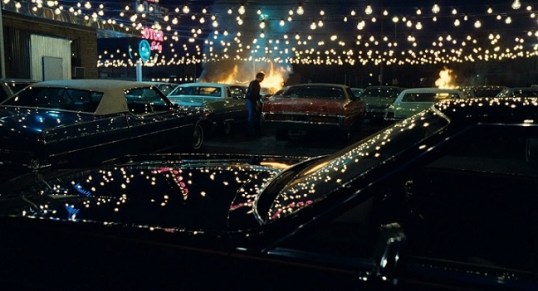
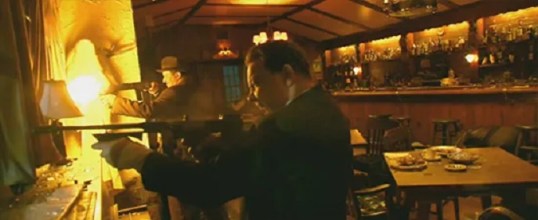
4 Shots From 4 Films: Special Sam Fuller Edition


4 Or More Shots From 4 Or More Films is just what it says it is, 4 shots from 4 of our favorite films. As opposed to the reviews and recaps that we usually post, 4 Shots From 4 Films lets the visuals do the talking!

On this date, 110 years ago, Samuel Fuller was born in Massachusetts.  Before he became a filmmaker, Fuller was a crime reporter and a pulp novelist.  His films were often melodramatic and unapologetically sordid.  They were also often dismissed when they were initially released but almost all of them were subsequently rediscovered by audiences who appreciated Fuller’s striking visuals and the often subversive subtext to be found underneath the surface of his genre films.

Today, we celebrate Fuller’s legacy with….

4 Shots From 4 Sam Fuller Films

Pickup on South Street (1953, dir by Samuel Fuller, DP: Joseph MacDonald)

Shock Corridor (1963, dir by Samuel Fuller, DP: Stanley Cortez)

The Naked Kiss (1964, dir by Samuel Fuller, DP: Stanley Cortez)

The Big Red One (1980, dir by Samuel Fuller, DP: Adam Greenberg)

A Blast From The Past: Lucy (dir by Paul Glickman)


In the picture above, you can see Lucy (played by Olga Soler), the title character of the 1975 educational short, Lucy.  Lucy is 15 years old and she spends almost all of her time with her boyfriend, Joe (Michael D’Emidio).  As Lucy herself explains her narration (which is provided by an actress named Marilyn Gold), her entire life revolved around Joe.  Since Joe dropped out of school, Lucy dropped out of school too.  Since Joe wanted to spend all of his time walking around New York City, Lucy did the same.  They thought they were in love.  One discreet sex scene later and Lucy’s pregnant!

Lucy is a bit different from some of the other educational films that I’ve seen about teenage pregnancy.  Though initially shocked and angered, Lucy’s parents are eventually supportive.  Joe doesn’t run away but instead promises to do whatever he can to help, though Lucy ruefully acknowledges that it won’t be much as Joe doesn’t even have a high school diploma.  Though a friend offers to help Lucy get an abortion, Lucy decides to have her baby and social services shows up to help her.  At the end of the film, Lucy is still not sure whether she’s going to keep her baby or give it up for adoption.  She just knows that her life will never be the same.  Compared to just about every other educational film that I’ve seen about this subject, Lucy takes a rather low-key and matter-of-fact approach to its story.  It’s well-made but rather depressing.

It’s also a rather obscure film.  I couldn’t find much about the film on the IMDb.  Is the Paul Glickman who is credited as the film’s director the same Paul Glickman who edited some of Larry Cohen’s best films?  Who knows?

Now, I know I’ve probably made this film sound really depressing to sit through but there is a dance scene towards the start of the film.  That helps.

Book Review: Death’s Running Mate by John D. Revere


Having previously taken on mutant chickens and barnyard sex, the fourth Justin Perry novel takes on the American political system!

First published in 1985, Death’s Running Mate is all over the place.  Author John D. Revere plays with time in Death’s Running Mate, which means that the book opens minutes before the climax of oversexed super assassin Justin Perry’s latest mission and then flashes back to how Perry and the readers arrived at that moment but the flashbacks themselves contain their own flashbacks and even the occasional flash forward.  It leaves the plot so jumbled that it would probably require keeping extensive notes to really understand everything that happens and jotting down notes is a bit more effort than a Justin Perry novel deserves.  The previous three Justin Perry novels were surreal but the fourth one plays out like an extended fever dream.  And yet, because it’s so strange, it’s also probably the most compelling of all of the Perry novels.  You keep turning page after page, just to see how much stranger it can get.

The book deals with politics.  A 36 year-old woman named Andrea McKay has come out of nowhere and is running for President as the candidate of the Federalist-Liberal Party.  She’s running on a platform to “throw the rats out” and she proves her sincerity by eating rat meat at her campaign events.  Those who have read the previous volumes of the Justin Perry series will not be a surprised to learn that Andrea McKay is actually being backed by SADIF, an evil conspiracy that previously infiltrated the Vatican and developed mutant chickens.  And since a major theme of these books is that Justin Perry is somehow at the center of everything that happens on the planet, most readers will not be surprised to learn that Andrea’s political platform was developed by SADIF abducting Justin during an orgy, holding him captive in a mental hospital for several months, and then interviewing him about his thoughts on politics.  Justin is not only an expert killer who literally can’t leave the house with getting laid.  He’s also so in touch with the American people that his vague political opinions can serve as the basis of a successful third party presidential campaign.  Interestingly enough, it turns out that Andrea McKay is being as manipulated by SADIF as Justin is by The Old Man, his boss at the CIA.  The suggestion, of course, is that Andrea, Justin, and the voters are all in the same situation.  They’re all being manipulated and used like pawns on a chessboard.

As strange as the Andrea McKay presidential campaign is, it’s not the strangest part of the book.  This is a novel that starts with Justin bragging about how he’s going to kill the population of an entire town in Illinois and then flashes back to Justin disguising himself as a psychologist so that he can prevent SADIF from breaking into a mental hospital and releasing all of the patients.  (It turns out that the mental hospital uses sex therapy and, of course, Justin has to be carefully examined before he’s allowed to work there.)  Among other events, Justin gets attacked by a woman driving a pumpkin truck and then later, he discovers the truth of his parentage.  And I’m not even getting into the scenes of teenage Justin learning how to make love with a girl named Thelma who later turns out to be a spy herself.  Did Justin Perry ever know anyone who didn’t turn out to be a spy?

To be honest, I’m probably not communicating just how weird this book is.  I haven’t even gotten to the stuff about Illinois or the author’s apparent belief that a presidential vacancy is filled by a special election.  (I laugh out loud at that part of the book, if just because it reminded me of Sally Kohn’s theory that impeaching Trump and Pence would lead to a special election between Paul Ryan and Hillary Clinton.  “Straight forward from here,” as Sally put it.)  Earlier, I described the book as being a fever dream but it’s really like several hundred fever dreams, all crammed together to form one big epic.  Not a bit of it makes sense but the total lack of coherence is undeniably fascinating.  Justin’s as much of a sex-crazed misogynist as he was in the previous books but, at least in this case, it nearly leads to collapse of the United States (which, I might add, leads me to suspect that these books were meant to be satirical).  Will Justin learn a lesson from this?  I’ve read the final book in the series and no.  He does not.

Speaking of that fifth book, I’ll be reviewing that one on Saturday!  And then, we’ll be done with Justin Perry.

AMV of the Day: Teeth (Scissor Seven)


Today seems like a good day to share another anime of the day!

(See how that all kind of rhymes?)

Anime: Scissor Seven

Song: Teeth (5 Seconds of Summer)

Creator: Itzzly 爱 (as always, please subscribe to this creator’s channel)

Past AMVs of the Day

Film Review: The Stranger (dir by Fritz Kiersch)


In the desert of Arizona, there sits a town.

That town is named Lakeview, despite the fact that there is no lake nearby.  There aren’t many buildings in the town.  There’s a service station.  There’s a diner.  There’s a sheriff’s office.  There’s a general store.  There are a few houses.  Lakeview is a place that people rarely visit and which no one can escape.

There is a sheriff.  His name is Cole (Eric Pierpoint) and he spends most of his days in an alcoholic stupor.  He’s been depressed ever since his girlfriend, Bridget, was murdered.  Now, Bridget’s younger sister, Gordet (Robin Lyn Heath), is living like a feral animal while the local shopkeeper, Sally (Ginger Lynn Allen), is determined to have Cole for herself.  Cole’s deputy (Ash Adams) is in love with Sally and wants Cole’s job for his own.  That’s a lot of drama for a small town.

Of course, the real drama in Lakeview comes from the fact that the town is run by a group of bikers!  The head biker is named Angel (Andrew Divoff).  By terrorizing the citizens, Angel and his gang make their own wishes come true without ever asking anyone else if that’s something they would be interested in.  Cole is too drunk and depressed to stand up to them.  The other townspeople are …. well, I don’t know what their problem is.  One assumes that they have to be tough, as they’re living in a harsh and inhospitable desert.  But none of them them are willing to stand up for themselves.  Maybe they’ve recently moved to Arizona from California and they’re not used to the idea of self-defense.  But, for whatever reason, Angel controls Lakeview.

But then the Stranger (Kathy Long) rides up on her motorcycle.  Dressed in black leather and wearing a corset that looks like it would actually be really uncomfortable in the desert heat, The Stranger has no name but she does know how to kick ass.  She has come to kill all the members of Angel’s gang.  Unfortunately, the majority of the gang is out-of-town when The Stranger arrives.  So, the Stranger waits in Lakeview and kills who she can.  The townspeople, led by Sally, want her to leave before things get too violent.  Meanwhile, Cole comes out of his drunken stupor just long enough to notice that the Stranger looks a lot like his dead girlfriend….

1995’s The Stranger was an attempt to a modern-day spaghetti western, with a woman playing the type of mysterious figure who would traditionally have been played by Clint Eastwood or Charles Bronson.  That, in itself, is a pretty good idea.  Unfortunately, The Stranger itself is abysmally paced and the filmmakers seem to have overlooked that, in the best spaghetti westerns, the silent, nameless heroes were usually paired with a more talkative (and often much more amusing) partner.  The Good, The Bad, and the Ugly had Eli Wallach.  Once Upon A Time In The West had Jason Robards.  In The Stranger, there’s not really anyone around to fill that role.  (Cole is too full of self-pity to be amusing.  Gordet spends most of the movie running from one abandoned car to another.)  As such, The Stranger becomes fairly grim and slow.  Things are only livened up when The Stranger beats people up.  Kathy Long was a kickboxing champion and she’s strong enough in the action scenes that it makes up for the fact that she doesn’t have a particularly compelling screen presence.  She and Eric Pierpoint also have next to no romantic chemistry, making the whole question of whether or not she’s Bridget’s ghost seem a bit moot.

The best reason to see the film is to watch Andrew Divoff play Angel.  Divoff is always a good villain and he’s memorably unhinged in The Stranger.  Unfortunately, he’s not in the film as much as the viewer might hope.  Watching the film, I half expected the Wishmaster to ask if I wanted Andrew Divoff’s role to be larger.  I would have said no while thinking yes.  You know how that Wishmaster is.