I was a fool to think Golden Earring showed up with Radar Love in the early 1970s.
They actually date back to the early 1960s. In fact, Barry Hay wasn’t even the original lead-singer. He came onboard in 1967. It’s weird to not hear Hay sing on a Golden Earring song even if that song is from a very different period. They weren’t even Golden Earring then. They were originally called The Golden Earrings. They had a pop-sound during this time.
The only thing weirder to me than not hearing Hay sing a Golden Earring song, is hearing him dial back the power of his voice to sing this kind of song. I’m well aware that This Is Spinal Tap (1984) already covered this kind thing, but it’s no less strange to me to come across this. It’s up there with listening to Bon Scott singing in the Australian pop-group The Valentines.
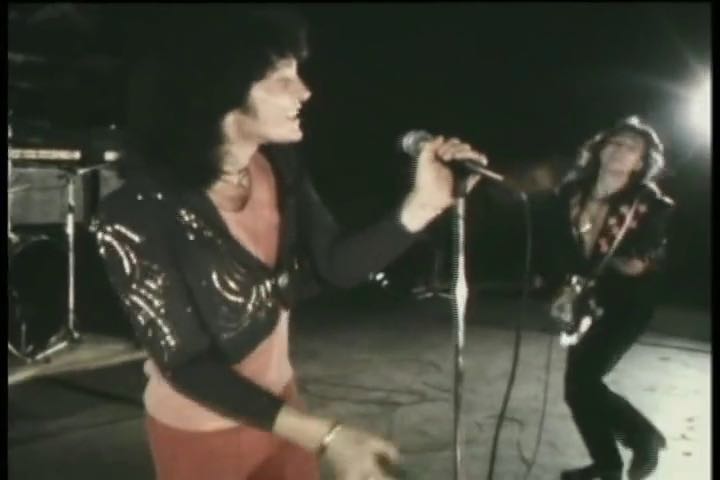
Then there’s the video for the song.
Hay looks more like he does from the 1980s onward,
When The Lady Smiles (1984)
in the 1960s,
than he did during the 1970s.
Radar Love (1974)
I guess that was just a phase.
The video is very 1960s–much like Radar Love is to the 1970s. It’s one of those videos that essentially turns a band into silent comedians, complete with mud wrestling.
That sequence goes on for quite awhile.
My personal favorite part of the video is when Hay pops out of the water playing an invisible flute.
I also like when one of the members of the band reaches out to turn the camera as a way to create a spin transition. It’s a nice little thing.
Along with Hay’s vocals sounding wrong, this video would not tell you that they would go on to do something like Clear Nite, Moonlight.
Speaking of that video, I made error when writing about it. I missed the obvious foreshadowing of the violent end in the form of the “So Little Time” license plate at the start of the video.
Clear Nite, Moonlight (1984)
To put that correction in a new post, is the main reason I did this post on another Golden Earring video. It’s also a fun video, regardless of my reason for doing it today.
The reason I put the date of release as 1967 is because according to Wikipedia, this was a single that was released in 1967 separate from any of their albums. That explains why Hay is here, but not on the album that they released in 1967, Winter-Harvest.
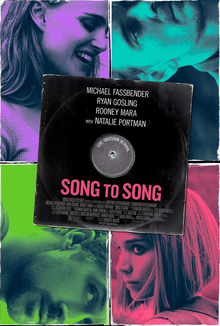
You’re watching a movie called Song to Song. It’s about beautiful people in a beautiful city.
In this case, the city is Austin, Texas. The people are all involved in the Austin music scene and they’re played by actors like Ryan Gosling, Rooney Mara, Natalie Portman, Michael Fassbender, and Cate Blanchett. A good deal of Song to Song was filmed at the Austin City Limits festival and several real-life musicians appear as themselves, though only Patti Smith is on screen long enough to make much of an impression. To be honest, both the music and Austin are almost incidental to the film. Though the movie was sold as an Austin film and it premiered at SXSW, it could have just as easily taken place in Ft. Worth.
The film is made up of short, deliberately obscure shots. The camera never stops moving, floating over images of sunsets, sunrises, and oddly empty streets. Because the film was shot with a wide-angle lens, you’re never not aware of the expanse around the characters. At times, all of those beautiful film stars run the risk of become specks on the landscape, as if the film itself is taunting the characters for thinking that they are more important than nature.
Who are the characters? It’s not always easy to say. There are plenty of voice overs but it’s rare that anyone directly states what they’re thinking or who they are. When the characters speak to each other, they mumble. The dialogue is a mix of the banal and the portentous, a sure sign of a film that was largely shot without a script. Eventually, you turn on the captioning so that you can at least understand what everyone’s muttering.
Michael Fassbender plays Cook. Cook appears to be a music producer but he could just as easily be a businessman who enjoys hanging out with and manipulating aspiring stars. People seem to know him but nobody seems to be particularly impressed by him. Cook spends a lot of time standing in front of a pool. Is it his pool? Is it his house? It’s hard to say. Cook is obsessed with control or maybe he isn’t. Halfway through the film, Fassbender appears to turn into his character from Shame.
Ryan Gosling is BV. BV appears to be a lyricist, though it’s never made clear what type of songs that he writes. At one point, you think someone said that he had written a country song but you may have misheard. BV appears to have an estranged relationship with his dying father. BV may be a romantic or he may not. He seems to fall in love easily but he spends just as much time staring at the sky soulfully and suggesting that he has a hard time with commitment. BV appears to be Cook’s best friend but sometimes, he isn’t. There’s a random scene where BV accuses Cook of cheating him. It’s never brought up again.
Rooney Mara is Faye. Faye contributes most of the voice overs and yet, oddly, you’re never sure who exactly she is. She appears to be BV’s girlfriend and sometimes, she appears to be Cook’s girlfriend. Sometimes, she’s in love and then, just as abruptly, she’s not. She may be a singer or she may be a songwriter. At one point, she appears to be interviewing Patty Smith so maybe she’s a music journalist. The film is centered around her but it never makes clear who she is.
Natalie Portman is Rhonda. Rhonda was a teacher but now she’s a waitress. She might be religious or she might not. She might be married to Cook or she might not. Her mother (Holly Hunter) might be dying or she might not.
And there are other beautful people as well. Cate Blanchett plays a character named Amanda. Amanda has a relationship with one of the characters and then vanishes after four scenes. There’s an intriguing sadness to Blanchett’s performance. Since the first cut of Song to Song was 8 hours long, you can assume her backstory was left on the cutting room floor. (And yet strangely, it works that we never know much about who Amanda is.) Lykke Li shows up, presumably playing herself but maybe not. Berenice Marlohe and Val Kilmer also have small roles, wandering in and out of the character’s lives.
There’s a lot of wandering in this movie. The characters wander through their life, stopping only to kiss each other, caress each other, and occasionally stare soulfully into the distance. The camera seems to wander from scene to scene, stopping to occasionally focus on random details. Even the film’s timeline seems to wander, as you find yourself looking at Rooney Mara’s forever changing hair and using it as a roadmap in your attempt to understand the film’s story.
“I went through a period when I thought sex had to be violent,” Rooney Mara’s voice over breathlessly explains, “We thought we could just roll and tumble, live from song to song, kiss to kiss.”
As you watch Song to Song, you find yourself both intrigued and annoyed. This is a Terrence Malick film, after all. You love movies so, of course, you love Malick. Even if his recent films have been flawed and self-indulgent, he is a true original. You want to support him because he’s an artist but, as you watch Song to Song, the emphasis really does seem to be on self-indulgence. The images are beautiful but the characters are so empty and the voice overs are so incredibly pretentious. Should you be mad or should you be thankful that, in this time of cinematic blandness, there’s a director still willing to follow his own vision?
At times, Song to Song is brilliant. There are images in Song to Song that are as beautiful as any that Malick has ever captured. Sometimes, both the images and the characters are almost too beautiful. The music business is tough and dirty but all of the images in Song to Song are clean and vibrant.
At times, Song to Song is incredibly annoying. It’s hard not to suspect that the film would have worked better if Natalie Portman and Rooney Mara had switched roles. Mara can be an outstanding actress with the right director (just check out her performance in Carol) but, in Song to Song, her natural blandness makes it difficult to take her seriously as whoever she’s supposed to be. Portman has much less screen time and yet creates an unforgettable character. Mara is in 75% of the film and yet never seems like an active participant.
At times, the film is annoyingly brilliant. Malick’s self-indulgence can drive you mad while still leaving you impressed by his commitment to his vision.
And then, other times, the film is brilliantly annoying. Many directors have mixed overly pretty images with pretentious voice overs but few do so with the panache of Terrence Malick.
Even fans of Terrence Malick, of which I certainly am one, will probably find Song to Song to be his weakest film. Even compared to films like To The Wonder and Knight of Cups, Song to Song is a slow movie and there are moments that come dangerously close to self-parody. Unlike Tree of Life, where everything eventually came together in enigmatic poignance, Song to Song often feels like less than the sum of its parts. And yet, I can’t totally dismiss anything made by Terrence Malick. Song to Song may be empty but it’s oh so pretty.
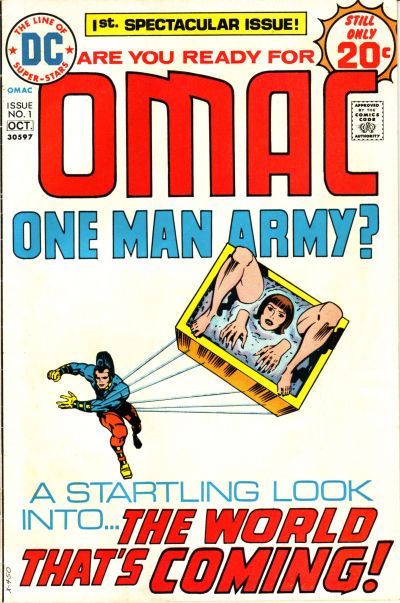
“Man, that cover scared the shit out of me when I was a kid!”
You have no idea how many times I’ve heard or read various iterations of that same statement made in regards to the image depicted above, which greeted kids all over America at newsstands (remember them?) back in 1974. Consider the words of noted Kirby scholar Charles Hatfield, who states that “ this frankly disturbing cover introduces a comic that is chilling, dystopic, and just plain flat-out bizarre,” or cartoonist Scott Shaw, who calls it “one of the most disturbing sexual images in the history of funnybooks,” or prolific YouTube comics commentator (and major Kirby fan) Howlermouse, who says it more or less verbatim – “this cover scared the shit out of me when I was a kid.”
So, like, what exactly is it about this cover, anyway? Even without the benefit of the context surrounding it…
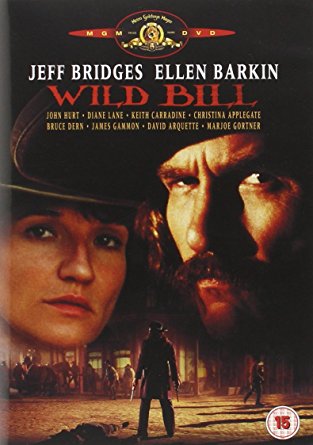
The year is 1876 and the legendary Wild Bill Hickok (Jeff Bridges) sits in a saloon in Deadwood and thinks about his life (most of which is seen in high-resolution, black-and-white flashbacks). Hickok was a renowned lawman and a sure shot, a man whose exploits made him famous across the west. Thanks to his friend, Buffalo Bill Cody (Keith Carradine), he even appeared on the New York stage and reenacted some of his greatest gun battles. Now, Hickok is aging. He is 39 years old, an old man by the standards of his profession. Though men like Charlie Prince (John Hurt) and California Joe (James Gammon) continue to spread his legend, Hickok is going blind and spends most of his time in a haze of opium and regret.
Hickok only has one true friend in Deadwood, Calamity Jane (Ellen Barkin). He also has one true enemy, an aspiring gunslinger named Jack McCall (David Arquette). McCall approaches Hickok and announces that he is going to kill him because of the way that Hickok treated his mother (played, in flashback, by Diane Lane). Hickok does not do much to dissuade him.
Based on both a book and a play, Wild Bill is a talky and idiosyncratic Western from Walter Hill. Hill is less interested in Hickok as a gunfighter than Hickok as an early celebrity. There are gunfights but they only happen because, much like John Wayne in The Shootist, Hickok has become so famous that he cannot go anywhere without someone taking a shot at him. Almost the entire final half of Wild Bill is set in that saloon, with Hickok and a gallery of character actors talking about the past and wondering about the future.
At times, Wild Bill gets bogged down with all the dialogue and philosophizing. (To quote The Good, The Bad, and the Ugly: “When you have to shoot, shoot. Don’t talk.”) Luckily, the film is saved by an intriguing cast, led by Jeff Bridges. In many ways, his performance was Wild Bill feels like an audition for his later performance in True Grit. David Arquette is intensely weird as the jumpy Jack McCall and Ellen Barkin brings the film’s only underwritten role, Calamity Jane, to life. Smaller roles are played by everyone from Bruce Dern to James Remar to Marjoe Gortner.
United Artist made the mistake of trying to sell Wild Bill as being a straight western, which led to confused audiences and a resounding flop at the box office. Ironically, years after the release of Wild Bill, Walter Hill won an Emmy for directing the first episode of HBO’s Deadwood, an episode the featured Wild Bill cast member Keith Carradine in the role of Hickok.
Obviously, I’m running behind this week. Usually, I post my recap of the latest episode of Twin Peaks: The Return within a few hours of the episode’s premiere. This week, I’m a day behind and I apologize. I could give you all sorts of excuses as to why I’m running behind but I won’t waste your time with that. Instead, I’ll simply quote Laura Dern from Blue Velvet: “It’s a strange world, isn’t it?”
Part 14 opens with Gordon Cole (David Lynch) in South Dakota, calling Sheriff Truman (Robert Forster) in Twin Peaks. While I know some people are frustrated with any episode that doesn’t open with Kyle MacLachlan either staring blankly at Janey-E or killing someone, I have to say that I always feel somewhat comforted when Gordon shows up. Some of that is because Gordon is a lot how I imagine David Lynch to be in real life, right down to the corny jokes and the earnest encouragement. However, there’s also the fact that Lynch has grown tremendously as an actor. If you watch the original Twin Peaks, Cole comes across as largely being a one-joke character. Sometimes it’s funny and sometimes, it’s not. However, in the revival, Gordon has emerged as one of the most compelling characters around.
Anyway, Truman lets Gordon know about the pages from Laura’s diary that were found earlier and mentions that the pages indicate that there are “two Coopers.” Gordon thanks him for the information and wishes all the best to both of the Truman brothers.
Meanwhile, Albert (Miguel Ferrer) tells Tammy (Chrysta Bell) about the very first blue rose case. It involved a murder in Washington, the death of a woman named Lois Duffy. Lois’s murder was witnessed by Cole and Philip Jeffries. As Albert tells it, Lois mentioned “blue roses” as she died. Her body then vanished. A woman, who looked exactly like Lois Duffy and who claimed to be Lois Duffy, was arrested for the murder but later hung herself in her cell. Tammy figures out that blue roses are not natural, they do not occur in nature. The dying woman was not a natural thing.
Cole steps into the room, announcing that he’s “got it.” After Cole spends a while flinching at the sound of a particularly aggressive window washer doing his job, they are joined by Diane (Laura Dern). Diane lights a cigarette and tells everyone to fuck off. Typical Diane.
Cole asks Diane about the last time she saw Cooper and whether he mentioned Major Briggs. Diane replies that she doesn’t want to talk about that night but she does eventually say that Cooper did mention Briggs. Albert tells her about Briggs’s death in the fire and the subsequent discovery of her headless body in South Dakota. He also mentions that a ring was found in Briggs stomach, a ring with an inscription that indicates that it was a gift to Dougie from Janey-E. A shocked Diane says that Janey-E is her estranged half-sister.
OH MY GOD!!!!!
Gordon calls the Las Vegas FBI office and tells Special Agent Headley (Jay R. Ferguson) that he wants Douglas Jones and Janey-E to be picked up on suspicion of having been involved with a double murder. Headley is quite enthusiastic about tracking Dougie down. As he yells at a subordinate, “THIS IS WHAT WE DO IN THE FBI!”
Back in South Dakota, Diane leaves the room. Cole tells Albert and Tammy about Sheriff Truman and the Two Coopers.
“And last night,” Cole continues, “I had another Monica Bellucci dream.”
In the dream, Gordon was in Paris on a case. He met with Monica Bellucci (who plays herself) at a cafe. Cole says that Cooper was at the cafe but he couldn’t see his face. Monica, Cole, and Monica’s friends had coffee. Monica said, “We’re like the dreamer who dreams and then lives inside the dream….but, who is the dreamer?”
In the dream, Monica told Cole to look over his shoulder. Cole did so and he saw a younger version of himself. Cole watched as the younger version of himself talked to Cooper (Kyle MacLachlan) about a dream that Cooper had. Suddenly, Phillip Jeffries (David Bowie, seen in archive footage from Twin Peaks: Fire Walk With Me) entered the office and pointed at Cooper.
“Who do you think that is!?” Jeffries said.
Back in the present, Cole says, “This has given me a lot to think about.”
(This entire sequence — from Cole calling Truman to Albert and Tammy talking to Cole’s dream — is absolutely brilliant and among the best work that Lynch has ever done as a director and an actor.)
Meanwhile, at the Twin Peaks Sheriff’s Department, Andy (Harry Goaz), Hawk (Michael Horse), and Boddy (Dana Ashbrook) are getting ready to go hiking to the place where Major Briggs used to take Bobby as a boy. But first, they arrest everyone’s least favorite corrupt asshole, Deputy Chad (John Pirruccello).
In the woods, while a faint electrical hum is heard in the background, Truman, Andy, Hawk, and Bobby make their way to the location that they were given in Briggs’s note. They find Naido (Nae Yuuki), a naked woman with no eyes, lying at the base of a tree. As Andy, the most kind-hearted of the group, rushes over to the help her, a vortex appears in the sky above him.
Suddenly, Andy’s siting in the same black-and-white room where this season began. Across from him is the Giant (Carel Struycken).
“I am the Fireman,” the Giant says.
Andy has visions of … well, of the series so far. He sees the dark figures at the gas station. He sees the Woodsman demanding, “Gotta light?” He sees Laura Palmer, with angels on either side of her. He sees Cooper and the Doppelganger. He sees himself leading Lucy into the lobby of the sheriff’s department. He sees electrical pole #6, the same pole in front of which Richard Horne ran over that little boy.
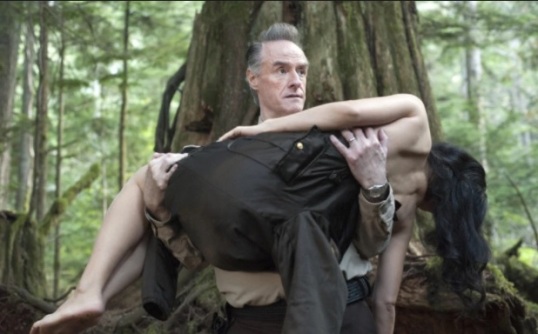
Suddenly, Andy is back in the woods. He is carrying Naido and he seems very confident of what needs to be done. “We have to get her off the mountain,” Andy says, “She is very important. There are people who want her dead. She’s fine physically. If we put her in a cell, she’ll be safe. Don’t tell anybody about this.”
(Of course, no one mentions that Naido doesn’t have any eyes.)
Back at the sheriff’s department, Lucy gives Naido some old pajamas and says she hopes they’re okay. Naido remains silent as Andy locks her up in a cell. After Andy and Lucy leave, a drunk in another cell starts to make monkey noises while the recently incarcerated Chad yells at him to shut up. Suddenly, Naido starts to softly murmur in her cell.
“It’s a fucking nuthouse!” Chad says.
“Fucking nuthouse,” the drunk replies, repeating Chad’s words in a way that reminded me of the way Dougie communicates with people in Vegas.
As Chad lies down in his cell, we see that the drunk is bleeding and a pool of blood is forming at his feet.
At the Great Northern, security guard James Hurley (James Marshall) is talking to another guard, Freddie Sykes (Jake Wardle). Freddie is originally from the UK and always wears a glove over his left hand. It’s James birthday and all he wants is for Freddie to explain why he always wears the glove.
Freddie explains that he can’t take the glove off. He tried once and his hand started bleeding. Freddie explains that one night, in London, he was sucked up into a vortex. A giant called The Fireman told him to go to a hardware store, find an open package of gloves, and put on only one glove. The glove gives Freddie super strength, which he discovered when he broke the neck of a man trying to prevent him from taking the glove. It was only after apparently killing this man that Freddie remembered that the Giant also told him to move to Twin Peaks, Washington. “There,” Freddie says the Giant told him, “you’ll find your destiny.”
James thanks Freddie for the story and then goes to check on the hotel’s furnace. As he does so, he hears an electrical hum, much like the one that was previously heard in Ben Horne’s office.
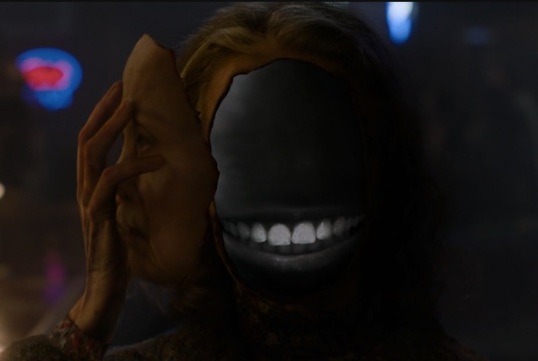
Meanwhile, Sarah Palmer (Grace Zabriskie) walks up to a sleazy bar. As she approaches, we hear the same electrical sound that we previously heard while Truman and the deputies were walking through the woods. Inside the bar, Sarah is harassed by a drunk who just won’t take no for an answer. So, Sarah opens her face, revealing the darkness underneath the human surface.
“Do you really want to fuck with this?” she asks, before closing her face and then biting the man’s neck and ripping out his throat…
OH MY GOD!!!!!
Sarah’s possessed! Well, we already knew that Sarah had psychic powers but … but… but….
Seriously, oh my God!
That said, I don’t blame Sarah. That guy was a jerk. We’ve all been there.
At the Roadhouse, two women — Megan (Shane Lynch) and Sophie (Emily Stofle) — talk about getting high, stealing, avoiding the nut house, and a missing acquaintance named Billy. Megan says that, when she last saw Billy, he was storming in and out of her kitchen, with blood coming from his nose. It is also revealed that Megan’s mom is named Tina. If all these names sound familiar, it’s because we already know that Audrey Horne has been 1) having an affair with Billy and 2) has a friend named Tina.
And so concludes a very intriguing episode of Twin Peaks: The Return.
To recap: Janey-E is Diane’s half-sister. The Fireman is sending people to Twin Peaks. And Billy and Tina actually do exist and aren’t just figments of Audrey’s imagination.
With only 4 episodes left, who knows where all of this is going to lead…
No, I won’t do three separate posts for the three different versions of this video. The differences are too small for that to make any sense. They’re all here–at least when this post goes up they should be. We’re gonna back into the original version.
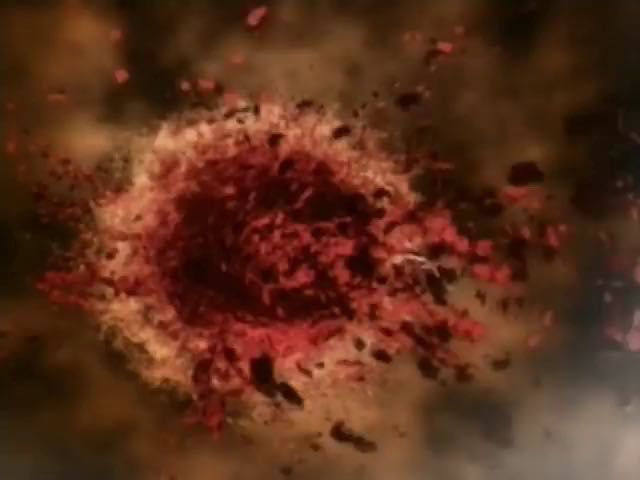
First things first, the release date that I found is sometime in June of 1994. According to Wikipedia, a couple of weeks later, the blackhole most of us probably remember was added in to give us the version posted above.
The second thing is that you’ll notice Cornell is wearing something around his neck.
Apparently, that was a fork necklace given to him by Shannon Hoon of Blind Melon. Hoon would die one year after the release of this video. There’s a reason I bring that up. It leads to the previous version of the video.
In this video you’ll see a side-by-side comparison of the two versions. The black hole isn’t shown as much. Whether that’s good thing or not, is up to you. I prefer it being there. The other effects are different or missing.
The thing I found interesting is the following:
While the bees were in the original, the more explicit reference to the bee-girl from the music video for No Rain by Blind Melon wasn’t. I have no idea if that is Heather DeLoach or not. I didn’t come across anything that said one way or another.
Regardless of whether it is or isn’t, I wonder why she wasn’t there to begin with. Maybe they weren’t sure they had the rights. Seeing as Shannon Hoon didn’t pass away till over a year later, my guess is that someone looked at that shot and thought the reference would go over people’s heads, so if they were going to give the video a facelift anyways, then put her in there.
Thank you, YouTube comments. I wouldn’t even know the following version exists without them. I hate those sections, and usually wish they would go away, but this time they lead me to this alternate, or uncensored version.
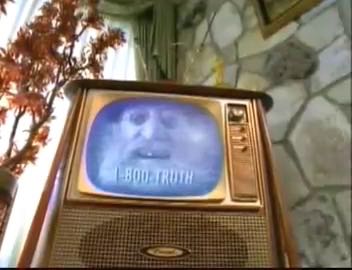
The only thing I noticed here is that the guy on the TV in this one has the phone number 1-800-TRUTH displayed below him.
I didn’t see any other differences when I watched it. There could be since someone mentioned that the black hole is missing. I didn’t notice it missing any less than the second version. I could be wrong though.
It doesn’t come as much of a surprise to me that the band says this video “was entirely the director’s idea.” They also went on to say that “our take on it was that at that point in making videos, we just wanted to pretend to play and not look that excited about it.”
They succeeded at that. I always wondered why they looked so disinterested. However, Thayil said that it was one of the few Soundgarden videos they liked. Them looking the way they did makes them look like they are the heart of darkness at the center of this black hole pulling this Blue Velvet-like idyllic landscape and characters towards their destruction.
When I was kid in middle school to high school, I knew about this video, but it was past its rotation time. It would pop up every once in awhile. Today I’ve seen it plenty of times. Then, it was like a 5-6 minute event to get to see it again.
There are numerous credits attached to this video.
The first is director Howard Greenhalgh. He’s done over a 100 music videos.
Megan Hollister produced it, Ivan Bartos shot it, Stan Kellam edited it, and both Ian Bird and John Wake did the specials effects.
Johnny Moon (William Shatner) is a half-breed. His father was white and his mother was a Comanche. Johnny was raised Comanche but he now lives as a white man. He is a good and law-abiding citizen but he has a problem. Johnny has a twin brother named Notah (played, of course, by William Shatner) and, hooked on peyote, Notah keeps holding up stagecoaches, killing white men, and raping white women. Sick and tired of people constantly trying to lynch him, Johnny contacts Notah and demands a final showdown. At the same time, Johnny refuses to tell anyone about Notah’s existence so everyone still wants to kill Johnny. The only person who realizes that Johnny and Notah are not the same is one of Notah’s victims, a showgirl named Kelly (Rosanna Yanni). She sees that good Johnny has blue eyes while bad Notah has black eyes.
William Shatner has described White Comanche as being his worst film, which is saying something when you consider some of the movies that Shatner made between the cancellation of Star Trek and the release of Star Trek: The Motion Picture. Still: William Shatner as twins, one of whom spends the entire movie tripping on peyote. That sounds like it should be fun and it would be except that, for the first and only time in his career, Shatner actually gives a low-key performance. When Shatner is playing Notah, he is the Shatner that we all know and love. But when Shatner plays Johnny Moon, he tries to give a subtle and restrained performance and, unfortunately, the movie is about 75% Johnny. That’s not what we pay money to see when we watch a William Shatner movie!
(By sheer coincidence, this post coincides with the birthday of character actor Millard Mitchell (1903-1953), who plays Tate in the film. Happy birthday, Millard! This one’s for you!)
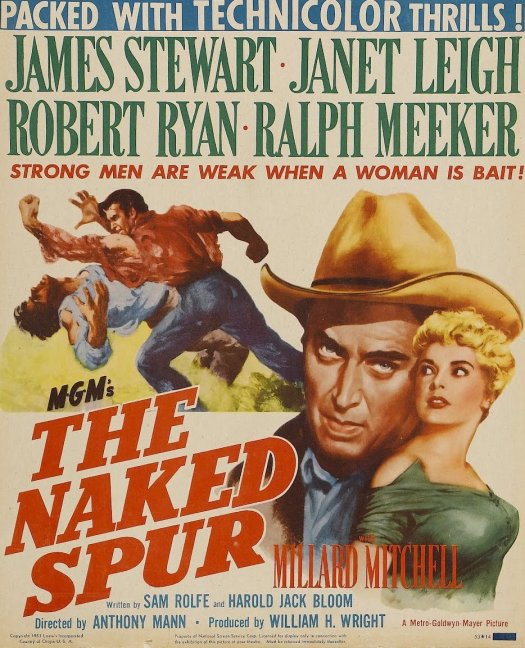
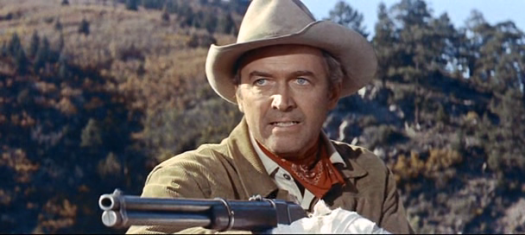
James Stewart and Anthony Mann moved from Universal-International to MGM, and from black & white to Technicolor, for THE NAKED SPUR, the third of their quintet of Westerns together. The ensemble cast of five superb actors all get a chance to shine, collectively and individually, creating fully fleshed out characters against the natural beauty of the Colorado backdrop.
Bitter Howard Kemp, whose wife sold their ranch and ran off while he was serving in the war, is hunting down killer Ben Vandergroat for the $5,000 bounty in hopes of rebuilding his life. Along the trail he meets old prospector Jesse Tate and recently discharged (dishonorably) Lt. Roy Anderson. The trio manages to capture Vandergroat, but he’s not alone… he’s accompanied by pretty wildcat Lina…
In 1914, 30 year-old Lawrence Sterne Stevens was serving as a cartographer in the British army when he was captured by the German army. Accused of being a spy, Stevens was forced to dig his own grave and was mere minutes away from being executed by a firing squad when he was rescued by advancing troops. Having narrowly survived the war, Stevens went on to study at the Academie Royale des Beaux Arts Bruxelles in Belgium and, from 1941 until his retirement in 1953, Stevens was one of the most prominent of the pulp illustrators. At the same time that Stevens was working, his son, Peter Stevens, was also a much sought after illustrator.
Here are just a few examples of Lawrence Sterne Stevens’s work:





 The year is 1876 and the legendary Wild Bill Hickok (Jeff Bridges) sits in a saloon in Deadwood and thinks about his life (most of which is seen in high-resolution, black-and-white flashbacks). Hickok was a renowned lawman and a sure shot, a man whose exploits made him famous across the west. Thanks to his friend, Buffalo Bill Cody (Keith Carradine), he even appeared on the New York stage and reenacted some of his greatest gun battles. Now, Hickok is aging. He is 39 years old, an old man by the standards of his profession. Though men like Charlie Prince (John Hurt) and California Joe (James Gammon) continue to spread his legend, Hickok is going blind and spends most of his time in a haze of opium and regret.







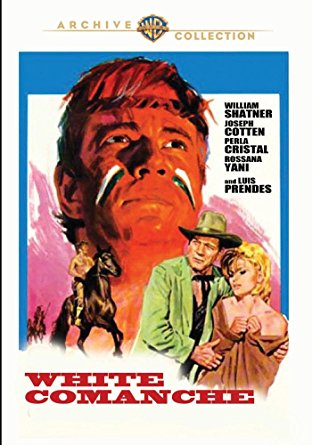 Johnny Moon (William Shatner) is a half-breed. His father was white and his mother was a Comanche. Johnny was raised Comanche but he now lives as a white man. He is a good and law-abiding citizen but he has a problem. Johnny has a twin brother named Notah (played, of course, by William Shatner) and, hooked on peyote, Notah keeps holding up stagecoaches, killing white men, and raping white women. Sick and tired of people constantly trying to lynch him, Johnny contacts Notah and demands a final showdown. At the same time, Johnny refuses to tell anyone about Notah’s existence so everyone still wants to kill Johnny. The only person who realizes that Johnny and Notah are not the same is one of Notah’s victims, a showgirl named Kelly (Rosanna Yanni). She sees that good Johnny has blue eyes while bad Notah has black eyes.


 Through the Shattered Lens