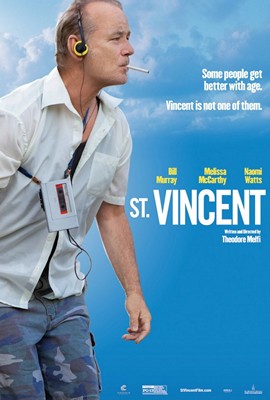
Film Review: St. Vincent (dir by Theodore Melfi)


St_Vincent_poster

It’s the craziest thing.

Every year, we get another Black List.  Despite the name, the Black List is not the annual list of actors and directors who need to be run out of America because of their political beliefs.  Instead, the Black List is a survey of the “most liked” unproduced scripts that are currently floating around Hollywood.

Now, of course, to a large extent, the Black List is basically just another marketing gimmick.  A lot of the scripts that have appeared on the Black List were already in development at the time that they appeared and, undoubtedly, there are clever studio execs who think to themselves, “Juno might be a difficult sell so let’s make sure it gets on the Black List!”

However, every year, there are a few films that are put into production directly as a result of the script appearing on the Black List.  What’s interesting is just how many of these films turn out to be, if not quite terrible, at least rather forgettable.  Transcendence, for instance, was on the Black List.  Cedar Rapids was on the Black List.  Broken City was on the freaking  Black List. Consider this: The Beaver would never have been made except for the fact that it was on The Black List!

What’s particularly interesting is that the script was often the worst thing about these films.  These were films with overly complicated scripts that often tried too hard to be both crowd pleasing and quirky.  If nothing else, the Black List proves that being the “most liked” doesn’t mean that a script is good, interesting, or intelligent.  It just means that it covered all the bases.

Case in point: the new film St. Vincent.  St. Vincent sat on top of the Black List and was apparently so “well-liked” that screenwriter Theodore Melfi not only saw his script produced but he also got to direct it.  And wouldn’t you know it — the two biggest failings of St. Vincent are the script and the direction.

It’s easy to point out why the direction is bad so I’ll start there.  St. Vincent essentially looks like the pilot for one of those sitcoms that would be described as being edgy just because it was about a cranky old man.  There is no visual flair to the film.  The images just sit there flat on the screen.

As for the script, it would be likable if it didn’t try so hard.  St. Vincent is about a guy named Vincent, a war hero who is now a cantankerous old alcoholic and a pathological gambler.  His best friend is a pregnant Russian stripper.  He owes money to a violent bookie.  Every weekend, he visits his wife in a nursing home and he pretends to be a doctor.  His wife no longer recognizes him.  When the recently divorced Maggie and her awkward son Oliver move in next door, Vincent agrees to babysit after school.  At first, Vincent just does it for the money but, as the movie progresses, he teaches Oliver how to stand up for himself and Oliver makes Vincent a little less grumpy.  Eventually, Oliver has to do a report for a school about someone in his life that he considers to be a real-life saint and guess who he picks?

St. Vincent tells the type of story that would usually bring me to tears and I’ll admit that there were a few times when I did get teary-eyed.  But, ultimately, the script was too heavy-handed for me to maintain those tears.  I love crying at movies but, at the same time, I resent it when a movie demands that I cry just because it happens to be mashing down on all of the right buttons.  This is one of those movies that doesn’t trust the audience.  Instead of letting us react to the characters, it just keeps piling on development after development.  It’s not enough that Maggie is a single mother who feels guilty about not being able to pick her son up from school.  Instead, Maggie’s ex-husband has to suddenly sue for custody.  It’s not enough that Vincent is struggling to pay the bills.  Instead, he has to have a bookie who shows up at random and threatens to kill him.  There’s more to an effective dramedy than just having half of your cast act as if they’re in a sitcom while the other half acts as if they’re appearing in an old episode of Law & Order.

And yet, despite the script and despite Melfi’s direction, St. Vincent does work and it really works only for one reason.  Melfi has managed to assemble a truly outstanding cast.  In the role Maggie, Melissa McCarthy proves that she deserves better than having to spend her career making movies like Identity Thief.  Jaeden Lieberhrer is likable and sympathetic as Oliver.  Playing the pregnant Russian stripper, Naomi Watts does the best that anyone probably could do with that poorly written character.

But, ultimately, the film is totally about Bill Murray.  Bill Murray plays Vincent and he saves the entire film.  Whether he’s being funny or being serious, Bill Murray gives the type of great performance that justifies his reputation for being a national treasure.  When those tears did come to my eyes, it was all due to Murray’s performance.

St. Vincent is a deeply flawed film but it’s worth seeing for Bill Murray.
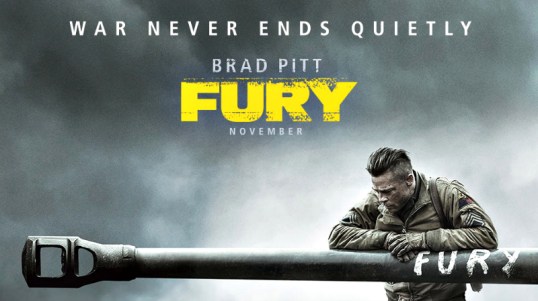
Review: Fury (dir. by David Ayer)


Fury

“Ideals are peaceful. History is violent.”

1998 saw the release of Steven Spielberg’s Saving Private Ryan.

Prior to this most films depicted World War II as a noble endeavor that needed to be done to help rid the world of Hitler and the horror he was inflicting upon Europe (beyond if given the chance). It gave birth to the “Greatest Generation” that people still look up to even to this day. These were young men who volunteered for a conflict that would change history and for the millions involved. Yet, World War II films were always cut and dried. It was always the good guys (American, British, Canadian, etc…) fighting against the nameless and efficient Nazi war machine.

In time, so many of these films followed the same formula that character stereotypes came about. We always had the cynical, older veteran who becomes a sort of father figure to a hodge-podge group of young, untested soldiers. What these films also had in common was the fact that they remain bloodless despite the nature of the story being told. Some filmmakers would try to buck this time-tested formula (Sam Fuller being the most prominent), but it would take 1998’s Saving Private Ryan to set a shift in how we saw World War II.

Spielberg lifted the rose-colored glasses from the audience and dared to show that while noble, World War II was still war and it still had the horror and brutality that all wars have. 2014’s Fury by David Ayer would continue this exploration of the last “Good War” in it’s most gritty and blood-soaked detail.

The film shows the last gasp of the German war machine as Hitler gives one of his final orders for the German people to repel the invading Allies. It was to be a scorched earth defense. Whether by choice or forced into this desperate tactic, every man, woman and child was to take up arms to their last breath to defend the Fatherland. It’s in this nightmare scenario that we find the veteran Sherman tank crew led by Don “Wardaddy” Collier trying to survive these final days til war’s end. Their home for the last two and a half years since North Africa has been a modified Sherman tank they call Fury. It’s a crew that’s been battle tested from the sands of North Africa, the maze-like hedgerows of France’s bocage and now the countryside of Germany itself.

We can see right from the start that this crew has been through hell and back many times and already resigned to going through hell many more times before they can eveb think of getting back home. It’s a crew that’s already lost one of it’s own minutes into the film. Wardaddy (Brad Pitt) looms over his crew like a weary father figure. This ragtag group consists of Bible (Shia LaBeouf) as the born-again Christian who sees their survival battle after battle as a sign that God’s grace is upon Fury and her crew. Then we have Gordo (Michael Peña) who has been so traumatized by the war and what he has had to do to survive that he has numbed himself from these memories by being in a constant state of drunkenness. Lastly, we have the tank’s loader Grady (Jon Bernthal) whose misanthropic attitude comes as a crude and brutish counterpoint to Bible’s religious fervor. Into this misanthropic soup of a crew comes in the replacement to their recently killed comrade.

Logan Lerman’s character, the young and naive clerk typist Norman Ellison, becomes the audience’s eyes in the brutal world of Fury and her crew. We’re meant to see the war’s brutality and horror not through the jaded and cynical eyes of Wardaddy and his men, but through a young man who has never killed an enemy or even fired a weapon in anger. Norman becomes the surrogate through which we determine and decide whether there is such a thing a nobility and honor in war.

Honor and nobility have always been used by those always willing to go to war to convince the young and impressionable to follow them into the breach. Fury takes these two words and what they represent and muddies them through the muck and gore left behind with each passing battle and tries to see if they remain unchanged on the other side. Norman is a literal babe in the woods as he must adapt or die in a war nearing it’s end but also becoming even more deadly and dangerous than ever. His very naivete quickly becomes a hindrance and a real danger to Wardaddy and his crew. He’s not meant for this world but has had it thrust upon him.

The film treats Norman’s humanity as a liability in a war that strips it from everyone given enough time. We see Wardaddy attempt to speed up the process during a tense sequence where Norman’s being forced to shoot a German prisoner. It’s a sequence of events that’s both unnerving and disturbing as we see the veteran soldiers encircling Norman and Wardaddy cheering or looking on with indifference in their eyes. They’ve all been in something similar and one can only imagine what they had to do to make it this far.

Fury straddles a fine line between showing and explaining it’s themes to the audience. It’s to David Ayer’s skill as a writer that the film’s able to use some finely choreographed scenes both violent and peaceful to make a point about war’s effect on it’s participants both physically and mentally. Whether it’s through several well-choreographed battle scenes to a sequence of tense and quiet serenity in the apartment of two German women that bring back the plantation segment from Coppola’s Apocalypse Now Redux, the film does a great job in showing how even when stripped down close to the bone, Wardaddy and his veteran crew still has semblance of humanity and the honor and nobility they all began the war with.

As a war film, Fury brings a type of combat to the bigscreen that has rarely been explored and never in such a realistic fashion as we watch tank warfare at it’s most tactical and most horrific. Ayer doesn’t fall for the jump cut style that many filmmakers nowadays sees as a way to convey the chaos of battle. Ayer and cinematographer Roman Vasnayov have planned every sequence to allow the audience to keep track of the two opposing sides and their place in the battle’s geography. And just like Spielberg’s own Saving Private Ryan, Fury shows the very ugly and bloody side of World War II. There’s a lot of bodies being blown apart and torn to chunks of meat yet they never seem to come off as gratuitous. Every bloody moment makes a point on the horrors of war and the level of inhumanity that another man inflicts on another man.

If there’s something that Fury does lag behind on it would be some of the narrative choices dealing with Norman’s character. The film takes place literally over a day’s time and the quick change in Norman’s mentality about the war seem very sudden and abrupt. While this day in the life of Fury and her crew worked well in Ayer’s past films (both as writer or director) here it puts Ayer stuck in a corner that made it difficult to fully justify Norman’s sudden change of heart from babe in the woods to hardened Nazi-killer. We can see throughout the film that the war is affecting him in ways that could lead up to this change, but to have it happen in just under a day really stretches it’s believability to the breaking point.

Yet, despite this the film is able to stay on course and recover from this misstep on the strength of Ayer’s direction and the performances of the ensemble cast. Brad Pitt has been the focus of the media campaign leading up to the release of Fury, but every actor who comprises the crew of Fury leave their own mark in the film. Shia Labeouf has had a tough past year both professionally and personally, but one has to admit that performances like the one he had in Fury is a reminder that he’s a damn fine good actor. Whether this film has become the path to his redemption in the eyes of the public is irrelevant. One doesn’t need to like the man to respect the talent he’s able to put up on the screen.

Awards season is in full swing as Fall 2014 arrives and Fury makes it’s case known that genre films (and make no mistake this is a genre film) can more than hold it’s own with the more dramatic life-exploring films that critics tend to put on the pedestal as examples of great filmmaking. While Fury is not perfect it is a very good film full of great performances that just misses being great.


Horror On The Lens: Horror Express (dir by Eugenio Martin)


Today’s horror on the lens is the 1972 classic Horror Express!

And you can watch it below!


Horror on TV: The Twilight Zone Ep. 111 “Printer’s Devil”


TheTwilightZoneLogo
In this episode of The Twilight Zone, Robert Sterling plays the editor of a failing newspaper. After being forced to fire all of his employees, Sterling prepares to commit suicide. However, before going through with it, Sterling is approached by a friendly old man (Burgess Meredith) who offers to both pay off Sterling’s debts and to work for him as the newspaper’s only reporter. Sterling agrees and…

Well, just the fact that this episode is entitled Printer’s Devil probably gives you a clue about what’s really going on with that nice old man…

Printer’s Devil is one of the rare hour-long episodes of The Twilight Zone. If nothing else, it’s worth watching just to compare Meredith’s performance here with his far different performance in Time Enough At Last.

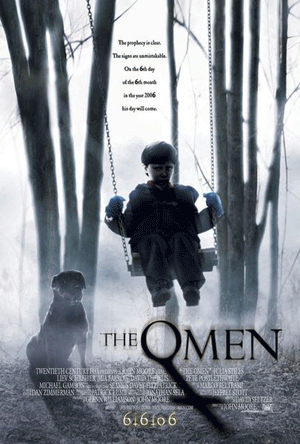
Horror Film Review: The Omen (dir by John Moore)


The_Omen_2006_poster

There’s really only one reason to see the 2006 remake of The Omen and that’s the fact that the priest who convinces Ambassador Thorn to adopt the Antichrist is played by the great Giovanni Lombardo Radice.

If you’re a fan of Italian horror, you’ll immediately know who Radice is and, whenever he appears in The Omen, you’ll be momentarily excited.  After all, Radice is an actor who has given memorable performances in films made by iconic directors like Lucio Fulci, Ruggero Deodato, Antonio Margheriti, Michele Soavi, and Martin Scorsese.  He’s appeared in everything from City of the Living Dead to Cannibal Apocalypse to The House On The Edge of the Park to Stagefright to Gangs of New York.  As both a horror icon and an excellent actor who has always been gracious and friendly to his fans, Giovanni Lombardo Radice is one of those actors who movie bloggers like me are always happy to see in any film.

(And, if anyone deserves a role in a Quentin Tarantino film, it’s Giovanni Lombardo Radice.)

And Radice gives a really great performance in The Omen.  He plays the role with just the right combination of menace and regret.  When he first appears, you can tell that he’s determined to get Robert Thorn to adopt Damien but that he’s not particularly happy about having to do it.  He may be one of the bad guys but he’s a bad guy with a conscience.  Later, when Radice makes a second appearance, it momentarily re-energizes the film.  He’s just got such a unique screen presence that, whenever he’s on-screen, Radice reminds you of the film that you want The Omen to be.

As for the rest of the remake — well, it’s all kind of pointless.  The film is largely a scene-by-scene remake of the first Omen and, unfortunately, it never quite answers the question of why the film needed to be remade in the first place.  The Gregory Peck role is played by Liev Schrieber while his wife is played by Julia Stiles.  The doomed photographer is played by David Thewlis.  Mia Farrow shows up in the role of the sinister nanny and Mia actually does a pretty good job but whenever she was delivering her lines, it was impossible for me not to imagine a remake of The Final Conflict where Ronan Farrow plays Damien.

Otherwise, the same characters die as in the original film and, often times, they die in the exact same way.  It’s really almost lazy how little the remake changes from the original.  And, ultimately, it makes the entire movie feel more than a little pointless.  You’re left with the feeling that the only reason the Omen was remade was so that it could be released on June 6th, 2006 (a.k.a. 6-6-06).

So, when it comes to The Omen, stick with the original but watch the remake for Giovanni Lombardo Radice.

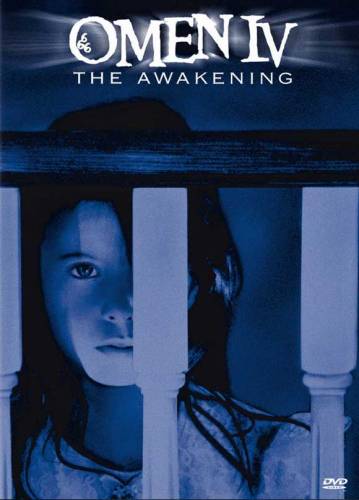
Horror Film Review: Omen IV: The Awakening (dir by Jorge Montesi and Dominique Othenin-Girard)


Omen_IV_DVD_cover

“Why am I watching this crap?”

That was the question that I asked myself many times last night as I watched Omen IV: The Awakening.

Seriously, it is just the WORST* and, if not for my own need to be a completist, I probably would have stopped watching after the first ten minutes.  But you know what?  I love movies, I love this site, and even more importantly — I LOVE YOU!  And I would do anything for you so I watched Omen IV: The Awakening so you wouldn’t have to.

Of course, when would you ever have to?  I probably should have considered that before I sat down to watch the film.

ANYWAY — let’s keep this quick.  The Omen IV: The Awakening was made for television and was originally broadcast way back in 1991.  It tells the story of Virginia Congressman Gene York (Michael Woods) and his wife, Karen (Faye Grant, who is currently in the news because of a tape that’s surfaced of her ex-husband Stephen Collins confessing to being a child molester).  Gene and Karen cannot have children so they adopt a baby from a bunch of nuns.  What they don’t suspect is that some of the nuns are actually in league with Satan and that their new daughter is actually the child of Damien Thorn!

Seven years later, they’ve named their daughter Delia and Delia has grown up to be something of a sociopath.  A bunch of new age hippie types suspect the truth about Delia but, whenever they get close to revealing that truth, they end up getting killed in freak accidents.  Meanwhile, Gene insists nothing is wrong while Karen…

Oh, forget it.  This movie is so bad that it’s painful to even try to describe the plot.

Let’s just say that this is an amazingly bad movie that has none of the power of the first Omen.  Nor is it as unintentionally fun as Damien: Omen II.  And none of the actors do as good as job as Sam Neill did in The Final Conflict.  Instead, it’s just a rather dull film where the tedium is only occasionally interrupted by somebody dying a terrible death.  There are two effective sequences — one in which a private detective (Michael Lerner) is chased by demonic spirits and another where a snake handler gets distracted just long enough to get bitten a few thousand times.  Otherwise, Omen IV: The Awakening deserves its terrible reputation.

AVOID IT AT ALL COSTS!

(Which probably won’t be hard since I imagine that the only way you could be tricked into watching it would be if you’re one of those film bloggers who insists on being a completist…)

—–

* Yes, it’s so bad that it gets the all caps treatment.

Horror Film Review: Omen III: The Final Conflict (dir by Graham Baker)


Omen_III_the_final_conflict

Originally, it had been planned that the Omen franchise would be made up of six or seven films and that each movie would check in on another year in the life of Damien Thorn, a bit like an apocalyptic version of Boyhood.  However, after Damien: Omen II failed to perform up to expectations, plans were changed.

Instead of continuing the story of Damien’s adolescence, the 1981 film Omen III: The Final Conflict jumps straight into Damien’s adulthood.  Now 32 years old and played by a very young (and handsome) Sam Neill, Damien Thorn is now the CEO of Thorn Enterprises.  With the help of his loyal assistant Harvey Dean (Don Gordon), Damien has become one of the most popular and powerful men on the planet.  Thorn Enterprises, having followed Paul Buhler’s scheme from the second film, is now responsible for feeding a good deal of the world.  Damien is seen as being a humanitarian and a future President.  When the U.S. Ambassador to the United Kingdom reacts to spotting a black dog in the park by committing suicide, Damien is appointed to the position.

(Needless to say, everyone in London is happy to see Damien.  Nobody says, “I just hope you don’t end up going crazy and dying a violent death, like everyone else in your family and immediate circle of acquaintances.”  But they’re probably thinking it…)

Now in London (and also appointed to be head of the United Nations Youth Organization, which just goes to show that your crazy uncle is right and the United Nations is a conspiracy), Damien pursues a rather creepy romance with journalist Kate Reynolds (Lisa Harrow) and makes plans to prevent the Second Coming by killing every single baby born on the morning of March 24th.  (But Harvey’s son was born on March 24th — wow, could this lead to some sort of conflict?)

Meanwhile, a group of priests (led by an embarrassed-looking Rossanno Brazzi) have recovered these damn daggers of Megiddo and are now all attempting to assassinate Damien.  Unfortunately, none of them are very good at their job.  (“You had one job, Father!  One job!”)

Bleh.

The Final Conflict is not that good.  It’s boring.  The plot is full of holes.  For instance — and yes, these are SPOILERS — why have we sat through two movies listening to characters insist that Damien has to be stabbed by all seven of the daggers when apparently, just one dagger will do the job?  Why, after being told that Jesus is going to be reborn as a child, does he then appear as an adult at the end of the film?  And finally, why does nobody ever seem to find it strange that everyone that Damien knows end up suffering a freak accident?

I will say that there are two good things about The Final Conflict.

First off, Sam Neill gives a good performance as Damien Thorn.  He’s handsome, he’s charismatic, and he’s not afraid to be evil.  But, unfortunately, Damien’s just not that interesting of a character anymore.  In the first Omen, he was interesting because he was an evil five year old.  In the second Omen, he was at least occasionally conflicted about his role.  In the third Omen, Damien is just evil and evil without nuance is boring.

Secondly, there’s that sequence where Damien’s followers go after the babies born on March 24th.  Oh my God, that was so disturbing and it was one of the few moments when The Final Conflict actually became horrific.

Otherwise, The Final Conflict is a thoroughly forgettable sequel to a memorable film.

Horror Film Review: Damien: Omen II (dir by Don Taylor)


DamienomenII

The first sequel to The Omen was 1978’s Damien: Omen II.  Damien: Omen II is an odd film, one that is not very good but yet remains very watchable.

Damien: Omen II takes place 7 years after the end of the original Omen.  Antichrist Damien Thorn (now played by Jonathan Scott-Taylor) is now 12 years old.  He lives with his uncle Richard (William Holden) and Richard’s 2nd wife, Ann (Lee Grant).  His best friend is his cousin Mark (Lucas Donat).  In fact, the only problem that Damien has is that his great-aunt Marion (Sylvia Sidney) can’t stand him and views him as a bad influence.  Fortunately, as usually seems to happen whenever someone puts an obstacle in Damien’s life, there’s always either a black dog or a black crow around to help out.

Damien and Mark are cadets at a local military academy where Damien deals with a bully by glaring at him until he falls to the ground, grabbing at his head.  In history class, Damien shocks his teacher by revealing that he knows the date of every battle ever fought.  Damien’s new commander, Sgt. Neff (Lance Henriksen), pulls Damien to the side and tells him to stop showing off and to quietly bide his time.

Meanwhile, Richard is busy running Thorn Industries.  One of his executives, Paul Buhler (Robert Foxworth), wants to expand Thorn’s operations into agriculture but his plans are opposed by Richard’s executive vice president, Bill Atherton (Lew Ayres), who considers Paul to be unethical.  However, during an ice hockey game, Bill falls through the ice and, despite the efforts of everyone to break through the ice and save him, ends up floating away.  Paul is promoted and pursues his plans to make money off of world famine.  In between all of this, Paul finds the time to speak to Damien and tell him that he has a great future ahead of him.

Along with Thorn Industries, Richard also owns the Thorn Museum in Chicago.  The museum’s curator is Dr. Charles Warren (Nicholas Pryor) who was a friend of the archeologist Karl Bugenhagen (Leo McKern) who, in the first film, revealed that not only was Damien the antichrist but that the only way to kill him was by stabbing him with the Seven Daggers of Meggido.  Dr. Warren is also friends with Joan Hart (Elizabeth Shepherd), a reporter who both knows the truth behind Bugenhagen’s death and who has also seen an ancient cave painting that reveals that the Antichrist looks exactly like a 12 year-old Damien Thorn.

Much as in the first film, just about everyone who comes into contact with Damien ends up getting killed in some odd and grotesque way.  Crows peck out eyes.  Trucks run over heads.  One unfortunate victim is crushed between two trains.  Another is chopped in half by an elevator cable.  At times, Damien: Omen II feels less like a sequel to The Omen and more like a forerunner to Final Destination.

Damien: Omen II is one of those films that I like despite myself.  It’s bad but it’s bad in a way that only a film from the 1970s could be and, as such, it has some definite historical value.  The script is full of red herrings, the acting is inconsistent, and the film can never seem to make up its mind whether Damien is pure evil or if he’s conflicted about his role as Antichrist.  As I watched the film, I wondered why the devil could so easily kill some people but not others.

And yet, Damien: Omen II is so ludicrous and silly that it’s undeniably watchable.  If the first film was distinguished by Gregory Peck’s defiant underplaying, the second film is distinguished by the way that William Holden delivers every line through manfully clenched teeth.  Everyone else in the cast follows Holden’s lead and everyone goes so far over-the-top that even the most mundane of scenes become oddly fascinating.

For me, the film is defined by poor Lew Ayres floating underneath that sheet of ice while everyone else tries to rescue him.  On the one hand, it’s absolutely horrific to watch.  I’m terrified of drowning and, whenever the camera focused on Ayres desperately pounding on the ice above him, I could barely bring myself to look at the screen.  But, at the same time, we also had William Holden screaming, “OH GOD!” and Nicholas Pryror enthusiastically chopping at the ice with a big axe and dozens of extras awkwardly skating across the ice.  Somehow, the scene ended up being both horrifying and humorous.  It should not have worked but somehow, it did.

And that’s pretty much the perfect description of Damien: Omen II.  It shouldn’t work but, in its own way, it does.

Horror Film Review: The Omen (dir by Richard Donner)


The Omen

A few days ago, Arleigh shared the theme song from 1976’s The Omen as Monday’s horror song of the day.  As I sat there and listened to Jerry Goldsmith’s award-winning hymn to Satan, it occurred to me that I happen to have all five of the Omen films sitting in my movie collection.  Seeing as how this is Halloween and how the world seems to be getting closer to ending with each passing day, I decided that this would be the perfect time to rewatch the entire franchise and consider whether or not The Omen films are truly as scary as a lot of people seem to think.

So, that’s what I did.

How did things turn out?

Well, in the long history of sequels and remakes, The Omen franchise is one of the more uneven collections.  This is one of those franchises where things tend to get less impressive with each subsequent entry.  However, 38 years after its initial release, the first Omen remains effective and, in its way, genuinely scary.

If you’re a horror fan, you probably know the general plot of The Omen regardless of whether you’ve actually watched it or not.  It’s one of those films that has been so frequently imitated that it’s almost possible to watch it by osmosis.

The film opens in Rome with diplomat Robert Thorn (Gregory Peck) being rushed to the hospital where his wife, Kathy (Lee Remick), has just given birth.  A priest (Martin Benson) tells him that his son died shortly after being born but that he can always just go home with an orphaned newborn that he just happens to have handy.  Robert agrees and decides not to tell his wife the truth about the child.  Robert and Kathy raise the boy and they name him Damien.  Four years later, the politically ambitious Robert is named as Ambassador to the Court of St. James.

The Thorns move to London and soon, odd things start to happen.  Damien (now played by Harvey Spencer Stephens) is a quiet boy with a piercing stare who throws a fit whenever he’s taken inside of a church.  When Kathy takes Damien to the zoo, they’re attacked by angry baboons.  A large Rottweiler mysteriously appears on the grounds of the Ambassador’s estate.  A mysterious and sinister nanny (Billie Whitelaw) shows up and explains that she’s been sent by an “agency.”  A crazed priest (Patrick Troughton) starts to stalk the Ambassador, demanding a chance to speak with him and insisting that Damien’s mother was actually a jackal.

Even more mysteriously, people start dying in the strangest of ways.  A young woman (Holly Palance) smiles as she shouts, “Damien, it’s all for you!” and then hangs herself, thoroughly ruining Damien’s fifth birthday party.  A freak lightning storm leads to a man being impaled by a weather vane.  Another person who suspects that there might be something wrong with Damien ends up losing his head in a graphic sequence that — even in this age of Hostel and Saw — is difficult to watch.

The Ambassador is contact by Keith Jennings (David Warner), a nervous photographer who fears that Damien may be planning on killing him.  Soon, Thorn and Jennings are flying to Italy and to the Middle East and discovering evidence that five year-old Damien might very well be the Antichrist.  Speaking of Damien, he and that nanny have been left alone with poor, victimized Kathy.

(“Oh, leave her alone,” I muttered as Damien attempted to kill Kathy for the hundredth time…)

As I watched The Omen, I tried to figure out why this film has held up so well.  It certainly wasn’t due to the performance of Gregory Peck who, quite frankly, seemed to mostly be going through the motions.  David Warner, on the other hand, gave such a good performance that it was almost difficult to watch.  (Don’t get attached to any character who appears in an Omen film.)   Some of the film’s effectiveness was undoubtedly due to Jerry Goldsmith’s intense score.  Anything’s scary when you’ve got a hundred voice shouting “Ave Satani” at you.

But, ultimately, I think the reason why The Omen still works is because the film generates such a palpable sense of doom.  This is one of those films that leaves you convinced that anyone can die at any minute and, considering that happens to be true in both this movie and in real life, that makes the horror of The Omen feel very real.  By the time the film ends, you’re left with little doubt that nobody in the film had the least bit of power or control over his or her own destiny.  Instead, they were all just pawns in a game that they had no hope of ever winning or understanding.  Is there anything scarier than feeling powerless?

All I know is that, having rewatched The Omen, I will never look at a plane of glass the same way again.


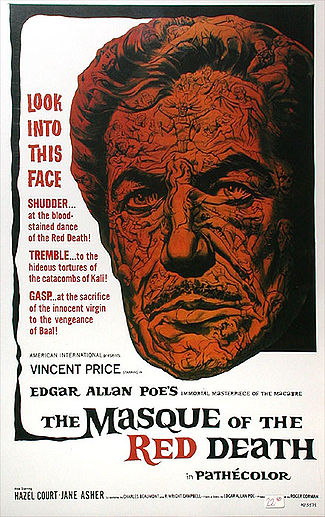
Horror on The Lens: The Masque of the Red Death (dir by Roger Corman)


MasqueOfTheRedDeath(1964film)

So here we are, 24 days into October, and I have yet to share an old Vincent Price film!  It’s not October without at least a little contribution from Vincent.  Well, allow me to correct that with today’s horror on the lens, the 1964 Roger Corman film The Masque of the Red Death.

Based on the classic story by Edgar Allan Poe, this film features Vincent Price giving one of his best performances as the doomed and decadent Satanist Prince Prospero.  The film’s cinematographer was future director Nicolas Roeg and The Masque of the Red Death is probably one of the most visually impressive of all of Corman’s films.

Enjoy!