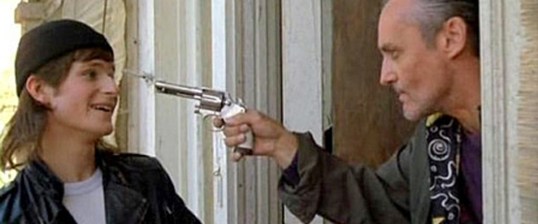
For the longest time, I thought that Two-Minute Warning was a movie about a gang of art thieves who attempt to pull off a heist by hiring a sniper to shoot at empty seats at the Super Bowl. As planned by a master criminal known as The Professor (Rossano Brazzi), the sniper will cause a riot and the police will be too busy trying to restore order to notice the robbery being committed at an art gallery that happens to be right next to the stadium.
I believed that because that was the version of Two-Minute Warning that would sometimes show up on television. Whenever I saw the movie, I always through it was a strange plan, one that had too many obvious flaws for any halfway competent criminal mastermind to ignore them. What if the sniper was captured before he got a chance to start shooting? What if a riot didn’t break out? The sniper spent the movie aiming at empty seats but, considering how many people were in the stadium, it was likely that he would accidentally shoot someone. Were the paintings really worth the risk of a murder charge?
Even stranger was that Two-Minute Warning was not only a heist film but it was also a 1970s disaster film. Spread out throughout the stadium were familiar character actors like Jack Klugman, John Cassevetes, David Janssen, Martin Balsam, Gena Rowlands, Walter Pidgeon, and Beau Bridges. It seemed strange that, once the shots were fired and Brazzi’s men broke into the gallery, all of those familiar faces vanished. When it comes to disaster movies, it is an ironclad rule that at least one B-list celebrity has to die. It seemed strange that Two-Minute Warning, with all those characters, would feature a sniper shooting at only empty seats. For that matter, why would there be empty seats at the Super Bowl?
That wasn’t the strangest thing about Two-Minute Warning, though. The strangest thing was that Charlton Heston was in the film, playing a police captain. In most of his scenes, he had dark hair. But, in the scenes in which he talked about the art gallery, Heston’s hair was suddenly light brown.
Recently, I watched Two-Minute Warning on DVD and I was shocked to discover that the movie on the DVD had very little in common with the movie that I had seen on TV. For instance, the television version started with the crooks discussing their plan to rob the gallery. The DVD version opened with the sniper shooting at a couple in the park. In the DVD version, there was no art heist. The sniper had no motive and no personality. He was just a random nut who opened fire on the Super Bowl. And, in the DVD version, he did not shoot at empty seats. Several of the characters who survived in the version that I saw on TV did not survive in the version that I saw on DVD.
What happened?
The theatrical version of Two-Minute Warning was exactly what I saw on the DVD. A nameless sniper opens fire and kills several people at the Super Bowl. In 1978, when NBC purchased the television broadcast rights for Two-Minute Warning, they worried that it was too violent and too disturbing. There was concern that, if the film was broadcast as it originally was, people would actually think there was a risk of some nut with a gun opening fire at a crowded event. (In 1978, that was apparently considered to be implausible.) So, 40 minutes of new footage was shot. Charlton Heston even returned to film three new scenes, which explains his changing hair color. The new version of Two-Minute Warning not only gave the sniper a motive (albeit one that did not make much sense) but it also took out all of the violent death scenes.
Having seen both versions of Two-Minute Warning, neither one is very good, though the theatrical version is at least more suspenseful than the television version. (It turns out that it was better to give the sniper no motive than to saddle him with a completely implausible one.) But, even in the theatrical version, the potential victims are too one-dimensional to really care about. Ultimately, the most interesting thing about Two-Minute Warning is that, at one time, an art heist was considered more plausible than a mass shooting.