Though the Academy of Motion Picture Arts and Sciences claim that the Oscars honor the best of the year, we all know that there are always worthy films and performances that end up getting overlooked. Sometimes, it’s because the competition too fierce. Sometimes, it’s because the film itself was too controversial. Often, it’s just a case of a film’s quality not being fully recognized until years after its initial released. This series of reviews takes a look at the films and performances that should have been nominated but were, for whatever reason, overlooked. These are the Unnominated.
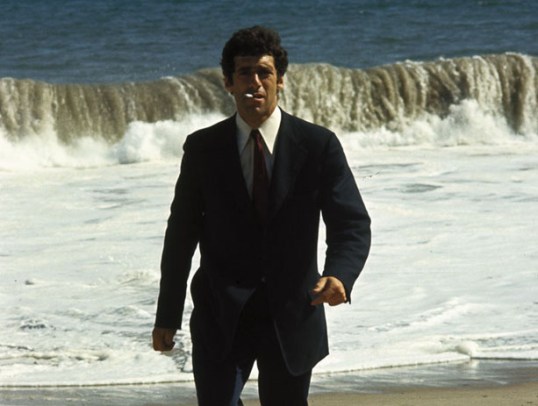
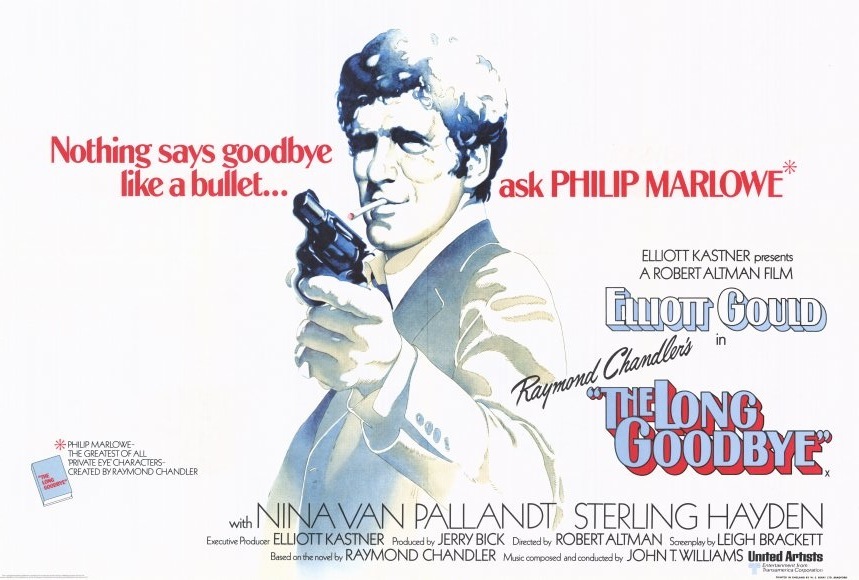
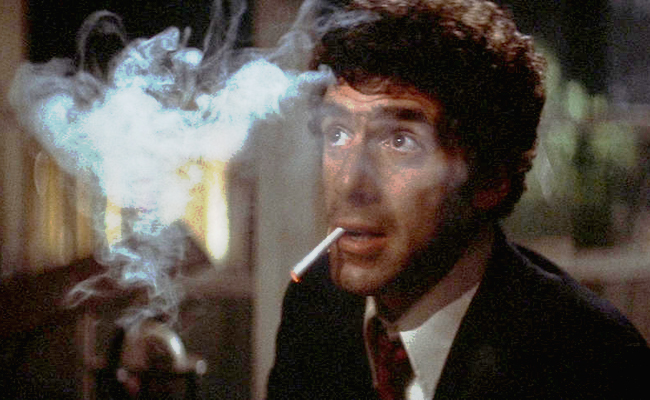
Elliott Gould is Phillip Marlowe!
If I had to pick one sentence to describe the plot of 1973’s The Long Goodbye, that would be it. Robert Altman’s adaptation of the Raymond Chandler detective novel loosely follows Chandler’s original plot, though Altman did definitely make a few important changes. Altman moved the story from the 50s to the then-modern 70s, replacing Chandler’s hard-boiled Los Angeles with a satirical portrait of a self-obsessed California, populated by gurus and hippies. And Altman did change the ending of the book, taking what one could argue is a firmer stand than Chandler did in the novel. In the end, though, the film really is about the idea of Chandler’s tough detective being reimagined as Elliott Gould.
Rumpled, mumbling, and with a permanent five o’clock shadow, Gould plays Marlowe as being an outsider. He lives in a shabby apartment. His only companion is a cat who randomly abandons him (as cats tend to do). With his wardrobe that seems to consist of only one dark suit, Marlowe seems out-of-place in the California of the 70s. When Marlowe’s friend, Terry Lennox (Jim Bouton), asks Marlowe to drive him to Mexico, one gets the feeling that Lennox isn’t just asking because Marlowe’s a friend. He’s asking because he suspects Marlowe would never be a good enough detective to figure out what he’s actually doing.
After Terry’s wife is murdered, Marlowe is informed that 1) Terry has committed suicide and 2) Marlowe is now a suspect. Convinced that Terry would have never killed himself, Marlowe investigates on his own. He meets Marty Augustine (Mark Rydell), a gangster who demands that Marlowe recover some money that he claims Terry stole. Marty seems like an almost reasonable criminal until he smashes a coke bottle across his girlfriend’s face. (One of Marty’s bodyguards is played by a silent Arnold Schwarzenegger.) Meanwhile, Terry’s neighbors include an alcoholic writer named Roger Wade (Sterling Hayden) and his wife, Eileen (Nina van Pallandt). Like Marlowe, Roger is a man out-of-time, a Hemingwayesque writer who has found himself in a world that he is not capable of understanding. Henry Gibson, who would later memorably play Haven Hamilton in Altman’s Nashville, appears as Wade’s “doctor.”
Marlowe, with his shabby suits and a cigarette perpetually dangling from his mouth, gets next to no respect throughout the film. No one takes him seriously but Marlowe proves himself to be far more clever than anyone realizes. Elliott Gould gives one of his best performances as Marlowe, playing him as a man whose befuddled exterior hides a clear sense of right and wrong. Gould convinces us that Marlowe is a man who can solve the most complex of mysteries, even if he can’t figure out where his cat goes to in the middle of the night. His code makes him a hero but it also makes him an outsider in what was then the modern world. The film asks if there’s still a place for a man like Phillip Marlowe in a changing world and it leaves it to us to determine the answer.
Frequently funny but ultimately very serious, The Long Goodbye is one of the best detective films ever made. Just as Altman did with McCabe & Mrs. Miller, he uses the past to comment on what was then the present. And, just as with McCabe & Mrs. Miller, The Long Goodbye is a film that was initially released to mixed reviews, though it would later be acclaimed by future viewers and critics. Whereas McCabe & Mrs. Miller received an Oscar nomination for Julie Christie’s performance as Mrs. Miller, The Long Goodbye was thoroughly snubbed by the Academy. Altman, Gould, Hayden, and the film itself were all worthy of consideration but none received a nomination. Instead, that year, the Oscar for Best Picture went to The Sting, a far less cynical homage to the crime films of the past.
The Long Goodbye (1973, directed by Robert Altman)
Rick Martin (Sterling Hayden) rides his horse into his hometown of Casper, Wyoming. He has an important message to deliver to the town marshal but first, he visits his mother’s grave and discovers that there is a maker with his name on it and an open grave waiting for him. Many of the other makers are for people who are specifically identified as have been “Murdered by Rick Martin.”
Rick is notorious for being a gunslinger and most of the town considers him to be nothing but a murderer, despite Rick’s claim that he’s never shot anyone who didn’t try to shoot him first. Despite the town’s feelings towards him, Rick warns his old friend, Marshal Bat Davis (James Millican), that the notorious outlaw Tom Quentin (John Dehner) is coming to Casper and is planning on tearing the place up. Rick offers to stick around and help fight Quentin and his men but the city council orders him to leave.
City councilman Canby Judd (William Bishop) especially wants to get rid of Rick. Judd murdered Rick’s mother for her land and he is also engaged to Rick’s former girlfriend, Laura (Karin Booth). When Rick asks Laura to come to California with him, Judd and his gunslinger (played by Rod Taylor, in one of his first film roles) conspire to put Rick in jail. At first, the town is happy to have Rick behind bars but then Tom Quentin and his gang show up.
Though it will never be the most popular film to use the title, 1955’s Top Gun is an intelligent B-western that puts as much emphasis on the hypocrisy of the town as it does on gunfights and duels. The population sign specifically says that Casper is home to “1,002 law-abiding citizens” and it is obvious that Rick is not considered to be good enough to be one of those citizens. Rick may have a violent past but he’s honest about who he is, unlike the holier-than-thou townspeople who put Rick in jail and then expect him to help them out when the real outlaws arrive. Though the townspeople pretend that there’s no place for someone like Rick Martin in their society, Rick understands the harsh reality of life in the old west. Director Ray Nazarro does a good job choreographing the fight scenes and Sterling Hayden give a tough and angry performance as Rick Martin and he’s supported by an able cast of western regulars. Western fans will find much to enjoy while watching Top Gun.
Ah, the 60s. Both the studio system and the production code collapsed as Hollywood struggled to remain relevant during a time of great social upheaval. The Academy alternated between nominating films that took chances and nominating films that cost a lot of money. It led to some odd best picture lineups and some notable snubs!
1960: Psycho Is Not Nominated For Best Picture and Anthony Perkins Is Not Nominated For Best Actor
To be honest, considering that the Academy has never really embraced horror as a genre and spent most of the 60s nominating big budget prestige pictures, it’s a bit surprising that Psycho was actually nominated for four Oscars. Along with being nominated for its production design and its cinematography, Psycho also won nominations for Alfred Hitchcock and Janet Leigh. However, Anthony Perkins was not nominated for Best Actor, despite giving one of the most memorable performances of all time. The film literally would not work without Perkins’s performance and, considering that Perkins pretty much spent the rest of his career in the shadow of Norman Bates, it’s a shame that he didn’t at least get a nomination for his trouble. Psycho was also not nominated for Best Picture, despite being better remembered and certainly more influential than most of the films that were.
1962: The Man Who Shot Liberty Valance Is Almost Totally Snubbed
The Man Who Shot Liberty Valance was not totally snubbed by the Academy. It received a nomination for Best Costume Design. But still, it deserved so much more! John Ford, James Stewart, John Wayne, Lee Marvin, Vera Miles, and the picture itself were all worthy of nominations. Admittedly, 1962 was a year full of great American films and there was a lot of competition when it came to the Oscars. Still, The Man Who Shot Liberty Valance definitely deserved a best picture nomination over the bloated remake of Mutiny on the Bounty. Today, if the first Mutiny on the Bounty remake is known for anything, it’s for Marlon Brando being difficult on the set. But The Man Who Shot Liberty Valance is still remembered for telling us to always print the legend.
1964: From Russia With Love Is Totally Snubbed
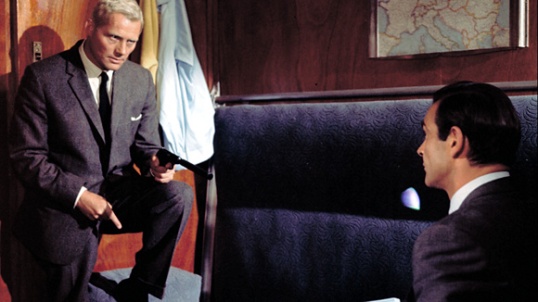
The same year that the Academy honored George Cukor’s creaky adaptation of My Fair Lady, it totally ignored my favorite James Bond film. From Russia With Love is a Bond film that works wonderfully as both a love story and a thriller. Sean Connery, Lotte Lenya, Robert Shaw, and Terence Young all deserved some award consideration. From Russia With Love was released in the UK in 1963. In a perfect world, it would have also been released concurrently in the U.S., allowing From Russia With Love to be the film that gave the the Academy the chance to recognize the British invasion. Instead, Tom Jones was named the Best Picture of 1963 and From Russia With Love had to wait until 1964 to premiere in the U.S. It was snubbed in favor of one of old Hollywood’s last grasps at relevance.
1964: Slim Pickens Is Not Nominated For Best Supporting Actor
Playing three separate roles, Peter Sellers dominates Dr. Strangelove: Or How I Learned To Stop Worrying And Love The Bomb. But, as good as Sellers is, the film’s most memorable image is definitely Slim Pickens whooping it up as he rides the bomb down to Earth. George C. Scott and Sterling Hyaden also undoubtedly deserved some award consideration but, in the end, Pickens is the one who brings the film to life even as he helps to bring society to an end.
1967: In Cold Blood Is Not Nominated For Best Picture
In Cold Blood, though not a perfect film, certainly deserved a nomination over Dr. Doolittle.In Cold Blood is a film that still has the power to disturb and haunt viewers today. Dr. Doolittle was a box office debacle that was nominated in an attempt to help 20th Century Fox make back some of their money.
1967: Sidney Poitier Is Not Nominated For Best Actor For In The Heat Of The Night
In 1967, Sidney Poitier starred in two of the films that were nominated for Best Picture but somehow, he did not pick up a nomination himself. His restrained but fiercely intelligent performance in In The Heat Of The Night provided a powerful contrast to Rod Steiger’s more blustery turn. That Poitier was not nominated for his performance as Virgil Tibbs truly is one of the stranger snubs in Academy history. (If I had to guess, I’d say that the Actors Branch was split on whether to honor him for In The Heat of the Night or Guess Who’s Coming To Dinner or even for To Sir With Love and, as a result, he ended up getting nominated for none of them.)
1968: 2001: A Space Odyssey and Planet of the Apes Are Not Nominated For Best Picture
Neither one of these classic science fiction films were nominated for Best Picture, despite the fact that both of them are far superior and far more influential than Oliver!, the film that won that year.
Not even Ennio Morricone’s score received a nomination!
1968: Petulia Is Totally Snubbed
Seriously, I don’t know what was going on with the Academy in 1968 but it seems they went out of their way to ignore the best films of the year. Richard Lester’s Petulia is usually cited as one of the definitive films of the 60s but it received not a single Oscar nomination. Not only did the film fail to receive a nomination for Best Picture but Richard Lester, George C. Scott, Julie Christie, Shirley Knight, Richard Chamberlain, and the film’s screenwriters were snubbed as well.
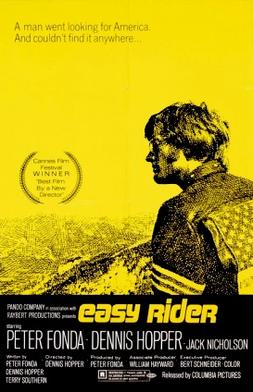
1969: Easy Rider Is Not Nominated For Best Picture
Yes, I know. Easy Rider is a flawed film and there are certain moments that are just incredibly pretentious. That said, Easy Rider defined an era and it also presented a portrait of everything that was and is good, bad, and timeless about America. The film may have been produced, directed, and acted in a drug-razed haze but it’s also an important historical document and it was also a film whose success permanently changed Hollywood. Certainly, Easy Rider’s legacy is superior to that of Hello, Dolly!
Agree? Disagree? Do you have an Oscar snub that you think is even worse than the 10 listed here? Let us know in the comments!
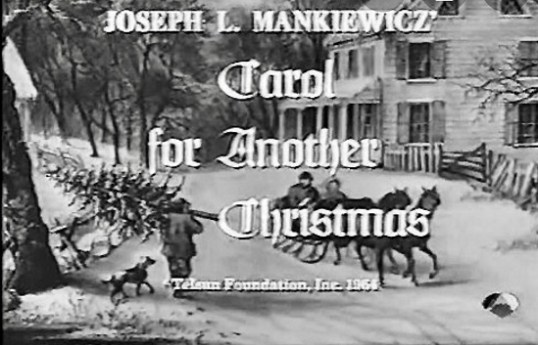
Daniel Grudge (Sterling Hayden) is a wealthy American industrialist who served in World War II and who, despite seeing first hand the horrors of Hiroshima, still believes that war is sometimes the only answer. He spends his Christmas Eve sitting in darkened study, thinking about his dead son (who was killed in combat) and listening to an old record. When his nephew, Fred (Ben Gazzara), stops by, it leads to an argument about American foreign policy. (Who stops by their uncle’s house on Christmas Eve to argue politics?) Fred is do-gooder. Daniel Grudge hates do-gooders.
So, naturally, it’s time for Daniel Grudge to be visited by three ghosts! The Ghost of Christmas Past (Steve Lawrence) takes Grudge first to a troop ship that is full of coffins, representing the dead of World War I. Then he forces Grudge to relive his own callous reaction to Hiroshima. Grudge sees how his actions upset the nurse (Eva Marie Saint) who was traveling with him. The Ghost of Christmas Present (Pat Hingle) invites Grudge to eat a feast in front of a camp full of refugees. The Ghost of Christmas Future (Robert Shaw) takes Grudge to the future where, after a devastating nuclear war, a buffoonish leader (Peter Sellers) encourages his followers to continue to make war and to live only for themselves. Grudge watches as his former butler (Percy Rodriguez) is murdered for advocating for peace. Back at his mansion, Fred shows up again and Grudge must now decide …. will he support the work of the United Nations?
YEEEEESH! What a heavy-handed movie! Really, I guess I shouldn’t be surprised at how unsubtle the film’s message was. Originally made for television, A Carol For Another Christmas was actually co-produced by the United Nations. It was the first of four UN-produced films that aired on ABC between 1964 and 1966. Seen today, with all that we know about the UN’s signature mix of corruption and incompetence, the film’s message seems almost laughably naïve. “Only the UN can bring peace,” the film says. Tell that to Israel, the next time that the UN passes a resolution condemning it for existing and defending itself. Say that only the UN can make the world a better place when some of the worst dictatorships on the planet are sitting on the Human Rights council.
The heavy-handed message aside, A Carol For Another Christmas was full of talent both behind and in front of the camera. This was the only TV movie to be directed by Joseph L. Mankiewicz and, whatever else one might say about the film, he was responsible for some intriguingly moody shots. The script was written by Rod Serling who, unfortunately, allowed his didactic tendencies to get the better of him and wrote a film where characters didn’t have conversations as much as they just gave speeches. The cast, however, is uniformly strong. Sterling Hayden, Robert Shaw, and Steve Lawrence are obvious stand-outs. Pat Hingle does fine until his role is diminished to one long harangue. Playing the so-called “Imperial Me,” Peter Sellers brings so much needed unpredictability to the film, even if his character is saddled with the film’s most heavy-handed moment. The Imperial Me teaches his followers that the individual is more important than the state and that everyone should focus on “me” instead of “we.” Cutting-edge satire this is not and again, there’s something rather offensive about the UN being held up as humanity’s last hope against rampant individualism.
This is very much a film of its time. The fear of nuclear war runs through every frame. The disillusionment that came with the assassination of John F. Kennedy is present in the film’s open-ended conclusion. What good is convincing one man when the rest of the world continues to think for itself? the film seems to be asking. Dickens, I think, would probably say that Serling missed the point of A Christmas Carol and it’s hard not to feel that Dickens would be correct.
Like a lot of people, I enjoy browsing the trivia sections of the IMDb. While it’s true that a lot of the items are stuff like, “This movie features two people who appeared on a television series set in the Star Trek Universe!,” you still occasionally came across an interesting fact or two.
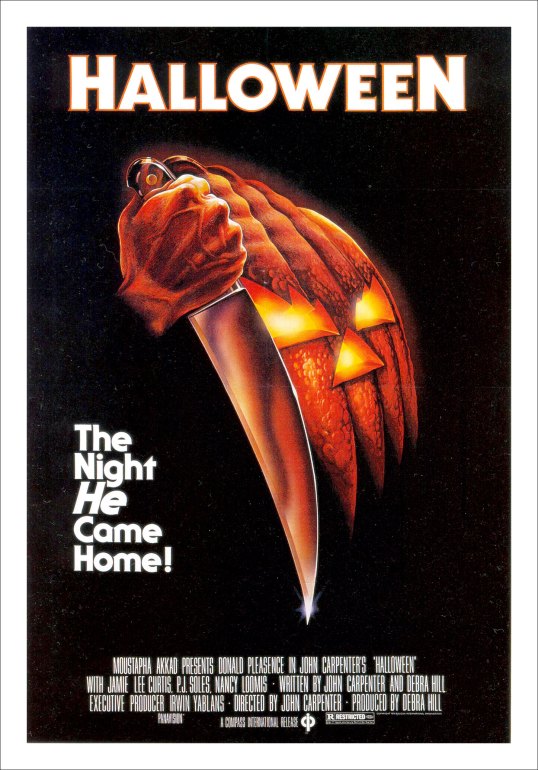
Of course, sometimes, you just come across something that makes so little sense that you can only assume that it was posted as a joke. For instance, I was reading the IMDb’s trivia for the original 1978 Halloween and I came across this:
Peter O’Toole, Mel Brooks, Steven Hill, Walter Matthau, Jerry Van Dyke, Lawrence Tierney, Kirk Douglas, John Belushi, Lloyd Bridges, Abe Vigoda, Kris Kristofferson, Sterling Hayden, David Carradine, Dennis Hopper, Charles Napier, Yul Brynner and Edward Bunker were considered for the role of Dr. Sam Loomis.
Now, some of these names make sense. Despite the fact that Sam Loomis became Donald Pleasence’s signature role, it is still possible to imagine other actors taking the role and perhaps bringing a less neurotic interpretation to the character.
Peter O’Toole as Dr. Loomis? Okay, I can see that.
Kirk Douglas, Sterling Hayden, Charles Napier, Steve Hill, or Lloyd Bridges as Dr. Loomis? Actually, I can imagine all of them grimacing through the role.
Walter Matthau? Well, I guess if you wanted Dr. Loomis to be kind of schlubby….
Abe Vigoda? Uhmmm, okay.
Dennis Hopper? That would be interesting.
Mel Brooks? What? Wait….
John Belushi? Okay, stop it!
Dr. Sam Loomis
My point is that I doubt any of these people were considered for the role of Dr. Loomis. Both director John Carpenter and producer Debra Hill have said that they wanted to cast an English horror actor in the role, as a bit of an homage to the Hammer films of the 60s. Christopher Lee was offered the role but turned it down, saying that he didn’t care for the script or the low salary. (Lee later said this was one of the biggest mistakes of his career.) Peter Cushing’s agent turned down the role, again because of the money. It’s not clear whether Cushing himself ever saw the script.
To be honest, I could easily Peter Cushing in the role and I could see him making a brilliant Dr. Loomis. But, ultimately, Donald Pleasence was the perfect (if not the first) choice for the role. Of course, Pleasence nearly turned down the role as well. Apparently, it was his daughter, Angela, who changed his mind. She was an admirer of John Carpenter’s previous film, Assault on Precint 13. Carpenter has said that he was originally intimidated by Donald Pleasence (the man had played Blofeld, after all) but that Pleasence turned out to be a professional and a gentleman.
Laurie Strode
Of course, Halloween is best known for being the first starring role of Jamie Lee Curtis. Curtis was actually not Carpenter’s first choice for the role of Laurie Strode. His first choice was an actress named Annie Lockhart, who was the daughter of June Lockhart. Carpenter changed his mind when he learned that Jamie was the daughter of Janet Leigh. Like any great showman, Carpenter understood the importance of publicity and he knew nothing would bring his horror movie more publicity then casting the daughter of the woman whose onscreen death in Psycho left moviegoers nervous about taking a shower.
There was also another future big name who came close to appearing in Halloween. At the time that she was cast as Lynda, P.J. Soles was dating an up-and-coming actor from Texas named Dennis Quaid. Quaid was offered the role of Lynda’s doomed boyfriend, Bob but he was already committed to another film.
Not considered for a role was Robert Englund, though the future Freddy Krueger still spent some time on set. He was hired by Carpenter to help spread around the leaves that would make it appear as if his film was taking place in the October, even though it was filmed in May.
Robert Englund, making May look like October
Interestingly enough, Englund nearly wasn’t need for that job because Halloween was not originally envisioned as taking place on Halloween or any other specific holiday. When producer Irwin Yablans and financier Moustapha Akkad originally approached Carpenter and Hill to make a movie for them about a psycho stalking three babysitters, they didn’t care when the film was set. It was only after Carpenter and Hill wrote a script called The Babysitter Muders that it occurred to Yablans that setting the film during Halloween would be good from a marketing standpoint. Plus Halloween made for a better title than The Babysitter Murders.
And, of course, the rest is history. Carpenter’s film came to define Halloween and it still remains the standard by which every subsequent slasher movie has been judged. Would that have happened if the film had been known as The Babysitter Murders and had starred John Belushi?
Before Stanley Kubrick became Stanley Kubrick, he made a pair of low-budget crime dramas in the mid-50’s that are standouts in the film noir canon. The second of these, THE KILLING, is a perfect movie in every way imaginable, showing flashes of the director’s genius behind the camera, featuring just about the toughest cast you’re likely to find in a film noir, and the toughest dialog as well, courtesy of hard-boiled author Jim Thompson.
THE KILLING is done semi-documentary style (with narration by Art Gilmore), and follows the planning, execution, and aftermath of a two million dollar racetrack heist. Sterling Hayden plays the mastermind behind the bold robbery, a career criminal looking for one last score. He’s aided and abetted by a moneyman (Jay C. Flippen ), a track bartender (Joe Sawyer ), a teller (Elisha Cook Jr. ), and a crooked cop (Ted de Corsia ). He…
Elliott Gould was a hot Hollywood commodity in the early 1970’s. The former Mr. Barbra Streisand broke through in the 1969 sex farce BOB & CAROL & TED & ALICE, earning an Oscar nomination for supporting actor. He was marketed as a counter-culture rebel, quickly appearing in MOVE, GETTING STRAIGHT, LITTLE MURDERS, and Robert Altman’s M*A*S*H. But his flame dimmed just as fast, and his erratic onset behavior and rumored drug abuse caused him to become unemployable. When Altman decided to make the neo-noir THE LONG GOODBYE, he insisted on casting Gould as Philip Marlowe. The film put Gould back on the map, and though critics of the era weren’t crazy about it, THE LONG GOODBYE stands up well as an artifact of its era and a loving homage to Raymond Chandler’s hard-boiled hero.
Philip Marlowe is clearly an anachronism is 70’s LA, with his ever-present cigarette, cheap suit, beat-up ’48 Lincoln…
“I got something for your mother and Sonny and a tie for Freddy and Tom Hagen got the Reynolds Pen…” — Kay Adams (Diane Keaton) in The Godfather (1972)
It probably seems strange that when talking about The Godfather, a film that it is generally acknowledged as being one of the best and most influential of all time, I would start with an innocuous quote about getting Tom Hagen a pen.
(And it better have been a hell of a pen because, judging from the scene where Sollozzo stops him in the street, it looked like Tom was going all out as far as gifts were concerned…)
After all, The Godfather is a film that is full of memorable quotes. “Leave the gun. Take the cannoli.” “I’m going to make him an offer he can’t refuse.” “It’s strictly business.” “I believe in America….” “That’s my family, Kay. That’s not me.”
But I went with the quote about the Reynolds pen because, quite frankly, I find an excuse to repeat it every Christmas. Every holiday season, whenever I hear friends or family talking about presents, I remind them that Tom Hagen is getting the Reynolds pen. Doubt me? Check out these tweets from the past!
But all that love also makes The Godfather a difficult film to review. What do you say about a film that everyone already knows is great?
Do you praise it by saying that Al Pacino, Robert Duvall, James Caan, Diane Keaton, Marlon Brando, John Cazale, Richard Castellano, Abe Vigoda, Alex Rocco, and Talia Shire all gave excellent performances? You can do that but everyone already knows that.
Do you talk about how well director Francis Ford Coppola told this operatic, sprawling story of crime, family, and politics? You can do that but everyone already knows that.
Maybe you can talk about how beautiful Gordon Willis’s dark and shadowy cinematography looks, regardless of whether you’re seeing it in a theater or on TV. Because it certainly does but everyone knows that.
Maybe you can mention the haunting beauty of Nina Rota’s score but again…
Well, you get the idea.
Now, if you somehow have never seen the film before, allow me to try to tell you what happens in The Godfather. I say try because The Godfather is a true epic. Because it’s also an intimate family drama and features such a dominating lead performance from Al Pacino, it’s sometimes to easy to forget just how much is actually going on in The Godfather.
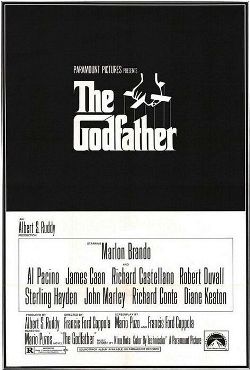
The Godfather tells the story of the Corleone Family. Patriarch Vito Corleone (Marlon Brando) has done very well for himself in America, making himself into a rich and influential man. Of course, Vito is also known as both Don Corleone and the Godfather and he’s made his fortune through less-than-legal means. He may be rich and he may be influential but when his daughter gets married, the FBI shows up outside the reception and takes pictures of all the cars in the parking lot. Vito Corleone knows judges and congressmen but none of them are willing to be seen in public with him. Vito is the establishment that nobody wants to acknowledge and sometimes, this very powerful man wonders if there will ever be a “Governor Corleone” or a “Senator Corleone.”
Vito is the proud father of three children and the adopted father of one more. His oldest son, and probable successor, is Sonny (James Caan). Sonny, however, has a temper and absolutely no impulse control. While his wife is bragging about him to the other women at the wedding, Sonny is upstairs screwing a bridesmaid. When the enemies of the Corleone Family declare war, Sonny declares war back and forgets the first rule of organized crime: “It’s not personal. It’s strictly business.”
After Sonny, there’s Fredo (John Cazale). Poor, pathetic Fredo. In many ways, it’s impossible not to feel sorry for Fredo. He’s the one who ends up getting exiled to Vegas, where he lives under the protection of the crude Moe Greene (Alex Rocco). One of the film’s best moments is when a bejeweled Fredo shows up at a Vegas hotel with an entourage of prostitutes and other hangers-on. In these scenes, Fred is trying so hard but when you take one look at his shifty eyes, it’s obvious that he’s still the same guy who we first saw stumbling around drunk at his sister’s wedding.
(And, of course, it’s impossible to watch Fredo in this film without thinking about both what will happen to the character in the Godfather, Part II and how John Cazale, who brought the character to such vibrant life, would die just 6 years later.)
As a female, daughter Connie (Talia Shire) is — for the first film, at least — excluded from the family business. Instead, she marries Sonny’s friend Carlo Rizzi (Gianni Russo). And, to put it gently, it’s not a match made in heaven.
And finally, there’s Michael (Al Pacino). Michael is the son who, at the start of the film, declares that he wants nothing to do with the family business. He’s the one who wants to break with family tradition by marrying Kay Adams (Diane Keaton), who is most definitely not Italian. He’s the one who was decorated in World War II and who comes to his sister’s wedding still dressed in his uniform. (In the second Godfather film, we learn that Vito thought Michael was foolish to join the army, which makes it all the more clear that, by wearing the uniform to the wedding, Michael is attempting to declare his own identity outside of the family.) To paraphrase the third Godfather film, Michael is the one who says he wants to get out but who keeps getting dragged back in.
And finally, the adopted son is Tom Hagen (Robert Duvall). Tom is the Don’s lawyer and one reason why Tom is one of my favorite characters is because, behind his usual stone-faced facade, Tom is actually very snarky. He just hides it well.
Early on, we get a hint that Tom is more amused than he lets on when he has dinner with the crude Jack Woltz (John Marley), a film producer who doesn’t want to use Johnny Fontane (Al Martino) in a movie When Woltz shouts insults at him, Tom calmly finishes his dinner and thanks him for a lovely evening. And he does it with just the hint of a little smirk and you can practically see him thinking, “Somebody’s going to wake up with a horse tomorrow….”
However, my favorite Tom Hagen moment comes when Kay, who is searching for Michael, drops by the family compound. Tom greets her at the gate. When Kay spots a car that’s riddled with bullet holes, she asks what happened. Tom smiles and says, “Oh, that was an accident. But luckily no one was hurt!” Duvall delivers the line with just the right attitude of “That’s my story and I’m sticking to it!” How can you not kind of love Tom after that?
And, of course, the film is full of other memorable characters, all of whom are scheming and plotting. There’s Clemenza (Richard S. Catellano) and Tessio (Abe Vigoda), the two Corleone lieutenants who may or may not be plotting to betray the Don. There’s fearsome Luca Brasi (Lenny Montana), who spends an eternity practicing what he wants to say at Connie’s wedding and yet still manages to screw it up. And, of course, there’s Sollozzo (Al Lettieri, playing a role originally offered to Franco Nero), the drug dealer who reacts angrily to Vito’s refusal to help him out. Meanwhile, Capt. McCluskey (Sterling Hayden) is busy beating up young punks and Al Neri (Richard Bright) is gunning people down in front of the courthouse. And, of course, there’s poor, innocent, ill-fated Appollonia (Simonetta Stefanelli)…
The Godfather is a great Italian-American epic, one that works as both a gangster film and a family drama. Perhaps the genius of the Godfather trilogy is that the Corleone family serves as an ink blot in a cinematic rorschach test. Audiences can look at them and see whatever they want. If you want them and their crimes to serve as a metaphor for capitalism, you need only listen to Tom and Michael repeatedly state that it’s only business. If you want to see them as heroic businessmen, just consider that their enemies essentially want to regulate the Corleones out of existence. If you want the Corleones to serve as symbols of the patriarchy, you need only watch as the door to Michael’s office is shut in Kay’s face. If you want to see the Corleones as heroes, you need only consider that they — and they alone — seem to operate with any sort of honorable criminal code. (This, of course, would change over the course of the two sequels.)
And, if you’re trying to fit a review of The Godfather into a series about political films, you only have to consider that Vito is regularly spoken of as being a man who carries politicians around in his pocket. We may not see any elected officials in the first Godfather film but their presence is felt. Above all else, it’s Vito’s political influence that sets in motion all of the events that unfold over the course of the film.
The Godfather, of course, won the Oscar for best picture of 1972. And while it’s rare that I openly agree with the Academy, I’m proud to say that this one time is a definite exception.
“Gentlemen! You can’t fight here! This is the war room!” — President Merkin Muffley (Peter Sellers) in Dr. Strangelove: Or How I Learned To Stop Worrying And Love the Bomb (1964)
The next time you hear someone bragging about how their favorite politician is an intellectual who always acts calmly and rationally, I would suggest that you remember the example of President Merkin Muffley, one of the many characters who populate the 1964 best picture nominee, Dr. Strangelove or How I Learned To Stop Worrying and Love the Bomb.
As played by Peter Sellers, Merkin Muffley is the epitome of rational political action. Speaking in a steady (if somewhat muffled) midwestern accent and always struggling to remain calm and dignified, Muffley keeps order in the War Room as the world edges closer and closer to apocalypse.
Just consider, for example, this scene where President Muffley calls the Russian leader (the nicely named Dimitri Kissoff) and explains that a little something silly has happened.
As Muffley explains in the above scene, Gen. Jack D. Ripper (Sterling Hayden) has gone crazy. Convinced that the Russians have been sapping his precious bodily fluids, Gen. Ripper has ordered a nuclear strike on Russia. Unfortunately, Russia has built a Doomsday Machine that, should Russia be bombed, will destroy the world.
While Muffley is at fist skeptical about a doomsday machine, his advisor, Dr. Strangelove (also played by Peter Sellers), explains that the doomsday machine not only exists but that it’s actually a pretty good idea. The wheelchair-bound Dr. Strangelove speaks in a German accent and appears to have lost control over the left side of his body. At random moments, his left arm shoots up in a Nazi salute. At other times, his hand tries to strangle him. Making these surreal moments all the more memorable is the fact that nobody in the War Room seems to notice or question them.
And, while it’s always tempting to dismiss a character like Dr. Strangelove as being an over-the-top caricature, the fact of the matter is that, following the end of World War II, several Nazi scientists ended up working for the U.S. government. In many ways, the U.S. space program was the creation of a bunch of real-life Dr. Strangeloves.
Of course, President Muffley and Dr. Strangelove aren’t the only roles played by Peter Sellers in this film. Sellers also plays Lionel Mandrake, a British officer who — as the result of an office exchange program — happens to be at Burpelson Air Force Base at the same time that Gen. Ripper orders the attack on Russia.
As famous as his Sellers’s performances as Dr. Strangelove and President Muffley may be, I actually think Mandrake is his best performance in the film. In many ways, Mandrake is the audience’s surrogate. He’s the one who gets to hear Ripper’s rambling explanation for why he launched an attack on Russia. He’s the one who has to try to convince the hilariously unhelpful Col. Bat Guano (Keenan Wynn) to help him find a quarter so he can call the Pentagon.
(“You’re gonna have to answer to the Coca-Cola company,” Guano says, before shooting open a Coke machine to get change.)
Sellers plays Mandrake as a parody of the traditional, stiff upper lip British army officer. Not only does that allow some great humor as Mandrake keeps a calm demeanor while listening to Ripper’s increasingly crazed monologue but it also allows Mandrake to be the only sane man in the movie.
(Of course, the whole point of Dr. Strangelove is that the world’s become so insane that one sane man can not make a difference. )
Sellers earned a best actor nomination for playing three different roles and he deserved it but, for me, the two best performances in the film come from Slim Pickens and George C. Scott.
Pickens, of course, is the bomber pilot who ends up riding an atomic bomb like a bull in a rodeo. As a character, Maj. Kong may be a bit too much of a spot-on stereotype but Pickens brings such sincerity to the role that it doesn’t matter. Oddly enough, you feel almost happy for him when he rides that bomb to his death. You know that’s exactly how he would have wanted to go out.
And then there’s George C. Scott, playing the role of Gen. Buck Turgidson. From the safety of the War Room, Turgidson looks forward to nuclear war and worries when President Muffley invites the Russian ambassador to join them. (“But he’ll see the big board!” Turgidson exclaims.) Turgidson is both hilariously stupid and hilariously confident. Perhaps my favorite Turgidson moment comes when he trips, falls, and stands back up without once losing his paranoid train of thought.
(Though he doesn’t have a big role, James Earl Jones makes his film debut in Dr. Strangelove. The way he delivers the line “What about Major Kong?” makes me laugh every time.)
50 years after it was first released, Dr. Strangelove remains a comic masterpiece of a nightmare, a film that proves that political points are best made with satire and not sermons.
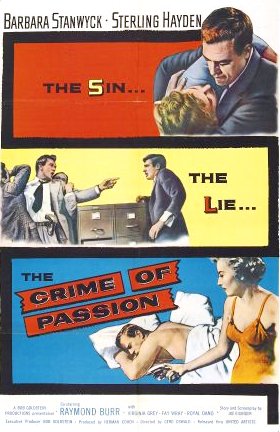
The third Netflix Noir that I watched was 1957’s Crime of Passion.
In Crime of Passion, Barbara Stanwyck plays Kathy Ferguson, a San Francisco-based advice columnist. She is approached by two homicide detectives who request her help tracking down a fugitive who they think might read her column. Charlie (Royal Dano) is aggressive and outspoken. When he first meets Kathy, he tells her, “You’re work should be raising a family and having dinner ready when your husband comes home from work.” His far more passive partner is Detective Bill Doyle (Sterling Hayden).
Kathy writes a column that convinces the fugitive to turn herself in. (The power of Kathy’s column is shown in an amusing montage where woman after woman is seen reading the column aloud. Significantly, no men are seen to ever read anything that Kathy has written.) The resulting fame leads to Kathy getting a job offer in New York.
However, before Kathy can leave, she gets a phone call from Bill. He asks her out on a date and, one scene later, they’re getting married in the shabby office of a justice of the peace. Kathy sacrifices her career to be a suburban housewife.
From the minute that Kathy first looks at the small and anonymous house and the boring neighborhood that she’ll be sharing with Bill, it’s obvious that things are not going to work out well. Even though Kathy even tells Bill, “I hope all your socks have holes in them and I can sit for hours darning them,” the life of domestic servitude is not for her.
Every day, she stays home while Bill goes to work. At night, she reluctantly plays hostess to the constant gatherings of Bill’s colleagues and their wives. The women stay in one room while the man gather in another. Kathy is quickly bored with the inane chattering of the other wives but whenever she tries to go into the other room, she finds herself treated like an unwanted intruder.
And worst of all is the fact that Bill has absolutely no ambition of his own. He’s got his house. He’s got his wife. He’s got his friends. And he doesn’t feel that he needs anything else.
Kathy takes it into her own hands to advance Bill’s career, first by having an affair with Bill’s boss (Raymond Burr) and finally by trying to find a spectacular crime that Bill can solve. And, as the suburbs continue to drive her mad, Kathy is not above creating a few crimes on her own…
In many ways, Crime of Passion reminds of another 50s film, Nicholas Ray’s Bigger Than Life.Both films use the conventions of melodrama to present a surprisingly subversive look at the horrors of suburban conformity. Unfortunately, Crime of Passion never quite reaches the heights of Bigger Than Life, largely because Sterling Hayden gives such a dull performance as Bill that you never believe that Kathy would have married him in the first place. (The film would have been far more impressive if Bill had started out as an apparently dynamic character whose dullness was then revealed after Kathy married him.) However, Barbara Stanwyck is well-cast as Kathy and Raymond Burr plays up his character’s ambiguous morality. If nothing else, Crime of Passion is one of those film to show anyone who is convinced that nothing subversive was produced in the 1950s.








 Through the Shattered Lens