Horror Film Review: The Lawnmower Man (dir by Brett Leonard)


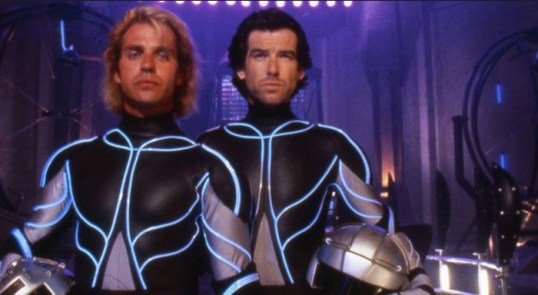
The 1992 horror/sci-fi hybrid, The Lawnmower Man, tells the story of two men.

Dr. Lawrence Angelo (played by Pierce Brosnan) is a scientist who is experimenting with ways to make less intellectually inclined people smarter. Dr. Angelo is kind of a burn out. You can tell he has issues because he needs to shave, he’s always sitting in the dark, and he’s never without a cigarette. You look at Dr. Angelo and you just imagine that he smells like smoke, bourbon, and lost dreams.

Jobe (Jeff Fahey) is the kind-hearted but intellectually disabled man who lives in a shack and spends his time mowing everyone’s lawn. Hence, he’s known as the …. wait for it …. THE LAWNMOWER MAN!

Together, Dr. Angelo and Jobe solve crimes!

No, not really. Instead, Dr. Angelo decides to experiment on Jobe. This leads to Jobe not only becoming smarter but also quicker to anger. Soon, Jobe is developing psychic abilities. He can move things with his mind. He can magically set people on fire. Basically, he can do whatever the script needs for him to do at the moment. Jobe is soon tormenting everyone who once bullied him. Father McKeen, the pervy priest, gets set on fire. Jake, the gas station attendant, is put into a catatonic state. An abusive father get run over by a lawnmower.

Dr. Angelo knows that Jobe is out-of-control and that the experiment has to be reversed. However, the sinister group behind Angelo’s research wants to use Jobe as a weapon because …. well, because they’re evil and that’s what evil people did back in 1992. Jobe, however, has other plans. He wants to become pure energy so that he can rule over a virtual world….

Or something like that. To be honest, it’s kind of difficult to really figure out what’s going on in The Lawnmower Man. The movie shares its name with a Stephen King short story but it has so little in common with its source material that King reportedly sued to get his name taken out of the credits. (Considering some of the films that King has allowed himself to be associated with, this is kind of amazing.) The film tries to be a satire, a slasher film, a conspiracy film, and a technology-gone-crazy film all in one and the end result is one big mess.

Along with all of that, The Lawnmower Man is also a time capsule of when it was made. A good deal of the film takes place in Jobe’s virtual reality universe, which looks a lot like a mix of Doom and Second Life. I imagine the film’s special effects may have seen impressive way back in the 20th Century but, seen today, they’re rather cartoonish, if occasionally charmingly retro.

On the plus side, the film does have an interesting cast. Pierce Brosnan is never convincing as burn-out but he tries so hard that he’s still fun to watch. Underrated actors like Jenny Wright, Geoffrey Lewis, Dean Norris, and Troy Evans all get a chance to show what they can do in minor roles. Finally, you’ve got the great Jeff Fahey, giving a far better performance than the script perhaps deserves. Though the film may be a mess, there’s something undeniably fun watching Jeff Fahey’s Jobe go from being meek to being a megalomaniac.

It’s a silly film and not one that’s meant to be watched alone. This is a film that has to be watched with a group of your snarkiest friends. Watch it the next time you’re looking for an excuse to avoid doing the yard work.

Sometimes They Come Back (1991, directed by Tom McLoughlin)


In 1963, nine year-old Jim Norman witnessed a group of juvenile delinquents murder his older brother Wayne in a tunnel before getting killed themselves when a train came barreling down the tracks.  Twenty-seven yeas later, Jim (Tim Matheson) is a history teacher and he has returned to his hometown to take a job at his old high school.  He is haunted by memories of what happened in the tunnel and then he is haunted for real as, one by one, all of the dead delinquents returns to life and enroll in his class.  They want revenge on the man that they blame for their fiery deaths.

Based on a Stephen King short story, Sometimes They Come Back was actually produced for television.  It originally aired on CBS, complete with a warning that viewer discretion was advised.  Though the ghost greasers are too ridiculous to really be scary (one of them laughs like a hyena), the movie was still more graphic than anything else that played in primetime that year.  I wonder how television audiences, in those pre-American Horror Story days, reacted to one of Jim’s students being dismembered in the backseat of a car and the ghost greasers then tossing pieces of his body over the bridge?

Tim Matheson takes the material seriously and gives an intelligent performance as Jim Norman.  Fans of Newhart might enjoy seeing William Sanderson (a.k.a. Larry of Larry, Darryl, and Darryl) playing a serious role as the one greaser who wasn’t killed by the train.  Most of the other characters, including Jim’s wife and his students, are forgettable.  The movie’s glaring weakness is the ghost greasers themselves.  Even with their Satanic car and their threatening ways, they’re too cartoonish to be frightening.  Sometimes They Come Back has its strengths but ultimately, it’s a middling Stephen King adaptation.

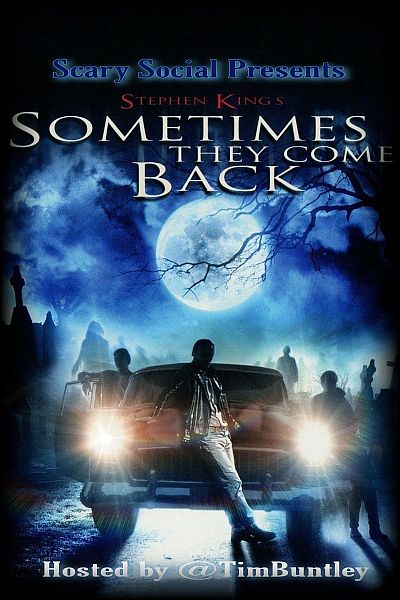
Live Tweet Alert: Watch Sometimes They Come Back with #ScarySocial


As some of our regular readers undoubtedly know, I am involved in a few weekly live tweets on twitter.  I host #FridayNightFlix every Friday, I co-host #ScarySocial on Saturday, and I am one of the five hosts of #MondayActionMovie!  Every week, we get together.  We watch a movie.  We tweet our way through it.

Tonight, for #ScarySocial, Tim Buntley will be hosting 1991’s Sometimes They Come Back!

In this adaptation of a Stephen King short story, the dead refuse to stay dead!

If you want to join us on Saturday night, just hop onto twitter, start the film at 9 pm et, and use the #ScarySocial hashtag!  The film is available on Prime.  I’ll be there co-hosting and I imagine some other members of the TSL Crew will be there as well.  It’s a friendly group and welcoming of newcomers so don’t be shy.

Horror Scenes that I Love: Pennywise Visits The Library In It


Admittedly, this scene from the 1990 version of It is a bit more goofy than scary but still, I love Tim Curry’s performance as Pennywise the Clown.  When the first part of the latest version of It came out, it was kind of fashionable to dismiss the 1990 version.  But then the second movie came out and everyone was like, “We waited a year for this!?  Give us back our Tim Curry!”

Anyway, in this scene, Pennywise shows at the Derry Public Library and offers Richie (Harry Anderson) some balloons.

Scenes That I Love: The Job Interview From The Shining


I don’t care what Stephen King says.  Stanley Kubrick’s adaptation of The Shining is great.

One of King’s big complaints about the film is that Jack is obviously unhinged from the start.  King is right that Jack Nicholson plays Jack Torrance as being someone who has a few screws loose even before he starts to work as the caretaker.  But it works for the film, as can be seen in this scene in which Stuart Ullman tells Jack about what happened to previous caretaker.

https://www.youtube.com/watch?v=-sLVxrT8tdw

Incidentally, Barry Nelson’s performance as Ullman is seriously underrated.  Ullman is a far more interesting character in the movie than he was in King’s book.  For that matter, the same can be said of just about every character in the movie as opposed to the way King envisioned them in his novel.  Maybe that’s the main reason King doesn’t like this movie.  Kubrick understood King’s story better than King himself did.

4 Shots From 4 Films: Special Stephen King Edition


4 Or More Shots From 4 Or More Films is just what it says it is, 4 shots from 4 of our favorite films. As opposed to the reviews and recaps that we usually post, 4 Shots From 4 Films lets the visuals do the talking!

Today, the Shattered Lens wishes a happy birthday to Mr. Stephen King!

In others words, it’s time for….

4 Shots from 4 Stephen King Films

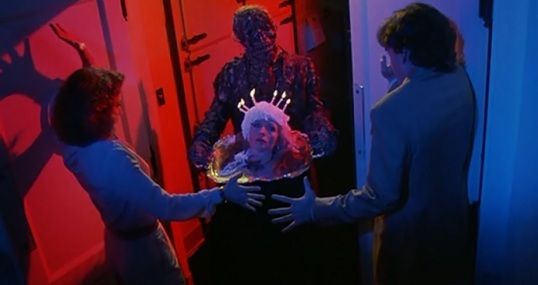
Creepshow (1982, dir by George Romero, written by Stephen King, DP: Michael Gornick)

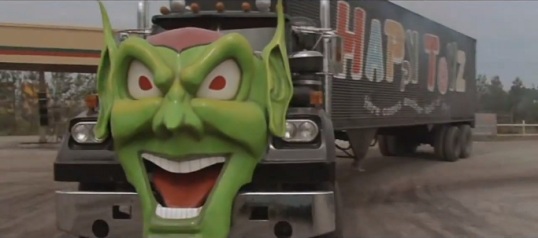
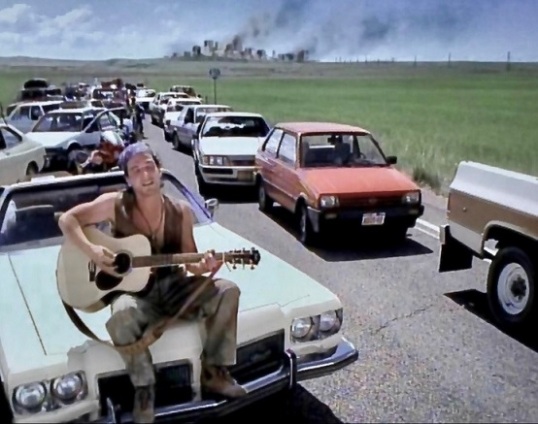
Maximum Overdrive (1986, dir by Stephen King, written by Stephen King, DP: Armando Nannuzzi)

Sleepwalkers (1992, dir by Mick Garris, written by Stephen King, DP: Rodney Charters)

The Stand (1994, dir by Mick Garris, written by Stephen King, DP: Edward J. Pei)

Horror Film Review: The Dark Half (dir by George Romero)


It will always fascinate me that Stephen King, one of the most popular writers in the world and one of the legitimate masters of horror, also has one of the least inspiring accounts on twitter.

Seriously, he may be the most popular author in the world but he tweets like a retiree who has just discovered the internet.  Go over to his twitter account and you won’t find memorable descriptions of small town hypocrisy.  You won’t find scenes of shocking psychological insight.  You won’t find moments of unexpected but laugh-out-loud dark humor.  Instead, you’ll find a combination of dad jokes, boomer nostalgia, and an unseemly obsession with wishing death on any public figure who is to the right of Bernie Sanders.  It’s odd because no one can deny that King’s a good storyteller.  At his best, Stephen King is responsible for some of the best horror novels ever written.  Everyone who is a horror fan owes him a debt of gratitude for the work that he’s done promoting the genre.  At his worst, he’s your uncle who retweets the article without reading it first.

Of course, someone can be great at one thing an terrible at something else.  I can dance but I certainly can’t sing.  Stephen King can write a best seller but a good tweet is beyond him.  That’s the dual nature of existence, I suppose.  That’s certainly one of the themes at the heart of both Stephen King’s The Dark Half and the subsequent film adaptation from George Romero.

Filmed in 1990 but not released for three years due to the bankruptcy of the studio that produced it, The Dark Half tells the story of Thad Beaumont and George Stark (both played by Timothy Hutton).  Thad is a professor who writes “serious” literature under his real name and violent, pulpy fiction under the name of George Stark.  No one reads Thad’s books but they love George Stark and his stories about the master criminal and assassin, Alexis Machine.  (Alexis Machine?  George Stark may be a good writer but he sucks at coming up with names.)  After a demented fan (played, with creepy intensity, by Robert Joy) attempts to blackmail him by threatening to reveal that he’s George Stark, Thad decides to go public on his own.  His agent even arranges for a fake funeral so that Thad can bury George once and for all.

Soon, however, Thad’s associates are turning up dead.  It seems as if everyone associated with the funeral is now being targeted.  Sheriff Alan Pangborn (Michael Rooker) suspects that Thad is the murderer.  However, the murderer is actually George Stark, who has come to life and is seeking revenge.  Of course, George has more problems than just being buried.  His body is decaying and he’s got a bunch of angry sparrows after him.  The Sparrows Are Flying Again, we’re told over and over.  Seeking to cure his affliction and to get those birds to leave him alone, Stark targets Thad’s wife (Amy Madigan) and their children.

The Dark Half has its moments, as I think we would expect of any film based on a Stephen King novel and directed by George Stark.  Some of the deaths are memorably nasty.  Hutton is believably neurotic as Thad and cartoonishly evil as Stark and, in both cases, it works well.  Rooker may be an unconventional pick for the role but he does a good job as Pangborn and Amy Madigan brings some unexpected energy to the thankless role of being the threatened wife.

But, in the end, The Dark Half never really seems to live up to its potential.  In the book, Thad was a recovering alcoholic and it was obvious that George Stark was a metaphor for Thad’s addiction.  That element is largely abandoned in the movie and, as a result, George goes from being the literal representation of Thad’s demons to just being another overly loquacious movie serial killer.  Despite having a few creepy scenes, the film itself is never as disturbing as it should be.  For all the blood, the horror still feels a bit watered down.  Take away the sparrows and this could just as easily be a straight-forward action film where the hero has to rescue his family from a smug kidnapper.  Comparing this film to Romero’s Martin is all the proof you need that Romero was best-served by working outside the mainstream than by trying to be a part of it.

Add to that, I got sick of the sparrows.  Yes, both the film and the book explain why the sparrows are important but “The Sparrows Are Flying Again” almost sounds like something you’d find in something written in a deliberate attempt to parody King’s style.  It’s a phrase that’s intriguingly enigmatic the first time that you hear it, annoying the third time, and boring the fifth time.

The Dark Half was a bit of a disappointment but that’s okay.  For King fans, there will always be Carrie.  (I would probably watch The Shining but apparently, King still hasn’t forgiven Stanley Kubrick for improving on the novel.)  And, for us Romero fans, we’ll always have Night of the Living Dead, Martin, Dawn of the Dead, and the original Crazies.  And, for fans of George Stark, I’m sure someone else will pick up the story of Alexis Machine.  It’s hard to keep a good character down.

Book Review: “They’re Here….” Invasion of the Body Snatchers: A Tribute, edited by Kevin McCarthy and Ed Gorman


On Saturday night, I watched Piranha, which featured the great character actor Kevin McCarthy in a supporting role. This led to me remembering McCarthy’s iconic performance in the original Invasion of the Body Snatchers (as well as his cameo in the 70s version). And that led to me remembering a book that I found at Half-Price Books a few years ago.

First published in 1999, They’re Here is a tribute to Invasion of the Body Snatchers, featuring essays about the films and interviews with some of the people involved. For instance, Stephen King and Dean Koontz both write about how seeing the original film influenced their later approach to horror. Jon L. Breen, James Combs, and Fred Blosser write about Jack Finney, the author of the book that served as the basis for the film. Other essays take a look at the remakes that were directed by Philip L. Kaufman and Abel Ferrara. Ferrara is himself interviewed and is as outspoken as ever. Also interviewed is Dana Wynter, who co-starred in the original.

However, the majority of the book is taken up with a terrifically entertaining and informative interview with Kevin McCarthy himself. McCarthy not only talks about filming the original Invasion of the Body Snatchers but also his entire career, his friendship with Montgomery Clift, and his status as pop cultural icon. Sometimes it can be disillusioning to read or listen to an interview in which an icon turns out to be kind of boring (call it the Steven Soderbergh syndrome) but, fortunately, McCarthy comes across as being just as eccentric, intelligent, interesting, and downright lovable as you would hope he would be. Kevin McCarthy, who passed away in 2010 at the age of 96, was one of the great character actors and this interview shows that he was …. wait for it …. quite the character! (Sorry.) The interview is a great tribute not only to McCarthy’s most famous film but also the man himself.

Seriously, if you’re a Body Snatchers fan but just appreciate great character acting, order a copy of this book!

Film Review: Doctor Sleep (Dir. by Mike Flanagan)


If I asked you about Stephen King’s The Shining, would the book or the film come to mind?

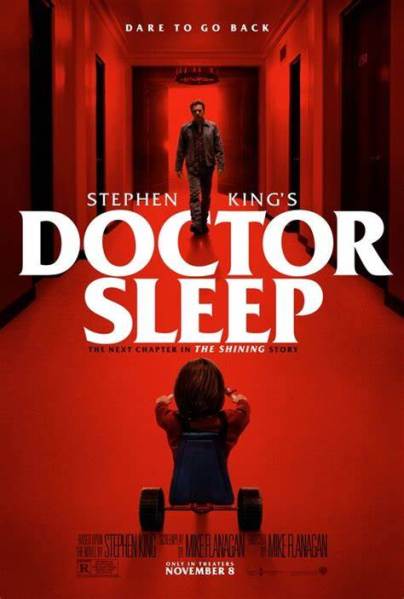
DoctorSleepPosterWhen it comes to adapting Stephen King’s stories to film, it’s not an easy feat. King himself had a problem turning his own short story “Trucks” into something good when he directed Maximum Overdrive. For every great film like Stanley Kubrick’s The Shining, or It-Chapter One, we occasionally get a misstep like The Dark Tower or It-Chapter Two.  As King can sometimes get wordy in his books, I’ve felt the best adaptations were the ones where the director’s own vision came into play. Kubrick made a number or changes to King’s story, including the Grady twins and the hedge maze, which were never in the novel. The film is so widely recognized that most people recall events in the movie, rather than the book. That’s the effect Kubrick had. 
With Doctor Sleep, Mike Flanagan once again proves he’s a fantastic fit for King. The film moves at a great pace, with great performances by Rebecca Ferguson and newcomer Kyliegh Curran. In an age where audiences are typically quiet, the applause that occurred in scenes during last night’s preview screening were great to hear. The film manages to pay homage to Kubrick’s The Shining and King’s Novel of Doctor Sleep while still completely showcasing Flanagan’s vision. Of course, we already knew this from Flanagan taking on King’s own Gerald’s Game and Netflix’s The Haunting of Hill House.  One might even argue that for this film, we may in time recall Flanagan’s tale more clearly than King’s.

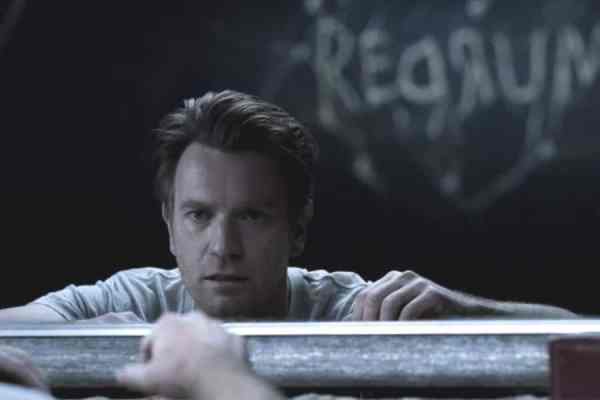
Doctor Sleep takes place after the events of The Shining, with Dan Torrance (Ewan McGregor) suffering from the same demons that plagued his father, Jack. Although the keeps to himself, he drinks too much, gets into brawls, and is unable to hold down decent work. Dan is also haunted by the Overlook Hotel, and the power that drew the souls to him known as The Shining. The Shining (or just the Shine) is a coveted power in King’s lore. When a group of nomads that feed on the Shine (in a way that’s reminiscent of Mick Garris’ Sleepwalkers) discover a girl with the same ability, Dan is brought out of hiding. 

Fans of the original Kubrick film will see there’s a lot of love here. You’ll be able to count some of the references to The Shining, from objects in a room to different locales. For casting, Flanagan uses a mixture of old favorites and new faces. You’ll recognize some of them right from the start, such as Bruce Greenwood and Violet McGraw. Others, like Jacob Tremblay (The Predator) are welcome additions. Rather than relying on footage from the original Shining, Flanagan recreates certain elements with new cast members, which I felt worked extremely well here. I’m not sure how others will take it.

Ewan McGregor is good in the role of Dan Torrance, which feels more like his Mark Renton character from Trainspotting than anything else to me.  This isn’t a bad thing, but it works. The film truly belongs to both Rebecca Ferguson (Mission Impossible: Fallout) and Kyliegh Curran. Ferguson’s Rose the Hat is a wicked villain, and she carries the role with a sinister, yet stylish flair. Ferguson has some of the best scenes in the film, particularly when paired with Zahn McClarnon (Midnight, Texas and Westworld), who plays Crow Daddy. Kyliegh Curran chews up the scenes she’s in, easily handling screen time with McGregor and Ferguson like a pro. Rounding out the cast are Cliff Curtis (Sunshine), Carl Lumbly (Mantis) and Emily Alyn Lind (The Babysitter). 

Doctor-Sleep-1

Dan Torrance (Ewan McGregor) can’t run from his past in Mike Flanagan’s Doctor Sleep.

As for the fear factor, there is some terror in the hunt for Abra and the way that the group interact. Doctor Sleep doesn’t have much in the way of jump scares, but makes up for it with some tense moments. I didn’t feel as scared as I did with It-Chapter One, but I cared enough about the characters to worry about how the story was going to turn out. That might be a turn off for those expecting to watch the movie from between their fingers or run out of the theatre screaming. If you enjoyed Flanagan’s other works, such as Hush or Oculus, you’ll be fine.

Speaking of Hush, Doctor Sleep lacks a Kate Siegel cameo. Flanagan is Siegel’s partner in crime (and husband). Together, they’ve been in almost every film they’d done. I’ve gotten used to going “Oh, there’s Kate!”, while watching his films. It’s not an issue at all, but it would’ve been cool to see her.

The camera work for Doctor Sleep is very even, though there are a few special effects scenes that really stand out and picked up some applause (or gasps) once they were over. The one main drawback I had with the film was that it was a little difficult to keep up with all of the locations and time periods early on. Even though everything’s clearly labeled, it took me a moment to recognize just where and when things were occurring. Not a terrible thing, though.

Overall, Doctor Sleep is an easy film to recommend. It has some great performances, and manages to be a great follow up to The Shining, while showing a lot of love for the source material.

Doctor Sleep hits cinemas on Friday, November 8th, and I’ll make a return visit.


Horror Film Review: Cujo (dir by Lewis Teague)


Cujo is a such a depressing movie that I can barely stand to watch it.

Cujo, of course, is the 1983 film adaptation of the book by Stephen King.  The book is about a dog that not only gets bit by a rabid bat but also gets possessed by the spirit of Frank Dodd, the serial killer who played a major role in The Dead Zone.  The film abandons the subplot about Frank Dodd and, instead, it just deals with a rabid dog that kills a lot of people and who eventually traps Donna Trentonn (Dee Wallace) and her young son, Tad (Danny Pintauro), is a car for several days.

I have to admit that I’m really not the sort of person who should be watching a film like Cujo in the first place.  When I was growing up, I was terrified of dogs.  According to my family, I was bitten by one when I was just three years old, not that I have any memory of that actually happening.  So, up until I was 18, I couldn’t handle being around them.  Whenever I would walk home from school, I would run across the street if I heard a dog barking at me from behind a fence.  If I was out with my family and I saw a dog approaching, I would hide behind the nearest big person.

I did have one good experience with a big dog when I was about ten years old.  My family was up at the lake and this big, black dog started following us around and it was so friendly that I couldn’t help but relax around it.  My mom was like, “See, Lisa Marie, not all dogs are bad.”  We went to get lunch, leaving the dog behind.  When we returned, the dog was there.  He was excited to see my mom.  He was excited to my aunt.  He was excited to see my sisters.  Then, he took one look at me and started to growl.  I was frozen in fear, just standing there as the dog slowly stood up.  My mom immediately stood in front of me, trying to block the dog’s view while I ran back to car.  Of course, that didn’t work.  The dog started barking and then took off running after me.  His owners then showed up and grabbed the dog just as it was about to lunge at me and then they didn’t even bother to apologize!  Instead, they told some story about how some other girl had thrown a rock at the dog and, as a result, the dog always growled at “little girls.”  They acted like it was no big deal.  (My aunt later told me that she had to grab my mom’s hand to keep her from slapping the dog’s owner when they tried to blame me for what happened.)  For months afterwards, I had nightmares about that dog.

Fortunately, enough time has passed that I’m no longer petrified in fear of dogs though they still make pretty damn nervous.  That said, Cujo, with its growling and killer dog, is exactly the type of film that’s designed to prey on my deepest fears.  And yes, the movie does scare me but I have to admit that I don’t really care much about the people who get killed by Cujo.  Instead …. I feel bad for Cujo.  Yes, even though Cujo scares me to death and I’m not a dog person in general, this movie depresses me specifically because of what happens to the dog.

When we first see him, Cujo is happily chasing a rabbit.  When he gets bitten by a rabid bat, he whimpers a little and I have to say that it breaks my heart to hear it.  I mean, Cujo is just such a cute dog!  And, to be honest, he seems like the type of big dog who maybe could have convinced me that not all dogs are bad.  (There’s a part of me that really wishes that I could relax and love dogs as much as everyone else does.)  But then he gets bitten by that bat and poor Cujo!  Rabies is a terrible disease.

Cujo is a good, straight-forward horror film, one that gets the job done without all of the padding and blather that you sometimes have to deal with when it comes to Stephen King film adaptations.   (Thankfully, nobody casually talks about Shawshank Prison or taking a trip to Derry or any of that other nonsense that seems to come up in most King films.)  Dee Wallace gives a good performance as Donna Trenton, who is trapped in the car and desperate to save her child.  King has said that he felt Wallace deserved an Oscar nomination for her performance and he’s probably right

But my God, I just cannot watch this movie without crying afterwards.  I just feel so bad for that dog.