The latest “Song of the Day” comes from the Halo 4 soundtrack. I have just finished playing the campaign and for a first-person shooter the story is what makes the game great. The song from the soundtrack I’ve ended up loving through my first listen through the album is track 15 with the simple title of “Green and Blue”.
The past Halo titles while it was under the development of it’s originators over at Bungie Studios had Martin O’Donnell composing all the music. His Halo theme as become one of the most iconic and recognizable piece of video game music. One doesn’t even have to be a fan of the series to recognize O’Donnell’s theme. When Bungie finally ended their work on the series and Microsoft’s in-house game studio created to take over with 343 Industries fans of the series were concerned that any future Halo titles wouldn’t be able to stand up to O’Donnell’s work under the original regime.
For Halo 4 a new composer was hired to create the appropriate score for the title. In comes Massive Attack’s Neil Davidge to follow in the huge foot steps of O’Donnell. The track I chose is just one piece of a huge orchestral score that Davidge (with assistance from Kazuma Jinnouichi) ended up creating for the title. It’s not just my favorite but also the one piece of music in the entire score that best describes the themes and emotional content of the narrative created for the campaign of Halo 4.
The song begins with a subtle opening that speaks of the revival of the game’s two leads in Master Chief and his A.I. companion, Cortana. They are the Green and Blue of the title. From their revival, to a ethereal lament that then moves moves into a growing, rousing section that best describes the two characters’ relationship and feelings for each other. These are two individuals who have been through hell and back and going into the breach once again and there’s a chance that one or both won’t be back.
As a fan of O’Donnell’s work on the series I was one of those who had concerns about whether Davidge could handle being the new musical caretaker for the Halo franchise. With this example from the game’s orchestral score my concerns have been alleviated and now have another Halo score to enjoy.
In honor of the site’s co-founder’s birthday I thought it appropriate that the latest “Song of the Day” pick be honor of one Lisa Marie Bowman.
Happy Birthday, Lisa Marie!
Red Headed Woman
Well, brunettes are fine, man Blondes are fun But, when it comes to getting the dirty job done, I’ll take a red-headed woman, a red-headed woman. It takes a red-headed woman to get a dirty job done.
Well, listen up, stud, Your life’s been wasted ’til you’ve got’ down on your knees and tasted A red-headed woman, a red-headed woman. It takes a red-headed woman to get a dirty job done.
Tight skirt, strawberry hair Tell me what you’ve got, baby, waiting under there. Big green eyes that look like, son, They can see every cheap thing that you ever done.
Well, I don’t know how many girls you dated, man You ain’t lived ’til you’ve had your tires rotated By a red-headed woman, a red-headed woman. It takes a red-headed woman to get a dirty job done.
And so my month of folk and folk/pagan/black metal indulgence comes to an end. Of course they’re the styles I listen to the most throughout the year, but October always holds a somewhat special status for the genres. It marks the height of fall and the coming of winter, the commencement of the six months of the year I enjoy most, and also the start of the holiday season. Halloween is something of the anti-holiday–an all-encompassing celebration of everything that is not modern Christian/Muslim/Jewish culture. It’s that one break in year-round social norms where people can dress and act in ways that, despite representing the human experience for the vast majority of our species’ existence, are strictly taboo in the today’s world. Sure, plenty of pagan practices may have lurked their way into Christmas and Easter. Sure Thanksgiving, despite its name, remains a fairly uncompromised belated harvest festival. But on Halloween we sugar-coat nothing but the candy, sending our children down the streets as ghouls and ghosts and all sorts of counter-cultural guises, embracing primal human nature with no need for repentance. It might be highly consumer-centric, but a little unrestrained gluttony seems thoroughly appropriate for the occasion. From death and the old gods to vampires and zombies, everything falling beyond the accepted sphere of modern religion has its day on October 31st.
Lastivka, alternatively titled Swallow, is a rather ridiculous rendition of what I gather is a traditional Ukrainian folk song. It first appears on Nokturnal Mortum’s Marble Moon ep, released in 1997. Enjoy.
Townes Van Zandt lived a troubled life, characterized by constant alcoholism, drug abuse, and failed relationships. He finally passed away of heart failure in a state of delirium tremens on January 1, 1997, at the age of 52, cryptically 44 years to the day after the death of perhaps his greatest influence, Hank Williams, under similar circumstances. As a song writer his music was inconsistent, but at his finest moments he tapped into his inner demons with an acute awareness that he was living more in dream than reality. He created his own folklore both in life and in song. The latter was quite deliberate, emerging sometimes from scratch and sometimes with attention to older legends. Narrated in the first person, always at night, bridging a gap between sleep and consciousness, he painted strikingly vivid images of personal confrontations with foul spirits and terrifying monsters physically imbued with emotional states which could never take on material form outside of a dream, or a song.
To call Spider Song a metaphor would do it a disservice. Of course it is about overcoming some inner demon, whatever that may be, and yes, through the battle against the spider we gain some insight into Van Zandt’s personal struggles, but that’s trivial. He’s not just beating that old dead horse again. The spider begins “in his dreams”, and at no point does it definitively leave them, yet the song is structured in such a way that Van Zandt’s dreams come to characterize more and more a real, physical monster encountered collectively by the narrator and the audience. What you get is a subtle transition from a nearly explicit metaphor (it’s in his dreams) to, by the end, momentary belief that a real, heroic, pitched battle against a giant spider is about to ensue. You don’t fully forget that the spider originated as a sort of representation of emotional states of fear, depression, or whatever you read into the first few stanzas of the song, but nevertheless here it stands, a menacing physical object. No, this song should not be regarded as a metaphor. Rather, our recognition of metaphor is employed to, over time, trick the senses into visualizing something supernatural.
Our Mother The Mountain is laden with hints at the supernatural from the outset: The woman’s esoteric claim to have come from her mother the mountain, her mysterious medallion, the refrain “singing tu-a-lu-ra-lai-o” with an emphasis on “lu-ra-lai”… “Lorelei”… The music feels like a dream, and the lyrics too, until the narrator stops observing the dream and tries to interact, reaching for her hand. The woman’s response is a manifest nightmare–a completely nonsensical appeal to pure foreboding terror captured in her physical actions. The narrator never sees her again, but he swears that it wasn’t just a dream, and as the listener you can’t help but believe him.
Spider Song
There is a spider in my dreams
Long and silent is his name
Cold as lightning is his smile
Final is his sting
His curse is deep as seven skies
Boys, I wouldn’t tell you lies
The legends say he never sleeps
and he’s never hungry long
He’s got us boys, I believe it’s true
But I’m fighting til he lays me down
Run his foul black body through
Cleave him all asunder
Think of your women, won’t you boys
Think of your mother growing old
Think about your darling son
Spit in the spider’s eye
Up at ease, against him ride
We’ll not take him by surprise
Give a scream down in your dreams
Let him know we’re coming
There is a spider in my dreams
Long and silent is his name
Cold as lightning is his smile
Final is his sting
Our Mother The Mountain
My lover comes to me with a rose on her bosom
The moon’s dancing purple all through her black hair
And her lady’s-in-waiting, she’ll stand ‘neath my window
And the sun will rise soon on the false and the fair
Singing tu-a-lu-ra-lai-o
She tells me she comes from My Mother The Mountain
And her skin fits her tightly, and her lips do not lie
She silently slips from her throat a medallion
Slowly she twirls it in front of my eyes
Singing tu-a-lu-ra-lai-o
I watch her, I love her, and I long for to touch her
The satin she’s wearing is shimmering blue
And outside my window her ladies are sleeping
My dogs are gone hunting; their howling is through
Singing tu-a-lu-ra-lai-o
So I reach for her hand, and her eyes turn to poison
And her hair turns to splinters, and her flesh turns to brine
She leaps ‘cross the room. She stands in the window
and screams that my first-born will surely be blind.
Singing tu-a-lu-ra-lai-o
Then she throws herself out to the black of the nightfall
She’s parted her lips, but she makes not a sound
I fly down the stairway and I run to the garden
No trace of my true love is there to be found
Singing tu-a-lu-ra-lai-o
So walk these hills lightly, and watch who you’re loving
By Mother The Mountain I swear that it’s true
And love not a woman with hair black as midnight
and a dress made of satin all shimmering blue
Singing tu-a-lu-ra-lai-o
My lover comes to me with a rose on her bosom
The moon’s dancing purple all through her black hair
And her lady’s-in-waiting, she’ll stand ‘neath my window
And the sun will rise soon on the false and the fair
This is by far the most disturbing song of my series, but what’s wrong with this picture is not remotely obvious from a distant, inattentive listen. On the surface you’ve got a pretty dark, melancholic guitar; soft, soothing female vocals; a love song’s refrain; and a slow transition into a sort of Planet Caravan chill out. Relaxing and mournful. Is that all?
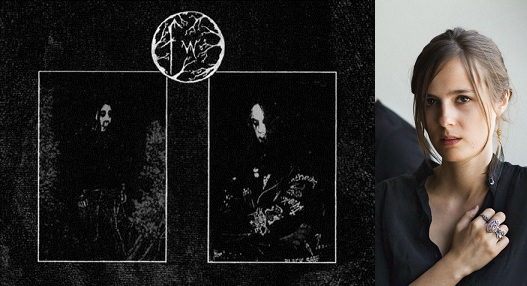
But what’s this business about a whip? And what exactly is Anne Lise Frøkedal, frontwoman for Norwegian indie pop band Harrys Gym, saying? And what the hell is she doing singing with Forgotten Woods?
Let me preface this with something else that shouldn’t be remotely obvious. Forgotten Woods are a lo-fi Norwegian black metal band. Don’t just take my word for it. Pause the song and click. The song I’m linking here appears on the same album. (Race of Cain, released in 2007, is also the source of the avatar I’ve been sporting on most sites for the past year or two.)
I hope you clicked. Just in case you didn’t:
Are we good and thoroughly confused just yet? Go ahead, put the song back on again from the start, and pay close attention now. “Indeed, we’ve seen the serpent rise. Six-legged triumphant reptile”? Is that guitar slide just an effect, or is it simulating a bomb falling through the sky? What exactly is this love song about, really?
Founding member “R” had this to say about the song in a Vampiria magazine interview: “The track itself is about discovering your true self, shedding your former suit of denial and fear and simply embrac[ing] the ultimate ego. Individuality, intolerance, indulgence. That’s what it’s all about in that song.”
They’re juxtaposing humanity at its most brutal to humanity at its most tender and calling attention to the similarities. Make what you will of them. The medium as best I interpret it: A woman reflecting on her experiences in the Third Reich with a sense of nostalgia. She acknowledges that it was the total social upheaval, dehumanization, and mass destruction, not the shallow ideologies used to justify them, from which she derived the highest state of personal fulfillment. But she has no regrets.
Indeed, we’ve seen the serpent rise
Six-legged triumphant reptile
Success! Chakra! I love you like no other
Totalitarian regards
The principle and the whip
Silence the mutant mind
Success! Chakra! I love you like no other
Inside, inside this dormant cyst
Outnumbered, writing in his presence
Reinventing the myths
Reversing the symbols
It is inevitable
Here’s a song that captures bizarre pagan ritual at its most Dionysian. Barely coherent woodwinds teeter on the brink of madness, spurred on by seductive, primitive drumming and the string drone of what I’m guessing is a hurdy-gurdy. Piorun are a folk and ambient band from Poland, which is not a particularly active country in the pagan metal scene, but it should come as no surprise from the brand of folk they play that the band has ties to Nokturnal Mortum.
It’s not particularly easy to dig up information on these guys. What’s available to me had to be plugged through Google Translator from Polish, but I gather Stajemy Jak Ojce, the 2004 release on which Nadbuanski Wit is the opening track, is their only full-length album.
I’m a bit confused as to just how “Polish” Piorun really is. The references I saw to “ties with Nokturnal Mortum” are a bit of an understatement; Knjaz Varggoth, Saturious, and Munruthel are all a part of the line-up, amounting to half of the band and all of the folk elements. Of the band’s three presumably Polish members, two are only credited with vocals. One, and possibly all three, were members of the now defunct Polish black metal band Archandrja. (I’ve not heard them save a few youtube samples just now.)
At any rate, Stajemy Jak Ojce is an absolutely brilliant album when the folk is allowed to shine. When the ambient takes more primacy it leaves a little to be desired. Nadbuanski Wit falls firmly in the former. Whether you choose to hear it as chilling and demented or as ritualistic and reverent, it’s bound to leave a lasting impression.
Latvia’s Skyforger have been around for ages. They first formed in 1991 as a folk-leaning death metal band called Grindmaster Dead, but by 1995 they changed their name to Skyforger and turned their attention to black metal. After leaving their mark on both the second generation of black metal and the formative years of pagan metal, they turned their attention to Latvian folk traditions unconditionally. Zobena Dziesma, translated as “Sword Song”, was released in 2003. It left metal at the door, and presented, in coordination with the Culture Capital Foundation of Latvia, an outstanding compilation of songs in traditional Latvian style.
“Skyforger is not a professional Folk group, and we are traditionally known for playing Folk/Pagan Metal. We started playing Folk music as amateur enthusiasts, only for ourselves. However, our friends and fans expressed a desire to hear more of these songs, and that led to the creation of this album. Most of the songs you can hear on this recording are taken from the repertoire of well known local Folk groups. Others are reworked versions of material from our previous albums. Our passion is to play olden songs of the war and mythology of our forefathers. In that respect, this album is no different from those we have recorded in the past. It is our tribute to ancient Latvian history, culture and folklore.”
Skyforger translate Zviegtin’ Zviedza Kara Zirgi as “Neighed the Battle Horses”. It’s the track that has always stood out to me most on the album. It is exceptionally visual. It’s one of those songs that transports you to another place and time, and allows you to engage an ancient world trapped somewhere between history and fantasy.
An unrelenting, wild ride through everything that makes Slavic pagan metal amazing, Масленица Широкая (Maslenitsa Shirokaya) is one of the finest songs in the entire genre. Anyone familiar with Russian pagan metal gods Pagan Reign should find the sound entirely familiar. When Pagan Reign broke up in 2006, Твердь (Tverd’) formed from the ashes. Guitarist Vetrodar and drummer Demosthen were the only returning members, but stylistically Tverd’s only album to date, Вслед за Солнцеворотом (Vsled Za Solntsevorotom), is such a direct continuation that it would be hard to understand Tverd’ as anything but a legitimate continuation of Pagan Reign. Even the band’s name is the title to Pagan Reign’s final album. It is also a reference, I would imagine, to their hometown Tver, just north of Moscow.
The quality of this song is just impeccable. It carries all of the epic glory of Pagan Reign’s Новгородские Пляски (Novgorodian Folk Dance), but with a more mature approach to the madness and the addition of a fantastic vocal performance by Svetlana Lebedeva. The song is structured, much like Novgorodian Folk Dance, to eschew standard composition and confront the listener with one bombastic movement after another, thriving in a state of constantly progressing triumphant climax. It lacks all of the frustration and anger that so many Slavic bands reflect in their recognition that the culture they’re preserving exists only in scattered embers. Maslenitsa Shirokaya is a pure celebration with no baggage. Cheers.
From the perspective of a guy who doesn’t speak a word of German, this has to be the second greatest band name ever after Helfahrt. But then, “Slartibartfass” apparently refers to a fictional character with an intentionally absurd name. To the best of my knowledge Helfahrt is a legitimate false cognate. HELFAHRT!
This is not Helfahrt. This is Slartibartfass, who paint a delightful vision of super-cute munchkins tying you up in your sleep and harvesting your kidneys. Tanz der Kobolde makes no pretense to anything more than what its name suggests. The death metal vocals are deliciously hokey (the only sort of context in which I actually like death metal vocals), and yes, the drummer is simulating stomping gremlin feet.
Kobolds are little Germanic sprites, typically invisible and inhabiting homes, caves, and ships. They’re fairly ambivalent little fellows. Some will do household chores for a pittance, and they say if you stab one to death it can drop gold. When annoyed by their human cohabitants they tend towards dismemberment. They don’t much care for clothing. The element cobalt is named after them; they often give it, laden with arsenic, to miners as a playful prank.
Slartybutt are from the Baden-Württemberg region of Germany. Tanz der Kobolde appears on their first album, Nordwind, released in 2006. It is definitely…. entertaining.
I said I’d make it weird for the last week leading up to Halloween. Here’s some true kvlt kazoo metal to kick things off.
I have no idea if that’s actually what Odroerir are playing (I mean, Finntroll did it) or if it’s some medieval woodwind similar to what Stary Olsa use in the Drygula song I recently featured, but either way the “wtf” factor was probably not lost on them. Odroerir are a folk metal band with medieval tendencies hailing from the Thuringia region of Germany. They formed in 1998, and Präludium is the opener to their 2001 debut full-length Laßt Euch Sagen Aus Alten Tagen. The band’s name is a German variant of Icelandic Óðrerir, the name of the chalice of mead imbued with the knowledge of wisdom and poetry in Norse mythology. I don’t know that much wisdom went into crafting this song, but you can bet plenty of mead was involved.