Lisa’s Early Oscar Predictions for September


It’s that time again!

It’s time for my somewhat random Oscar predictions!

Judging from the reactions at Venice Film Festival, Bradley Cooper’s A Star is Born would appear to be the current Oscar front runner.  At the very least, it seems destined to be nominated.  Personally, I still wonder if a remake of A Star is Born is going to have enough political cachet in a year that, so far, has been dominated by Hollywood virtue signaling.

Anyway, it’s a bit of a cliché to say the Oscar race is wide open but, despite all of the buzz around A Star is Born, it still feels as if it is.  That said, it’s also becoming a bit more clear.  Former front runners like Mary, Queen of Scots have fallen off the radar.  It seems likely the Martin Scorsese’s The Irishman will not be released until next year.  There are rumors that Clint Eastwood’s The Mule might get a December qualifying run but, for now, those are just rumors.

Below are my predictions for this month.  The usual caveats about wishful thinking and wild guesses apply.  To be honest, we won’t know anything for sure until the critics and the guilds make their voices heard in December and January.

Be sure to check out my predictions for January, February, March, April, May, June, July, and August!

Best Picture

Beautiful Boy

BlackKklansman

Black Panther

Crazy Rich Asians

The Favourite

First Man

Green Book

If Beale Street Could Talk

Roma

A Star is Born

Best Director

Damien Chazelle for First Man

Jon M. Chu for Crazy Rich Asians

Bradley Cooper for A Star is Born

Alfonso Cuaron for Roma

Spike Lee for BlackKklansman

Best Actor

Steve Carell in Beautiful Boy

Bradley Cooper in A Star is Born

Ryan Gosling in First Man

Rami Malek in Bohemian Rhapsody

Robert Redford in Old Man and the Gun

Best Actress

Glenn Close in The Wife

Olivia Colman in The Favourite

Nicole Kidman in Destroyer

Melissa McCarthy in Can You Ever Forgive Me?

Julia Roberts in Ben Is Back

Best Supporting Actor

Mahershala Ali in Green Book

Timothee Chalamet in Beautiful Boy

Sam Elliott in A Star is Born

Ben Foster in Leave No Trace

Michael B. Jordan in Black Panther

Best Supporting Actress

Claire Foy in First Man

Regina King in If Beale Street Could Talk

Sissy Spacek in Old Man and the Gun

Rachel Weisz in The Favourite

Michelle Yeoh in Crazy Rich Asians

Barry and Oscar

Lisa’s Early Oscar For Predictions For August


It’s time once again for my monthly attempt to predict next year’s Oscar nominations!

As always, these predictions should be taken with a grain of salt.  BlackKklansman has emerged as a contender and there’s a few impressive trailers out there.  If the Academy goes through with this stupid Best Popular Film Oscar, I’m going to assume that’ll knock Black Panther out of contention for Best Picture.  For now, I’m going to hope that the backlash will cause the Academy to abandon the idea.

(For the record, it now appears that the whole Best Popular Film fiasco was due more to pressure from ABC than from actual members of the Academy.  And, let’s just be honest — Best Popular Film sounds just stupid enough to be the idea of a television executive.)

So, as usual, these nominations are a combination of wishful thinking, wild guesses, and sincere intuition.  If nothing else, they should be amusing to look back upon when the actual nominations are announced.

Be sure to check out my predictions for January, February, March, April, May, June, and July!

Best Picture

Beautiful Boy

Black Panther

BlackKklansman

Boy Erased

First Man

Green Book

If Beale Street Could Talk

Old Man and the Gun

Roma

Widows

Best Director

Damien Chazelle for First Man

Alfonso Cuaron for Roma

Barry Jenkins for If Beale Street Could Talk

Spike Lee for BlackKklasman

Steve McQueen for Widows

Best Actor

Christian Bale in Backseat

Steve Carell in Beautiful Boy

Ryan Gosling in First Man

Rami Malek in Bohemian Rhapsody

Robert Redford in Old Man and the Gun

Best Actress

Glenn Close in The Wife

Viola Davis in Widows

Felicity Jones in On The Basis of Sex

Keira Knightley in Colette 

Saoirse Ronan in Mary, Queen of Scots

Best Supporting Actor

Mahershala Ali in Green Book

Timothee Chalamet in Beautiful Boy

Russell Crowe in Boy Erased

Adam Driver in BlackKklansman

Michael B. Jordan in Black Panther

Best Supporting Actress

Claire Foy in First Man

Nicole Kidman in Boy Erased

Regina King in If Beale Street Could Talk

Margot Robbie in Mary, Queen of Scots

Sissy Spacek in Old Man and the Gun


Lisa’s Oscar Predictions for July


Well, here we are.  We’re more than halfway through the year and, to be honest, the Oscar forecast seems just as cloudy as ever.

To be honest, I’m starting to get the feeling that this is going to be a year where the Academy is more concerned with sending a message than anything else.  Just as the Emmy nominations were all about sticking it to Trump (as opposed to actually honoring the best that television has to offer), it wouldn’t surprise me to see the Academy try to do the same thing.  That doesn’t mean that the nominees aren’t going to deserve to be nominated, of course.  Instead, it just means that this might be a good year for films with a political agenda.

Anyway, here are my predictions for July!  They’re still pretty random, to be honest.  Be sure to also check out my predictions for January, February, March, April, May, and June!

Best Picture

Backseat

Black Panther

BlackKklansman

Boy Erased

The Favourite

First Man

If Beale Street Could Talk

Mary, Queen of Scots

Old Man and The Gun

Widows

Best Director

Damien Chazelle for First Man

Barry Jenkins for If Beale Street Could Talk

Yorgos Lanthimos for The Favourite

Spike Lee for BlackKklansman

Josie Rourke for Mary, Queen of Scots

Best Actor

Christian Bale in Backseat

Steve Carell in Beautiful Boy

Ryan Gosling in First Man

Robert Redford in Old Man and The Gun

John David Washington in BlackKklansman

Best Actress

Glenn Close in The Wife

Felicity Jones in On the Basis of Sex

Keira Knightley in Colette

Rosamund Pike in A Private War

Saoirse Ronan in Mary, Queen of Scots

Best Supporting Actor

Russell Crowe in Boy Erased

Sam Elliott in A Star is Born

Topher Grace in BlackKklansman

Michael B. Jordan in Black Panther

Sam Rockwell in Backseat

Best Supporting Actress

Claire Foy in First Man

Nicole Kidman in Boy Erased

Regina King in If Beale Street Could Talk

Margot Robbie in Mary, Queen of Scots

Sissy Spacek in Old Man and the Gun

Lisa’s Early Oscar Predictions for June


We’re nearly halfway through 2018 and it’s time for me to once again post my somewhat random Oscar predictions!

As usual, these predictions are a combination of instinct or wishful thinking.  Do I really think that Orson Welles’s final film will dominate the Oscars?  Well, why not?  It’d be a great story if it happened.  The same goes for Black Panther becoming the first comic book movie to receive a best picture nomination.  It’d be nice if it happened and, with most of the contenders still unseen, there’s no reason to arbitrarily dismiss the film’s chances.

Based on the reaction that it received at Cannes, I’ve added Spike Lee’s BlackKklansman to my list of predicted best picture nominees.

As always, take these predictions with a grain of salt.  Some of these films and performers will be nominated.  (First Man, for instance, seems like a lock.)  Many of them will not.  If nothing else, my monthly predictions always seem to be useful for a good laugh in retrospect.  And there’s nothing wrong with that!  The predictions that don’t come true are often even more fun than the predictions that do.

It should also be remembered that some of the films listed below don’t even set release dates yet.  Some of them might not even open this year.  There are other films — like Burden — that seems like they should be contenders but they’ve yet to get a distributor.  And then there’s Martin Scorsese’s The Irishman, which is scheduled to be released by Netflix in 2019 but it’s always possible that film could be moved up on the schedule.  If The Irishman does get a last-minute December release, chances are that the Oscar race will be dramatically altered.

Or maybe not.  Remember how Silence was a front runner all through 2016, just to end up with one nomination?  It’s hard to predict which films will have “that Barton Fink feeling.”

(Yes, I’m currently watching Barton Fink.  Thinking about the Oscars will enjoying a film from the Coen Brothers?  Life is good, as my twitter girl crush often puts it.)

Please be sure to check out my predictions for January, February, March, April, and May.

Best Picture

BlackKklansman

Black Panther

Boy Erased

First Man

If Beale Street Could Talk

Mary, Queen of Scots

The Other Side of the Wind

A Star is Born

White Boy Rick

Widows

Best Director

Damien Chazelle for First Man

Barry Jenkins for If Beale Street Could Talk

Spike Lee for BlackKklansman

Steve McQueen for Widows

Orson Welles for The Other Side of the Wind

Best Actor

Steve Carell in Beautiful Boy

Bradley Cooper in A Star is Born

Willem DaFoe in At Eternity’s Gate

Ryan Gosling in First Man

Robert Redford in The Old Man & The Gun

Best Actress

Viola Davis in Widows

Felicity Jones in On The Basis of Sex

Melissa McCarthy in Can You Ever Forgive Me?

Chloe Grace Moretz in The Miseducation of Cameron Post

Saoirse Ronan in Mary, Queen of Scots

Best Supporting Actor

Timothee Chalamet in Beautiful Boy

Russell Crowe in Boy Erased

Adam Driver in BlackKklansman

Sam Elliott in A Star is Born

Michael B. Jordan in Black Panther

Best Supporting Actress

Claire Foy in First Man

Nicole Kidman in Boy Erased

Regina King in If Beale Street Could Talk

Margot Robbie in Mary, Queen of Scots

Sissy Space in The Old Man & The Gun

Cannes Film Review: Missing (dir by Costa-Gavras)


The 1982 film Missing takes place in Chile, shortly after the American-backed military coup that took out that country’s democratically elected President, Salvador Allende.

Of course, the film itself never specifically states this.  Instead, it opens with a narrator informing us that the story we’re about to see is true but that some names have been changed “to protect the innocent and the film.”  The film takes place in an unnamed in South America, where the military has just taken over the government.  Curfew is enforced by soldiers and the sound of gunfire is continually heard in the distance.  Throughout the film, dead bodies pile up in the streets.  Prisoners are held in the National Stadium, where they are tortured and eventually executed.  Women wearing pants are pulled out of crowds and told that, from now on, women will wear skirts.  The sky is full of helicopters and, when an earthquake hits, guests in a posh hotel are fired upon when they try to leave.  About the only people who seem to be happy about the coup is the collection of brash CIA agents and military men who randomly pop up throughout the film.

Again, the location is never specifically identified as Chile.  In fact, except for the picture of Richard Nixon hanging in the American embassy, the film never goes out of its way to point out that the film itself is taking place in the early 70s.  If you know history, of course, it’s obviously meant to be Chile after Allende but the film itself is set up to suggest that the story its telling is not limited to one specific place or time.

Charlie Horman (John Shea) is an American who lives in the country with his wife, Beth (Sissy Spacek).  Charlie is a writer who occasionally publishes articles in a local left-wing newspaper.  In the aftermath of the coup, Charlie is one of the many people who go missing.  All that’s known is that he was apparently arrested and then he vanished into the system.  The authorities and the American ambassador insist that Charlie probably just got lost in the confusion of the coup and that he’ll turn up any day.  Even though thousands have been executed, everyone assumes that Charlie’s status as an American would have kept him safe.  As brutal as the new government may be, they surely wouldn’t execute an American….

Or, at least, that’s what Ed Horman (Jack Lemmon) believes.  Ed is Charlie’s father, a businessman from New York who simply cannot understand what’s going on.  He can’t understand why his son and his daughter-in-law went to South America in the first place.  He can’t understand why his government is not doing more to find his son.  And, when he eventually arrives in South America himself, Ed cannot understand the violence that he sees all around him.

Working with Beth, Ed investigates what happened to his son.  At first, Ed blames Beth for Charlie’s disappearance and Beth can barely hide her annoyance with her conservative father-in-law.  But, as their search progresses, Beth and Ed come to understand each other.  Beth starts to see that, in his way, Ed is just as determined an idealist as Charlie.  And Ed learns that Charlie and Beth had good reason to distrust the American government…

Costa-Gavras is not exactly a subtle director and it would be an understatement to say that Missing is a heavy-handed film.  The Embassy staff is so villainous that you’re shocked they don’t all have mustaches to twirl while considering their evil plans.  When, in a flashback, Charlie meets a shady American, it’s not enough for the man to be a CIA agent.  Instead, he has to be a CIA agent from Texas who heartily laughs after everything he says and who brags on himself in the thickest accent imaginable.  When Charlie talks to an American military officer, it’s not enough that the officer is happy about the coup.  Instead, he has to start talking about how JFK sold everyone out during the Bay of Pigs.

As the same time, the film’s lack of subtlety also leads to its best moments.  When Beth finds herself out after curfew, the city turns into a Hellish landscape of burning books and dead bodies.  As Beth huddles in a corner, she watches as a magnificent white horse runs down a dark street, followed by a group of gun-toting soldiers in a jeep.  When Ed and Beth explore a morgue, they walk through several rooms of the “identified” dead before they find themselves in a room containing the thousands of unidentified dead.  It’s overwhelming and heavy-handed but it’s also crudely effective.  While the film itself is a bit too heavy-handed to really be successful, those scenes do capture the horror of living under an authoritarian regime.

(Interestingly, Missing was a part of a mini-genre of films about Americans trapped in right-wing South American dictatorships.  While you can’t deny the good intentions of these films, it’s hard not to notice the lack of films about life in Chavez’s Venezuela or the political dissidents who were lobotomized in Castro’s Cuba.)

Missing won the Palme d’Or at the 1982 Cannes Film Festival (an award that it shared, that year, with the Turkish film Yol) and it also received an Oscar nomination for best picture of the year.  (It lost to Gandhi.)

Lisa Marie’s Too Early Oscar Predictions for May!


It’s time for me to post my monthly Oscar predictions!

As always, the usual caveats apply.  It’s way too early for me to try to make any predictions.  Most of the films listed below haven’t even been released (or screened) yet and it’s totally possible that a big contender might come out of nowhere in the fall.  That seems to happen almost every year.

So, take these predictions with a grain of salt.  These are my guesses.  Some of them are based on instinct.  Some of them are just there because I think it would be a really, really neat if that movie or performer was nominated.  However, I will say this: I do think that if a comic book movie is ever nominated for best picture, it will be Black Panther.

(I actually preferred Avengers: Infinity War to Black Panther — sorry, Ryan — but, much like Get Out, Black Panther has gone beyond being a movie.  It’s become a cultural signpost, in a way that Infinity War never will.)

The Cannes Film Festival is going on right now and one potential Oscar contender — Spike Lee’s BlackkKlansman — is due to make its debut in the upcoming days.  Right now, I don’t have BlackkKlansman listed in my predictions, mostly because the Academy hasn’t exactly embraced Lee in the past.  But I will be interested to see how Cannes reacts to the film.

(Check out my predictions for January, February, March, and April!)

Best Picture

At Eternity’s Gate

Black Panther

Boy Erased

First Man

If Beale Street Could Talk

Mary, Queen of Scots

The Other Side of the Wind

A Quiet Place

Widows

Wildfire

Best Director

Damien Chazelle for First Man

Ryan Coogler for Black Panther

Barry Jenkins for If Beale Street Could Talk

Steve McQueen for Widows

Josie Rourke for Mary, Queen of Scots

Best Actor

Steve Carell in Beautiful Boy

Willem DaFoe in At Eternity’s Gate

Ryan Gosling in First Man

Lucas Hedges in Boy Erased

Robert Redford in Old Man and the Gun

Best Actress

Viola Davis in Widows

Felicity Jones in On The Basis of Sex

Melissa McCarthy in Can You Ever Forgive Me?

Saoirse Ronan in Mary. Queen of Scots

Kristen Stewart in JT LeRoy

Best Supporting Actor

Russell Crowe in Boy Erased

Sam Elliott in A Star Is Born

Oscar Isaac in At Eternity’s Gate

Michael B. Jordan in Black Panther

Forest Whitaker in Burden

Best Supporting Actress

Claire Foy in First Man

Nicole Kidman in Boy Erased

Regina King in If Beale Street Could Talk

Margot Robie in Mary, Queen of Scots

Sissy Spacek in Old Man And The Gun


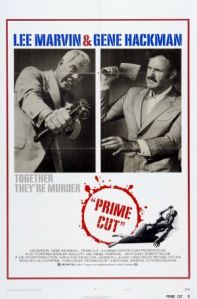
A Movie A Day #39: Prime Cut (1972, directed by Michael Ritchie)


primecutNick Devlin (Lee Marvin) is a veteran enforcer for the Chicago mob.  His latest assignment has taken him out of the city and sent him to the farmlands of Kansas.  Nick is the third enforcer to be sent to Kansas, all to collect a $500,000 debt from a local crime boss named Mary Ann (Gene Hackman).  The first one ended up floating face down in the Missouri River.  The second was chopped up into sausages at the local slaughterhouse.  Nick might have better luck because he once had an affair with Mary Ann’s wife, Clarabelle (Angel Tompkins).

When Nick tracks down Mary Ann to demand the money, he discovers that Mary Ann and his brother Weenie (Gregory Walcott, best remembered for his starring role in Plan 9 From Outer Space) are running a white slavery ring.  Kidnapping girls from a nearby orphanage, Mary Ann and Weenie keep them naked and doped up in a barn.  One of the girls, Poppy (Sissy Spacek, in her film debut), looks up at Nick and says, “Help me.”  Nick takes Poppy with him, claiming that he’s holding her for collateral until he gets the money.

The main attraction here is to see two iconic tough guys — Lee Marvin and Gene Hackman — fighting over Sissy Spacek, who is only slightly less spacey here than in her breakthrough role in Badlands.  In Prime Cut, the ruthless Chicago mobster turns out to have more of a conscience than the rural good old boys who work for Mary Ann and Weenie.  Nothing sums up Prime Cut better than the scene where Lee Marvin, wearing a black suit, and Sissy Spacek are pursued through a wheat field by a thrasher that’s being driven by a roly-poly farmer wearing overalls.  Prime Cut is both an exciting crime film and a trenchant satire of both the American heartland and the type of gangster movies that made Lee Marvin famous.

Film Review: Badlands (1973, directed by Terrence Malick)


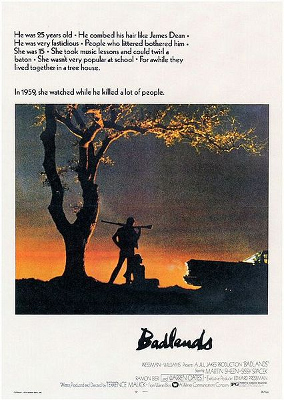
Badlands_movie_posterTerrence Malick is such an influential director that it is easy to forget that he has only directed nine films over the past 42 years.  (One of those ten, Knight of Cups, will be released later this year.  Two other are currently in postproduction.)  He has received Oscar nominations for The Thin Red Line and The Tree of Life but, for me, Malick’s best work remains his directorial debut, Badlands.

Badlands is based on the real-life murder spree of Charles Starkweather and his girlfriend, Caril Ann Fugate.  In 1958, 20 year-old Starkweather murdered 11 people in Nebraska and Wyoming.  14 year-old Fugate was with Starkweather at the time of the murders but has always claimed that she was Starkweather’s hostage.  After the two of them were captured, Starkweather was sent to the electric chair while Fugate served 17 years of a life sentence.

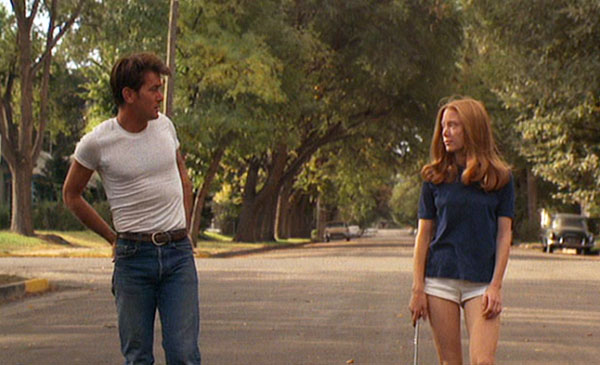
In Badlands, 25 year-old Kit (Martin Sheen) is a garbage man who has a huge chip on his shoulder.  One day, Kit spots 15 year-old Holly (Sissy Spacek) outside, twirling a baton.  Kit starts to talk to Holly, who thinks that he looks like her favorite actor, James Dean.  Kit and Holly start dating.  Holly’s father (Warren Oates), a sign painter who has never recovered emotionally from the death of his wife, tells Kit to stay away from his daughter.  After Kit murders her father, Holly joins him in fleeing from the scene of the crime.  With the police and bounty hunters chasing them, the two young lovers head across the midwest and leave a trail of bodies in their wake.

Badlands sticks pretty close to the facts of the real-life Starkweather/Fugate case but, at the same time, it is definitely the product of Terrence Malick’s artistic vision.  It is interesting to see how, even in his first film, Malick was already exploring the themes and using the techniques that would later distinguish both The Thin Red Line and The Tree Of Life.  Like those two films, Badlands is full of majestic scenery, contrasting the beauty of nature with the ugliness of humanity.  Like all Malick films, Badlands also features a narrator.  Holly tells us her story but, in contrast to the philosophical narrators from Malick’s later films, Holly speaks exclusively in romantic clichés and delivers her narration in a flat, unemotional style.

badlands-1973-starkweather-holly-kit-martin-sheen-sissy-spacek

When we first see Holly, her white shorts, blue shirt, and red hair add up to an all-American tableau.  When Holly falls in love with Kit because of his resemblance to James Dean and then either justifies or ignores every destructive thing that he does, she is predicting the rise of our current celebrity-dominated culture.  Meanwhile, Kit is so determined to be James Dean that he even imitates Dean’s performance from Rebel Without A Cause while talking to the police.

Badlands is one of Malick’s most accessible films.  Sissy Spacek is amazing as the childlike Holly and Martin Sheen has probably never been better than in his role here.  And, of course, you have the great Warren Oates in the small but crucial role of Holly’s harsh father.  Badlands is an American classic and still the best film of Terrence Malick’s legendary career.

Embracing the Melodrama #50: In the Bedroom (dir by Todd Field)


in_the_bedroom_ver3

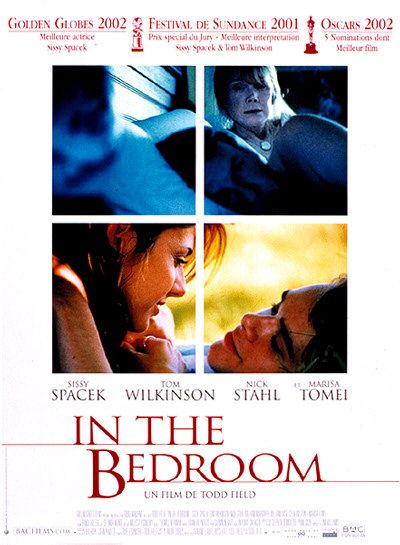
If some enterprising young filmmaker were to try to remake Ordinary People as a film noir, he would probably be wasting his time because director Todd Field already beat him to it with the 2001 best picture nominee In The Bedroom.

In the Bedroom takes place in a small town in Maine, the type of idyllic location where almost everyone is a fisherman and, in one way or another, everyone’s future is dependent on the whims of the rich and powerful Strout family.  Dr. Matt Fowler (Tom Wilkinson) and his wife Ruth (Sissy Spacek) seem to have the perfect life: a happy marriage and a smart and likable son, Frank Fowler (Nick Stahl).  Frank has just graduated from college and appears to have a great future ahead of him except for one thing.  He’s fallen in love with Natalie Strout (Marisa Tomei), the ex-wife of the abusive Richard Strout (William Mapother).  When Frank announces that he’s thinking about not going to grad school but instead staying in town so he can work as a fisherman and marry Natalie, Ruth is horrified that her son is throwing his life away.  However, Matt argues that Frank is just going through a phase.

The violent and unstable Richard is determined to win Natalie back.  When Frank attempts to protect Natalie during one of Richard’s rampages, Richard kills Frank by shooting him in the eye.  Richard is arrested for the murder but, largely as a result of his family’s influence, he is only convicted of accidental manslaughter and gets off with probation.  Matt and Ruth are left to both work through their grief and guilt and to eventually seek their own violent vengeance on Richard Strout.

In the Bedroom is probably one of the darkest films that I’ve ever seen in my entire life.  Not only is the film thematically dark but a good deal of it takes place at night and Todd Field fills the screens with shadows.  In the Bedroom is full of scenes of characters just staring at each other, struggling to find the right words to express their feelings and, far too often, simply giving up and saying nothing.  Field makes good use of the frequent silence though.  When Matt and Ruth yell at each other in the kitchen of their home, it’s both shocking and poignant because it stands in such sharp contrast to their usual silence.  Later. when Matt confronts Richard, the frequent pauses in their strained conversation serves to make the scene all the more ominous and creepy.

However, despite being one of the saddest films ever made, In The Bedroom is worth watching just for the performances of the cast.  You probably know that Tom Wilkinson, Sissy Spacek, and Marisa Tomei are all great so instead, I’m going to focus on the two members of the cast who did not receive Oscar nominations.  William Mapother does a really good job playing an unlikable character.  The dangerous yet dorky vibe that made him so menacing when he played Ethan Rohm on Lost is fully present and put to good use here.  Finally, Nick Stahl gives a wonderful performance as poor, doomed Frank.  With limited screen time, Stahl makes Frank into such a believable and sympathetic character that his death becomes a tragedy that the audience feels as well.

Sadly, Nick Stahl has recently been in the new more for his personal troubles than his film careers.  Films like In The Bedroom and Bully show why Nick deserves a chance to make a comeback.

bedroom-11

44 Days of Paranoia #6: JFK (dir by Oliver Stone)


JFK-John-F-Kennedy-DVD-Yon-OLIVER-STONE__76044126_0When I first decided to do this series of reviews of conspiracy-themed films, I knew that I would eventually have to review the 1991 Oliver Stone film JFK.

JFK is one of those films that continues to divide audiences.  Those who think that John F. Kennedy was killed by a conspiracy tend to love this film and are given to describing JFK as being “one of the most important films ever made.”  Those who believe that Lee Harvey Oswald was the lone assassin dismiss Stone’s film as being left-wing propaganda.  Just check out  the message board at the imdb if you need evidence of just how worked up people get over this film and its subject matter.

It seems that very few of the people who criticize or praise JFK ever review it as a work of cinema.  Instead, they focus on the film’s politics.  If I criticize the film for wasting the talents of Sissy Spacek or featuring one of Kevin Costner’s least interesting performances then I’m running the risk of having to deal with angry conspiracy theorists telling me that I need to open my eyes to the reality of American history.  On the other hand, if I praise Tommy Lee Jones’s wonderfully decadent turn as one of the film’s conspirators, chances are that someone is going to accuse me of being a naive leftist.

Then again, perhaps that reaction is to be expected.  Oliver Stone is one of our most political and least subtle filmmakers.  His movies are specifically designed to challenge the status quo.  For that reason, it’s not surprising to discover that Stone considers JFK to be the best of all of his films.

JFK is based (rather loosely, some claim) on the true story of New Orleans District Attorney Jim Garrison (played by Kevin Costner) and how, in 1967, he charged businessman Clay Shaw (played by Tommy Lee Jones) with being a part of a conspiracy to kill John F. Kennedy.  Shaw was eventually acquitted and both Jim Garrison and his investigation remain controversial to this day.

JFK courts controversy immediately with its portrayal of Jim Garrison.  I’ve read several accounts of the Garrison investigation and the one thing that they all seem to agree on is that Jim Garrison was a flamboyant, bigger-than-life figure who enjoyed publicity.  Even among those who believe that Garrison uncovered some valuable evidence as a result of his investigation, there is a good deal of ambiguity about Garrison’s motives.  However, in Stone’s film, Jim Garrison is played by Kevin Costner and is portrayed as being an incorruptible, all-American idealist.  It’s not that Costner gives a bad performance.  Instead, it’s just a rather uninteresting one, especially when one compares Costner’s Garrison to some of the stories about the real-life Garrison.

However, as the film unfolds, it becomes obvious that Stone is using Costner’s blandness to the film’s advantage.  Over the course of three hours, JFK slowly peels back layers of secrecy and cover-ups and reveals the shadow world that, according to Stone, lurks underneath everyday reality.  Costner’s Garrison might not be interesting but he is a stable presence.  He anchors the film, giving us someone to relate to while the film itself grows more and more bizarre.

While Costner’s might give the least interesting performance of his career in this film, the same cannot be said of the rest of the cast.  JFK is full of familiar faces, many of whom are only on-screen for a few minutes but all of which play an important role in creating Stone’s shadow universe.  Kevin Bacon, Gary Oldman, Joe Pesci, Michael Rooker, Donald Sutherland, and Tommy Lee Jones; they all have small roles but every single one of them makes an undeniable impression.  Whether you agree with the film’s conclusions are not, it’s impossible not to enjoy JFK for the chance to spot a bunch of familiar faces giving memorably bizarre performances.

But ultimately, its impossible to review JFK without considering the film’s conclusions.  JFK makes the case that John F. Kennedy was killed as the result of a massive right-wing conspiracy that involved the military, business interests, the CIA, the FBI, anti-Castro Cubans, and the mafia.  By the end of the film, the question becomes less who killed JFK and more who didn’t kill JFK.

Myself, I’m not going to claim to be enough of an expert on the Kennedy assassination to argue whether JFK is accurate or if it’s just propaganda.  However, as a film reviewer, I can say that it’s a very well-made and powerful film but it’s also one of those films that works better the first time you see it than the second time.

The first time you see it, the film overwhelms you.  It leaves you convinced that yes, there was a conspiracy and yes, everyone was involved and yes, Jim Garrison was right!  It convinces you so thoroughly that you end up using exclamation points, just to make sure everyone knows how convinced you are.

However, with each subsequent time that you view JFK, you became a bit more aware of just how manipulative and one-sided it truly is.  You become a bit more aware of the technique underneath the outrage and, if you’re a smart film watcher, you remember that JFK is a recreation as opposed to being a historical document.  You become more and more aware that Stone approached the material with a destination in mind and, like any good director, he has specifically shaped the material to make sure that you reach that destination at the end of the journey.

That was certainly my experience with JFK.  I first saw it in high school and it convinced me that JFK was the victim of a conspiracy.  Then, when I was in college, I watched it for a second time and, though I still believed the film’s conclusions, I also found myself much more aware of how the film’s length and Stone’s direction were designed to beat the audience into submission.  When I saw the film a third time, I found myself resenting the film’s manipulative nature and, as a result, I found it a lot more difficult to accept Stone’s conclusions.

However, when I rewatched the film last night for this review, I was surprised to discover that JFK actually holds up pretty well.  It’s still way too long (and, unlike a lot of other reviewers, I am not impressed by the droning speech that Costner delivers at the end of film) and Stone’s lack of subtlety does backfire on a few occasions.  However, perhaps because I was finally watching the film as entertainment as opposed to judging the film on its political or historical merits, I discovered that JFK is a watchable and entertaining film, one that does a pretty good job of making Stone’s case.  If nothing else, it’s worth watching just for the chance to see the wonderfully snarky performances of Tommy Lee Jones, Kevin Bacon, and Gary Oldman.

Perhaps the best thing that I can say about JFK is that its the type of film that will inspire smart people to do their own research and come to their own conclusions, which may or may not be the same conclusions that Oliver Stone reaches.

And, honestly, isn’t that the most that we can ask of any film?

JFK