Late Night Retro Television Review: 1st & Ten 3.3 “A Loaded Gun”


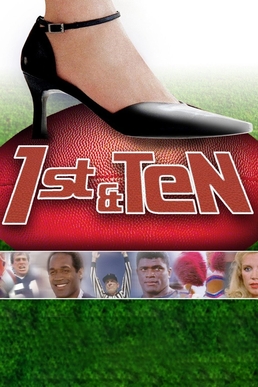
Welcome to Late Night Retro Television Reviews, a feature where we review some of our favorite and least favorite shows of the past! On Wednesdays, I will be reviewing 1st and Ten, which aired in syndication from 1984 to 1991. The entire series is streaming on Tubi.

This week, OJ Simpson argues with his wife.

Episode 3.3 “A Loaded Gun”

(Dir by Stan Lathan, originally aired on August 19th, 1987)

With Yinessa continuing to hold out for more money, Teddy thinks that he’s come up with a solution.  He tells Yinessa that he will personally take out an insurance policy on him so that Yinessa can work out with the team, despite not having a contract.  Yinessa agrees.  TD Parker tells all of the defenders not to touch Yinessa because they cannot risk him getting hurt.

“Anyone who touches Yinessa is going to wind up in Buffalo!” Parker tells them.

Unfortunately, John Manzak has been taken too many steroids.  As a result, the first thing he does is sack Yinessa.  Yinessa is injured.  As he’s rushed to the hospital, Diane tells Teddy, “Thank God you got that insurance policy.”  Teddy looks worried — uh oh, it looks like someone didn’t get that insurance policy!

At the hospital, a doctor tells Diane that Yinessa has a detached retina and he’ll probably never play football again.

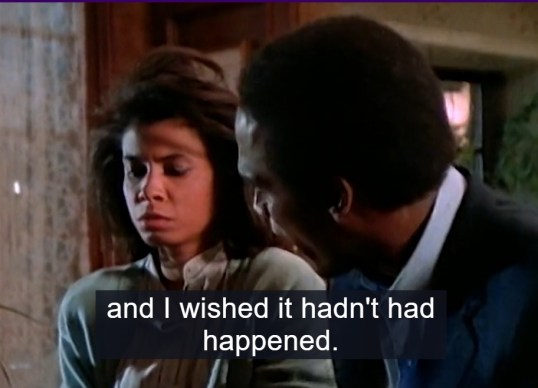
Meanwhile, TD is having trouble in his marriage.  He forgets his wife’s birthday but TD’s secretary (Leah Ayres) sends flowers and buys a gift.  Unfortunately, TD’s wife sees through the entire ruse.  She and TD argue.  And because TD Parker is played by OJ Simpson, it’s hard not to worry whenever anyone argues with him.

Hey, that’s a good point, OJ!  Let’s move on!

Also, in this episode, Bubba goes to therapy because he hasn’t been able to make love to his wife since she gave birth.  Jethro goes with him and pretends to have a shoe fetish.  This led to another patient hiding his shoes.  1st and Ten is a comedy that rarely makes me laugh but I have to admit that I did chuckle when Jethro started talking about how much he loved shoes.

Other than the therapy scene, this was a pretty serious episode.  Yinessa might never play again.  John Manzak is going crazy due to the steroid abuse.  (Is he going to be sent to Buffalo?  I don’t know how he’s going to handle that!)  The kicker is still looking for a wife so he won’t get deported.  And Diane has no idea what’s going on with her team.

How will the Bulls ever make it to the championship game!?

I guess I’ll have to keep watching to find out.

Retro Television Review: The Love Boat 7.7 and 7.8 “When Worlds Collide/The Captain and the Geisha/The Lotter Winners/The Emperor’s Fortune”


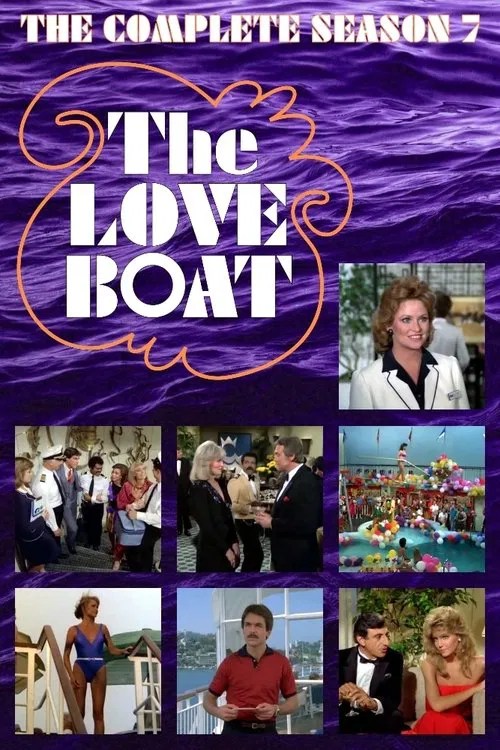
Welcome to Retro Television Reviews, a feature where we review some of our favorite and least favorite shows of the past!  On Wednesdays, I will be reviewing the original Love Boat, which aired on ABC from 1977 to 1986!  The series can be streamed on Paramount Plus!

This week, it’s a very special cruise of The Love Boat!

Episodes 7.7 and 7.8 “When Worlds Collide/The Captain and the Geisha/The Lotter Winners/The Emperor’s Fortune”

(Dir by Jerome Courtland, originally aired on November 5th, 1983)

The Love Boat is sailing to Japan!

Lila (Heather Thomas) is a photographer whose father is in a wheelchair due to the injuries that he received during World War II.  She meets and falls for Bud O’Hara (Tony Danza).  It seems like love at first sight but how will she react when they arrive in Japan and she discovers that Bud’s father (James Shigeta) is Japanese!?  At first, Lila cannot get over her prejudice but then Bud’s father reveals that his own parents were killed at Hiroshima and that he has also struggled with forgiveness.  “I am proud to be Japanese,” Tony Danza declares.

Martha Chambers (Mariette Hartley) is a professor in Asian studies who has a crush on the Captain.  When she finds out that the Captain is fascinated by the culture of Japan, Martha pretends to be a geisha.

Barney (Ted Knight) and his wife (Rita Moreno) have just won five million dollars in the lottery and they spend almost the entire cruise showing off how much money they have.  The crew isn’t comfortable dealing with the nouveau riche.  Myself, I’m just happy that this storyline didn’t feature Ted Knight or Rita Moreno pretending to be Japanese.

Celia (Jean Hoffman) and her daughter, Joanie (Nancy Morgan), own one piece of an embroidered silk artwork.  Ben Cummins (John Ritter) owns another piece.  They’ve all been invited to Japan by a businessman named Yamamoto.  Yamamoto claims to have the third piece and says that, when all the pieces are together, they will form a treasure map.  Ben falls for Joanie.  Celia falls for Harvey (Harvey Korman), a businessman who happens to be on the cruise.  When the other two silk pieces are stolen, it doesn’t take long for Ben to figure out that Harvey is the one who took them.  Harvey explains that he is Yamamoto and that he’s a career criminal.  However, because he’s fallen in love with Celia, he returns all three of the silk pieces to her.

This two-hour episode was a travelogue.  The Love Boat did one or two of these type of episodes every season.  The show would leave the sound stages of Los Angeles and instead be filmed on an actual boat during an actual cruise.  With these two hour episodes, the storylines were usually just an excuse for the Love Boat crew and their guest stars to see the sights.  That’s certainly the case here.  Captain Stubing gets a full tour of Japan.  (Captain Stubing also has a lengthy fantasy sequence where he imagines himself as a shogun.  It’s definitely not the show’s finest moment.)

It’s a good thing that the scenery is lovely in this episode because the stories themselves are nothing special and, in some cases, they’re actually difficult to watch.  The Love Boat attempted to make a plea for tolerance and forgiveness and that’s definitely a good thing.  But then the show cast Tony Danza as a half-Japanese man named Bud O’Hara and that was more than a bit cringey.  There’s nothing about Tony Danza that is the least bit Japanese.  For that matter, there’s nothing particularly Irish about him either.

This was not the best cruise of the Love Boat.


Late Night Retro Television Review: Pacific Blue 3.14 “Heartbeat”


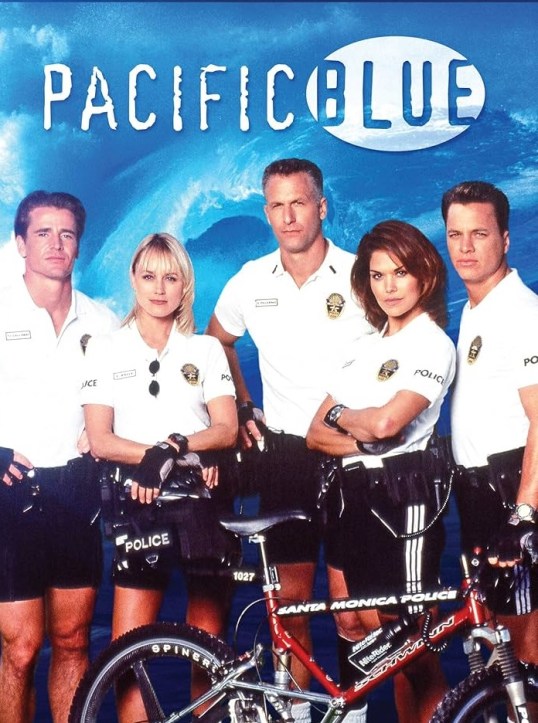
Welcome to Late Night Retro Television Reviews, a feature where we review some of our favorite and least favorite shows of the past! On Tuesdays, I will be reviewing Pacific Blue, a cop show that aired from 1996 to 2000 on the USA Network!  It’s currently streaming everywhere, though I’m watching it on Tubi.

This week, Palermo dies but it’s not a permanent condition.

Episode 3.14 “Heartbeat”

(Dir by Terence H. Winkless, originally aired on December 28th, 1997)

This week, Pacific Blue decided to stop pretending that it was anything more than a Baywatch ripoff by having Carmen Electra appear as Lani MacKenzie, the lifeguard that she played on Baywatch.  She helped the bicycle cops out with a rescue and then the bike cops helped her out when she had to break up a knife fight on the beach.

Lani was also present to discuss a new program in which two EMTs will ride with the cops.  They will learn how to get around on a bicycle while teaching the bike cops stuff like CPR.  One of the EMTs is Alexa Cholak (Alex Datcher), an ex-girlfriend of Palermo’s.  This complicates things when an explosion rips across the beach.  Palermo and a random woman are injured.  Alexa and all the bike cops work on restarting Palermo’s heart, giving him mouth-to-mouth and chest compressions.  Palermo lives.  The woman dies.  The woman’s boyfriend then sues the bike patrol because he says that they were so concerned about saving Palermo that they essentially just let his girlfriend die.  We’re supposed to dislike the boyfriend but he is actually kind of …. sort of …. right?  Chris points out that the woman would have died even if the EMTs had tried to save her but they had no way of knowing that at the time.  Essentially, they decided to save their friend Palermo while ignoring someone else who was seriously injured.

This really gets to one of the major problems I have with Pacific Blue.  The show just assumes that we’re going to be on the side of the bike patrol no matter what, despite the fact that they often come across as being a bunch of jerks.  That’s certainly the case here.  When Palermo returns to the office, everyone starts applauding and cheering for him, despite the fact that the dead woman’s boyfriend happens to be standing just a few feet away.

This episode features scenes of the members of the bike patrol being interviewed by a therapist after the explosion.  Palermo says that, when he was dead, he didn’t see a bright light or feel any sort of inner peace.  He didn’t see his loved ones waiting for him.  It’s like even the show is admitting that Palermo is going to go to Hell for creating the bike patrol.

As for the rest of the episode, Chris and Victor investigated the claims of an environmentalist whack job (Michael Houston King) who said that a big evil businessman (Larry Wilcox, of CHiPs fame) was polluting the beach.  It turned out the environmentalist was telling the truth.  Meanwhile, shaken by the death of the woman and the resulting lawsuit, Alexa resigned from the bike patrol.  It would have been touching if Alexa had actually been in more than one episode.  Still, each member of the bike patrol popped a wheelie in honor of Alexa.  It was dumb.  Get those bicycles off the beach!

Stupid episode, this week.


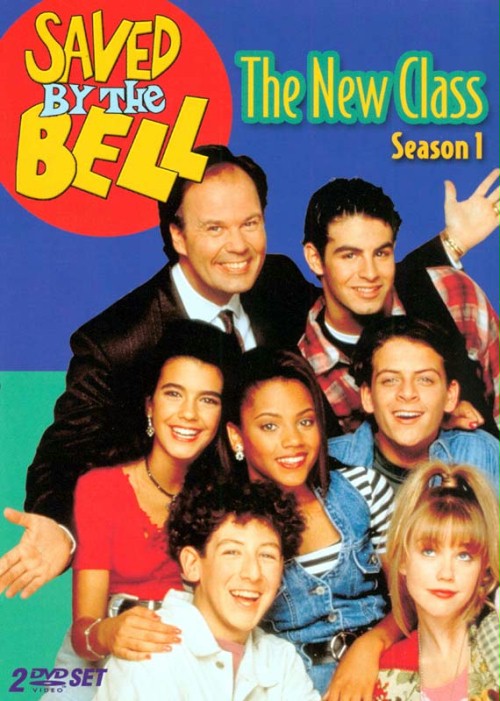
Retro Television Review: Saved By The Bell: The New Class 1.4 “Home Shopping”


Welcome to Retro Television Reviews, a feature where we review some of our favorite and least favorite shows of the past!  On Tuesdays, I will be reviewing Saved By The Bell: The New Class, which ran on NBC from 1993 to 2o00.  The show is currently on Prime.

This week, an old friend makes an appearance.

Episode 1.4 “Home Shopping”

(Dir by Don Barnhart, originally aired on October 2nd, 1993)

With the entire school freaking out about midterms and Scott and Lindsay working in the school store (which apparently is just a cardboard sign set up next to a trashcan in the hall), Scott comes up with a brilliant idea.  Why not start a home shopping network on Baywatch’s TV station?  And why not sell a special memory tonic that is basically just chocolate syrup and fish oil?

Soon, the entire school is drinking Chocolate Memory.  Evil old Dr. Hammersmith (David Byrd) announces that he’s going to make his midterm even more difficult as a way to combat the use of Chocolate Memory.  Scott recruits James the Actor (Mark Blankfield) to pretend to be a Harvard professor who is willing to offer Dr. Hammersmith a job but only if Dr. Hammersmith gives an easy midterm.

James the Actor, I should mention, appeared in a handful of episodes of the original Saved By The Bell.  He was a waiter at the Maxx and an actor who would happily put on a fake beard whenever Zack needed to fool someone.  It’s not a  surprise that he would come back for Saved By The Bell: The New Class.  What is a surprise is that Scott — a transfer student from another school — somehow knows who James is.  In fact, how do any of the members of the new cast know James as well as they do?  James was Zack’s friend and now, suddenly, he’s Scott’s friend.  It seems like James, a grown man approaching 50, just liked hanging out with high school students and helping them with their zany schemes.  Red flag!  Red flag!

Oh, this episode was dumb.  Presumably, everyone flunked their midterms, except for Megan who was so worried about fooling Mr. Hammersmith that she actually studied for them.  What’s funny is that the “difficult” questions that Mr. Hammersmith asked weren’t that difficult.  I mean, if you can’t remember the year that the Boston Tea Party occurred, maybe you should be held back a grade or two.  (1773, by the way.)

One of the more familiar complaints about the first season of Saved By The Bell: The New Class is that it didn’t do much to differentiate itself from the original series.  It just brought in a bunch of new people and had them act like Zack, Slater, Kelly, and Weasel.  That’s certainly true in this case.  As I watched Scott go through the motions with his wacky scheme, I found myself suspecting that the episode’s script probably just had a line marked through “Zack” and “Scott” added in pencil.

At the end of the episode, Megan and Scott share a smile and agree that they make a great team.  “Whooooo!” the audience shouts.  I guess they make an okay team.  I mean, they managed to get everyone in the school to drink a potentially lethal combination of fish oil and chocolate syrup.  If Megan wants to become a professional con artist, I guess she’s found her man.

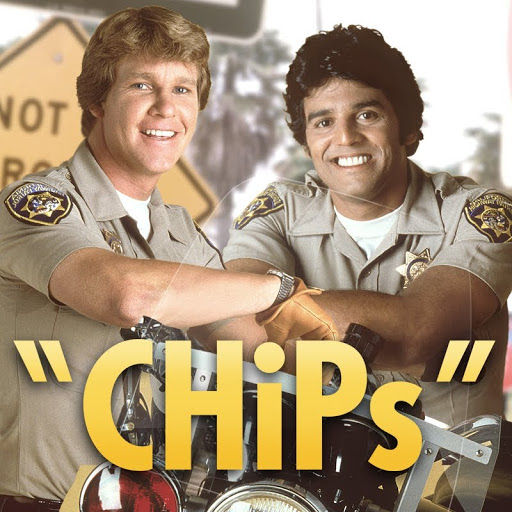
Late Night Retro Television Review: CHiPs 5.8 “Diamond In The Rough”


Welcome to Late Night Retro Television Reviews, a feature where we review some of our favorite and least favorite shows of the past!  On Mondays, I will be reviewing CHiPs, which ran on NBC from 1977 to 1983.  The entire show is currently streaming on Prime!

Who will be Jon’s partner this week?  Read on to find out.

Episode 5.8 “Diamond in the Rough”

(Dir by Leslie H. Martinson, originally aired on November 22nd, 1981)

Erik Estrada is not in this episode which means that a pre-transition Caitlyn Jenner is back as Officer Steve McLeish.  Yay!  Jenner is just as off-putting and unconvincing as the last time that he appeared on this show.  Unfortunately, it appears that the show’s producers picked up on the fact that he wasn’t a particularly good (or even appealing) actor and, as a result, neither Jon nor Steve do much in this episode.  It’s almost as if the show’s producer didn’t realize that Jenner’s inability to show emotion or deliver his lines without smiling like a goofball was the most entertaining thing about the episodes without Estrada.

Instead, the episode is split between a veteran thief (Henry Jones) plotting his next robbery and an angry kid named Pat (Nicky Katt, in one of his first roles) who stays with the Getraers while his mother is recovering after a car accident.  As the car accident was caused by the thief’s car, Pat is in a position where he can identify the thief.  But first, Pat has to stop getting angry at everyone.

This episode didn’t add up too much.  The whole thing felt a bit half-baked and one gets the feeling that the script was hastily thrown together so that it wouldn’t require Estrada (who was recovering from a stunt-gone-wrong at the time) while, at the same time, it also wouldn’t require Jenner to do much more other than stand around and direct traffic.  Robert Pine gets to do a bit more than usual, which is good because he was the best actor on the show.  But still, on the whole, this just didn’t feel like a proper episode of CHiPs.

One final note: Nicky Katt was really good as Pat.  Most child actors tend to go overboard and come across as being cutesy.  Katt, on the other hand, seemed to be sincerely angry in the role of Pat.  Your heart really broke for him.  Even as a child actor, Katt was a smart and intuitive actor.  He is definitely missed.

Retro Television Review: Miami Vice 5.14 “The Lost Madonna”


Welcome to Retro Television Reviews, a feature where we review some of our favorite and least favorite shows of the past!  On Mondays, I will be reviewing Miami Vice, which ran on NBC from 1984 to 1989.  The entire show can be purchased on Prime!

This week, Crockett and Tubbs — or is it Burnett and Cooper? — enter the art world.

Episode 5.14 “The Lost Madonna”

(Dir by Chip Chalmers, originally aired on March 17th, 1989)

When Crockett and Tubbs take down what they think is a drug deal, they’re shocked to discover that Stanley Costa (Stephen G. Anthony) was actually smuggling two paintings!  They could always ask Stanley what’s going on but — whoops!  They killed him during the show’s precredit sequence.

Detective Whitehead (Michael Chiklis) comes down from New York City and explains that the two paintings are the side pieces for a triptych called The Last Madonna.  It was recently stolen from a Paris museum and Whitehead is convinced that theft was masterminded by Joey Scianti (Peter Dobson).

It’s time for Tubbs and Crockett to — *sigh* — go undercover.  Why they’re still always going undercover, I have never really understood.  Every time they go undercover, their cover gets blown.  Do the members of the Miami underworld just not communicate with each other?  Shouldn’t everyone know, by this point, that Tubbs and Crockett are cops?  In this case, Tubbs goes undercover as someone who appreciates art.  Crockett goes undercover as the crude Sonny Burnett….

Yes, Crockett is still using the Burnett cover.  He’s doing this despite the fact that he just recently had a mental breakdown that led to him not only thinking that he actually was Burnett but also becoming Miami’s biggest drug lord.  Even if the Scianti family was dumb enough to not know that Crockett was a cop, surely they would have heard enough about drug lord Sonny Burnett to wonder why he would be hanging out with a connoisseur of fine art.

(Indeed, it’s hard not to notice that everyone has apparently moved on rather quickly from Sonny’s mental breakdown and his time as a drug lord.  For that matter, Sonny certainly doesn’t seem to ever give much thought to his dead second wife.  Remember her?  The world-famous singer who was literally gunned down in front of him?  She appears to have been forgotten.)

This episode was dull, largely because the Scianti family was never really a credible threat.  They came across as being a bunch of buffoons and, as such, it was hard to really get that concerned about whether or not they would figure out that Crockett and Tubbs were actually cops.  This is another episode that features a twist that you’ll see coming from miles away.  From the minute Michael Chiklis first showed up, I knew that he was eventually going to try to steal the The Lost Madonna for himself.

Considering that there was a lot of humor in this episode (Crockett, not surprisingly, struggled with understanding modern art), there’s also some surprisingly graphic violence.  Crockett and Tubbs gun down Stanley Costa and blood splatters all over the wall.  Whitehead shoots Joey Scianti and the shocked Joey looks down at his wound and says that it’s “real blood.”  Tonally, this episode is all over the place.

Everyone seemed kind of bored with this episode.  This was definitely a final season entry.

In Praise Of Korey and Cory


As you all know, I don’t really do sports but I just jumped out of my chair and started cheering when I saw Korey Dropkin and Cory Thiesse defeat the Italian team in the Winter Olympic semi-finals for mixed doubles curling.

The other night, during the Super Bowl, I was talking to some friends about how nothing seems to really unite people anymore.  Even the Super Bowl entertainment divided people this year.  The once legendary Super Bowl commercials have become bland and boring because there really aren’t universally beloved celebrities any more.  It used to be exciting seeing your favorite actor shilling for junk food or car insurance.  Now, when an actor shows up in a commercial, we immediately remember all the stupid things they said during the previous election cycle.  (The Budweiser commercial was an exception.  One reason why everyone loved that commercial with the horse and the eagle is because we all know that neither one of them is going to start spouting off about politics on Twitter.)

Even at the Winter Olympics, the same press that will never ask Eileen Gu about the Chinese government sentencing Jimmy Lai to life imprisonment is all too eager to demand that American athletes denounce their country.  Some people say that that goal of the media is to divide us.  Personally, I think the goal of the media is to make money and the easiest way to do that is to generate controversy which will then generate the clicks that are needed to survive.  Getting people angry is less a subversive plot and more a business model.

But as I watched Korey and Cory — two people from Minnesota who Duluth, Minnesota — come from behind to defeat the very strong Italian team, I felt more optimistic than I have in a long time.  Beyond the fact that Cory is a lab technician and Korey is a realtor, I don’t know much about who Korey and Cory are when they’re not on the ice and quite frankly, I don’t need to know.  I don’t need to know how they vote.  I don’t need to know how they feel about this issue or that.  I don’t need to know what movies they watched or what music they listen to or anything else.  All I need to know is that they’re good at curling and they’re representing America in Italy and doing a great job of it.  Whenever the camera switched to the watch parties in Duluth or to Korey’s family in the stands, I felt very proud of both them and my country.

As individuals, we may not always agree on everything but, as Americans, we can all cheer for Korey and Cory and, in doing so, we can be reminded that we’re not really as divided as the media’s business model and social media’s algorithms would like us to believe.  Tomorrow, they go for the gold against Sweden.  I’ll be watching.

Late Night Retro Television Review: Degrassi: The Next Generation 2.5 “Weird Science”


Welcome to Late Night Retro Television Reviews, a feature where we review some of our favorite and least favorite shows of the past!  On Sunday, I will be reviewing the Canadian series, Degrassi: The Next Generation, which aired from 2001 to 2015!  The series can be streamed on YouTube and Tubi.

This week, Emma is annoyed about something.

Episode 2.5 “Weird Science”

(Dir by Bruce McDonald, originally aired on November 11th, 2002)

Emma is still upset that Mr. Simpson is dating her mother.  This episode opens with an extremely awkward “family” dinner, in which Mr. Simpson asks that Emma call him “Archie” at home and Emma responds by calling him “Mr. Simpson.”  (At least he didn’t ask her to call him Snake.)  I could actually relate to Emma in this scene, if just because, when I was Emma’s age, I was an absolute brat towards anyone who tried to date my mom.  If anything, Mr. Simpson should be happy that all he has to deal with is Emma glaring at him.  He wouldn’t have been able to survive me and my sisters.

It’s science fair time!  Emma’s experiment takes a look at whether or not having a healthy breakfast can be help someone perform better at school.  She takes first prize but, because Mr. Simpson is one of the judges, she’s not sure that she earned it.  And, after Manny accidentally sends an email to the entire school in which she mentions that “Mr. Simpson loves Emma’s mom,” second-place finisher Liberty isn’t so sure that Emma deserves the prize either.

Liberty says that Emma should withdraw her experiment and give the first prize trophy to Liberty.  Liberty, as I’ve mentioned in the past, is the absolute worst.  Emma confronts Mr. Simpson and he explains to her that all of the judges voted for Emma to get first prize.  Emma apologizes and promises to be nicer to Mr. Simpson.

(This, of course, frees Mr. Simpson to later knock up and marry Spike before cheating on her with Ms. Hatzilakos but that’s an entire season away.)

Meanwhile, Spinner is freaking out because he keeps getting erections at awkward moments — hey, Degrassi goes there!  (Seriously, that was Degrassi’s slogan for a while.)  Spinner blames it on Emma forcing him to eat bananas as a part of her experiment.  Jimmy thinks that Spinner is crazy and eventually they ask Sheila the Cafeteria Lady if certain foods could be to blame for Spinner being perpetually at attention.  Sheila says that it’s just a part of growing up.  Spinner and Jimmy are relieved but I’m concerned that, in Canada, it’s apparently left to the cafeteria workers to explain these things.

This episode is largely remembered for the Spinner subplot, with Spinner panicking and getting embarrassed in Ms. Kwan’s class, so much so that I’m always surprised to discover that it’s mostly about Emma getting mad at Mr. Simpson.  Emma, of course, is destined to eventually marry Spinner at the end of Degrassi Takes Manhattan.  The Spinner/Emma marriage has often been criticized because Spinner and Emma hardly ever interacted in the seasons leading up to their sudden decision to get married.  But this episode shows that Emma apparently felt close enough to Spinner to experiment on him.

Next week: Craig and the gang get into trouble!

My Favorite 2026 Super Bowl Commercial


The commercials were pretty dull this year, largely because we don’t have any universally beloved celebrities anymore.  Getting someone famous and likable to do something cute used to be the easiest way to create a great Super Bowl commercials but now, hardly anyone is likable and even most celebrities are only famous with a niche audience.  Humor, which used to be a key part of most good Super Bowl commercials, fell out of fashion in 2017 and, even though most people have moved on from that weird time, the advertising world still hasn’t quite recovered.  The use of AI isn’t helping.  For instance, this year, Dunkin Doughnuts tried to do a commercial with a bunch of old sitcom stars.  Usually, you would think that would work but the de-aging technology made the entire thing feel like a zombie movie.

Really, there’s only one non-movie commercial that really struck my fancy this year and it’s from Budweiser.  I don’t even drink but I do love horses, I love majestic birds, and I love classic Lynard Skynard.  Also, it should be noted that the eagle at the end of the commercial was not AI.  He’s an actual eagle by the name of Lincoln.  This commercial is called “American Idols” and it definitely deserves the title.

The Super Bowl was bland this year and I have a feeling that’s going to be the state of things for a while.  But this commercial definitely brought tears to my eyes.  This is what Super Bowl commercials are supposed to be all about.

Retro Television Review: Homicide: Life On The Street 4.21 “Scene of the Crime”


Welcome to Retro Television Reviews, a feature where we review some of our favorite and least favorite shows of the past!  On Sundays, I will be reviewing Homicide: Life On The Street, which aired from 1993 to 1999, on NBC!  It  can be viewed on Peacock.

This week, it’s another night in Baltimore.

Episode 4.21 “Scene of the Crime”

(Dir by Kathy Bates, originally aired on April 12th, 1996)

This week, three murders are committed in the projects of Baltimore.

The first murder occurs when a drug dealer is tossed off the roof of an apartment complex, “the towers.”  Making the Lewis and Kellerman’s investigation difficult is the fact that the city has given a security contract to the Black Muslims.  The Muslims have been patrolling the Towers for a year and, in that time, they’ve chased out most of the drug dealers that once terrorized the building’s residents.  Kellerman feels that the Muslims are racists.  Giardello says that the Muslims just caused the dealers to go to another block.  Lewis, however, is a bit more conflicted.  As he explains it to Kellerman, why should white neighborhoods by the only ones allowed to have their own private security force?

The second and third murders occur at another set of towers.  This time, two teenage drug dealers ended up shooting each other.  When Munch and Russert arrive at the scene, they are met by patrolman Stu Gharty (Peter Gerety).  Gharty walks them through the scene, shows how the two dealers ended up killing each other, and then excuses himself to wait for the medical examiner.  Munch is impressed with Gharty but Russert can’t help but note the thirty-minute time gap between when Gharty got the call about the shooting and when he called for homicide.  Gharty confesses that, when he first arrived, he didn’t immediately enter the building, despite hearing the gunshots.  Gharty was concerned for his safety.  Munch understands and, even more importantly, he doesn’t believe in getting other cops in trouble.  Russert, however, is angered, especially after it turns out that one of the teenagers bled to death while Gharty was waiting outside.

This was an excellent episode of Homicide, one that was smart enough to paint anyone as being all good or all bad.  Ishmael Al-Hadj (Victor Williams), the head of the Muslim security force, is an anti-white fanatic but Lewis has a point when he says that Ishmael and his men have largely kept peace in the Towers in a way that the police have not been able to do so.  In the end, Ishmael turns over the name of the murderer but only after he knows that the man is no longer in Baltimore.

As for Stu Gharty, Russert is absolutely correct when she says that he failed to do his duty but, largely due to Peter Gerety’s empathetic performance, it’s hard not to sympathize with Gharty.  As Russert herself admits, Gharty has been a good cop for years but, that one night, he allowed his fear to get the better of him.  Russert, who is still thinking like a captain despite being demoted, feels that one moment of weakness cannot be overlooked.  Just about everyone else disagrees.  Whereas Russert and Kay Howard sees someone who failed to do his job, a detective like Munch looks at Gharty and sees a 54 year-old cop who is just a few years away from getting reassigned a desk job on account of his age and who made one mistake because he didn’t want his family to get a call telling them that he was dead.  At one point, Gharty says he’s thinking of just taking retirement.  Of course, he didn’t.  Instead, he returned a few seasons later as a regular.

This episode also featured Munch preparing for the return of Bolander.  After calling Bolander multiple times, Munch finally got him to agree to drop by the Waterfront Bar.  Of course, Bolander never showed up.  And it makes sense, really.  After getting shot and nearly dying during the previous season, Bolander was obviously done with being a cop.  (And, of course, Ned Beatty was no longer on the show.)  Still, there was something rather poignant about Munch’s growing realization that his partner and his hero was no longer going to be around.

Next week, the season comes to an end!