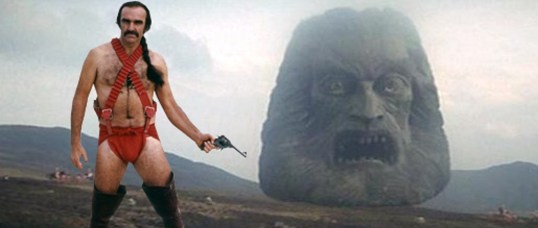
Welcome to the year 2293. Savages known as the Brutals live in a wasteland and worship a giant stone head named Zardoz, who comes out of the sky, tells them to shoot guns and not have sex, and then dumps hundreds of firearms on them. One Brutal, Zed (Sean Connery, wearing what appears to be a big red diaper) jumps into Zardoz’s mouth and discovers that Zardoz is actually a spaceship that is piloted by Arthur Frayn (Niall Buggy). Zed shoots Arthur and then flies with Zardoz to the Vortex, where a bunch of overdressed and overaffected Immortals are having a perpetual garden party.
The Immortals, who can live forever because they’ve mentally learned how to slow the aging process, take an immediate interest in Zed. They want to know where Arthur is. Zed wants to explore the Vortex and learn what’s going on. The Immortals assign Zed to do menial tasks. Consuela (Charlotte Rampling) falls in love with Zed but keeps trying to kill him. If you could live forever, the film asks, wouldn’t you eventually want to die? I would not.
John Boorman, you nut! Boorman is one of the greatest directors ever, responsible for PointBlank, Deliverance, and Excalibur. Zardoz shows what happens when a great filmmaker falls so in love with his vision that no one can tell him that it’s not working. Zardoz is pure Boorman, obsessed with nature, curious about paganism, and cynical about religion. Boorman had something that he wanted to say about nature and humanity and he deserves a lot of credit for that. He had just directed Deliverance and could have had his pick of projects in 1974. He could have directed an action spectacular or he could have just gone home to Europe and counted his money. Instead, Boorman decided to go with a dream project that he had been trying to put together for years.
Did it work? No, it did not. A few stunning images (that stone head!) aside, the movie itself is slow and talky and Sean Connery, with his deep brogue, is miscast as Zed. (As Lisa said last night, “I’m glad to see Scotland survived the apocalypse.”) With his pony tail and his handle-bar mustache, Connery seemed like he was doing a dry run for his Highlander character. Charlotte Rampling is beautiful as Consuela and some viewers — mostly men — will appreciate her costumes, but the society of the Immortals is never as interesting as Boorman seems to think it is.
Zardoz is bad but still compelling because Boorman was so dedicated to whatever it was he thought the message of the movie was. Watch it with a bud and try to figure it out,
Hey hey!! Before you read this, know that this isn’t the only review for The Longest Day. Lisa Marie also wrote about it. Read that first, and then double back here if you like.
With June 6th being the 81st Anniversary of D-Day, I decided to write about 1962’s The Longest Day, a film often discussed in my family, but surprisingly, I don’t recall ever fully watching it until today. I’ll try to get a hold of a hard copy of this in the future. The film is currently available to watch (with ads) on YouTube. This was a film my Aunt adored, as she liked seeing the Military come to the rescue in any situation (which happened often in most classic sci-fi films). This, They Died With Their Boots On, and All Quiet on the Western Front were films she raved about.
According to the National WWII Museum, “The Allies suffered over 10,300 total casualties (killed, wounded, or missing), of which approximately 2,400 were on Omaha Beach.” it was also an incredible offensive achievement, with nations gathering together to take the fight to a common enemy.
I don’t have a whole lot to say about this. As this is a film based on actual events (which takes some movie related liberties), I can’t complain or state I loved the “story”. As my boss at my Dayjob sometimes says, “It is what it is.” In terms of presentation, however, I highly recommend it. The film never really falters, nor does it give you too much time to relax. There’s a quiet tension with all of the characters you meet (all of the Allied ones, anyway), wondering if they may make it through by the end. If nothing else, watching it reminds one of the sacrifices made and the courage of anyone deciding to run head first into battle like that.
The film is epic in scope, with a runtime of 3 hours and an all star cast that includes Robert Mitchum (Cape Fear), Eddie Albert (Dreamscape), John Wayne (The Quiet Man), Henry Fonda (Once Upon a Time in the West) Curt Jurgens (The Spy Who Loved Me), Red Buttons and Roddy McDowall (who would later work together in The Poseidon Adventure), Richard Beymer (West Side Story), Frank Findlay (Lifeforce), Gert Frobe and Sean Connery (both two years shy of working together in Goldfinger), Richard Burton (Cleopatra) and Robert Ryan (The Wild Bunch) among others.
Much like 1970’s Tora!Tora!Tora! (which my Dad often talked about), there were multiple directors for The Longest Day. Bernhard Wiki captured the German scenes, Andrew Marton handled the American ones, and Ken Annakin handled both the English and French sequences. This is all brought together in a seamless and pretty amazing tapestry. Unlike Steven Spielberg’s Saving Private Ryan, The Longest Day only covers the time leading up to and through the Omaha Beach assault, using the bulk of the film’s 3rd hour for the event. The entire film makes wonderful use of the time with all the alternate views, and by the time the first combat starts near the start of the 2nd hour, it continues to flow from interaction to interaction. There are also some wonderful arial shots over the battles, including an classic one shot that’s pretty marvelous given the time period.
The film takes place just before the invasion. American troops are already in the water on boats. Others are ready to parachute in. The French are ready to fight, waiting for the right phrase to hit the radio to put them into action. all are waiting to hear from the Britians on when the Allied Assault should begin. The weather isn’t optimal, but with the operation already delayed once before, President Eisenhower (Henry Grace) decides the 6th is the drop date. The Germans assume nothing will happen assaults are supposedly not done in harsh weather, but this proves to be quite the mistake.
It was wonderful to see everything come together. From the French sabotaging communications, to the strange comedy of soldier toting bagpipes to lead the Scottish into battle, or the Nuns who walked right through battle to save lives, it’s quite a sight to behold.
Zardoz (1974, dir by John Boorman, DP: Geoffrey Unsworth)
As some of our regular readers undoubtedly know, I am involved in a few weekly watch parties. On Twitter, I host #FridayNightFlix every Friday and I co-host #ScarySocial on Saturday. On Mastodon, I am one of the five hosts of #MondayActionMovie! Every week, we get together. We watch a movie. We tweet our way through it.
Tonight, at 10 pm et, I will be hosting #FridayNightFlix! The movie? Zardoz, starring Sean Connery, Charlotte Rampling, and a big ugly head!
If you want to join us this Friday, just hop onto twitter, start the movie at 10 pm et, and use the #FridayNightFlix hashtag! I’ll be there tweeting and I imagine some other members of the TSL Crew will be there as well. It’s a friendly group and welcoming of newcomers so don’t be shy.
117 years ago today, Ian Fleming was born in Mayfair, London. A member of British Intelligence during World War II, Fleming is today best-remembered as the creator of James Bond.
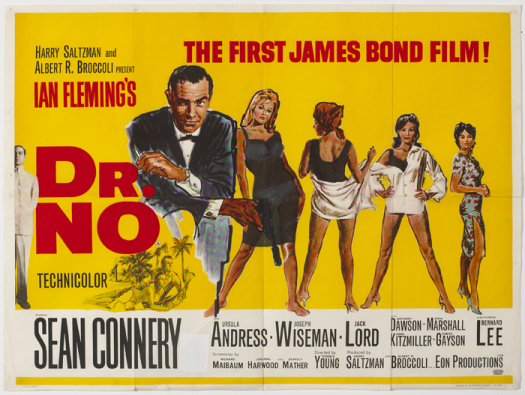
Today’s scene that I love comes from 1962’s Dr. No. Here is Sean Connery, in his first appearance as Fleming’s iconic secret agent. Eunice Gray was cast as Sylvia Trench, who was originally envisioned as being Bond’s permanent “London” girlfriend. She also appeared in From Russia With Love before the idea was abandoned. We all know that Bond’s true love was Tracy di Vincenzo.
1979’s Meteor is about a big rock that is tumbling through space. Earth is directly in its path and, if it hits the planet, it could be an extinction-level event. Unfortunately, little bits of the rock keep breaking off and crashing into Earth, destroying cities and fleeing extras. Goodbye, Hong Kong. Goodbye, Switzerland, which is destroyed via stock footage lifted from Avalanche. Goodbye, New York, which blows up in such spectacular fashion that the scene was later re-used in The Day After.
It might seem like the planet is doomed. The meteor is unstoppable. Bruce Willis hasn’t become a star yet. But fear not! Some of the brightest faces of the 70s have been recruited to stop the meteor. Natalie Wood, in one of her final films, plays a translator and gets covered in muddy river water. Sean Connery wears a turtleneck and curses in that Scottish way of his. Karl Malden wears a hat and tells people to calm down while he calls the President. Brian Keith plays a Russian with all the grace and skill of a cat trying to rip open a bag of treats. Martin Landau is the military official who doesn’t think that the scientist know what they’re talking about. Henry Fonda is the president. That’s a lot of balding men for one movie and it’s hard not to notice that both Malden and Keith often seem to be wearing a hat whenever they share a scene with Connery. My personal theory is that the production, having spent all of their money on blowing up New York, couldn’t afford more than two toupees so everyone had to take turns wearing them. (The few scenes where Malden is hatless while in Connery’s presence are often oddly filmed, with either Connery on Malden standing with their back to the camera, almost as if the scenes were actually done with a stand-in.)
We’re supposed to breathe a sigh of relief when we see that Henry Fonda is playing the President but I’ve seen FailSafe and I remember him allowing the Russian to nuke New York City. Interestingly enough, New York gets destroyed in this film too. Why didn’t President Fonda care about New York City? Of course, the scientists and the military folks are all located in a control center that’s located under the city. Malden mentions that they’re right next to the Hudson River. It doesn’t seem to occur to anyone that this is a bad idea but, then again, they also elected Henry Fonda president again.
My late friend and colleague Gary Loggins described Meteor as being a “crashing bore.” I have to admit that this is one of the few times that I have ever disagreed with Gary. Meteor is a tremendous amount of fun, as long as you’re watching it with a group of people and nobody takes it seriously. (The first time I saw it was at one in the morning while I was in college. Jeff and I watched it in the lounge of one of the dorms. We may be the only two people to have romantic memories of Meteor.) Meteor features a cast of champion scenery chewers. Karl Malden, Sean Connery, Martin Landau, Brian Keith, none of them were exactly subtle actors and giving them an excuse to argue about how to deal with a meteor allows for a lot of very enjoyable overacting. As well, the special effects are so cheap and obviously fake that it’s hard not to laugh out loud whenever the film cuts to that shot of the meteor rolling through space or the incredibly shiny American and Russian missiles slowly heading towards it.
Meteor’s a lot of fun, even if it is one of those movies where no one points out that our heroes inevitably seem to make every situation worse with their own stupidity. It’s very much at the tail-end of the 70s disaster boom. Watch it for the stars. Watch it for the rock. And watch it for the hairpieces.
Today’s scene that I love is a chaotic scene in which a fragments of a meteor cause a tidal wave to crash over Hong Kong. It’s chaos on a budget in 1979’s Meteor! This scene was actually filmed in Los Angeles and featured cardboard cut-outs of buildings in a big water tank.
In 1971’s The Anderson Tapes, Sean Connery stars as Duke Anderson.
Duke is a career criminal, a safecracker who has just spent ten years in prison. He’s released, alongside Pops (Stan Gottlieb), who spent so much time behind bars that he missed two wars and the Great Depression, and the quirky Kid (Christopher Walken, making his film debut). Duke immediately hooks up with his former girlfriend, Ingrid (Dyan Cannon), and decides to rob the luxury apartment building where Ingrid is now living.
Of course, Duke will have to put together a crew. It’s not a heist film without a quirky crew, is it? Duke recruits the Kid and Pops. (The Kid is happy to be in the game but he’s not a fan of violence. Pops, meanwhile, has none of the skills necessary for living in the “modern” world and would much rather return to prison.) Duke also brings in the flamboyant Tommy Haskins (an overacting Martin Balsam) and driver Edward Spencer (Dick Anthony Williams). Duke goes to the mob for backing and Pat Angelo (Alan King) gives it to him on the condition that he take along a sociopathic racist named Socks (Val Avery) and that Duke kills Socks at some point. Duke reluctantly agrees.
So far, this probably sounds like a conventional heist film. Director Sidney Lumet mixes comedy and drama with uneven results but, overall, he does a good job of ratcheting up the tension and TheAndersonTapes is a good example of one of my favorite mini-genres, the “New Yorkers will be rude to anyone” genre. At first glance, Sean Connery seems to be playing yet another super smooth operator, a confident criminal with a plan that cannot fail. Duke seems like a criminal version of James Bond, However, as the film progresses, we start to suspect that things might be getting away from Duke. When Duke has to go the Mafia for support and is told that killing Socks is now a part of the job, we see that Duke isn’t as in-control of the situation as we originally assumed. This is the rare Sean Connery film where he has someone pushing him around.
(Apparently, Connery took this role as a part of his effort to escape being typecast as Bond. Perhaps that explains why Duke seems like almost a deconstruction of the James Bond archetype.)
Of course, what really lets us know that Duke isn’t as in-charge as he assumes is the fact that four different law enforcement agencies are following his every move. From the minute he gets out of prison, Duke is being watched. The apartment is bugged. Security cameras records his every move. Once the heist begins, we’re treated to flash forwards of breathless news reports. TheAndersonTapes is less a heist film and more a portrait of the early days of the modern Surveillance State. Of course, none of the agencies make any moves to stop Duke because doing so would reveal their own existence. The film really does become a portrait of a government that has gotten so big and intrusive that it’s also lost the ability to actually do anything.
The Anderson Tapes is entertaining, even if it’s not really one of Lumet’s best. Connery is, as always, a fascinating screen presence and it’s always entertaining to see a young Christopher Walken, showing early sings of the quirkiness that would become his signature style. TheAndersonTapes is a portrait of a world where you never know who might be listening.
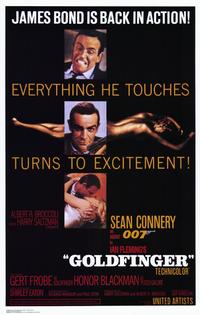
Seeing as how today would have been Gert Frobe’s birthday, it seems only appropriate that today’s scene of the day should be one of the best moments from the original Bond franchise. In 1964’s Goldfinger, Frobe sets the standard by which all other Bond villains would be judged.
There was a time in my life, before I could drive, when I would beg my parents to stop at the video store every time we went to the neighboring town of Conway, Arkansas. The town I grew up in was too small to have more than just a gas station, so this movie buff had to take advantage of every trip to town. One night when we were headed home, my parents relented to my repeated requests, so we stopped off at Budget Video. I wanted to choose all the movies, but unfortunately mom and dad would also let my brother and sister choose movies from time to time as well. On this particular night, my brother wanted to rent THE UNTOUCHABLES (1987). I don’t remember what I was wanting, but I do remember that it was not THE UNTOUCHABLES. I probably pouted a little bit, but we ended up taking THE UNTOUCHABLES home with us. We turned it on that night, and I’ll gladly admit that I was 100% wrong. THE UNTOUCHABLES immediately became one of my favorite films. Great job, bro!
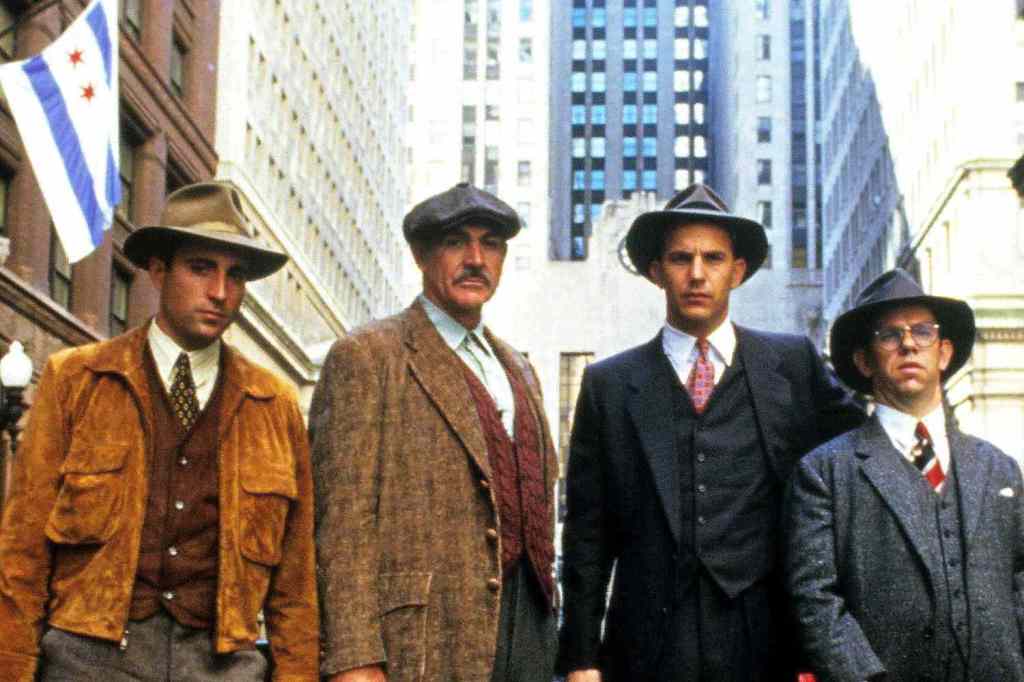
It’s 1930 and Prohibition is the law of the land in the United States of America. Treasury agent Eliot Ness (Kevin Costner) has been given the seemingly impossible task of bringing down notorious gangster Al Capone (Robert De Niro), who supplies booze to nearly all of Chicago. Capone doesn’t just supply the booze, he rules Chicago with an iron fist; and if you’re a local business who doesn’t want to buy his product, he just may blow your ass up! Ness’ job is made especially difficult due to the rampant corruption in Chicago, where everyone from the Mayor, to the judges, lawyers, and law enforcement officers are all on Capone’s payroll, making it pretty much impossible to trust anyone. In a complete stroke of luck, Ness encounters the honest Irish American policeman James Malone (Sean Connery) and asks him to join him in bringing down Capone. With Malone, Ness has found that honest and badass cop who’s not afraid to go up against Capone and his goons. Knowing that most of the police force is already compromised, the two men head to the police academy to try to find another honest cop. This turns out to be another great move as they come upon an Italian American trainee named George Stone (Andy Garcia), who’s a prodigy with a gun. Their last, and greatest move in this humble CPA’s opinion, comes when they accept accountant Oscar Wallace (Charles Martin Smith) to their team. Wallace is convinced that the key to bringing down Capone is trying to build a tax evasion case against him. He’s initially laughed at, but it’s soon apparent that this accountant knows his debits and credits, and his expertise may be just what’s needed to end Capone’s reign of terror once and for all.
I’ve always considered THE UNTOUCHABLES to be a near perfect film. One of the main reasons I find the film so perfect is the direction of Brian De Palma. I’ve been a fan of his “style” for so long, with films like DRESSED TO KILL (1980) and BLOW OUT (1981), but I think he just nails the material here. There are so many great scenes, but the “Union Station” sequence has to be one of the most perfectly choreographed sequences of all time. The building of the tension, the slow-motion shootout when the bad guys arrive, and finally the badass resolution all prove what an absolute master De Palma could be with the right material. De Palma claims that he made up the series of shots as he was filming the scenes at the train station, making the final product that much more impressive. And this all plays out against the background of a “lullaby theme” composed by the legendary Ennio Morricone (THE GOOD, THE BAD, AND THE UGLY). This is what “cinema” is all about.
THE UNTOUCHABLES has an amazing cast of actors to bring its “based on real events” story to life. Kevin Costner was just beginning to emerge as a movie star when this movie was made back in 1987. Especially as a younger actor, Costner was good at projecting both a certain innocence, tempered with the willingness to do what it takes to get the job done once his family and friends are put in danger. And what can you say about actors like Sean Connery and Robert De Niro?!! Connery is so charismatic, wise, and tough as the beat cop who shows Eliot Ness how to beat Capone… ”he sends one of yours to the hospital, you send one of his to the morgue!” He’s a beat cop because he’s incorruptible, and Connery projects that stubborn honesty perfectly. I’m so glad that Connery won an Oscar for this performance, as it would be the only time he would ever be nominated for an Academy Award. He’s amazing in this role, even if his accent is Scottish rather than Irish (a notable controversy at the time). Connery may have won the Oscar, but Robert De Niro matches him scene for scene. His ability to make Capone both charismatic and evil in equal measure is an example of what makes De Niro special as an actor. So many actors phone in these types of broad performances, but not De Niro. I also just think it’s cool that De Niro admitted that his performance was heavily influenced by Rod Steiger’s in 1959’s AL CAPONE. I love Steiger and consider this a wonderful tribute. Throw in a young Andy Garcia, the always underrated Charles Martin Smith, and a creepy Billy Drago as Frank Nitti, and you have one of the better casts ever assembled. I especially became a fan of Garcia based on his performance in THE UNTOUCHABLES.
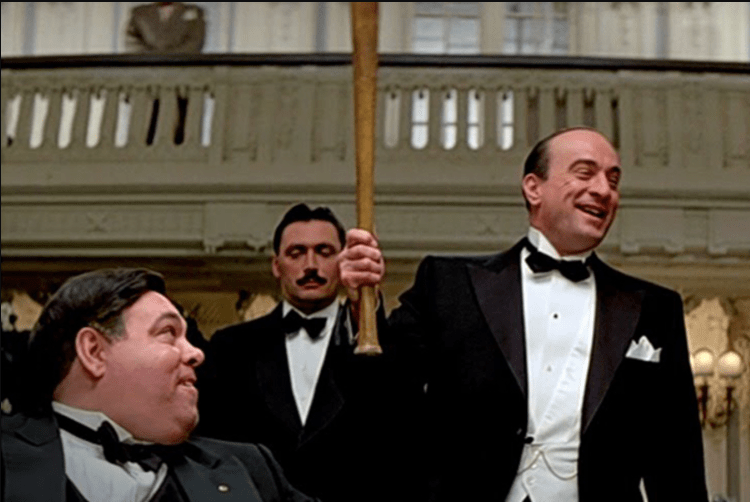
The last person I want to mention is the screenwriter, David Mamet. His screenplay is another perfect element of THE UNTOUCHABLES. The same man who has directed his own films like HOUSE OF GAMES (1987), HOMICIDE (1991), THE SPANISH PRISONER (1997), and SPARTAN (2004) knows how to write a great screenplay. There are so many amazing moments, from the “baseball bat” sequence to the “Stone recruitment” scene, and even Ness’ “he’s in the car” line about Frank Nitti, it’s a muscular screenplay full of big-time moments of audience satisfaction.
At the end of the day, THE UNTOUCHABLES is just a great movie. I still periodically thank my brother for picking it out that fateful day in the late 80’s, and it will always be one of my very favorites. It’s one of those movies that I recommend with zero reservations!
Check out the trailer below, and if you’re smart, you’ll watch one of the great movies of the 1980’s, Brian De Palma’s THE UNTOUCHABLES.
In honor of what would have been Sean Connery’s 93rd birthday, today’s scene that I love comes from the film for which Connery won an Oscar, 1987’s The Untouchables.
In this scene, Kevin Costner’s Eliot Ness first meets Sean Connery’s Jim Malone.