The year is 1989 and the Cold War is coming to an end. Colonel Jack Knowles (Roy Scheider) was a hero in Vietnam but now, years later, his eagerness to fight has made him an outsider in the U.S. Army. Most people would rather that Knowles simply retire but, as long as there are wars to be fought, Knowles will be there. His only friend, General Hackworth (Harry Dean Stanton), arranges for Knowles to be assigned to an outpost on the West German-Czechoslovakia border. As soon as he arrives, Knowles starts to annoy his superior officer, Lt. Col. Clark (Tim Reid). When Knowles sees a Czech refugee gunned down by the Soviets while making a run for the border, he unleashes his frustration by throwing a snowball at his Russian counterpart. Like Knowles, Col. Valachev (Jurgen Prochnow) is a decorated veteran who feels lost without a war to fight. Knowles and Valachev are soon fighting their own personal war, even at the risk of starting a full-scale conflict between their two nations.
The Fourth War was one of the handful of films that John Frankenheimer directed for Cannon Films. Much as he did with The Manchurian Candidate, Frankenheimer mixes serious thrills with dark satire in The Fourth War. Frankenheimer gets good performances from the entire cast, especially Scheider and Prochnow. The real star of the movie is the snow-covered landscape, which Frankenheimer turns into a metaphor for the entire Cold War. When Knowles and Valachev end up throwing punches on a frozen lake that’s breaking apart underneath their feet, it is not hard to see what Frankenheimer’s going for with this film. Released shortly after the fall of the Berlin Wall, The Fourth War is an underrated thriller that deserves to be rediscovered.
Harry Mitchell (Roy Scheider) is a businessman who has money, a beautiful wife named Barbara (Ann-Margaret), a sexy mistress named Cini (Kelly Preston), and a shitload of trouble. He is approached by Alan Raimey (John Glover) and informed that there is a sex tape of him and his mistress. Alan demands $105,000 to destroy the tape. When Harry refuses to pay, Alan and his partners (Clarence Williams III and Robert Trebor) show up with a new tape, this one framing Harry for the murder of Cini. They also make a new demand: $105,000 a year or else they will release the tape. Can Harry beat Alan at his own game without harming his wife’s political ambitions?
Based on a novel by the great Elmore Leonard and directed by John Frankenheimer, 52 Pick-Up is one of the best films to ever come out of the Cannon Film Group. Though it may not be as well-known as some of his other films (like The Manchurian Candidate, Seconds, Black Sunday, and Ronin), 52 Pick-Up shows why Frankenheimer was considered to be one of the masters of the thriller genre. 52 Pick-Up is a stylish, fast-paced, and violent thriller. John Glover is memorably sleazy as the repellent Alan and the often underrated Roy Scheider does an excellent job of portraying Harry as a man who starts out smugly complacent and then becomes increasingly desperate as the story play out.
One final note: This movie was actually Cannon’s second attempt to turn Elmore Leonard’s novel to the big screen. The first attempt was The Ambassador, which ultimately had little to do with Leonard’s original story. Avoid The Ambassador but see 52 Pick-Up.
What’s an Insomnia File? You know how some times you just can’t get any sleep and, at about three in the morning, you’ll find yourself watching whatever you can find on cable? This feature is all about those insomnia-inspired discoveries!
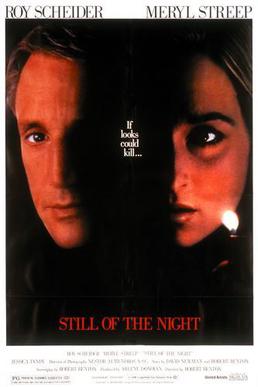
If last night, at 1:30 in the morning, you were having trouble getting to sleep, you could have turned on the TV, changed the channel to your local This TV station, and watched 1982’s Still Of The Night.
Still of the Night actually tells two stories. The first story deals with Dr. Sam Rice (Roy Scheider), a psychiatrist who is living a perfectly nice, mild-mannered, upper class existence in Manhattan. His patients are rich and powerful and his sessions with them provide him with a view of the secrets of high society.
One of Sam’s main patients is George Bynum (Josef Sommer), who owns an auction house and who is a compulsive cheater. George tells Sam that he’s haunted by strange nightmares and that he is also worried about a friend of his. George says that this friend has murdered in the past and George fears that it’s going to happen again. When George is murdered, Sam wonders if the murder was committed by that friend. He also wonders if that friend could possibly have been one of George’s mistresses, the icy Brooke Reynolds (Meryl Streep).
The second story that Still of the Night tells is about our endless fascination with the films of Alfred Hitchcock. Still of the Night is such an obvious homage to Hitchcock that it actually starts to get a little bit silly at times. Almost every scene in the film feels like it was lifted from a previous Hitchcock film. At one point, there’s even a bird attack! (Add to that, Scheider’s mother is played by Jessica Tandy, who previously played Rod Taylor’s mother in The Birds.) Meryl Streep is specifically costumed and made up to remind viewers of previous Hitchcock heroines, like Grace Kelly, Kim Novak, Eva Marie Saint, and Tippi Hedren.
Unfortunately, considering the talent involved, Still of the Night never really works as well as it should. Both Scheider and Streep seem to be miscast in the lead roles. If Still of the Night had been made in the 50s, one could easily imagine James Stewart and Grace Kelly playing Sam and Brooke and managing to make it all work through screen presence along. However, Scheider and Streep both act up a storm in the lead roles, attacking their parts with the type of Actor Studios-gusto that seems totally out-of-place in an homage to Hitchcock. Scheider is too aggressive an actor to play such a mild character. As for Streep, she’s miscast as a noir-style femme fatale. Streep’s acting technique is always too obviously calculated for her to be believable as an enigma.
That said, there were still some effective moments in Still of the Night. The majority of the dream sequences were surprisingly well-done and effectively visualized. I actually gasped with shock while watching one of the dreams, that’s how much I was drawn into those scenes.
According to Wikipedia, Meryl Streep has described Still of the Night as being her worst film. I think she’s being way too hard on the movie. It’s nothing special but it is an adequate way to kill some time. Certainly, I’d rather watch Still of the Night than sit through Florence Foster Jenkins.
This past Wednesday night, I went out to New Bedford’s Zeiterion Theater to watch a screening of the summertime classic JAWS. The Z, as we locals call it, began life as a vaudeville palace in 1923, and five months later changed its name to The State and ran the latest silent movies. The State operated as a movie house until the late 70’s, with the historic building refurbished in 1982 and retro rebranded as the Zeiterion, hosting concerts, plays, dance, and other performing arts. The city (which now owns and operates the Z) recently purchased a state-of-the-art high-definition digital projector and, after an absence of almost a year, movies are back in New Bedford! They kicked off a “summer series” of films with Steven Spielberg’s summer blockbuster scarefest, filmed not far from here (just a fast ferry ride away aboard the Sea Streak) on Martha’s Vineyard.
Apparently, today is the opening day of the 2017 baseball season. The only reason that I know that is because of my sister Erin. I don’t know much about baseball, to be honest. I know that my city’s team is the Texas Rangers and they were once owned by George W. Bush. I know that Houston has a team called the Astros. But, really, the main thing that I know about baseball is that my sister absolutely loves it.
So, when Erin asked me to review a baseball movie today, how could I say no? I mean, I may know next to nothing about baseball but I certainly know something about movies!
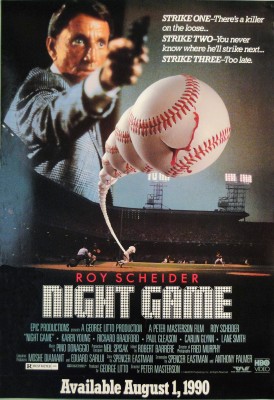
For that reason, I’m going to take a few minutes to tell you about a 1989 film called Night Game. Night Game is many things. It’s a movies that features a lot of baseball, even though it’s not really a sports film per se. It’s a police procedural, though the film itself suggests that the police often don’t have the slightest idea what they’re actually doing. It’s a serial killer film, though its killer is never quite as loquacious as we’ve come to expect in this age of Hannibal Lecter and Dexter Morgan. At times, it’s a slasher film, though it’s never particularly graphic. Mostly, Night Game is a Texas film.
Directed by native Texan Peter Masterson, Night Game is like the original Texas Chainsaw Massacre in that it is one of those rare films that not only takes place in Texas but was actually filmed on location. To be exact, Night Game was filmed in both Galveston and Houston. The entire film has a friendly and quirky Texas feel to it. Masterson may not have been a great visual director (If not for some language and nudity, Night Game could pass for a TV movie) but Night Game is a movie where the plot is less important than capturing the little details of a time. a location, and the people who lived there. Though Night Game is 28 years old, it’s portrait of my home state still seemed very contemporary to me. I guess Texas hasn’t really changed that much over the past few decades.
As for the film’s plot, someone is murdering young women in Galveston and leaving their bodies on the boardwalk. Obviously, that’s not going to be good for attracting Spring Break revelers. The film doesn’t make any effort to keep the murderer’s identity a secret. We see his face fairly early on. We also see that he has a hook for a hand. Eventually, we do learn the murderer’s motives. They’re pretty silly but then again, individual motives rarely make sense to anyone other than the guy with the hook for a hand.
Detective Mike Seaver (Roy Scheider) has been assigned to solve the case. One thing that I really liked about Night Game was that Mike was pretty much just a normal guy with a job to do. He wasn’t self-destructive. He wasn’t always drunk. He wasn’t suicidal. He wasn’t always lighting a cigarette and staring at the world through bloodshot eyes while the lighting reflected off of his artful stubble. He was just a detective trying to do his job and get home on time. After sitting through countless films about self-destructive cops and criminal profilers, the normalcy of Mike was a nice change of pace.
Mike does have a backstory. He used to play baseball and he still loves the game. He goes to every Astros home game in Houston. He’s in love with Roxy (Karen Young), who works at the stadium. Things are only slightly complicated by the fact that Mike had a previous relationship with Roxy’s mother (Carlin Glynn). Don’t worry, Mike’s not secretly Roxy’s father or anything like that. It’s not that type of movie.
Anyway, Mike is such a fan of baseball that he realizes something. The killer only strikes on nights that the Astros win a game. And he only strikes if a certain pitcher was throwing the ball. The obvious solution would be to shoot the pitcher in the arm and end his athletic career. However, Mike’s too nice a guy to do that. Instead, he just tries to track down the killer…
And, as I said, Night Game actually isn’t a bad little movie. Make no mistake, it’s a very slight movie. At no point are you going to say, “I’m going to remember that scene for the rest of my life!” That said, it’s a surprisingly good-natured film and Roy Scheider’s performance is likable and unexpectedly warm. With all that in mind, Night Game is an entertaining and (mildly) bloody valentine to my home state.
Plus, it’s a baseball movie! I don’t know much about baseball but, if my sister loves it, it has to be a good thing!
Theater screens of the 70’s were awash in blue as the “tough guy cop” film put a chokehold on Hollywood. DIRTY HARRY Callahan took on punks in a series of action flicks, SERPICO took down corruption in New York, and L.A. detective Joseph Wambaugh’s novels were adapted into big (and small) screen features. Producer Philip D’Antoni helped usher in this modern take on film noir with 1968’s BULLITT starring Steve McQueen, followed by the Oscar-winning THE FRENCH CONNECTION , with Gene Hackman as brutal cop Popeye Doyle.
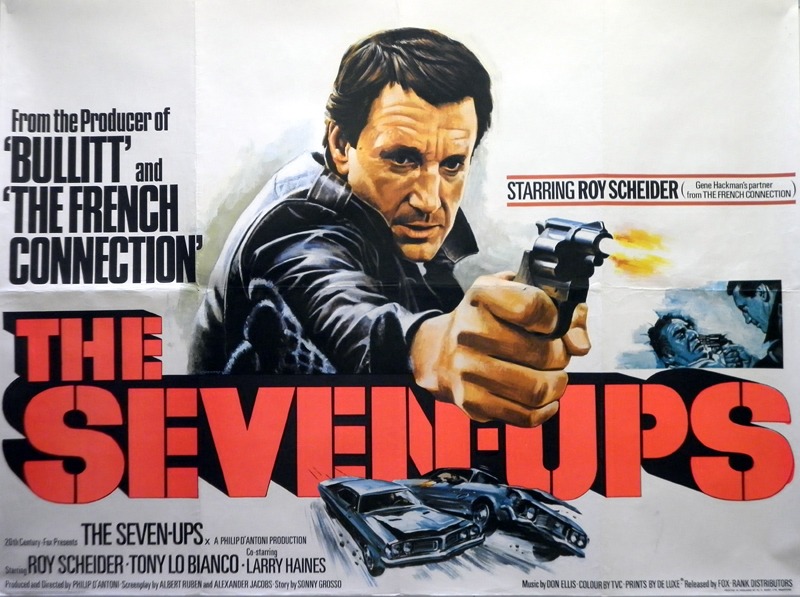
D’Antoni decided to direct his next effort, 1973’s THE SEVEN-UPS. CONNECTION costar Roy Scheider gets his first top-billed role as Buddy Manucci, head of an elite “dirty tricks” squad that takes down perps whose felonies will land them seven years and up in jail (hence the title; it has nothing to do with the lemon-lime soda!). Manucci’s childhood pal Vito Lucia (Tony LoBianco) is…
I was going to post on KLUTE last week, but between my Internet service going on the fritz and getting swept up in Oscar Fever, I never got around to it. Better late than never though, and KLUTE is definitely a film worth your time. It’s a neo-noir directed by that master of 70’s paranoia, Alan J. Pakula, who’s also responsible for THE PARALLAX VIEW, ALL THE PRESIDENT’S MEN, and SOPHIE’S CHOICE. KLUTE is both an intense thriller and character study, with an Oscar-winning performance by Jane Fonda.
PI John Klute is sent to New York City to investigate the disappearance of his friend, Tom Gruneman. Seems Gruneman has been sending obscene letters to Bree Daniels, a call girl he met there. Klute sets up shop in her apartment building, shadowing her and tapping her phone. When he finally goes to question her, Bree says she doesn’t remember Gruneman, but it’s possible he could…
First of all, I’d like to thank Kellee Pratt of Outspoken and Freckled for inviting me to participate in the 31Days of Oscar Blogathon. It’s cool to be part of the film blogging community, and even cooler because I get to write about THE FRENCH CONNECTION, a groundbreaking movie in many ways. It was the first R-Rated film to win the Academy Award for Best Picture, and scored four other golden statuettes as well. It also helped (along with the Clint Eastwood/Don Siegel DIRTY HARRY) usher in the 70’s “tough cop” genre, which in turn spawned the proliferation of all those 70’s cop shows that dominated (KOJAK, STARSKY & HUTCH, BARETTA, etc, etc).
The story follows New York City cops Jimmy “Popeye” Doyle and his partner Sonny “Cloudy” Russo as they investigate a large shipment of heroin being brought in from France. The detectives focus on Sal Boca, a small time hood…
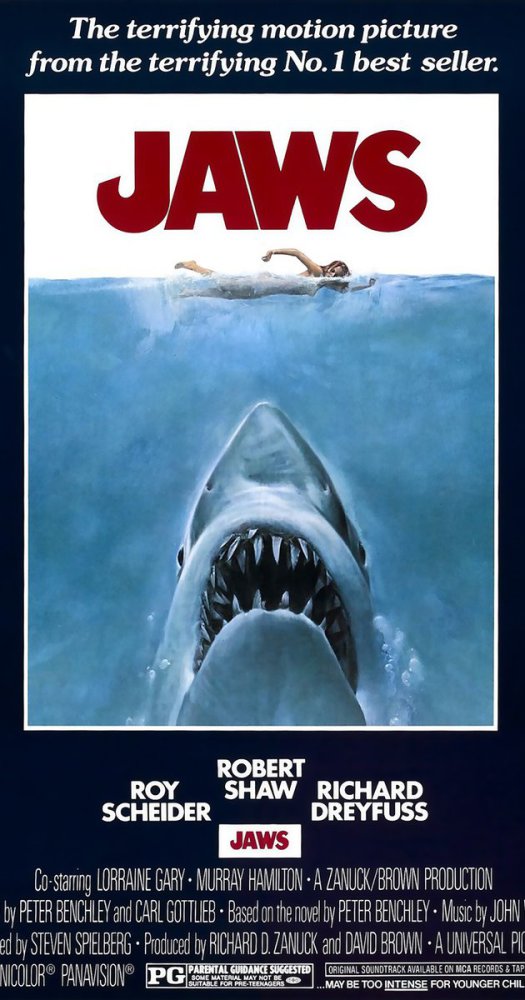
There’s little that is more intimidating than trying to write a review of the 1975 best picture nominee, Jaws.
I mean, seriously, what’s left to be said about this film? Jaws is one of those movies that everyone has seen and everyone loves. And, even if someone somehow hasn’t seen the film, chances are that they still know all about it. They know that it’s a movie about a giant shark that attacks Amity Island, just as the summer season is starting. They know that the town’s mayor refuses to close the beaches, because he doesn’t want to lose the tourist dollars. They know that the final half of the film is three men (Roy Scheider, Richard Dreyfuss, and Robert Shaw) floating around in a boat, searching for a shark. And they certainly know that, whenever you hear John Williams’s iconic theme music, it means that someone is about to get attacked.
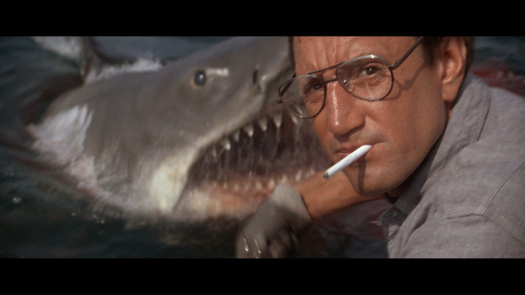
What’s amazing about Jaws is that, even though everyone’s seen it and it’s been parodied a few thousand times, Jaws remains incredibly effective. I still find myself cringing whenever the shark catches Alex Kintner and that geyser of blood explodes out of the ocean. I still jump whenever the shark suddenly emerges from the water and scares the Hell out of Roy Scheider. I still laugh at Richard Dreyfuss’s hyperactive performance and I instinctively cover my ears whenever I realize that Robert Shaw is about to drag his nails across that chalk board.
And then there’s that music, of course! Even after being used, misused, and imitated in countless other films, the Jaws theme still fills me with a sort of existential dread. The mechanical shark was notoriously fake-looking and was rarely seen onscreen as a result. The camera and the music stand in for the shark and it works beautifully.
The one unfortunate thing about Jaws is that it’s been so critically acclaimed and so embraced by audiences that I think people tend to forget that it is primarily a horror film. Mainstream critics tend to look down on horror as a genre so, rather than admit the obvious, they claim that Jaws is more of a thriller than a horror film. Or they talk about how it’s actually meant to be a political allegory or an environmental allegory or an examination of male bonding.
So, let’s just make this clear. No matter what the elitist critics or even Steven Spielberg himself may say, Jaws is primarily a horror film, with that relentless killer shark serving as a prototype for such future horror fiends as Michael Myers, Jason Voorhees, Freddy Krueger, and both of the Ghostface and Jigsaw Killers. (Jaws even opens with a stereotypical slasher movie death, as a nude and stoned swimmer is suddenly attacked by an unseen killer.) If not for Scheider, Shaw, and Dreyfuss floating in the endless ocean, you would never have had films — like the Blair Witch Project — about people being lost and stalked in the wilderness. And when that shark attacks and graphically rips apart its victims, how different is it from something you might find in a George Romero or Lucio Fulci zombie film?
On the basis of Jaws and Duel, I think it can be argued that, if Steven Spielberg hadn’t become America’s favorite director of crowd-pleasing, Oscar-contending blockbusters, he could have been one of our best horror directors. Sadly, Spielberg has pretty much abandoned horror and I doubt that Jaws would be as effective if it were made today. (I suspect that the temptation to resort to a cartoonish CGI shark would be too great.)
But that’s all speculation.
What matters is that Jaws remains one of the greatest films ever made.
Earlier today, thanks to Netflix, I watched the 1971 best picture winner, The French Connection.
Based on a true incident, The French Connection is the story of two NYPD detectives, the reasonable and serious Buddy Russo (Roy Scheider) and his far more hyperactive partner, Popeye Doyle (Gene Hackman). When we first see them, Doyle is dressed as Santa Claus and they’re both chasing a drug dealer through the streets of New York. When they eventually catch up with the dealer, Russo plays good cop while Doyle plays batshit insane cop. That’s a pattern that plays out repeatedly over the course of the film. Russo suggests caution. Doyle blindly fires his gun into the shadows. Russo is sober. Doyle is frequently drunk. Russo is careful with his words. Doyle is a casual racist who never seems to stop talking. The one thing that Russo and Doyle seem to have in common is that they’re both obsessed with catching criminals.
The French Connection is also the story of Alain Charnier (Fernando Rey), a suave and always impeccably dressed French businessman. Charnier has a plan to smuggle several millions of dollars of heroin into the United States by hiding it in a car that will be driven by an unsuspecting (and rather vacuous) French actor named Henri Devereaux (Frederic de Pasquale). Working with Charnier is a low-level mafia associate named Sal Boca (Tony Lo Bianco) and a lawyer named Joel Weinstock (Harold Gray).
(Incidentally, Weinstock’s chemist is played by an actor named Patrick McDermott, who also played Susan Sarandon’s abusive hippie boyfriend in Joe. The French Connection was McDermott’s third film and also his last. I point this out because McDermott totally steals his one scene in The French Connection. When one considers both his performance here and his work in Joe, it’s strange and unfortunate that McDermott’s cinematic career ended after just three films. According to a comment left on the imdb, he later ran a health food store in Nebraska.)
When Doyle and Russo just happen to spy Sal hanging out with a group of mobsters at a local club, they decide (mostly on a whim) to investigate what Sal’s up to. They notice that Sal drives a car that he shouldn’t be able to afford. Will they discover how Sal is making his money and will they be able to stop Charnier from smuggling his heroin into the United States?
Well…let’s just say that The French Connection was made in 1971. That’s right, this is one of those films where everything is ambiguous. Neither Russo nor Doyle are traditional heroes. Neither one of them is foolish enough to believe that their actions will make a difference. Instead, they seem to view it all as a game, with Doyle and Russo as the win-at-any-cost good guys and the French as the bad guys. And, indeed, it’s interesting to note that, when the police do make their move against Charnier, it’s the people who work for him who suffer the worst punishments.
I have to admit that, as a civil libertarian, Doyle is the type of cop who should make my skin crawl. He’s an obsessive bigot, the type who runs into the shadows with his gun drawn and blindly firing. When I watched The French Connection, a part of me wanted to get offended and say, “It’s none of your business why Sal has an expensive car!” But I didn’t. In fact, I was rooting for Doyle the whole time. The French Connection is probably one of the best cast films of all time. Hackman gives such a good performance that, while you can’t overlook Doyle’s flaws, you can accept them. Meanwhile, Rey is so sleazy and smug in the role of Charnier that you really don’t care about his rights. You just want to see him taken down.
(That said, if I ever got hold of a time machine and went back to New York in 1971, I’d rather be arrested by Russo than Doyle. Doyle seems like he’d be the type to grope while frisking.)
Seen today, it’s a bit odd to think of The French Connection as being a best picture winner. It has nothing to do with the film’s quality. The film’s performances remain strong. William Friedkin’s documentary-style direction is still compelling and he makes the decay of 1970s New York oddly beautiful. Instead, it’s the fact that The French Connection essentially tells a very simple story that, when seen today, feels very familiar. It’s a cop film and it includes every single cliché that we’ve come to associate with cop films. (Russo and Doyle even have a supervisor who yells at them for not doing things by the book.) But, what you have to realize is that the majority of those clichés were invented by The French Connection. If imitation is the sincerest form of flattery, then The French Connection is probably one of the most flattered film ever made.
And what better way to end this review than by sharing The French Connection‘s most influential scene? In the scene below, Doyle chases a commuter train that happens to be carrying one of Charnier’s associates.