Guilty Horror Pleasure #87: The ‘Burbs (dir by Joe Dante)


1989’s The ‘Burbs takes place in …. well, it’s right there in the title.

Welcome to the suburbs!  It’s place with big houses, green lawns, and neighbors who often don’t have much to do other than watch each other and gossip.  Ray Peterson (Tom Hanks) lives with his wife, Carol (Carrie Fisher), and is friends with Art Weingartner (Rick Ducommun) and Mark Rumsfield (Bruce Dern).  Ricky Butler (Corey Feldman) is the local teenager.  It’s a nice neighborhood …. at least, until the Klopeks move in.

The Klopeks are viewed with suspicion from the minute they show up.  They’re from a different country, they always seem to be burying something in their backyard, and Dr. Werner Klopek (Henry Gibson) is oddly stand-offish.  When Walter Seznick (Gale Gordon) disappears and the the Klopeks are seen around Walter’s house and with Walter’s dog, Ray and his friends start to suspect that their new neighbors might be ritualistic murderers!

Oh, how I love The ‘Burbs.  The film’s portrait of the suburbs as being a hotbed of paranoia may be a familiar one but it doesn’t matter when you’ve got actors like Tom Hanks and Bruce Dern throwing themselves into their roles.  As always, Hanks is the glue that holds the film and its disparate parts together, giving a likable performance as a man who goes from being the voice of reason to being convinced that his neighbors are cannibals.  Bruce Dern gleefully sends up his own image as a paranoid Vietnam vet but there’s also a sweetness to Dern’s performance that really makes it stand out.  Dern’s character might be a little crazy but he does truly care about his neighbors.

Just as he did with Piranha and The Howling, Dante balances humor with suspense.  He does such a good job of telling the story and getting good performances from his cast, that even the film’s big twist works far better than one might expect.  It’s an 80s film so, of course, a few things explode towards the end of it.  The film’s character-based humor is replaced with some broader jokes but no matter.  The Burbs is an entertaining trip to the heart of suburban paranoia.

As the saying goes, just because you’re paranoid, that doesn’t mean that they aren’t out to get you.

Previous Guilty Pleasures

  1. Half-Baked
  2. Save The Last Dance
  3. Every Rose Has Its Thorns
  4. The Jeremy Kyle Show
  5. Invasion USA
  6. The Golden Child
  7. Final Destination 2
  8. Paparazzi
  9. The Principal
  10. The Substitute
  11. Terror In The Family
  12. Pandorum
  13. Lambada
  14. Fear
  15. Cocktail
  16. Keep Off The Grass
  17. Girls, Girls, Girls
  18. Class
  19. Tart
  20. King Kong vs. Godzilla
  21. Hawk the Slayer
  22. Battle Beyond the Stars
  23. Meridian
  24. Walk of Shame
  25. From Justin To Kelly
  26. Project Greenlight
  27. Sex Decoy: Love Stings
  28. Swimfan
  29. On the Line
  30. Wolfen
  31. Hail Caesar!
  32. It’s So Cold In The D
  33. In the Mix
  34. Healed By Grace
  35. Valley of the Dolls
  36. The Legend of Billie Jean
  37. Death Wish
  38. Shipping Wars
  39. Ghost Whisperer
  40. Parking Wars
  41. The Dead Are After Me
  42. Harper’s Island
  43. The Resurrection of Gavin Stone
  44. Paranormal State
  45. Utopia
  46. Bar Rescue
  47. The Powers of Matthew Star
  48. Spiker
  49. Heavenly Bodies
  50. Maid in Manhattan
  51. Rage and Honor
  52. Saved By The Bell 3. 21 “No Hope With Dope”
  53. Happy Gilmore
  54. Solarbabies
  55. The Dawn of Correction
  56. Once You Understand
  57. The Voyeurs 
  58. Robot Jox
  59. Teen Wolf
  60. The Running Man
  61. Double Dragon
  62. Backtrack
  63. Julie and Jack
  64. Karate Warrior
  65. Invaders From Mars
  66. Cloverfield
  67. Aerobicide 
  68. Blood Harvest
  69. Shocking Dark
  70. Face The Truth
  71. Submerged
  72. The Canyons
  73. Days of Thunder
  74. Van Helsing
  75. The Night Comes for Us
  76. Code of Silence
  77. Captain Ron
  78. Armageddon
  79. Kate’s Secret
  80. Point Break
  81. The Replacements
  82. The Shadow
  83. Meteor
  84. Last Action Hero
  85. Attack of the Killer Tomatoes
  86. The Horror At 37,000 Feet

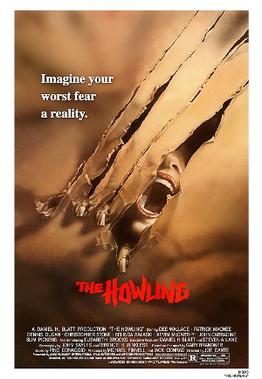
Horror Film Review: The Howling (dir by Joe Dante)


The 1981 film, The Howling, takes place at The Colony.

The Colony is a lovely place, a nice resort out in the middle of the countryside.  It’s a place that celebrity therapist George Waggener (Patrick Macnee) sends his clients so that they can recover from trauma.  It’s a bit of a grown-up version of the ranch to which Dr. Phil used to send juvenile delinquents.  Of course, the Colony is full of adults and they’re an eccentric bunch.  I mean, one of them — named Erle Kenton — is actually played by John Carradine!  That’s just how eccentric the place is.  Sheriff Sam Newfield (Slim Pickens) keeps an eye on the place but everyone knows that there’s nothing to worry about when it comes to The Colony.  Dr. Waggner does good work.

Karen White (Dee Wallace) is a Los Angeles news anchor who was held hostage by a serial killer named Eddie Quist (Robert Picardo).  While she was with Eddie, she was forced to not only watch videos of Eddie’s crimes but she also saw something happen with Eddie that terrified her to such an extent that she has blocked it from her mind.  Karen was rescued by the police but she is haunted by nightmares.  Dr. Waggner arranges for Karen and her husband, Bill Neill (Christopher Stone, who was married to Dee Wallace when they co-starred in this film), to spend some time at the Colony.

Bill loves the Colony, especially after he attracts the eye of Marsha (Elisabeth Brooks), the resort’s resident seductress.  Karen, however, is less enamored of the place.  The Colony feels off to her and she’s not happy about the howling in the distance or the fact that Bill has suddenly started to grow distant from her.  Could it be that The Colony is actually crawling with werewolves and that Bill has become one of them?  (It’s totally possible and, to The Howling‘s credit, it doesn’t waste any time letting us know that.)  Karen’s friend, Terry Fisher (Belinda Balanski), and her boyfriend, Chris Halloran (Dennis Dugan), do some research of their own into Eddie Quist, The Colony, and whether or not werewolves exists and they meet a helpful bookstore owner named Walter Paisley (Dick Miller).

To understand the approach that director Joe Dante and screenwriter John Sayles take to The Howling, one needs to only consider the names of some of the characters.  George Waggner.  Bill Neill. Terry (which can be short for Terence) Fisher.  Fred (or is that Freddie) Francis.  Erle Kenton.  Sam Newfield.  Jerry Warren.  All of these characters are named after horror film directors.  This is the type of werewolf film where Chris Halloran has a copy of The Three Little Pigs sitting on his desk.  Veteran actors like Kevin McCarthy, John Carradine, Slim Pickens, and Kenneth Tobey show up in small roles.  Roger Corman mainstay Dick Miller plays yet another character named Walter Paisley and he kicks Forrest J. Ackerman out of his bookstore.  Roger Corman himself plays a man making a phone call.  After a werewolf is shot on live TV, the program immediately cuts to a dog food commercial and we see a blank-faced child telling his unconcerned parents that someone just turned into a wolf.  The Howling was made by people who obviously love B-horror and that love is present in every frame of the film.

Like Dante’s Piranha, The Howling is a film with a sense of humor but it’s not a comedy.  The werewolves are still impressive, even forty-two years after the film was first released.  The character of Eddie Quist (“I’m going to give you a piece of my mind”) is a terrifying monster and the sight of his signature smiley face will fill you with dread, especially when it shows up in a place where it really shouldn’t be.  The film cynically ends on a note of noble sacrifice that will apparently not make much difference, with the suggestion being that human beings are either too distracted or too jaded to realize that there are monsters among them.  The Howling is a fast-paced and well-directed homage to B-horror and it’s still terrifically entertaining.

Film Review: Atlas Shrugged, Part II (dir by John Putch)


2012’s Atlas Shrugged: Part II picks up where Part I left off.

The time is still the near future.  (Part I specifically set the story as taking place five years into the future.  Part II declines to use a specific date but it does feature some news personalities playing themselves so it’s still clearly only meant to be a few years from 2012.)  The economy has gotten even worse.  The poor are only getting poorer while the rich are getting richer.  Under the direction of Head of State Thompson (Ray Wise) and his main economic advisor, Wesley Mouch (Paul McCrane), the government has nationalized nearly every business.  Halfway through the film, Thompson declares a national emergency and uses the Fair Share Law to invoke Directive 10-289.  All inventors, businessmen, and other creative people are required to sign their patents over to the government and to stop trying to develop now techniques.  Wages are frozen.  No one can be fired and no one can be hired.  Creative thinking is discouraged.  Asking questions or expressing doubt is forbidden.  People are encouraged to snitch on anyone not following the Directive.  Thompson and Mouch insist that it’s for the “good of the people,” and anyone who disagrees runs the risk of being dragged into court and sent to prison for ten years.  Meanwhile, gas now costs $42.00 a gallon.  One of the funnier moments of the film features someone paying $865.72 to fill up a truck.

Dagny Taggart (Samantha Mathis), the Vice President of Taggart Transcontinental Railways, is still trying to discover who invented an experimental motor that she found hidden away in a mine.  The motor could potentially change the way that goods are transported but it appears to be missing one component.  Unfortunately, all of the great scientists and inventors have been vanishing, with many of them leaving behind notes that ask, “Who is John Galt?”  Meanwhile, Dagny’s lover, Hank Rearden (Jason Beghe), fights to protect Rearden Metal from being taken over by the government and Dagny’s brother, James (Patrick Fabian), sells out to Wesley Mouch with the end result being that there’s no one left at Taggart Transcontinental with the intelligence or the experience necessary to keep two trains from colliding in a tunnel.

Given that Ayn Rand herself was an atheist who wrote very critically of religion, it’s interesting how much of Atlas Shrugged: Part II feels like one of those evangelical films where the Rapture comes and the entire world falls apart because all of the believers have suddenly vanished.  In the case of Atlas Shrugged, the world falls apart because all of the creatives and all of the leaders of industry and all of the innovative thinkers have abandoned it so that they can create a new community with John Galt.  (They’ve “stopped the motor of the world.”)  In many ways, this is the ultimate in wish fulfillment, a way of declaring, “They’ll miss me when I’m gone!”  Indeed, the majority of people who keep a copy of Rand’s novel displayed on their bookcase do so because they believe that they would be one of the lucky ones who was approached by Galt.  No one expects that they’ll be the person left behind to try to run the railroad.  It’s a bit like how like the most strident Marxist activists always assume they’ll be the ones organizing the workers as opposed to being a worker themselves.

Not surprisingly, the same critics who attacked Part I didn’t care much for Atlas Shrugged Part II.  When I first saw it, I thought the film was a bit too long and I was annoyed that, with the exception of a few minutes at the end, the film didn’t really seem to move the story forward.  At the same time, just as with the first film, I appreciated the fact that the second film was proudly contrarian in its portrayal of the government as being inherently incompetent.  After all, this was 2012, back in the “good government” era, when a lot of people still reflexively assumed that the government was staffed only by hyper-competent policy wonks who knew what they were doing and who were only concerned with making sure that “the trains ran on time,” to borrow an old expression.

Rewatching the film this weekend, I have to say that I actually appreciated Atlas Shrugged Part II a bit more than the first time I watched it.  Yes, Part II was still a bit too long and the domestic drama between Hank and his wife fell flat but Part II is still a marked improvement on the first film.  Some of that is because Part II had a higher budget than Part I and, as a result, it didn’t look as cheap as the first film.  The corporate offices looked like actual corporate offices and the factories looked like real factories.  Secondly, the second film had an entirely different cast from the first film.  Samantha Mathis, Jason Beghe, and especially Patrick Fabian were clear improvements on the actors who previously played their roles.  That’s especially important when it comes to Mathis and Beghe because, as opposed to the first film, Part II convinces the viewer that  Dagny and Hank actually are as important as they think they are.  When the trains collide in the tunnel, the viewer never doubts that Mathis’s Dagny could have prevented the disaster if not for the government’s attempts to force her out of her own company.  As well, the viewer never doubts that Beghe’s Hank would fight to the end to protect his business, even if it means prison.  One wouldn’t have necessarily believed that while watching the first film.

Finally, having lived through the COVID era, the film’s portrait of government overreach and incompetence feels a lot more plausible when watched today.  One doesn’t have to be a fan of Rand’s philosophy or agree with her solutions to see the parallels between Directive 10-289 and the policies that led to children being kept out of schools and numerous small business having to shut their doors.  In an era when most people’s faith in governmental institutions has been broken to such an extent that it might never be fixed in our lifetime, Atlas Shrugged Part II resonates.  Whereas the film once felt subversive, now it feels downright prophetic.

White Mile (1994, Directed by Robert Butler)


In this HBO movie, Alan Alda plays the biggest asshole in the world.

Alda is cast as Dan Cutler, an ad exec who books a corporate retreat to Canada’s White Mile.  He tells the nine men who accompany him, some of whom are clients and some of whom work for him, that it’s going to be a weekend of fishing and male bonding.  What he doesn’t reveal is that the trip is also going to require whitewater rafting.  Despite the fact that the majority of the men are out-of-shape and hardly any of them have any rafting experience, Dan insists that they all take part.  When their guide says that they’re going to need to take two boats, Dan refuses.  He wants everyone in one boat, the better so they can all work together to prove their manhood by conquering the river.

The trip starts out well but, when the raft hits a rock and turns over, five of the men end up dead.  Despite injuring his leg, Dan survives and, when he returns to work, he’s hailed as a hero.  However, one of the widows of the men who didn’t survive is now suing the company.  While Dan tries to cover his own ass, one of the survivors — Jack Robbins (Peter Gallagher) — is faced with a dilemma of his own.  As one of the few people who knows that Dan demanded that the guide only use one boat, will Jack testify to the truth at the trial or will he follow Dan’s orders and keep quiet about what really happened?

Based on a true story, White Mile features some brief but exciting (and harrowing) rafting scenes but the film is less about what happened in the wilderness and instead about what’s happening behind the closed doors of corporate America.  White Mile does a good job of taking Alda’s sensitive male persona and pushing it through the looking glass.  As played by Alda, Dan is the type of tyrannical boss who we’ve all had to deal with.  His friendly smile barely disguises a bullying streak.  Even after the accident leaves five of his colleagues dead, Dan is still convinced that the trip was a good idea and that everyone was having the best day of their lives until they hit that rock.  When the river guide initially finds Dan stranded on a rock, Dan makes a show of telling the guide to come back for him later and to find the others.  When Dan later comes across one of the dead men, he says, “He must have had a bad heart,” as he grasps at any way to avoid taking responsibility.  Though White Mile is dominated by Alda’s villainy, it also features good performances from Gallagher, Robert Loggia, Bruce Altman, and Jack Gilipin.  When Gilpin demands to know if anyone at the ad agency has shown any true remorse for what happened, he is speaking for the entire audience.

White Mile was an early HBO film and, because it was released before HBO became known for its original programming, it’s often unfairly overlooked.  When it was released on DVD, it was advertised as being an action-adventure film, which it definitely is not.  Instead, it’s a look at the type of head games that far too often act as a substitute for responsible and ethical management in corporate America.  It’s a good movie and you’ll never look at Alan Alda the same way again.

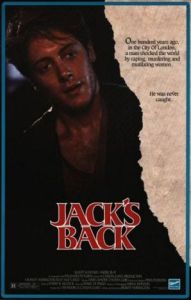
A Movie A Day #282: Jack’s Back (1988, directed by Rowdy Herrington)


When med student Rick Westford (James Spader) is found hung at the free clinic where he worked, the police say that he committed suicide.  Rick’s estranged twin brother, John (James Spader), does not agree and launches an investigation of his own.  With the help of Rick’s co-worker, Chris (Cynthia Gibb), John discovers that Rick may have learned the identity of a serial killer who has been copying the crimes of Jack the Ripper and murdering prostitutes in Los Angeles.  However, the killer knows that John is getting close to discovering his identity so the killer sets out to frame John not only for the prostitute murders but for the murder of his brother as well.
Jack’s Back is a movie that deserves to be better known than it is.  James Spader gives two great performances, as both Rick and John.  He and Cynthia Gibb make a good team and Jack’s Back actually does some unexpected things with their relationship.  Jack’s Back was directed by Rowdy Herrington, who is best known for Roadhouse and Gladiator.  Jack’s Back is part murder mystery, part action thriller, and part horror movie and Herrington does a good job of switching back and forth through Jack’s Back constantly shifting tone.  Because this is a low-budget movie with a small cast, there really are not enough suspects to make the murderer’s identity a surprise but Spader, Herrington, and Gibb always keep things interesting.

This is a film that really does deserve to be better known.

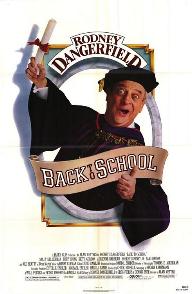
A Movie A Day #150: Back to School (1986, directed by Alan Metter)


Thornton Melon (Rodney Dangerfield) started with nothing but through a combination of hard work and chutzpah, he started a chain of “Tall and Fat” clothing stores and made a fortune.  Everyone has seen his commercials, the one where he asks his potential customers, “Do you look at the menu and say, ‘Okay?'”  He has a new trophy wife named Vanessa (Adrienne Barbeau) and a chauffeur named Lou (Burt Young).  Thornton never even graduated from high school but he gets respect.
However, his son, Jason (Keith Gordon), doesn’t get no respect.  No respect at all.  Jason is a student at a pricey university, where he is bullied by Chas Osborne (William Zabka) and can’t get a date to save his life.  Jason’s only friend is campus weirdo Derek Lutz (Robert Downey, Jr.).  When Thornton sees that his son isn’t having any fun, he decides to go back to school!

Back to School is a predictable but good-natured comedy.  It is like almost every other 80s college comedy except, this time, it’s a 65 year-old man throwing raging parties and making the frat boys look stupid instead of Robert Carradine or Curtis Armstrong.  On the stand-up stage, Dangerfield always played the (sometimes) lovable loser but in the movies, Dangerfield was always a winner.  In both Caddyshack and Back to School, Dangerfield played a self-made man who forced his way into high society and showed up all of the snobs.  While Back to School is no Caddyshack, it does feature Rodney at his best.

Rodney may be the funniest thing about Back to School but a close second is Sam Kinison, who owed much of his early success to Rodney Dangerfield’s support.  Kinison plays a history professor, who has some very strongly held views about the Vietnam War and who punctuates his points with a primal screen.

Also, keep an eye out Kurt Vonnegut, playing himself.  Rodney hires him to write a paper about Kurt Vonnegut for one of his classes.  The paper gets an F because Rodney’s literature professor (Sally Kellerman) can tell that not only did Rodney not write it but whoever did knows absolutely nothing about the work of Kurt Vonnegut.

So it goes.

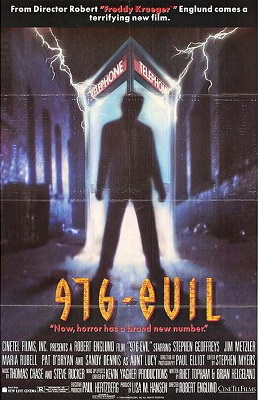
The TSL’s Daily Horror Grindhouse: 976-Evil (dir by Robert Englund)


976-evil_cover

Ewwwwww!  The movie reeks of stale cigarettes and Axe body spray!

976-Evil tells the story of two teenagers named Spike (Patrick O’Bryan) and Hoax (Stephen Geoffreys).  You know what?  Whether your parents decide to name you Spike or to name your Hoax, your life is pretty much fucked up from the minute either name is entered on your birth certificate.  Anyway, Spike and Hoax are cousins.  Spike is the dangerous bad boy who rides a motorcycle and wears a leather jacket.  Hoax is the really nerdy kid who worships Spike and who lives with his ultra-religious mother (Sandy Dennis).  Hoax can’t wait until the day he and Spike ride across the country on their motorcycles.  Spike is just busy trying to get laid and looking forward to heading out on his own.

Anyway, Hoax eventually gets tired of being picked on all the time so he decides to call the phone number mentioned in the film’s title.  Hoax discovers that he has a direct line to Hell and the voice on the other end has some definite ideas for what Hoax could do to even the score.  For instance, Hoax could cause spiders to attack a Spike’s girlfriend.  And, after that, Hoax could transform into a monster and attack the local bullies at their poker game.

“That’s a dead man’s hand!” Hoax announces, while literally holding up a dead man’s hand.

(That’s right!  Turning evil means becoming a master of puns!)

Uh-oh!  It looks like Hoax has been possessed by evil!  Even worse, the phone bill is HUGE!  Those calls to the Devil aren’t cheap, you know!  Can Spike defeat his cousin or will evil rule the day?

Now, I will say this for 976-Evil: as annoying as Stephen Geoffreys is when he’s playing nerdy Hoax, he actually is a bit frightening as evil Hoax.  For that matter, Patrick O’Bryan is probably does about as good a job as you can do while playing a character named Spike.

But otherwise, 976-Evil is nearly unwatchable.  I mean that literally.  The entire film appears to be covered by a layer of grime.  Between the unappealing visuals, the poor dialogue, and the lack of appealing characters, there’s really not much in 976-Evil to hold our attention.  It might help if we felt bad for Hoax but, even before he calls the phone number, he’s such a weirdo perv that you just kind of want him to go away.  Hoax is basically the type of loser who thinks that an Axe body spray commercial is a documentary.  You can imagine him desperately spraying himself before he goes to school every day and announcing, “I smell like Axe!  I’m losing my virginity next period!  And then me and Spike are going to ride our motor scooters to Toronto!”

Released in 1989, 976-Evil was also the directorial debut of Robert Englund.  I kinda hate to be so negative about the film because Robert Englund is such a good actor and he always comes across as being such a nice guy.  If you haven’t already, be sure to get a copy of Englund’s autobiography, Hollywood Monster.  Englund tells a lot of good stories and is admirably positive about being a horror icon.  But, though Robert Englund’s a great guy, 976-Evil just doesn’t work.

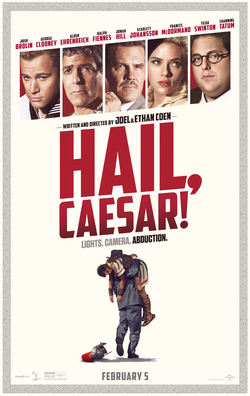
Guilty Pleasure No. 31: Hail, Caesar! (dir by the Coen Brothers)


Sometimes, I wonder if I was the only filmgoer who actually enjoyed Hail, Caesar! when it was released in February.

Oh, don’t met wrong.  I know that I’m being a bit overdramatic when I say that.  It got some good reviews from the critics, though the praise was rather muted when compared to the reviews that traditionally greet the latest film from the Coen Brothers.  I know more than a few people who have agreed with me that Hail, Caesar! was an entertaining lark of a film.

But I know a lot more people who absolutely hated Hail, Caesar!  Of course, no film is going to please everyone and the Coen Brothers have always had a tendency to attempt to deliberately alienate their audience.  But what has always struck me is the fact that the people who disliked Hail, Caesar seem to really, really dislike it.  Talk to them and you get the feeling that they view Hail, Caesar as almost being some sort of a crime against both humanity and cinema.

Taking place in a stylized Hollywood in 1951, Hail, Caesar! tells the story of Eddie Mannix (Josh Brolin).  Eddie is a shadowy figure.  As head of production at Capitol Pictures, Eddie’s job is to keep the “bad” behavior of the stars from getting out into the press.  (The press is represented by Tilda Swinton who, in a typical Coen Brothers twist, plays twin sisters who are rival gossip columnists.  If the thought of that makes you smile, you are potentially a part of the right audience for Hail Caesar.  If it makes you roll your eyes, you should probably avoid the film.)  Eddie is the most powerful man in Hollywood and he will do anything to protect the image of the American film industry.  He will lie.  He will cheat.  He will threaten.  He is so ruthless and so good at his job that even Lockheed Martin is trying to hire him away from Capitol.  And yet, at the same time, Eddie is also a family man and a Catholic who is so devout that he goes to confession on a nearly hourly basis.

(For all you non-Catholics out there, Pope Francis only goes to confession twice a month.)

Hail, Caesar! follows Eddie as he deals with a series of potential problems.  Temperamental director Laurence Laurentz (Ralph Fiennes) is upset because he’s been forced to cast Hobie Doyle (Alden Ehrenreich, giving the film’s best performance), a good-natured but inarticulate cowboy star, in his sophisticated comedy.  Synchronized swimmer DeeAnna Moran (Scarlett Johansoon) is not only pregnant but unmarried as well!  (It’s the 50s, remember.)

However, the biggest crisis is that Baird Whitlock (George Clooney) has vanished from the set of his latest film. A mysterious group known as The Future has taken credit for kidnapping him.  It’s not really much of a spoiler to reveal that The Future is a cell of communist scriptwriters and they are determined to convert the rather dumb Baird to the struggle.  As opposed to most films about Hollywood in the 50s, the communist screenwriters are portrayed as being a bunch of self-righteous and rather cowardly nags, the majority of whom spend more time debating minutiae than actually trying to the overthrow capitalism.  In many ways, Hail, Caesar is the anti-Trumbo.

As you might guess from the plot description, there’s a lot going on in Hail, Caesar but none of it really adds up too much.  Nor is it supposed to.  We’re encouraged to laugh at these frantic characters, as opposed to sympathize with them.  Eddie Mannix and Hobie Doyle both emerge as heroes because they’re the only characters who remain calm and confident, regardless of what strangeness is happening onscreen.  Eddie may be ruthless, the film tells us, but at least he gets results.  Hobie may not be the smartest or most talented guy in Hollywood, we are told, but at least he doesn’t pretend to be anything other than who he is.

Hail, Caesar! is a bit of a lark, a celebration of style over substance.  As far as Coen Brother films go, Hail, Caesar has more in common with Burn After Reading than No Country For Old Men.  The film is largely an inside joke aimed at people who know the history of Hollywood, which is perhaps why some viewers reacted so negatively.  Inside jokes are fun when you’re in on the joke.  When you’re not in on it, though, they’re just annoying.

As for me, I thoroughly enjoyed Hail, Caesar!  It may not be the Coens at their best but it’s a lot of fun and it appealed me as both a history nerd and a lover of old movies.  The best parts of Hail, Caesar! are the scenes that parody the largely forgotten, big-budget studio productions of the 1950s.  This is the rare film that acknowledges that not every film made before the 1960s was a masterpiece.  The Coens love movies but that doesn’t keep them from getting a little bit snarky.  For example, check out this production number featuring Channing Tatum:

Is Hail, Caesar self-indulgent?

Yes.

Is it largely an inside joke?

Yes.

Did I absolutely adore it?

You better believe I did.

Hail,_Caesar!_Teaser_poster

Previous Guilty Pleasures

  1. Half-Baked
  2. Save The Last Dance
  3. Every Rose Has Its Thorns
  4. The Jeremy Kyle Show
  5. Invasion USA
  6. The Golden Child
  7. Final Destination 2
  8. Paparazzi
  9. The Principal
  10. The Substitute
  11. Terror In The Family
  12. Pandorum
  13. Lambada
  14. Fear
  15. Cocktail
  16. Keep Off The Grass
  17. Girls, Girls, Girls
  18. Class
  19. Tart
  20. King Kong vs. Godzilla
  21. Hawk the Slayer
  22. Battle Beyond the Stars
  23. Meridian
  24. Walk of Shame
  25. From Justin To Kelly
  26. Project Greenlight
  27. Sex Decoy: Love Stings
  28. Swimfan
  29. On the Line
  30. Wolfen