Welcome to Retro Television Reviews, a feature where we review some of our favorite and least favorite shows of the past! On Mondays, I will be reviewing Miami Vice, which ran on NBC from 1984 to 1989. The entire show can be purchased on Prime!
This week, Switek takes center stage!
Episode 5.8 “Hard Knocks”
(Dir by Vern Gillum, originally aired on January 20th, 1989)
Stan Switek has a gambling problem!
That’s right. The lovable Stan Switek, played by Michael Talbott, finally gets to be the center of another episode and it’s a pretty dark one. It’s not as dark as the one where Stan discovered that his partner and best friend had been given a heroin overdose but it’s still pretty depressing.
There are a lot of things that lead to Switek becoming both an alcoholic and a gambling addict. The death of Larry Zito still haunts him. The job haunts him. The fact that he’s continually stuck in “the black box,” and doing surveillance on terrible people haunts him. At the start of the episode, he learns that he’s been turned down for a promotion and it will be another two years before he can apply again. Castillo says it’s about money. The Miami PD doesn’t have the money to pay Switek a sergeant’s salary. “You’re the best at what you do,” Castillo tells Switek. That’s of little help.
Switek is best friends with Mac Mulhern (Jordan Clarke), the father of a hotshot college quarterback named Kevin Mulhern (Richard Joseph Paul). When Switek’s former bookie (Ismael “East” Carlo) is murdered by Goodman (Richard Jenkins, who apparently always looked like he was in his late 50s, even 40 years ago), Goodman orders Switek to tell Kevin to throw his upcoming game. In order to make sure that it happens, Goodman kidnaps Mac and threatens to kill him.
Switek snaps. Switek sets out to get his own justice against Goodman and to rescue Mac. Fortunately, Crockett and Tubbs realize what’s happening and they show up in time to help Switek out. Once Goodman is dead and Mac is free, Kevin is able to win the game.
Later, Crockett confronts Switek. He says that Switek’s name is all over Goodman’s books. What’s Crockett going to do? Given that Crockett spent months as Miami’s biggest drug lord, I’m not sure that Crockett is in a position to judge anyone. Fortunately, Crockett seems to understand that as well. Crockett hands the evidence over to Switek and promises to keep quiet. Switek — who has spent almost the entire series as comedic relief — breaks down and starts to cry.
That’s one dark episode! It’s also a very well-done episode. Michael Talbott gave an excellent performance as Switek, revealing the character’s dark side while still remaining true to who Switek has been since the series began. Don Johnson and Philip Michael Thomas didn’t do much in this episode but the final scene between Switek and Crockett was wonderfully acted by both Talbott and Johnson.
This was a good episode but I’m worried about Switek now. I hope everything works out because there’s only a few episodes left!
Speaking of which, Retro Television Review will be going on break for the holidays at the end of this week. Miami Vice will return on January 5th!
“What is sacred to a bunch of goddamned savages ain’t no concern of the civilized man! We got permission!” — Buddy
Bone Tomahawk (2015) begins in quiet dread. A still horizon, the whisper of wind across rock, a hint of bone under the dust—the American frontier looms like an unfinished thought. This silence sets the tone for S. Craig Zahler’s remarkable debut, a film that wears the form of a Western only to strip it down to nerve and marrow. It’s a story of decency under siege, of men pushing past the last borders of civilization and discovering that what lies beyond is not the unknown, but the origin of everything they thought they’d overcome.
At first glance, the premise seems familiar. When several townspeople vanish from the small settlement of Bright Hope, Sheriff Franklin Hunt (Kurt Russell) leads a rescue expedition into the desert. Riding with him are three others: the injured but determined Arthur O’Dwyer (Patrick Wilson), whose wife has been taken; his tender-hearted deputy, Chicory (Richard Jenkins), whose chatter and old-fashioned kindness soften the film’s bleak austerity; and the self-assured gunman John Brooder (Matthew Fox), a man equal parts gallant and cruel. Together, they represent the moral cross-section of a civilization still trying to define itself—duty, love, loyalty, arrogance.
Their journey outward becomes one of inward descent. Zahler’s script unfolds at a deliberate pace, steeped in stillness and exhaustion. The first half moves like ritual—meandering conversations, humor worn thin by weariness, the small comforts of campfire fellowship flickering against the vast emptiness around them. It’s here that Bone Tomahawk begins its slow transformation. What starts as a rescue Western gradually becomes something deeper and older. By stripping away the romance of exploration, Zahler reveals the frontier not as a space of discovery, but as a place of reckoning—a mirror of the instincts civilization pretends to have tamed.
The film’s most haunting element is its portrayal of the so-called “troglodytes,” the mysterious group believed to be responsible for the kidnappings. They are less a tribe than an incarnation of the wilderness itself—nameless, wordless, and utterly beyond cultural translation. Covered in ash, communicating through the eerie hum of bone instruments embedded in their throats, they seem less human than ancestral, as though the land itself had dragged them upward from its own depths. Zahler refuses to frame them anthropologically or politically; instead, they represent the primal truth the American frontier sought to bury under its myths of order and progress.
Western films, for more than a century, have mythologized the wilderness as an external force—something to conquer. But the “troglodytes” in Bone Tomahawk feel like the soil’s memory of what came before conquest: the savage necessity that built the very myths used to conceal it. They are the frontier’s unspoken ancestry—what remains after all the churches, taverns, and codes of decency are stripped away. Civilization needs them to remain hidden in the canyons, out of sight and unspoken, because their existence contradicts everything the polite narrative of the Old West stands for. They are what progress denies but cannot erase.
Zahler’s restraint strengthens this allegory. He shoots the desert not as backdrop but as evidence—a geographical wound extending beyond the horizon. The wilderness looks stunning but predatory, its stillness full of threat. Even when the posse’s odyssey is free of immediate danger, there’s the growing sense of being consumed: by the sun, by exhaustion, by the quiet knowledge that the world they’re riding into has no use for their notions of law and virtue. Civilization, here, is a pocket of light surrounded by something much older and hungrier.
That hunger, the need to conquer and consume, connects Bone Tomahawk to its spiritual predecessor, Antonia Bird’s Ravenous (1999). Bird’s film transformed the Donner Party’s historical ghosts into an allegory of Manifest Destiny, equating cannibalism with American expansion—the act of devouring land, life, and self under the guise of progress. Zahler continues that lineage with deliberate starkness. For him, violence in the frontier isn’t just literal; it’s foundational, the unacknowledged currency of civilization. Where Ravenous expressed its critique with mordant humor, Bone Tomahawk speaks in solemn tones, observing how every civilized act—the enforcement of law, the defense of home—rests upon the refusal to see what was consumed to create it.
The “troglodytes” embody that refusal incarnate. They are not villains in the traditional sense; Zahler grants them no ideology or explanation, only the primal fact of their survival. In doing so, he flips the Western’s moral equation: the barbarians at the edge of civilization are not invaders, but reminders of its origins. They are ghosts of the violence that founded the frontier, the unspoken proof that the West was never as far from savagery as it claimed. To look upon them is to glimpse the beginning—the raw, lawless reality America buried beneath the idea of itself.
Kurt Russell, magnificent in his restraint, anchors this tension. His Sheriff Hunt evokes a fading kind of decency: measured, fair, and unwavering even in futility. Russell plays him not as a Western hero but as a man committed to honor in a world that no longer rewards it. His calm authority softens only around those he loves and hardens in the face of what he doesn’t understand. In that measured decency lies the film’s aching question: what happens when morality meets something that does not recognize it?
Patrick Wilson’s O’Dwyer embodies faith’s physical agony—a man driven by devotion, limping through a landscape that punishes his determination. Richard Jenkins provides heart and subtle tragedy; his rambling, almost comical musings on aging and loneliness become the story’s moral texture, the sound of humanity scraping against extinction. And Matthew Fox, in his most precise performance, gives voice to the arrogance of the civilized killer—a man who fashions violence as virtue, believing his elegance excuses his cruelty.
Together, the four men form a living cross-section of the West’s moral mythos. Their journey exposes how fragile those ideals become once separated from the safety of town limits. They embody the dream of order confronting the truth of chaos—and the cost of looking too long into the void beyond it.
Zahler’s filmmaking is remarkably self-assured for a debut, and what stands out most is his willingness to trust stillness. There is no manipulated rhythm, no swelling score to guide emotion. The soundscape is shaped by wind, hoofbeats, crackling fires, and quiet voices rattled by exhaustion. The silence itself becomes a spiritual presence, pressing down on the travelers until conversation feels like resistance. Each scene builds tension not through action, but through waiting—the dread of what remains unseen, what civilization has pretended not to hear.
The violence, when it erupts, is unforgettable. Zahler does not linger voyeuristically, yet the weight of what happens lands with moral precision. The horror feels earned—an eruption of the primal into the civilized. Its purpose is not to shock, but to remind: the line between the men of Bright Hope and the people they fear is thinner than they want to believe. The frontier, as Zahler presents it, is not an untouched wilderness but the graveyard of an ongoing denial—the myth of progress stacked atop the bones of the devoured.
In that way, Bone Tomahawk moves beyond the idea of genre blending. It is not merely a “horror Western,” but a meditation on how those two sensibilities spring from the same source. Both depend on the confrontation between safety and the unknown, belief and disbelief. Both are rituals of fear, structured to reassure yet always at risk of unveiling the truth. Zahler’s greatest achievement is the way he strips away that reassurance. By the film’s final stretch, the promises of civilization—hope, faith, righteousness—have been exposed as fragile constructions built atop an ancient void.
And yet, through all its darkness, Zahler allows a flicker of grace. The film’s humanity endures in small gestures: a conversation interrupted by laughter, a hand extended in kindness, the stubborn persistence of dignity in impossible circumstances. Bone Tomahawk never preaches or offers catharsis, but it does something harder—it bears witness. It shows men maintaining decency not because it protects them, but because it defines them. In that endurance lies the film’s quiet heartbeat.
Like Ravenous before it, Bone Tomahawk reimagines cannibalism and frontier brutality not as aberrations, but as mirrors reflecting a truth about the American project: that every step westward demanded erasure, and that what was erased refuses to stay buried. The “troglodytes” linger not only in the canyons but within the culture that feared them—proof that civilization’s polish has always covered the rough, enduring shape of appetite.
By the end, what remains is not revelation or redemption, but silence—the kind that comes after myth collapses. Zahler’s film leaves its characters and viewers alike to confront the space where civilization ends and something older begins. The desert remains untouched, vast and timeless, holding the secret at the center of all Western stories: that progress has always been haunted by the primitive, that the world we built never left the wilderness—it merely disguised it.
Measured, brutal, and strangely tender, Bone Tomahawk stands as both a reclamation and an undoing of the Western myth. It listens to the echoes of the Old West and answers them not with triumph, but with reckoning. In its dust and silence lies a truth older than law or legend: civilization may light its fires, but there will always be something in the dark watching, waiting—the part of us it never truly left behind.
Will Randall (Jack Nicholson), the editor-in-chief of a New York Publishing house, doesn’t get much respect, not from his wife (Kate Nelligan), not from his boss (Christopher Plummer), and certainly not from Stuart Swinton (James Spader), the sleazy executive who is plotting to steal his job and destroy his marriage. But then, one night, Will runs over a black wolf on a country road. When he tries to helps it, the wolf bites him. Soon after, Will starts to feel different whenever the moon is full.
I remember that, when Wolf came out in 1994, some people said that casting Jack Nicholson as a werewolf seemed like typecasting. Nicholson apparently understood this as well so he actually downplays his usual mannerisms for the first part of the movie and gives a convincing performance as a harried executive who is worried he’s about to lose his job. It’s only after he is bitten that Will Randall starts to come alive. Not only does he develop the predator instinct necessary to survive in New York City but he also, without fear, pursues his boss’s daughter, Laura (Michelle Pfeiffer, at her most beautiful). Typecast or not, Jack Nicholson is excellent in Wolf. Equally good is James Spader as Will’s business rival, who starts to show some predator-like aspects of his own.
Director Mike Nichols was not normally a horror director and, around the midway point, his direction falters and there are times when he just seems to be going through the motions. He gets good performances from his cast but doesn’t know how to craft a good jump scare. The best parts of the movie are when Wolf uses lycanthropy as a metaphor for petty office politics, with Will “marking” his territory while talking to Stewart and showing a renewed killer instinct. Wolf works better as a social satire than as a horror movie.
Fans of Frasier will be happy to see David Hyde Pierce in a small but key role. He delivers the film’s best line. Fans of Friends may also notice David Schwimmer in a small role. He says nothing worth remembering. Their presence, though, is a reminder of just how much American culture changed in 1994. By the end of the year, both went from small roles in Wolf to co-starring in the two of the most popular sitcoms in America.
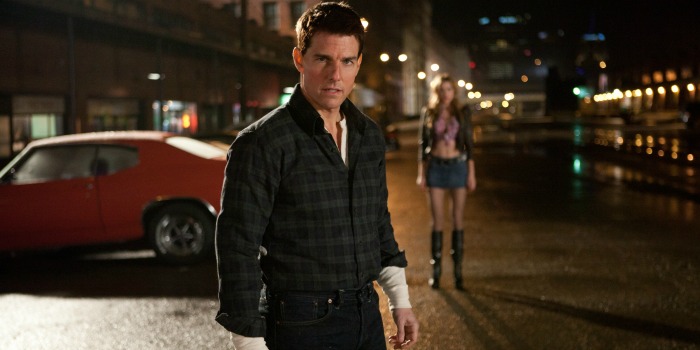
In honor of Tom Cruise’s 63rd birthday, I decided to revisit the 2012 film JACK REACHER. Cruise stars as the title character in the film version of the Lee Child novel “One Shot.” The story follows Reacher, a former military investigator, who gets pulled into the case of James Barr (Joseph Sikora), a sniper who supposedly killed five people in a random shooting in Pittsburgh. Although all the evidence is neatly stacked up against Barr, the sniper just has one request for his defense, “Get Jack Reacher.” Emerging from a self-imposed hiding, Reacher teams up with Barr’s defense attorney Helen Rodin (Rosamund Pike), to try to figure out what in the hell is going on. Once he has access to the evidence, and based on what he already knows about James Barr, Reacher immediately starts tearing holes in the case being presented by Police Detective Calvin Emerson (David Oyelowo) and District Attorney Alex Rodin (Richard Jenkins). Reacher’s own investigation uncovers a conspiracy involving a mysterious criminal organization led by the evil, and partially deformed Zec (Werner Herzog), whose plans are violently enforced by his badass henchman Charlie (Jai Courtney). It seems they have orchestrated the shooting to appear random, but they were really just after one person, Oline Archer (Susan Angelo), whose construction company is vital to their criminal enterprise. With the help of defense attorney Rodin, as well as the owner of an Ohio shooting range, former Marines Corps Gunnery Sergeant Martin Cash (Robert Duvall), Reacher is determined to bring the real killers to justice!
I remember there being some controversy surrounding the announcement that Tom Cruise would be starring as Jack Reacher. Dedicated readers of Lee Child’s books didn’t seem to appreciate that Cruise’s physical stature is not even close to the way the character is described. If I was an avid fan of the books, I would definitely understand the concern, but I’ve never read a single book in the series. This is one of those instances where my lack of reading experience allows me to completely enjoy the film, because Tom Cruise is flat out excellent. He’s smart, funny, a badass lone wolf of justice, and completely believable. I’d go so far as to say that the primary reason I love this film is Tom Cruise’s incredible star turn as Jack Reacher. With the choice of Tom Cruise or another actor who more closely resembles the Reacher from the book, I’m going with Cruise 10 out of 10 times. With that said, I’m also happy for the purists out there that the new REACHER series on Amazon, which began in 2022 and is still going strong, addresses this “size controversy” in it’s casting. I’ve heard good things about the series, and I’ll eventually get around to watching it as well.
Aside from Tom Cruise’s magnetic central performance, I find JACK REACHER to be a truly entertaining movie, and I don’t think we get enough of those these days. It has exciting and fun action scenes, a sly sense of humor, chillingly evil bad guys who get their comeuppance at the end, and an incredible supporting cast. Thinking back on it now, Rosamund Pike as the defense attorney, Werner Herzog as the evil villain, and Robert Duvall as the “cranky old Robert Duvall” character are the supporting performances that stand out the most to me, but all the casting choices are good. With his shepherding of the “Mission: Impossible” series, director Christopher McQuarrie has proven himself to be an expert at delivering fun movies, and he delivered big time here for film audiences a few years before taking on his first impossible mission.
In summary, I don’t really have a single negative thing to say about JACK REACHER. Most of the negative things I’ve read online have been due to the disappointment that some viewers have felt based on the differences between the books and the movie. I just know that I still watch it every couple of years and enjoy it immensely each time. JACK REACHER is one of my favorite films of its decade!
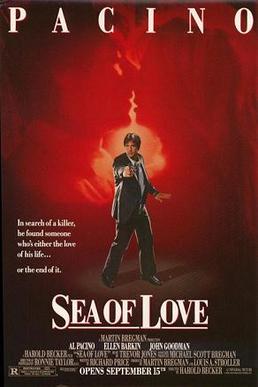
In New York City, someone is ritualistically murdering the men who are placing rhyming personal ads in a tabloid newspaper. Assigned to the case is Frank Keller (Al Pacino), an alcoholic burn-out whose wife just left him for another cop. Keller and his partner (John Goodman) decide to go undercover. Frank places a rhyming personal ad of his own and then goes to a restaurant to see who shows up. When Helen Cruger (Ellen Barkin) answers the ad, it leads to a relationship between Frank and Helen. Frank is falling for Helen but what if she’s the murderer?
Sea of Love is a superior thriller, even though it doesn’t really work as a mystery. As soon as you see a certain person’s name in the cast list, you’re going to guess who the killer is because that person is always the killer. Sea of Love isn’t really about the mystery, though. It’s about people looking something that’s missing from their lives and realizing that the world is passing them by. The movie works because of the performances of Al Pacino and Ellen Barkin, cast as two lonely middle-aged people who are desperately looking for some sort of connection. Helen and Frank are both in their 40s and wondering if their current situation is really as good as it’s going to get. The film uses Frank’s fear that Helen could be the killer as a metaphor for the fear that anyone feels when they are first starting to open up to someone. Both Pacino and Barkin give emotionally raw and poignant performances. I don’t think I’ve ever seen Al Pacino look as miserable as he did for the majority of Sea of Love. This was Pacino’s first film role after the disaster of Revolution and the movie’s box office success was revived Pacino’s career and convinced him to give movies a try again.
Director Harold Becker captures the feel of New York at its grittiest and least welcoming and Richard Price’s script is full of priceless dialogue. This is one of the rare films in which everyone has something intelligent or meaningful to say. Featuring a strong supporting cast and career-best performances from Ellen Barkin and Al Pacino, Sea of Love is much more than just another cop film.
As much as I enjoy writing about movies and talking about movies, I make a living by helping people with their annual income tax filings. That means from around January 15th through April 15th each year, almost every waking hour is spent focused on tax return preparation. While I’m working on these tax returns, I will often play movies or TV shows on one of my computer screens. These aren’t just any movies, though. These are movies or TV shows that make me feel good and help me relax while I’m working so many hours. Over the years, I’ve used movies like THE OTHER GUYS, THE HANGOVER, and ZOMBIELAND. A few years ago, THE ANDY GRIFFITH SHOW was on Prime, and I watched the entire 8 seasons through 3 times during tax season. One genre I hit hard this time of year is romantic films, both comedies and dramas. The main thing I’m looking for is happy endings. My favorite romantic films include NOTTING HILL, RETURN TO ME, HITCH, YOU’VE GOT MAIL, PERSUASION & SENSE AND SENSIBILITY. As a big fan of Nicolas Cage, IT COULD HAPPEN TO YOU, Cage’s 1994 romantic comedy with Bridget Fonda has joined that list over the years as well. Since today, January 7th, 2025, is Nicolas Cage’s 61st birthday, and tax season is coming, I thought I’d write about this charming film!
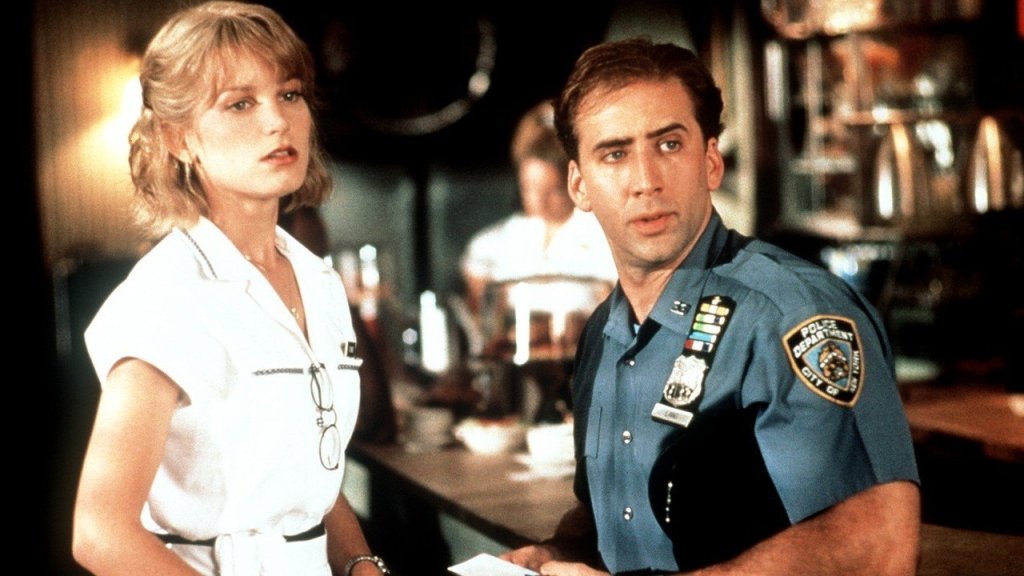
IT COULD HAPPEN TO YOU revolves around Charlie Lang (Nicolas Cage), a New York City cop who seems like an all-around good guy. One day he’s having coffee at a local diner with his partner Bo (Wendell Pierce), when they get a police call. Charlie finds himself without the money to give a proper tip to his waitress, Yvonne (Bridget Fonda), so he improvises on the spot and tells her he has a lottery ticket to be drawn on that very same night. Further, he goes on to tell her if he wins, he’ll split the winnings with her as a tip. The two cops head on out, Charlie happy that he gave her something, and Yvonne, who’s not having a good day anyway, just shakes it off knowing that it’s just another small tip she missed out on. But wouldn’t you know it, on this night the stars all align and Charlie’s number is drawn as a winner. Charlie and his wife Muriel (Rosie Perez) are ecstatic with their win, which amounts to around $4 million. In the middle of their celebration, Charlie remembers his promise to Yvonne and tells Muriel. To say she’s upset is an understatement, and she begs him to stiff the waitress. Charlie is just too honest for that, so he is able to convince Muriel that $2 Million is enough for them to live comfortably on. She begrudgingly agrees, but the fuse has been lit between Charlie and Muriel. The next day, Charlie goes back to the diner and tells Yvonne that they won. At first not believing it’s true, Charlie is able to convince Yvonne that he’s honoring his tip by giving her half of the winnings. We have found out that Yvonne is having severe financial problems, and this “tip” comes as a completely unexpected answer to her prayers. Alls well that ends well, right? As we all know, money can bring out the very best or the very worst in people and we see that play out throughout the rest of the movie. I’ll just put it this way, as Charlie and Muriel grow apart with their newfound money, Charlie and Yvonne grow closer together, bound by this amazing experience.
It’s all a pretty crazy setup, but IT COULD HAPPEN TO YOU is a movie that I relate to idealistically. I really like Cage and Fonda in their roles. I’d love to be as honest and likable as Nicolas Cage’s character Charlie Lang. He is just a good guy, way down deep. I want to be that kind of guy. And Bridget Fonda’s character Yvonne is also very appealing. She’s presented as a lady going through a lot of personal issues, but who somehow seems to always show a kind and compassionate spirit to everyone around her, especially to others who are struggling. The scene where Charlie convinces her that he really is giving her half the money is quite an uplifting scene. Both of these characters have an honesty and attitude about life that resonates with me. Some people might argue that their characters should have more depth to make them more realistic and less one-dimensional, and they might be right, but I personally enjoy seeing them as just really honest and kind people.
It should also be pointed out that you have to be able suspend your disbelief to enjoy IT COULD HAPPEN TO YOU. If your movies “have” to be realistic, this is not the movie for you. The entire premise is a fairytale, and the movie should be seen as such. For the movie to work, the good guys have to be really good guys, and the bad guys have to be really bad guys. I’ve mentioned earlier how kind both Charlie and Yvonne are throughout the film, with the money not changing their attitudes about life in any way. If anything, the money allows them to be even more kind and generous to others. Well, money has had the exact opposite effect on Muriel, and we soon learn that $2 Million isn’t enough for her and that the full $4 Million would not have been enough either. At this point, I’m not sure $100 Million would have been enough. In our fairytale story, she can’t be presented as a lady realistically struggling with her husband’s overly generous tip, she has to be presented as extremely selfish and cruel. I mean, how else is the story going to get Charlie and Yvonne together?!
All in all, IT COULD HAPPEN TO YOU works for me. I’ve said many times I’m a sucker for a good romance, and this film fits the bill for me. The main characters warm my heart as they are decent, kind and honest. I like a good fairytale. It’s one of the main reasons I enjoy the movies, and it doesn’t seem like we get enough good fairytales these days.
Check out the trailer for IT COULD HAPPEN TO YOU below!
And if you’re looking for more awesome information about Nicolas Cage, check out John Rieber’s latest post where he celebrates Cage’s birthday with a movie marathon!
That was one of my main thoughts as I watched 1993’s And The Band Played On.
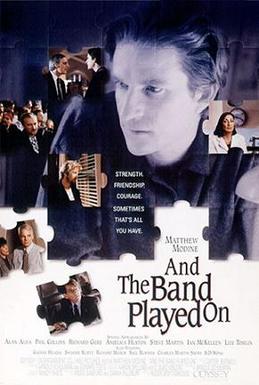
Directed by Roger Spottiswoode and featuring an all-star cast, And The Band Played On deals with the early days of the AIDS epidemic. It’s a film that features many different characters and storylines but holding it all together is the character of Dr. Don Francis (Matthew Modine), an epidemiologist who is haunted by what he witnessed during the Ebola epidemic in Africa and who fears that the same thing is going to happen in America unless the government gets serious about the mysterious ailment that is initially called “gay cancer” before then being known as “GRID” before finally being named AIDS. Dr. Francis is outspoken and passionate about fighting disease. He’s the type who has no fear of yelling if he feels that people aren’t taking his words seriously enough. In his office, he keeps a track of the number of HIV infections on a whiteboard. “Butchers’ Bill” is written across the top of the board.
Throughout the film, quite a few people are dismissive of Dr. Francis and his warnings. But we, the audience, know that he’s right. We know this because we know about AIDS and but the film also expects us to trust Dr. Francis because it’s specifically stated that he worked for the World Health Organization before joining the Center For Disease Control in Atlanta, Georgia. As far as the film is concerned, that’s enough to establish his credentials. Of course, today, after living through the excesses of the COVID pandemic and the attempts to censor anyone who suggested that it may have begun due to a lab leak as opposed to some random guy eating a bat, many people tend to view both the WHO and the CDC with a lot more distrust than they did when this film was made. As I said, we live in a cynical time and people are now a lot less inclined to “trust” the experts. To a large extent, the experts have only themselves to blame for that. I consider myself to be a fairly pragmatic person but even I now find myself rolling my eyes whenever a new health advisory is issued.
This new sense of automatic distrust is, in many ways, unfortunate. Because, as And The Band Played On demonstrates, the experts occasionally know what they’re talking about. Throughout the film, people refuse to listen to the warnings coming from the experts and, as a result, many lives are lost. The government refuses to take action while the search for a possible cure is hindered by a rivalry between international researchers. Alan Alda gives one of the best performances in the film, playing a biomedical researcher who throws a fit when he discovers that Dr. Francis has been sharing information with French scientists.
It’s a big, sprawling film. While Dr. Francis and his fellow researchers (played by Saul Rubinek, Glenne Headly, Richard Masur, Charles Martin Smith, Lily Tomlin, and Christian Clemenson) try to determine how exactly the disease is spread, gay activists like Bobbi Campbell (Donal Logue) and Bill Kraus (Ian McKellen) struggle to get the government and the media to take AIDS seriously. Famous faces pop up in small rolls, occasionally to the film’s detriment. Richard Gere, Steve Martin, Anjelica Huston, and even Phil Collins all give good performances but their fame also distracts the viewer from the film’s story. There’s a sense of noblesse oblige to the celebrity cameos that detracts from their effectiveness. All of them are out-acted by actor Lawrence Monoson, who may not have been a huge star (his two best-known films are The Last American Virginand Friday the 13 — The Final Chapter) but who is still heart-breakingly effective as a young man who is dying of AIDS.
Based on a 600-page, non-fiction book by Randy Shilts, And The Band Played On is a flawed film but still undeniably effective and a valuable piece of history. Director Roger Spottiswoode does a good job of bringing and holding the many different elements of the narrative together and Carter Burwell’s haunting score is appropriately mournful. The film ends on a somber but touching note. At its best, it’s a moving portrait of the end of one era and the beginning of another.
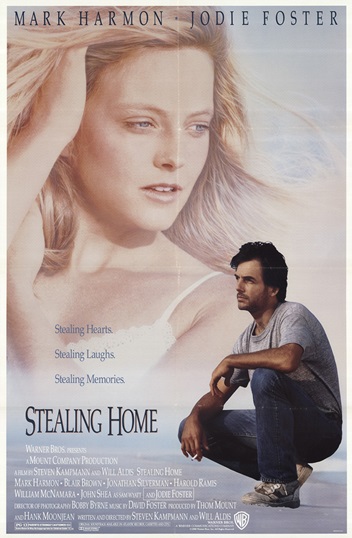
Back in December, Lisa agreed to watch a baseball movie with me to make up for making me watch The Catcherin 2023. The one we picked was Stealing Home, because it starred Mark Harmon and Jodie Foster and it looked like it would be a sweet movie.
Stealing Home opens with Billy Wyatt (Mark Harmon), a minor league baseball player who is getting ready to take the field and who is standing for the National Anthem. I immediately liked Billy because he was standing for the Anthem and not taking a knee. I also like aging minor leaguers because they’re still playing the game even though they know they’ve probably missed their window to move up to the majors. Billy Wyatt loves both the game and his country.
As Billy waits to play ball, he thinks about another type of love, the love that he had for Katie Chandler (Jodie Foster). Katie was six years older than him and encouraged him to always pursue his dreams, whether it was in baseball or love. The movie flashes back to Billy living in a motel with a cocktail waitress and getting a phone call from his mother who tells him that Katie has committed suicide and she wants Billy to spread her ashes at a special place. Billy then flashes back to his childhood and his teen years, in which he’s played by William McNamara who does not look like he could ever grow up to be Mark Harmon. Billy’s best friend is Alan Appleby, who is played as a teenager by Jonathan Silverman and as an adult by Harold Ramis. Jonathan Silverman growing up to be Harold Ramis seems even more unlikely than William McNamara becoming Mark Harmon. Billy remembers losing his virginity to Appleby’s prom date, losing his dad to a car wreck, and a Fourth of July weekend that he spent on the beach with Katie and his mom (Blair Brown).
Only Jodie Foster plays Katie Chandler and we only see Katie thorough Billy’s eyes. Jodie Foster gives a lively performance as Katie but she always more of a plot device than a fully rounded character. We never find out why Katie killed herself. Her father says that Katie was unhappy during her adult life but why? Even after Billy gets her ashes and tries to figure out where she wanted him to spread them, he never thinks about why she killed herself. In fact, he hadn’t even talked to her for years. That really bothered me.
The movie ends with Billy stealing home during a game and proving that he’s still got it as far as baseball goes. I love baseball but I still felt like Katie’s untold story was probably more interesting than Billy’s. I liked Mark Harmon’s performance and I really wanted to like Stealing Home more than I did. I wish the movie had been more about who Katie was instead of being about who Billy thought Katie was.
Welcome to Retro Television Reviews, a feature where we review some of our favorite and least favorite shows of the past! On Mondays, I will be reviewing Miami Vice, which ran on NBC from 1984 to 1989. The entire show is currently streaming on Tubi!
This week, Crockett and Tubbs head down to Colombia and learn about the smuggler’s blues!
Episode 1.16 “Smuggler’s Blues”
(Dir by Paul Michael Glaser, originally aired on Feb. 1st, 1985)
Someone is blowing up drug dealers and their families in Miami. Homicide Detective Jones (Ron Vawter) doesn’t know why anyone cares about a bunch of smugglers being killed but DEA Agent Ed Waters (a youngish Richard Jenkins) is concerned that a vigilante is on the loose.
If there is a vigilante on the loose, who could it be? Well, we know that it’s not going to be any of our regular cast members, even if Castillo does seem to be kind of tightly wound. So, that really leaves Jones and Waters as our only two suspects. Looking over the notes that I trotted down for this episode, I see that I immediately said that Waters had to be the killer because, when the killer anonymously called the Department towards the end of the episode, I instantly recognized Richard Jenkins’s voice. Of course, it turned out I was totally wrong. Detective Jones turned out to be the killer and apparently, I have no idea what Richard Jenkins actually sounds like.
Anyway, before Detective Jones can be revealed as the murder, Crockett and Tubbs have to go to Colombia so that they can go undercover as dealers and purchase a large amount of cocaine. The idea is that the vigilante will target either Crockett and Tubbs or they’ll go after Trudy, who is undercover as Tubbs’s wife. Working on their own, Crockett and Tubbs recruit a pilot named Jimmy Cole (Glenn Frey) to fly them to Colombia.
Former Eagle Glenn Frey was specifically cast in this episode because the plot was largely based on a song that he had written, Smuggler’s Blues. (The episode’s script was written by Miguel Pinero, who played Calderone earlier in the season.) The song is played throughout the episode, the lyrics hammering home one of Miami Vice‘s key themes. The war on drugs can never be won because there’s way too much money to be made in smuggling and selling.
It’s a good episode, one that features a likable guest turn from Glenn Frey and plenty of action. When Crockett and Tubbs land in Colombia, they find themselves having to fight off both enforcers and cops. Their only ally is Cole, a man who they would normally be expected to arrest, (In a nicely acted scene, Tubbs and Cole bond over the fact that they both served in Vietnam.) Back in the United States, Crockett, Tubbs, and Cole have to fight off a thief, played by Richard Edson. And after all that, it’s still up to Tubbs and Crockett to save Trudy from being blown up in a trailer and this leads to wonderfully tense bomb disarming scene. In the end, Crockett and Tubbs score a victory but we are left with little doubt that it will only be a temporary one. That’s the politics of contraband, to quote both the song and the show.
Dealing with life and crimes of serial killer and cannibal Jeffrey Dahmer (played by Evan Peters), Dahmer premiered on Netflix last September and, despite not getting a lot of promotional push, it went on to become Netflix’s most-watched miniseries to date. I first tried to watch it in October. Then I tried again in November. And I tried a third time in January. All three times, I couldn’t make it through the first episode. The whole thing seemed so oppressively sad and dark that I couldn’t bring myself to stick with it. The image of Dahmer killing people in his ugly apartment and then drinking a beer while watching The Exorcist III was not an image that I wanted in my head.
This week, I decided to give the miniseries another shot. I did so for the most shallow of reasons. The Emmys are approaching and I don’t want to end up pulling a repeat of last year, where I had to scramble to somehow cram watching all of the possible contenders into a two-and-a-half week period. Because it’s a Netflix show and it’s a Ryan Murphy production and it portrays Dahmer has being the type of white male killer who could only thrive in a society shaped by systemic racism, Dahmer will probably be an Emmy contender. So, this week, I finally watched the entire miniseries.
Using the same jumbled chronology that sabotaged Ryan Murphy’s The Assassination of Versace, Dahmer tells the story of Dahmer, his crimes, and some of his victims. The first episode features Dahmer’s eventual arrest. The second, third, and fourth episodes give us a look at his childhood. The sixth episode tells the story of one of his victims. The remaining four episodes focus on the aftermath of Dahmer’s crimes. For the most part, the series is well-acted and it makes a convincing case that Dahmer could have been stopped if not for the biases and the incompetence of the Milwaukee police. That said, it’s also ten hours long and ten hours is a long time to spend mired in the darkness of Jeffrey Dahmer’s life and crimes. Much as with the second half of The Assassination of Versace, Dahmer gets bogged down by its refusal to trust the audience to be able to understand the show’s message. Any point that is made once in Dahmer will be made four more times, just to make sure that everyone picked up on it.
It’s a typical Ryan Murphy true crime production. While Murphy didn’t direct any of Dahmer’s ten episodes, he did produce and co-write the first four episodes. Both Murphy and Evan Peters have insisted that the show was not meant to make excuses for Dahmer. Murphy reportedly told the directors to make sure that the story was never told from Dahmer’s point of view and to keep the audiences on the outside looking in. To its credit, Dahmer doesn’t glorify him by portraying him as being witty, erudite, or in any way clever. As portrayed in this miniseries, Jeffrey Dahmer was an alcoholic loser who peaked in high school, despite the fact that he really wasn’t that impressive back then either.
But again, Dahmer is ten hours long and there are really only three episodes in which Dahmer is not the main character. Episode six is told from the point of view for Tony Hughes (Rodney Burford), who was one of Dahmer’s victims. Episode seven is told from the point of view of Glenda Cleveland (Niecy Nash), who was traumatized as a result of being Dahmer’s neighbor and who later became an activist on behalf of the families of Dahmer’s victims. In one of the many infuriating moments of the Dahmer saga, Glenda attempts to help one of Dahmer’s drugged victims, 14 year-old Konerak Sinthasomphone, just for the police to tell her to stay out of it before taking the 14 year-old back to Dahmer’s apartment. (Perhaps aware of how unbelievable that this scene will seem to some viewers, the show includes actual audio of the call that Glenda made to the police to check on what had happened to the child that she tried to save. As Glenda points out that the child was bleeding and obviously drugged, the police brusquely tell her to mind her own business.) Episode eight focuses on Lionel (Richard Jenkins), Dahmer’s guilt-stricken father. All of three — especially Richard Jenkins — give stand-out performances but it is ultimately Dahmer who dominates. Indeed, though the miniseries portrays Dahmer as being a compulsive killer, it still can’t resist portraying his grandmother as being a fundamentalist scold who won’t stop telling Dahmer that he needs to go to church. It still can’t resist portraying Dahmer’s first victim as being a homophobe. It still can’t resist a sequence depicting the execution of an unrepentant John Wayne Gacy, as if to argue, “At least Dahmer said he was sorry!” Intentional or not, the decision to put Dahmer at the center of the story does encourage the viewer to make excuses for him.
With the exception of the episodes centering on Tony Hughes and Konerak Sinthasomphone, it is hard not to feel that the documentary focuses on Dahmer at the expense of his victims. (It should be noted that Tony Hughes’s mother is among those who have been critical of the miniseries and its portrayal of Tony as being Dahmer’s “boyfriend” before his murder.) Until the end of the miniseries, we don’t find out the names of the majority of Dahmer’s victims and it largely feels like an afterthought.
In the end, the miniseries is overlong and, while it certainly doesn’t glorify him, it still occasionally falls into the trap of making excuses of Dahmer. The film ends by ruefully noting that, despite the efforts of Glenda Cleveland, no memorial has ever been built for the victims of Jeffrey Dahmer. This miniseries could have been that memorial if it had focused on them instead of on him.



 Through the Shattered Lens