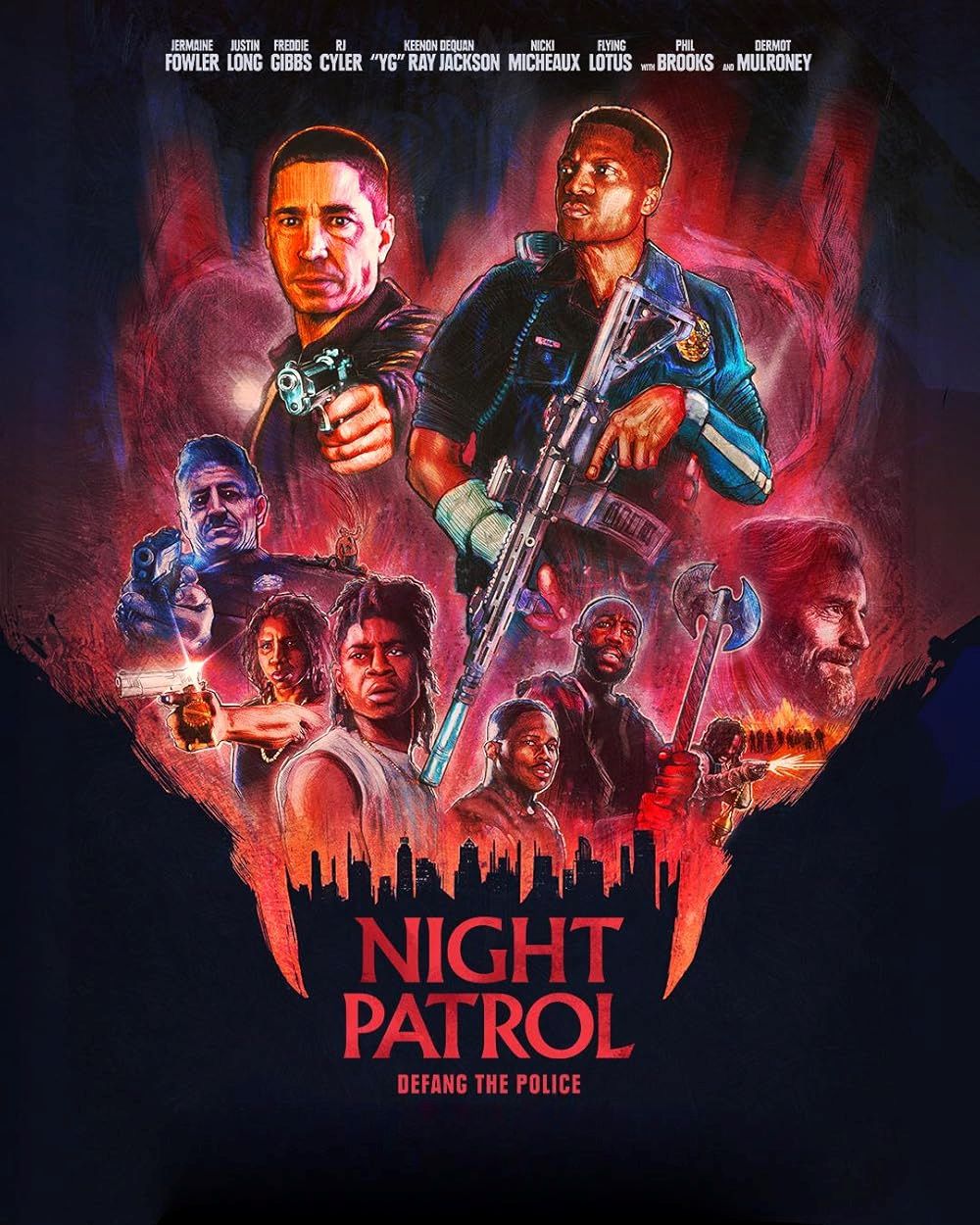
Review: Night Patrol (dir. by Ryan Prows)


“They vampires. They drink blood!” Bornelius

You know the feeling of digging through a forgotten VHS bin and finding a movie that looks like it was beamed in from a parallel universe where grindhouse cinema never died? That’s Night Patrol in a nutshell. Directed by Ryan Prows, this scrappy, bloody genre mashup has a raw, politically charged energy that mixes social outrage with lurid horror tropes. And honestly, streaming services like Shudder have become the bargain bin of the 21st century—the place where genre films of dubious budget and quality get a new life, or in some cases, their only life. Night Patrol is a perfect example of that ecosystem: too weird for a wide theatrical release, too ambitious to be dismissed outright, and exactly the kind of movie you stumble upon at 1 AM, three scrolls deep into a streaming queue. The core idea is audacious: what if the most elite, secret unit of the LAPD wasn’t just crooked, but was actually a coven of vampires using gang violence as a cover for their midnight snacks? It’s the kind of premise that feels like it was dreamed up at 2 AM after a Super Fly and The Warriors double feature—and I mean that as a high compliment.

If you lean in, you’re in for a bumpy but often thrilling ride. The film centers on two LAPD partners: Ethan (Justin Long) and Xavier (Jermaine Fowler). Ethan is the legacy kid, the son of a legendary cop (Dermot Mulroney), who finally gets the nod to join the secretive “Night Patrol.” Xavier, who grew up in the very housing projects the unit is supposedly “cleaning up,” is left on the outside looking in, suspicious of everything. Naturally, Ethan quickly discovers that his new colleagues aren’t just trigger-happy; they’re literally heartless monsters with metal-plated fangs and a thirst for the residents of the neighborhood Xavier calls home.

Meanwhile, on the streets, Xavier’s brother Wazi (RJ Cyler) and his mother Ayanda (Nicki Micheaux) are realizing that the gang war heating up isn’t just about turf—it’s about survival against the undead. The film’s greatest strength is how it throws these characters into a blender. You have the buddy-cop tension between Long and Fowler, the street-level horror from Cyler’s perspective, and this ancient mystical element brought by Micheaux, who plays a matriarch dabbling in Zulu magic to fight the monsters. It’s a lot, but for the first hour, Prows manages to balance these plates relatively well. There’s a hint of that old-school exploitation energy here: Micheaux’s Ayanda refuses to rely on a broken system and instead arms herself with ancestral power, which gives the film a satisfying underdog-revenge backbone.

Let’s talk about the cast, because this is where Night Patrol either fires on all cylinders or sputters, depending on the scene. Justin Long, our reigning scream king, is perfectly cast as the moral compass who suddenly realizes he’s sold his soul to the corporate office. He plays the “good apple” realizing the whole barrel is rotten with a kind of weary, panicked authenticity. Jermaine Fowler is the secret weapon here; he’s grounded, funny, and provides the emotional anchor the film desperately needs when the visuals go off the rails. Think of him as a reluctant warrior caught between two worlds—the badge he wanted to trust and the community he can’t abandon.

Then, there’s C. M. Punk. The WWE champion plays a vicious white supremacist vampire sergeant, and I have to hand it to him—he’s terrifying. He doesn’t chew scenery so much as he drains it dry of all warmth. He has a physical presence and a cold, dead stare that works perfectly for a monster hiding in a uniform. On the flip side, while rapper Freddie Gibbs and Flying Lotus bring a fun, playful swagger to their gang-heavy roles, some of the other supporting performances—specifically among the vampire coven—feel stiff and amateurish. It creates an uneven texture where one scene feels like a gritty HBO drama and the next feels like a student film. That inconsistency is part of the movie’s scrappy charm, but it also keeps it from feeling fully polished—exactly the kind of rough edge you expect from a bargain bin discovery.

Visually, director Ryan Prows (who previously directed the segment The Subject in V/H/S/94) knows exactly how to make Los Angeles look like a sun-bleached hellscape during the day and a neon-drenched deathtrap at night. The cinematography is gritty and grainy, giving it that ’90s VHS vibe that makes every alleyway feel dangerous. It echoes the cheap, hungry look of independent cinema from decades past, which fits the movie’s B-movie ambitions perfectly. However, style only gets you so far, and Night Patrol hits a serious wall in its final act.

The pacing, which was already a slow burn, starts to drag heavily. There is a lot of talking. A lot of sitting in rooms explaining the “ancient lore” of the vampires, and honestly, the rules get so convoluted that you stop caring who the original evil vampire was and just want to see somebody get staked. The movie tries to have its cake and eat it too—it wants to be a serious critique of the “Thin Blue Line” ideology, an action-horror romp, and a mystical family drama. Usually, it ends up being a muddled version of all three. A tighter script would have known exactly how long to linger on a metaphor before cutting to the chase, but Night Patrol often forgets that lesson. This is where the bargain bin analogy really stings: you can feel the ambition straining against the budget and the runtime, and not every swing connects.

When the action finally does hit in the last twenty minutes, it’s brutally fun. There are guts ripped out, decapitations, and a final boss form for the villains that looks like something out of a heavy metal album cover. It’s just a shame it takes so long to get there. The social commentary is loud and clear—cops as gangs, systemic racism, the failure of the “few bad apples” defense. It’s not subtle, but for a movie where a guy gets thrown through a window in slow motion, subtlety isn’t really the goal. Night Patrol has teeth, and when it remembers to bite, it draws blood. It just spends too much time trying to decide what flavor of juice it wants to suck. And yet, without a service like Shudder, a movie like this probably never sees the light of day. It’s too rough for festivals, too niche for Netflix’s algorithm, and too weird for traditional distributors. Streaming has become the digital equivalent of the $5 DVD barrel outside a video store—full of misfires, hidden gems, and everything in between.

It’s a C+ effort that gets a B+ for sheer ambition, and honestly, in the wasteland of January genre releases, that’s more than enough to warrant a watch—if only to see Justin Long react to C. M. Punk turning into a bat-demon while Jermaine Fowler tries to talk sense into everyone. You can’t get that anywhere else, and that’s exactly why the bargain bin still matters.

Horror Review: Bone Tomahawk (dir. by S. Craig Zahler)


“What is sacred to a bunch of goddamned savages ain’t no concern of the civilized man! We got permission!” — Buddy

Bone Tomahawk (2015) begins in quiet dread. A still horizon, the whisper of wind across rock, a hint of bone under the dust—the American frontier looms like an unfinished thought. This silence sets the tone for S. Craig Zahler’s remarkable debut, a film that wears the form of a Western only to strip it down to nerve and marrow. It’s a story of decency under siege, of men pushing past the last borders of civilization and discovering that what lies beyond is not the unknown, but the origin of everything they thought they’d overcome.

At first glance, the premise seems familiar. When several townspeople vanish from the small settlement of Bright Hope, Sheriff Franklin Hunt (Kurt Russell) leads a rescue expedition into the desert. Riding with him are three others: the injured but determined Arthur O’Dwyer (Patrick Wilson), whose wife has been taken; his tender-hearted deputy, Chicory (Richard Jenkins), whose chatter and old-fashioned kindness soften the film’s bleak austerity; and the self-assured gunman John Brooder (Matthew Fox), a man equal parts gallant and cruel. Together, they represent the moral cross-section of a civilization still trying to define itself—duty, love, loyalty, arrogance.

Their journey outward becomes one of inward descent. Zahler’s script unfolds at a deliberate pace, steeped in stillness and exhaustion. The first half moves like ritual—meandering conversations, humor worn thin by weariness, the small comforts of campfire fellowship flickering against the vast emptiness around them. It’s here that Bone Tomahawk begins its slow transformation. What starts as a rescue Western gradually becomes something deeper and older. By stripping away the romance of exploration, Zahler reveals the frontier not as a space of discovery, but as a place of reckoning—a mirror of the instincts civilization pretends to have tamed.

The film’s most haunting element is its portrayal of the so-called “troglodytes,” the mysterious group believed to be responsible for the kidnappings. They are less a tribe than an incarnation of the wilderness itself—nameless, wordless, and utterly beyond cultural translation. Covered in ash, communicating through the eerie hum of bone instruments embedded in their throats, they seem less human than ancestral, as though the land itself had dragged them upward from its own depths. Zahler refuses to frame them anthropologically or politically; instead, they represent the primal truth the American frontier sought to bury under its myths of order and progress.

Western films, for more than a century, have mythologized the wilderness as an external force—something to conquer. But the “troglodytes” in Bone Tomahawk feel like the soil’s memory of what came before conquest: the savage necessity that built the very myths used to conceal it. They are the frontier’s unspoken ancestry—what remains after all the churches, taverns, and codes of decency are stripped away. Civilization needs them to remain hidden in the canyons, out of sight and unspoken, because their existence contradicts everything the polite narrative of the Old West stands for. They are what progress denies but cannot erase.

Zahler’s restraint strengthens this allegory. He shoots the desert not as backdrop but as evidence—a geographical wound extending beyond the horizon. The wilderness looks stunning but predatory, its stillness full of threat. Even when the posse’s odyssey is free of immediate danger, there’s the growing sense of being consumed: by the sun, by exhaustion, by the quiet knowledge that the world they’re riding into has no use for their notions of law and virtue. Civilization, here, is a pocket of light surrounded by something much older and hungrier.

That hunger, the need to conquer and consume, connects Bone Tomahawk to its spiritual predecessor, Antonia Bird’s Ravenous (1999). Bird’s film transformed the Donner Party’s historical ghosts into an allegory of Manifest Destiny, equating cannibalism with American expansion—the act of devouring land, life, and self under the guise of progress. Zahler continues that lineage with deliberate starkness. For him, violence in the frontier isn’t just literal; it’s foundational, the unacknowledged currency of civilization. Where Ravenous expressed its critique with mordant humor, Bone Tomahawk speaks in solemn tones, observing how every civilized act—the enforcement of law, the defense of home—rests upon the refusal to see what was consumed to create it.

The “troglodytes” embody that refusal incarnate. They are not villains in the traditional sense; Zahler grants them no ideology or explanation, only the primal fact of their survival. In doing so, he flips the Western’s moral equation: the barbarians at the edge of civilization are not invaders, but reminders of its origins. They are ghosts of the violence that founded the frontier, the unspoken proof that the West was never as far from savagery as it claimed. To look upon them is to glimpse the beginning—the raw, lawless reality America buried beneath the idea of itself.

Kurt Russell, magnificent in his restraint, anchors this tension. His Sheriff Hunt evokes a fading kind of decency: measured, fair, and unwavering even in futility. Russell plays him not as a Western hero but as a man committed to honor in a world that no longer rewards it. His calm authority softens only around those he loves and hardens in the face of what he doesn’t understand. In that measured decency lies the film’s aching question: what happens when morality meets something that does not recognize it?

Patrick Wilson’s O’Dwyer embodies faith’s physical agony—a man driven by devotion, limping through a landscape that punishes his determination. Richard Jenkins provides heart and subtle tragedy; his rambling, almost comical musings on aging and loneliness become the story’s moral texture, the sound of humanity scraping against extinction. And Matthew Fox, in his most precise performance, gives voice to the arrogance of the civilized killer—a man who fashions violence as virtue, believing his elegance excuses his cruelty.

Together, the four men form a living cross-section of the West’s moral mythos. Their journey exposes how fragile those ideals become once separated from the safety of town limits. They embody the dream of order confronting the truth of chaos—and the cost of looking too long into the void beyond it.

Zahler’s filmmaking is remarkably self-assured for a debut, and what stands out most is his willingness to trust stillness. There is no manipulated rhythm, no swelling score to guide emotion. The soundscape is shaped by wind, hoofbeats, crackling fires, and quiet voices rattled by exhaustion. The silence itself becomes a spiritual presence, pressing down on the travelers until conversation feels like resistance. Each scene builds tension not through action, but through waiting—the dread of what remains unseen, what civilization has pretended not to hear.

The violence, when it erupts, is unforgettable. Zahler does not linger voyeuristically, yet the weight of what happens lands with moral precision. The horror feels earned—an eruption of the primal into the civilized. Its purpose is not to shock, but to remind: the line between the men of Bright Hope and the people they fear is thinner than they want to believe. The frontier, as Zahler presents it, is not an untouched wilderness but the graveyard of an ongoing denial—the myth of progress stacked atop the bones of the devoured.

In that way, Bone Tomahawk moves beyond the idea of genre blending. It is not merely a “horror Western,” but a meditation on how those two sensibilities spring from the same source. Both depend on the confrontation between safety and the unknown, belief and disbelief. Both are rituals of fear, structured to reassure yet always at risk of unveiling the truth. Zahler’s greatest achievement is the way he strips away that reassurance. By the film’s final stretch, the promises of civilization—hope, faith, righteousness—have been exposed as fragile constructions built atop an ancient void.

And yet, through all its darkness, Zahler allows a flicker of grace. The film’s humanity endures in small gestures: a conversation interrupted by laughter, a hand extended in kindness, the stubborn persistence of dignity in impossible circumstances. Bone Tomahawk never preaches or offers catharsis, but it does something harder—it bears witness. It shows men maintaining decency not because it protects them, but because it defines them. In that endurance lies the film’s quiet heartbeat.

Like Ravenous before it, Bone Tomahawk reimagines cannibalism and frontier brutality not as aberrations, but as mirrors reflecting a truth about the American project: that every step westward demanded erasure, and that what was erased refuses to stay buried. The “troglodytes” linger not only in the canyons but within the culture that feared them—proof that civilization’s polish has always covered the rough, enduring shape of appetite.

By the end, what remains is not revelation or redemption, but silence—the kind that comes after myth collapses. Zahler’s film leaves its characters and viewers alike to confront the space where civilization ends and something older begins. The desert remains untouched, vast and timeless, holding the secret at the center of all Western stories: that progress has always been haunted by the primitive, that the world we built never left the wilderness—it merely disguised it.

Measured, brutal, and strangely tender, Bone Tomahawk stands as both a reclamation and an undoing of the Western myth. It listens to the echoes of the Old West and answers them not with triumph, but with reckoning. In its dust and silence lies a truth older than law or legend: civilization may light its fires, but there will always be something in the dark watching, waiting—the part of us it never truly left behind.

Horror Trailer: Bone Tomahawk


Bone Tomahawk

We never have enough horror set in the Old West. It’s a setting that should be rife with infinite possibilities for some very scary storytelling.

When we do get Old West horror they tend to be direct-to-video and low-budget affairs. Now don’t get me wrong low-budget horror sometimes are some of the most effective. The closer it gets to it’s grindhouse roots the better. Then again some do end up being a pile of turds that end up getting relegated in the dollar bin at supermarkets.

My hope is that the latest Old West horror starring Kurt Russell will be the former and not the latter.

Bone Tomahawk made it’s premiere at this year’s Fantastic Fest and from all intents and purpose had a very positive reception to it’s genre mash-up of cowboys vs cannibals. Now what better way to follow-up The Green Inferno but with another cannibal fare set in the dusty plains and canyons of the Old West.

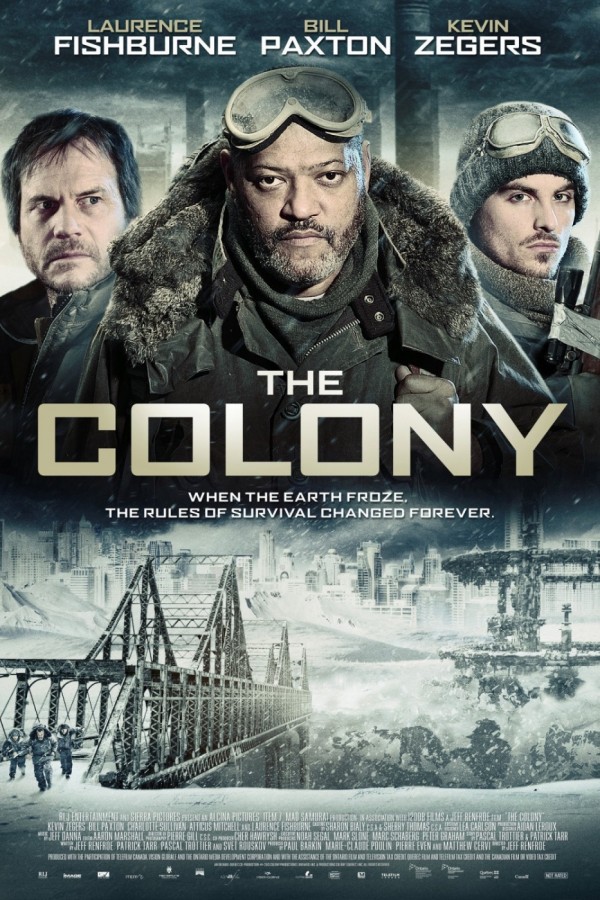
Horror Review: The Colony (dir. by Jeff Renfroe)


TheColony

“You’re going to need every bullet.”

The Colony was this little-seen horror film that came out in early 2013. From the trailers shown it looked like it was going to be a decent looking post-apocalyptic, scifi-horror that looked to evoke the sort of icy desolation and paranoia that Carpenter’s The Thing did so perfectly. Under Canadian-filmmaker Jeff Renfroe’s command the film’s high, lofty horror goals didn’t exactly come to fruition.

The film itself wasn’t awful by any stretch of the imagination, but it does suffer a lot from having it look like it was one of those mid-2000 SyFy film productions. At times some of the sequences even looked like it was copied off from one of those the SyFy “New Ice Age” disaster flicks starring Dean Cain. Yet, there’s some genuine tense moments in The Colony that should make this film a look-see if there’s nothing else to see.

Yes, the film is about the planet going through a sort of artificially-created Ice Age due to weather tampering. It’s a story that could’ve been lifted from early Twilight Zone episodes. Humanity barely survives inside spread out colonies using former factories and government bunkers. These colonies don’t just have the danger or dwindling supplies, simple diseases and the cold weather to deal with, but as we soon find out there’s now a new danger that’s much closer to home.

The Colony’s ad campaign and trailers have focused on it’s two American stars in Laurence Fishburne and Bill Paxton to sell the film. Both actors do some workman-like performances which helps anchor the ensemble cast’s performance. It’s the cast’s performances that elevates The Colony above it’s SyFy counterparts and one of it’s few saving graces. The other being the filmmakers’ success in creating a sense of freezing isolation through the use of arctic-like location shoots and some very well-done CGI icy landscapes.

The horror part of the film comes from the so-called “other” survivors who have adjusted to the scarcity of food by turning on the only abundant source of nourishment left in a world where there are no more growing things. Yes, The Colony tries to revive that old horror staple of the late 70’s and early 80’s which we know of as the cannibal-subgenre.

Cannibal films never truly went away but they remained mostly in the very outer fringes of the horror scene. They tended to be quite awful affairs that went for extreme shocks to bring in the horror crowd, but that only works when there’s a semblance of a narrative to explain things. With The Colony the film does a good enough job to try and explain why some have turned to a diet of the so-called other “white meat”. To add a new wrinkle to these feral antagonists the filmmakers they decided to update them for the modern audiences by giving them free-running skills that makes them seem more than human once they enter the screen. If the film has any sort of lesson to impart it could be that eating “long pig” might just give one parkour-like abilities.

The Colony definitely tried to be one of those scifi-horror that wanted to elevate itself to something beyond it’s grindhouse and exploitation roots, but it’s trying to be somethng it wasn’t meant to be that became it’s biggest flaw. The set-up of an Ice Age created by man is a time-tested story and the reintroduction of the cannibal thread to the film’s storyline was ripe for a grandg uignol-like production that could’ve been done using practical effects. But the filmmakers tried to mimic the CGI-smorgasbord of the Roland Emmerich-style, but they just barely distinguished themselves from what amounted to be an enhanced SyFy-production.

It’s a film that has enough entertaining moments, but overall it was a nice try that that just failed short of it’s goals.