That Richard Burton is today best-remembered for his tumultuous marriages to Elizabeth Taylor and for his performances in several less-than-worthy films is unfortunate as Burton was also one of the most highly regarded staged actors of his generation. In fact, late in his life, Burton often expressed regret that he had ever left the stage for films to begin with.
In 1964, Burton played Hamlet on Broadway, in a production that was directed by John Gielgud. (Gielgud also provided the voice of the Ghost.) This is a video-recording of both that production and Burton’s acclaimed performance. Burton brings an intense and almost divine madness to the role. Watching, one can see why Burton would have preferred to have been remembered for this instead of for playing Mark Antony.
Hey hey!! Before you read this, know that this isn’t the only review for The Longest Day. Lisa Marie also wrote about it. Read that first, and then double back here if you like.
With June 6th being the 81st Anniversary of D-Day, I decided to write about 1962’s The Longest Day, a film often discussed in my family, but surprisingly, I don’t recall ever fully watching it until today. I’ll try to get a hold of a hard copy of this in the future. The film is currently available to watch (with ads) on YouTube. This was a film my Aunt adored, as she liked seeing the Military come to the rescue in any situation (which happened often in most classic sci-fi films). This, They Died With Their Boots On, and All Quiet on the Western Front were films she raved about.
According to the National WWII Museum, “The Allies suffered over 10,300 total casualties (killed, wounded, or missing), of which approximately 2,400 were on Omaha Beach.” it was also an incredible offensive achievement, with nations gathering together to take the fight to a common enemy.
I don’t have a whole lot to say about this. As this is a film based on actual events (which takes some movie related liberties), I can’t complain or state I loved the “story”. As my boss at my Dayjob sometimes says, “It is what it is.” In terms of presentation, however, I highly recommend it. The film never really falters, nor does it give you too much time to relax. There’s a quiet tension with all of the characters you meet (all of the Allied ones, anyway), wondering if they may make it through by the end. If nothing else, watching it reminds one of the sacrifices made and the courage of anyone deciding to run head first into battle like that.
The film is epic in scope, with a runtime of 3 hours and an all star cast that includes Robert Mitchum (Cape Fear), Eddie Albert (Dreamscape), John Wayne (The Quiet Man), Henry Fonda (Once Upon a Time in the West) Curt Jurgens (The Spy Who Loved Me), Red Buttons and Roddy McDowall (who would later work together in The Poseidon Adventure), Richard Beymer (West Side Story), Frank Findlay (Lifeforce), Gert Frobe and Sean Connery (both two years shy of working together in Goldfinger), Richard Burton (Cleopatra) and Robert Ryan (The Wild Bunch) among others.
Much like 1970’s Tora!Tora!Tora! (which my Dad often talked about), there were multiple directors for The Longest Day. Bernhard Wiki captured the German scenes, Andrew Marton handled the American ones, and Ken Annakin handled both the English and French sequences. This is all brought together in a seamless and pretty amazing tapestry. Unlike Steven Spielberg’s Saving Private Ryan, The Longest Day only covers the time leading up to and through the Omaha Beach assault, using the bulk of the film’s 3rd hour for the event. The entire film makes wonderful use of the time with all the alternate views, and by the time the first combat starts near the start of the 2nd hour, it continues to flow from interaction to interaction. There are also some wonderful arial shots over the battles, including an classic one shot that’s pretty marvelous given the time period.
The film takes place just before the invasion. American troops are already in the water on boats. Others are ready to parachute in. The French are ready to fight, waiting for the right phrase to hit the radio to put them into action. all are waiting to hear from the Britians on when the Allied Assault should begin. The weather isn’t optimal, but with the operation already delayed once before, President Eisenhower (Henry Grace) decides the 6th is the drop date. The Germans assume nothing will happen assaults are supposedly not done in harsh weather, but this proves to be quite the mistake.
It was wonderful to see everything come together. From the French sabotaging communications, to the strange comedy of soldier toting bagpipes to lead the Scottish into battle, or the Nuns who walked right through battle to save lives, it’s quite a sight to behold.
What’s an Insomnia File? You know how some times you just can’t get any sleep and, at about three in the morning, you’ll find yourself watching whatever you can find on cable or streaming? This feature is all about those insomnia-inspired discoveries!
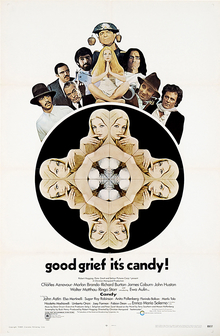
If you find yourself having trouble getting to sleep tonight, you can always pass the time by watching the 1968 film, Candy. It’s currently on Tubi.
Based on a satirical novel by Terry Southern and Mason Hoffenberg, Candy follows Candy Christian (Ewa Aulin), a naive teenager from middle America as she has a number of increasingly surreal adventures, the majority of which end with her getting sexually assaulted by one of the film’s special guest stars. It’s very much a film of the 60s, in that it’s anti-establishment without actually seeming to know who the establishment is. It opens with a lengthy sequence that appears to be taking place in outer space. It ends with an extended sequence of Candy walking amongst the film’s cast and a bunch of random hippies. Director Christian Marquand appears as himself, directing the film. Yep, this is one of those films where the director and the film crew show up and you’re supposed to be say, “Far out, I didn’t realize I was watching a movie, man.”
The whole thing is a bit of a misfire. The novel was meant to be smut that satirized smut. The film isn’t really clever enough to work on any sort of real satirical level. As was the case with a lot of studio-made “psychedelic” films in the 60s, everything is a bit too obvious and overdone. Casting the Swedish Ewa Aulin as a character who was meant to represent middle America was just one of the film’s missteps. Based on The Graduate, Mike Nichols probably could have made a clever film out of Candy. The French Christian Marquand, a protegee of Roger Vadim’s, can not because he refuses to get out of the film’s way. It’s all jump cuts, flashy cinematography, and attempts to poke fun at American culture by someone who obviously knew nothing about America beyond the jokes told in Paris.
That said, the main reason that anyone would watch this film would be for the collection of guest stars who all show up and try to take advantage of Candy. Richard Burton plays an alcoholic poet named MacPhisto and his appearance goes on for far too long. (Burton, not surprisingly, appears to actually be drunk for the majority of his scenes.) Ringo Star — yes, Ringo Starr — plays a Mexican gardener who assaults Candy after getting turned on by the sight of MacPhisto humping a mannequin. When Emmanuel’s sisters try to attack Candy, she and her parents escape on a military plane that is commanded by Walter Matthau. Landing in New York, Candy’s brain-damaged father (John Astin) is operated on by a brilliant doctor (James Coburn) who later seduces Candy after she faints at a cocktail party. Candy’s uncle (John Astin, again) also tries to seduce Candy, leading to Candy getting lost in New York, meeting a hunchback (Charles Aznavour), and then eventually ending up with a guru (Marlon Brando). Candy’s adventures climax with a particularly sick joke that requires a bit more skill to pull off than this film can afford.
If you’re wondering how all of these famous people ended up in this movie, you have Brando to thank (or blame). Christian Marquand was Brando’s best friend and Marlon even named his son after him. After Brando agreed to appear in the film, the rest of the actors followed. Brando, Burton, and Coburn received a share of the film’s profits and Coburn later said that his entire post-1968 lifestyle was pretty much paid for by Candy. That seems appropriate as, out of all the guest stars, Coburn i the only one who actually gives an interesting performance. Burton is too drunk, Matthau is too embarrassed, Starr is too amateurish, and Brando is too self-amused to really be interesting in the film. Coburn, however, seems to be having a blast, playing his doctor as being a medical cult leader.
Candy is very much a film of 1968. It has some value as a cultural relic. Ultimately, it’s main interest is as an example of how the studios tried (and failed) to latch onto the counterculture zeitgeist.
If you study the history of the International Left in the years immediately following the death of Lenin, it quickly becomes apparent that the era was defined by the rivalry between Joseph Stalin and Leon Trotsky.
Trotsky, the self-styled intellectual who was credited with forming the Red Army and who many felt was Lenin’s favorite, believed that he should succeed Lenin as the leader of Communist Russia. Stalin, the ruthless nationalist who made up in brutality what he lacked in intelligence, disagreed. Stalin outmaneuvered Trotsky, succeeding Lenin as the leader of the USSR and eventually kicking Trotsky out of the country. Trotsky would spend the rests of his life in exile, a hero to some and a pariah to others. While Stalin starved his people and signed non-aggression pacts with Hitler, Trotsky called for worldwide revolution. To Stalin, Trotsky was a nuisance whose continued existence ran the risk of making Stalin look weak. When Trotsky was assassinated in Mexico in 1940, there was little doubt who had given the order. After Totsky’s death, the American Communist Party, which had already been weakened by the signing of the non-aggression pact between Hitler and Stalin, was further divided into Stalinist and Trotskyite factions.
Ideologically, was there a huge difference between Stalin and Trotsky? Many historians have suggested that Trotsky probably would have taken many of the same actions that Stalin took had Trotsky succeeded Lenin. Indeed, the idea that Trotsky was somehow a force of benevolence has more to do with the circumstances of his assassination than anything that Trotsky either said or did. In the end, the main difference between Stalin and Trotsky seemed to be Trotsky was a good deal more charismatic than Stalin. Unlike Trotsky, Stalin couldn’t tell a joke. However, Stalin could order his enemies killed whenever he felt like it and some people definitely found that type of power to be appealing. Trotsky could write essays. Stalin could kill Trotsky.
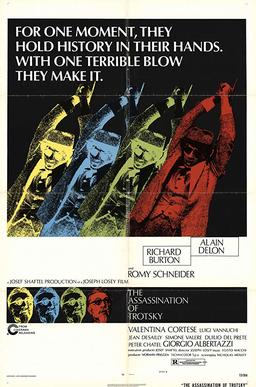
First released in 1972, The Assassination of Trotsky is a cinematic recreation of the events leading to the death of Leon Trotsky in Mexico. French actor Alain Delon plays Frank Jacson, the Spanish communist who was tasked with infiltrating Trotsky’s inner circle and assassinating him with a pickaxe. Welsh actor Richard Burton plays the Russian Trotsky, giving long-winded monologues about world revolution. Italian Valentina Cortese also plays a Russian, in this case Trotsky’s wife, Natalia. And finally, French actress Romy Schneider plays Gita Samuels, who is based on Jacson’s American girlfriend. This international cast was directed by Joseph Losey, an American director who joined the Communist Party in 1946 and who moved to Europe during the McCarthy era.
Losey was an interesting director. Though his first American feature film was the anti-war The Boy With Green Hair, the majority of his American films were on the pulpy side. Not surprisingly, his European films were far more open in their politics. Losey directed his share of undeniable masterpieces, like The Servant, Accident, and The Go-Between. At the same time, he also directed his share of misfires, the majority of which were bad in the way that only a bad film directed by a good director can be. The same director who gave the world The Go-Between was also responsible for Boom!
And then there’s The Assassination of Trotsky. It’s a bit of an odd and rather uneven film. Alain Delon’s performance as the neurotic assassin holds up well and some of his scenes of Romy Schneider have a true erotic charge to them. The scenes of Delon wandering around Mexico with his eyes hidden behind his dark glasses may not add up too much but they do serve as a reminder that Delon was an actor who could make almost any scene feel stylish.
But then we have Richard Burton, looking like Colonel Sanders and not even bothering to disguise his Welsh accent while playing one of the most prominent Russians of the early 20th Century. The film features many lengthy monologues from Trotsky, all of which Burton delivers in a style that is very theatrical but also devoid of any real meaning. As played by Burton, Trotsky comes across as being a pompous phony, a man who loudly calls for world revolution while hiding out in his secure Mexican villa. Now, for all I know, Trotsky could have been a pompous phony. He certainly would not have been the first or last communist to demand the proletariat fight while he remained secure in a gated community. The problem is that the film wants us to admire Trotsky and to feel that the world was robbed of a great man when Jacson drove that pickaxe into his head. That’s not the impression that one gets from watching Burton’s performance. If anything, Burton’s overacting during the assassination scene will likely inspire more laughs than tears.
The Assassination of Trotsky is one of those films that regularly appears on lists of the worst ever made. I feel that’s a bit extreme. The film doesn’t work but Alain Delon was always an intriguing screen presence. (Interestingly enough, Delon himself was very much not a supporter of communism or the Left in general.) The film fails as a tribute to Trotsky but it does make one appreciate Alain Delon.
Today’s horror scene that I love features Linda Blair in 1977’s The Exorcist II: The Heretic, the sequel to the film for which she received an Oscar nomination.
Linda Blair was only 13 when she was cast a Regan McNeil, the girl who is possessed by a demon inThe Exorcist. She was nominated for Best Supporting Actress, only losing the award after it was revealed that Mercedes McCambridge had dubbed Blair for the scenes in which she was possessed. Blair has gone on to have a long career, appearing in movies that may not have been as honored by the Academy as TheExorcist was but which are still often very entertaining when taken on their own terms.
In The Exorcist II, Blair returned to the role of Regan. Now in her late teens, Regan says that she can’t remember anything about being possessed. Father Philip Lamont (Richard Burton) and Dr. Gene Tuskin (Louise Fletcher) think that Regan is repressing her memories and, in this scene …. well, I don’t really know how to describe this scene. Seriously, The Exorcist II is such a strange movie! Basically, Dr. Tuskin has a hypnosis machine while allows people to link minds. Dr. Tuskin links with Regan’s mind and then Lamont links with Tuskin’s mind. It’s all incredibly silly but it does allow for this scene in which “good Regan” shares the screen with “possessed Regan.”
Here is a weird scene from a weird movie, featuring a total of four Oscar-nominated performers. (For the record, Burton was nominated multiple times and, the same year he appeared in this film, he also appeared in Equus, for which he received his final nomination. Louise Fletcher won for One Flew Over The Cuckoo’s Nest. Max von Sydow would later be nominated for Pelle the Conqueror and Extremely Loud and Incredibly Close. And, of course, Linda Blair was nominated for The Exorcist.)
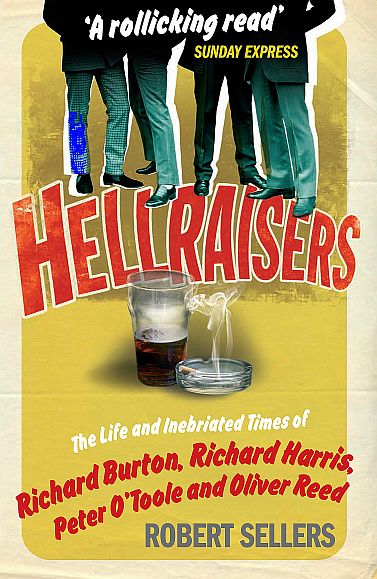
First published in 2009, Hellraisers is a fast-paced look at the life and times of four men, Richard Burton, Richard Harris, Peter O’Toole, and Oliver Reed, and an examination of what they all had in common.
First off, they were all talented actors who were at the height of their careers in the 60s and the 70s.
They all first came to prominence in the UK. Peter O’Toole and Oliver Reed were English. Richard Burton was Welsh. Richard Harris was born in Ireland.
With the exception of Oliver Reed, all of them were multiple Oscar nominees but none of them actually won the award.
All four of them could boast filmographies that included some of the best and some of the worst films of all time.
And, of course, all four of them were infamous for their drinking. They were all, if I may borrow the book’s title, famous for raising Hell.
Hellraisers is a frequently entertaining look at their careers and their legendary off-screen exploits. All four of them come across as being very different drinkers. Richard Burton was a depressing drunk, one who drank because he was aware that he was wasting his talents in mediocre films. O’Toole was a drunk who alternated between being charming and being dangerous, someone who was capable of coming across as being a bon vivant even at his lowest moments. Richard Harris was the angry drunk but he was also the one who seemed to have the both the best understanding of why he drank and why, at a certain age, it was necessary for him to cut back. And, finally, Oliver Reed was the showman, the one who viewed drinking a beer the way that others viewed having a cup of tea and who would rather damage his career than allow anyone else to tell him how to live. He knew that he had a reputation and he was determined to live up to it, even at the risk of his own health.
Perhaps not surprisingly, it’s Oliver Reed who dominates the book. There was very little that Reed wouldn’t do while drunk and he was drunk quite a lot of the time. He was also perhaps the most unpredictable of all of the actors profiled in the book, a raw mountain of energy who kept audiences off-balance. Personally, I would not have wanted to have been along in a room with a drunk Oliver Reed. The book has too many stories of Reed dropping his trousers and asking everyone to look at what he called his “mighty mallet,” for the reader to feel totally safe with Reed. At the same time, anyone who has seen a good Oliver Reed performance knows that he deserved better roles than he was often given. (Then again, the book is also honest about the fact that a lot of filmmakers would not work with Reed because they had justifiable reasons to be terrified of him and his erratic nature.) Over the course of the book, Reed comes across as hyperactive, easily bored, and also far more intelligent than most gave him credit for. In many ways, he was a prisoner of his own reputation. He was outrageous because he knew that was what was expected of him. As shocking as some of his behavior seems today, he felt that he was giving the people what they wanted and Hellraisers suggests that he may have been right.
Personally, I don’t drink and I find most heavy drinkers to be tedious company at best. That said, Hellraisers is an interesting book. Burton, Harris, O’Toole, and Reed are all fascinating talents and the book takes a look at how their hellraising reputations both hurt and, in some cases, helped their careers. However, the book is more than just a biography of four actors who drank a lot. It’s also an examination of a different era, of a time when performers were expected to raise Hell and when one could get away with being a contrarian just for the fun of it. One can only imagine what the moral scolds of social media would have to say if Oliver Reed were around today! As a result, this is a book that can be enjoyed by both film lovers and history nerds, like you and me.
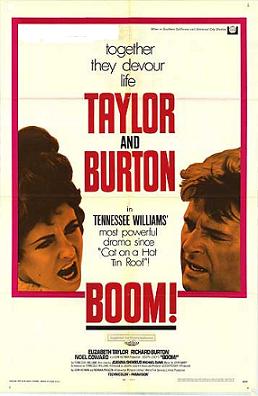
“Boom!” says poet Chris Flanders (Richard Burton) in the 1968 film of the same name. Boom, he goes on the explain, is the sound of life being lived. Every minute that we’re reminded that we’re still alive is a “Boom!” It’s the type of thing that 18 year-old artists say to get laid, though the film treats Chris’s comment with an almost supernatural reverence.
Chris has just shown up on an island that’s owned by Flora Goforth (Elizabeth Taylor), who is the richest woman in the world and who is apparently dying of one of those diseases that makes you lie in bed and yell a lot. Flora lives on the island with an entourage that includes a secretary named Miss Black (Joanna Shimkus) and a head of security named Rudi (Michael Dunn). Rudi is a dwarf and he dresses like a Nazi and often does a stiff-armed salute, just in case we missed the fact that he’s supposed to be a fascist. Why exactly Flora, who were supposed to sympathize with, would employ a Nazi, we never really find out. The film seems to think that there’s something extremely daring about casting a person of short statue as the head of Flora’s security though, ultimately, it’s about as profound as uttering “Boom!” every few minutes.
Anyway, Flora is dying but she’s also dictating her autobiography. It turns out that she’s rich because she married a lot of wealthy men, all of whom died and left her all of their money. Flora’s always in a bad mood but things improve a little when Chris mysteriously shows up on the island and starts saying, “Boom!” all the time. Flora and Chris have several conversations about life and the meaning of it all, the majority of which are full of obscure statements and half-baked attempts at being profound. The dialogue is pretentious but it’s also not very memorable, which is a shame. One can survive being pretentious but being forgettable is simply unforgivable.
Eventually, a friend of Flora’s shows up. Famed playwright Noel Coward plays The Witch of Capri, a flamboyant friend to the rich and famous. He loves to gossip and has a bitchy comment for every occasion. One could argue that Coward is merely playing himself, though one imagines that the real-life Coward could have also come up with a few genuinely witty lines. The Witch informs Flora that Chris has a habit of showing up at the bedside of rich women right before they die. Some people think that Chris is a gigolo while others believe Chris to be …. THE ANGEL OF DEATH!
(Dramatic music)
Which is it? Don’t worry, the answer is revealed by the end of the movie. Of course, it takes a while to get to the end. Boom! is two hours long but it feels much longer. Storywise, Boom! feels like it would be ideal as a 30-minute episode of some old anthology show but director Joseph Losey keeps the story moving at a very slow pace and there are so many dramatic pauses and unnecessary zoom shots that the film itself becomes a bit of an endurance test. Just when you think the movie is finally going to get moving, Chris says, “Boom!” or there’s an extreme close-up of Flora’s ring and everything slows down again.
Boom! is one of the many films that Richard Burton and Elizabeth Taylor made together in the 60s. Unfortunately, both actors are miscast in the lead roles. Flora is described as being old and sickly. Elizabeth Taylor was in her 30s and appeared to be in robust health during the shooting of the film. Chris Flanders is supposed to be in his 20s and a seeker of truth and enlightenment. Burton was in his 40s and looked like he was in his 60s. He spends most of the film looking and sounding as if he’s just come off a weekend bender, which makes him look all the more ludicrous when he hears the ocean and says, “Boom!”
On the plus side, the film is lovely to look at. Flora’s house is big and beautiful. The island scenery is gorgeous. Flora’s costumes are ludicrously ornate but still, they are what you would want to see an international movie star wearing in 1968. As such, the film is always nice to look at. In fact, perhaps the best way to watch Boom! is to turn down the sound so you don’t have to listen to any of the dialogue.
Boom! was based on a Tennessee Williams’s play called The Milk Train Doesn’t Stop Here Anymore. The filmmakers decided to change the name to Boom! and I really can’t blame them for that. This was Elizabeth Taylor’s third film to be based on a Tennessee Williams play. Unfortunately, it matched neither the critical nor the commercial success of Cat On A Hot Tin Roof or Suddenly, Last Summer.
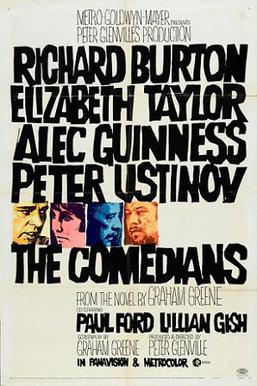
Richard Burton stars Mr. Brown (Richard Burton), a deeply cynical and world-weary Englishman who owns what passes for a luxury hotel in Haiti. Though Mr. Brown hopes to be able to sell the hotel and get out of Haiti, he is also having an affair with Martha (Elizabeth Taylor), the German wife of Pineda (Peter Ustinov), the ambassador from Uruguay. Mr. Brown tries to avoid politics, which it turns out is not easy to do when you’re living under a murderous regime.
Complicating Mr. Brown’s life is Major Jones (Alec Guinness), a retired British army officer who has come to Haiti to do business but who is promptly imprisoned when it’s discovered that he was invited to come to the island by a minister who was subsequently declared to be an enemy of the state. The fascist Captain Concasseur (Raymond St. Jacques) arrests Major Jones and Mr. Brown takes it upon himself to try to get Jones released. Unfortunately, Major Jones doesn’t quite understand how serious his situation is and he’s convinced the Haitians that he’s not only a brilliant military leader but that he can also arrange for them to receive a cache of weapons, which he claims he has hidden in a Miami warehouse.
Meanwhile, Mr. and Mrs. Smith (Paul Ford and Lillian Gish) have also arrived on the island, hoping to set up a vegetarian center in Haiti. (Mr. Smith even once ran for President of the U.S. as the candidate of the Vegetarian Party.) In many ways, Mr. and Mrs. Smith serve as a stand-in for clueless American activists, obsessing over minor issues while ignoring the larger problems that are right in front of their faces.
From the start, The Comedians establishes Haiti as being a dangerous place, a country where the people live in fear of the brutal police and where the poor struggle to survive day-to-day while their rulers live a life of luxury. It’s a place where political dissidents regularly disappear, though the police aren’t above murdering people in public as well. It’s a country where the State rules supreme, controlling the citizens through both fear and a fierce cult of personality. Rebels like Dr. Magiot (James Earl Jones) only want the country to be free but they know that, as long superpowers like America are supporting the regime, there’s little that the rebels can realistically hope to accomplish.
A major theme running through The Comedians is that the real suffering of the Haitian people is often overshadowed by the strategic concerns of the United States. Unfortunately, pretty much the same thing happens within the film itself. While there’s several black actors in supporting roles, the story focuses on the white characters and, as a result, it sometimes feels like the film’s message is less about the people being oppressed and more about how unfortunate it is that people like Brown, Jones, and the Smiths are being inconvenienced by it all. Like many similarly well-intentioned political films from the late 60s, The Comedians get so bogged down in all of the personal dramas that it loses sight of what’s actually the important part of the story. The film is often seems more interested in Brown and Martha’s affair than in the conditions that would lead to people like Dr. Magiot risking their lives to bring about change.
For the most part, it’s a well-acted film. Richard Burton’s natural self-loathing is put to good use and Alec Guinness has a few poignant scenes as a pathological liar who doesn’t realize how much trouble he’s actually in until it’s too late. (Guinness also has a scene where he wears blackface and pretends to be Burton’s maid. He does this in order to escape from the secret police and the film doesn’t treat it as being a joke but it’s still rather cringey to watch.) Elizabeth Taylor is miscast as Martha and her German accent comes and goes but Paul Ford and Lillian Gish do a good job playing clueless Americans. Perhaps the film’s strongest performance comes from Zakes Mokae, who doesn’t say much as a member of the secret police but who exudes menace every time that he’s on screen. Still, as well acted at it may be, the film is slowly paced and always seem hesitant about taking any position beyond a general sense that dictatorships are bad.
That said, there’s nothing wrong with reminding people that dictatorships are bad. That’s especially an important message today. The past few years have left me convinced that a lot of people secretly yearn for a dictatorship and would be willing to trade their freedoms for a false sense of security. Though the film may struggle dramatically, it’s still works as a warning about what true authoritarianism actually is.
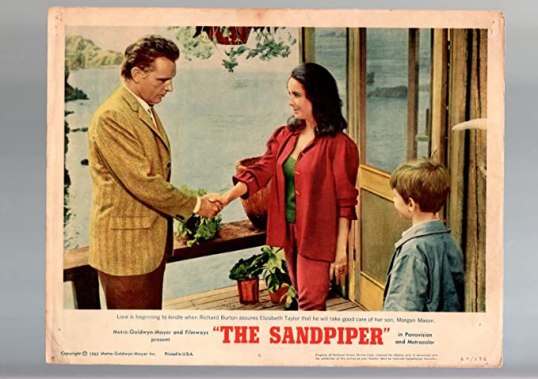
I recorded The Sandpiper that last time that it aired on TCM. This 1965 film is one of the many films that Elizabeth Taylor and Richard Burton made together after they fell in love during the making of Cleopatra. And while it’s true that Who’s Afraid of Virginia Woolf? won Taylor an Oscar and probably should have won one for Burton as well, the majority of the Taylor/Burton films were overproduced melodramas that often seemed as if they’d been rushed into production in order to capitalize on the couple’s tabloid popularity. Unfortunately, Virginia Woolf aside, neither Taylor nor Burton seemed to bring out the best in each other as actors.
The Sandpiper finds Taylor playing Laura Reynolds, an artist who lives in a California beach house with her young son, Danny (Morgan Mason). Laura is a free spirit who believes that everyone, including her son, should have the freedom to make their own choices. She is resistant to any and all authority. She’s a bohemian, a rebel, the type who doesn’t care what society has to say and who flaunts her refusal to follow the dictates of respectability. Good for her! However, she’s also Elizabeth Taylor, which means that she’s impossibly glamorous and even her “cluttered” beach house looks like it’s a hundred times more expensive than anything that anyone viewing the film will ever be able to afford. Though Taylor tries hard, there’s nothing convincingly bohemian about her.
Richard Burton plays Dr. Edward Hewitt, who runs the nearby Episcopal school. Dr. Hewitt is not a free spirit. Instead, he and his wife, Claire (Eva Marie Saint), very much believe in structure and playing by the rules. They believe in a traditional education and, when a judge orders Danny to be enrolled at their school, that’s what Hewitt plans to give him. This, of course, brings Hewitt into conflict with Laura. Both of them have differing ways of looking at the world and Laura is not a fan of religion in general. However, since they’re played by Burton and Taylor, they’re destined to fall in love and have a scandalous affair.
Dr. Hewitt is one of the many religious figures that Burton played throughout his career. In fact, Burton played so many alcoholic priests that I spent most of the movie assuming that Hewitt was an alcoholic as well. However, he’s not. He’s just Episcopalian. That said, Burton delivers every line of dialogue in his trademark “great actor” voice and every minute that he’s onscreen just seems to be full of self-loathing. Even before he cheats on his wife, Hewitt seems to hate himself. Of course, once Burton does start cheating on his wife, it only gets worse. The film presents Hewitt as being something of a hesitant participant, someone who knows that he’s doing the wrong thing but he simply cannot stop himself. Laura, meanwhile, is presented as being someone who is fully willing to break up a marriage to get what she wants. One gets the feeling that 1965 audiences probably just assumed they were watching the true story of how Taylor and Burton fell in love during the making the Cleopatra. That said, it’s all pretty tame. Just like Taylor, director Vincente Minnelli was too much of a product of the old Hollywood to truly embrace this story for all of its sordid potential.
If you’ve ever wanted to watch Charles Bronson debate religion with Richard Burton, this is the film for you. Bronson plays a sculptor and an atheist who upsets Hewitt by calling him “reverend.” Bronson is actually more convincing in the film than either Burton or Taylor, bringing a rough authenticity to his role. Whereas Burton and Taylor both seem to be going through the motions, Bronson comes across as if he actually has a personal stake in the film’s story. It’s not enough to save the movie, of course. Fortunately, a year later, Liz and Dick would be used to better effect in Who’s Afraid of Virginia Woolf?
The 1963 film, The V.I.P.s, is about a group of very important people who have all shown at Heathrow Airport at the same time, all in an effort to get the Hell out of England. They’ve all got their own individual reasons for wanting to leave the country but the important thing is that they all want to leave. Unfortunately, a fog has rolled onto the runway and the plane can’t take off. Because this film was made in 1963, all the passengers are allowed to leave the plane and wait, overnight, in a hotel.
Among the Very Important People:
Flamboyant film producer Max Buda (Orson Welles, playing a version of himself) needs to leave London before he receives a gigantic tax bill. Accompanying him is his latest discovery, Gloria Gritti (Elsa Martinelli). Max is the type who does things like barging into the plane’s cockpit and demanding to know why the pilots aren’t willing to risk crashing the plane. That may sound self-centered on Max’s part but Welles is such a charmer that you forgive him. Add to that, he’s trying to avoid paying taxes and that’s something that I can definitely get behind.
The Duchess of Brighton (Margaret Rutherford) is an eccentric but impoverished noblewoman who is going to lose her home if she doesn’t fly to Florida and take on a somewhat demeaning job. The Duchess is the type who struggles to find room in the overhead compartment for her ludicrous oversized hatbox. She’s never really been out in the real world before. Margaret Rutherford won an Oscar for her performance, which is occasionally amusing but never particularly subtle. (Have you seen Airport? Rutherford has the Helen Hayes role, basically.)
Lee Mangrum (Rod Taylor) is a businessman who is on the verge of losing his business. Miss Mead (Maggie Smith) is his secretary. Miss Mead is secretly in love with Lee, who somehow hasn’t noticed. We’re supposed to sympathize with Lee but he’s so incredibly clueless that it’s hard not to feel that Miss Mead could do better.
Finally, we have Frances Andros (Elizabeth Taylor). Frances is one of the most popular film stars in the world. She’s married to Paul Andros (Richard Burton), who is very wealthy and who, like most Burton characters, is also very moody. Frances has decided to leave Paul and go to America with her lover, Marc Champselle (Louis Jourdan). However, the fog gives Paul a chance to come to the airport and try to talk Frances out of leaving him.
Make no mistake about it, Liz Taylor and Burton are the main attraction here. Welles, Rod Taylor, Rutherford, and Smith all get plenty of scenes but it’s obvious that the people behind The V.I.P.s understood that most of the audience would be there to watch Liz and Burton acting opposite each other. This was, I think, the first film that they made together after falling in love on the set of Cleopatra. Due to Cleopatra’s legendarily difficult production, it was released around the same time as The V.I.P.s, despite going into production years before the latter film. Audiences could go watch Liz and Dick fall in love in Cleopatra and then head over to a different theater and watch the two of them fight in The V.I.Ps. Elizabeth Taylor may be playing Frances Andros and Richard Burton may be playing Paul Andros but they really might as well be playing themselves.
The V.I.P.s is a big and glossy film, the type of movie that the Hollywood studios used to make as their way of saying, “See! You won’t get this on TV!” It’s frequently silly but it’s also undeniably watchable. While Burton and Taylor’s later films tended to feature the two of them at their worst, they’re both actually really good in The V.I.P.s and the scenes where they argue have an emotional heft to them that, with the exception of Who’s Afraid of Virginia Woof?, wasn’t found in their other films. For once, you watch the film and you really do hope that Liz and Dick will work things out and stay together. The V.I.P.s may be dated (just try to chase someone through an airport or get off a delayed flight now) but it’s still entertaining.


 Through the Shattered Lens