Horror Film Review: Terror of Mechagodzilla (dir by Ishiro Honda)


Megchagodzilla has returned!

The robot version of Godzilla, Mechagodzilla made his debut in 1974’s Godzilla vs. Mechagodzilla.  In that film, it was revealed that Mechagodzilla was built and controlled by a bunch of aliens who wanted to use him to subjugate humanity so that the aliens could take over the Earth.  The real Godzilla put an end to those plans, not only saving the world from an alien invasion but also tossing Mechagodzilla into the ocean.

Unfortunately, it would appear that Godzilla didn’t do a good enough job taking care of his robotic counterpart because, in 1975’s Terror of Mechagodzilla, the aliens are able to resurrect Mechagodzilla and they once again sent it out to destroy humanity, starting with Japan.  Working with the aliens is a mad scientist named Dr. Mafune (Akihko Hirata).  Mafune’s daugther, Katsura (Tomoka Ai0), is a cyborg who has a mechanical and mental connection to Mechagodzilla.  Whenever her eyes glow, Mechagodizlla does something destructive.  The aliens team Mechagodzilla up with a new monster, the fearsome Titanosaurus.
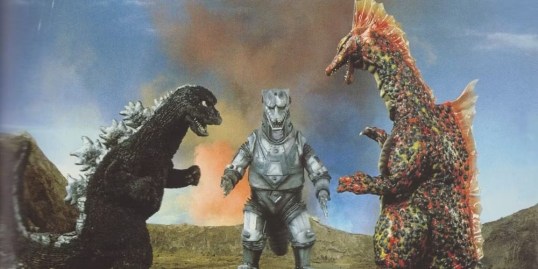
 

Mechagodzilla and Titanosaurus work together to once again destroy Japan and it must be said that they appear to be quite capable of doing just that.  Say what you will about the special effects in these films, the scene where Mechagodzilla blows up an entire city block does pack a punch.  If Mechagodzilla is laser-focused on blowing stuff up, Titanosaurus just seems to be looking for a fight with someone.  Titanosaurus is a very enthusiastic monster, like a previously bullied kid who has just hit a growth spurt and now can’t wait to beat up everyone on the playground.  Eventually, Godzilla shows up to give Titanosaurus the fight that he’s looking for.

This film is one of the ones where Godzilla is firmly established as being humanity’s champion.  The atomic beast who once represented the trauma of the nuclear attacks on Hiroshima and Nagasaki is now a friend to all humans.  That said, it’s hard not to notice that it takes Godzilla a while to actually show up.  He allows Mechagodzilla and Titanosaurus to blow up a lot of buildings and probably kill a lot of people before he finally puts in an appearance and orders them to stop.  It’s nice that Godzilla showed up in time to save a group of children from Mechagodzilla but you have to wonder how many of those children are now orphans because Godzilla wasn’t willing to do anything while Mechagodzilla was blowing up apartment buildings.

The majority of this film centers not on Godzilla but instead on some Interpol agents who are trying to figure out what the professor and the aliens are planning on doing.  (To me, it seemed pretty obvious that the aliens were planning on using a bunch of giant monsters to destroy humanity but maybe Interpol had some information that I didn’t.)  The agents do eventually manage to track down the aliens and the professor.  There’s some sub-James Bond style action as the agents attack the evil lair.  Despite everything that Interpol does in this film, it’s obvious that Godzilla is man’s only hope.

This was the last of the original Godzilla films.  After this film came out, it would be nearly ten years before the monster was revived and returned to once again being a threat to humanity as opposed to being a friend.  Sadly, Terror of Mechagodzilla doesn’t feature enough giant monster action.  When the monsters are onscreen and fighting, this movie is a lot of fun.  Godzilla’s visible frustration with having to deal with Mechagodzilla again is very endearing.    Unfortunately, the majority of the film gets bogged down with the humans searching for the bad guys and trying to figure out their extremely simple plot.  In the end, the movie leaves the viewer thankful for Godzilla but also frustrated that he didn’t get more to do.

Previous Godzilla Reviews:

  1. Godzilla, King of the Monsters (1958)
  2. Godzilla Raids Again (1958)
  3. King Kong vs Godzilla (1962)
  4. Mothra vs. Godzilla (1964)
  5. Ghidorah: The Three-Headed Monster (1964)
  6. Invasion of the Astro-Monster (1965)
  7. Godzilla vs. The Sea Monster (1966)
  8. Son of Godzilla (1967)
  9. Destroy All Monsters (1968)
  10. All Monsters Attack (1969)
  11. Godzilla vs Hedorah (1971)
  12. Godzilla vs Gigan (1972)
  13. Godzilla vs Megalon (1973)
  14. Godzilla vs Mechagodzilla (1974)
  15. Godzilla vs. Mothra (1992)
  16. Godzilla vs. Destoroyah (1995)
  17. Godzilla, Mothra, and King Ghidorah: Giant Monsters All-Out Attack (2001)
  18. Godzilla (2014)
  19. Godzilla: Planet of the Monsters (2017)
  20. Godzilla, King of the Monsters (2019)
  21. Godzilla vs Kong (2021)
  22. Godzilla Minus One (2023)

Horror Film Review: You’re Not Alone (dir by Eduardo Rodriguez)


Oh, screw this.

About fifty minutes into this movie, an adorable calico kitty cat is killed for no good reason.  We’re not supposed to care because the cat belonged to an annoying neighbor, the cat had a silly name (Mr. Nibbles, though considering that the cat’s a calico, it really should have been named Ms. Nibbles), and the cat was trespassing in the main character’s house.  But, to tell you the truth, I’ve had it with movies that feature animals being killed for nothing more than shock value.  Don’t get me wrong.  I know that cat wasn’t really killed and the cat’s owner probably got paid for her services but I’ve seen so many movies with so many dead pets that it just feels lazy at this point.

As for the rest of the film, it tells the story of Emma (Katia Winter) and her daughter, Isla (Leya Catlett).  Emma, a recovering alcoholic and a recent widow, has recently gotten custody of Isla.  They live in a gigantic house, one that I’m not sure how Emma affords on her salary as a waitress.  While Emma tries to bond with the uncommunicative Isla, strange things start to happen around the house.  Doors seem to open and close on their own.  The home security system keeps going off.  Things keep disappearing.  People keep disappearing.  Isla starts to talk about “the lost ghost” who apparently lives in her closet.  Isla explains that the lost ghost is “always here” and he’s always watching Emma.  Along with the ghost, Emma is haunted by memories of her past and an obsessive stalker who keeps showing up at inopportune moments.

You’re Not Alone actually gets off to a good start.  Haunted house films are almost always effective because everyone can relate to them.  We’ve all had the experience of lying in bed and wondering if someone is wandering around outside or if the sounds are just in our imagination.  You don’t even have to live in a house to have that fear.  Even when you’re living in an apartment, things get creepy once you turn out the lights,  Katia Winter gives a good and sympathetic performance as Emma and you’re on her side from the minute you see her having to deal with a snooty woman at the custody hearing.  The early scenes of Emma trying to keep calm and do her best even while her life seems to be falling apart are the best in the film.

But You’re Not Alone loses its way as it continues.  The cat dies.  A visit to a church feels like it was lifted from a hundred other horror films.  Emma’s best friend disappears in the closet but Emma never seems to notice her absence and Isla, who witnessed the disappearance, never mentions it to her.  A bunch of flies invade the house because someone’s seen The Amityville Horror.  The film commits the unpardonable sin of getting boring and a sudden twist ending can’t change that fact.

Call it the Curse of Mr. Nibbles.  Kill the cat and your film falls apart.

Horror Film Review: X: The Man With X-Ray Eyes (dir by Roger Corman)


X: The Man With The X-Ray Eyes (1963, dir by Roger Corman, DP: Floyd Crosby)

Eyes.  They’re one of the most important parts of our body but they’re also frightening easy to damage. Unlike the heart or the liver or the brain, they don’t have a protective covering of skin and bone.  They sit exposed and  are easily injured.  They can be ripped out of one’s head, which is a scary thought.  As well, they tend to grow weaker over time.  I love my multi-colored eyes and I think they’re one of my best features but I still spend a lot of time wishing that they weren’t quite as vulnerable as they are.  I often say that I’m blind without my contacts or my glasses.  That’s not quite true, of course.  I can see enough to get by if I forget to put in my contacts but I still have to do a lot of squinting, enough so that most people can take one look at me and say, “You forgot to put in your contacts, didn’t you?”  In my case, my eyesight has definitely gotten even worse over the past few years.  I’ve been told that’s normal but it still freaks me out.  I worry about waking up one day and not being able to see anything at all.

Director Lucio Fulci, a diabetic who was slowly going blind during the final years of his life, was infamous for including scenes of eyes being either pierced or gouged out in his films.  The New York Ripper even featured one scene where an eye was slit in half with a razor blade.  (This occurred in a close-up, no less!)  In Joe D’Amato’s Beyond the Darkness, there’s a scene where a mad taxidermist replaces the eyes of his dead fiancée with glass and for me, that’s one of most disturbing elements of the film.  Horror directors understand the vulnerability of the eyes and the sadness when life is extinguished from those eyes.  Eyes are said to be the windows to soul and when those eyes are lifeless, it’s a reminder that a living soul is a fleeting thing.

Perhaps that’s why 1963’s X: The Man With The X-Ray Eyes is such an effective work of art.  Directed by Roger Corman, the film tells the story of Dr. James Xavier (Ray Milland), a doctor who has developed eye drops that, when taken, allow one to have x-ray vision.  Dr. Xavier claims that the eye drops will allow doctors to more easily diagnose their patients and certainly, he has a point there.  His friend, Dr. Sam Brant (Harold J. Stone), points out that the eyes are directly connected to the brain and that using experimental eye drops on them could potentially drive a person mad.  Dr. Xavier proves Dr. Brant’s point by losing his tempter and accidentally pushing him out of a window.

Ah, x-ray vision.  It all starts out fun.  Dr. Xavier is performing miracle surgeries and seeing what everyone looks like naked.  (The swinging jazz party scene is a classic example of how 60s B-movies teased audiences while never quite showing everything.) But once he’s forced to go on the run from the police, Xavier finds himself making a living as a carnival psychic while still trying to refine his eyedrops.  Xavier’s sleazy manager (Don Rickles) tries to turn Xavier into a faith healer but, with Xavier’s x-ray vision growing more erratic and more intense, Xavier ends up running off to Vegas with a former colleague, Dr. Diane Fairfax (Diana Van der Vils).

And again, it’s all fun and games as Xavier uses his powers to cheat at cards.  But then the megalomania kicks in and, after Xavier basically announces that he’s cheating, he finds himself being chased through the desert by a police helicopter and freaking out as more and more of the universe is revealed to him.  Much like a Lovecraftian protagonist who has been driven mad by the sight of the Great Old Ones, Xavier finds himself overwhelmed by the center of the universe.  At a tent revival, a preacher shouts, “If thine eye offends thee, pluck it out!”

The film’s final image is a shocking one and it stays with you.  (There were rumors that the film originally ended with Xavier shouting, “I can still see!” but Corman himself said that never happened.)  Even without that final image, this would be one of Corman’s best films, a surprisingly intelligent and rather sad story about a man who, in trying to see what is usually hidden, was driven mad by what he discovered.  Ray Milland was well-cast as Dr. Xavier and watching him go from being a somewhat stiff but good-hearted scientist to a raving madman at a revival is quite an experience, a testament to the vulnerability that all humans share.  In the name of science, Xavier goes from being a respected researcher to being chased through the desert by a helicopter.  The man who wanted to be able to see everything finds himself wishing to be forever blinded.  Sometimes, the film suggests, it’s best not to be able to see everything around us.  Sometime, the mysteries of the universe should remain mysteries and the rest of us should respect our own vulnerabilities.

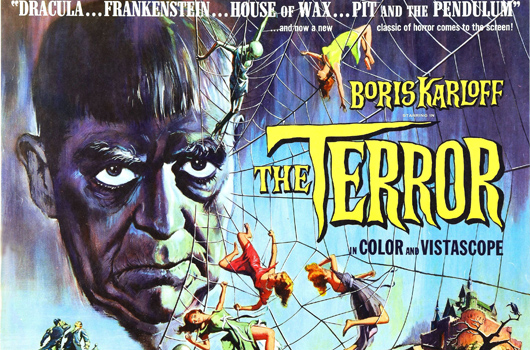
Horror on the Lens: The Terror (dir by Roger Corman, Francis Ford Coppola, Jack Hill, Monte Hellman, Dennis Jakob, and Jack Nicholson)


Have you ever woken up and thought to yourself, “I’d love to see a movie where a youngish Jack Nicholson played a French soldier who, while searching for a mysterious woman, comes across a castle that’s inhabited by both Dick Miller and Boris Karloff?”

Of course you have!  Who hasn’t?

Well, fortunately, it’s YouTube to the rescue.  In Roger Corman’s 1963 film The Terror, Jack Nicholson is the least believable 19th century French soldier ever.  However, it’s still interesting to watch him before he became a cinematic icon.  (Judging from his performance here and in Cry Baby Killer, Jack was not a natural-born actor.)  Boris Karloff is, as usual, great and familiar Corman actor Dick Miller gets a much larger role than usual.  Pay attention to the actress playing the mysterious woman.  That’s Sandra Knight who, at the time of filming, was married to Jack Nicholson.

Reportedly, The Terror was one of those films that Corman made because he still had the sets from his much more acclaimed film version of The Raven.  The script was never finished, the story was made up as filming moved alone, and no less than five directors shot different parts of this 81 minute movie.  Among the directors: Roger Corman, Jack Hill, Monte Hellman, Francis Ford Coppola, and even Jack Nicholson himself!  Perhaps not surprisingly, the final film is a total mess but it does have some historical value.

(In typical Corman fashion, scenes from The Terror were later used in the 1968 film, Targets.)

Check out The Terror below!

October Positivity: The Wager (dir by Judson Pearce Morgan)


In 2007’s The Wager, Randy Travis plays Michael Steele, an Oscar-nominated actor who….

Stop laughing, that’s not nice.

Okay, I’ll be the first to admit that Randy Travis is not exactly the first person that I would cast as an Oscar-nominated actor.  And, I’ll also be the first to admit that having Randy Travis act in this film makes it even harder to believe him as someone who could someday be nominated for an Oscar.  A lot of country music stars have tried their hand at acting and most of them have been able to survive on the basis of their own authenticity.  But there’s nothing authentic about Travis’s performance here.  Even when he picks up a guitar and sings a song about the difficulties that he’s facing, he’s not convincing.  In this, it’s not so much that Travis is a stiff actor as he just seems to evaporate whenever he’s on screen.

As for the film, Michael Steele is an actor who is known for his strong faith and his refusal to do sex scenes.  When a director (Bronson Pinchot) throws a fit over Steele’s refusal to shoot once such scene, Steele says that he’ll do the scene but only if it’s followed by a scene in which his co-star has to deal with being a single mother.  OUCH!  Michael Steele seems like he’s fun at parties….

(Apparently, it doesn’t occur to Michael that his character could wear a condom.)

Wait a minute.  This guy has the same name as that jackass who is always on the news talking about how he’s a Republican who thinks everyone should vote for the Democrats.  I wonder if that’s intentional.  Anyway….

Michael Steele’s career has had its up and downs.  His recent divorce from Annie (Nancy Stafford) has damaged his family friendly image.  But his Oscar nomination and the fact that he’s expected to win has once again made the world’s most popular star.  But then — scandal!  A tabloid photographer snaps a picture of Michael talking to a young actress at his house.  In the background, a little kid watches.  Now, the kid is a part of the Big Brother program and Michael was just trying to help the younger woman with her career but it doesn’t matter.  Soon, Michael finds himself being portrayed as being some sort of pervert.  When he punches a photographer, he finds himself getting arrested — RIGHT IN FRONT OF HIS CHURCH!

Now, as you may have guessed, this is yet another retelling of the story of Job, with Michael having his faith tested by one disaster after another.  He doesn’t lose his faith and, as a result, he wins both an Oscar and he also becomes a hero when he rescues the kid from the Big Brother program from his abusive stepfather.  Anyone who thinks that God wouldn’t have a hand in who wins an Oscar obviously did not listen to Will Smith’s acceptance speech.

The Wager is a film that would probably not be made today.  Today, you’re not likely to see a socially conservative, faith-based film where a successful actor is wrongly accused of being a pervert.  Then again, you also probably wouldn’t see a politically liberal film in which a successful white male actor was wrong accused of being an abuser, not in today’s cultural climate.  On both the Left and the Right, attitudes towards Hollywood have changed.  Beyond the film’s political and cultural subtext, its portrait of the Oscars as being the most important event of the year also feels rather old-fashioned.  I imagine it felt old-fashioned in 2007 as well….

Then again, this is a film in which Randy Travis plays the best actor of his generation so perhaps it’s best not to take any of it too seriously.  The miscasting of Travis pretty much sabotages the movie from the start but, on the positive side, Bronon Pinchot is amusing as a bitchy director and Jude Ciccolella has a few good scenes as Michael’s supportive agent.  Give those men an Oscar!

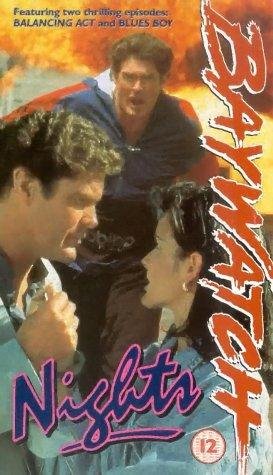
Late Night Retro Television Review: Baywatch Nights 2.12 “Frozen Out Of Time”


Welcome to Late Night Retro Television Reviews, a feature where we review some of our favorite and least favorite shows of the past!  On Tuesdays, I will be reviewing Baywatch Nights, a detective show that ran in Syndication from 1995 to 1997.  The entire show is currently streaming on YouTube!

From Iceland to Malibu, you can’t keep a good Viking down.

Episode 2.12 “Frozen Out Of Time”

(DIr by Rick Jacobson, originally aired on February 9th, 1997)

After a volcanic eruption in Iceland, a frozen Viking boat is discovered floating in the ocean.  Inside the boat are two Vikings, who have spent the past 900 years in blocks of ice.  Under the orders of Dr. Lancaster (Edward Mulhare), the Vikings are transported to Malibu.  Lancaster’s plan is to thaw the Vikings out and see if they can be revived.  Daimont Teague, who has a habit of popping up anywhere that someone is trying to do something stupid, is not sure if Dr. Lancaster knows what he’s doing so he decides to call Mitch and Ryan to the lab.

Now, you can justifiably say, “What is Mitch going to do with a frozen Viking?”  It’s a legitimate question.  Of course, you can also wonder why Dr. Lancaster thinks that he’ll be able to revive the Vikings.  I mean, they’ve been frozen for 900 years!  That’s a long time to float around in a block of ice.

Of course, the Vikings are revived.  Unfortunately, it turns out that they were on that boat because they were trying to settle a blood feud.  The first Viking (Sven-Ole Thorsen) goes on a rampage through the lab and then runs around Malibu pier.  Mitch and Griff are able to capture him and bring him back to the lab.  Unfortunately, the other Viking (Nils Allen Stewart) has woken up and the two Vikings soon reignite their interrupted duel to the death.

I’m actually leaving out a few details but you can probably guess everything that happens in this episode from what I’ve told you.  It’s not really a shock when Mitch turns out to be an expert in Viking culture.  It’s also not a surprise when the two Vikings end up killing each other and Mitch gives them a traditional Viking funeral.  It’s not just that Mitch puts them on a wooden raft and then shoots a flaming arrow at it.  It’s that Mitch dramatically yells, “Valhalla!” while doing so.

Myself, I’m a bit curious about how the Vikings manage to go right back to fighting as soon as they thawed out.  It would seem like, after 900 years of lying prone in one position, they would be a little bit stiff.  I would imagine that there would at least be some backpain or maybe a touch of arthritis.  (I mean, I’m not even 40 and I’ve already got arthritis in my ankle.)  Also consider that the Vikings have no trouble breathing the air, despite the fact that Los Angeles’s polluted air is undoubtedly a lot different from what their lungs are used to.  And that’s not even to mention all of the germs that the Vikings have never experienced before.  It seems like the Vikings should have at least had a cold or something.

Was this episode a good one?  Hey, it featured David Hasselhoff, Angie Harmon, and two 900 year-old Vikings.  Of course, it was good!  Baywatch Nights is always at its best when it embraces the absurdity and there’s nothing more absurd than this episode.

Guilty Pleasure No. 71: Submerged (dir by Fred Olen Ray)


THUNDERSTRIKE!

Listen, if you’re going to watch the 2000 film Submerged, you better be a  big fan of the term “Thunderstrike,” because it’s repeated so many times that one gets the feeling that the actors just loved saying it.

Thunderstrike is a satellite that was built by western businessman Buck Stevens (Dennis Weaver).  He and his daughter (Nicole Eggert) and her sort-of boyfriend (Hannes Jaenicke) are all flying to Hawaii so that they can conduct more tests on the Thunderstrike.  However, arms dealer Owen Cantrell (Tim Thomerson) wants the Thunderstrike for himself so he sends a mercenary named Jeff Cort (Coolio.  Yes, Coolio.) to steal the plans from the airplane.  The plan is to kill the pilot, substitute a new pilot, and then crash the plane into the ocean …. which is pretty much what happens, despite the best efforts of heroic CIA agent, Rex Manning (Maxwell Caulfield).

Actually, wait a minute.  Maxwell Caulfield’s character is named Jim Carpenter.  Well, I don’t care.  He’ll always be Rex Manning to me!

While Special Agent Mack Taylor (Brent Huff) tries to stop Cantrell from stealing the Thunderstrike, Captain Masters (Fred Williamson) tries to figure out a way to bring the plane to the surface.

If this sound familiar, it’s because Submerged has the same plot as Airport ’77.

If it looks familiar, it’s because Submerged lifts a lot of footage from Airport ’77, including the scene where the plane crashes, the scene where the plane settles on the ocean floor, and the scene where the plane is lifted off the ocean floor.  Even a scene of water pouring into plane is lifted from Airport ’77, which means that the plane in Submerged suddenly has a staircase that no one apparently noticed before.

Submerged was directed by the wonderful Fred Olen Ray and seriously, how can you not love it?  Between the cast and the fact that it features all of the best parts of Airport ’77, this is a film for which the term guilty Ppeasure was invented!  It helps that the cast, for whatever reason, appears to be taking the film rather seriously.  This film was Dennis Weaver’s final screen appearance and he seems to be having a ball playing a cheerful good old boy who can’t wait to put a dangerous satellite in the sky.

Plus, the film features Rex Manning!

Plus, Jack Deth!

Plus, Black Caesar!

Plus …. THUNDERSTRIKE!

Previous Guilty Pleasures

  1. Half-Baked
  2. Save The Last Dance
  3. Every Rose Has Its Thorns
  4. The Jeremy Kyle Show
  5. Invasion USA
  6. The Golden Child
  7. Final Destination 2
  8. Paparazzi
  9. The Principal
  10. The Substitute
  11. Terror In The Family
  12. Pandorum
  13. Lambada
  14. Fear
  15. Cocktail
  16. Keep Off The Grass
  17. Girls, Girls, Girls
  18. Class
  19. Tart
  20. King Kong vs. Godzilla
  21. Hawk the Slayer
  22. Battle Beyond the Stars
  23. Meridian
  24. Walk of Shame
  25. From Justin To Kelly
  26. Project Greenlight
  27. Sex Decoy: Love Stings
  28. Swimfan
  29. On the Line
  30. Wolfen
  31. Hail Caesar!
  32. It’s So Cold In The D
  33. In the Mix
  34. Healed By Grace
  35. Valley of the Dolls
  36. The Legend of Billie Jean
  37. Death Wish
  38. Shipping Wars
  39. Ghost Whisperer
  40. Parking Wars
  41. The Dead Are After Me
  42. Harper’s Island
  43. The Resurrection of Gavin Stone
  44. Paranormal State
  45. Utopia
  46. Bar Rescue
  47. The Powers of Matthew Star
  48. Spiker
  49. Heavenly Bodies
  50. Maid in Manhattan
  51. Rage and Honor
  52. Saved By The Bell 3. 21 “No Hope With Dope”
  53. Happy Gilmore
  54. Solarbabies
  55. The Dawn of Correction
  56. Once You Understand
  57. The Voyeurs 
  58. Robot Jox
  59. Teen Wolf
  60. The Running Man
  61. Double Dragon
  62. Backtrack
  63. Julie and Jack
  64. Karate Warrior
  65. Invaders From Mars
  66. Cloverfield
  67. Aerobicide 
  68. Blood Harvest
  69. Shocking Dark
  70. Face The Truth

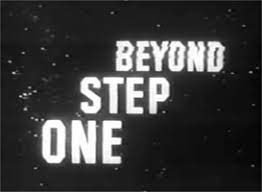
Horror on Television: One Step Beyond 1.1 “The Bride Possessed” (dir by John Newland)


During the month of October, we like to share classic episodes of horror-themed television.  That was easier to do when we first started doing our annual October Horrorthon here at the Shattered Lens because every single episode of the original, black-and-white Twilight Zone was available on YouTube.  Sadly, that’s no longer the case.

However, there is some good news!  Twilight Zone may be gone but there are other horror shows on YouTube!  For instance, there’s One Step Beyond, a supernatural-themed anthology show that claimed every story that it told was based on an actual incident.  This show ran on ABC from 1959 to 1961 and was scheduled to air opposite of Twilight Zone.

The very first episode of One Step Beyond aired on January 20th, 1959.  In this episode, a young bride (Virginia Leith) on her honeymoon suddenly starts to act differently.  (Not only does she become more outspoken but she also loses her Southern accent.)  Is it possible that she’s been possessed by the spirit of a murdered woman and now, she’s going to solve her own murder?

Watch to find out!

October Hacks: Death Rink (dir by Daniel Zubiate)


It’s time for the local roller rink to close for the night.  Manager Rachel (Katheryn McCune) and her crew are shutting the place down.  You might think that would be a relatively simple task but you’ve never seen people who do as little work as Rachel and her crew.  They probably could shut the place down in a matter of minutes and then go have fun somewhere else.  Instead, they sit around and talk and smoke some weak weed and then they play foosball and someone else plays pinball and then they talk some more and then someone calls on the phone so everyone gathers around to listen to Rachel talk to the guy and then Daley (Robert Posey) hits on Rachel and tells her, “You know I’m over 18, right?”  Considering that Daley looks like he’s about 50, I’m sure Rachel figured that out.  And then….

Did I mention this is a slasher film?  It’s easy to forget because the film is only 74 minutes long and we don’t even see the killer’s mask until the first murder occurs at the 44 minute mark.  Some of the killings — well, two of them — are creatively nasty but they still feel like an afterthought, as if the director suddenly remembered that he was making a slasher film and not a mumblecore epic about a bunch of losers working at a roller rink.

Death Rink is dull.  There’s no other way to put other than to say that Death Rink in one of the most mind-numbingly boring movies that I have ever sat through.  The pacing of this film makes you appreciate the power of a good editor.  The almost total lack of background music makes you appreciate a good composer.  The dark lighting will make you appreciate all the more the value of a cinematographer who understands the importance of setting the proper mood.  Everything about this film will make you appreciate films that at least manage to be mediocre.

Now, I will say this.  It’s hard for me judge because it’s not like I’ve ever had a real job but I imagine that this film does capture just how boring it would be to work at a small-town roller rink.  The total monotony of the character’s lives is absolutely believable.  If this film set out to be a portrait of what it’s like to have a dead end life in the middle of nowhere, it succeeded.  The film also captured the torture of listening to dumb people attempt to have a conversation.  It’s a movie that definitely reminded me of why I don’t like to listen to dumb people talk about their lives.

And I’ll also give the film this.  At the end of the film, one of the final living characters fights the killer with a broom and that was almost weird enough to work.  Of course, it would have been even better if the scene had been properly lit so that I could have actually seen the characters without squinting so hard that I was worried I was going to pop a blood vessel.  But I guess I can’t have everything.

As far as roller rinks go, I’ll stick with Skatetown USA.

The TSL’s Horror Grindhouse: Without Warning (dir by Greydon Clark)


1980’s Without Warning opens with a father (Cameron Mitchell) and his gay son (Darby Hinton) on a hunting trip.  The father taunts his son about not being what the father considers to be a real man.  He says that his son would have no chance of surviving in the wilderness.

“Why does it always have to be like this?” the son asks with a sincerity that will break your heart.

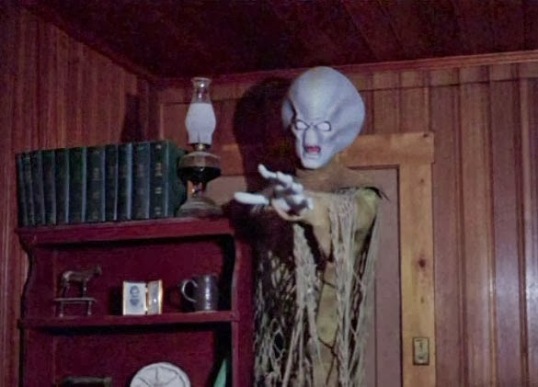
Suddenly, a bloodsucking starfish flies through the air, lands on the father, and starts to suck out his blood with a phallic stinger.  The father dies while his son watches.  The son picks up his rifle and prepares to fight back.  This will be the son’s chance to prove that his father was incorrect.  This is the son’s chance to prove that he can survive in the wilderness and….

Just kidding.  The son forgot to load the rifle and promptly gets a starfish to the eye.

That’s the type of film that Without Warning is.  Characters are introduced.  The majority of them are played by B-actor who have seen better days.  They get a few minutes of character development.  Then, they die and the viewer is left feeling a bit depressed because they all seemed like they deserved just a bit more screentime than they received.  Larry Storch shows up as a boy scout leader who gets a starfish to the back while trying to light a cigarette.  Neville Brand, Ralph Meeker, and Sue Anne Langdon hang out in a bar and refuse to believe that the Earth has been invaded by blood-sucking starfish.  Jack Palance plays a hunter and gas station owner who wants to capture an alien as a trophy.  Martin Landau plays Sarge, an unbalanced Vietnam Vet who has been telling people for years that there are aliens out there.  Everyone laughed at old Sarge but they won’t be laughing for long!  At the time this film was made, Palance was a two-time Oscar nominee.  He finally won his Oscar for City Slickers, a decade after Without Warning.  Martin Landau, for his part, won his Oscar 15 years after Without Warning.  Good for them.  If nothing else, this movie should remind everyone who has dismissed Eric Roberts’s chances that there’s still time!

That said, none of these familiar faces are the stars of the film.  Instead, the majority of the film follows four teenagers on a road trip, Sandy (Tarah Nutter), Greg (Christopher S. Nelson), Beth (Lynn Theel), and Tom (David Caruso).  David Caruso as a sex-crazed teenager sounds more amusing than it actually is.  If anything, the sight of him wearing shorts and t-shirt is almost blinding.  (As a fellow redhead, I sympathize.  We burn but we don’t tan.)  Tom and Beth die early on, leaving Greg and Sandy to try to escape from the alien (Kevin Peter Hall) who is tossing around the starfish.  Both characters are pretty generic but Christopher Nelson is at least likable.

Without Warning has a reputation for being the best film that Greydon Clark ever directed and I would agree that it’s one of his better ones, though I prefer The Forbidden Dance.  Then again, when you consider some of the other films that Clark directed, it’s easy to see that Without Warning didn’t exactly have a huge bar to clear.  Though the script borrows a bit too much from nearly every other horror film ever made, Without Warning is nicely paced and the killer starfish are genuinely frightening and their bloodsucking is almost Cronenbergian in its ick factor.  Just as he would for John Carpenter, cinematographer Dean Cundey gives us some nicely eerie shots of the alien.  Landau and Palance go all out, understanding that subtlety has no place in a film like this.  Without Warning is a dumb B-movie but it’s definitely entertaining.

Without Warning (1980, dir by Greydon Clark, DP: Dean Cundey)