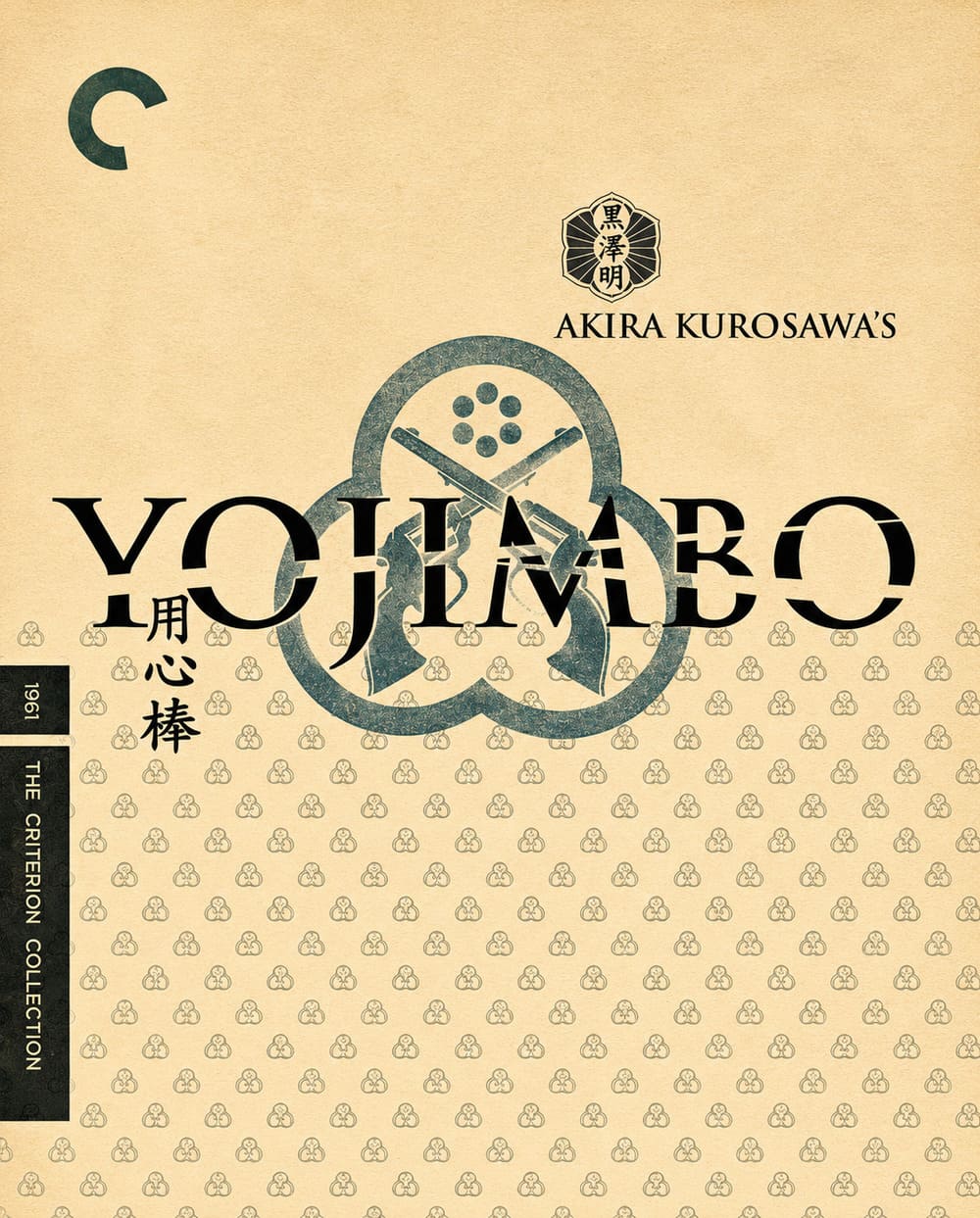
“I’ll get paid for killing, and this town is full of people who deserve to die.” — Sanjuro
The title Yojimbo means “bodyguard,” which is a funny label for a man who spends most of the movie protecting nobody. Kurosawa’s hero is a hired sword who sells his services to two sides at once, and the job he’s really doing is far more mischievous than guarding anyone. That gap between the title and the behavior sets the tone for one of the slyest, most influential movies ever made about a man with a sword.
The setup is clean and nasty. A masterless samurai wanders into a wind-blown town divided between two gangs, one led by a silk merchant and the other by a sake brewer. Everyone else is hiding indoors, and the only man with a thriving business is the coffin-maker. The samurai gives his name as Sanjuro after glancing out a window at a mulberry field, which tells you right away that it’s invented. He sizes up the situation and decides to turn it to his advantage. He takes work from one boss, then the other, and starts feeding each side exactly the wrong information at the right moment.
What makes this more than a simple revenge or rescue plot is how patient the film lets him be. Sanjuro doesn’t charge into the fray. He plants a rumor, lets a negotiation fall apart, watches a rival’s men stumble into an ambush, and only then steps in to collect. The plot is basically a long con, and Kurosawa understands that the pleasure lies in watching a clever person work. You aren’t waiting for the hero to win so much as waiting to see which domino he’ll nudge next, and the answer is usually more outrageous than you expected.
Toshiro Mifune is the engine that makes all of this work. He takes the stiff, dignified image of the samurai and turns it into something rumpled and feline. He scratches his neck, shrugs his shoulders, and rolls his arms inside a dirty kimono as if the whole world were a mild inconvenience. It’s a physical performance built from tiny, lazy gestures, and those gestures tell you everything about the man: he’s tired, he’s bored, and he’s far more dangerous than he looks. The slouch is a kind of disguise, and the film keeps reminding you that it’s one.
Then, when it’s time to fight, Mifune snaps into focus with frightening speed. The swordplay is short and sharp, and the sound design gives every cut a heavy thud. Because the fights end almost before you register them, the violence feels casual, and the casualness is exactly what makes it a little shocking. There’s no long, ceremonial duel to prepare you. A man is standing there, then he isn’t. The comedy and the brutality keep feeding each other, and the film never lets either cancel the other out, which is a tricky balance that few movies manage.
Kurosawa’s visual style does as much work as the performance does. He loves long lenses and deep, crowded frames, so you often see several layers of action at once: Sanjuro watching from a tower with his feet up, thugs scheming in the middle distance, a stray dog trotting by with a severed hand in its mouth. The main street becomes a stage, dusty and exposed, and the camera arranges the extras like pieces on a board. It feels sealed off from everything else, which makes the gangs’ obsession with one another seem both ridiculous and doomed. It’s a great example of how composition alone can land a joke without a single line of dialogue.
That sense of a closed world also explains why the film is so good at comedy of escalation. Each side believes it’s one clever move away from winning, and every move feeds the other side’s paranoia. The gang bosses are not stupid in any simple way; they’re just ordinary men caught in a feud that has grown bigger than any of them, and Sanjuro’s gift is recognizing that. He doesn’t create the hatred in the town. He simply gives it a shove and then settles back to watch it roll.
The film’s pedigree adds an extra layer of fun. Kurosawa has pointed to The Glass Key, a noir adapted from Dashiell Hammett, as a source, and plenty of critics see the plot as even closer to Hammett’s novel Red Harvest. Whatever the exact debt, the notion of a cynical outsider cleaning up a rotten town by turning the crooks on each other fits American hardboiled fiction like a glove, and Kurosawa dropped it into the Edo period without a hiccup. It’s also a good reminder that cinematic borrowing moves in circles. Japan borrowed from American crime writing, and then Italy and Hollywood borrowed straight back.
This is where the film’s central achievement comes into focus: the antihero. Sanjuro is no noble knight. He’s a mercenary and a manipulator who takes money from everyone and lies to nearly everybody, and he doesn’t pretend otherwise. Set him beside the classic Hollywood gunfighter, like the title character in Shane, who rides in to protect decent people with a clear conscience, and he looks like another species altogether. Heroes like that arrive with a purpose. Sanjuro arrives with an appetite, and the audience is invited to find that refreshing.
Yet Kurosawa slips a conscience in sideways, and this is the detail that keeps the character from becoming a mere trickster. Sanjuro helps free a family from the gangs, pays for their escape, then barks at them to leave and never look back. He can’t stand cruelty, but he won’t admit it, and he covers the impulse with gruffness and irritation. That crack in the cynical armor is what makes him so appealing. He’s a bad man who does a good thing and then acts annoyed about it, and the embarrassment he feels about his own decency is, oddly, what makes us trust him.
You can see how portable that character turned out to be. The shape is simple enough to fit on a napkin: a wandering loner arrives in a town with two warring factions and plays them against each other. The film’s own follow-up, Sanjuro, arrived in 1962 and brought Mifune’s character back, so Kurosawa clearly knew he had something audiences wanted. After that, the template spread far beyond Japan, and it kept finding new settings. It turns out that nearly every culture has a town it would like to see burned to the ground by a stranger with good aim.
The most famous descendant is Sergio Leone’s A Fistful of Dollars, from 1964, which moves the story to a border town in the American West and puts Clint Eastwood in the lead as the Man With No Name. It follows the bones of Yojimbo so closely, down to the rival families, the coffin-maker, and the rescued mother and child, that the lack of authorization became a scandal and led to legal trouble. Even so, Leone made it feel like his own film. He slowed everything down, stretched the silences, and turned faces into landscapes with operatic close-ups, while Ennio Morricone’s whip-cracking score gave the whole thing a swagger of its own.
The difference in temperament is worth noticing. Eastwood’s stranger is stoic and almost mythic, a figure who barely speaks. Mifune’s Sanjuro is chatty, twitchy, and openly amused by the mess around him. Eastwood’s squint doesn’t owe much to Mifune’s shrug, but the attitude underneath is the same: a stranger in a bad town who’s smarter than everyone around him. If Kurosawa made the antihero a comedian, Leone made him a legend, and both versions have proved remarkably durable.
Walter Hill’s Last Man Standing, from 1996, takes another run at the story, setting it in a Texas town during Prohibition with rival bootleg gangs and Bruce Willis in the lead. Hill credited Kurosawa openly, and the film is a competent, moody gangster picture with a dusty, washed-out palette. What it lacks is Mifune’s mischief. Willis plays the character as a cold killer, which makes him less fun to watch and a lot less surprising. When the hero has no sense of humor about his own scheme, the audience loses its invitation to enjoy it.
Still, putting the three films together offers a neat lesson in how much of a story can survive a change of costume. Swords become six-shooters, which become Tommy guns, and the structure holds without trouble. That durability says something about how well Kurosawa built the thing. A good premise can move from era to era because it isn’t really about the weapons or the clothing; it’s about a cynical outsider, a divided community, and the uncomfortable truth that violence can be profitable for the person smart enough to manage it.
Beyond the direct remakes, Yojimbo belongs to a larger family of Kurosawa films, along with Seven Samurai, that helped shape how filmmakers around the world imagined the lone hero and the hired gun. You can trace echoes through the Spaghetti Westerns and the hardboiled action pictures that followed. Fans sometimes connect Kurosawa’s wider body of work to Star Wars as well, though that’s more a feeling of lineage than a clean borrowing from this particular movie. The more dependable throughline is the drifter who rides into town, plays both sides, and leaves with his hands only slightly cleaner than when he arrived.
The supporting cast keeps all this lively. Tatsuya Nakadai steals scenes as a pistol-carrying younger brother in a scarf, smirking like he’s the only person who has read the script, and he makes a great foil for Mifune. His weapon of choice is itself a statement: the old world of swords is about to be outpaced by something newer and more efficient. The finale pits sword against gun, and the film knows exactly how silly and thrilling that matchup is. Kurosawa also refuses to let the humor soften the bleakness. By the end, the town has all but destroyed itself, and nothing the hero has done feels especially heroic, just necessary.
Which is why, in the end, the most telling winner of the whole affair is the coffin-maker. Gangs rise and fall, swords flash, and the so-called bodyguard strolls away without a backward glance, but the one man who profits from every round of bloodshed is the guy selling the boxes. That’s the film’s cruelest joke, and it’s aimed at every tough-guy fantasy that came after it. Yojimbo is funny, savage and gorgeously shot, and more than six decades on, it still makes the genre’s heroes look a little foolish by comparison.
Kurosawa-Mifune Collaborations

