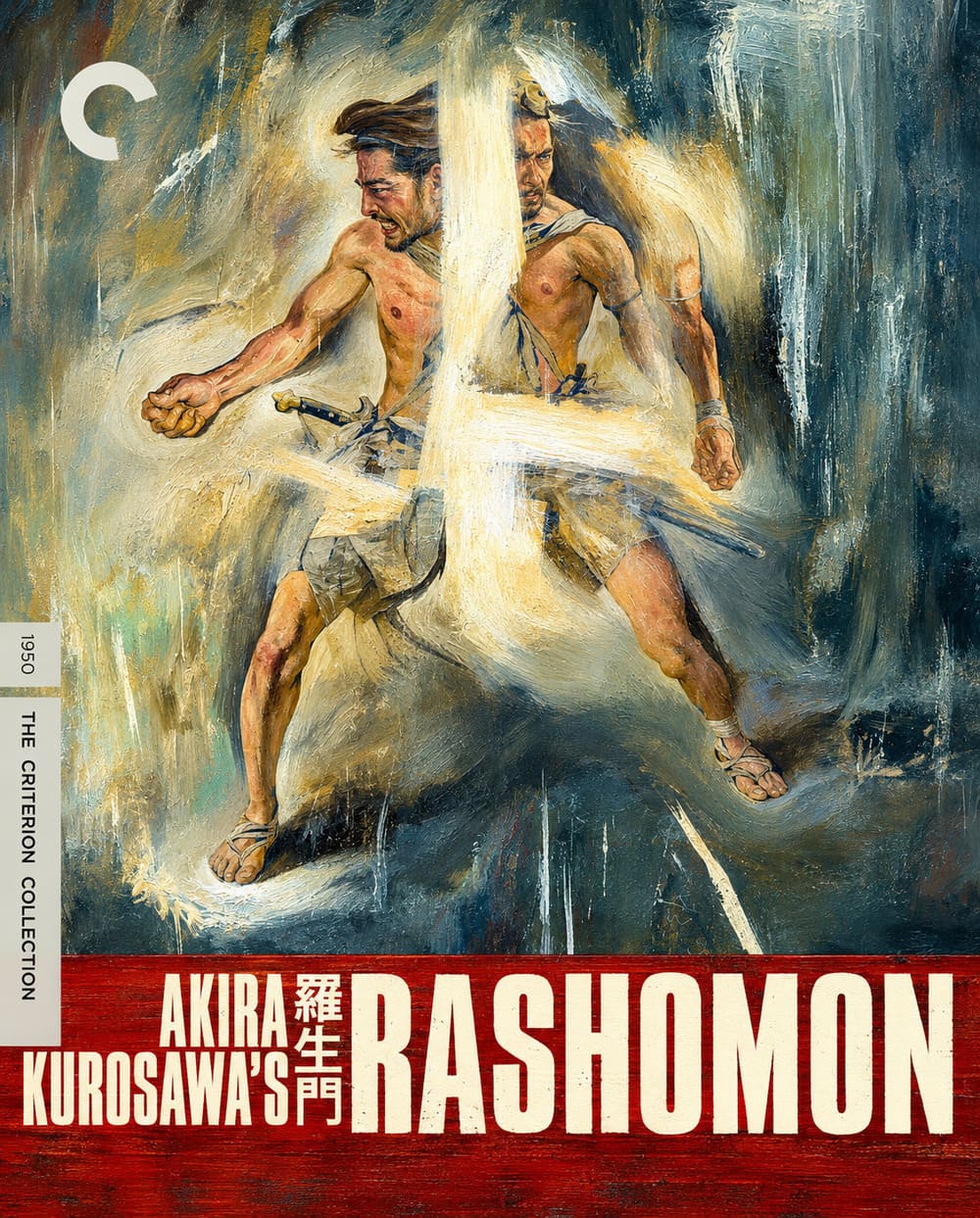
“If men lie in this world, what makes you so sure they’ll be honest in the next?” — Commoner
Some movies earn their place in film history by doing something first, while others survive because they still feel alive long after their innovations become familiar. Akira Kurosawa’s Rashomon belongs firmly in that second category. Released in 1950, it has become one of the greatest films of all time, but that reputation shouldn’t make it sound like homework. This is a lean, emotionally messy movie about people telling stories that make themselves easier to live with. Its famous narrative structure remains fascinating, yet what really sticks is the uncomfortable recognition that almost everyone here would rather protect an identity than admit an ugly truth.
The setup is beautifully simple. Beneath a ruined city gate during a torrential downpour, a woodcutter and a priest struggle to explain a disturbing incident to a skeptical commoner. A samurai has died in the woods, his wife has been sexually assaulted, and a bandit named Tajōmaru is involved. But the accounts of what happened refuse to line up. As different versions unfold, details change, motives shift, and supposedly solid evidence becomes slippery. What initially looks like a murder mystery gradually turns into something more unsettling: an investigation into why people need their version of reality to win.
The clever part is that Kurosawa doesn’t simply give us contradictory dialogue and ask us to sort it out. He shows each account with the immediate confidence movies usually reserve for facts. We’re accustomed to believing images, especially when a flashback appears to explain something that has already happened. Rashomon quietly takes advantage of that habit. Each reconstruction feels convincing while we’re watching it, only for the next one to pull the floor away. The camera records the stories vividly, but vividness turns out to be no guarantee of honesty. That distinction gives the film its enduring sting.
Kurosawa and co-screenwriter Shinobu Hashimoto also understand that an unreliable narrator is more interesting when the dishonesty has an emotional purpose. These characters aren’t merely scrambling to avoid punishment. They’re trying to preserve pride, dignity, desirability, or some flattering idea of personal strength. Even an account that sounds self-incriminating can serve someone’s vanity. That makes the film more psychologically sharp than a straightforward guessing game. The question isn’t only who killed the samurai. It’s why each speaker needs the encounter to have happened in a particular way, and what that need reveals despite their efforts to conceal it.
After four previous collaborations—Drunken Angel, The Quiet Duel, Stray Dog, and Scandal—Kurosawa and Toshirō Mifune really hit their stride with Rashomon. Their earlier work together had already shown the actor’s intensity, but here the match between Kurosawa’s visual energy and Mifune’s explosive physical presence feels especially exciting. There’s a sense that the director knows exactly how to harness his star’s wildness without making it feel controlled. Just as importantly, Mifune makes that wildness serve the film’s slippery approach to character: his performance is magnetic, but magnetism isn’t the same thing as credibility.
As Tajōmaru, Mifune scratches, sprawls, laughs, and throws his body around as though civilized behavior were an irritating costume he has already discarded. His swagger can be funny, frightening, and embarrassingly theatrical within the same scene. Crucially, that theatricality fits a man invested in his own legend. Mifune doesn’t just play a dangerous criminal; he plays someone who enjoys imagining how a dangerous criminal ought to look. The gap between those two things becomes increasingly revealing as competing versions challenge his heroic self-portrait. His bravado invites our attention while giving us plenty of reasons to distrust the story attached to it.
Machiko Kyō has an especially difficult assignment as the samurai’s wife, whose personality changes depending on who controls the story. Across the accounts, she appears vulnerable, calculating, devastated, or furious. It would be easy to read those shifts as inconsistency, but they’re central to the film’s design: we’re often seeing someone else’s construction of her. Still, the treatment of sexual violence deserves scrutiny. Her suffering repeatedly becomes material through which men negotiate honor and humiliation. The film exposes those attitudes, but it doesn’t entirely escape their limitations. That tension makes the character worth discussing rather than reducing her to a puzzle piece.
For all the attention paid to the screenplay, Rashomon is also an astonishing piece of visual filmmaking. Working with cinematographer Kazuo Miyagawa, Kurosawa turns the forest into a place where perception itself seems unstable. Sunlight breaks through the leaves, faces move between brightness and shadow, and branches interrupt our view. The images are gorgeous without feeling like decorative scenery. They give the uncertainty a physical texture. You can almost feel the heat and the disorientation, as though the landscape were making it harder for anyone to see clearly, including us.
The woodcutter’s early walk through the woods is a perfect example of how much the film communicates without explanation. The camera follows and observes him from shifting positions, drawing us deeper into a space that feels both ordinary and strangely enchanted. Shots aimed toward the sun make the light feel active, almost invasive. Instead of hurrying toward the discovery that will start the mystery, Kurosawa lets movement and rhythm establish a mood. It’s confident filmmaking: a stretch of walking becomes suspenseful because the act of looking has already started to feel uncertain.
The contrast between the settings is just as expressive. The forest is restless and visually tangled; the courtyard testimony scenes are exposed and comparatively spare. Characters address an unseen authority in a way that puts the audience uncomfortably close to the judge’s position. Meanwhile, the ruined gate offers shelter without reassurance. Rain pounds outside as the men debate whether human beings deserve any faith at all. These spaces aren’t merely convenient locations for different parts of the plot. Each creates a different relationship between storytelling, judgment, and the desire to find somewhere morally secure.
One of the film’s smartest choices is to make violence look different according to the teller. A sword fight can resemble a thrilling display of masculine skill in one account and an exhausting, frightened scramble in another. The less glamorous version is particularly memorable because the bodies suddenly seem vulnerable rather than legendary. Men stumble, hesitate, and struggle to keep going. Kurosawa understands how action choreography can become characterization: the same encounter changes meaning when its participants stop looking like accomplished warriors and start looking like people terrified of being killed.
That willingness to question storytelling itself explains the film’s enormous influence. The term “Rashomon Effect” now describes conflicting accounts of the same event, particularly when witnesses’ perspectives or interests make certainty difficult. For screenwriters and filmmakers, Rashomon offered a powerful model for making narrative structure carry the theme. Repetition needn’t be redundant when each return changes our understanding of character and evidence. Its storytelling legacy extends to films as varied as The Handmaiden, Courage Under Fire, Talvar, The Usual Suspects, and Hero. These aren’t identical applications of one formula, but they demonstrate how widely its challenge to straightforward narration has traveled.
Its historical impact was equally significant. Winning the Golden Lion at the 1951 Venice Film Festival helped bring Japanese cinema to wider international attention. That breakthrough is part of why Rashomon occupies such a prominent place in film history, though historical importance alone wouldn’t explain its staying power. What keeps it compelling is the marriage of an immediately understandable situation with questions that refuse to settle down. You don’t need specialist knowledge to recognize wounded pride or self-serving storytelling. The formal sophistication grows out of behavior that remains painfully familiar.
What makes Rashomon worth returning to is that knowing its structure doesn’t drain its power. Once you stop watching for the solution, you start noticing the performances within the performances: the flattering gestures, the convenient omissions, the moments when fear gets dressed up as honor. Kurosawa makes those small acts of self-invention as gripping as the mystery itself. For all its deserved status as a landmark, the film never feels trapped behind museum glass. It’s sweaty, strange, sometimes darkly funny, and still capable of making you question why you believed the person who happened to speak first.
Kurosawa-Mifune Collaborations

