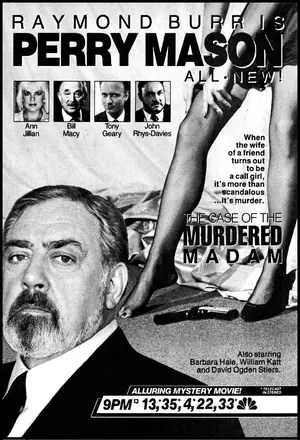
I Watched Perry Mason: The Case Of The Murdered Madam (1987, Dir. by Ron Satlof)


Former madam Suzanne Domenico (Ann Jillian) attempts to blackmail four rich men who are planning on embezzling money from a bank and is found dead by her husband, Tony, shortly afterwards.  Tony (Vincent Baggetta) is arrested and charged with murdering his wife.  Tony’s older brother used to run around with Della Street (Barbara Hale) and Della is able to get Perry Mason (Raymond Burr) to defend him in court.  Paul Drake, Jr. (William Katt) is brought in to do the investigative legwork.  Once again, Paul falls for a younger woman (Daphne Ashbrook) who will probably never be mentioned again in any of the other movies.

This movie was a little sad because it was obvious that Raymond Burr was not in good health.  He spends most of the movie sitting or moving with crutches.  In the movie, they say that Perry is using crutches because of a skiing accident but looking at Raymond Burr, there’s no way to imagine him skiing.  Burr is still as sharp as ever when asking questions in the courtroom but it’s still clear that he was in pain when he did this movie.  Perry being sidelined does mean that Barbara Hale and William Katt get to do more than usual.  After spending the last few movies constantly getting outrun and smacked around, Katt finally gets to beat someone up in the movie.

The mystery isn’t bad, even though I guessed who the murderer was long before the trial started.  The entire embezzlement scheme comes down to embezzling a few cents a day so that no one will notice.  That’s the same thing they tried to do in Office Space!  Luckily, no one got murdered that time.

Overall, this was a good entry in the Parry Mason movies, especially for those of us who like watching Paul Drake, Jr.  I’m starting to wonder if all of Perry and Della’s friends are going to end up getting accused of murder at some point.  My aunt and I always used to joke about how often Jessica Fletcher’s nephew was accused of murdering someone.  It might be just as dangerous to be a friend of Perry Mason’s!

I Watched Perry Mason: The Case Of The Sinister Spirit (1987, Dir. by Richard Lang)


David Hall (Matthew Faison) is an obnoxious horror writer who invites a group of associates and former friends to spend the night at a “haunted” hotel.  He’s invited them because all of them are on the verge of suing him for writing about them in his latest book, The Resort.  Over the course of the night, he plays cruel practical jokes on all of them.  Finally, someone gets fed up and tosses him over a railing.  The police arrest publisher Jordan White (Robert Stack) and charge him with the murder.  It’s a good thing that Jordan’s best friend is Perry Mason (Raymond Burr).

Perry uses a cane in this movie and is not that active outside of the courtroom.  That means that it’s up to Paul Drake, Jr. (William Katt) to do most of the investigating.  As usual, Paul falls for an attractive, younger woman, in this case the hotel’s owner, Susan Warrenfield (Kim Delaney).  Every movie features Paul falling for someone and then we never hear about them again.  Does Paul have commitment issues?

I enjoyed this Perry Mason mystery.  The hotel was a great location and I appreciated that the movie tried to add some horror elements to the story.  The Perry Mason movies can be predictable so I always like it when they at least try to do something a little bit different.  This was a fun entry in Perry Mason’s career.

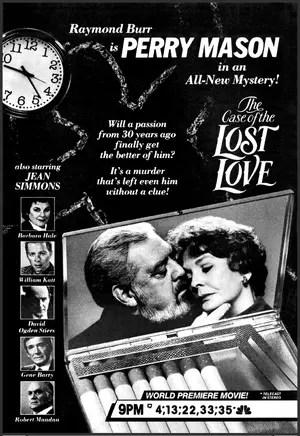
I Watched Perry Mason: The Case Of The Lost Love (1987, Dir. by Ron Satlof)


Perry Mason’s ex-girlfriend, Laura Robertson (Jean Simmons), is about to be appointed to the Senate when blackmailer Pete Dixon (Jonathan Banks) threatens to reveal that she once underwent shock treatment after having a nervous breakdown.  When Dixon is murdered, Laura’s husband (Gene Barry) is arrested.  Laura hires Perry (Raymond Burr) to serve as his attorney.

At first, this movie felt weird to me because it didn’t seem right for Perry to have an ex-girlfriend when we all know that he and Della (Barbara Hale) were in love.  When Laura is at the office waiting to see Perry, she and Della have a conversation and it’s obvious that each is jealous of the other.  When Laura asks, “What about you and Perry?,” Perry shows up before Della can answer.  We all know what the answer was though.  Della loves Perry and, probably because she was so upset over Perry dating Laura, she threw herself at Paul Drake, Sr. and that’s how we got Paul Drake, Jr.

As for Paul Drake, Jr. (William Katt), he flirts with two different women in this movie but he doesn’t get to do as much investigating as he did in the first few films.  This movie is almost all Perry Mason interrogating people.  Raymond Burr uses a cane in this movie and there’s a few scenes where it’s obvious that he was in pain but he still gives a very good performance.  The movie is very talky but it also has the best courtroom confession scene yet and Raymond Burr really sells Perry’s ambivalent feelings.  The identity of the killer actually took me by surprise!

It was weird to see Perry in love with someone oter than Della but this was still an excellent entry in the series.

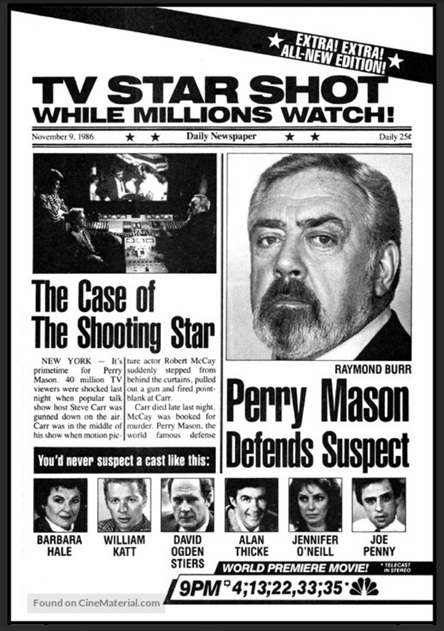
So, I Watched Perry Mason: The Case Of The Shooting Star (1986, Dir. by Ron Satlof)


Actor Robert McCay (Joe Penny) decides that it would be hilarious to shoot talk show host Steve Carr (Alan Thicke) on live television.  McCay thinks that the gun is loaded with blanks but, before he goes on the show, someone slips a live round into the gun.  McCay kills Steve Carr and there are a million witnesses who see him do it.  Time to call in Perry Mason (Raymond Burr)!

The third Perry Mason movie isn’t as good as the first two.  Shooting someone on television as a joke and then leaving the studio immediately afterwards is a really stupid thing to do.  As my sister pointed out while we were watching, even if Robert McCay wasn’t guilty of premeditated murder, he was probably guilty of negligent homicide for not bothering to double check whether or not there was a live round in the gun.  McCay goes right back to shooting his movie, even while he’s on trial for murder.  As for the trial, it was ridiculous.  How many people can confess under cross examination in one trial?  “Mistrial!” my sister yelled whenever Perry pulled one of his stunts and I agreed.

Paul (William Katt) teams up with a photojournalist (Wendy Crewson) and his investigation somehow leads to him playing a priest in a cheap vampire movie.  For once, Perry didn’t give Paul a hard time about anything.  Maybe he realized Paul’s scenes were the best part of The Case of the Shooting Star.

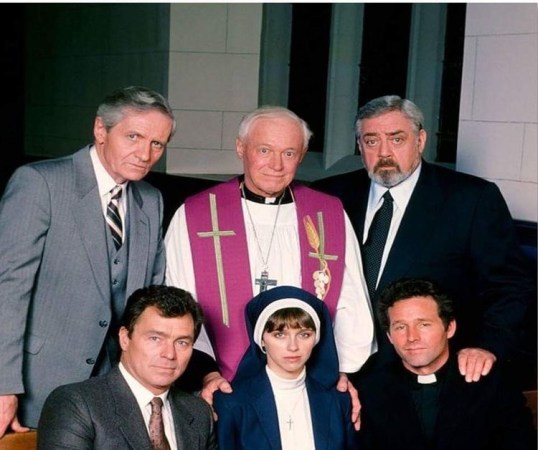
I Watched Perry Mason: The Case of the Notorious Nun (1986, Dir. by Ron Satlof)


In the second Perry Mason movie, Perry (Raymond Burr) defends Sister Margaret (Michele Greene), who has been accused of murdering Father Thomas O’Neil (Timothy Bottoms).  The D.A. (David Ogden Stiers) says that Sister Margaret was having an affair with Father O’Neil and she killed him when he tried to break it off.  However, the movie shows us that, just like in the last movie, Father O’Neil was actually killed by a hitman (Hagan Beggs).  Perry, Della (Barbara Hale), and Paul Drake, Jr. (William Katt) have to figure out who ordered the priest’s murder.

I enjoyed the Case of the Notorious Nun, even if it wasn’t as good as the previous film.  It was still entertaining and I loved watching Perry constantly give Paul a hard time about every little thing but this time, it was really obvious who the actual killer was.  Paul, of course, had romantic feelings for Sister Margaret but nothing came from them, other than a chaste kiss on the cheek.  Sorry, Paul.  You’re charming but you’re not that charming.

Father O’Neil was far more sympathetic than the previous movie’s victim.  Father O’Neil was trying to make the world a better place and his death with was a real tragedy.  That made it all the more satisfying when Perry was able to get his cross-examination confession.  There was an alarming scene early on in the movie where Perry checked into a hospital because he was feeling faint and I get the feeling that they framed the scene to make Raymond Burr look even heavier than he was.  (This movie justified Paul Drake doing all the leg work while Perry stayed at the office.)  But even if he moves a little slower than he used to, Perry Mason is still the best lawyer out there.

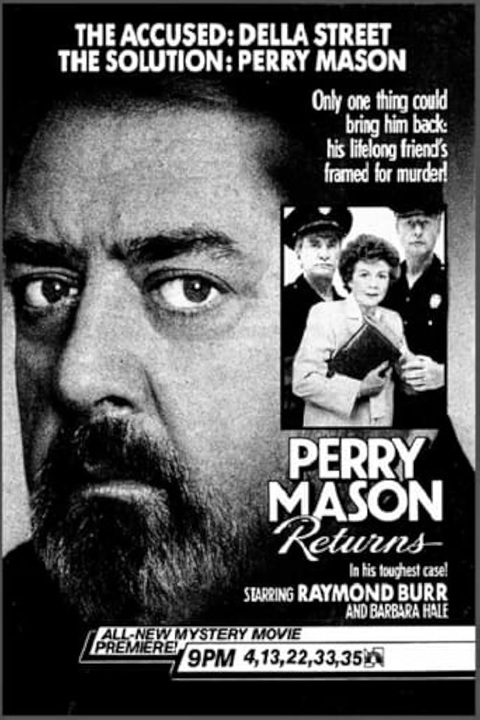
I Watched Perry Mason Returns (1985, Dir. by Ron Satlof)


When his former secretary, Della Street (Barbara Hale), is arrested for murdering wealthy businessman Arthur Gordon (Patrick O’Neal), Judge Perry Mason (Raymond Burr) resigns from the bench so that he can defend her in court.

Perry Mason Returns reveals who the killer is when the murder happens.  The killer is a lowlife named Robert Lynch (James Kidnie), who is wearing a gray wig and a frumpy dress so that everyone will mistake him for Della.  It doesn’t take Perry and private detective Paul Dark, Jr. (William Katt) long to discover that Lynch is the murderer but, after someone shoots Lynch, they have to figure out who hired Lynch to kill Gordon.  Gordon had recently disinherited his entire family so Perry and Paul have a lot of suspects to consider.  30 minutes in, I thought I knew who the killer was but it turned out I was wrong.

My Aunt Kate loved her detective stories and, when I was growing up, I would always watch them with her whenever we were visiting for the holidays.  Watching Perry Mason Returns really made me feel nostalgic, even if it also made me feel dumb for not being able to guess who the killer was.  Perry gives up being a judge so that he can defend Della Street in court.  That’s true love.  William Katt, who plays Paul Drake’s son, was Barbara Hale’s real-life son so I think that proves my theory that Della loved both Perry and Paul.

Perry Mason Returns was fun to watch.  It had more action than I was expecting because Paul Drake, Jr. was always getting into tight situations.  The movie really tried to make William Katt into an action star.  The murder mystery held my attention and, of course, Perry got the murderer to confess on the stand and on the record.  Some things never change!  One thing that really amused me was that, as soon as Perry took the case, everyone naturally assumed he would win.  Della wasn’t worried for a minute, even though she was facing life in prison.  “You didn’t tell me Perry Mason was her lawyer!” Robert Lynch yelled at the person who hired him.  He knew the gig was up.  Perry Mason always wins!

Watching Perry Mason Returns, I felt like I was a kid again, watching movies with my Aunt Kate and trying to solve the mystery with her.  All of the Perry Mason made-for-TV movies are on YouTube so I’ll be reviewing more of them in the future.

Airplane II: The Sequel (1982, directed by Ken Finkleman)


It isn’t the past.  It isn’t the present.  It’s the future.

The moon has been colonized and, on Earth, the Mayflower II is preparing for its first international flight.  It will be carrying passengers from Houston to the lunar station.  Test pilot Ted Striker (Robert Hays) claims that the Mayflower II is not ready to make the trip but he’s been in the Ronald Reagan Hospital For The Mentally Ill ever since he had a nervous breakdown after losing his squadron during “the war.”

Aboard the Mayflower II is Ted’s ex-wife, Elaine (Julie Haggerty), and her new boyfriend, Simon (Chad Everett).  Simon says the Mayflower II is in perfect shape but he also turns into jelly whenever things get too rough.  Piloting the Mayflower II is Captain Clarence Oveur (Peter Graves) and waiting on the Moon is Commander Buck Murdock (William Shatner).  The crew of the Mayflower II is going to have a tough flight ahead of them.  Not only is the shipboard computer making plans of its own but one of the passengers (Sonny Bono) has a bomb in his briefcase.  Also, Ted has broken out of the hospital and is on the flight, boring people with his long stories.

Every successful film gets a sequel and when Airplane! was a surprise hit in 1980, it was inevitable that there would be an Airplane II.  Robert Hays, Julie Haggerty, Lloyd Bridges, Peter Graves, and Stephen Stucker all returned.  Unfortunately, Jim Abrahams, the Zucker brothers, Robert Stack, Kareem Abdul-Jabbar, and Leslie Nielsen did not.  (The directors and Nielsen were all working on Police Squad and their absence is strong felt.)  Airplane II recreates many of the same jokes as the first Airplane! but without the first film’s good nature or genuine affection for the disaster genre.  Airplane! was made for the love of comedy.  Airplane II was made for the love of money and, while there are more than a few amusing moments, the difference is obvious and there for all to see.

Not surprisingly, Airplane II is at its funniest whenever William Shatner is on screen.  In the role of Bud Murdock, Shatner pokes fun at his own image and shows himself to be a good sport.  He’s still not as funny as Leslie Nielsen or Robert Stack in the first film but that’s because, unlike Stack and Nielsen in their pre-Airplane! days, there had always been a hint of self-parody to Shatner, even in his most dramatic roles.  If Stack and Nielsen shocked people by showing that they could do deadpan comedy, Shatner’s performance just confirmed what most suspected, that he had always been in on the joke.  Still, he’s the funniest thing in Airplane II and, whenever I rewatch this movie, I am happy he was there.

Airplane II was a box office failure, which is why the world never got an Airplane III.  Fortunately, the world did get Hot Shots and The Naked Gun.

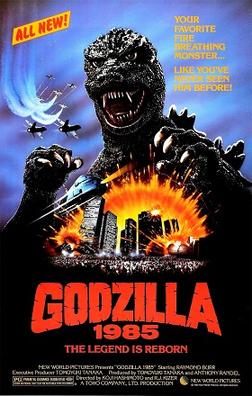
Horror Film Review: Godzilla 1985 (dir by R.J. Kizer and Koji Hashimoto)


Nine years after The Terror of Mechagodzilla, Godzilla finally returned to Japanese movie screens in The Return of Godzilla!

One year later, Raymond Burr joined him when The Return of Godzilla was released in the United States as Godzilla 1985.

The film’s plot is a simple one, though it does have an interesting subtext.  Godzilla is once again roaming the planet and, after spending the last few years as humanity’s champion, he is once again destroying everything in his path.  (This is a rare later Godzilla film that features only Godzilla.  Mothra, Rodan, Ghidorah, and that weird armadillo that always used to follow Godzilla around, none of them are present.  The son of Godzilla is not mentioned, to the regret of no one.)  Looking to prevent a mass panic, the Prime Minister of Japan tries to cover up the news of Godzilla’s return.  But when a Russian submarine is destroyed by Godzilla and the Russians blame the Americans and bring the world to the verge of atomic war, the Prime Minister is forced to reveal the truth.  The Super X, an experimental new airplane, is deployed to take Godzilla out but it turns out that Godzilla is not that easy to get rid of.

Now, as I said, there is an interesting subtext here.  If the first Godzilla films were all about the trauma of Hiroshima and Nagasaki, this version of Godzilla is all about being trapped between the whims of two super powers.  For the most part, Godzilla only attacks Japan.  At the time this movie came out, he had been attacking Japan for nearly 30 years and the rest of the world was content to allow Japan to deal with the consequences alone.  However, when Godzilla sinks that Russian sub, both the Russians and the Americans blame each other and bring the world to the brink of annihilation.  Japan, like the rest of the world, finds itself caught in the middle.  In the end, it’s up to Japan to not only defeat Godzilla but to keep the Americans and Russians from blowing up the rest of the world.  Godzilla may be bad, this movie tells us, but he’s nowhere near as bad as the idiots with all of the atomic missiles.

Of course, when The Return of Godzilla came to America, extra scenes were shot to make it clear that America had Japan’s back.  For that reason, Raymond Burr returns as journalist Steve Martin.  Martin is called in to share his first-hand knowledge of what Godzilla is capable of.  One has to wonder who thought that was a good idea as Martin basically comes across as being a grouchy crank who just wants to tell everyone to get off his lawn.  As opposed to the first Americanized Godzilla film, which was edited to make it appear as if Burr was actually talking to characters from Gojira, Godzilla 1985 just features a lot of scenes of Burr staring at a screen in the Pentagon and making ominous comments about what Godzilla is capable of doing.  It’s a wasted cameo but I guess the film’s American distributors didn’t have faith that Godzilla could pull in the audiences on his own.

Fortunately, Raymond Burr’s time-consuming cameo can’t keep this film from being a lot of fun.  It’s a Godzilla film, after all.  Godzilla stomps on a lot of buildings and breathes a lot of fire and wisely, the film doesn’t wait too long before allowing him to go on his rampage.  After spending several films as an almost comic character, this film reminds audiences that Godzilla was always meant to be frightening.  Of course, lest anyone take this film too seriously, the size of the Super X changes from scene to scene, depending on which miniature was being used.  Godzilla loses his temper and falls into a volcano but there’s never any doubt that he’ll be back.  You can’t stop Godzilla!

Previous Godzilla Reviews:

  1. Godzilla, King of the Monsters (1958)
  2. Godzilla Raids Again (1958)
  3. King Kong vs Godzilla (1962)
  4. Mothra vs. Godzilla (1964)
  5. Ghidorah: The Three-Headed Monster (1964)
  6. Invasion of the Astro-Monster (1965)
  7. Godzilla vs. The Sea Monster (1966)
  8. Son of Godzilla (1967)
  9. Destroy All Monsters (1968)
  10. All Monsters Attack (1969)
  11. Godzilla vs Hedorah (1971)
  12. Godzilla vs Gigan (1972)
  13. Godzilla vs Megalon (1973)
  14. Godzilla vs Mechagodzilla (1974)
  15. The Terror of Mechagodzilla (1975)
  16. Cozilla (1977)
  17. Godzilla vs. Mothra (1992)
  18. Godzilla vs. Destoroyah (1995)
  19. Godzilla, Mothra, and King Ghidorah: Giant Monsters All-Out Attack (2001)
  20. Godzilla (2014)
  21. Godzilla: Planet of the Monsters (2017)
  22. Godzilla, King of the Monsters (2019)
  23. Godzilla vs Kong (2021)
  24. Godzilla Minus One (2023)

Horror Film Review: Godzilla (dir by Luigi Cozzi, Inshiro Honda, and Terry Morse)


The year was 1976 and the flamboyant Italian producer, Dino de Laurentiis, was drumming up a lot of publicity for his remake of the monster classic, King Kong.  In Italy, the journalist, screenwriter, and director Luigi Cozzi assumed that the King Kong remake would be a huge hit and decided to get in on the action himself.  If Italian audiences loved a film about a big monkey, how about a film about a big radioactive lizard?

Cozzi’s original plan was to buy the distribution rights to Gojira but Toho Studios turned him down.  They did, however, agree to allow Cozzi to distribute the American cut of Gojira, Godzilla, King of the Monsters.  (That’s the version where Raymond Burr appears as American reporter Steve Martin and, through some clever editing tricks, appears to be interacting with the characters from the original Japanese version.)

Cozzi immediately ran into two huge problems when it came to distributing Godzilla, King of the Monsters.  First off, the film was in black-and-white and most Italian theater owners refused to show black-and-white films.  Cozzi’s solution was to “colorize” the film by putting translucent gel over the frame, resulting in random splotches of color that gave the entire film what could generously be called a radioactive glow.  Secondly, the American cut was considered to be too short for theatrical distribution.  Cozzi proceeded to re-cut the re-cut, adding in scenes of actual war footage and clips from other 50s monster movies.  As a result Cozzi’s film opens not with Tokyo on fire but instead stock footage of Hiroshima before the bomb was dropped.  Later, footage of actual victims of the bomb would he used as footage of victims of Godzilla.

Having re-cut the film, Cozzi then decided that the movie could use a synthesizer-heavy soundtrack, which was provided by Vince Tempera, Fabio Frizzi, and Franco Bixio.

The end result …. well, the end result is a mess but it’s a mess that fascinating for fans of Godzilla.  The colorization creates an odd effect, in which the images are all familiar but still seem different, as if being viewed in a dream.  Often times, the splashes of color are so harsh and random that it makes it difficult to actually see what’s happening in the scene.  I had to look away a few times, due to the harshness brightness of some of the yellows.  There are a few times — and by that, I mean a very few times –when the color effects oddly work.  In those rare moments, Godzilla’s atomic nature seems to be radiating through the entire movie.

As for the “new footage,” it’s thoroughly tasteless to use actual footage from Hiroshima and Nagasaki but, at the same time, it also serves to remind the viewer of the national trauma that inspired the creation of Godzilla in the first place.  The footage reminds the viewer of the horrors of war while also leaving viewers wondering they really should be watching it used in the way that it’s used in this movie.  (For his part, Cozzi said he used actual war footage because modern audiences would expect more violence and destruction than was present in the original film.  It’s reasonable to assume that any subtext was purely accidental.)

Finally, the soundtrack …. actually, I like this version’s score.  It’s wonderfully ominous, especially at the start of the film.

Nicknamed Cozilla by Cozzi himself, 1977’s Godzilla is a bizarre experiment that doesn’t quite work but I would say it’s still one that should be seen by anyone who is interested in the history of either Godzilla or exploitation films in general.  (And make no mistake, this version of Godzilla is definitely an exploitation film.)  For years, the film was impossible to see outside of Italy.  Now, of course, you can find a copy on just about every torrent site.

Previous Godzilla Reviews:

  1. Godzilla, King of the Monsters (1958)
  2. Godzilla Raids Again (1958)
  3. King Kong vs Godzilla (1962)
  4. Mothra vs. Godzilla (1964)
  5. Ghidorah: The Three-Headed Monster (1964)
  6. Invasion of the Astro-Monster (1965)
  7. Godzilla vs. The Sea Monster (1966)
  8. Son of Godzilla (1967)
  9. Destroy All Monsters (1968)
  10. All Monsters Attack (1969)
  11. Godzilla vs Hedorah (1971)
  12. Godzilla vs Gigan (1972)
  13. Godzilla vs Megalon (1973)
  14. Godzilla vs Mechagodzilla (1974)
  15. The Terror of Mechagodzilla (1975)
  16. Godzilla vs. Mothra (1992)
  17. Godzilla vs. Destoroyah (1995)
  18. Godzilla, Mothra, and King Ghidorah: Giant Monsters All-Out Attack (2001)
  19. Godzilla (2014)
  20. Godzilla: Planet of the Monsters (2017)
  21. Godzilla, King of the Monsters (2019)
  22. Godzilla vs Kong (2021)
  23. Godzilla Minus One (2023)

Retro Television Reviews: The Love Boat 2.18 and 2.19 “Alas, Poor Dwyer/After the War/Itsy Bitsy/Ticket to Ride/Disco Baby”


Welcome to Retro Television Reviews, a feature where we review some of our favorite and least favorite shows of the past!  On Wednesdays, I will be reviewing the original Love Boat, which aired on ABC from 1977 to 1986!  The series can be streamed on Paramount Plus!

This week, it’s disco, high school, and alcoholism on The Love Boat!

Episodes 1.18 and 1.19 “Alas, Poor Dwyer/After the War/Itsy Bitsy/Ticket to Ride/Disco Baby”

(Dir by Roger Duchowny, originally aired on February 3rd, 1979)

It’s time for the Haney High class reunion and one of the school’s most beloved graduate, Julie McCoy, has arranged for her former classmates to celebrate their 10-year reunion on the Pacific Princess!

This was a special double-sized episode of The Love Boat.  (It was split into two episodes for syndication.)  Along with being twice as long, this episode also features twice as many guest stars and a twice as much romance and drama.  It turns out that Haney High’s Class of ’69 was a large one indeed.

(It’s not really made clear as to whether everyone on the cruise is there for the reunion or if there are passengers on the cruise who are just trying to enjoy a vacation.  I have to say that I would be a bit annoyed if I boarded a cruise just to discover that it was being used for someone else’s loud and crowded high school reunion.  Seeing as how the entire boat has been decorated with signs welcoming the “class of Haney High,” I hope that it was just Hany High alumni on the cruise.  Otherwise, some people definitely ended up feeling left out of all the fun.)

Along with being a supersized episode, quite a bit of this episode was filmed while the ship was on an actual cruise.  (The Love Boat would always take one or two actual cruises during each season.  That was one reason why so many actors were eager to be on a show that was never really a critical favorite.)  As a result, the characters in this episode spend far less time in their cabins than usual.  Instead, almost every scene takes place on one of the decks.  The ocean looks lovely.  A scene where Doc talks to Gopher and Isaac features a striking sunset in the background.

As for the storylines, it’s a little bit hard to know where to start with this episode.  Not only did the passengers all get storylines but so did Captain Stubing, Doc Bricker, and Julie McCoy.  I guess as good a place to start as any would be with Malcolm Dwyer (Raymond Burr), the high school’s beloved drama teacher.  Mr. Dwyer boards the ship and, rather than talk to any of his former students, he immediately starts drinking.  It quickly becomes apparent to everyone that Mr. Dwyer has a drinking problem.  He’s haunted by the fact that, rather than becoming a star himself, he instead just became a teacher.  Fortunately, Captain Stubing immediately realizes what is going on with Mr. Dwyer and he takes it upon himself to help.  When Mr. Dwyer demands to know why Stubing cares so much about his drinking, the Captain lets down his guard and reveals that he too is an alcoholic.

This episode was the first time that the show directly acknowledged that Captain Stubing was a recovering alcoholic, though it was something that was occasionally hinted at.  While Raymond Burr occasionally seems to be trying too hard to turn Mr. Dwyer into a grandly tragic figure, the scene where the Captain talks about his alcoholism is still a surprisingly poignant moment.  Gavin MacLeod really captures the vulnerability of the moment as the normally reserved Captain opens up about something in which he takes no pride.  Gavin MacLeod was, himself, a recovering alcoholic and, when he warns Dwyer about his drinking, it’s obvious that it’s not just Captain Stubing talking to a passenger.  It’s also Gavin MacLeod talking to the show’s audience.  It’s a surprisingly poignant moment.

Speaking of poignant moments, Jack Forbes (John Rubinstein) is on the cruise with his wife, Kathy (Judi West).  When Jack sees Mike Kelly (Michael Cole), he freaks out.  Mike was the king of Haney High, the high school quarterback with a bright future ahead of him.  In school, he was Jack’s best friend.  After they graduated, both Jack and Mike received their draft notices.  Mike went to Vietnam and returned in a wheelchair.  Jack fled to Canada with Kathy.  When Jack sees Mike, he feels ashamed of himself and lies about what he did during the war.  Jack worries that, if everyone finds out that he was a cowardly draft dodger, they’ll toss him overboard.

(To be honest, if Jack should be worried about anything, it should be running into the guy who got sent to Vietnam in his place.  When someone dodged the draft, that meant someone else has to go in his place and that person was usually someone who didn’t have the resources to just pick up and leave the country.)

With Kathy’s encouragement, Jack finally confesses to Mike and Mike tells Jack that he already knew.  Mike forgives Jack and, again, it’s a surprisingly poignant moment.  John Rubinstein and Michael Cole both gave heartfelt and committed performances and the show approached the issue with the type of nuance that I don’t most people would necessarily expect from an episode of The Love Boat.

While this is going on, Doc is spending the cruise with Bitsy (Conchata Ferrell).  When Doc saw Bity’s high school yearbook photo, he insisted that Julie sit him up with her.  (Yeah, that’s not creepy at all.)  Doc is shocked to discover that Bitsy has gained weight since high school.  Gopher and Isaac give Doc a hard time for dating Bitsy during the cruise.  After getting to know her and discovering her quick wit, Doc announces that Bitsy is beautiful even if she is “chubby” and, believe it or not, as bad as it is to read about it, the whole thing feels even more cringey and awkward when you watch the episode.  This was another storyline that existed to confirm that Doc and Gopher were walking HR nightmares.

Meanwhile, Wendy (Kim Darby) is trying to figure out which one of her former classmates anonymously paid for her ticket and sent her a love poem.  Was it Ross Randall (Christopher George), who is now a television star?  Was it former class clown Pete DeLuca (Kelly Monteith)?  Or was it the class hippie, Jason Markham (Bob Denver)?  What was odd about this storyline was that the cruise was for Julie’s ten-year class reunion but both Christopher George and especially Bob Denver were obviously quite a bit older than the other members of their class.  (If either one of them was 28, one can only assume they spent the past decade drinking 24/7.)  Ross, at one point, talked about how Mr. Dwyer was the teacher who inspired him but Ross appeared to be roughly the same age as Mr. Dwyer.  It was weird but hey, that’s The Love Boat!

As for who sent Wendy the ticket, it turned out that her secret admirer was her husband, Tom (David Landberg).  Tom and Wendy were separated so Tom decided to send her on the cruise so she could find someone better.  (That’s the saddest thing I’ve ever written.)  In the end, Wendy realizes that she still loves Tom.  Yay!

Finally, Julie is super-excited because her ex-boyfriend, Joey (Michael Lembeck), is on the cruise.  Joey is now a disco instruction (yay!) and he works with Sherry (Lisa Hartman), who was the most popular girl at Haney High.  Julie wants to rekindle her romance with Joey but it soon becomes clear that Sherry has feelings for Joey too.  Sherry even asks Julie to back off a little when it comes to Joey.  However, when Gopher and Isaac take a break from fat-shaming Bitsy and Doc, they encourage Julie to fight for what she wants.  Julie pursues Joey even more aggressively.  In the end, Julie, Joey, and Sherry all realize that Joey and Sherry belong together but it was still interesting to see Julie in a less than heroic role for once.

Of course, the best thing about the Julie/Joey/Sherry love triangle is that it featured disco!  Joey not only taught everyone how to dance but he also turned the ship’s ballroom into a huge discotheque.  By the end of the episode, everyone was dancing while a disco version of the Love Boat theme played.  It was great!

As you may have guessed, I really enjoyed this episode.  Yes, the stuff with Bitsy was cringey and it was annoying that Bitsy never got a chance to really stand up for herself and tell everyone to just accept her for who she was.  (Conchata Ferrell was an actress who was at her best when she was telling people off.)  But the rest of the episode was surprisingly well-written and acted and the fact that the cast and crew went on an actual cruise while filming only added to the fun.  If nothing else, this episode showed why the cruise industry continues to go strong, despite all of the shipwrecks, hijackings, and pandemics that have plagued it for the past few decades.  This was a fun episode, one that definitely made me want to set sail for adventure!