“Stop worrying. It doesn’t matter if it’s bull — once it’s in print, the public believes it.” — Hori
There are two movies competing for attention in Akira Kurosawa’s Scandal (1950), and the messier one is ultimately the more rewarding. One is a straightforward attack on a tabloid magazine that turns an innocent encounter into a profitable fiction. The other follows a shabby lawyer whose conscience keeps losing arguments with his worst impulses. Kurosawa doesn’t quite smooth out the transition between them, but that imbalance gives the film a peculiar appeal. What begins as an indignant demand for public accountability becomes something more intimate: a sympathetic, occasionally overearnest look at how difficult it can be to stop letting yourself down.
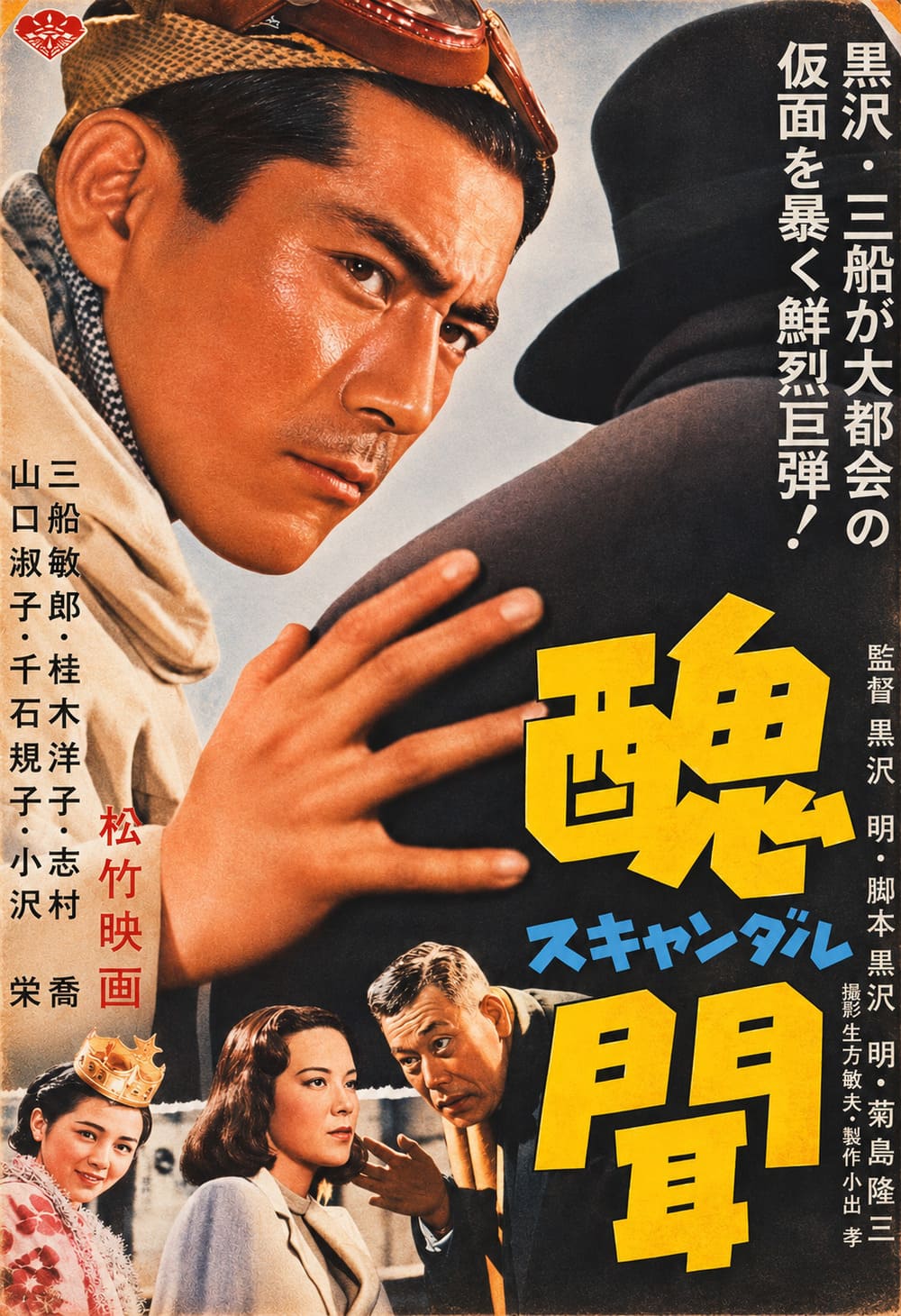
The setup is wonderfully straightforward. Painter Ichiro Aoe, played by Toshiro Mifune, meets popular singer Miyako Saigo, played by Yoshiko Yamaguchi, while out in the mountains. She has missed her bus, and he offers her a motorcycle ride to the hotel where they are both staying. Their casual acquaintance becomes tabloid material when photographers catch them together and a magazine manufactures an affair. Aoe decides to sue. There is nothing especially complicated about the ethical situation, which is partly the point: the magazine doesn’t uncover an uncomfortable truth. It creates a profitable lie and expects its targets to absorb the damage.
Scandal also continues the developing partnership between Kurosawa and Mifune, who first worked together on Drunken Angel (1948). Their collaboration would eventually encompass sixteen films, ending with Red Beard (1965), rather than extending throughout their lives. Here, you can already appreciate how effectively Kurosawa channels Mifune’s physical confidence. His Aoe seems comfortable taking up space, whether riding his motorcycle or confronting people who mistake shamelessness for professional initiative. The characterization can feel a little too spotless, but Mifune makes righteousness feel less like a lecture than it might have in another actor’s hands. You believe he would turn a personal insult into a fight over principle because backing down seems physically impossible for him.
The film is sharpest about the gap between an image and the story attached to it. A photograph appears to offer proof, but the magazine supplies the meaning, turning proximity into intimacy and ordinary friendliness into sexual intrigue. That makes Scandal feel contemporary without requiring any strained comparison to social media. Its real subject, at least initially, is the business of directing public attention. Accuracy is inconvenient when insinuation sells. Unfortunately, the magazine’s villainy is presented so broadly that the argument sometimes becomes dramatically easy. Kurosawa knows exactly where he stands, but leaves little room for the opposition to reveal anything unexpected.
Then Takashi Shimura enters as Hiruta, the shabby lawyer who takes Aoe’s case, and the film’s center of gravity shifts. Hiruta has gambling debts, a desperately ill daughter, and a talent for recognizing the right thing shortly before doing the wrong one. His vulnerability makes him susceptible to corruption, but it also makes him the most interesting person onscreen. Where Aoe is essentially a fixed moral point, Hiruta is constantly slipping. Shimura gives that instability an uncomfortable intimacy: this isn’t simply a dishonest man waiting to be exposed, but someone forced to keep company with his own disappointment.
That change of focus is both the film’s biggest weakness and its saving grace. As a story about public humiliation, Scandal loses momentum when the lawyer’s private misery takes over. Miyako, in particular, becomes less central than the premise seems to promise, and the consequences of the fabricated romance never receive the sustained attention they deserve. Yet Hiruta introduces the moral uncertainty missing from the opening conflict. The question stops being whether the magazine is wrong and becomes whether a compromised person can still act courageously. That is a richer dramatic problem, even if the transition between the two films feels awkward.
Shimura’s performance also complicates the sentimentality, although it cannot always rescue it. The suffering daughter gives Hiruta’s predicament an emotional urgency that occasionally feels too conveniently arranged. You can sense the screenplay reaching for the audience’s sympathy, then reaching a little farther just to make sure. But Shimura makes shame feel lived-in rather than decorative. His weakness isn’t charming, and the film is better whenever it allows him to be genuinely pathetic. The compassion comes from watching someone who understands his failures without possessing the strength to stop repeating them. That tension gives the melodrama a pulse beneath its obvious machinery.
The Christmas drinking sequence is where that emotional approach comes together most beautifully. Hiruta’s despair opens into a communal singing of Auld Lang Syne, with Aoe eventually joining the surrounding drinkers. On paper, it sounds like an invitation to roll your eyes: broken men, alcohol, a familiar song, the possibility of starting over. In practice, the scene earns its warmth through the fragile movement from individual misery toward shared feeling. Nobody suddenly becomes admirable. For a few minutes, though, the characters can imagine being better than they have been. The scene expresses the film’s faith in redemption more persuasively than its more explicit moral arguments.
Visually, there is plenty to enjoy even when the storytelling gets baggy. The crisp editing and carefully arranged compositions give scenes an assurance that the screenplay doesn’t always possess. Kurosawa can make a public space feel busy without losing the individual trapped inside it. The courtroom material benefits from that sensitivity to crowded environments: photographers and reporters turn a supposed search for truth into another spectacle. The people harmed by publicity must submit to still more publicity to challenge it. That irony is stronger than the fairly conventional courtroom mechanics, and it briefly brings the film’s two competing interests back into alignment.
Coming immediately before Rashomon, also released in 1950, Scandal can look like a modest detour beside a breakthrough. But treating it only as preparation misses its particular appeal. This is Kurosawa working in an openly argumentative, emotionally exposed register, less interested in ambiguity about the original accusation than in the difficulty of living decently afterward. It is not especially subtle, and its redemptive impulses sometimes soften the harder questions it raises. Still, the performances keep those impulses from feeling empty. For all its structural wandering and occasional pleading, Scandal finds something moving in the distance between knowing what is right and finally managing to do it.
Kurosawa-Mifune Collaborations