In 1988’s Rambo III, John Rambo (Sylvester Stallone) has finally found peace. He’s also apparently found a good cosmetologist because his hair looks amazing.
Having destroyed the town of Hope and belatedly won the Vietnam War, Rambo is now living with a bunch of Buddhist monks in Thailand. The only time he fights is so he can win money that he then donates to the monastery. When Sam Trautman (Richard Crenna) and CIA agent Robert Griggs (Kurtwood Smith) show up and ask him to lead a team of mercenaries into Afghanistan, Rambo refuses. Even though Afghanistan is occupied by the same type of Russians that Rambo defeated when he returned to Vietnam, Rambo still refuses. Not even seeing pictures of dead civilians can sway Rambo. Rambo is a man of peace now. Griggs thinks he’s a coward but Trautman understands. However, when Trautman is forced to lead the mercenaries himself, he ends up getting captured by the Russians. Now, Rambo feels that he has no choice but to head to Afghanistan to save the only real friend that he has.
For better or worse, Rambo III is a film of its time. It went into production when the Russians were occupying Afghanistan and they were losing a war with the Mujahideen and several other tribes. (In fact, the Russians actually announced that they would be withdrawing from Afghanistan just a few days before Rambo III opened.) In the best 80s tradition, Rambo spends the majority of this movie blowing up communists. If you’re actually aware of the amount of harm that communism — especially the type that was practiced by the Russians — has actually done to the world, there’s something very satisfying about watching it get defeated by one rugged individualist. You can quote Marx and Lenin all you want. It’s not going to do you any good when Rambo rams into your helicopter with a tank.
At the same time, it’s hard to watch Rambo III without thinking about how some of the Mujahideen (though certainly not all) later formed what would become Al-Qaeda and The Taliban. Though the Russians were repelled, Afghanistan itself fell apart as the tribes that were once (as seen in Rambo III) united in their fight against Russia then turned on each other. And, of course, America itself would later get drawn into its own war in Afghanistan, one that ended with the then-President making an ignominious and chaotic exit, 13 members of the U.S. military being killed during the 2021 Kabul airport attack, and the Taliban once again coming to power.
All of that aside, though, what type of movie is Rambo III? It’s the longest of all the First Blood films and it doesn’t have the emotional power of the first film or the unapologetically over-the-top vibe of the second film. The opening scenes in Thailand almost feel like a parody of a Rambo film. And yet, once the action finally starts, Rambo III is definitely entertaining. As played by Marc de Jonge, the main Russian is so evil that you really do find yourself looking forward to his inevitable one-and-one confrontation with Rambo. Rambo III may not be the best for the First Blood films but it understands that sometimes, it’s just fun to watch the bad guys explode. Speaking of exploding, there’s a scene where Rambo cauterizes a wound with gunpowder. Apparently, after the film came out, someone attempted to do this in real life and blew off his leg. Don’t try to be Rambo, folks. There can be only one.
It’s interesting to see Rambo and Trautman fighting together. Trautman may not be as big as Rambo but he’s still a badass in his own way. Assuming that Trautman was roughly the same age as the actor who played him, he was 60 years old and still withstood Russian torture. In the first film, Trautman took credit for creating Rambo. In the third film, he glad that he did.
“If you want to walk out of this fucking place, you will listen to people who know!” — Spc. Abraham “Doc” Johnson
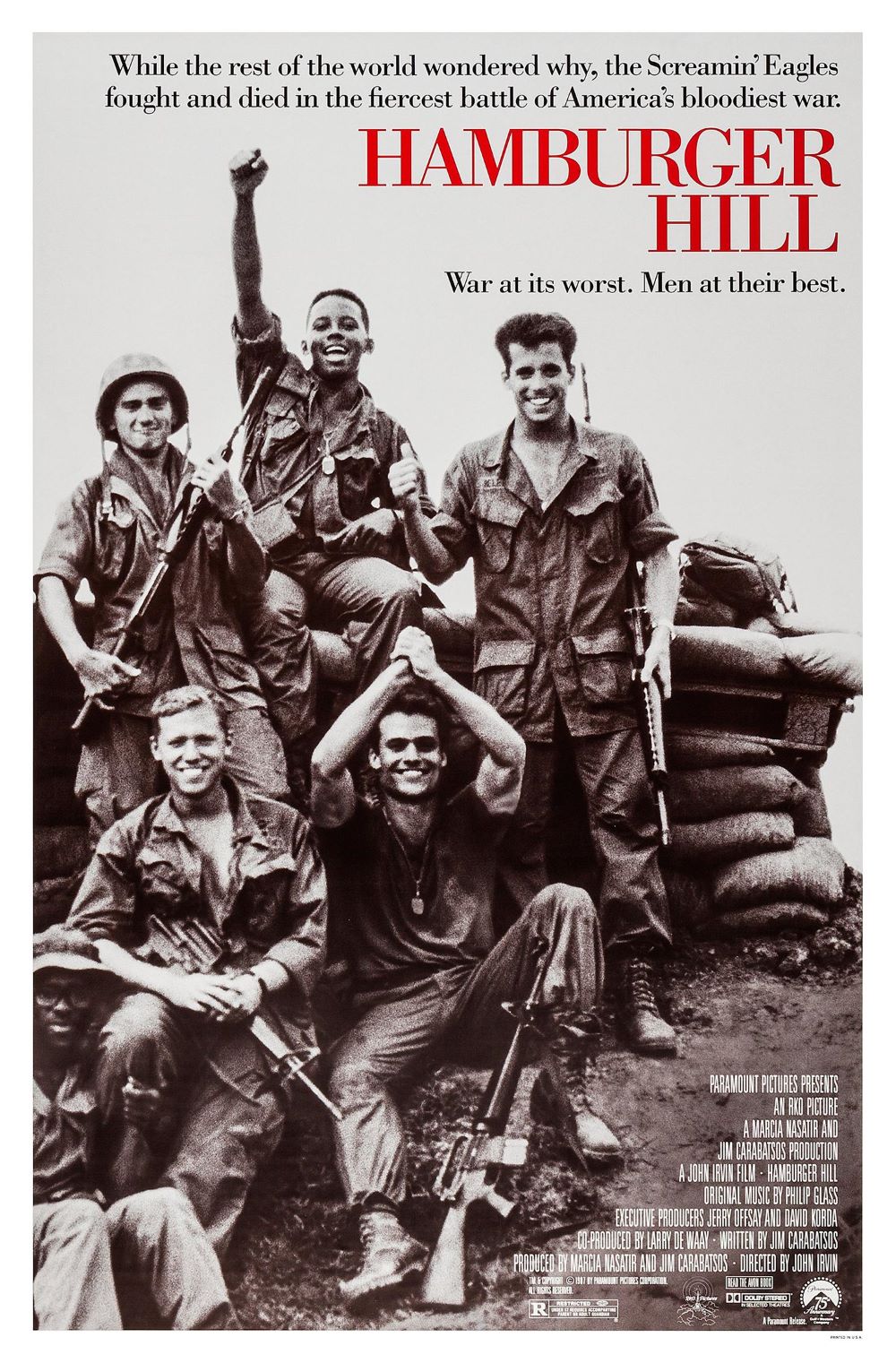
Hamburger Hill is one of those Vietnam War movies that doesn’t really bother decorating the war with grand metaphors or tortured soul‑searching; it just puts you on the hill with the grunts and makes you feel every miserable inch of the climb. Released in 1987 and directed by John Irvin, the film is a fictionalized but tightly focused take on the real week‑long “Battle of Hamburger Hill” in the A Sầu Valley, a piece of rugged terrain in central Vietnam that saw some of the bloodiest fighting between U.S. and North Vietnamese Army (NVA) forces in May 1969. The movie dramatizes the 101st Airborne’s 3rd Battalion, 187th Infantry Regiment as they’re ordered to assault a heavily fortified hill over and over again, and it leans hard into the idea that the battle is less about grand strategy and more about raw endurance and attrition.
One of the first things that strikes you about Hamburger Hill is how deliberately it avoids big stars and splashy heroics. The ensemble is made up mostly of young, relatively unknown actors, which ironically makes the cast feel more authentic. You’re not watching a famous movie star playing a grunt; you’re watching a squad of guys who could actually be kids your age sent halfway across the world to die in the mud. The central figure is second‑lieutenant Al Frantz, played by a young Dylan McDermott, who’s stepping up from a desk job into direct combat command. He’s not some infallible war‑hero archetype; he’s earnest, nervous, and visibly out of depth, which makes his slow hardening under fire feel earned rather than heroic. Watching him wrestle with guilt, responsibility, and the absurdity of the orders he’s obeying gives the film a quiet moral backbone without sliding into preachy territory.
The movie is structured around roughly ten days of repeated assaults on “Hamburger Hill,” a soggy, razor‑sharp ridge in the A Sầu Valley that the NVA had turned into a killing zone. Each push uphill is more brutal than the last, and the film doesn’t soften the violence. When someone gets hit, they don’t go down in a graceful slow‑motion shot; they drop suddenly, sometimes mid‑sentence, in a spray of gore that feels uncomfortably real. The script doesn’t fetishize the blood and mud, but it refuses to look away from it either, which makes the whole thing feel like a visceral anti‑glory tract. By the time audiences get to the tenth assault, trudging through torrents of rain and mud while bullets stitch the air around them, the sequence has the effect of a slow, grinding nightmare. It’s less about who’s “winning” and more about the fact that everyone involved is being slowly chewed up by the same machine.
What really keeps Hamburger Hill from feeling like a simple, grim slaughter‑fest is its attention to the characters in the squad. The film invests time in a handful of men—White, Black, and Latino—whose camaraderie, tensions, and private doubts slowly emerge between patrols and firefights. There’s Doc Johnson, the company medic played by Courtney B. Vance, who holds himself together with a veneer of calm professionalism while quietly absorbing the emotional toll of patching up one friend after another. Doc becomes a kind of moral anchor, someone who sees the humanity in every soldier while still recognizing the war’s dehumanizing logic. His presence also lets the film quietly deal with racial friction and class differences without turning them into tidy, feel‑good sermons. The way the soldiers talk over each other, argue about politics back home, and joke about their own fear turns squad life into a cramped, sweaty microcosm of America itself.
The political backdrop of the late‑Vietnam era is always in the background, too. The men occasionally hear distorted chunks of anti‑war protests and news coverage over the radio, and you can see how that information chips away at their sense of purpose. Some of the older soldiers, like the gruff Sgt. Worcester played by Steve Weber, have already lost whatever idealism they might have had and just want to get through the next day. Newer guys, meanwhile, are still wrestling with why they’re there at all, and whether the hill they’re dying for means anything to anyone back in the States. The film doesn’t answer those questions directly; it just lets you feel the uncertainty. That ambivalence is part of what makes Hamburger Hill feel historically grounded. It’s less interested in telling you who was right or wrong in the Vietnam War and more interested in showing what it actually felt like to be a small‑arms infantryman in late‑1969, during one of the bloodiest stretches of fighting in the A Sầu Valley.
Visually, the movie leans into a muddy, washed‑out palette that makes the Philippines‑standing‑in‑for‑Vietnam locations feel appropriately oppressive. The hill itself—the real‑life “Hamburger Hill” in the A Sầu Valley—is a constant, looming presence: slick with rain, choked with barbed wire, and studded with foxholes and bunkers. The camera often stays at ground level, jostling with the soldiers as they crawl, scramble, and stumble upward, which makes the terrain feel like an active enemy. The sound design is similarly unglamorous—gunfire isn’t especially stylized, explosions are chaotic rather than cool, and the constant hiss of rain and distant artillery keeps the film in a state of low‑grade dread. Even the score, a Philip Glass–style arrangement of repetitive, slightly unnerving motifs, adds to the feeling of being trapped in a loop of violence you can’t escape. Everything in the film is built to make the combat feel routine, exhausting, and numbing, rather than spectacular.
Another thing Hamburger Hill handles surprisingly well is the way it dovetails the physical horror of the battle with the men’s private lives back home. In quieter moments between attacks, the soldiers talk about girlfriends, family, and their plans for “after the war,” even though, for some of them, those plans are clearly not going to happen. The film doesn’t milk this stuff for melodrama; instead, it floats just beneath the surface, turning every casual conversation into a quiet pre‑eulogy. When someone makes a joke about getting back to Chicago or New York or wherever they’re from, the line feels both genuine and heartbreaking, because you know the movie might quietly erase that future a few scenes later. That low‑key sense of fragility makes the emotional impact of each death feel more personal, because the film has already taken the time to show you who these guys are when they’re not being shot at.
Narratively, the film doesn’t try to convince you that taking the hill is some great strategic triumph. If anything, it’s openly skeptical about the rationale behind the whole operation. The soldiers keep getting told to “take it, hold it, then fall back,” and the repetition of that order drives home the sense that the hill is more of a symbolic goal than a tactical necessity. The film doesn’t stage a big, dramatic monologue about this; it just lets the repetition of the mission, the rising body count, and the unanswered questions hang in the air. That choice aligns Hamburger Hill more with a film like Apocalypse Now or Full Metal Jacket in spirit, even though its tone is far more straightforward and less stylized. It’s less interested in mythmaking and more interested in capturing the eerie timelessness of infantrymen being sent to die for reasons they don’t fully understand, during one of the fiercest set‑pieces of the Vietnam War.
In terms of its legacy, Hamburger Hill often gets overshadowed by Oliver Stone’s Platoon, which came out a year earlier and snagged the Oscars’ attention. But in a lot of ways, Irvin’s film is a grittier, more unsentimental companion piece. It doesn’t try to map the Vietnam War onto a single moral allegory, and it doesn’t give you a hero to latch onto and cheer for. Instead, it gives you a squad of men, flaws and all, and asks you to watch them go through hell while trying to keep their foothold on each other. That ensemble‑driven approach, combined with the unrelenting realism of the battle sequences, is what makes Hamburger Hill feel like less of a “movie” and more like a grim, ground‑level documentary rooted in the real‑world horror of the Battle of Hamburger Hill.
By the end, the film doesn’t offer a clean sense of resolution. The soldiers do eventually take the hill, but the victory is so hollow and so costly that it hardly feels like a win at all. The last few scenes linger on survivors looking shell‑shocked and exhausted, many of them quietly wondering what the point of it was. The movie doesn’t spell that out in a clumsy voice‑over; it trusts you to feel the absurdity and the weight of what they’ve been through. That refusal to wrap things up with a neat moral bow is one of Hamburger Hill’s strengths. It understands that sometimes the most honest thing a war film can do is show you the damage and then leave you with the questions.
In the crowded field of Vietnam War movies, Hamburger Hill stands out because it strips away the spectacle and just focuses on the brutal, day‑to‑day reality of trying to take a piece of ground that probably shouldn’t matter as much as it does. It’s not a flashy, revolutionary film, but it’s a stubbornly honest one, anchored in the real‑world carnage of the week‑long Battle of Hamburger Hill in the A Sầu Valley. It’s a movie that would rather make you feel the mud squeeze between your toes, hear the too‑close sound of automatic fire, and watch the faces of guys who’ve run out of explanations for why they’re still climbing. If you’re looking for a Vietnam film that doesn’t sugarcoat the war or overdress it in symbolism, Hamburger Hill is the kind of movie that sticks with you precisely because it doesn’t try to be anything more than what it is: a raw, claustrophobic portrait of a squad walking into a meat grinder, one rain‑soaked step at a time.