The image at the top of this post is taken from the film Cut Bank and features Teresa Palmer and Liam Hemsworth. It’s a striking picture, isn’t it? If there’s anything positive that can be said about Cut Bank, it’s that it’s a visually striking film. Some of the film’s images compare favorably with the work of the Coen Brothers in No Country For Old Men and Fargo.
(Perhaps not surprisingly, the film’s director, Matt Shakman, previously directed two episodes of the Fargo tv series.)
Of course, it’s not just the film’s visual style that will remind you of the Coens. The plot is full of Coen DNA as well and that’s a bit of a problem. The thing that sets the Coen Brothers apart from other directors is that only they seem to understand how to best pull off their unique brand of ironic quirkiness. It’s difficult to think of any other director who could have done A Serious Man,Burn After Reading, or any other Coen film. It’s telling that whenever other directors have attempted to film a Coen Brothers script — whether it was Angelina Jolie with Unbroken or Steven Spielberg with Bridge of Spies — the resulting film has almost always been overwhelmingly earnest. (If you try, you can imagine a Coen-directed version of Bridge of Spies, one with Josh Brolin in the Tom Hanks role, Steve Buscemi as Rudolph Abel, and maybe Bruce Campbell as a CIA agent.) The Coen style is one that has inspired many a director but ultimately, it seems to be something that only the Coens themselves are truly capable of pulling off.
(Though Ridley Scott came close with the underrated The Counselor…)
Plotwise, Cut Bank has everything that you would normally expect to find in a Coen Brothers film. For instance, it takes place in Cut Bank, Montana and, much as in Fargo and No Country For Old Men, a good deal of time is devoted to detailing the oddness of life in the middle of nowhere. Also, much as in Fargo and No Country For Old Men, the entire film revolves around an overly complicated crime gone wrong.
Dwayne McLaren (Liam Hemsworth) has spent his entire life in the Montana town of Cut Bank and is looking for a way to get enough money to move out to California with his beauty pageant-obsessed girlfriend, Cassandra (Teresa Palmer). Dwayne learns that the U.S. Postal Service will pay a reward to anyone who provides information about the death of a postal worker. One day, while filming one of Cassandra’s pageant audition videos, Dwayne accidentally films both the shooting of mailman Georgie Wits (Bruce Dern) and the theft of his mail truck.
Wow, what luck!
Sheriff Vogel (John Malkovich) throws up as soon as he hears about the murder. After all, he’s never had to investigate one before. Town weirdo Derby Milton (Michael Stuhlbarg) is upset that the stolen mail truck contained a parcel that he was waiting for. Meanwhile, Big Stan (Billy Bob Thornton), who happens to be both Cassandra’s father and Dwayne’s boss, seems to be suspicious about how Dwayne just happened to be in the field at the same time that Georgie was getting killed…
Dwayne’s efforts to collect his reward are stymied by the fact that postal inspector Joe Barrett (Oliver Platt) doesn’t want to hand over any money until Georgie’s body has been found. Unfortunately, it’s going to be difficult for anyone to find Georgie’s body because Georgie is still alive! That’s right — Georgie’s been working with Dwayne the whole time…
Meanwhile, it turns out that Derby is not someone you want to mess with. In fact, he’s just as efficient a killing machine as Javier Bardem in No Country For Old Men. And Derby is determined to retrieve his parcel…
Cut Bank got an extremely limited release in April of this year and it didn’t get much attention. To a certain extent, I can understand why. It’s a film that has its moments but ultimately, it’s never as good as you want it to be. The best thing about the film is that it features a lot of eccentric actors doing their thing. Any film that allows Bruce Dern to interact with Michael Stuhlbarg deserves some credit. Unfortunately, Dwayne and Cassandra are not particularly interesting characters and Hemsworth and Palmer give rather one-dimensional performances. Since you don’t care about them, you don’t really care if Dwayne’s scheme is going to work out. William H. Macy may have been a despicable loser in Fargo but you could still understand what led to him coming up with his phony plan and you felt a strange mix of sympathy and revulsion as everything spiraled out of his control. The same can be said of Josh Brolin in No Country For Old Men. Dwayne, however, just comes across like someone who came up with a needlessly complicated plan for no good reason.
In 2013, the script for Cut Bank was included as a part of the Black List, an annual list of the “best” unproduced scripts in Hollywood. What’s odd is that, for all the hype that goes along with being listed, Black List scripts rarely seem to work as actual films. Oh sure, there’s been a few exceptions. American Hustle was on the Black List, for instance. But a typical Black List film usually turns out to be something more along the lines of The Beaver or Broken City. Watching Cut Bank, I could see why the script generated excitement. The story is full of twists and all of the characters are odd enough that I’m sure readers had a lot of fun imagining which beloved character actor could fill each role. Unfortunately — as so often happens with Black List films — the direction does not live up to the writing. Yes, the plot is twisty and there’s a lot of odd moments but the film never escapes the long shadow of the films that influenced it.
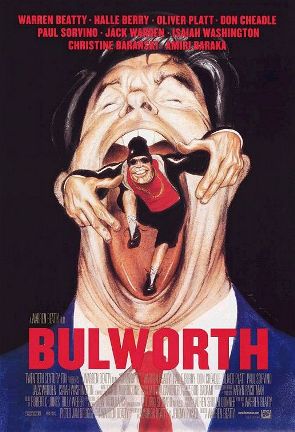
So, if you’ve ever wondered what happened to Robert Redford’s Bill McKay after he was elected to the U.S. Senate at the end of The Candidate, I imagine that he probably ended up becoming something like the protagonist of 1998’s Bulworth, U.S. Sen. Jay Bulworth.
As played by Warren Beatty, Bulworth is a veteran senator. A former liberal firebrand, he may still decorate his office with pictures of him meeting Bobby Kennedy and Martin Luther King but Bulworth sold out a long time ago. Now, he just says whatever has to say in order to get elected, including pretending to have a happy marriage. He has become a part of everything that’s wrong with Washington.
Sick of both politics and life in general, Bulworth decides that he’d rather be dead. But, in order to make sure that his daughter collects on his $10,000,000 life insurance policy, Bulworth cannot commit suicide. Instead, he arranges for a contract to be taken out on his life. In two days, Bulworth will be assassinated.
Returning to California for his campaign, Bulworth gets drunk and suddenly starts to say what he actually believes. He attacks the Washington establishment. He attacks the voters. He attacks the insurance companies and comes out for single payer health insurance. With his desperate press secretary (Oliver Platt) chasing behind him, Bulworth spends the night dancing at a club where he discovers marijuana and meets a girl named Nina (Halle Berry).
(Platt, meanwhile, discovers that he really, really likes cocaine.)
Soon, Nina and Bulworth are hiding out in the ghetto, where Bulworth meets both Nina’s brother (Isiah Washington) and local drug dealer, L.D. (Don Cheadle), and gets a lesson about how economics actually work in the ghetto. Soon, Bulworth is appearing on CNN where he raps his new political platform and suggests that the solutions for all of America’s problems would be for everyone to just keep having sex until eventually everyone is the same color.
Of course, what Bulworth doesn’t know is that Nina also happens to be the assassin who has been contracted to kill him…
I have mixed feelings about Bulworth. On the one hand, the film starts out strong. You don’t have to agree with the film’s politics in order to appreciate the film’s passion, Bulworth is an angry film and one that’s willing to say some potentially unpopular things. It’s a film about politics that doesn’t resort to the easy solutions that were proposed by some of the other films that I’ve reviewed for Shattered Politics. Warren Beatty does a pretty good job of portraying Bulworth’s initial mental breakdown and Oliver Platt is a manic wonder as he consumes more and more cocaine.
But, once Warren Beatty starts rapping, the film starts to fall apart and becomes a bit too cartoonish for its own good. You get the feeling that Warren Beatty, at this point, is just trying to live out the liberal fantasy of being the only wealthy white man in America to understand what it’s like to be poor and black in America.
Bulworth starts out well but ultimately, it begins better than it ends.
First released in 1993 and something of a perennial on AMC, Indecent Proposal tells the story of David (Woody Harrelson) and Diane (Demi Moore), two kids who meet in high school, get married, and end up living what, in Hollywood, passes for an average, middle class lifestyle — which is to say, Diane is a successful real estate broker, David is an architect, and they’re in the process of building their dream house on the beach. (Just like everyone else you know, right?) However, the economy goes bad, David loses his job, and they find themselves deep in debt.
Desperately, they decide to take a gamble. Literally. They go to Las Vegas and, at first, it seems like everything’s going to be alright. David has a run of luck and makes a lot of money. They make so much money that David and Diane end up having sex on top of it. Now, I have to admit, if I ever won $25,000 dollars in Vegas, I would probably spread it on a bed and roll around naked on it as well. But only if it was paper money. Coins would probably be uncomfortable and I’d hate to end up with a hundred little impressions of George Washington’s profile running up and down my body.
But anyway, David and Diane make the mistake of sticking around in Vegas for a second day and they end up losing all of the money that they previously won and you better believe that when the chips are pulled away, Diane is shown trying grab them in slow motion while going, “Noooooo!” Soon, David and Diane are sitting in an all-night diner and trying to figure out what to do next. A waitress overhears them and sadly shakes her head. Obviously, she’s seen a lot of movies about Las Vegas.
Anyway, this movie is too dumb to waste this many words on its plot so let’s just get to the point. David and Diane meets John Gage (Robert Redford), a millionaire who offers to give David a million dollars in exchange for having one (and only one) commitment-free night with Diane. David and Diane agree and then spend the rest of the movie agonizing over their decision. Eventually, this leads to Diane and David splitting up, John Gage reentering the picture and proving himself to be not such a bad guy, and David eventually buying a hippo.
It’s all really dumb.
Anyway, I was planning on making quite a few points about this set-up but, quite frankly, this film is so dumb that I’m getting annoyed just writing this review. So, instead of breaking this all down scene-by-scene, I’m just going to point out a few things and then move on to better melodramas.
1) Every character in the movie has a scene where they eventually ask what we (the viewing audience) would do if we were in a similar situation. “Would you have sex for a million dollars?” Well, let’s see. Basically, the deal seems to be that you have safe, non-kinky, missionary position sex with a millionaire who you will never have to see again after you get paid. And you’re getting a million dollars in return. Would I do it? OF COURSE, I’D DO IT! It’s a million dollars, it’s just one night, and it’s not like you’re being asked to fuck Vladimer Putin or something. If the film wanted to create a true moral dilemma, they should have cast someone other than Robert Redford as John Gage and they should have had Gage propose something more than just one night. If Gage had been played by an unappealing actor (or perhaps if the film were made today with Redford looking as craggly as he did in Capt. America or All Is Lost) or if it had been a million dollars for Diane to serve as a member of Gage’s harem for a year, the film would have been far different and perhaps not any better but at least all of the subsequent angst would have made sense.
2) What really annoyed me is that, after Diane returns from her night with Gage, neither she nor her husband ever cash that million dollar check. If you’re going to agree to the stupid deal, at least take advantage of it.
3) Finally, why would you accept a check for something like that? Did Gage write, “For letting me fuck your wife” in the memo line? Why not get paid in cash so, at the very least, you don’t have to deal with IRS?
During my sophomore year of college, I had a political science professor who, every day of class, would sit on his desk and ramble on and on and on about his past as a political activist. He protested Viet Nam, he hung out with revolutionaries, he loved Hugo Chavez, and I assume he probably had a Che Guevara poster hanging in his office. Whenever he wanted to criticize George W. Bush, he would compare him to Richard Nixon and then pause as if he was waiting for the class to all start hissing in unison. He always seemed to be so bitterly disappointed that we didn’t. What he, and a whole lot of other people his age, didn’t seem to understand was that Richard Nixon was his boogeyman. The rest of us could hardly care less.
That was the same problem that faced the 2008 best picture nominee Frost/Nixon.
Directed rather flatly by Ron Howard, Frost/Nixon tells the true story about how a light-weight English journalist named David Frost (played by Michael Sheen) managed to score the first televised interview with former President Richard Nixon (Frank Langella). Both Frost and Nixon see the interviews as a chance to score their own individual redemptions while Frost’s assistants (played by Oliver Platt and Sam Rockwell) see the interview as a chance to put Richard Nixon on trial for Watergate, the Viet Nam War, and every thing else under the sun. That may not sound like a very exciting movie but it does sound like a sure Oscar contender, doesn’t it?
I’ve always secretly been a big history nerd so I was really looking forward to seeing Frost/Nixon when it was first released in 2008. When I first saw it, I was vaguely disappointed but I told myself that maybe I just didn’t know enough about Richard Nixon or Watergate to really “get” the film. So, when the film later showed up on cable, I gave it another chance. And then I gave it a chance after that because I really wanted to like this film. Afterall, it was a best picture nominee. It was critically acclaimed. The word appeared to be insisting that this was a great film. And the more I watched it, the more I realized that the world was wrong. (If nothing else, my reaction to Frost/Nixon made it easier for me to reject the similarly acclaimed Avatar a year later.) Frost/Nixon is well-acted and slickly produced but it’s not a great film. In fact, Frost/Nixon is epitome of the type of best picture nominee that inspires people to be cynical about the Academy Awards.
Before I get into why Frost/Nixon didn’t work for me, I want to acknowledge that this was a very well-acted film. By that, I mean that the cast (Frank Langella, Michael Sheen, Kevin Bacon, Sam Rockwell, and Oliver Platt) all gave very watchable and entertaining performances. At the same time, none of them brought much depth to their characters. Much like the film itself, nobody seems to have much going on underneath the surface. Frank Langella may be playing a historic figure but, ultimately, his Oscar-nominated performance feels like just a typically grouchy Frank Langella performance. Michael Sheen actually gives a far more interesting performance as David Frost but, at the same time, the character might as well have just been identified as “the English guy.” In fact, a better title for this film would have been The Grouchy, the English, and the Superfluous.
For all the time that the film devotes to Rockwell and Platt blathering on about how they’re going to be giving Richard Nixon “the trial he never had,” this film is ultimately less about politics and more about show business. Ron Howard devotes almost as much time to the rather boring details of how the interviews were set up and sold into syndication as he does to the issues that the interview brings up. Unfortunately, for a movie about show business to succeed, the audience has to believe that the show is one that they would actually enjoy watching, This, ultimately, is why Frost/Nixon fails. While the filmmakers continually tell us that the Frost/Nixon interviews were an important moment in American history, they never show us. Yes, everyone has hideous hair and wide lapels but, otherwise, the film never recreates the period or the atmosphere of the film’s setting and, as a result, its hard not to feel detached from the action happening on-screen. For all the self-congratulatory claims made at the end of the film, it never convinces us that the Frost/Nixon interviews were really worth all the trouble. Much like my old poli sci professor, Frost/Nixon never gives us a reason to care.
For a far more interesting and entertaining look at the Watergate scandal, I would recommend the 1976 best picture nominee All The President’s Men. Recreating the story of how two Washington Post reporters (played by Robert Redford and Dustin Hoffman) exposed the Watergate scandal that eventually led to Nixon’s resignation, All The President’s Men is the movie that Frost/Nixon wishes it could be. Despite being made only two years after Watergate, All The President’s Men doesn’t take the audience’s interest for granted. Instead, director Pakula earns our interest by crafting his story as an exciting thriller. Pakula directs the film like an old school film noir, filling the screen with menacing shadows and always keeping the camera slightly off-center. Like Frost/Nixon, All The President’s Men is a well-acted film with a bunch of wonderful 70s character actors — performers like Ned Beatty, Jason Robards, Jack Warden, Martin Balsam, and Robert Walden, and Jane Alexander — all giving effectively low-key and realistic performances. The end result is a film that manages to be exciting and fascinating to those of us who really don’t have any reason to care about Richard Nixon or Watergate.
Both of these two films were nominated for best picture. Frost/Nixon quite rightly lost to Slumdog Millionaire. All The President’s Men, on the other hand, lost to Rocky.
When one sees the name Roland Emmerich attached as the director to a film on any given year one almost has to audibly groan. He’s not on the level of Uwe Boll in terms of awful films, but he does give Michael Bay a run for the title of worst blockbuster filmmaker. It’s quite a shame to see Emmerich’s films one after the other get worse and worse. This was a filmmaker who showed some talent in the scifi-action genre with such cult classics as Universal Soldier and Stargate. He would reach his apex with the popcorn-friendly and thoroughly enjoyable Will Smith alien-invasion flick, Independence Day. Since reaching those lofty heights each successive film has been more groan-inducing and worse than the previous one. For a brief moment in 2009 this would change as he finally succeeded in destroying the world that he had only hinted at with previous films such as ID4, Godzilla and The Day After Tomorrow. The film 2012 was released in late-2009 and, while it was universally lambasted by critics and a large portion of the public, I thought it was his most fun film since ID4.
2012 literally has the world greet it’s apocalypse according to the Mayan Calendar in the year 2012. The first forty or so minutes has Emmerich explaining the details of how the world will end in 2012 either through the film’s lead scientist (played by Chiwetel Ejiofor) or through a conspiracy-theorist played with manic glee by Woody Harrelson. The bulk of this film is almost like disaster porn for film lovers who are into disaster flicks. We have earthquakes which sends the whole California coast sliding into the Pacific. Supervolcanoes erupting in what is the Yellowstone National Forest right up to mega-tsunamis that dwarf the highest mountain ranges.
The cast might be called an all-star one, but I rather think it’s more a B-list with such names as John Cusack playing a goofy everyman who must save his ex-wife and two young children right up to Danny Glover playing the lame duck of lame duck presidents (I guess Morgan Freeman was unavailable or already done with disaster films after doing Deep Impact). The performance by this cast ranged from alright to laughable, but even with the latter the sense of fun never wavered. This was a flick about the world ending and Emmerich delivered everything promised.
It’s the scenes of world devastation which made this film so enjoyable for me and has become one of my latest guilty pleasures. No matter how bad the dialogue got or how wooden some of the acting came off the sense of wonder from Emmerich destroying the world on the big-screen and on my TV made this film fun to watch. Maybe those who hated it or thought it was trash were aiming to high. I will admit that the film is trash, but in a good way that past enjoyable disaster flicks of the 70’s were fun. It took the premise serious enough, but the filmmakers involved didn’t skimp on over-the-top destruction. I mean this film’s premise means we get to see in high-definition billions of people die as the planet decides to suddenly switch things around to get a better feng shui vibe to the planet.
Scenes such as the mega-tsunamis topping over the Himalayan mountain range was awesome. But even that scene couldn’t top the super-quake which destroys Los Angeles around Cusack’s character who tries to outdrive the quake and the resulting chasms which appear to chase his limo with is family inside. Seeing Los Angeles and the bedrock it’s on upheave and slide into the Pacific was one of the best disaster porn sequences I’ve ever seen and I don’t see anything topping it in the near future.
2012 as a Roland Emmerich production already has a black mark on it because of his reputation as a filmmaker, but for once he actually made a film that was able to surpass all the glaring flaws from it’s one-note, stereotypical characters to it’s wooden dialogue. He did this by making a film with disaster scenes of such epic spectacle that one had no choice but to just sit back and enjoy the ride. It’s a bad film, but it sure was a fun ride. This is why I decided on a fan-made trailer which best exemplifies this film and not the one made by the studio.
I eagerly await the sequel I fully expect from Hollywood: 2013:Disaster Strikes Back.
The name Matthew Vaughn should be familiar with comic book fans everywhere. In 2005, Vaughn was introduced as the director to replace Bryan SInger for the third film in the X-Men franchise. The news was met with some cautious optimism. This was a filmmaker who had quite the loyal and growing following for his work on Stardust and Layer Cake. Months after he was picked my 20th Century Fox news came down that he was backing out of the project due to personal reasons and the film scrambled for a replacement which ended up being Brett Ratner. History was made that day as the beginning of the franchise’s decline began and steep plummet which recently reached it’s nadir with 2009’s Wolverine: Origins.
It’s has now been five years since X-Men: The Last Stand made it to the big-screen and now we have a new film in the franchise. X-Men: First Class has a familiar name behind the director’s seat and it looks like Matthew Vaughn stayed this time around (after directing a smaller superhero film in Kick-Ass for 2010) to craft what could become the best film in the X-Men/Wolverine film franchise. This film is a prequel/reboot of sorts (more on that later) and brings a fresh set of eyes and take on the origin story of this franchise.
X-Men: Last Stand actually begins the film exactly how the first X-Men film began with the 1944 World War II concentration camp setting where a young Erik Lensherr (later to become Magneto) finally manifests his power over magnetic fields as he watches his parents torn from his side. The first film ended that sequence once Erik was knocked out, but this time around it continues with a mysterious man named Schmidt (aka Sebastian Shaw and played with James Bond villainous-flair by Kevin Bacon) taking great interest in Erik and his ability which Erik could only use during bouts of pain and anger. The film continues this slight change in the series’ origins by switching over to Westchester County and into the expansive home of a young Charles Xavier who finds a certain young, blue-skinned shapeshifter named Raven who he invites to stay and become his friend once he realized he wasn’t the only one who was different and with abilities.
These two sequences continue to move the film forward as the we see these two “leaders in the making” adults and trying to find their place in the world of the free-swinging lifestyle and the Cold War culture of the 1960’s. Charles Xavier (played like a well-meaning cad and good-natured naivete about the world by James McAvoy) is a student working on his doctorate in Oxford on genetic theories while his “sister” Raven (Jennifer Lawrence) accompanies him. This is a Xavier who still hasn’t found the patient benevelonce of Patrick Stewart’s Professor X and uses his considerable telepathic abilities to help him pick up on beautiful coeds instead. It’s during such a scene where we see Raven show just a hint of jealousy as Xavier tries his lines and moves on a beautiful British lass. It would seem Raven’s feelings for her ‘brother” may go beyond sibling affection though Xavier doesn’t see her as anything other than a sister for him to protect.
Erik Lensherr’s time as an adult was shown as having become a life of obsession over his treatment at the hands of the Nazi’s and those of Schmidt’s as he travels the world in search of escaped Nazi war criminals. Erik takes him throughout South America as he finds the trail of Nazis hiding out in that region since the end of the war. We see this adult Erik hardened by his anger and single-minded need for revenge on Schmidt and those he worked for. He’s not above using his abilities to kill in order to get the information he requires and there’s a hint of satisfaction when he does kill those he sees as responsible for his tragic upbringing with his magnetic abilities. These two adult sequences continues the film’s theme of the ideological difference between Xavier and Erik being formed through nature and nurture as their lives moved down diverging paths from an early beginning until it convergence for a small, brief period around the time of the Cuban Missile Crisis.
The film’s second act begins with Moira McTaggart (Rose Byrne), now a covert CIA Agent, investigating a certain Col. Hendry who she suspects as having betrayed the nation to the Soviets, but instead finds out that the true nature of Hendry’s associations were much more insidious and dangerous. The iconic Hellfire Club of the comics finally make their appearance with Schmidt who actually happens to be Sebastian Shaw (whose powers grant him the ability to absorb all kinetic energy which he uses to keep himself young and can release with explosive results), Emma Frost (January Jones) who’s a telepath with the ability to turn body in a sort of diamond-form, Riptide who can create tornado-like abilities and finally the demonic-looking Azazel whose ability to teleport might give people not well-versed in the “X-Men Universe” a clue as to one-half of parents who may be responsible for Nightcrawler in the second film.
X-Men: First Class spends much of this second act like it was Ocean’s 11 as Xavier and Erik get recruited by the CIA to find other mutants and create their own mutant team to counter Sebastian Shaw’s Hellfire Club and his goal of initiating World War III between the US and the USSR and thus destroy all of humanity and leave the planet for the mutants to rule over. Yeah, it is this part of the film’s plot which may strain the suspension of disbelief for some audiences who never grew up reading the comics, but it shouldn’t. Ian Fleming’s James Bond series used scenarios just as ludicrous with villains just as Machiavellian in the form of SPECTRE so X-Men: First Class and it’s world domination plans shouldn’t be too farfetched to fans of that British superspy and his adventures.
This middle section of the film is where X-Men: First Class actually begins to lag after a strong first act. I don’t know if the sequences of the new recruits training, bonding and learning how to use their powers could’ve been written to move much faster without losing some of the character building scenes. From how this second act played it seemed to look like scenes were actually cut out to try and keep the film from being too long (it’s final cut being just a tad over two hours already upon release), but I wouldn’t be surprised if the DVD/Blu-Ray release actually has a director’s or uncut version that actually expands this middle section to really give life to it instead of having it play out like a perfunctory training montage with a dash of character beats.
The film hits it’s action-film stride with the third and final act as Xavier and Erik’s team of young mutants must now use their abilities to stop Shaw and his Hellfire Club and at the same time prevent World War III from beginning and not freaking out the humans who are still unaware of their existence as a whole. It’s this third section which we see too much of it in the trailers and tv spots that one might say we’ve seen it all before we even see the film as a whole, but it still kept back a lot from those ads to make the whole final twenty minutes of the film thrilling and action-packed.
All of this could just mean that X-Men: First Class was just your run-of-the-mill superhero action film that we get on a yearly basis come summertime, but it’s a testament to Matthew Vaughn’s direction and the strength of the script by Vaughn, longtime collaborator Jane Goldman and Thor scribes Ashley Edward Miller and Zack Stentz that the film goes beyond being just an action film with all it’s sturm und drang coupled with fancy special effects. The previous films in the series always explored important cultural and moral themes that’s always been the bread-and-butter of the X-Men stories in the comic books. We just don’t see the film explore the ideological difference between Xavier’s peaceful co-existence between humans and mutants alike, but also we get more detail on why Magneto finally comes to the conclusion that war between humans and mutants was an inevitability and why his stance doesn’t fall under the aegis of being evil, but something that anyone could understand and even support whether one was human or mutant.
The story also doesn’t just pay lip-service to the idea of how mutants view themselves and how even within the mutant community there’s a visible rift between those whose abilities are invisible to the general population and those whose abilities and genetic mutation physically manifest themselves in such ways that to many might not look to appealing. This idea really gets a major exploration in the subplot involving Raven (soon to be Mystique), Hank McCoy and, to a certain degree, Xavier and Erik. We see how those like Xavier whose abilities don’t show in a physical manner have a sort of “don’t ask, don’t show” about those like Raven when it comes to their power when in public.
Raven (played beautifully by Jennifer Lawrence) is caught between Xavier who wants her to remain incognito so as not to shock the world too soon in realizing that mutants exists and that of Erik who sees Raven’s original blue-skinned form as beauty and perfection and how she should never hide who she truly is. This tug and pull between her two mentors makes for a convincing subplot in how Raven comes to the conclusion which would take her to the side of Magneto in later films, but also highlight how the two sides in later films have so much intertwining bonds of friendship and relationship that seeing them against each other becomes a tragedy on its own. Civil wars are not just a thing of humans but those who sees themselves apart from them.
The great performances by most of the leads add to the film’s strength. McAvoy and Fassbender, at first, look to be unconvincing in terms of their appearance as the younger versions of Patrick Stewart and Ian McKellen, respectively. This becomes a non-issue once they’ve established themselves through their performances which gives new layers to the personalities of Professor X and Magneto. Many people always saw these two as the comic book version of Martin Luther King, Jr and Malcolm X, but that’s an oversimplification. The film and the performances by McAvoy and Fassbender digs deeper into both their characters’ motivations and ideologies and how their past experiences and upbringing couple with their time together as brothers-in-arms and friends show more about these two than just being mutant-proxies of MLK and Malcolm X. The other young mutants do an adequate enough job that they don’t seem lost in the film. Nicholas Hoult as the young Hank McCoy and how he plays off Lawrence’s Raven during their little subplot in the film is one stand-out that I hope gets explore even more in any follow-up sequel.
There’s a nice burgeoning young love chemistry between him and Lawrence as Beast and Raven that doesn’t seem too tacked on to create a the prerequisite love couple in any film. Their common trait of having physical mutations and how they seem to both feel apart even from their fellow mutants develop their characters in ways the previous films in the series never did. They never want to rid themselves of their mutant powers. They just want to look normal and still keep their abilities. It’s a having your cake and eat it too mentality that has some surprising results for both Raven and Hank.
X-Men: First Class has had some fans of the series put in a very difficult situation. The film definitely is a prequel to the previous films, but it also does a major time in rewriting continuity in the series. I was one of those fans and thought it would ruin the film in the context of the franchise. I’m surprised that in the end I didn’t really care and actually hope that this film actually is a reboot of the franchise. I see this film and forget the previous three as being part of it. This film was just too good and fun in it the end for continuity issues to become the major flaw that sinks it. I liken this film as similar to Christopher Nolan rebooting the Batman film franchise. That film honored the contributions to the character, but went on it’s own way to tell that character’s tale. I see Vaughn doing the same with this film. He has done something which many thought was a near-impossible task and that’s make the X-Men franchise relevant once more in a pop-culture landscape that seems to have left the franchise behind after the disastrous Wolverine: Origins of 2009.
This film delivered on the ideas that made the comic books so beloved by millions of fans for almost a half-century. It made great use of the 1960’s time and setting to tell a story of these characters beginnings as heroes and villains (though the latter shouldn’t be seen as them being truly just evil bad guys). Even the inclusion of real-world historical event like the Cuban Missile Crisis was a nice touch which gave the film a foundation in realism. Again, this film played off like a superhero, Marvel version of an Iam Fleming James Bond story. For those who are huge fans of the previous films there’s even two brief cameos of those films two favorite characters that appear in this film. They don’t come off as cheesy and unnecessary and actually come off as great additions. I won’t mention who these cameos were but the audience’s reaction to them was very vocal and very positive. I say the same should be said for X-Men: First Class as a film that resuscitates the franchise.
Today we saw the release of the second official trailer for the upcoming X-Men prequel/reboot helmed by British director Matthew Vaughn.
X-Men: First Class looks to show the early days when Professor X and Magneto were still friends and allies instead of the adversarial relationship they had in the first three films in the franchise. This new trailer shows more of the characters who will be involved in this film. It also shows the mutants and their powers in action. I must admit that I wasn’t too thrilled with the previous trailers shown about this film, but this latest shows more action and finally reveals it’s summer blockbuster pedigree. The sequence with Magneto lifting the submarine out of the water was really cool.
It’s still not the superhero film this summer that tops my must-see list, but this trailer has put this film in the running as one of the films I must-see.
X-Men: First Class is still slated to have a June 3, 2011 release.
Of all the Marvel Comic book films coming out this summer it is the one not being made by Marvel themselves which seems to be getting the biggest amount of negative press and buzz from the fans. The last couple weeks has seen pictures from the set either leaked by accident or on purpose to gauge fan reaction. To say that reaction has been underwhelming would be an understatement.
The film is 20th Century Fox Studios latest film on the X-Men franchise. A franchise which is now batting 2-for-4. The first two films in the franchise were thought of as being very good to great and the last two seen as a major mess or just plain awful. Now the fifth film has just released it’s first official trailer and from the look of things it looks to be retconning all the vents which occurred in the first four films. The scenes used for the trailer looked very good and the looks of the many (people complaining about the amount of characters in the third Nolan/Batman film will be apoplectic once they see First Class) characters gives me some hope.
The film has Matthew Vaughn just fresh off of Kick-Ass and it will be up to him to create a gem out of the rough stone people seem to be judging the film at the moment. X-Men: First Class is set for a June 3, 2011 release.




 Through the Shattered Lens