From 1954’s On The Waterfront, here’s the scene that won Marlon Brando his first Oscar.
In 1990, Marlon Brando received his final Academy Award nomination when he was nominated for his supporting performance in 1989’s A Dry White Season.
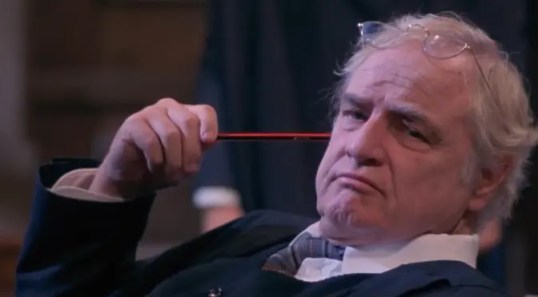
Brando played Ian McKenzie, a human rights lawyer who lives and work in South Africa at the height of the Apartheid regime. When we first see McKenzie, he’s sitting in his office and complaining about how all the flowers surrounding him have given him a permanent allergy. When Ben Du Toit (Donald Sutherland) explains that he’s trying to learn the truth about why his gardener and his gardener’s son both died in the custody of South Africa’s “special branch,” McKenzie replies that bringing the case would be a waste of time. McKenzie makes several dismissive comments about the case and tells Du Toit that pursing the matter would lead to Du Toit becoming a pariah himself. Only when Du Toit says that he’ll just find another lawyer to pursue the manner does McKenzie agree to take the case. His comments may have seemed callous but they were McKenzie’s way of testing Du Toit’s commitment to actually getting to the truth.
Up until the death of his gardener, Ben Du Toit was someone who blindly believed in the system. A former rugby star and a teacher, Ben grew up in South Africa and is proud to call himself a “true African.” (In one of the film’s best scenes, Ben’s driver, Stanley — played by Zakes Mokae, — informs Ben that being an African in South Africa means not being allowed to vote and having to carry identification papers everywhere with him.) When the gardener’s son is first arrested, Ben repeatedly says, “He must have done something.” When Ben’s gardener is arrested, Ben believes that it’s all just a terrible mistake and that he’ll be released soon. Even after the gardener is killed, Ben initially believes the official story that the death was a suicide. It’s only after Stanley takes Ben to the funeral home and shows him the gardener’s tortured body that Ben finally comes to realize that he was tortured to death by Captain Stolz (Jurgen Prochow).
Still, Ben is naive enough to assume that McKenzie will be able to get some sort of justice. In court, McKenzie easily exposes the flaws in Stolz’s story. When Stolz claims that the dead man’s injuries were the result of the man throwing himself against the bars of his cell, McKenzie mentions that the man’s back was injured and then asks if he was throwing himself backwards. Stolz smirks and says that the man was “an animal.” McKenzie may be a brilliant lawyer but it’s a foregone conclusion that he’s going to lose the case. Stolz is exonerated and the expression on McKenzie’s face is one that indicate that he is not surprised at all.
It’s a small role. Brando gets less than ten minutes of screentime but he makes perfect use of them and shows that, even in the latter half of his career, Brando could still give a good performance when he cared about the material. Both Brando and Susan Sarandon took small roles in this anti-Apartheid drama because they believed in the message. Sarandon’s casting is a bit distracting. She never becomes the journalist she’s playing, instead she just seems like a movie star lending her name to a cause that she believes in. But Brando becomes Ian McKenzie and he expertly reveals the absurd lengths to which the Apartheid government will go to excuse its actions.
The majority of the film deals with Ben Du Toit and his slow-awakening about the truth of the country that he calls home. Upon realizing the truth about the country’s government and its actions, Du Toit declares that he can no longer go back to being who he once was and it costs him his family, his home, and ultimately his life. Donald Sutherland does a wonderful job, portraying Du Toit’s growing understanding of what’s actually happening in South Africa. Wisely, the film doesn’t portray Du Toit as being a saint. It fully understands that Du Toit only started to care about Apartheid when it effected somebody that he knew and fortunately, Stanley is always there to call Du Toit out whenever he starts to forget about his own role in supporting the system that he now opposes. It’s a powerful and heartfelt film, one that is well-known for Brando’s performance but works just as well when Brando is off-screen as well.
4 Or More Shots From 4 Or More Films is just what it says it is, 4 shots from 4 of our favorite films. As opposed to the reviews and recaps that we usually post, 4 Shots From 4 Films lets the visuals do the talking!
101 years ago, on this date, Marlon Brando was born in Omaha, Nebraska. One of the greatest of American actors and one of the main reasons why so many young actors became enamored with the Method, Marlon Brando played many roles in our culture. When he was young, he was a Broadway bad boy. When he went out to Hollywood, he became a legitimate movie star. In the 60s, he was a cautionary tale as his career suffered a series of notorious flops. In the 70s, he made a comeback and, in during the final years of his career, he was as known for his eccentricities as for his talent. It’s a shame that those eccentricities overshadowed Brando as an actor. When he wanted to be, he was one of the best to ever appear on stage or in the movies.
In honor of the wonderful, tragic, and talented Marlon Brando, it’s time for….
4 Shots From 4 Marlon Brando Films
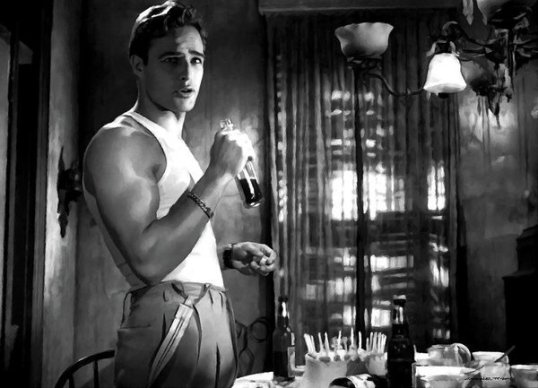
A Streetcar Named Desire (1951, dir by Elia Kazan, DP: Harry Stradling)
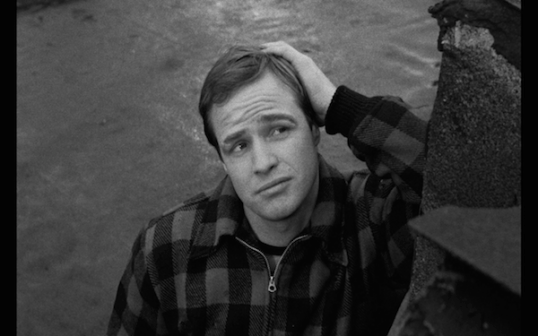
On The Waterfront (1954, dir by Elia Kazan, DP: Boris Kaufman)
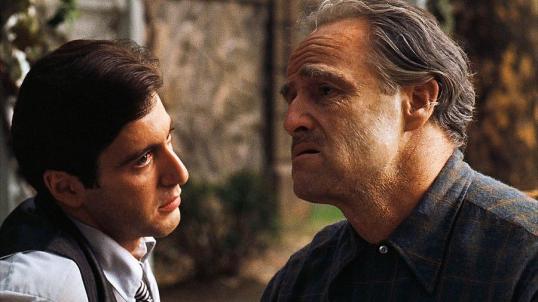
The Godfather (1972, dir by Francis Ford Coppola, DP: Gordon Willis)
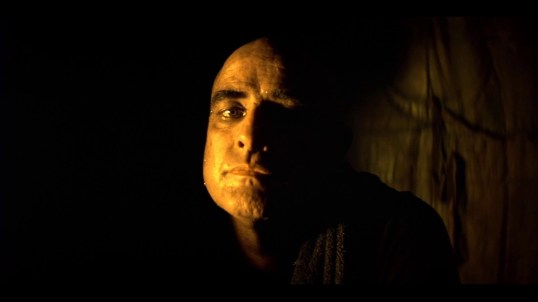
Apocalypse Now (1979, dir by Francis Ford Coppola, DP: Vittorio Storaro)
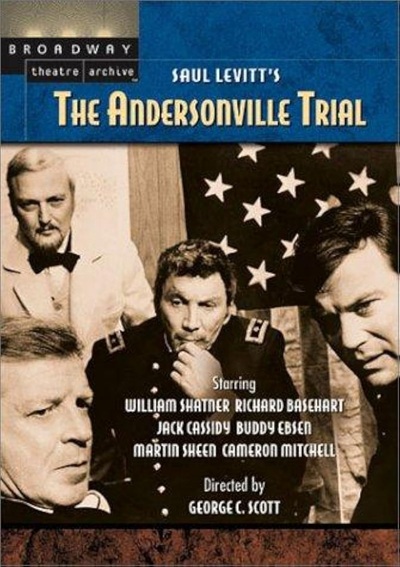
1970’s The Andersonville Trial takes place in one muggy military court room. The year is 1865. The Civil War is over but the wounds of the conflict are still fresh. Many of the leaders of the Confederacy are still fugitives. Abraham Lincoln has been dead for only a month. The people want someone to pay and it appears that person might be Captain Henry Wirz (Richard Basehart).
Originally born in Switzerland and forced to flee Europe after being convicted of embezzlement, Henry Wirz eventually ended up in Kentucky. He served in the Confederate Army and was eventually named the commandant of Camp Sumter, a prison camp located near Andersonville, Georgia. After the war, Captain Wirz is indicted for war crimes connected to his treatment of the Union prisoners at the camp. Wirz and his defense counsel, Otis Baker (Jack Cassidy), argue that the prison soon became overcrowded due to the war and that Wirz treated the prisoners as well as he could considering that he had limited resoruces. Wirz points out that his requests for much-needed supplies were denied by his superiors. Prosecutor Norton Chipman (William Shatner) argues that Wirz purposefully neglected the prisoners and their needs and that Wirz is personally responsible for every death that occurred under his watch. The trial is overseen by Maj. General Lew Wallace (Cameron Mitchell), the same Lew Wallace who would later write Ben-Hur and who reportedly offered a pardon to Billy the Kid shortly before the latter’s death. Wallace attempts to give Wirz a fair trial, even allowing Wirz to spend the trial reclining on a couch due to a case of gangrene. (Agck! The 19th century was a scary time!)
The Andersonville Trial started life as a 1959 Broadway production. On stage, George C. Scott played Chipman, an experience he described as difficult because, even though Chipman was nominally the play’s hero, Wirz was actually a much more sympathetic character. When the play was adapted for television in 1970, Scott returned to direct. Admittedly, the television version is very stagey. Scott doesn’t make much effort to open up the play. Almost all of the action is confined to that courtroom. We learn about the conditions at Fort Sumter in the same way that the judges learned about the conditions. We listen as the witnesses testify. We listen as a doctor played by Buddy Ebsen talks about the deplorable conditions at Fort Sumter. We also listen as a soldier played by Martin Sheen reports that Wirz has previously attempted to suicide and we’re left to wonder if it was due to guilt or fear of the public execution that would follow a guilty verdict. We watch as Chipman and Baker throw themselves into the trial, two attorneys who both believe that they are correct. And we watch as Wirz finally testifies and the play hits its unexpected emotional high point.
As most filmed plays do, The Andersonville Trial demands a bit of patience on the part of the viewer. It’s important to actually focus on not only what people are saying but also how they’re saying it. Fortunately, Scott gets wonderful performances from his ensemble cast. Even William Shatner’s overdramatic tendencies are put to good use. Chipman is outraged but the play asks if Chipman is angry with the right person. With many of the Confederacy’s leaders in Canada and Europe, Wirz finds himself standing in for all of them and facing a nation that wants vengeance for the death of their president. Wirz claims and his defense attorney argues that Wirz was ultimately just a soldier who followed orders, which is what soldiers are continually told to do. The Andersonville Trial considers when military discipline must be set aside to do what is morally right.
Admittedly, when it comes to The Andersonville Trial, it helps to not only like courtroom dramas but to also be a bit of a history nerd as well. Fortunately, both of those are true of me. I found The Andersonville Trial to be a fascinating story and a worthy production.
First released in 2019 and funded by an Indiegogo campaign, The Reliant is the epitome of a late-era Eric Roberts film.
Roberts appears towards the beginning of the film. He gets roughly 45 seconds of screen time. He delivers three lines, all in close-up. His character is named Mr. Johnson but, to know that, you have to sit through the entire film so that you can track down his name in the end credits. We don’t know anything about his character, other than he’s a hardware store owner. We don’t know anything about his fate. When last seen, his store is being overrun by a bunch of Antifa goons. It’s not looking good for Mr. Johnson but luckily, he has a lot of weapons.
Kevin Sorbo is also in the film. His role is slight larger. He only gets maybe 16 minutes worth of screentime. His character is killed off fairly early but he does get to appear in a few flashbacks and a fantasy sequence. He plays a father who has taught his children how to shoot guns and survive in case society breaks down. Society does break down and he dies while defending his family. He probably would have survived if his liberal daughter Sophie (Mollee Gray) hadn’t hid the key to the gun safe. Sophie (boo!) doesn’t believe in the Second Amendment and doesn’t like it when her father goes shooting. Not even the sight of hundreds of angry rioters getting ready to open fire on her house can change Sophie’s mind. Boo, Sophie, boo!
Sophie doesn’t believe in killing, even if self-defense. (I don’t believe in killing either. That said, if someone’s coming at you with a gun, you have every right to defend yourself.) When she finds out that her fiancé, Adam (Josh Murray), has had to kill people while she and her siblings were hiding out in the woods, Sophie throws a fit and says that she doesn’t even want Adam — who can barely walk due to an injury — staying at her family’s camp. Sophie is a …. well, I swore off profanity for Lent.
Sophie and her family are being stalked by Jack (Brian Bosworth), an angry man who has a personal grudge against them. Along with Roberts and Sorbo, Bosworth is the other “name” in this movie and he actually does get substantial screentime. And he actually gives a good performance as well, certainly the best in this film.
The Reliant is a technically well-made film and some of the action sequences are surprisingly effective. Unfortunately, whenever the characters are arguing about faith and whether or not guns cen be a useful tool, the movie becomes painfully draggy. The Reliant is occasionally fun in a “I’m going to show this to the most annoying leftie I know and watch them get offended” sort of way. But, for the most part, it’s just too talky and slow for its own good.
Previous Eric Roberts Films That We Have Reviewed:
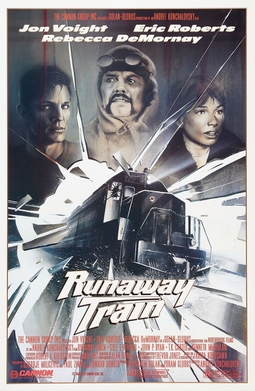
In 1985’s Runaway Train, Eric Roberts plays Buck McGeehy, a prisoner at Stonehaven Maximum Security Prison in Alaska.
Like the majority of the prisoners, Buck looks up to Manny (Jon Voight), a bank robber who has just been released from spending three years in solitary confinement. Manny is a tough guy who refuses to allow the prison system to beat him down. Warden Ranken (John P. Ryan) views Manny as being a threat to his authority and he’s especially angry that it was the courts that ordered that Manny finally be released from solitary. When Ranken tries to arrange for Manny to be assassinated at a prison boxing match, it’s Buck who saves Manny’s life. When Manny later manages to escape from the prison, Buck tags along.
Manny and Buck are a study in contrasts. Manny is as cold as the Alaskan landscape. He’s ruthless and doesn’t allow himself to get too close to anyone but, at the same time, he does live by a definite code. Buck is simple-minded, an earnest guy who talks too much and who probably wouldn’t have survived a day in prison if it wasn’t for his skill as a boxer. Buck and Manny manage to make their way across the frozen wilderness but, when they hop on a train, they soon find themselves trapped on the out-of-control locomotive, along with a railroad engineer named Sara (Rebecca De Mornay). The three of them have to find a way to either escape from or stop the train. At the same time, the obsessed Warden Ranken is determined to recapture Manny and, if that means flying a helicopter over the train so that Ranken can lower himself onto it, so be it.
Runway Train, which was based on a script by Akira Kurosawa, was one of the few Cannon films to find success with not just critics but also audiences and the industry. The Golden Globes nominated it for Best Film. The Academy didn’t go quite that far but they did nominate the film for Best Editing, along with also nominating Jon Voight for Best Actor and Eric Roberts for Best Supporting Actor. While Voight is a multiple-Oscar nominee (and one-time winner for Coming Home), Runaway Train is, so far, the only film for which Eric Roberts has been nominated. (He should have been nominated for Star 80 but his character in that film was a bit too realistically sleazy for the Academy to honor.) Roberts has described Runaway Train as being one of his favorite films and he even used the title for his autobiography. It was on this film that he met Danny Trejo, who not only trained Roberts for the boxing scenes but also helped Roberts kick his addiction to cocaine.
And Roberts has every reason to be proud. Runaway Train is a fast-moving, visually stunning thrill ride, a masterpiece of the pulp imagination. Yes, the symbolism of the runaway train is a bit obvious. Yes, the philosophical edge of the film’s dialogue can sometimes feel a bit out-of-place. Who cares? John Voight and Eric Roberts sell their characters with such skill that you don’t care that they’re both criminals who have done terrible things. From the minute we see that frozen jail and the prisoners tossing burning pieces of paper at the guards, we know why both Manny and Buck have to escape. John P. Ryan turns the warden into everyone’s worst nightmare of a small, pretty man with power, an authoritarian who uses the system to control the lives of others and who resents anyone who does not bow down before him. Even though her role is largely limited to reacting to what everyone else does around her, Rebecca de Mornay still turns Sara into a compelling character and never allows her to become merely a damsel in distress. Runaway Train is a heart-pounding action film and one that still holds up today.
Previous Eric Roberts Films That We Have Reviewed:
1954’s Dragnet opens with a gangland slaying. We watch as a man is brutally gunned down in a field in Los Angeles. The rest of the film deals with the efforts of the LAPD to track down and arrest the killers.
Based on the televisions show that gave birth to the whole “cop show” format, Dragnet features Jack Webb as Sgt. Joe Friday, calmly and efficiently investigating the slaying. Working with Friday is Officer Frank Smith (Ben Alexander) but the film (just like the show) is ultimately about how the whole criminal justice system works together as a machine designed to protect the citizenry and to punish crime.
Or, at least, that’s the way it’s supposed to work. Especially if you’re only familiar with Dragnet from its late 60s incarnation and the countless parodies that followed, the 1954 Dragnet can seem surprisingly cynical and rough-edged. The killings are violent, the criminals are ruthless, and the cops are often frustrated in their attempts to solve crimes. In this film, at least, justice is not guaranteed.
The shooting victim is identified as a low-level gangster named Miller Starkie and Friday and Smith immediately suspect that he was killed on the orders of West Coast mob boss Max Troy (Stacy Harris). Friday and Smith know that Troy is guilty and they even figure out who worked with Troy to kill Starkie. But, throughout the film, they struggle to get any sort of concrete evidence tying Max to the crime. Dragnet is a police procedural that follows every bit of the investigation, including the attempts to convince a grand jury to indict Max. One of the more interesting moments in the film is when Friday gives his grand jury testimony and it becomes obvious that the district attorney was right to be skeptical about trying to bring charges. Friday really doesn’t have enough evidence to justify arresting Max for the crime that everyone knows he committed. To the film’s credit, it doesn’t attack the grand jury system or suggest that the system is unfairly rigged for the criminals. Friday may be frustrated but he understands that the system has to protect the rights accused first. One has to be presumed innocent until proven guilty even when everyone knows that person is guilty.
That said, Friday and Smith and the entire LAPD end up harassing Max Troy in a way that would probably not fly if the film were made today. At one point, a line of police cars park in front of Max’s house and then all shine their lights into his windows. Friday and Smith end up following Max everywhere that they he goes, stopping him and randomly frisking him before ordering him to empty his pockets. Today, I imagine this would lead to lawsuit. Even in the film, it doesn’t exactly pay off.
What does pay off is sending a police woman (played by Ann Robinson) into Max’s nightclub undercover, with a recording device. This whole sequence is interesting because it’s apparent that the idea of a tiny recording devices — something that we take for granted nowadays — was apparently a new and exciting concept in 1954. (Indeed, the one used in this film actually looks a bit bulky.) For a few minutes, the action stops so Dragnet can show off the LAPD’s latest toy.
I liked Dragnet. It’s an nicely-paced time capsule and, despite its docudrama style and television origins, director Jack Webb manages to come up with a few memorable visuals. As someone who has binged the late 60s version of Dragnet, it was interesting to see a tougher and much more cynical version of the series. While Webb was hardly an expressive actor, his dour demeanor serves him well as Joe Friday and Stacy Harris is appropriately sleazy as the crime boss. Despite all of Friday’s frustrations, the case eventually comes to a conclusion in the 1954 film, even if it’s not the one that Friday and his bosses wanted. Max may be able to escape the police but he can’t escape his own health. Friday and Smith move on to investigate the next case. As always, the names will be changed to protect the innocent.
105 years ago today, Jack Webb was born.
Webb appeared in a handful of films but he’s probably best remembered for developing, directing, and starring in America’s first cop show, Dragnet. As Sgt. Joe Friday, Webb dealt with crimes both big and small. In the late 60s, he dealt with hippies and other anti-American forces. A few years ago, I binged the 60s version of Dragnet and I have to admit I got totally addicted to it. It was somehow both effective and totally camp at the same time. That takes skill!
Webb is the narrator of today’s Blast From The Past. 1961’s A Force In Readiness is a 30-minute short film about the Marines. Seen today, it seems like a lengthy commercial but, when it was first released, the director was awarded a special Oscar “for his outstanding patriotic service in the conception, writing and production of the Marine Corps film, A Force in Readiness, which has brought honor to the Academy and the motion picture industry.”
Webb provides the narration in his trademark style. If the Greatest Generation could all speak in one voice, that voice would probably sound a lot like Jack Webb’s.
I like The Doors.
That can be a dangerous thing to admit, about both the band and Oliver Stone’s 1991 film. Yes, both the band and the film could be a bit pretentious. They both tended to go on for a bit longer than necessary. They were both centered around a guy who wrote the type of poetry that I used to love back in my emo days. It’s all true.
But, with The Doors as a band, I find that I can’t stop listening to them once I start. Even if I might roll my eyes at some of the lyrics or if I might privately question whether any blues song really needs an organ solo, I can’t help but love the band. They had a sound that was uniquely their own, a psychedelic carnival that brought to mind images of people dancing joyfully while the world burned around them. And say what you will about Jim Morrison as a poet or even a thinker, he had a good voice. He had the perfect voice for The Doors and their rather portentous style. From the clips that I’ve seen of him performing, Morrison definitely had a stage presence. Morrison died young. He was only 27 and, in the popular imagination, he will always look like he’s 27. Unlike his contemporaries who managed to survive the 60s, Morrison will always eternally be long-haired and full of life.
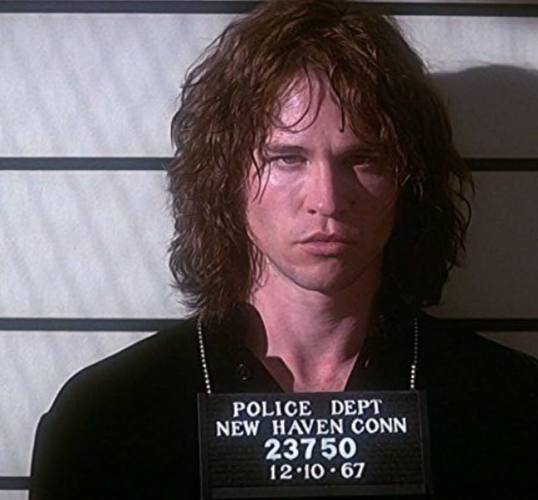
As for The Doors as a movie, it’s definitely an Oliver Stone film. It’s big. It’s colorful. It’s deliberately messy. Moments of genuinely clever filmmaking and breath-taking visuals are mixed with scenes that are so heavy-handed that you’ll be inspired to roll your eyes as dramatically as you’ve ever rolled them. Stone loved the music and that love comes through in every performance scene. Stone also loves using Native Americans as symbols and that can feel a bit cringey at times. Why would Jim Morrison, whose was of Scottish and Irish ancestry, even have a Native American spirit guide? At its best The Doors captures the chaos of a world that it’s the middle of being rebuilt. The 60s were a turbulent time and The Doors is a turbulent movie. I’ve read many reviews that criticized The Doors for the scene in which Morrison gets involved in a black magic ceremony with a journalist played by Kathleen Quinlan. I have no idea whether or not that scene happened in real life but the movie is so full of energy and wild imagery that the scene feels like it belongs, regardless of whether it’s true or not. Stone turns Jim Morrison into the warrior-artist-priest that Morrison apparently believed himself to be and the fact that the film actually succeeds has far more to do with Oliver Stone’s enthusiastic, no-holds-barred direction and Val Kilmer’s charismatic lead performance than it does with Jim Morrison himself.
The Doors spent several years in development and there were several actors who, at one time or another, wanted to play Morrison. Everyone from Tom Cruise to John Travolta to Richard Gere to Bono was considered for the role. (Bono as Jim Morrison, what fresh Hell would that have been?) Ultimately, Oliver Stone went with Val Kilmer for the role and Kilmer gives a larger-than-life performance as Morrison, capturing the charisma of a rock star but also the troubled and self-destructive soul of someone convinced that he was destined to die young. Kilmer has so much charisma that you’re willing to put up with all the talk about opening the doors of perception and achieving a higher consciousness. Kilmer was also smart enough to find the little moments to let the viewer know that Morrison, for all of his flamboyance, was ultimately a human being. When Kilmer-as-Morrison winks while singing one particularly portentous lyric, it’s a moment of self-awareness that the film very much needs.
(When the news of Kilmer’s death was announced last night, many people online immediately started talking about Tombstone, Top Gun, and Top Secret. For his part, Kilmer often said he was proudest of his performance as Jim Morrison.)
In the end, The Doors is less about the reality of the 60s and Jim Morrison and more about the way that we like to imagine the 60s and Jim Morrison as being. It’s a nonstop carnival, full of familiar faces like Kyle MacLachlan, Michael Madsen, Crispin Glover (as Andy Warhol), Frank Whaley, Kevin Dillon, and a seriously miscast Meg Ryan. It’s a big and sprawling film, one that is sometimes a bit too big for its own good but which is held together by both Stone’s shameless visuals and Val Kilmer’s charisma. If you didn’t like the band before you watched this movie, you probably still won’t like them. But, much like the band itself, The Doors is hard to ignore.
Though the Academy of Motion Picture Arts and Sciences claim that the Oscars honor the best of the year, we all know that there are always worthy films and performances that end up getting overlooked. Sometimes, it’s because the competition too fierce. Sometimes, it’s because the film itself was too controversial. Often, it’s just a case of a film’s quality not being fully recognized until years after its initial released. This series of reviews takes a look at the films and performances that should have been nominated but were, for whatever reason, overlooked. These are the Unnominated.
I have come around on Tombstone.
The first time I watched this 1993 film, I was a bit confused as to why so many of my friends (especially my male friends) worshipped the film. To me, it was a bit too messy for its own good, an overlong film that told a familiar story and which featured so many characters that it was difficult for me to keep track of them all. Perhaps because everyone I knew loved the film so much, I felt the need to play contrarian and pick out every flaw I could find.
And I still think those flaws are there. The film had a troubled production, with original director Kevin Jarre falling behind in shooting and getting replaced by George Pan Cosmatos, a director who didn’t have any real interest in the material and whose all-business approach rubbed many members of the cast the wrong way. Kurt Russell took over production of the film, directing the actors and reportedly paring down the sprawling script to emphasize the relationship between Russell’s Wyatt Earp and Val Kilmer’s Doc Holliday. On the one hand, this led to a lot of characters who really didn’t seem to have much to do in the finished film. Jason Priestley’s bookish deputy comes to mind. On the other hand, Russell was right.
The film’s heart really is found in the friendship between Wyatt and Doc. It doesn’t matter that, in real life, Wyatt Earp was hardly as upstanding as portrayed by Kurt Russell. It also doesn’t matter that the real-life Doc Holliday was perhaps not as poetic as portrayed by Val Kilmer. Today, if you ask someone to picture Wyatt Earp, they’re probably going to picture Kurt Russell with a mustache, a cowboy hat, and a rifle. And if you ask them to picture Doc Holliday, they’re going to picture Val Kilmer, sweating due to tuberculosis but still managing to enjoy life. Did Doc Holliday every say, “I’ll be your huckleberry,” before gunning someone down? He might as well have. That’s how he’s remembered in the popular imagination. And it’s due to the performances of Russell and Kilmer that I’ve come around to eventually liking this big and flawed western. With each subsequent viewing, I’ve come to appreciate how Russell and Kilmer managed to create fully realized characters while still remaining true to the Western genre. If Wyatt Earp initially fought for the law, Doc Holliday fought for friendship. Kilmer is not only believable as a confident gunslinger who has no fear of walking into a dangerous situation. He’s also believable as someone who puts his personal loyalty above all else. He’s the type of friend that everyone would want to have.
That said, I do have to mention that there are a lot of talented people in the cast, many of whom are no longer with us but who will live forever as a result their appearance here. When Powers Boothe delivered the line, “Well …. bye,” he had no way of knowing that he would eventually become a meme. Boothe is no longer with us, I’m sad to say. But he’ll live forever as long as people need a pithy way to respond to someone announcing that they’re leaving social media forever. Charlton Heston appears briefly as a rancher and he links this 90s western with the westerns of the past. Robert Mitchum provides the narration and it just feels right. The large ensemble cast can be difficult to keep track of and even a little distracting but there’s no way I can’t appreciate a film that manages to bring together not just Russell, Kilmer, Boothe, Heston, and Mitchum but also Sam Elliott, Bill Paxton, Michael Biehn, Michael Rooker, Billy Bob Thornton, Frank Stallone, Terry O’Quinn, and even Billy Zane! The female roles are a bit underwritten. Dana Delaney is miscast but Joanna Pacula feels exactly right as Doc Holliday’s lover.
But ultimately, this film really does belong to Val Kilmer. When I heard the sad news that he had passed away last night, I thought of two films. I thought of Top Gun and then I thought of Tombstone. Iceman probably wouldn’t have had much use for Doc Holliday. And Doc Holliday would have resented Iceman’s attitude. But Val Kilmer — that brilliant actor who was so underappreciated until he fell ill — brought both of them to brilliant life. In the documentary Val, Kilmer attends a showing of Tombstone and you can say he much he loves the sound of audience cheering whenever Doc Holliday showed up onscreen.
Tombstone was a flawed film and 1993 was a strong year. But it’s a shame that Val Kilmer was never once nominated for an Oscar. Tombstone may not have been a Best Picture contender but, in a year when Tommy Lee Jones won the Oscar for Best Supporting Actor for his role in the similarly flawed The Fugitive, it seems a shame that Kilmer’s Doc Holliday was overlooked.
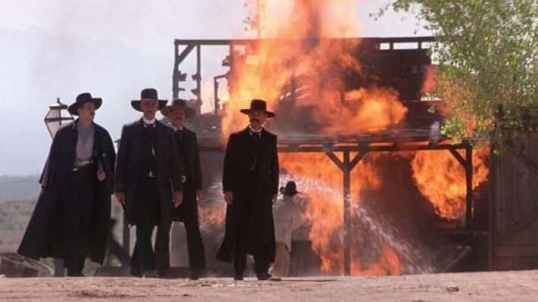
Tombstone (1993, dir by George Pan Cosmatos (and Kurt Russell), DP: William Fraker)
Previous entries in The Unnominated:
 Through the Shattered Lens