I have to admit that I don’t know much about Nightcrawler but I do like this trailer. If nothing else, it seems to promise a wonderfully manic performance from Jake Gyllenhaal. Add to that, I love the music playing the background.
Tag Archives: movie
Here’s the 2nd Trailer for If I Stay!

In the future, I think 2014 will be remembered as a good year for those of us who like to cry at the movies. And, as evidence to help prove my point, here’s the 2nd trailer for If I Stay, the upcoming adaptation of Gayle Forman’s excellent and emotional 2009 novel. This film, directed by R.J. Cutler and starring Chloe Grace Moretz, will be opening on August 22nd.
Trailer: Fifty Shades of Grey

A few months ago, I was talking to an online acquaintance when I made the mistake of referring to Fifty Shades of Grey as being “Fifty Shades of Fanfic.” I thought I was making a perfectly valid point because, as we all know, the book started out as a piece of Twilight fanfic and, even more importantly, it reads like really bad (albeit sexy) fanfic. The person I was talking to however … Oh. My. God. You would have thought that I had just said the worst, most inflammatory thing in the history of offensive statements. Before I knew it, I had been blocked on twitter and unfriended on Facebook, which I have to admit really upset me because her unfriending me left me with an odd number of Facebook friends and, as our regular readers know, Lisa doesn’t do odd numbers.
But anyway, my point is that Fifty Shades of Grey may not have been great literature but a lot of people feel very strongly about it. And even those of us who may view dismissively the book’s prose will probably still end up seeing the movie when it’s released next year.
Below, you’ll find the first trailer for Fifty Shades of Grey, which promises the audience a very hot Valentine’s Day in 2015. In short, this trailer follows in the proud tradition set by the trailer for Endless Love.
Trailer: The Imitation Game
Benedict Cumberbatch seems like one of those actors who is destined to eventually get at least one or two Oscar nominations over the course of his career. Last year, a lot of people thought he might end up getting nominated for The Fifth Estate but then the film came out and promptly bombed. In 12 Years A Slave, his supporting performance was overshadowed by Michael Fassbender’s more traditionally villainous turn. If they awarded an Oscar for voice over work (and they really should), then Cumberbatch would have probably picked up the award for bringing Smaug to life in The Hobbit.
So, Cumberbatch still awaits his first nomination but he might not have to wait too much longer. In the upcoming Imitation Game, Cumberbatch plays Alan Turing, who was responsible for cracking Germany’s secret code during World War II. After the war, Turing was prosecuted under the UK’s anti-gay laws. This is one of those true stores that would seem to be the right film at the right time to be a potential Oscar contender.
A trailer — which focuses on Turing’s work during World War II and only hints at the persecution that would define the rest of his life — was released earlier today. And you can watch it below!
Wasted Youth : Richard Linklater’s “Boyhood”
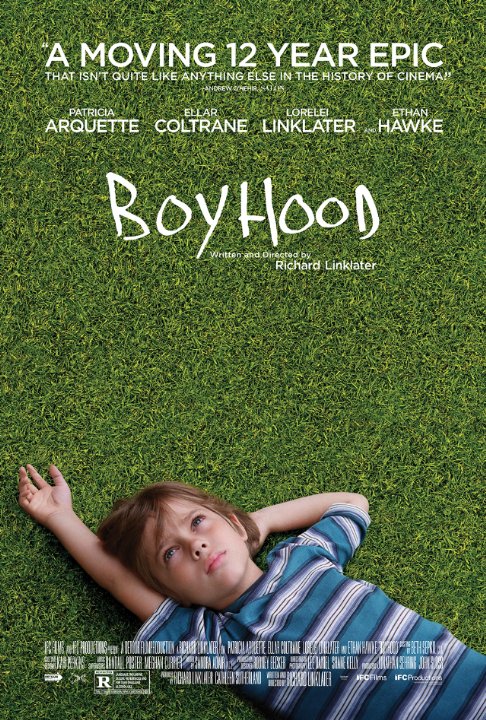
It’s safe to say that there’s no film other film in 2014 that I was more predisposed toward liking before ever having seen in that Richard Linklater’s Boyhood. Anyone who follows my “byline” at any of the various sites I write for (please! Get something better to do with your time!) even occasionally will know that I’m a tremendous fan of the director’s other works — from his superb animated efforts such as A Scanner Darkly and Waking Life to his honest and heartfelt live-action films such as Bernie, School Of Rock, Fast Food Nation, Dazed And Confused, and his breakthrough hit, Slacker (which I just recently reviewed through decidedly rose-tinted nostalgic lenses), the guy just has the magic touch, in my opinion. Heck, even his Bad News Bears remake was kinda fun, if you ask me. And, of course, the three films in his hopefully-still-ongoing “Before” series aren’t just great movies, but flat-out events in my life when they come out. I love ’em to pieces and make no apologies for it. Jesse and Celine may not be real people, but they’re still my fucking friends, goddamnit.
And yet for one reason or another it seems Linklater always flies below the radar. Maybe it’s because his naturalistic, unforced style doesn’t command attention. He’s not one to overpower you with sentimentality or melodrama, and the almost nonchalant nature of his work trusts the audience to be smart enough to make up its own collective mind about the stories he’s bringing to the screen. I like that. I think we need more filmmakers who aren’t out to either manipulate our emotions or “wow” us with their technique. Linklater goes about his business with respect for his stories, his characters, and his viewership — and while that may not win him a ton of awards, it certainly earns him my respect.
All that’s changing now, though. After over two decades operating, for the most part, on the margins (not that he doesn’t have a devoted fan base, it’s just not a terribly large one, comparatively speaking), the finished result of his grand 12-year-epic centered on young actor Ellar Coltrane as he ages from 7 to 19, Boyhood (originally titled 12 Years but re-named at the last minute to avoid confusion with recent Academy Award best picture winner 12 Years A Slave) is finally here, and Linklater’s richly-deserved moment in the spotlight has finally arrived. He’s made it to the to the top of the mountain. He’s the talk of the town. The man of the hour. The toast of Hollywood.
And ya know what? He deserves to be. I’m just not so sure he deserves it for this particular film.
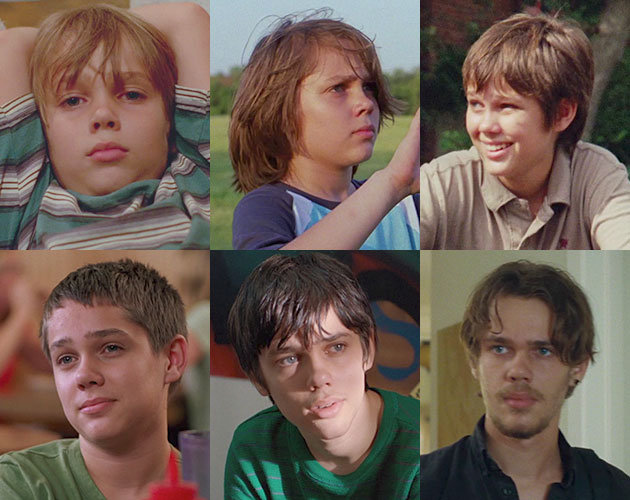
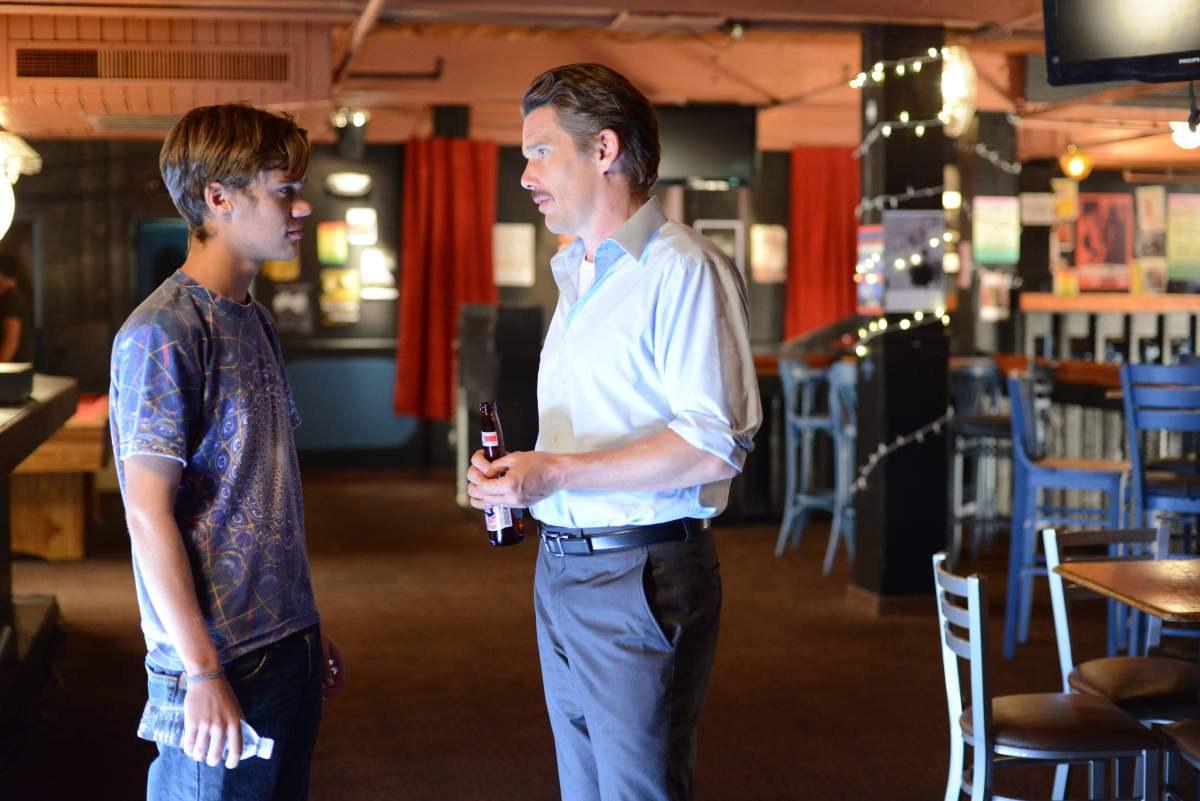
Don’t get me wrong — Boyhood is pretty good stuff in many respects. What Linklater’s pulled off here is certainly remarkable — getting essentially the same cast together year in and year out (the principle players being Coltrane as growing boy Mason, Patricia Arquette and Ethan Hawke as his divorced-from-the-film’s-outset parents, and the writer/director’s own daughter, Lorelei, as older sister Samantha) to make a series of short films that would eventually be assembled into one “grand work” is ambitious and bold and frankly just plain tough to work out logistically. So my hat’s off to to him for even realizing a project of this scope and magnitude.
I just wish the finished product were anywhere near as powerful, affecting, and awe-inspiring as we’re being told it is by the paid dictators of consensus opinion out there. The exploration of aging and the different stages we go through on, to sound unbearably pompous for a moment, life’s journey aren’t even particularly new themes for Linklater to explore — as a matter of fact, it’s what the “Before” series is all about, and they tackle the subject much better than this flick does. So maybe the folks who make their living telling us all what to think are just making up for lost time by showering accolades all over Boyhood after largely ignoring last year’s Before Midnight. Or maybe they honestly just like this one better because their taste isn’t all that great, I dunno.
In any case, I’ve still got a few good things to say about this before I lay out my gripes, so let me say that Linklater is to be commended for the smooth, easy flow with which he transitions from one scene to the next, and for letting events in the story take their time and “breathe” a bit without resorting to strict formulas of, say, 15 minutes per year or somesuch. Each and every actor is also to be congratulated for their work here, as the performances are quite simply astonishing. Yeah, Coltrane is obviously the star of the show, and watching him grow up in front of our eyes is every bit the amazing experience everyone makes it out to be, but all the other major players turn in terrific work, as well, as do many of the minor ones (Marco Perella deserves special mention here for his role as Mason’s troubled — and troubling — stepfather-for-a-time). So kudos to everybody involved for some truly great work.
Here’s the rub, though (you knew it was coming) — the material they’ve got to work with just ain’t all that hot. Linklater has taken his non-manipulative approach (you know, the one I was just praising him for) to near-pathological extremes here and the end result is a film that feels almost clinically removed from its own subjects. Add in the disappointing fact that many of his characters are one-note ciphers — Mason’s mother gets an education and improves her economic and social standing over the years but still can’t help but marry one alcoholic loser after another, while his father laregely remains a go-nowhere “slacker” for ages (Hawke spends the first half of the film essentially playing Jesse Wallace) before undergoing an instant transformation and getting a new wife, new baby, new mustache, and, apparently, his shit together all at the same time — and what we wind up with is a movie that never transcends its origins as a cinematic experiment, as well as one that’s populated not by leaving, breathing people so much as specimens floating around in a celluloid petri dish.

I’m not foolish enough to think that unfairly-high expectations going in didn’t have something to do with why I left the theater feeling so flat after this one — shit, a 99% score on Rotten Tomatoes is flat-out unheard of — but even if this had been made by somebody I’d never heard of and landed on our screens out of nowhere, I’d still be less than awestruck by the finished product. I fully appreciate everything Linklater was trying to do here, sure, but what he’s ended up doing is completing what amounts to a 12-year-long sociological study that’s so concerned with preserving the integrity of its ground rules (don’t force anything, adhere to faux-documentary stylings at all costs, let things play out as absolutely naturally as you can possibly manage given you’re still working from a script, etc.) that it forgets it has an audience to win over. I admire Linklater for protecting his characters from directorial heavy-handedness, to be sure, but it’s a shame he wasn’t able to find a way to share their story that would have let us in while still keeping the melodrama and schmaltz out.
So yeah, Boyhood definitely came up short for this armchair critic, despite the fact that I was rooting for it as hard as anyone. Walling off your characters to prevent Lifetime-movie-of-the-week-style syrup from oozing into their protective membrane is one thing, but walling them off from from genuine viewer involvement results in a film that feels oddly disconnected, even divorced, from events that could be so much more effectively communicated if given even an ounce of immediacy. We want to care about Mason and his family beyond the level that Linklater allows us to , but he never lets us, or himself, get that close, and its for that reason that Boyhood will always remain much more interesting for what it does than for what it actually is. Maybe he’ll give us another installment in 2026 that corrects the mistakes he made here? Chuckle at the idea all you want, but no one saw a sequel to Before Sunrise coming, either.
Film Review: Deliver Us From Evil (dir by Scott Derrickson)
 I had high hopes for Deliver Us From Evil, largely because it was directed by Scott Derrickson who, in 2012, gave us the wonderfully atmospheric and disturbing Sinister. Unfortunately, having now seen Deliver Us From Evil, I can only call it the anti-Sinister. Whereas Sinister took the viewers by surprise, Deliver Us From Evil is predictable. Whereas Sinister was full of genuinely disturbing moments, Deliver Us From Evil is full of jump scenes that are scary for a few seconds but then swiftly vanish from the memory. Whereas Sinister was fascinating for featuring a morally ambiguous hero, Deliver Us From Evil features a hero who is so mundanely heroic that you find yourself hoping that he’ll fail just as punishment for his smug hubris.
Perhaps the only way that Deliver Us From Evil tops Sinisteris that it features none other than the King of Television Snark, Joel McHale. As someone who loves both The Soup and Community, I’m always happy to see Joel but he’s oddly cast here, playing a muscle-bound, adrenaline junkie cop. It’s not that Joel does a bad job. In fact, he’s probably the most likable and compelling character in the entire film. It’s just that you can’t look at him on screen without asking, “Joel, why are you here!?”
Anyway, Deliver Us From Evil is pretty much your standard demonic possession/cop thriller hybrid. Mysterious murders are being committed. The murderers speak in a weird language and, it soon turns out, all of them are linked both to the discovery of ancient tomb in Iraq and to a painting company that was started by a group of returning veterans. It’s up to cops Ralph Sarchie (Eric Bana) and Parker (Joel McHale – why, Joel, why!?) to solve the crime. Helping them along the way is a former drug addict priest named Mendoza (Edgar Ramirez). If you’re guessing that the whole thing leads to a violent exorcism on a stormy night – well, you’re definitely on the right track.
Scott Derrickson does the best that he can with the material but he’s hampered by the fact that the film is based on a book that was written by the real-life Ralph Sarchie. Perhaps as a result, the film’s Ralph is such an upright and moral hero (though he does yell at his daughter in one unpleasant moment but even that is excused as simply being evidence of how personally Ralph takes his job) that he’s also not that interesting of a character. Eric Bana, who is actually a pretty good comedic actor, struggles to find some sort of depth to Ralph but ultimately, it’s just not there. And since 90% of horror is psychological, Deliver Us From Evil cannot recover from revolving around such a flat protagonist.
As a result, Derrickson has little option but to fill the film with standard horror movie scenes. The scenes, as themselves, work well enough but the story is so predictable that they don’t make much of an impact. The end result is a film that you’ve seen a hundred times before.
The only difference, of course, is that this version features Joel McHale dancing around with a knife.
Let’s Play Catch Up With The Trailer for Exodus: Gods and Kings
Here’s another trailer that came out while I was busy Embracing the Melodrama. I’m not really sure how I feel about Exodus: Gods and Kings. The trailer looks good and epic and all that but what’s the deal with all of the”sword and sandal” films coming out this year? Not only do we have two Hercules films, Pompeii, and the 300 sequel, we also had Noah and now we’ve got Exodus coming out. Last year, we saw a spate of end-of-the-world films. This year, we’re seeing films that are meant take place at the beginning of the world. Anything to avoid dealing with present, I suppose.
Incidentally, I still say that Ridley Scott’s previous film, The Counselor, was far better than most people realize.
Here’s the 1st Trailer for Wild!
I’ve been so busy, over the past two weeks, with Embracing the Melodrama that I didn’t get a chance to share with you the trailer for one of the films that I am most anticipating seeing this year: Jean-Marc Vallee’s Wild!
Here it is, only six days late…
Embracing the Melodrama #60: Blue Ruin (dir by Jeremy Saulnier)
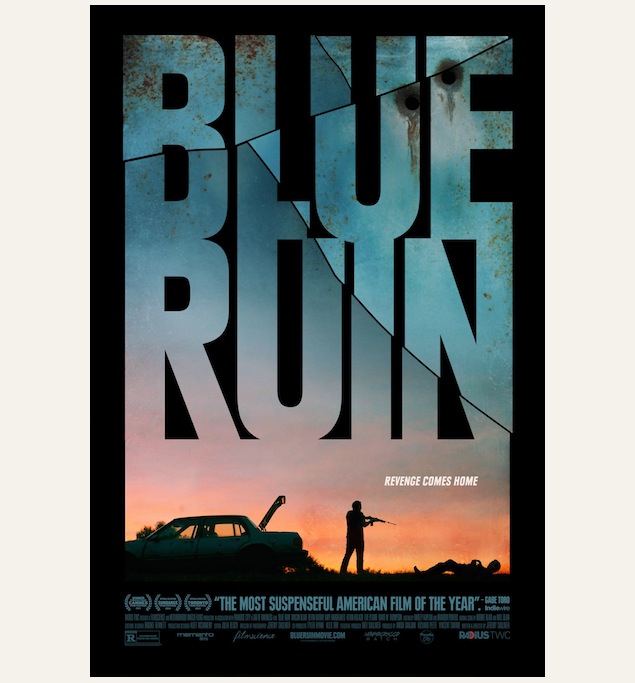
Well, all good things must come to an end and here it is. This is the final entry in a little series that I like to call Embracing the Melodrama. For the past two weeks, I’ve been reviewing, in chronological order, 60 of the most and least memorable melodramas ever filmed. We’ve looked at everything from films that were nominated for (and occasionally won) Oscars to films that played in a few grindhouses and drive-ins before disappearing into obscurity. We’ve reviewed big budget spectaculars and movies that were apparently filmed for less money than I typically spend during a weekend shopping spree. I hope that you’ve enjoyed reading these reviews as much as I’ve enjoyed writing them. If I’ve introduced you to a film you previously did not know or if I’ve inspired you to track down and watch an old classic, then I’ve accomplished what I set out to do and I’m happy. We started this series by looking at a film from 1916 and now, we end it with a movie that was released into theaters just a few months ago.
That film is Blue Ruin and, if you haven’t seen it yet, you really should.
Now, I want to be careful just how much I tell you about Blue Ruin‘s story because, much like the thematically similar Cold In July, Blue Ruin may start out like a standard thriller but it soon moves in unexpected and surprising directions. It’s not so much that the film’s plot is unpredictable (in fact, one of the film’s strengths is that the story told is essentially a simple one) as much as it’s the fact that the film adds an element of ambiguity to that plot that forces you to reconsider all of your preconceived notions. Blue Ruin is a revenge film for people who like to think.
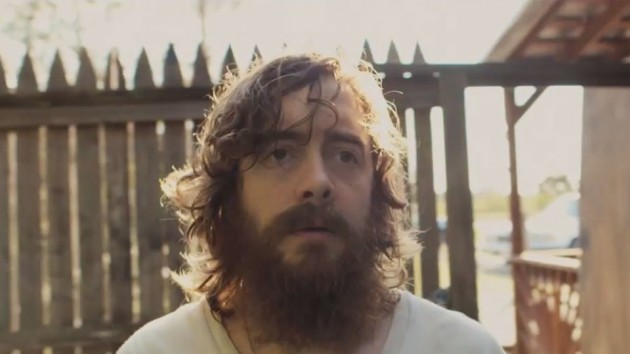
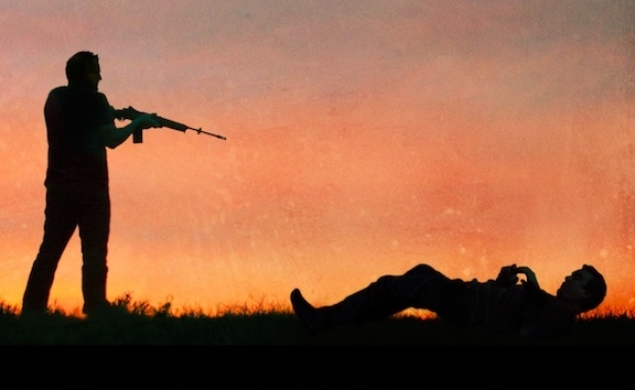
Blue Ruin opens with the bearded and clearly unstable Dwight (Macon Blair) going through trash cans and dumpsters in search of food. Dwight lives in his filthy car and it quickly becomes obvious that, despite Dwight’s disheveled appearance, he’s not really much of a threat to anyone. Instead, he simply wants to be left alone. However, one day, Dwight is approached by a friendly police officer who tells him that a man named Wade Cleland has been replaced from prison. The suddenly motivated Dwight responds by driving his car to the prison and watching as Wade is released. Dwight than manages to get a knife (after first trying to steal a gun and failing so completely that you can’t help but feel sorry for him) and goes to the small country bar where Wade and his family are celebrating his freedom. Dwight manages to get into the club and, after a brutal fight, fatally stabs Wade in the temple.
Macon Blair in Blue Ruin
The rest of the film deals with both the reasons behind and the consequences of Dwight’s actions and it would not be right for me to spoil the film any more than I already have. Let’s just say that neither Dwight nor the Clelands turn out to be quite who we believed them to be. The crimes of the past aren’t quite as clear-cut as either Dwight or the Clelands initially assumed. All that is clear is that now that Dwight has taken his revenge, the Clelands now feel the need to take their own revenge. It’s an endless cycle that’s made all the more complicated by the fact that neither Dwight nor the Clelands are as good at this whole revenge thing as they think.
Chances are that you’ve never heard of Macon Blair. I hadn’t heard of him until I saw him in this movie. But, obscure or not, that doesn’t change the fact that, in the role of Dwight, Macon Blair gives one of the best performances of the year so far. He turns Dwight into a sort of mentally unstable everyman and, as a result, Dwight is a truly memorable and unexpectedly poignant lead character.
It’s interesting that 2014 has seen the release of several films that feature unlikely and morally ambiguous protagonists dealing with violence, revenge, and secrets in the South. Blue Ruin joins Cold In July and Joe as one of the best films of 2014. And it also provides a high note for which to close out Embracing the Melodrama.
Embracing the Melodrama #59: At Any Price (dir by Ramin Bahrani)
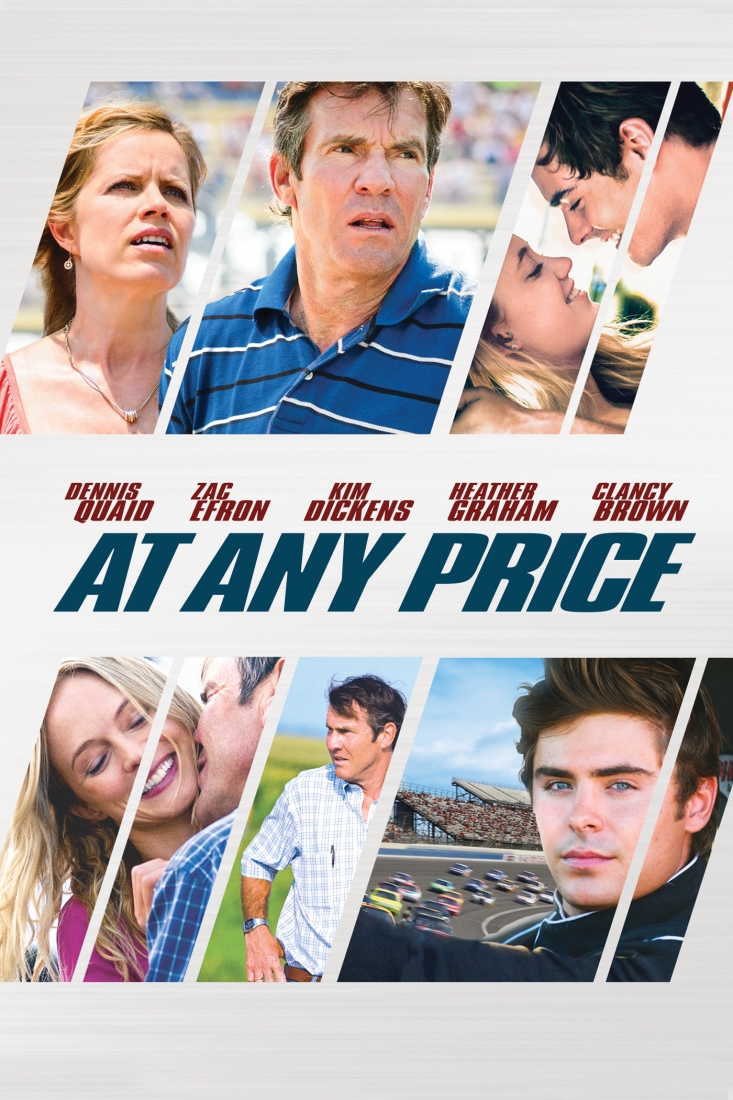
With Embracing the Melodrama coming to a close (only two more reviews to go, including this one!), I want to take this opportunity to tell you about a good film from last year that didn’t get quite as much attention as it may have deserved. The Iowa-set At Any Price is a look at greed, family secrets, and even murder in rural America. It’s not a perfect film but it features a perfect lead performance from Dennis Quaid and it’s worth taking a chance on.
Dennis Quaid plays Henry Whipple, an Iowa farmer who also works as a sales representative for the Liberty Seed Company. Henry sells genetically modified seeds and one thing that this film gets absolutely right is just how cut-throat the seed business truly is in the heartland. Henry is very proud to be the top seed salesman in the county, with only Jim Johnson (Clancy Brown) coming close to matching him. The film’s best scenes are the ones that follow Henry as he travels along his route, selling seeds, giving away candy bars, and always flashing his wide grin. It’s only as the film progresses that we start to notice how desperate that grin really is. Henry, we soon realize, is motivated mainly by greed and fear. He’s the type of farmer who will go to a stranger’s funeral just to try to buy the deceased’s land. Henry is also the type of guy who is willing to cut ethical corners to sell seeds as well. As far as Henry is concerned, he’s only doing what he has to do to make sure that he has a successful business to pass on to his family.
Henry is all about his family and, while that may be his redemption, it’s also his family’s curse because Henry is something of a control freak. Henry’s loyal wife (Kim Dickens) turns a blind eye to Henry’s mistress (Heather Graham). Meanwhile, his oldest son has fled Iowa and moved down to South America. Henry’s remaining son, Dean (Zac Efron), is more interested in pursuing a career in NASCAR than on the family farm. Eventually, as the result of a shocking and almost random act of violence, Dean is forced to pick his future.
With both Neighbors and That Awkward Moment, Zac Efron has been reinventing himself as a skilled comedic actor. Before that, however, he appeared in a series of movies that were meant to show his dramatic range, films like The Paperboy, Parkland, and this one. These films ranged in quality from terrible to good but, in all of them, Zac Efron felt miscast. Efron is the weak link in At Any Price. Dean is supposed to be a character driven by both anger and a need to win (at any price — we have a title!) but when we look at Efron’s pretty blue eyes, we’re left with the impression that there’s not much going on behind them.
Far more effective is Dennis Quaid. Quaid is so likable in the role that it takes a while to realize that Henry is essentially a monster. And yet, you never totally lose your sympathy for him. He has his own demons, demons that he’s passing down to his son. The power of Quaid’s performance is that you can tell he knows he’s wrong but he just can’t stop himself.
At Any Price is a good farmland melodrama, full of beautiful landscapes and carefully observed details. It’s not a perfect film but it is one worth watching for anyone who is wondering whatever happened to the American dream.