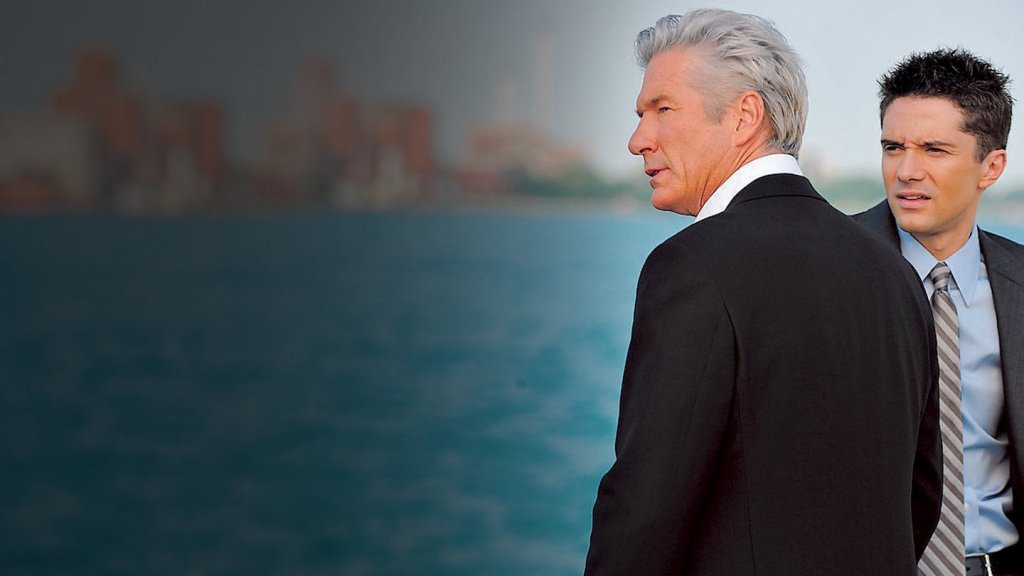
#MondayMuggers presents THE DOUBLE (2011) starring Richard Gere!


Every Monday night at 9:00 Central Time, my wife Sierra and I host a “Live Movie Tweet” event on X using the hashtag #MondayMuggers. We rotate movie picks each week, and our tastes are quite different. Tonight, Monday February 3rd, we’re watching THE DOUBLE starring Richard Gere, Topher Grace, and Martin Sheen.

Sierra had a day off from work last week and she watched this movie 3 times. Then she told me it would be her choice for the week! I’d say she really likes the movie!

THE DOUBLE is the story of a retired CIA operative (Gere), who’s paired with a young FBI agent (Grace), trying to solve the mystery of a senator’s murder. All of the signs are pointing towards an assassin from the Soviet Union!

Here is some interesting trivia about the film:

  1. THE DOUBLE is directed and written by Michael Brandt. After directing this film, Brandt would be the driving force behind the various Chicago based TV series’ CHICAGO FIRE, CHICAGO P.D., and CHICAGO MED. He also wrote the screenplays to 3:10 TO YUMA (2007) and WANTED (2008). This is a talented man!
  2. Filming was halted for six weeks after Richard Gere dislocated his shoulder during a fight sequence with actor Tamer Hassan.
  3. If you enjoyed the TV show CASTLE, the beautiful Stana Katic is in this movie. She’s billed 5th, but she only has about 5 minutes of screen time. That shows you how popular that show was at the time of this films release in 2011. 

So join us tonight to for #MondayMuggers and watch THE DOUBLE! It’s on Amazon Prime.

I’ve included the trailer for THE DOUBLE below:

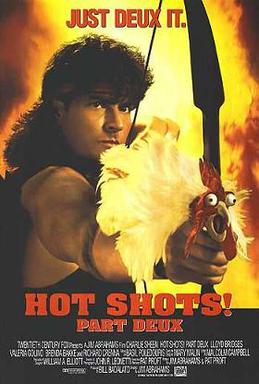
Hot Shots! Part Deux (1993, directed by Jim Abrahams)


Topper Harley (Charlie Sheen) is back but instead of being a knock-off of Tom Cruise, he’s now Sylvester Stallone.

When two separate teams of U.S. soldiers fail to rescue a group of hostages who are being held by Saddam Hussein (Jerry Haleva, who built an entire career out of his resemblance to the Iraqi dictator), it not only embarrasses America but threatens the reelection campaign of President Tug Benson (Lloyd Bridges).  President Benson can get away with throwing up on the Japanese ambassador and knocking over all the other Presidents with a shovel (though Gerald Ford falls on his own) but he can’t survive a hostage crisis.  Colonel Denton Waters (Richard Crenna) and Michelle Huddleston (Brenda Bakke) attempt to recruit Topper Harley from the Buddhist monastery, where he’s been living since the disappearance of Ramada (Valeria Golino).  Topper refuses to help with a third mission but, after Water is captured by Saddam, Topper does decide to lead the fourth mission.  Working with Ryan Stiles and Miguel Ferrer, Topper heads into the jungle to save Colonel Waters, reunite with Ramada, and discover his destiny.

The sequel to Hot Shots! is more of the same, a non-stop cavalcade of jokes, movie references, and deadpan one liners.  There are enough laugh out loud moments to make up for the jokes that don’t work.  I’ll always like the moment when Charlie Sheen sees Martin Sheen on another patrol boat.  (“Loved you in Wall Street!”)  It’s a movie made in the vein of Airplane! but the jokes aren’t as timeless as in that classic.  Everyone remembers Rambo enough to get the main joke and the interrogation scene in Basic Instinct has left enough of an impression that Topper’s “I know what to get your for Christmas,” comment to Michelle still draws a chuckle but do you remember Body of Evidence and the first President Bush vomiting at a state dinner?  Not all of the jokes have aged well but Charlie Sheen does a decent Rambo impersonation and Lloyd Bridges’s dim bulb President is one of the more relatable parts of the movie.  Fortunately, jokes about Saddam Hussein getting flattened by a piano will always be funny.

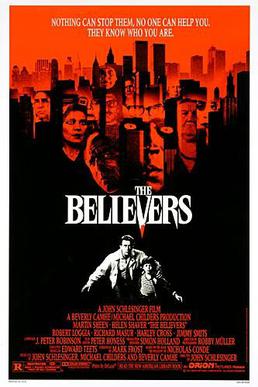
14 Days of Paranoia #4: The Believers (dir by John Schlesinger)


When it comes to unfortunate and dumb ways to die, getting electrocuted while standing in a puddle of spilled milk would seem to rank fairly high on the list.  Unfortunately, it’s exactly what happens to the wife of Cal Jamison (Martin Sheen) during the first few minutes of 1987’s The Believers.

Traumatized by his wife’s death (and probably also by all of the people asking, “Wait a minute, she was standing in milk?”), Cal relocates from Minneapolis to New York City.  Accompanying him is his young son, Chris (Harley Cross).  Upon arriving in New York, Cal starts a tentative new relationship with artist Jessica Halliday (Helen Shaver) and he also gets a job working a psychologist for the NYPD.

And several members of the NYPD are going to need a good psychologist because they are investigating a series of brutal and ritualistic murders.  All of the victims are children around Chris’s age and the murders are so grisly that even a hardened cop like Lt. Sean McTaggart (Robert Loggia) finds himself traumatized.  When Detective Tom Lopez (Jimmy Smits, in one of his first roles) discovers one of the bodies, he has an apparent mental breakdown and starts to rant and rave about an all-powerful cult that Tom claims is committing the murders.

After Tom commits suicide, his ravings are dismissed as being the product of a mentally ill man.  However, Cal is not so sure and starts to investigate on his own.  What he discovers is a cult made up of a motely mix of wannabe gangsters and members of high society.  While his friends and lovers either die or lose their minds around him, Cal discovers that the cult is actually closer to both him and his son than he ever realized.

An odd film, The Believers.  On the one hand, there’s plenty of creepy scenes, including one in which Jessica gets a truly disturbing skin condition.  The scenes in which Cal discovers that his friends have lost their minds as a result of the Cult are frequently sad and difficult to watch.  Robert Loggia has scene that brought tears to my eyes.  The mix of street witchery and upper class power lust is nicely handled and, as always, Harris Yulin makes for an effective villain.  The Believers creates an ominous atmosphere of paranoia, one in which you really do come to feel that no one in the film is quite who they say they are.

And yet, it’s obvious that director John Schlesinger — whose previous films included Darling and the Oscar-winning Midnight Cowboy — had more on his mind than just making an effective Omen-style horror film.  He also tries to deal with Cal coming to terms with the death of his wife and Chris coming to terms with the idea of Cal dating someone new and all of those scenes of straight-forward domestic drama feel out-of-place in what should have been an energetic and grisly B-movie.  In those ploddingly earnest scenes, Schlesinger seems to be trying almost too hard to remind us that he’s not really a horror filmmaker and they just feel out of place.

If there was ever a movie that called for the unapologetic and wickedly sardonic directorial vision of David Cronenberg, it was The Believers.  As it is, The Believers is an intriguing but frustratingly uneven mix of paranoia, witchcraft, and domestic melodrama.

14 Days of Paranoia:

  1. Fast Money (1996)
  2. Deep Throat II (1974)
  3. The Passover Plot (1976)

Live Tweet Alert: Watch The Believers With #ScarySocial!


As some of our regular readers undoubtedly know, I am involved in a few weekly live tweets on twitter.  I host #FridayNightFlix every Friday, I co-host #ScarySocial on Saturday, and I am one of the five hosts of #MondayActionMovie!  Every week, we get together.  We watch a movie.  We tweet our way through it.

Tonight, for #ScarySocial, I will be hosting 1987’s The Believers, starring Martin Sheen!

If you want to join us on Saturday night, just hop onto twitter, start the film at 9 pm et, and use the #ScarySocial hashtag!  The film is available on Prime and Tubi!.  I’ll be there co-hosting and I imagine some other members of the TSL Crew will be there as well.  It’s a friendly group and welcoming of newcomers so don’t be shy.


October True Crime: Out of the Darkness (dir by Jud Taylor)


The 1985 film, Out of the Darkness, takes place in New York City.

It begins in 1977 and it ends in 1978.  As the opening title card informs us, it’s a film about a city that was living in fear of the gunman known as the Son of Sam.  One of the first images that we see is an a handgun being fired at two people who are making out inside of a car.  We then cut to a police station where a homicide detective (played by Sam McMurray) reads aloud the letter that the Son of Sam sent to Jimmy Breslin.

That said, David Berkowitz, the killer who claimed that he was told to murder by a dog before later changing his story and claiming that he was a part of a Satanic conspiracy, spends most of the film in the shadows.  His name isn’t even mentioned until the film’s final third.  Instead, the majority of the film focuses on Ed Zigo (Martin Sheen), a New York City detective who tries to balance his desire to catch the Son of Sam with taking care of his wife (Jennifer Salt), who is due to have surgery for her heart condition.  Ed Zigo is dedicated and intelligent New York cop, the type who has no problem walking into a Mafia-controlled bar and asking the owner if his son has any connections to the family business.  He’s also a dedicated family man who freaks out when his daughter goes out on a date.  When his wife dies after surgery, Ed Zigo deals with his grief by throwing himself into his work but, as he tells his priest (Hector Elizondo), he no longer has his old confidence.  He fears that he’s going to make a mistake that’s either going to put his partner (Matt Clark) in harm’s way or allow the Son of Sam to continue to killing.

And really, it’s not a problem that the film focuses less on the killer and more on the people trying to track him down.  Martin Sheen gives a strong and sincere performance as the dedicated Ed Zigo, perfectly capturing not only his dedication but also his fear and his weariness.  (In many ways, his performance here feels like a forerunner to his performance in The Departed.)  The film captures the feel of living in a city where no one trusts anyone and it is also a good example of a “New Yorkers will be rude to anyone” film.  Even with a killer running around, no one wants to listen to a word the police have to say.  When David Berkowitz does show up, he’s played by an actor named Robert Trebor who gives an appropriately creepy performance.

Interestingly enough, Joe Spinell also appears in Out of the Darkness, playing the small but important role of an early Son of Sam suspect.  Though he only appears in two scenes, Spinell makes a memorably seedy impression.  Of course, today, Spinell is remembered for playing a character based on the Son of Sam in the infamous 1980 grindhouse shocker, Maniac.

(Trivia fans will also want to note that Charlie Sheen has a wordless cameo as a man who shuts his apartment door in the face of Martin Sheen and Matt Clark when they attempt to ask him if he witnessed the latest murder.  “Nice guy,” Martin says, in response.)

If you’re looking for a film in which Berkowitz is cursed out by a dog, Summer of Sam is probably the one to go for.  However, if you’re looking for a more low-key but realistic portrayal of Berkowitz’s reign of terror, Out of the Darkness is a good one to go with.

Late Night Retro Television Reviews: Gun 1.2 “Ricochet”


Welcome to Late Night Retro Television Reviews, a feature where we review some of our favorite and least favorite shows of the past!  On Tuesdays, I will be reviewing Gun, an anthology series that ran on ABC for six week in 1997.  The entire show is currently streaming on Tubi!

This week, on Gun, Martin Sheen plays a cop who might be investigating the final murder of his career!

Episode 1.2 “Ricochet”

(Dir by Peter Horton, originally aired on April 19th, 1997)

The second episode of Gun opens with the death of a Japanese businessman.  He’s found shot on a cliffside that overlooks the ocean.  The gun that shot him is discovered and taken by a homeless man named Lazy Eye Pete (Bud Cort).  Pete is a cheerfully eccentric type, one who sings for money and who is dedicated to taking care of his pet dog, Chester.  But, as soon as Pete gets that gun, his personality starts to change and he even ends up pulling the gun on a group of teenagers who were attempting to mug him.  In the end, Pete sells the gun to a friend of his.

Also searching for that gun is Detective Van Guinness (Martin Sheen).  Guinness, who suffers from ulcers and who takes his job very personally, has promised his girlfriend (Tess Harper) that he will retire from the force.  However, he doesn’t want to go out on a simple or an unsolved case.  Fortunately, for Guinness, he’s assigned the complicated case of the dead businessman.  Unfortunately, for him, his girlfriend is not at all amused by his refusal to retire.

Van’s partner (Kirk Baltz) thinks that the businessman was killed during a robbery but Guinness disagrees.  Guinness thinks that the businessman was murdered by either his wife (Nancy Travis) or his amoral attorney (Christopher McDonald).  The wife and the attorney are sleeping together and they’ve also come up with a plan to somehow fix the California state lottery.  (I couldn’t really follow what their plan was but then again, I’ve also never played the lottery.)  The attorney thinks that the wife is the murderer.  The wife thinks that the attorney is the murderer.  The truth is a bit more complicated but, in order to full understand what happened, Van Guinness is going to have to find that gun.

Though the plot was a bit too complicated for its own good (Seriously, what was going on with the whole lottery subplot?), the second episode was a definite improvement over the first episode, with director Peter Horton keeping the action moving at a steady pace and establishing the consistent tone that the previous episode lacked.  Ricochet played out like a true ensemble piece, splitting its attention between Martin Sheen, Bud Cort, Nancy Travis, and Christopher McDonald.  All four of the actors did a good job bringing their characters to life.  I especially liked Christopher McDonald’s amoral attorney.  Nobody plays a crooked attorney with quite the style and wit of Christopher McDonald!

Next week: Rosanna Arquette and James Gandolfini appear in an episode directed by the show’s co-creator, James Steven Sadwith.


Scenes That I Love: Harrison Ford Briefs Martin Sheen In Apocalypse Now


Happy birthday, Harrison Ford!

Today’s scene that I love features Harrison Ford in one of his more unexpected roles.  In Francis Ford Coppola’s Apocalypse Now, he played one of the three men who ordered Martin Sheen to go upriver and assassinate Marlon Brando.  It’s a small role, especially when one considers that Ford had appeared as Han Solo just two years before.  Given the lengthy shooting of Apocalypse Now, there’s some debate as to whether Ford was actually cast in the role before he was selected for Star Wars.  Giving credence to that theory is that Ford played a similar role for director Francis Ford Coppola in The Conversation.  However, it’s hard not to notice that Ford plays Col. G. Lucas, which would suggest that his casting was a bit of an inside joke.  Speaking of inside jokes, G.D. Spradlin plays General R. Corman, no doubt named for the man who gave Coppola his start in the business.

(Interesting enough, both Spradlin and Corman played U.S. Senators in The Godfather Part II.)

In this scene, Ford shows off the nerdy intensity that was actually kind of his acting trademark before Star Wars changed his screen persona.  This scene, along with his work in The Conversation, serves as a reminder that Harrison Ford is a pretty good character actor along with being one of the last great movie stars.

Horror on TV: Circle of Fear 1.15 “Dark Vengeance”


In today’s episode of Circle of Fear, Martin Sheen plays a construction worker who finds a box at a site.  He brings it home to show his wife, Kim Darby.  When they open the box, they discover only a mirror and a toy horse.  Hey, that doesn’t seem too bad, right?  But then Darby starts to have nightmares that indicate that the horse might be cursed!

This episode aired on January 12th, 1973.  It’s always a little bit jarring to see Martin Sheen playing a regular guy, back before The West Wing brought out his pompous side.  Young Martin Sheen was quite a good actor.  His resemblance to Emilio Estevez is uncanny.  I wonder if they’re related.

(That’s a joke, everyone.  Calm down.)

Enjoy!

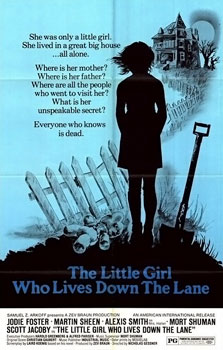
Horror Film Review: The Little Girl Who Lives Down The Lane (dir by Nicolas Gessner)


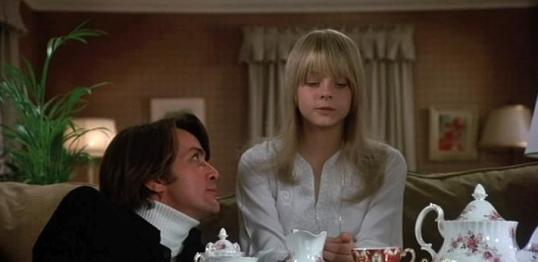
First released in 1976, The Little Girl Who Lives Down The Lane tells the story of Ryann Jacobs (played by Jodie Foster, who was thirteen years old when she made this film).

Rynn lives in a small New England town, in a house that her father has leased for three years.  It’s been a while since anyone has seen Rynn’s father.  Rynn always tells everyone that he’s either out of town or that he’s busy in his study and can’t be disturbed.  When the friendly local policeman (Mort Schuman) expresses some doubt about Rynn’s claim that her father is working, Rynn says that her father is a drug addict, like all of the great poets.

Rynn’s main problem is with the Halletts.  Cora Hallett (Alexis Smith) owns the house in which Rynn is living.  Cora drops by regularly, haughtily demanding to see Rynn’s father.  Her creepy son, Frank (Martin Sheen), also makes a habit of visiting.  He’s not interested in Cora’s father.  Instead, he’s interested in Cora.  Everyone in the town knows that Frank is a perv but no one is willing to do anything about it.  He’s protected by his mother’s money.

One day, when Cora drops by, she insists on going into the basement.  She says she has something down there that she needs to retrieve.  Rynn tells her not to go down there but Cora refuses to listen, which turns out to be a huge mistake.  Cora screams at what she sees down there and then falls to her death.  With the help of her only friend, Mario (Scott Jacoby) an aspiring magician who walks with a limp, Rynn covers up the murder.

Mario turns out to be a very good friend, indeed.  Not only does he tell people that he’s seen Rynn’s father but he even stands up to Frank when he shows up at the house, searching for his mother.  However, as it soon becomes clear, Frank isn’t one to give up so easily….

The Little Girl Who Lives Down The Lane is an interesting hybrid of a film.  It definitely does have elements of horror.  The running theme throughout the film is that Rynn might kill people but it’s all the adults in her life who are truly monstrous.  Frank is truly a monster and Martin Sheen gives a remarkably intense and creepy performance in the role.  Frank is the type who will say that worst things imaginable and then smirk afterward, confident that he’ll never have to face any sort of justice for his crimes.

At the same time, the film is also a coming-of-age-story and a teen romance.  Rynn and Mario are two outsiders who find each other.  You like both of them and you want things to work out for them, even though you spend almost the entire film worried that Rynn might end up poisoning Mario.  Foster and Jacoby share some genuinely sweet scenes.  Things would be just fine, the film seems to be saying, if all of these stupid adults would just mind their own business.

The Little Girl Who Lives Down The Lane is an effectively creepy and sometimes even sweet little film about a girl who occasionally has to kill people.  Keep an eye out for it!

Conspiracy: The Trial of the Chicago 8 (1987, directed by Jeremy Kagan)


The year is 1969 and, in an Illinois courtroom, 8 political radicals stand accused of conspiring to disrupt the 1968 Democratic Convention.  The prosecution is putting the entire anti-war movement on trial while the defendants are determined to disrupt the system, even if it means being convicted.  The eight defendants come from all different sides of the anti-war movement.  Jerry Rubin (Barry Miller) and Abbie Hoffman (Michael Lembeck) represent the intentionally absurd Yippies.  Tom Hayden (Brian Benben) and Rennie Davis (Robert Carradine) are associated with the Students for a Democratic Society.  Bobby Seale (Carl Lumbly) is one of the founders of the Black Panthers while David Dellinger (Peter Boyle) is a longtime peace activist.  John Friones (David Kagan) and Lee Weiner (Robert Fieldsteel) represent the common activists, the people who traveled to Chicago to protest despite not being a leader of any of the various organizations.  Prosecuting  the Chicago 8 are Richard Schulz (David Clennon) and Tom Foran (Harris Yulin).  Defending the 8 are two radical lawyers, Leonard Wienglass (Elliott Gould) and William Kunstler (Robert Loggia).  Presiding over the trial is the fearsome and clearly biased Judge Julius Hoffman (David Opatoshu).

Conspiracy: The Trial of the Chicago 8 is a dramatization of the same story that inspired Aaron Sorkin’s The Trial of the Chicago 7 but, of the two films, it’s Jeremy Kagan’s The Trial of the Chicago 8 that provides a more valuable history lesson.  By setting all of the action in the courtroom and recreating only what was said during the trial, director Jeremy Kagan and his cast avoid the contrived drama that marred so much of Sorkin’s film.  Kagan trusts that the true story is interesting enough to stand on its own.  Kagan includes documentary footage from the convention protest itself and also interviews with the people who were actually there.  While Kagan may not have had the budget that Sorkin did, his film has the authenticity that Sorkin’s lacked.  Kagan also has the better cast, with Michael Lembeck and Barry Miller both making Abbie Hoffman and Jerry Rubin into something more than the mere caricatures that they are often portrayed as being.

The Trial of the Chicago 8 was a film that Jeremy Kagan spent a decade trying to make.  When he first tried to sell the idea behind the film to CBS in 1976, Kagan had Marlon Brando, Walter Matthau, George C. Scott, and Dustin Hoffman all willing to work for scale and take part in the production.  CBS still passed on the project, saying that no one was interested in reliving the 60s.  It wasn’t until 1987 that Jeremy Kagan was finally able to revive the film, this time with HBO.  It actually worked out for the best because, with HBO, there was no need to try to come up with a “clean” version for the language that was used in the courtroom or in the interviews with the actual participants.  The defendants could be themselves.

Though it has been overshadowed by Sorkin’s subsequent film, The Trial of the Chicago 8 is the definitive film about what happened in the aftermath of the the 1968 Democratic Convention.