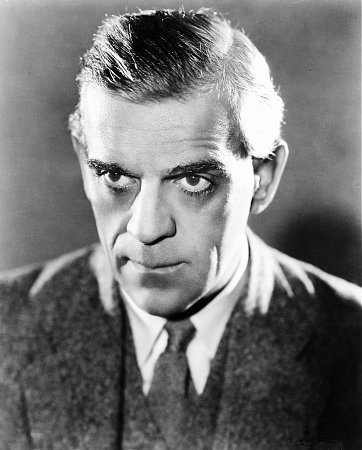
By most standards, Boris Karloff (who has born William Henry Pratt) was a true Edwardian gentleman, a reserved but polite man who treated people with respect and who was a generous co-star to his fellow cast members. Early on in his acting career, he played a wide variety of character but, due to his performance as Frankenstein’s Monster and a host of other iconic characters, Boris Karloff would join Bela Lugosi as the first horror star of the sound era. As opposed to Lugosi, who struggled with his resentment over being typecast and soon found himself ostracized from mainstream Hollywood, Karloff remained a popular character actor and horror star for his entire life. Karloff’s dissatisfaction with the hours that he was expected to spend in makeup to play both Frankenstein’s Monster and the Mummy led to Karloff serving as one of the founding members of the SAG.
In this scene, from 1935’s The Bride of Frankenstein, Karloff’s monster briefly finds a friend. Unfortunately, as so often happened, that friendship is quickly ruined by the ignorance of others.
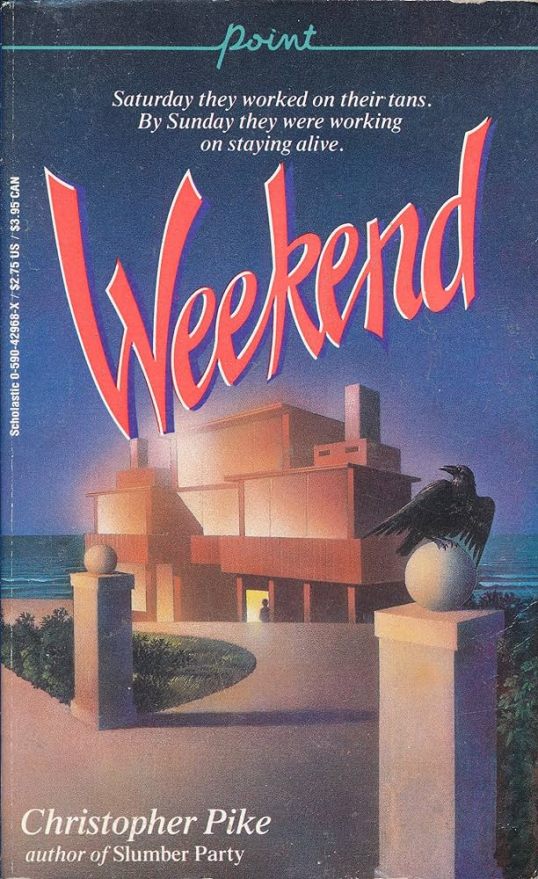
The 1986 novel, Weekend, involves the most memorable senior ditch day ever!
9 friends, who have a tangled web of personal relationships and conflicting feelings towards each other, head down to Mexico for the weekend. They’ve got a mansion to stay in, one that belongs to the absent parents of their friend Robin. Robin once had a great singing voice and a great future but, at the last party that her friends threw, someone spiked her drink with insecticide. Now, Robin can barely speak and is only being kept alive by a dialysis machine. The weekend in Mexico starts out as a fun but soon, secrets are being revealed, live are being put at risk, and who knows who will survive to the end!
The majority of the story is told through the eyes of Shani, who is a well-written and complicated character. As opposed to the characters who populate the majority of R.L. Stine’s Fear Street books, Shani is nether perfect nor totally evil. Instead, she’s someone who has very real emotions and, even more importantly, very real reactions to everything that’s going on around her. (Christopher Pike’s novels have always felt a little less generic than R.L. Stine’s. That said, Pike’s novels also have a tendency to be a bit more unnecessarily complicated than Stine’s.) That said, the other characters are not as well-written as Shani and, with a total of 9 people staying at that mansion, it can get a bit difficult to keep straight of who is who. Keep a notebook nearby so you can jot down who betrayed who at which pep rally because it’s not always easy to keep track of it all.
I always enjoy books about people stranded with a killer for the weekend and Weekend does a good job of keeping you guessing as to who is responsible for what. The finale, in which everything is explained, is enjoyably over the top. Pike, wisely, chooses to embrace the melodrama when it comes to wrapping everything up.
Weekend is an enjoyably over-the-top novel. If nothing else, this book might make you appreciate your own occasionally overdramatic friends. Because as dramatic as they may be, they’re nowhere near as bad as the folks in Weekend.
In the early 80s, Robert Hansen was a respected businessman in Anchorage, Alaska. He owned a restaurant. He was known for being a family man. He held several local hunting records. Almost everyone who met him described him as being friendly and good-natured. In those days before the Internet, it wasn’t as if someone could do a Google search and discover that Hansen had a long criminal record in both Iowa and Alaska. There was no way to know that Hansen had been a teenage arsonist and that had been arrested and charged with rape in the early 70s. (The charges were ultimately plea bargained down to assault.) Even those who did know about his background felt that Hansen had turned his life around and was now an upstanding member of society.
At the same time that Hansen was a respected member of the Anchorage community, he was abducting young women and, after holding them prisoner and raping him at his cabin, flying them into the Alaskan wilderness where he would then hunt them in his own version of The Most Dangerous Game. It’s known, for sure, that Hansen murdered at least 18 women. It’s felt that the number is much higher. Along with his own good reputation, Hansen was protected by the fact that many of his victims were transients and sex workers. Their disappearances were rarely reported to the police and, when they were, the police didn’t go out of their way to find them. Much as happened with the Green River Killer in Washington State, Hansen was able to get away with his crimes for over 20 years not because he was particularly clever but because his victims were considered to be on the fringes of society.
The 2011 film, The Frozen Ground, is a fictionalized account of the investigation that led to Hansen’s arrest. John Cusack plays Robert Hansen. Nicolas Cage plays Jack Holcombe, a weary Alaskan state trooper who has to deal with uncooperative witnesses and beaurocratic indifference while investigating Hansen’s crimes. Vanessa Hudgens plays Cindy Paulson, a 17 year-old sex worker who survives her encounter with Hansen but whose story is originally ignored by the police because of what Cindy does for a living. Both Jack and Hansen comes to realize that Cindy is the only person who can positively identify the killer but Cindy has disappeared into the Anchorage underworld, working as a stripper and being manipulated by her pimp, Clate Johnson (50 Cent).
Taking full of advantage of the chilly atmosphere and the isolation of the Alaskan wilderness, The FrozenGround is an effective journey into the heart of darkness, featuring excellent performances from Nicolas Cage and John Cusack. Cusack smoothly alternates between being the arrogant hunter and the desperate prey while Cage’s weary expression captures the psychological toll of investigating the crimes of someone like Robert Hansen. Of course, when the film came out, it received a lot of attention for featuring Vanessa Hudgens in a dramatic role. Hudgens’s performance here continues the tradition of former Disney (and Nickelodeon) actresses trying to prove their range by playing an edgy role. Though there’s a few scenes where she does seem to be trying too hard to make sure that we all know she’s capable of more than High School Musical, Hudgens is convincing for the most part.
As for the real-life Robert Hansen, he was sentenced to spend 461 years in prison for his crimes. (Alaska has no death penalty.) In 2014, three years after the release of this film, the 75 year-old Hansen died of natural causes while still incarcerated.
4 Shots From 4 Films is just what it says it is, 4 shots from 4 of our favorite films. As opposed to the reviews and recaps that we usually post, 4 Shots From 4 Films is all about letting the visuals do the talking.
This October, I am going to be using our 4 Shots From 4 Films feature to pay tribute to some of my favorite horror directors, in alphabetical order! That’s right, we’re going from Argento to Zombie in one month!
Today’s director: one of the masters of Hammer horror, Terence Fisher!
4 Shots From 4 Terrence Fisher Films
Horror of Dracula (1958, dir by Terence Fisher, DP: Jack Asher)
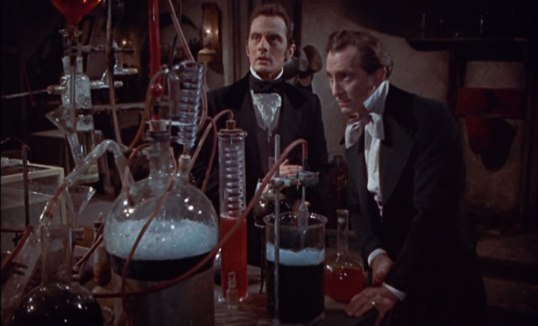
The Revenge of Frankenstein (1958, dir by Terence Fisher, DP: Jack Asher)
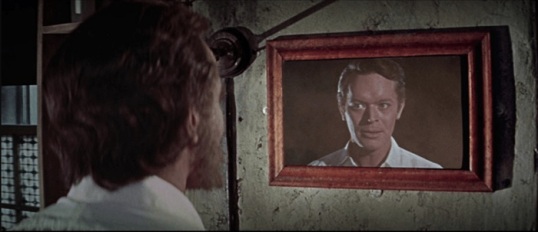
The Two Faces of Dr. Jekyll (1960, dir by Terence Fisher, DP: Jack Asher)
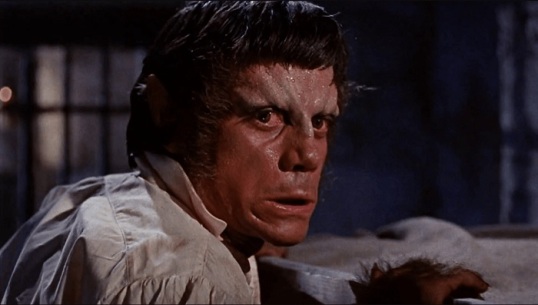
The Curse of the Werewolf (1961, dir by Terence Fisher, DP: Arthur Grant)
It doesn’t get more 80s than 1987’s Aerobicide, a rather ludicrous slasher film that is also known as Killer Workout.
The clients and the staff at Rhonda’s Work-Out are in danger. People are being murdered inside the gym, left and right. One member of the gym is slashed to death in the showers. Another one is beaten to death with a barbell while his friend is killed with a very large safety pin. One instructors ends up hanging in a closet while another is stabbed to death in a locker room. A group of teens show up to spray graffiti on the outside of the club and they all end up getting murdered as well.
Most people would assume that, with all of those murders going on, that the place would be closed down or, at the very least, people would stop frequenting the gym. But no, the opposite happens. Every murder is followed by an aerobics class, in which the camera shamelessly lingers on the lycra-clad participants, none of whom seem to be particularly concerned about working out at a crime scene. ( If your body’s looking too big, one of the film’s many songs tells us, Like a hippo or a pig/ Gotta workout/ gotta work out….) The gym’s owner, Rhonda Johnson (Marica Karr), doesn’t seem to be particularly concerned about the gym getting a bad reputation as a result of all the murders. Instead, she’s more annoyed with her surviving instructors, snapping at one, “Stop showing off your tits and that tight little ass!” Personally, I would think looking good would be a top priority for someone working at a gym but apparently, Rhonda feels differently.
(Then again, if people were being murdered at my gym, I’d probably cancel my membership, despite the fact that my gym is only a few blocks away from my house and most of the people who go there are relatively cool. That said, the main reason why I signed up for a membership was so my sister could get a discount on her membership fees. Personally, I prefer running.)
Even if Rhonda refuses to close the gym, you would think that Lt. Morgan (David James Campbell) would make sure that the gym had a full-time police presence. Eventually, Morgan does assign one policeman to watch the gym but that’s only after several murders have already occurred and that one policeman’s presence doesn’t really do much good. Then again, Lt. Morgan never comes across as being a particularly good cop. Morgan is spectacularly bad at his job, which wouldn’t be a huge problem if not for the fact that Morgan is also the hero of the film. Eventually, he does figure out that the murders are connected to a tragic tanning bed accident but it’s hard to say how exactly he managed to do that. Rather than actually showing us Lt. Morgan gathering clues and drawing conclusions, the film just has him randomly blurt stuff out.
It’s all pretty ridiculous but, because the film is such a film of it’s time, it’s also rather fascinating. KillerWorkout may not have been the only or even the first film to combine Flashdance with slasher chills but it is the first one to feature a song with lyrics like, “It’s the perfect body you’re looking for/it’s aerobocide.” This is one of those films where you come for the big hair and the 80s fashions and the bass-heavy score and you stay for the ludicrous plot twists, the overacting, the overheated dialogue, and the out-of-nowhere plot twists that dominate the film’s final 30 minutes. It’s not necessarily a “good” film but I defy anyone to look away once it begins.
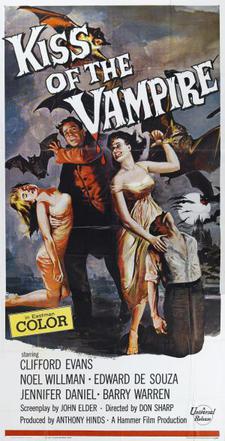
The 1963 Hammer film opens with a funeral in early 20th century Bavaria. It’s a solemn affair, full of mourning villagers and taking place in an atmospheric cemetery. However, just as the wooden coffin is being lowered into the grave, the stern Prof. Zimmer (Clifford Evans) walks through the funeral party, carrying a stake and a hammer. Without bothering to open the coffin, he hammers the stake through the lid. As the members of the funeral party wail and scream, bright red blood bubbles up from the coffin.
Yep, it’s a Hammer vampire film! That means that once again, we’ve got a small village, we’ve got superstitious townspeople, we’ve got an aristocratic vampire and his vampire brides, and we’ve got a mix of red blood and cleavage. What we do not have is Christopher Lee, despite the fact that Kiss of the Vampire was originally planned to be a Dracula film. Lee, who was a serious student of the occult and a fan of Bram Stoker’s version of the legendary vampire, was very much not a fan of Hammer’s interpretation of the character and, whenever he could get out of doing a Hammer Dracula film, he would.
As a result, Kiss of the Vampire features not Dracula but instead Dr. Ravna (Noel Willman), a vampire who lives in a castle and who has a loyal cult of followers. Both his son (Barry Warren) and his daughter (Jacquie Wallis) are also vampires. When two British newlyweds drive into town on their honeymoon, Dr. Ravna hopes to turn Marianne Harcourt (Jennifer Daniel) into a vampire as well. Marianne’s husband, Gerald (Edward de Souza), teams up with Prof. Zimmer to keep that from happening. It’s vampire doctor versus human professor!
This was director Don Sharp’s first horror film for Hammer and he does a pretty good job of creating an appropriately gothic atmosphere. Almost all of the things that we love about Hammer films is present in Kiss of the Vampire, from the cobblestone streets to the imposing castles to the elaborate masquerade ball that allows Dr. Ravna to abduct Marianne in the first place. There’s also a lot of blood, including a wonderfully grisly scene where Prof. Zimmer deliberately sets his arm on fire in order to cauterize a vampire bite. Visually, the film is full of macabre images and operatic horror. In fact, one could argue that the absence of Dracula and Van Helsing allows Kiss of the Vampire to go in a direction that the other Hammer vampire films could not. The finale, which featured the heroes using black magic to battle the vampires, was originally meant to be the finale of The Brides of Dracula until Peter Cushing objects that Prof. Van Helsing would never use dark magic to battle a vampire. Prof. Zimmer, on the other hand, had no such qualms.
That said, the film really does suffer from the fact that Noel Willman does not have the evil charisma of Christopher Lee and Dr. Ravna and Prof. Zimmer do not share the long history of Dracula and Van Helsing. Kiss of the Vampire is a good film but it’s hard not to mourn what it could have been.
As some of our regular readers undoubtedly know, I am involved in hosting a few weekly live tweets on twitter and occasionally Mastodon. I host #FridayNightFlix every Friday, I co-host #ScarySocial on Saturday, and I am one of the five hosts of Mastodon’s #MondayActionMovie! Every week, we get together. We watch a movie. We snark our way through it.
Tonight, for #MondayActionMovie, the film will be 1995’s The Demolitionist! Selected and hosted by Bunny Hero, which was apparently inspired by Robocop! So, you know it has to be good!
Following #MondayActionMovie, Brad and Sierra will be hosting the #MondayMuggers live tweet. We will be watching 2022’s DoubleThreat! The film is on Prime!
It should make for a night of fun viewing and I invite all of you to join in. If you want to join the live tweets, just hop onto Mastodon, pull up The Demolitionist on YouTube, start the movie at 8 pm et, and use the #MondayActionMovie hashtag! Then, at 10 pm et, switch over to Twitter and Prime, start DoubleThreat, and use the #MondayMuggers hashtag! The live tweet community is a friendly group and welcoming of newcomers so don’t be shy.
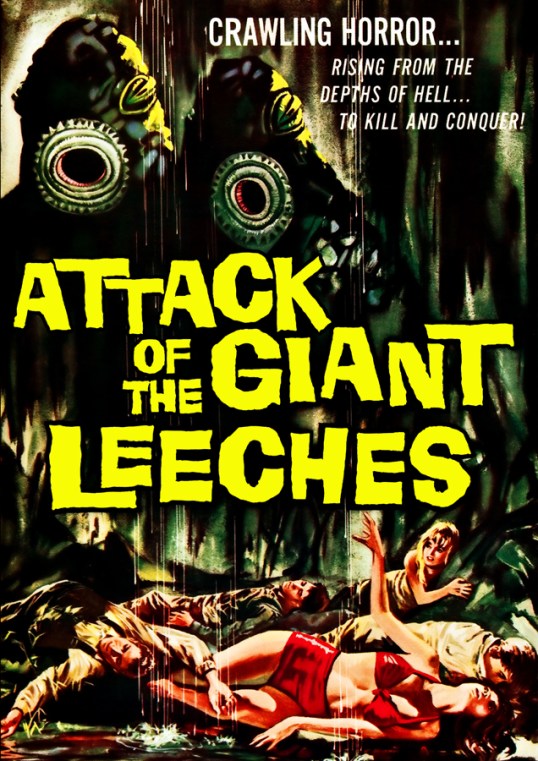
For today’s public domain horror film, I present to you 1959’s Attack of the Giant Leeches. This 60-minute film is a classic Drive-in film. It features an iconic performance from Yvette Vickers, who is one of my favorites of the strong, confident, unapologetically sexy women who dominated the old B-movies. (Plus, she was only 5’3 and it’s not easy being brave when you’re having to look up at everyone. Trust me, I know.) This short little film is steamier than Louisiana in August and is full of bayou atmosphere.
I have to admit that I’m kinda freaked out by the scenes of people floating underwater in this film. And leeches .… agck! Don’t even get me started on leeches. Especially giant leeches….
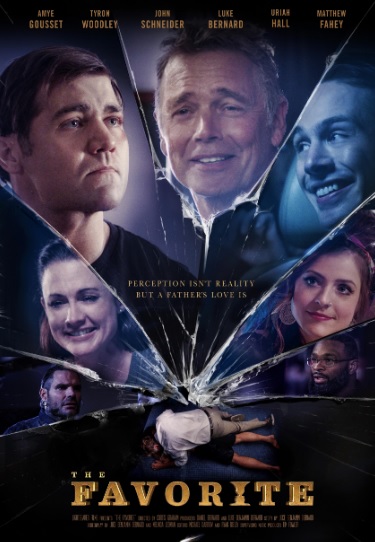
The 2019 film, The Favorite, tells the story of two brothers.
Benjamin Bernard (Luke Benjamin Bernard) is an MMA fighter, an up-and-comer who never gives up in the ring and has won the loyalty of his fans as a result. His nickname is “The Favorite” because the crowd loves to watch him fight. What the crowd doesn’t know is that Benjamin rarely feels like the favorite in his everyday life. Instead, he’s lived his life overshadowed by his brother and, as a result, he’s grown up to be angry and insecure.
Benjamin’s brother is Luke (Matthew Fahey). Luke is a star soccer player, one who is destined to go pro as soon as he graduates. (At one point, he’s projected to be the number one draft choice.) Luke has always been a good son and a good friend and a good brother. He and Benjamin love each other but Benjamin just cannot get over his jealousy towards the strong relationship between Luke and their father, Daniel (John Schneider).
The tensions between the two come to a head one night while the two of them are on a double date. Luke is driving when Benjamin punches him. Luke loses control of the SUV, resulting in a catastrophic crash. Luke’s girlfriend is killed. Benjamin’s girlfriend may never walk again. Luke is taken to the hospital in a coma and the doctors are forced to remove a part of his skull in order to save his life, causing half of the top of Luke’s head to cave in. Somehow, Benjamin survives the accident with only a few minor cuts and bruises.
After spending days in a coma, Luke finally opens his eyes. It quickly becomes apparent that he’s suffered severe brain damage. He can barely walk or speak but Luke also makes it clear that he intends to recover. With the help of Benjamin and Daniel, Luke makes quick progress. But when Benjamin confesses that it was his actions that led to the car crash and the death of Luke’s girlfriend, will Luke ever be able to forgive him?
The Favorite ends with an interesting postscript. As the end credits roll, the viewers are informed that the film’s star, Luke Benjamin Bernard, was in a similar car accident in 2013. The accident left him in a stage 3 coma and, just as happened to Luke in the film, the doctor’s had to remove a portion of Bernard’s skull in order to save his life. Bernard was given little chance of recovery but, to the shock of everyone, he did eventually wake up from his coma. He had to learn how to walk, talk, and write again. He even had to re-learn how to swallow and eat solid food. Much like the film’s Luke, the real Luke made remarkable progress in his recovery, completing rehab in three weeks. While in the hospital, Bernard had a dream about two brothers who were dealing with the same thing that he was dealing with. That dream led to Bernard writing the script for The Favorite, with Benjamin and Luke representing two sides of himself and his recovery. The film ends with a shot of him giving a motivational speech and I don’t care how cynical you may be, it’s incredibly touching.
It’s a touching film as well. Yes, the budget is low and there are a few scenes that are a bit overwritten. A subplot about Benjamin trying to win the MMA championship felt like it was lifted from a dozen other films. But, in the end, it doesn’t take away from the power of the film’s story or the excellent performances of Bernard, Fahey, and Schneider. This is a heartfelt movie, one that celebrates the love of family and the promise of hope.
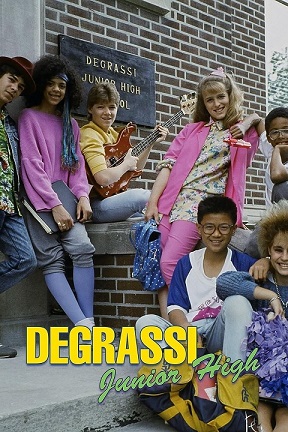
Welcome to Late Night Retro Television Reviews, a feature where we review some of our favorite and least favorite shows of the past! On Sunday, I will be reviewing the Canadian series, Degrassi Junior High, which aired on CBC and PBS from 1987 to 1989! The series can be streamed on YouTube!
This week, Degrassi goes there!
Episode 1.5 “The Great Race”
(Dir by Clarke Mackey, originally aired on February 15th, 1987)
“Degrassi goes there!” was the catch phrase that was often used to describe Degrassi: The Next Generation because Degrassi had a reputation for being the show that would deal with the type of issues that other teen shows didn’t have the guts to take on. Indeed, it’s generally agreed that Degrassi did, at the beginning, “go there.” The general point of contention amongst fans is when Degrassi stopped going there and became too much of a soap opera for its own good. A lot of fans will tell you that it was Season 10. Personally, I think it was when the show moved to Netflix. But no matter. That’s something that we will get to far in the future.
This week’s episode of Degrassi Junior High proves that Degrassi was willing to go there before the cast members of the Next Generation had even been born. This episode opens with Melanie (Sara Ballingall) worrying that her breasts aren’t developing as quickly as they should be and complaining that her mother refuses to allow her to wear a bra because she says that Melanie doesn’t need one. When her friend, L.D. (Amanda Cook), secretly takes Melanie bra shopping, Melanie feels good about herself for exactly 12 hours before she goes to school and is immediately made fun of by Joey (Pat Mastoianni) and his idiot friends. Myself, I had the opposite issue of Melanie when I was in middle school. I developed before everyone else and I had to deal with stupid and hurtful comments about actually having breasts, not just from the boys and girls who had the excuse of being immature but also from adults who really should have known better. Growing up is not easy.
Melanie has a crush on a classmate who is named Archie but who is known as …. OH MY GOD, IT’S SNAKE! As any fan of Degrassi knows, Archibald “Snake” Simpson (Stefan Brogren) is destined to become one of the most important characters in the history of the franchise. Though he starts out as just another student, Snake is destined to become a teacher at Degrassi, Emma Nelson’s stepfather, a cancer survivor, and eventually the school’s principal. All of that is far in the future, of course. In this episode, Snake is just a friendly and tall guy who wears a loud Hawaiian shirt and occasionally flashes an appealing smile. In fact, Snake is not even friends with Joey or Wheels in this episode. (That will change, with their friendship coming to define Degrassi for many people.)
Everyone in this episode is fascinated by Snake. Yick and Arthur, who are worried that they’re not getting as tall as their classmates, decide to follow around the very tall Snake to see what he eats. Meanwhile, Jason (Tyson Talbot), the captain of the soccer team, wants Snake to join the soccer team because he’s a good swimmer.
What? Okay, allow me to explain….
Basically, when the totally sexist Jason makes an announcement asking people to come out and support the Boys’ Soccer Team, L.D. and Melanie demand to know why he didn’t mention the fact that the Girls’ Swim Team, of which they are both members, won their last swim meet. Jason replies that no one cares about girls’ sports. This leads to the swim team challenging the soccer team to a swimming competition. Because Snake is a championship swimmer, Jason wants him to swim for the boys but Snake would have to join the soccer team to do so and, as Snake himself admits, he sucks at soccer. (Awwwww! That’s our Snake! Always honest! Except for that time he cheated on Spike but again, that’s far in the future….)
Anyway, Melanie is so tired of being made ridiculed that she’s not sure that she even wants to swim anymore. But Snake encourages her to do so because she’s really good at swimming. (Snake has realized that Jason just wanted him to join the soccer team so he could swim and being the most ethical student at Degrassi, Snake wants not part of that.) Melanie shows up for the meet and the girls totally humiliate the boys. YAY! Plus, the girls’ team gets revenge on Joey by tossing him in the pool. YAY AGAIN!
This was a good episode and a good example of Degrassi going there and handling a subject to which its viewers could relate with sensitivity. Plus, after walking around in the background for the previous 4 episodes, Snake finally got to speak. It’s just not Degrassi without Snake!



 Through the Shattered Lens