4 Shots From 4 Films is just what it says it is, 4 shots from 4 of our favorite films. As opposed to the reviews and recaps that we usually post, 4 Shots From 4 Films lets the visuals do the talking.
Today, in honor of National Science Fiction Day, it’s time for….
4 Shots From 4 Science Fiction Films
2001: A Space Odyssey (1968, dir by Stanley Kubrick, DP: Geoffrey Unsworth)
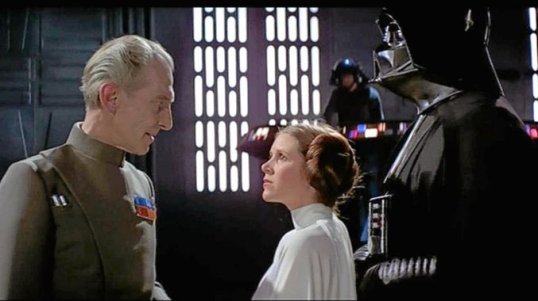
Star Wars Episode IV: A New Hope (1977, dir by George Lucas, DP: Gilbert Talyor)
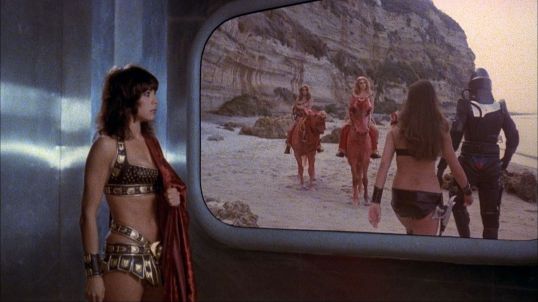
Starcrash (1978, dir by Luigi Cozzi, DP: Paul Beeson and Roberto D’Ettorre Piazzoli)
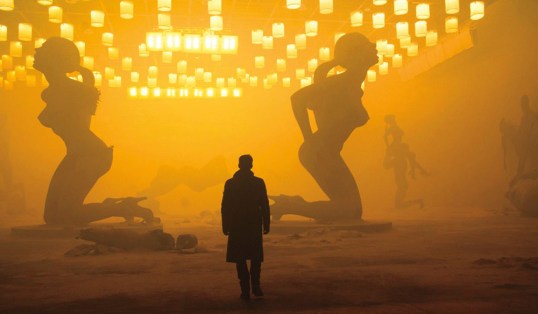
Blade Runner 2049 (2017, dir by Denis Villeneuve, DP: Roger Deakins)
1973’s Save The Tiger tells the story of Harry Stoner (Jack Lemmon).
When Harry was a young man, he loved baseball and he felt like he could conquer the world. He saw combat in World War II and spent the final part of the war on the Island of Capri, recuperating after being wounded in battle. Harry went on to partner up with Phil Greene (Jack Gilford) and they started a clothing company in Los Angeles, Capri Casuals.
Now, Harry is a middle-aged man who is still haunted by nightmares about the war. He’s married. He has a daughter attending school in Switzerland. He’s respected in the industry. He lives in a nice house in Beverly Hills. And he’s totally miserable. He wakes up every day and wonders what is happening to the country. He talks about witnessing a wild pitch at a baseball game, missing the days when something like that could seem like the most important thing in his life. He spends all of his time at work, cheating to balance the books and keeping clients happy by setting them up with a sophisticated prostitute named Margo (played, with a weary cynicism, by Lara Parker).
Save The Tiger covers just a few days in the life of Harry Stoner, as he searches for some sort of meaning in his life. He gives a ride to a free-spirited hippie (Laurie Heineman) who offers to have sex with him. (Harry replies that he’s late for work.) He accepts an award at an industry dinner and, as he tries to give his acceptance speech, he is haunted by the sight of dead soldiers sitting in the audience. With Phil, he debates whether or not to balance the books by setting fire to one of their warehouses in order to collect the insurance. Harry sees a poster imploring him to “Save the Tigers.” Who can save Harry as he finds himself increasingly overwhelmed by the realities of his life?
As I watched Save the Tiger, I found myself thinking about two other films of the era that featured a middle-aged man dealing with a midlife crisis while searching for meaning in the counterculture. In Petulia and Breezy, George C. Scott and William Holden each found meaning in a relationship with a younger woman. And while Petulia and Breezy are both good films, Save The Tiger is far more realistic in its portrayal of Harry’s ennui. There is no easy solution for Harry. Even if he accepted the hippie’s offer to “ball” or if he acted on the obvious attraction between himself and Margo, one gets the feeling that Harry would still feel lost. Harry’s problem isn’t that he’s merely bored with his life. Harry’s problem is that he yearns for a past that can never be recaptured and which may only exist in his imagination. If George C. Scott and William Holden were two actors who excelled at playing characters who refused to yield to the world’s demands, Jack Lemmon was an actor who played characters who often seemed to be desperate in their search for happiness. Save The Tiger features Lemmon at his most desperate, playing a character who has yielded so often and compromised so much that he now has nowhere left to go.
It’s not exactly a cheerful film but it is one that sticks with you. Jack Lemmon won his second Oscar for his performance as Harry and he certainly deserved it. Lemmon does a wonderful job generating some sympathy for a character who is not always particularly likable. Many of Harry’s problems are due to his own bad decisions. No one forced him to use “ballet with the books” to keep his business open and no one is forcing him to hire arsonist Charlie Robbins (Thayer David, giving a performance that is both witty and sinister at the same time) to burn down not only his warehouse but also an adjoining business that belongs to an acquaintance. Harry could admit the truth and shut down his business but then how would he afford the home in Beverly Hills and all the other symbols of his success? Harry yearns for a time when he was young and his decisions didn’t have consequences but that time has passed.
This isn’t exactly the type of film that many would expect from the director of Rocky but director John G. Avildsen does a good job of putting the viewer into Harry’s seedy world. I especially liked Avilden’s handling of the scene where Harry hallucinates a platoon of wounded soldiers listening to his awards speech. Instead of lingering on the soldiers, Avildsen instead uses a series of a quick cuts that initially leave the audience as confused as Harry as to what Harry is seeing. Both Rocky and Save The Tiger are about a man who refuses to give up. The difference is that perhaps Harry Stoner should.
“You can’t play with us, mister!” a kid yells at Harry when he attempts to recreate the wild pitch that so impressed him as a youth. In the end, Harry is a man trapped by his memories of the past and his dissatisfaction with the present. He’s made his decisions and he’ll have to live with the consequences but one is left with the knowledge that, no matter what happens, Harry will be never find the happiness or the satisfaction that he desires. The tigers can be saved but Harry might be a lost cause.
“The Don is Dead!” shouts the title of this 1973 film and it’s not lying.
After the powerful and respect leader of the Regalbuto crime family dies, the Mafia’s governing body meets in Las Vegas to debate who should be allowed to take over the family’s operations. Frank Regalbuto (a smoldering Robert Forster) wants to take over the family but it’s agreed that he’s still too young and hot-headed. Instead, control of the family is given Don Angelo DiMorra (Anthony Quinn), an old school Mafia chieftain who everyone agrees is a man of respect. Don DiMorra will serve as a mentor to Frank while Frank’s main enforcers, The Fargo Brothers, will be allowed to operate independently with the understanding that they will still respond if the mob needs them to do a job. Tony Fargo (Forrest) wants to get out of the rackets all together while his older brother, Vince (Al Lettieri), remains loyal to the old ways of doing things.
Frank is not happy with the arrangement but he has other things to worry about. He knows that there’s a traitor in his family. While he and the Fargo brothers work to uncover the man’s identity so that they can take their revenge, Don Angelo falls in love with a Vegas showgirl named Ruby Dunne (Angel Tompkins). However, Ruby is engaged to marry Frank and, when Frank returns from taking care of the traitor, he is tipped off as to what has been happening in his absence. Frank goes crazy, nearly beating Ruby to death. Don Angelo declares war on Frank and the Fargo brothers are forced to decide which side they’ll serve.
In the 1970s, almost every crime film was either a rip-off of The French Connection or The Godfather.The Don Is Dead is unique in that it attempts to rip off both of them at the same time. The film opens French Connection-style with a couple of hoods trying to double-cross Frank during a drug deal, leading to shoot-out. (Keep an eye out for Sid Haig as one of Frank’s men.) The film is full of scenes that are meant to duplicate the gritty feel of The French Connection though, needless to say, none of them are directed with the cinema verité intensity that William Friedkin brought to that classic film. Meanwhile, Anthony Quinn plays a character who is very much reminiscent of Don Vito Corleone, even pausing at one point to tell Frank that “drugs are a dirty business.” The Godfather‘s Abe Vigoda and Al Lettieri show up in supporting roles and Robert Forster gives a performance that owes more than a little to James Caan’s Oscar-nominated turn as Sonny Corleone. (Interestingly enough, both Quinn and Forster were among the many actors considered for roles in The Godfather.)
Unfortunately, the film itself is slowly-paced and never really draws us into the plot. Director Richard Fleischer, who directed a lot of films without ever developing a signature style, brings none of the intensity that William Friedkin brough to The French Connection nor can he duplicate Francis Ford Coppola’s operatic grandeur. The Don is Dead plays out like a particularly violent made-for-TV movie. There’s a lot of talented people in the cast but they’re defeated by thinly drawn characters. Robert Evans often said that Coppola was hired to direct The Godfather because, as an Italian-American, he would bring an authenticity to the material that a non-Italian director would not be able to do. The Don Is Dead would seem to indicate that Evans knew what he was talking about.
Today’s music video of the day comes to us from Tears For Fears and their seventh studio album, The Tipping Point.
This song is a mix of melancholy emotions and hope for a better future. As the video shows it can be easy to feel like you’re drowning in today’s world, with its constant flood of negativity and disturbing imagery. As I sit here typing this post, I still can’t go on twitter without immediately being confronted by a video of a woman being burned alive in a New York subway car. There’s only so much of that ugliness that one can see before it becomes tempting to assume that the human race is defined solely by the worst members of it. The majority of the people that I know, though, are kind, loving, and tolerant. And if they see you drowning, they’ll be the first to reach out and pull you to safety.
What’s an Insomnia File? You know how some times you just can’t get any sleep and, at about three in the morning, you’ll find yourself watching whatever you can find on cable or streaming? This feature is all about those insomnia-inspired discoveries!
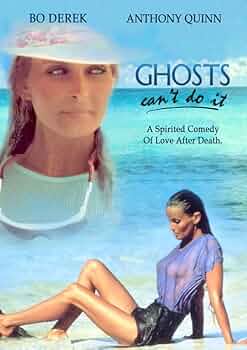
If you find yourself having trouble getting to sleep tonight or tomorrow, you may want to try watching 1989’s Ghosts Can’t Do It. It won’t necessarily put you to sleep but it will give you something to ponder while you lie in bed and stare up at the ceiling. For instance, how exactly did this movie get produced without anyone coming up with a better title than Ghosts Can’t Do It?
Bo Derek plays Kate, the wife of elderly billionaire Scott (played by Anthony Quinn, who appears to be drunk in the majority of his scenes). Despite their age difference, Kate and Scott are deeply in love. When they’re not playing in the snow and riding horses around the ranch, they’re having sex. “Sex, sex, sex, sex!” the movie seems to chant in almost every scene. But then Anthony Quinn has a heart attack, which in this film means that he spends what appears to be hours lying in the snow while trading jokes with Kate. (It’s important to be able to joke with your partner but if my man had a heart attack, my first reaction would be to get a doctor.)
Scott survives his heart attack but he’s told that, in his weakened state, he can no longer have sex. Also, he can’t get a new heart because he’s too old. Facing a future without sex, Scott shoots himself. Fortunately, Scott’s guardian angel (Julie Newmar) takes sympathy on him and sends his spirt back down to Earth. Only Kate can see and hear him and, while she’s happy to be reunited with him, they are both upset to discover that ghosts can’t do it.
Scott comes up with a plan. Kate needs to find a young, virile lover and then murder him so that Scott can possess his body and then he and Kate can have sex whenever they feel like it. Because that plan makes total sense and there’s no way that it could lead to Kate’s soul being damned to an eternity in Hell, Kate agrees. Kate travels the world, having sex and looking for a man who will be able to please her after she has murdered him. Eventually, Kate meets a charming young criminal named Fausto (Leo Damian) and decides that he’ll do. Scott can’t wait to inhabit Fausto’s body but Kate suddenly realizes that she might not have it in her to be a murderer! Well, she’ll never know unless she tries. (I never thought that I would be able to shoot down a drone but then, one night in December….)
While all of this is going on, Kate is handling Scott’s business affairs. This leads to a meeting with a famous and ruthless businessman named Donald Trump. Yes, the 45 and 47th President of the United States plays himself in this film. Kate and Trump meet in a conference room to discuss a deal. Kate mentions that she read Trump’s book. Trump smiles and nods. They have hard-boiled business dialogue. Kate tells Trump that he’s “too pretty” to be as ruthless as he is. ‘You noticed,” Trump says. It’s a pretty dumb scene but, from a historical point-of-view, it’s a reminder of the fact that, long before he was elected President, Trump was already a ubiquitous figure on the American pop cultural scene.
Ghosts Can’t Do It is definitely a misfire, albeit one that is such a huge misfire that it become interesting in the same way that trainwrecks are often interesting. Almost everything about it, from the dialogue to the attempts at humor to the nearly unreadable font that is used for the opening credits, feels wrong. There is one brief moment that works, in which Kate dances with her ghost husband and, for the first and only time in the film, we see a flicker of genuine chemistry between Bo Derek and Anthony Quinn. (Bo Derek, I will mention, is not quite as bad an actress as her reputation suggests. It’s just that she should have been playing campy soap opera villainesses on late night television as opposed to starring in her husband’s crackpot films.) Otherwise, this movie is perhaps the worst movie to ever feature both a two-time Oscar winner and a future President. And, for that reason, it’s a watchable curiosity. It’s just what insomnia demands.
Welcome to Late Night Retro Television Reviews, a feature where we review some of our favorite and least favorite shows of the past! On Wednesdays, I will be reviewing Monsters, which aired in syndication from 1988 to 1991. The entire series is streaming on YouTube.
It’s time to return to Monsters!
Episode 3.3 “Bug House”
(Dir by Kenny Myers, originally aired on October 14th, 1990)
Ellen (Karen Sillas) visits her sister, May (Juliette Kirth) and is shocked by what she discovers. May is living in a cabin that was once owned by their father and she’s allowed the place to become infested with roaches and other bugs! May is pregnant and appears to be mentally unstable. She lives with her boyfriend, the handsome but creepy Peter (Robert Kerbeck).
What’s interesting is that, even though Ellen is disgusted by how May is living, one gets the feeling that Ellen is also secretly happy to see that her sister is struggling. It’s obvious that there are a lot of complicated feelings between the two of them. Their conversation at the start of the episode is a masterclass in passive aggressive communication. And even though Ellen claims not to trust Peter, it’s easy to guess what’s going to happen between them.
Unfortunately, Peter’s not just some creepy guy with a condescending attitude. He’s actually an insectoid creature who just happens to be wearing a human mask. And when May gives birth, she gives birth to a giant roach. While Peter gazes adoring at the roach, May is devoured by maggots. As terrifying as that is, the episode ends with Ellen pregnant….
AGCK!
This was an episode of Monsters that actually lived up to its name. Peter was a horrifying creation and the scenes with the bugs were among some of the most effective that I’ve seen on this show. With this episode, Monsters moved beyond the deliberate campiness of the majority of its episodes and instead embraced Cronenbergian body horror. The atmosphere was full of dread and the cabin was an effectively macabre location. (What made the cabin especially disturbing was that it was obvious that it had once been quite nice before Peter moved in. Bugs ruin everything!) Everything from the dilapidated set design to the dark lighting to the ominous music came together to make this episode feel like a filmed nightmare. Speaking for myself, there’s nothing more terrifying than a giant roach. Seriously, I hate those things! Even the name — Roach — sounds like something that would kill you if it got a chance.
But what truly made this episode work were the performances of Karen Sillas and Juliette Kirth as the two sisters. They not only captured the bond that all sisters share but they also captured how that bond can sometimes lead to competition. The sisters love each other but there’s also a lot of resentment behind almost everything that they say to each other, which brings a whole extra layer of meaning to this episode’s story.
This was an excellent episode and a great way to return to Monsters!
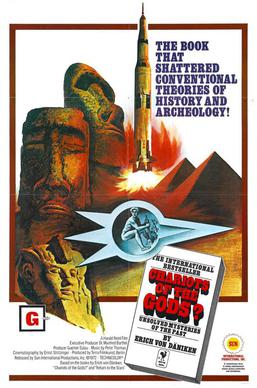
First released in 1970, the German documentary Chariots of the Gods tests the proposition that you can prove anything with stock footage and a narrator.
Chariots of the Gods takes viewers on a tour through some of the most visually impressive locations ever seen by human eyes. Look at the ruins of the Aztec and Inca civilizations! Behold a Mayan observatory! Marvel at Egypt’s pyramids! Trace the amazing Nazca Lines of South America! View the amazing “heads” of Easter Island! Be amazed that an ancient civilization was able to create a primitive battery! Feast your eyes upon colorful cave drawings of mythic beasts and powerful wizards! Examine this skull of a 200,000 year-old bison and think about just how long living things have inhabited this amazing planet!
And then read the ancient texts and consider how every civilization wrote of certain shared events, suggesting that the legendary cataclysms of mythology were based on things that actually happened. Read the words of men and women who lived centuries ago and consider that humans have always been trying to figure out how things work. Humans have always been curious and imaginative creatures and the fact that, from the beginning of time, they were inspired to record their stories indicates that we have an instinctual understanding of the importance of history.
It takes your breath away but, according to this documentary, it shouldn’t.
All of those things that you think humans did? According to Chariots of the Gods, it was the aliens. The aliens built the pyramids. The aliens inspired the cave drawings. All of those ancient texts are actually about spaceships landing on Earth and the aliens saying, “Hi.” The great flood that appears in both the Bible and the epic of Gilgamesh? Aliens! Enoch’s journey into Heaven? Aliens! Elijah’s ascension? Aliens! The Nazca lines? An alien airport! The statues of Easter Island? Alien robots! Chariots of the Gods opens by suggesting that the human race is basically just a big cargo cult, worshipping stuff left behind by the aliens.
Seriously, what a depressing way to look at the world! Instead of marveling at the determination of ancient man, this documentary says that the whole thing was done by aliens and the humans were apparently just standing off to the side. Forget about celebrating ingenuity and imagination. The aliens did it all and all of the ancient stories and all of the cave drawings should be taken very literally because it’s not like the ancient artists could have just been really talented or creative. Instead, when the authors of the Epic of Gilgamesh wrote about Gilgamesh floating over the Earth, it was because it really happened! Imagination had nothing to do with it.
In the tradition of most pseudoscience documents, Chariots of the Gods is one of those documentaries that makes its point by basically refusing to accept that any other viable theories exist. Repeatedly, we’re flatly told that “scientists agree….,” as if every scientist has signed off on the idea of ancient aliens. The documentary’s narrator often informs us that there’s no way ancient people could have constructed and moved giant statues or monuments but he fails to mention that numerous studies that have argued and demonstrated that actually ancient people could very well have done all of that. Essentially, Chariots of the Gods is a travelogue in which we are shown stock footage of some really cool sights while the narrator says, “I bet an alien did that!”
Silly as it was, Chariots of the Gods was still a box office hit and it was nominated for Best Documentary Feature. It’s pseudoscientific legacy lives on today.
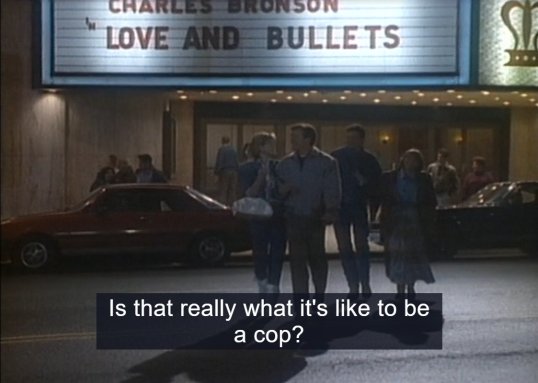
Made for television in 1991 and possessing a rather unwieldy title, Shoot First: A Cop’s Vengeance tells the story of two friends in San Antonio in the early 80s.
Farrell Tucker (Dale Midkiff) and Stephen Smith (Alex McArthur) are both cops. They entered the police academy together, they graduated as a part of the same class, and they both hope to be partners while working to keep the streets of San Antonio safe. Tucker is laid back and friendly and not one to worry too much about following all of the regulations. Stephen Smith, on the other hand, is uptight and, at first, by-the-book. He grew up in a poverty-stricken, crime-riddled neighborhood and it left a definite impression on him. He hates crime and criminals but what he really can’t stand is a justice system that seems to be more concerned with the victimizers than with the victims. Tucker and Smith enjoy spending their time together, drinking at the local cop bars and practicing their shooting on the weekends. Tucker’s not much of a shot, whereas Smith is a sharpshooter who rarely misses.
At first, no one notices or even cares that some of San Antonio’s less upstanding citizens are getting gunned down in the streets. But when Smith somehow manages to be first on the scene to a series of shootings, it gets the attention of Internal Affairs. With Sergeant Nicholas (Terry O’Quinn) investigating the possibility of a cop-turned-vigilante and Chief Hogan (G.D. Spradlin) announcing that no one is above the law, Smith starts to get a bit paranoid and Tucker is forced to consider that his friend could very well be a murderer.
And, of course, Tucker’s right! The first scene features Tucker confronting Smith and then the majority of the film is told in flashback. Even if not for that narrative choice, one could guess at Smith’s guilt just from the title of the film. When Shoot First: A Cop’s Vengeance was released on home video, the title was changed to Vigilante Cop, which made Smith’s guilt even more obvious. Finally, some viewers will guess that Smith is guilty because the film is based on a true story. Officer Stephen Smith actually did go on a killing spree, gunning down men who he felt had escaped the law and even sending threatening letters to his chief when the latter announced that vigilante activity would not be tolerated. Officer Stephen Smith went from being a follower of the rules to someone who attempted to write his own rules. It’s an interesting story for anyone who wants to google it.
As for the film, it’s adequate without being particularly memorable. Alex McArthur and Dale Midkiff both give good performance as Tucker and Smith and the cast is full of talented people like Terry O’Quinn, G.D. Spradlin, Bruce McGill, and Lynn Lowry. Observant viewers will even notice a long-haired Jeremy Davies, showing up for a split-second. I liked the performance of Loryn Locklin, as the waitress who marries Smith and then discovers that her charming husband actually has some very serious issues. The main problem with the film is that the story moves a bit too slowly for its own good and some of the Texas accents were more than a little dodgy. If you’re looking for an action film, this won’t be for you, though the shootings are surprisingly graphic for something that was made for television. Shoot First: A Cop’s Vengeance is a rather routine telling of an interesting story.
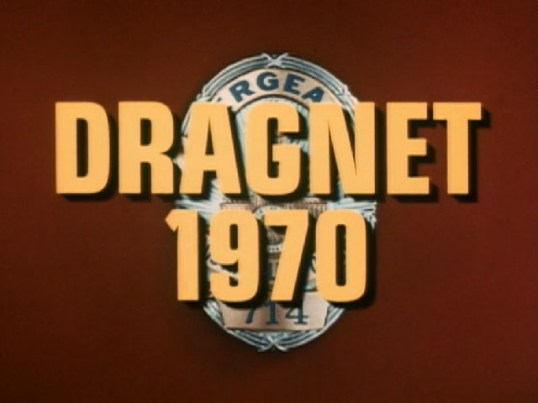
Dragnet began as a radio program in 1949 before making it’s way over to television in 1951. Each episode starred (and the majority were directed by) Jack Webb, who played a no-nonsense cop named Joe Friday. Friday narrated every episode, dropping trivia about the history of Los Angeles while also showing viewers how the cops went about catching criminals. Despite what is commonly believed, Joe Friday never said, “Just the facts, ma’m,” but he did investigate each case with the cool determination of a professional who kept his emotions under control. The majority of Dragnet’s episodes were based on actual cases that were worked by the LAPD, hence the opening declaration of, “The story you are about to see is true.”
On television, Dragnet originally ran from 1951 to 1959, during which time Dragnet also became the first television series to be adapted into a feature film. Jack Webb decided to relaunch Dragnet in 1966 and he produced a made-for-television movie that followed Friday and his latest partner, the far more talkative Bill Gannon (Harry Morgan), as they worked multiple cases over the course of one long weekend. That made-for-television movie led to a series that ran from 1967 to 1970.
The second television series is the best-remembered version of Dragnet, beloved for its scenes of Friday and Gannon debating the issues with a motely collection of hippies, campus radicals, and pipe-smoking academics. Jack Webb viewed Friday as being the voice of the common American, who supported the troops, supported the president, and who wanted to spend the weekend grilling in peace. Friday was the middle-aged suburbanite who wanted to the kids to stay off the grass, whether it was on his front lawn or being sold on a college campus. These episodes were often campy. It’s hard not to smile while listening to Friday and Gannon deadpan their way through conversations with flakey long-haired hippies. It was often obvious that the writers of Dragnet had never actually had any experiences with the hippies, beyond what they saw on the evening news. And yet, as silly as things often were, the show is an interesting time capsule of the era in which it was made. If nothing else, it’s a chance to see the turbulent 60s through the eyes of the other side.
Last year, I shared my favorite episode of Dragnet. For the new year, I’m sharing my second favorite, an episode that originally aired on March 19th, 1970. In Night School, Joe Friday is attending a night class where he and his classmates sit in a circle and just “rap” about the issues of the day. No one knows that Joe is a cop but Joe feels that he is still on duty and when he sees that the guy sitting across from him has a baggie of weed in his notebook, Friday makes an arrest. The professor, who says “There’s nothing wrong with marijuana, I smoke it myself!,” attempts to kick Sgt. Friday out of his class. “Would you rather be known as good ol’ friendly Joe, the class narc?” the professor asks. Joe fights for his right to get an education and a man with an eyepatch emerges as an unlikely voice of reason.
Why do I like this episode? There’s something undeniably entertaining about seeing straight-laced, deadpan Joe Friday attending a class with at least three hippies. It always amuses me that, on this show, Joe Friday loosening up just means that Joe trades his suit for a sweater. Also entertaining is Leonard Stone’s over-the-top performance as the villainous professor. And how can you not smile at Bill Gannon’s weary claim of “I just knew there was no way you could get a B sitting around talking?” Or Jack Webb’s delivery of the line, “That’s my thing, keeping the faith, baby?” Or Jack Curtiss’s hyperactive performance as campus drug pusher Jerry Morgan? “Hey, that’s just oregano!” Whatever you say, Jerry.
Today’s blast from the past certainly does feel like a trip in a time machine. Step on in and take a look at California in 1970!
Though the Academy of Motion Picture Arts and Sciences claim that the Oscars honor the best of the year, we all know that there are always worthy films and performances that end up getting overlooked. Sometimes, it’s because the competition too fierce. Sometimes, it’s because the film itself was too controversial. Often, it’s just a case of a film’s quality not being fully recognized until years after its initial released. This series of reviews takes a look at the films and performances that should have been nominated but were, for whatever reason, overlooked. These are the Unnominated.
“Honorable men go with honorable men.” — Giovanni Cappa
1973’s Mean Streets is a story about Little Italy. The neighborhood may only be a small part of the sprawling metropolis of New York but, as portrayed in this film, it’s a unique society of its very own, with its own laws and traditions. It’s a place where the old ways uneasily mix with the new world. The neighborhood is governed by old-fashioned mafiosos like Giovanni Cappa (Cesare Danova), who provide “protection” in return for payment. The streets are full of men who are all looking to prove themselves, often in the most pointlessly violent way possible. When a drunk (David Carradine) is shot in the back by a teenage assassin (Robert Carradine), no one bothers to call the police or even questions why the shooting happened. Instead, they discuss how impressed they were with the drunk’s refusal to quickly go down. When a soldier (Harry Northup) is given a party to welcome him home from Vietnam, no one is particularly shocked when the solider turns violent. Violence is a part of everyday life.
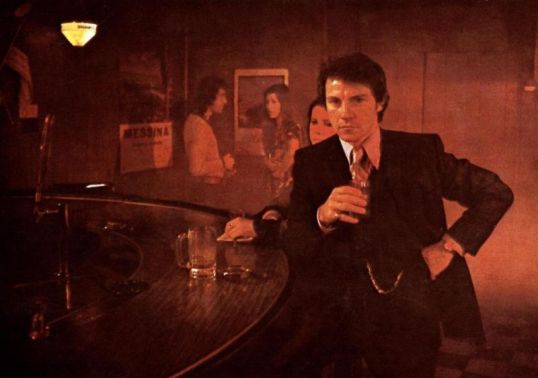
Charlie Cappa (Harvey Keitel) is Giovanni’s nephew, a 27 year-old man who still lives at home with his mother and who still feels guilty for having “impure” thoughts. Charlie prays in church and then goes to work as a collector for Giovanni. Giovanni is grooming Charlie to take over a restaurant, not because Charlie is particularly talented at business but just because Charlie is family. Giovanni warns Charlie not to get involved with Teresa (Amy Robinson) because Teresa has epilepsy and is viewed as being cursed. And Giovanni particularly warns Charlie not to hang out with Teresa’s cousin, Johnny Boy (Robert De Niro). Johnny Boy may be charismatic but everyone in the neighborhood knows that he’s out-of-control. His idea of a good time is to blow up mailboxes and shoot out street lamps. Charlie, who is so obsessed with sin and absolution that he regularly holds his hand over an open flame to experience the Hellfire that awaits the unrepentant sinner, finds himself falling in love with Teresa (though it’s debatable whether Charlie truly understands what love is) and trying to save Johnny Boy.
Charlie has other friends as well. Tony (David Proval) runs the bar where everyone likes to hang out and he seems to be the most stable of the characters in Mean Streets. He’s at peace with both the neighborhood and his place in it. Meanwhile, Michael (Robert Romanus) is a loan shark who no one seems to have much respect for, though they’re still willing to spend the afternoon watching a Kung Fu movie with him. Michael knows that his career is dependent on intimidation. He can’t let anyone get away with not paying back their money, even if they are a friend. Johnny Boy owes Michael a lot of money and he hasn’t paid back a single dollar. Johnny Boy always has an excuse for why he can’t pay back Michael but it’s obvious that he just doesn’t want to. Charlie realizes that it’s not safe for Johnny Boy in Little Italy but where else can he go? Brooklyn?
Mean Streets follows Charlie and his friends as they go about their daily lives, laughing, arguing, and often fighting. All of the characters in Mean Streets enjoy a good brawl, despite the fact that none of them are as tough as their heroes. A chaotic fight in a pool hall starts after someone takes offense to the word “mook,” despite the fact that no one can precisely define what a mook is. The fights goes on for several minutes before the police show up to end it and accept a bribe. After the cops leave, the fight starts up again. What’s interesting is that the people fighting don’t really seem to be that angry with each other. Fighting is simply a part of everyday life. Everyone is aggressive. To not fight is to be seen as being weak and no one is willing to risk that.
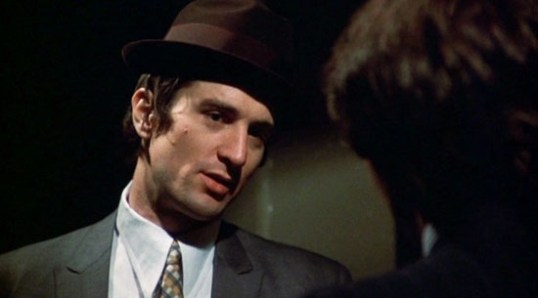
Mean Streets was Martin Scorsese’s third film (fourth, if you count the scenes he shot before being fired from The Honeymoon Killers) but it’s the first of his movies to feel like a real Scorsese film. Scorsese’s first film, Who’s That Knocking On My Door?, has its moments and feels like a dry run for Mean Streets but it’s still obviously an expanded student film. Boxcar Bertha was a film that Scorsese made for Roger Corman and it’s a film that could have just as easily been directed by Jonathan Demme or any of the other young directors who got their start with Corman. But Mean Streets is clearly a Scorsese film, both thematically and cinematically. Scorsese’s camera moves from scene to scene with an urgent confidence and the scene where Charlie first enters Tony’s bar immediately brings to mind the classic tracking shots from Goodfellas, Taxi Driver, and Casino. One gets the feeling that Pete The Killer is lurking somewhere in the background. The scenes between Keitel and De Niro are riveting. Charlie attempts to keep his friend from further antagonizing Michael while Johnny Boy tells stories that are so long and complicated that he himself can’t keep up with all the details. Charlie hold everything back while Johnny Boy always seems to be on the verge of exploding. De Niro’s performance as Johnny Boy is one that has been duplicated but never quite matched by countless actors since then. He’s the original self-destructive fool, funny, charismatic, and ultimately terrifying with his self-destructive energy.
Mean Streets was Scorsese’s first box office success and it was also the film that first brought him widespread critical acclaim. However, in a year when the totally forgotten A Touch of Class was nominated for Best Picture, Mean Streets did not receive a single Oscar nomination, not even for De Niro’s performance. Fortunately, by the time Mean Streets was released, De Niro had already started work on another film about the Mafia and Little Italy, The Godfather Part II.

 Through the Shattered Lens