She’s a former high school outcast who can now legally carry a gun. How much of an outcast was Penny? She was such an outcast that she was humiliated at a school dance by a bunch of popular kids who tied her down to a chair, made her up to look like a pig, and then displayed her in front of the entire class. Seriously, how do teenage bullies come up with stuff? I mean, I was never one to take part in bullying but, even if I was, my ADD would make it impossible for me to pull off most of the elaborate schemes that always seem to take place in movies like this.
Anyway, Penny was traumatized by the whole incident but she still managed to graduate and eventually become a cop. That’s right. Penny is upholding the law and she’s got an entire department to back her up in case she happens to shoot anyone and …. well, can you see why this might be a problem for her former high school classmates?
One night, Penny is called out to investigate a home invasion. After Penny shoots the home invader dead, she meets with the home’s owner and it turns out to be a former classmate, Tara (Kaitlyn Black)! Tara, who seems to have no memory of Penny’s life being destroyed in high school, is soon hanging out with her old classmate. She invites her to a party. She and Penny go out to the desert for target practice. The whole time, of course, Penny keeps imagining that she’s surrounded by the taunting laughter of her former classmates. Penny’s going to get her revenge, even if it means coming up with a scheme that’s even more ludicrously elaborate as the one that embittered her in the first place.
Hometown Killer is a classic Lifetime film, one that full embraces every melodramatic possibility of its storyline. Penny may be a dishonest murderer but you still feel sorry for her because of what she went through in high school. This is one of those films that makes you think, “Y’know, she probably she shouldn’t be doing this but maybe she should.” Director Jeff Hare adds enough little quirky touches to distinguish Hometown Killer from other, similar films. I especially liked the way the he took us in and out of Penny’s mind, always keeping us off-balance as to whether or not we were seeing what was really happening or if we were instead seeing what Penny thought was reality. It kept the audience off-balance and, as a result, Hometown Killer generated a lot more suspense than the average Lifetime film.
The success of a film like this pretty much hinges on the actress playing the killer and Ashley Gallegos did a great job of making Penny both sympathetic and frightening. Perhaps her greatest moment in the film is when she simply watches the chaos that she’s created and allows herself a slightly satisfied smirk. It’s a small moment but it tells us everything that we need to know about what’s going on in her head. Also impressive was Kelly Marcus, who was wonderfully obnoxious as the prototypical high school bully who never adjusted to life in the real world.
Hometown Killer aired on Lifetime and, Lifetime being Lifetime, it will undoubtedly air again. Keep an eye out for it!
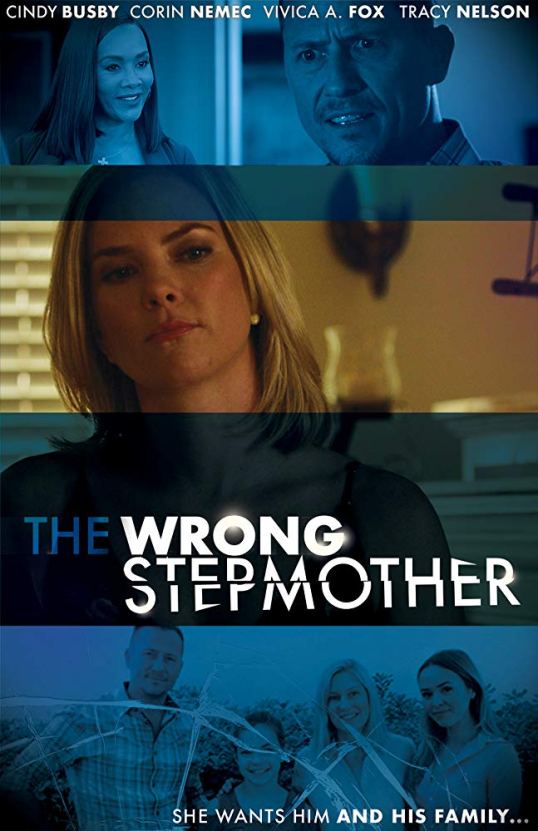
Actually, Maddie (Cindy Busby) is not a mother, though she would like to be. She not even a stepmother, despite what the title says. Instead, she’s just dating the recently widowed Michael (Corin Nemec). If she does end up marrying Michael, Maddie will become a stepmother — perhaps even a WRONG stepmother — to his two daughters, Lilly (Calli Taylor) and Nicole (McKinley Blehm).
It doesn’t take Lilly long to realize that there’s something off about Maddie. For one thing, she catches Maddie trying to check her social media. Then she overhears Maddie claiming to be her mother. And finally, Maddie changes up Lilly’s college admission essay. See, Lilly wrote about how much her late mother influenced her. Maddie, however, changes it into an essay about how much Lilly loves her future stepmother.
Yes, Maddie has some issues. As we discover at the start of the film, she has a history of stalking people. About halfway through the film, she murders two people. Whenever you’re watching a film on Lifetime, you know someone’s going to get murdered at exactly halfway through the film. You can set the time by it.
As with all of Lifetime’s “Wrong” films, Vivica A. Fox has a small role. In this one, she plays Ms. Price, the high school guidance counselor who is extremely unimpressed by Lilly’s college admissions essay. When Ms. Price confronts Lilly about how unimpressive her essay was, Fox delivers the lines with such subtle fury and annoyance that it brought back a lot of high school memories for me. As played by Fox, Ms. Price is the type of high school counselor who scares you to death but who also changes your life for the better. If Ms. Price had been my counselor, I definitely wouldn’t have spent so much time skipping class and shoplifting makeup at Target.
Anyway, the main complaint that you always hear about Lifetime films is that they’re all exactly the same but that’s actually their appeal. They’re fun to watch, precisely because 1) they’re predictable and 2) the viewer is always going to be smarter than the people in the movie. I mean, we can take one look at Maddie and say, “Okay, don’t let her in the house.” However, Michael’s not that smart and, if he was, we really wouldn’t have a movie. Sometimes, you just have to stop crying about plausibility and enjoy what you’re watching.
The Wrong Stepmother gets a big boost from the casting of the always likable Corin Nemec as Michael. I mean, it’s pretty much impossible not to root for a character played by Corin Nemec, even if that character is way too trusting of someone who he met on a dating app. Meanwhile, Cindy Busby is properly psychotic as Maddie and, of course, you’ve got Vivica A. Fox changing lives as Ms. Price.
The Wrong Stepmother is an entertaining Lifetime film. Watch it with your snarkiest friends.
According to the good people at Checkiday, the proper way to celebrate National Bikini Day is to put on a bikini and head to the beach! Unfortunately, I don’t live anywhere near the beach so instead, I’ve just been cleaning the house and taking out a wasp nest while wearing a bikini, which is an experience that’s both frightening and empowering at the same time.
(Seriously, we had a huge wasp nest that showed up overnight over the front door. I went outside and sprayed the nest, which resulted in the porch getting covered with dying and angry wasps. Of course, that’s when I realized that, because of the whole bikini thing, I had put on a t-shirt but I’d forgotten to put on shoes so I was barefoot, the backdoor was locked, and I didn’t have my keys on me, again because of the whole bikini thing. Rather than walking in bare feet across a porch covered by angry wasps, I literally crawled through a window to get back in the house, at which point I put on my shoes, went outside, and swept up all the wasps and the nest. It’s been quite a day!)
Anyway, as we often do here at the Shattered Lens, we’re going to recognize both this holiday and four of our favorite movies! Here, in honor of National Bikini Day, are….
So, usually, whenever a holiday rolls around, Doc, the ennui-afflicted TSL Cat, writes a celebratory post. Every year, I get people asking me how Doc, with his big paws and his lack of a formal education, can handle typing out a 500-word post. And every year, I say the same thing: “Doc can do anything he puts his mind to!”
That said, I wanted to write today’s holiday post because I do have a very important message that I want to share with anyone who might be reading this. I share this every year but, judging by the thunderous explosions and crackling bangs that kept me away last night, it needs to be said again.
First off, it’s great that you have fireworks but you know what? You don’t need to shoot them off in your back yard! GET OUT OF THE SUBURBS IF YOU’RE GOING TO SHOOT THOSE THINGS OFF! Go out to the country and drink your beer and blow your hands off out there. A few years ago, we actually had some drunken idiots who tried to shoot off fireworks in the middle of the street and it’s the closest I’ve ever come to calling the police on anyone.
Seriously, fireworks are fun and America’s great. But neither one of those is an excuse for being a dick.
Secondly, remember that most animals aren’t going to be aware that today is Independence Day. What we think of as being a celebration is going to sound like the end of the world to them. Take care of your pets and make sure they’re safely inside tonight. Doc’s probably going to spend tonight under my bed, as he often seems to do during the noisy holidays. Fortunately, after about an hour, he forgets why he’s hiding and instead concentrates on trying to play tag whenever he sees my ankles.
Finally, the sounds of this holiday can bring back terrible memories for some people. Please keep our veterans in mind before you try to make your neighborhood sound like a war zone.
So, I guess my 4th of July message is this: Be kind. Be considerate. Let’s be the best that we can be.
The other night, I watched 2018’s The House That Jack Built on Showtime and I have to say that, sitting here the morning afterwards, I kind of wish that I hadn’t. It’s a well-made film and there’s a bit more going on underneath the surface that some other reviews might lead you to suspect but, at the same time, it’s also deeply unsettling and, even by the standards of Lars von Trier, disturbing. It’s not a film to watch right before you go to bed, nor is it a film to watch at the beginning of a long week. I’m still feeling the after effects of having watched this movie and I imagine I’ll probably be jumpy for the next few days.
The title character, Jack (Matt Dillon), is someone who loves to talk about himself. He’s an engineer but he wishes he was an architect. He thinks of himself as being an artist and an intellectual and he has no hesitation about informing you that he’s smarter than just about everyone else on the planet. He’s annoyed that he’s not better-known. He feels that his work is underappreciated.
The House that Jack Built runs two and a half hours and, as a result, we spent a lot of time listening to Jack talk. One thing that quickly becomes apparent is that Jack knows a lot but he understand very little. He spends a lot of time talking about Glenn Gould, Goethe, and Nazi architecture but his thoughts on them are rather shallow and predictable. When we see flashbacks to Jack’s youth, we don’t see any signs of the intelligence that he claims to possess as an adult. Instead, we just see a scowling country boy who used to abuse animals. Jack may insist on calling himself “Mr. Sophistication” but there’s really nothing sophisticated about him and one gets the feeling that his faux intellectualism is something that he developed to justify the fact that he’s a sociopath and a serial killer. Jack claims to have murdered at least 60 people and he also says that each murder was a work of art. If art reflects the time and place in which it was made than how can we condemn Jack for reflecting the soullessness and cruelty of the real world in his own creations? The answer, of course, is that we can very easily condemn Jack. Jack uses the state of the world to justify his actions but that doesn’t mean we have to buy what he’s selling.
The House That Jack Built is built around a lengthy conversation between Jack and an enigmatic character named Verge (Bruno Ganz). Jack shows Verge the “five incidents” that, over the course of 12 years, have defined who Jack is as a person and a serial killer. The five incidents feature Jack killing everyone from a stranded motorist (Uma Thurman) and a grieving widow (Siobhan Fallon Hogan) to a terrified mother and her two sons. Jack has a brief and toxic relationship with one of his victims (heart-breakingly played by Riley Keough) and it leads to an act of violence that’s so disturbing that I don’t even want to relive it long enough to write about it. Throughout it all, Jack tries to justify himself while Verge continually calls him out on his bullshit. Watching the film, I found myself very thankful for Verge. The film would have been unbearable if it has just been Jack bragging on himself, unchallenged. Verge not only calls out Jack but also anyone who would idolize someone like Jack. At times, the film itself seems to be ridiculing the whole idea of the Hannibal Lecter-style serial killer. There’s nothing suave or witty about Jack. He’s just a loser with no soul.
Even though I was watching the R-rated version (as opposed to the unrated director’s cut), the murders were still disturbingly graphic. But what really made the film unsettling was its peek into Jack’s nihilistic worldview. As much as he may try to convince you otherwise, it soon becomes clear that there’s nothing going on inside of Jack’s head. When Jack isn’t suffering from delusions of grandeur, he’s mired in self-pity. (Listening to Jack, one is reminded of the infamous BTK Killer, who spent hours in court describing his murders without a hit of emotion but who later broke into tears when informed that he would be spending the rest of his life in prison.) Unlike most movie serial killers, Jack doesn’t have a flamboyant origin story or any sort of trauma-related motive for his crimes. He kills because he wants to. Jack is capable of being superficially charming. As a sociopath, he’s learned how to put people at ease. But there’s nothing behind that charm. When he performs some post-mortem surgery to give one of his victims a permanent smile, the results are grotesque because Jack has no idea what a real emotion looks like. (Jack weakly waves at the body, as if he’s trying to teach himself how to act like a normal person.)
Throughout the film, we get a lot of stock footage. (It’s justified by the fact that Jack is talking about art and history, two subjects about which he only has a surface knowledge.) Interestingly enough, we also get several clips that were lifted from Von Trier’s previous films. At one point, Jack passes a cabin that some viewers will recognize from Antichrist. While Jack tries to dispose of a body, David Bowie’s Fame plays on the soundtrack and it’s hard not to be reminded of how Bowie’s Young Americans played over the closing credits of both Dogville and Manderlay. We’re left to wonder if Jack is meant to be, in some way, a stand-in for Von Trier. Much like Jack, Von Trier is often accused of using his own artistic pretensions to justify a nihilistic and misogynistic worldview. It’s easy to imagine Verge as a stand-in for some of Von Trier’s fiercest critics. What then are we to make of the fact that the film also portrays Verge as being correct and Jack as being (literally) bound for Hell? Is Von Trier telling us that, as much as some people may dislike him and his work, at least he’s not a serial killer like Jack? Is Von Trier attacking himself? Or is Von Trier perhaps satirizing his own controversial persona? Perhaps all three are correct.
By the film’s end, Jack is in Hell. Interestingly enough, the portal to Hell is found in a house that’s made up of the bodies of Jack’s many victims. Verge — short for Virgil, of course — gives him a tour. When Jack sees a broken bridge, Virgil informs him that it once led to Heaven but it can’t be crossed now. However, Jack is convinced that he can climb over a cliff and make his way to Heaven. Virgil assures Jack that many have tried but none have succeeded. Jack, of course, tries and, needless to say, he doesn’t make it. In the end, redemption is impossible and yet you wonder how, in a world with Heaven and, one assumes, God, Jack even came to exist in the first place. If Jack had channeled his sociopathic nature into something more productive than murder, would he have been allowed into Heaven?
As I said, it’s a well-made film but it’s also deeply unsettling. I’m probably going to be jumping at my own shadow for at least a week or two. At the very least, I’m not answering the door for anyone….
Monday is Canada Day so I spent most of Sunday celebrating by watching Degrassi! I imagine I’ll do the same tomorrow. Love you, Canada!
What a week. On my first night back from my vacation, I got a call from my neighbor and was informed that some strange man had just put a piece of paper on my car’s windshield. After throwing on some clothes, I ran outside and discovered that I had been given a parking ticket for parking in front of my own house! (Usually, I park in the driveway but, on Monday, we had company so I did the nice thing and let them have the driveway.) According to the ticket, I was guilty of “Illegal Parking — Facing Traffic.”
And listen, I get it. If you’re parking in the city, you need to park so you’re not facing traffic. But this was a residential street, one that hardly has any traffic. I mean, at the very least, give me a warning before charging me 60 dollars!
Later, I would learn that I was one of several people in the neighborhood to have been given a parking ticket that night. Apparently, some good citizen decided to call the police and let them know that something had to be done about all the people parking in the street!
Well, here’s the good thing. After three days of trying, I was finally able to look up my citation online and I discovered that the charges had been dismissed and the ticket had been reduced to just being a “warning.” Unofficially, I’ve been informed that all the citations were originally meant to be just warnings but the cop they sent down to the neighborhood apparently screwed up and gave out actual tickets. On Thursday, I got a “Dear Resident” letter from the police department, saying that all of the “charges” filed against the residents of the neighborhood had been dropped “in the interest of justice.”
Which …. you know, whatever. As long as I don’t have to pay 60 dollars for parking in front of my house, that’s all that matters to me. Still, if there was any chance of me becoming any less anti-government this year, this experience killed it.
Anyway, that’s my drama of the week. In other news, I started my summer job writing for the Big Brother Blog this week! And I watched some movies and I read a lot of books about traffic law.
In fact, here’s what I watched, read, and listened to this week!
With the exception of the Marvel films, franchises have struggled to live up to box office expectations during 2019. Even Toy Story 4 is considered to have had a “soft” opening.
Here’s the final trailer, which was released earlier today. If nothing else, Dwayne Johnson and Jason Statham are two action stars with a similar appreciation for the absurd and it’s hard to imagine not having at least a little bit of fun watching them play off of each other for two hours or so.
 Penny (Ashley Gallegos) is your worst nightmare.