Film Review: Left Behind: The Movie (dir by Vic Sarin)


As I watched the 2000 film Left Behind: The Movie (not to be confused with the remake starring Nicolas Cage), I found myself thinking about names.

For instance, if your name is Rayford Steele, you really probably don’t have any choice but to become a pilot and maybe star in a low-budget action movie.  I mean, let’s just be honest.  People with names like Rayford Steele don’t end up working the night shift at 7-11.  In Left Behind, Rayford Steele is played by Bad Johnson and Johnson has just the right look to play a character named Rayford Steele.  He’s handsome in a somewhat old-fashioned, Gary Cooperish sort of way.

And yes, Rayford is a pilot.  He had a wife who resents the fact that Rayford is always flying off and abandoning his family.  She goes to church and she worries that he’s not a believer.  Rayford, meanwhile, is having an affair with flight attendant Hattie Dunham (Chelsea Noble).  That affair, however, may have to soon come to an end because Hattie has a new job with the UN.  Poor Hattie.  Nothing good ever comes from working at the UN!

Just as anyone named Rayford Steele would have to become a pilot, I imagine that anyone named Buck Williams would have to become a globe-trotting journalist.  We’re told that Buck is one of the most famous and successful journalists in the world.  Someone even mentions that Buck is so brave that he would have reported from Hiroshima while the first atomic bomb was being dropped.  (I assume that would have been a fairly short broadcast.)  Unfortunately, it’s a bit of a struggle to buy Buck Williams as a crusading journalist because he’s played by Kirk Cameron.  Buck is described as being tough and cynical.  There’s absolutely nothing tough about Kirk Cameron.  At his best, he projects an earnest blandness.  At his worst, he reminds you that he’s the guy who, years after starring in this film, would claim that a conspiracy of atheists was responsible for Saving Christmas receiving bad reviews.

Finally, if your name is Nicolae Carpathia, you’re pretty much destined to grow up to be very wealthy and also very evil.  You’re not going to end up living in the suburbs, mowing your own lawn and complaining about property taxes.  No, with a name like Nicolae Carpathia, you’re destined to end up using your position at the UN to take over the world.  When you declare that your goal is to lead the world into “seven years of peace,” everyone knows that you’re planning on doing the exact opposite.

Or, at the very least, everyone should know.  As played by Gordon Currie, Nicolae Carpathia is obviously evil from the minute he first appears.  (Even if you didn’t know his name, you would think he was evil just from the way he smirks.)  However, in the world of Left Behind, almost everyone loves Nicolae Carpathia.  When thousands of people mysteriously vanish, all at the same time, Carpathia is the person to whom humanity turns their tear-brimmed eyes.  The viewers know that it’s the Rapture and Rayford Steele and Buck Williams come to realize that it was the Rapture but Carpathia sees it as an opportunity to lead humanity into a …. dare I say it? …. new world order.

Left Behind is an odd film.  For the most part, it’s a fairly ludicrous film, a low-budget and excessively preachy attempt to create a religious epic on a Wal-Mart budget.  Kirk Cameron is miscast as a journalist and the film’s special effects are so obviously cheap that one can’t help but feel the filmmakers got a bit too ambitious for their own good.  (Just check out the scene at the start of the film when Buck Williams reports while “bombs” explode all around him.)  With a running time of one hour and 40 minutes, the film drags a bit and the characters are often frustratingly dense.  (Even non-evangelicals have, at the very least, heard that there’s a thing called the Rapture.)  And yet, occasionally, there will be moments when the film actually comes close to working.  Brad Johnson, for instance, gives about as good a performance as anyone could as Rayford Steele.  The scene where Carpathia manipulates a subordinate into committing suicide may not be terrible original but it’s still surprisingly effective.

Despite the fact that the film itself barely made a profit, Left Behind would go on to spawn two sequels.  We’ll look at the first, Tribulation Force, in 15 minutes.  Hope to see you then!

Lifetime Film Review: Ruthless Realtor (dir by Devon Downs and Kenny Gage)


So, imagine this scenario.

You’re young, you’re attractive, you’ve got a great career, and you’ve got a partner who is also young and attractive and who has a great career.  You’ve just arranged to buy a new home and it’s a big, beautiful, and surprisingly affordable house.  Of course, you suspect that the house has a history but then again, what house doesn’t?  It’s a little bit annoying that the lights keep randomly going out but that’s what you get for living in California.  So, you move into the house and it seems like everything’s perfect.

Except….

Your realtor simply will not go away!  It’s not enough that she showed you the house and arranged for you to purchase it and that she also apparently lied to the bank on your behalf (even though you certainly didn’t ask her to do that).  She also wants to be your best friend.  She wants to be a part of your family.  You simply cannot get rid of her….

That’s the situation in which Annie (Lily Anne Harrison) and her husband Ralph (Brian Ames) find themselves.  Annie’s a successful lawyer.  Ralph’s a photographer.  Annie’s pregnant with their first child.  The house is lovely.  Everything should be great.  But Meg (Christie Burson) simply won’t stop coming by the house!

Annie thinks it’s strange to come home and find her realtor cooking dinner in the kitchen.  Ralph thinks that it’s nothing to worry about but then, during a photography session, Meg tries to kiss him.  Ralph and Annie tell Meg to stop coming around but Meg keeps showing up.  The increasingly distraught Meg insists that someone was trying to break into the house and that the house itself has a dangerous history that Annie and Ralph need to know about.  Soon, Meg ends up in jail.

Problem solved, right?

Well, no.  Not only does Meg escape from jail but it turns out that there’s even more to Meg’s story than Annie and Ralph originally suspected….

I’ve always felt that one of the best things about Lifetime movies is that they always seem to take place in big houses and Ruthless Realtor proves my point.  The house really is gorgeous, regardless of how many have died inside of it.  When Annie tells her friend Lynette (Alexandra Peters) that she plans on staying in the house regardless of all the craziness going on around and inside of it, you can hardly blame her.  A big house like that?  A few murders are worth the risk!

Along with the big house, the other thing that I liked about Ruthless Realtor is that, as played by Christie Burson, Meg is literally the only likable character in the film.  Even though she’s obviously unstable and tries to break up a marriage, it’s impossible not to sympathize with her.  Annie and Lynette are both extremely self-righteous and full of themselves.  Ralph is painfully goofy.  But Meg actually believes in something and you have to feel sorry for her as she vainly tries to convince Annie that something terrible has happened at the house.  It should be noted that the film seems to fully understand that Meg is a hundred times more likable than any of the other characters and it takes good advantage of that fact with a few twists during the final half of the film.

Ruthless Realtor is an entertaining-enough Lifetime film.  If nothing else, it deserves to be seen for Christie Burson’s performance as Meg and for that beautiful house.


Here’s The Trailer For Come Play!


It’s weird how many Community stars keep popping up in somewhat forgettable horror films.

Alison Brie was in Scream 4.  Joel McHale just did Becky and he was also in Deliver us from Evil.  Donald Glover was in The Lazarus Effect.  Has Chevy Chase done a horror film?  How about Danny Pudi?  According to Wikipedia, he appeared in a movie called Babysplitters.  I can only imagine that’s a movie about splitting babies so that would definitely count….

Anyway, Gillian Jacobs is the latest member of the study group to show up in a horror film.  I will admit that I nearly gave up on the trailer for Come Play when I heard that, “He’s autistic, dude,” line.  Even in the trailer, that felt like a clumsy piece of exposition.  But I stuck with the rest of the trailer and …. well, it’s doesn’t look too bad.  It doesn’t look too good either.  It looks like an adequate Halloween time waster, to be honest.

Anyway, here’s the trailer for Come Play:

Here’s The Trailer for Ammonite!


Down here at the Texas Branch Office of Through the Shattered Lens, our internet and cable were both out on Monday night and for all of Tuesday.  It was Hell but, fortunately, we’re back up and running today.  Unfortunately, as a result of everything being down, I missed the premiere of the trailer for Ammonite.

Ammonite, which stars Kate Winslet and Saoirse Ronan, is expected to be a major Oscar contender.  There’s already speculation that this film could win Winslet her second Oscar and Ronan her first.  Winslet plays paleontologist Mary Anning while Ronan is cast as geologist Charlotte Muchison.  The trailer certainly suggests that the film could very well be a contender.  It’s a period piece starring two acclaimed actresses and dealing with not only universal themes but also subject matter that feels very relevant to what’s happening in the world today.

Well, better late than never, here’s the trailer for Ammonite!

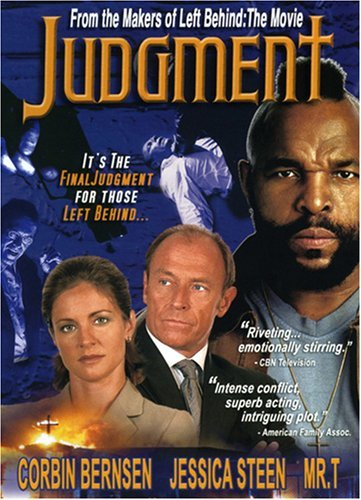
Film Review: Judgment (dir by Andre Van Heerden)


After three previous movies that all dealt with the growing power of Franco Macalousso (Nick Mancuso) and the revolution spearheaded by former journalist Helen Hannah (Leigh Lewis), the Apocalypse saga finally came to a close with the 2001 film, Judgment.

One of the more interesting things about the Apocalypse franchise is that each film was done in the style of a different genre.  Apocalypse was pretty much a straight-forward, faith-based film.  Revelation attempted to be an action film.  Tribulation was a horror film.  Meanwhile, Judgment is a courtroom drama, complete with a witnesses, objections, a corrupt judge, two former lovers turned legal adversaries, and a verdict.  Of course, the verdict itself is never in question.

Helen Hannah has finally been captured by O.N.E.  (That stands for One Nation Earth.)  Instead of just executing her like he does everyone else, Macalousso wants to put her on trial.  He wants to humiliate her while the entire world is watching.  He wants a show trial.  Mitch Kendrick (Corbin Bernsen), who father was a preacher who was executed after a previous show trial, is assigned to serve as Helen’s defense attorney,  Prosecuting the case is Victoria Thorne (Jessica Steen), who is Mitch’s former lover and one of the few people to know that Mitch has a fake mark of the beast on his hand.  Victoria believes that taking part in the trial will finally bring Mitch fully over to the side of Macalousso.

The trial has been carefully scripted out but, to everyone’s shock, Mitch refuses to follow the script.  Instead, he says that Helen cannot be punished because she has only been doing what her God told her to do so, therefore, God should be on trial instead of Helen.  Macalousso decides that he actually likes the idea of putting God on trial so he agrees to let Mitch do his thing.

Meanwhile, a revolutionary named  J.T. (Mr. T) is making plans to bust Helen out of prison but he finds himself frustrated by Helen’s aversion to violence.  J.T. just wants to break into the court and shoot everyone.  “There’s another way,” everyone keeps telling him….

Judgment is the best of the Apocalypse films, which may not be saying much when you consider how bad the other films are.  That said, Leigh Lewis had considerably improved as an actress by the time that she appeared in this film and Corbin Bernsen gives a good performance as a man torn between doing the right thing or doing what he has to do to keep himself safe.  Jessica Steen and Michael Copeman (as the Judge) bring a little bit more nuance than expected to their roles and Nick Mancuso is properly charismatic and smug as Franco Macalousso.  For a faith-based film, Judgment is not particularly preachy and I appreciated the fact that the film’s message was ultimately one of peaceful resistance.  Unfortunately, the film is also about 20 minutes too long.  It clocks in at 102 minutes and there are some parts of this film that seriously dragged.

As I’ve said about the previous Apocalypse films, Judgment actually works better as a political film than a religious tract.  The film presents Franco Macalousso as being the Beast but he could just as easily be seen as the ultimate symbol of collectivism.  When it’s announced that Helen is being prosecuted for the crime of “Hatred of the Human Race” and when witnesses in the court swear an oath to the “unity of all people,” it’s not a subtle moment but it’s a lot of fun for those viewers who tend to value personal freedom over the demands of the collective.

Judgment was the final Apocalypse film, though it doesn’t really bring the overall story to a close.  Tomorrow, we’ll bring our look at the apocalypse to a close with a look at the — God help us — Left Behind series.

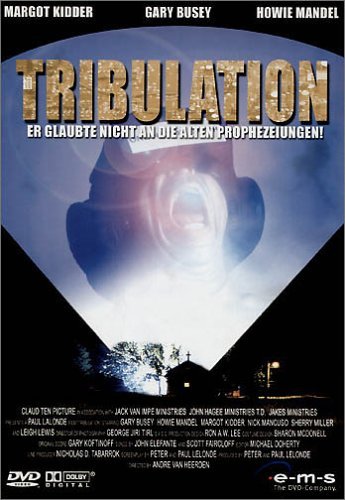
Film Review: Tribulation (dir by Andre Van Heerden)


The Apocalypse saga continues with 2000’s Tribulation!  This is the film that answers the question: How do you get an outspoken atheist and a prominent Jewish entertainer to star in your evangelical Christian propaganda film?  Apparently, you do it by not revealing what type of film that you’re making.

At least, that’s what Margot Kidder said happened.  In an interview with the AV Club, Kidder said that neither she nor Howie Mandel realized that they were appearing in a Christian film until they got on the set, looked at the complete script, and asked why Kidder’s character mysteriously vanished from the film.  According to Kidder, this was a film that she did because she was broke, she couldn’t get a job because she had a reputation for being difficult, and she was offered a lot of money to go up to Toronto for a week and shoot a few scenes.  And so, Kidder, who was not a fan of religion in general, was cast as Eileen Canboro, the outspoken Christian who tries to teach everyone about the rapture.

To quote Kidder: “And I still get stopped by those freaky fundamentalists going “Oh, I’m so glad you did Tribulation.” And I wanna go, “Don’t count me into your group, honeybuns. I’m not one of you.”

As for the film itself, it stars Gary Busey as Tom Canboro, a police detective who is indifferent to religion.  His brother-in-law is Jason Quincy (Howie Mandel), an occultist who, early on in the film, gets possessed by a bunch of Satanists.  The film never really makes it clear why Jason was possessed, beyond I guess to warn against using Ouija boards or reading New Age literature.  After Jason is briefly possessed, the Satanists decide that they have to kill everyone who saw him possessed so that no one learns of their existence.  (But it seems like it would have just been simpler to not possess anyone in the first place.)  All of this leads to Tom eventually slipping into a coma.  Don’t ask how.  It just does.

While Tom’s out of it, the events of the first two movies happen.  Franco Manculousso (Nick Mancuso) magically rids the world of nuclear missiles and declares himself to be the messiah.  Millions of people — including Margot Kidder — mysteriously vanish.  An underground rebellion — labeled “The Haters” by Manculousso — forms against the one world government.  Everyone in the world is given a VR headset that will allow Manculousso to either kill them or steal their soul by giving them the mark of the beast.

(In this film, getting the mark of the beast means that you literally end up with 666 tattooed on your hand.  One thing I always find interesting about films like this is how they take everything in Biblical prophecy so literally.  For instance, 7 is the number of God so therefore it makes sense that the number of the Beast’s number would be 6 because the Beast will always be powerful but ultimately inferior.  He’ll be “one away” from God.  However, films like this always feature people wandering around with 666 prominently displayed on their body and oddly, no one ever says, “Hey, have you ever seen that Omen movie?”)

Anyway, Tom eventually wakes up and finds himself trapped in this brand new world.  It turns out that his sole remaining brother is now prominent follower of Manculousso’s and Jason is now involved in the Hater underground.  A few characters from the previous films pop up, largely so they can be executed by Manculousso.  You know how it goes.

Anyway, if Apocalypse was basically a found footage film and Revelation was an action film, Tribulation is a horror film, complete with demonic possession, exploding heads, and virtual reality snakes.  It’s also a bit slow — it takes forever for Tom to actually enter that coma — but it has a few effective scenes.  Howie Mandel, for instance, really throws himself into being possessed.  As for Gary Busey, Margot Kidder said in that previously cited interview that he was a “pain in the ass” to work with but he actually gives a …. well, I don’t know if it’s really a good performance but it’s definitely interesting.  He’s credible during the first half of the film and then, during the second half of the film, he seems to be genuinely confused.  There’s a few weird moments where he smiles when he definitely shouldn’t be smiling but otherwise, Busey’s okay in this film.

There would be one more film in the Apocalypse saga, Judgment.  I’ll be posting a review of that film in 15 minutes.  Hope to see you there!

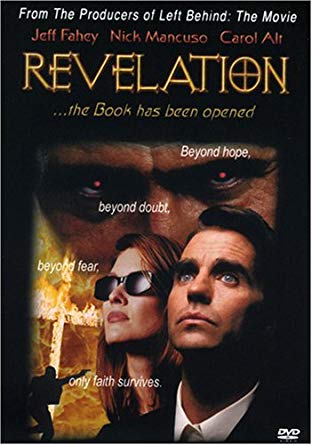
Film Review: Revelation (dir by André van Heerden)


The world which started to end in the 1998 film Apocalypse continues to end in its first sequel, 1999’s Revelation!

Revelation beings three months after the end of Apocalypse.  The people of the world worship the president of the European Union, Franco Macalousso (Nick Mancuso, replacing Sam Bornstein from the first film).   The world is ruled over by O.N.E., which stands for One Nation Earth.  Those who oppose Macalousso’s claim to the messiah are known as “The Haters.”  At the start of the film, a school bus has been bombed and all of the children aboard have been killed.  O.N.E. claims that the Haters bombed the bus but counterterrorist agent Thorold Stone (Jeff Fahey) comes across evidence that it was actually an inside job.  When Macalousso’s second-in-command, Len Parker (David Roddis), attempts to murder Thorold, he’s forced to go on the run.

The Day of Wonders is approaching.  On this day, everyone on Earth is to put on a VR headset.  Macalousso hasn’t made clear what the headset will do but everyone’s planning on doing it because Macalousso has told them to do it and everyone on the planet does what Macalousso says.  Thorold tracks down Willy Spino (Tony Nappa), a wheelchair-bound programmer (in the 90s sense of the term, of course) who is somehow involved with setting up The Day of Wonders.  Willy says that O.N.E. is not the benevolent organization that everyone thinks it is.  You would have thought that Thorald would have figured that out after Parker attempted to kill him but Thorald remains convinced that Maclousso is the messiah and that his wife and daughter previously vanished not because they were Christians but because they were abducted by aliens.

Anyway, long story short, it turns out that Willy’s stepsister is Helen Hannah (Leigh Lewis), the news anchor from the first film.  Helen is now a leader in the Hater underground.  While she tries to convince Thorold that Macalousso is actually the Devil, Willy spends his time flirting with a cynical blind woman named Cindy (Carol Alt).  Both Willy and Cindy find themselves tempted to put on the VR headset, just to see what the Day of Wonders will hold for them….

Revelation is a marked improvement on Apocalypse though, considering how shoddy the production of that first film was, that’s really not saying much.  As opposed to the first film’s stiff performances and reliance on stock footage, Revelation features actual actors, actual sets, and an actual script.  There’s even a few action sequences and some attempts at intentional humor.  That said, if you’re a nonbeliever, Revelation isn’t going to convert you and, about halfway through the film, all of the action stops so that Thorold and Hannah can have a very long discussion about faith and whether or not God should prove his existence by turning over a glass of water.

Like the first film, Revelation actually works better as a political allegory than a religious tract.  Today, it’s kind of easy to laugh at the bulky computers that fill O.N.E.’s headquarters and the scenes where Willy carefully explains what virtual reality and computer viruses are serve as a reminder that, apparently, there was a time when all of this stuff was still viewed as being somehow exotic.  I mean, it’s easy to be snarky about this movie.  But let’s be honest — it’s probably easier today than it was when this film was first released to imagine a world where everyone blindly does whatever the government tells them to do.  And the idea of a group running a false flag operation — like blowing up a school bus and blaming it on unseen enemies — no longer seems quite as outlandish as it perhaps did it 1999.

Revelation was apparently enough of a success that it was followed by yet another sequel.  This one was called Tribulation and I’ll be posting a review of it in about 15 minutes.  Hope to see you then!


Film Review: A Thief In The Night (dir by Donald W. Thompson)


First released in 1972, A Thief In The Night is one of the most successful independent films ever made.

Shot in Iowa with a largely amateur cast, A Thief In The Night was made for a budget of $68,000.  During the first decade of its release, it made a profit of 4.2 million dollars.  Interestingly enough, the film itself rarely played in theaters and the majority of the money came from donations made by the members of the audience.  Consider that.  Audiences had the opportunity to watch the movie for free and still chose to pay.  People were either extremely generous in the 70s or the film’s target audience really responded to it.

In a 1989 interview, the film’s producer estimated that the film had been seen by 100 million people.  By the time the 2010s rolled around, that number had grown to 300 million.  Though the film never got much attention from the mainstream press, it was a big enough success to spawn three sequels and to also inspire countless other films that dealt with the same themes as this film.

As for what the film’s about, it opens with Patty (played by Patty Dunning) waking up and discovering that her husband has disappeared.  (His razor is sitting in the sink, almost as if he had been holding it before suddenly vanishing into thin air.)  Over the radio, she hears reports that people all over the world have disappeared!  Religious scholars are saying that perhaps the rapture has happened.  Interestingly, those religious scholars have apparently been left behind and …. wait a minute!  Patty’s been left behind too!

The first half of the film is full of flashbacks to Patty’s childhood and how she first met and married Jim Wright (Mike Niday).  Interestingly enough, the flashbacks don’t necessarily play out in chronological order, which gives the entire first half of the film a stream-of-consciousness feel.  We also get a somewhat random scene of Jim getting bitten by what appears to be a cobra.  It feels like one of those things where you simply don’t turn down the chance to put a cobra in your film.  If you’ve got a snake, you use it.  And the first half of the film actually works surprising well.  The low-budget and the random flashbacks and even the rather amateurish acting make the entire film feel like something of a fever dream.

During the second half of the film, the UN takes over the world and everyone is required to get the mark of the beast.  Patty doesn’t want to get the mark but it turns out that those without the mark can’t shop for food or buy the latest fashions.  Eventually, soldiers start to round up the unmarked and, before you know it, Patty is being chased through Des Moines by not only the United Nations but also by all of her friends, who now have the mark.  Eventually, Patty ends up on a bridge with only two possible options.  Either get the mark or jump.  As opposed to the unconventional first half of the film, the second half is basically one long chase scene and it does get a bit repetitive after a while.  That said, it’s kind of interesting to see someone being chased through downtown Des Moines as opposed to downtown New York or Los Angeles.

A Thief In The Night is undeniably crude and it gets a bit heavy on the preaching.  Patty is continually told that it’s not good enough to just be a Christian.  She has to be a super Christian or she’ll get left behind.  I would think that would make anyone either extremely neurotic or extremely cynical.  But if you can overlook the film’s preachiness, it’s a crudely effective in a dream-like way.  You can tell that the filmmakers must have spent some time at the drive-in and that maybe they watched Night of the Living Dead when they weren’t in church because they whole film is full of skewed camera angles and abrupt jump cuts with a good deal of emphasis being put on Patty’s newly isolated status.  In more ways than one, the film was obviously designed to scare the Hell out of its target audience.

A Thief in the Night works best when viewed as being a filmed fever dream.  It’s crude but effective.