Icarus File No. 21: Reach Me (dir by John Herzfeld)


The 2011 film, Reach Me, opens with a rapper named E-Ruption (Nelly) appearing on a morning show and talking about how, while he was serving a prison sentence, he read a self-help book called Reach Me.  It asked him to consider whether or not his childhood self would be happy with his adult self.  The book was written by a mysterious man named Teddy Raymond.  No one knows who this Teddy Raymond is.  He’s never appeared in public.  People film themselves reading the book online and then upload to YouTube as a way of sharing Teddy’s wisdom.  I honestly can think of nothing more annoying and boring than watching someone else read a self-help book but whatever.  I live in Texas.  The movie takes place in California.

Tabloid editor Gerald (Sylvester Stallone) takes a break from action painting to order one of his reporters, Roger King (Kevin Connolly), to track down Teddy Raymond.  Roger wants to write the great American novel.  He doesn’t care about self-help.  He meets Teddy’s associates, Wilson (Terry Crews) and Kate (Lauren Cohan) and Wilson talks about how Teddy magically cured Kate’s stutter.  Roger then wanders around the beach, asking random people, “Teddy Raymond?  Are you Teddy Raymond?”  Oh look!  There’s a guy named Teddy (Tom Berenger) who reluctantly cures Roger of his smoking addiction by ordering Roger to yell at the ocean …. over and over and over again.

Collette (Kyra Segdwick) has just been released from prison.  Reading Teddy’s book has inspired her to try to become a fashion designer.  Collette’s daughter, Eve (Elizabeth Henstridge), is an aspiring actress who was earlier groped by a sleazy star named Keating (Cary Elwes).  Collette and Eve literally crash their car into a car being driven by Wolfie (Thomas Jane), a sociopathic undercover cop who enjoys killing people and who goes to confession after every shooting.  (At the start of the movie, he guns down Danny Trejo.)  The alcoholic priest, Father Paul (Danny Aiello), refuses to hear any more of his confessions.

Meanwhile, wannabe mob boss Frank (Tom Sizemore) is upset because another mob boss, Aldo (Kelsey Grammer), doesn’t treat him with any respect.  Frank sends two of his hitmen, Thumper (David O’Hara) and Dominic (Omari Hardwick), to kill a man who owes him money and to also shoot the man’s dog.  Thumper has been reading Teddy Raymond’s book and doesn’t want to shoot the dog.  Dominic realizes that his heart isn’t into the mob life so, taking the book’s message to heart, he calls Frank and says, “My heart’s not in it.”

(Don’t try that with any real mobsters.)

Eventually, all of the characters do come together.  They don’t exactly come together in a plausible manner but they do all end up at the same location so let’s give the film credit for that.  Let’s also give this film credit for leaving me seriously confused.  I have no idea whether this film was meant to a parody or a celebration of the self-help industry.  At first, I suspected that it meant to be a parody because all of Teddy Raymond’s advice was painfully shallow and the type of basic crap that anyone could come up with.  I actually found myself losing respect for the people who claimed that Teddy had changed their lives.  But at the movie progressed, I realized that I was supposed to take Teddy and his advice seriously.  This was a film that I guess was meant to have something to say but who knows what exactly that was.

That said — hey, everyone’s in this movie!  Director John Herzfeld was a former college roommate of Sylvester Stallone’s and, once Stallone agreed to appear, that apparently convinced a lot of other “name” actors to take the risk as well.  There’s a lot of talent in this film but little of it is used correctly.  Kelsey Grammer as an Italian mobster instead of the editor?  Sylvester Stallone as the editor instead of the Italian mobster?  Thomas Jane as a sociopath who has a girlfriend by the end of the movie, one who smiles and tells him, “Try not to shoot anyone?”  Kyra Sedgwick as an ex-con?  These are all good actors but just about everyone, with the exception of the much-missed Danny Aiello, is miscast.

It’s a true Icarus File.  It was a just a little more self-aware, this would have been a Guilty Pleasure.  But, in the end, self-help cannot help itself.

Previous Icarus Files:

  1. Cloud Atlas
  2. Maximum Overdrive
  3. Glass
  4. Captive State
  5. Mother!
  6. The Man Who Killed Don Quixote
  7. Last Days
  8. Plan 9 From Outer Space
  9. The Last Movie
  10. 88
  11. The Bonfire of the Vanities
  12. Birdemic
  13. Birdemic 2: The Resurrection 
  14. Last Exit To Brooklyn
  15. Glen or Glenda
  16. The Assassination of Trotsky
  17. Che!
  18. Brewster McCloud
  19. American Traitor: The Trial of Axis Sally
  20. Tough Guys Don’t Dance

Lisa Marie Reviews An Oscar Nominee: Born On The Fourth of July (dir by Oliver Stone)


In 1989, having already won an Oscar for recreating his Vietnam experiences in Platoon, director Oliver Stone returned to the war with Born On The Fourth Of July.

Based on the memoir of anti-war activist Ron Kovic, Born on the Fourth of July stars Tom Cruise as Kovic.  When we first meet Kovic, he’s growing up on Long Island in the 50s and 60s.  He’s a clean-cut kid from a nice family.  He’s on the school wrestling team and he’s got a lot of friends.  When he was just 15, he heard John F. Kennedy telling people to ask what they can do for their country and he was inspired.  He decided he wanted to join the Marines, despite the fact that his father (Raymond J. Barry) was still haunted by the combat that he saw in World War II.  (In one of the film’s better scenes, a young Kovic notices that the elderly veterans marching in the Independence Day parade still flinch whenever they hear a firecracker.)  He enlists in the Marines after listening to a patriotic speech from a recruiter (played by Tom Berenger).  Ron runs through the rain to attend his prom and has one dance with Donna (Kyra Sedgwick), on whom he’s always had a crush.  There’s nothing subtle about the way that Stone portrays Kovic’s childhood.  In fact, one might argue that it’s a bit too idealized.  But Stone knows what he’s doing.  The wholesomenss of Kovic’s childhood leaves neither him nor the viewer prepared for what’s going to happen in Vietnam.

Vietnam turns out not to be the grand and patriotic adventure that Kovic thought it would be.  After Sgt. Kovic accidentally shoots one of his own men in a firefight, he is ordered to keep quiet about the incident.  After he is wounded and paralyzed in another firefight, Kovic ends up in a Hellish VA hospital, surrounded by men who will never fully recover from their mental and physical wounds.  Kovic is eventually returns home in wheelchair.  The film then follows Kovic as he goes from defending the war in Vietnam to eventually turning against both the war and the government.  At one point, he ends up with a group of disabled vets in Mexico and there’s a memorable scene where he and another paraplegic (Willem Dafoe) attempt to fight despite having fallen out of their chairs.  Eventually, Kovic returns to America and turns his anger into activism.

There’s nothing subtle about Born On The Fourth Of July.  It’s a loud and angry film and Oliver Stone directs with a heavy-hand.  Like a lot of Stone’s films, it overwhelms the viewer on a first viewing and it’s only during subsequent viewings that one becomes aware of just how manipulative the film is.  Tom Cruise gives a good performance as Ron Kovic but his transformation into a long-haired, profane drunk still feels as if it happens a bit too abruptly.  A good deal of the film centers on Kovic’s guilt about accidentally killing one of his men but the scene where he goes to the soldier’s family and asks them for forgiveness didn’t quite work for me.  If anything, Kovic came across as being rather self-centered as he robs the man’s mother and father of the belief that their son had at least died heroically in combat as opposed to having been shot by his own sergeant.  Did Kovic’s need to absolve himself really give him the right to cause this family more pain?  Born on the Fourth Of July is an effective work of agitprop.  On the first viewing, you’ll want to join Kovic in denouncing the military and demanding peace.  On the second viewing, you’ll still sympathize with Kovic while also realizing that he really owes both his mother and father an apology for taking out his anger on them.  By the third viewing, you’ll be kind of like, “Wow, I feel bad for this guy but he’s still kind of a jerk.”  That said, when it comes to making an effective political film, Adam McKay could definitely take some lessons from Oliver Stone.  Born On The Fourth of July is at its best when it simply captures the feeling of living in turmoil and discovering that the world is not as simple a place as you once believed.  As idealized as the film’s presentation of Kovic’s childhood may be, anyone who has ever felt nostalgia for an earlier and simpler world will be able to relate.

Oliver Stone won his second Best Director Oscar for Born On The Fourth Of July.  The film itself lost Best Picture to far more genteel version of the past, Driving Miss Daisy.


Retro Television Review: Miami Vice 2.12 “Phil the Shill”


Welcome to Retro Television Reviews, a feature where we review some of our favorite and least favorite shows of the past!  On Mondays, I will be reviewing Miami Vice, which ran on NBC from 1984 to 1989.  The entire show can be purchased on Prime!

The Vice Squad goes after Phil Collins!

Episode 2.11 “Phil the Shill”

(Dir by John Nicolella, originally aired on December 13th, 1985)

Switek and Zito call in sick so that they can go to the taping of a silly game show called Rat Race.  While Zito sits in the audience, Switek answers trivia questions about Elvis and competes in an obstacle course race with his spacey opponent (Emo Phillips).  Hosting the show is the very effusive and very British Phil Mayhew (Phil Collins).

As we already know, Switek knows everything about Elvis.  And he’s in better shape than Emo Phillips so, when it comes time for the obstacle course, he reaches and hits his buzzer first.  But Switek’s buzzer doesn’t go off.  Emo’s buzzer works and Emo proceeds to robotically recite a complex string of Elvis trivia.

To his horror, Switek realizes that the quiz show was fixed!

Switek and Zito decide that they want to take down Phil and reveal his con artist ways.  Unfortunately, for them, the rest of the Squad doesn’t care.  Crockett, in particular, is annoyed that Switek pretended to be sick to get a night off of work.  However, it then turns out that Phil has hooked up with Sarah MacPhail (Kyra Sedgwick), the girlfriend and business partner of Tony Rivers (Michael Margotta), a drug dealer that Crockett has spent months trying to set up.

It’s time to call in Izzy and have him pretend to be an interior decorator so that Phil can be tricked into throwing a party that can be attended by …. SONNY BURNETT AND RICO COOPER!  Listen, I know I mention that a lot but I just can’t let it go …. how are Sonny and Rico able to maintain their undercover identities when they’re constantly arresting major drug dealers and taking part in DEA busts?  How come it never occurs to the criminals that dealer Sonny Burnett might have something in common with cop Sonny Crockett?  Does no one ever notice that Sonny Burnett drives the same car and wears the same white suit as Sonny Crockett?

This was a bit of an odd episode.  It was obviously written so that Phil Collins (whose In The Air Tonight set the mood for the entire series) could play Phil Mayhew.  And while Phil Collins does not appear to have been an actor of amazing range, he still does a good job as the weaselly Phil Mayhew.  The Phil scenes are played for humor while the scenes with Tony Rivers definitely are not.  Tony is a violent sociopath who casually kills several people over the course of the episode.  Scenes of Switek pouting about the game show feel awkward when combined with scenes of Tony machine gunning two drug dealers.  Collins does a good job within his range and Michael Margotta is an energetic villain.  However, the best performance in this episode actually comes from Kyra Sedgwick, who does a great job as someone who eventually turns out to be just as ruthless and dangerous her boyfriend.

This is a fast-paced and energetic episode, one that moves quickly enough that the viewer doesn’t really have time to consider the oddness of Phil Mayhew getting involved with the same drug dealer that Crockett happens to be investigating.  Personally, I’m always happy when the members of the supporting cast get to do something more than just stand in the background.  Switek and Zito are a good team.

Cleaning Out The DVR: Story of a Girl (dir by Kyra Sedgwick)


(Hi there!  So, as you may know because I’ve been talking about it on this site all year, I have got way too much stuff on my DVR.  Seriously, I currently have 163 things recorded!  I’ve decided that, on February 15th, I am going to erase everything on the DVR, regardless of whether I’ve watched it or not.  So, that means that I’ve now have only have a month to clean out the DVR!  Will I make it?  Keep checking this site to find out!  I recorded Story of a Girl off of Lifetime on July 23rd, 2017!)

Michael (Kevin Bacon) owns a pizza place in a small town.  He’s just hired 16 year-old Deanna Lambert (Ryann Shane) to work for him over summer.  Deanna shows up for her first day of work.  Deanna apologizes for being late.  Michael points out that he has no costumers so it doesn’t matter.  Michael then introduces Deanna to his other employee, Tommy (Tyler Johnston).  Deanna looks shocked.  Tommy looks shocked.

“You two know each other?” Michael asks.

“In the biblical sense,” Tommy replies.

And so it goes from there…

Seriously, what was I doing on July 23rd that kept me from watching Story of a Girl?  Was I watching a shark movie on SyFy?  I do remember that Story of a Girl was very aggressively advertised in the days leading up to its premiere and I did actually mean to watch it.  I’ve read the Sara Zarr penned book on which it was based and the commercials made it look fairly good.  Add to that, it was directed by Kyra Sedgwick and co-starred Kevin Bacon and they seem like such a nice couple that I was naturally hoping it would be a good movie.

Three years ago, a sex video featuring 13 year-old Deanna and 17 year-old Tommy went viral.  While Tommy (who, as Michael points out, was committing a felony) suffers not a single bit for taking advantage of his best friend’s younger sister, Deanna is branded a slut and sent into social exile.  Her father, Ray (Jon Tenney), refuses to forgive her.  Tensions at home are exasperated by the presence of Deanna’s brother, Darren (Iain Belcher), his girlfriend, Stacey (Sosie Bacon), and their baby.  Darren and Stacey are planning on moving into a place of their own and Deanna is planning on going with them.

Though it may not be obvious from that plot description, Story a Girl is not a typical Lifetime film.  It takes place in a thoroughly blue-collar milieu and the Lamberts live in perhaps the ugliest, most cluttered house that I’ve ever seen.  Between that house and Ray acting like an asshole 24/7, it’s easy to understand why Deanna wants to get away from these people.  The problem, however, is that, after only a few minutes, most viewers will be desperate to get out of there as well.  And, unlike Deanna, viewers actually have a way of doing that.  They can just change the channel.  The film does have a good and important message but the characters are all so off-putting that a good deal of the audience probably won’t stick around to hear it.

Story of a Girl is a disappointingly superficial film.  The Juno influence is obvious but Story of a Girl never comes to life in the same way that Juno did.  Kevin Bacon is solid as Michael and Ryann Shane does a passable Ellen Page impersonation but everyone else is trapped in a film that’s long on plot but short on depth.  I really wanted to like Story of a Girl but I just didn’t.

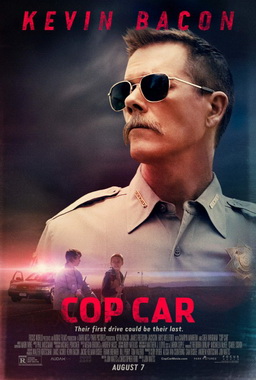
Film Review: Cop Car (dir by Jon Watts)


Cop_Car_poster

Cop Car opens with two young boys, Travis (James Freedson-Jackson) and Harrison (Hays Wellford) walking through a field.  Over the course of the film, we really don’t learn that much about either Travis or Harrison.  They speak in the tones and accent of childhood and the trailer park.  They’re just two ordinary kids, who appear to be bored out of their mind and who can blame them because it appears that they live out in the middle of nowhere.

And then, suddenly, their boredom ends.

They comes across a deserted cop car sitting in the middle of the wilderness.  After a successive number of dares, they end up inside of the car.  And then, they discover that the keys are still in the car as well.  Soon, Harrison and Travis are taking turns driving the car, roaring down the highway, nearly running an irate motorist (Camryn Manheim) off the road and basically having a great time.

What the kids don’t know is that the cop car belonged to Sheriff Kretzer (Kevin Bacon), a grim-faced lawman who isn’t going to allow two little kids to make a fool out of him.  Even while Harrison and Travis are playing around in the car, Kretzer is pursuing them.  Along the way, Kretzer is reduced to stealing a truck, gets stopped for speeding, and basically sacrifices any ounce of personal dignity that he may have.  Along the way, cars crash and cows are nearly run over.

And it all sounds like the making of a comedy, doesn’t it?  Just from reading the plot description, you might be justified in thinking that Cop Car is a white trash version of Ferris Bueller’s Day Off.  Well, make no mistake.  Cop Car has its funny moments but it is definitely not a comedy.  Sheriff Kretzer may occasionally be a bit of a bumbling adversary but he is no Principal Rooney.  Instead, Kretzer is a vicious and effective killer.

The reason Kretzer was away from his car is that he was busy burying a body in the woods.  And what the kids don’t realize, at first, is that there’s another body in the trunk of the car.  Kretzer is determined to get back his cop car and he’s willing to kill the boys to do it.  Even worse, Kretzer’s badge and uniform give him both the ability and the authority to do so.

There’s one particularly effective scene where Harrison and Travis playing with the weapons that Kretzer left in the car is juxtaposed with Kretzer pouring a baggie of cocaine into a toilet.  But, at the same time, I almost wish that the whole drug dealing subplot had been left out of the film.  When we first meet Kretzer, he’s scary precisely because his motives are unknowable.  He’s an authoritarian with a badge, and a bad mustache.  The more specific the film gets about Kretzer’s motivations, the less interesting he becomes.  Imagine if Kretzer has simply been an unstoppable force of wounded machismo, motivated by nothing more than his belief that his law is the only law that matters.  By making Kretzer a criminal as well as a cop, Cop Car dilutes its otherwise strong critique of the pro-authoritarian strain that currently runs through American culture.

As a thriller and chase film, Cop Car works pretty well, though the first half is significantly better than the second.  (The second half gets a little bogged down with the man in the trunk.)  Director Jon Watts keeps the film moving at a good pace and he shows that he knows how to generate suspense.  There’s a lengthy and narratively risky scene where Kretzer repeatedly tries and fails to pick a lock but the scene pays off in the end and Watts deserves some credit for having faith in the patience of his audience.

But really, Cop Car works largely because Kevin Bacon has become a national treasure.  It’s always fun to watch him throw himself into playing off-center roles like Sheriff Kretzer.  Bacon is smart enough to play up Kretzer’s stupidity without ever downplaying his dangerous and cunning nature.  It’s a great performance in a pretty good film.

http://www.youtube.com/watch?v=O4PulMiFpMk

Film Review: Man on a Ledge (dir. Asger Leth)


The newly released film Man on a Ledge is about a man (played by Sam Worthington) who checks into a hotel room in New York City and then climbs out on a ledge and threatens to jump off unless a specific hostage negotiator is brought in to talk him off the ledge.  We quickly discover that Worthington isn’t just a depressed jumper.  Instead, he’s got a really lengthy and overly complicated back story.  It turns out that he’s a former detective who used to moonlight for a venture capitalist and then one day, he was accused of stealing a priceless diamond and destroying it.  This resulted in him getting sentenced to 25 years in prison but when his father is reported to have died, Worthington is released from jail for a day so he can attend the funeral.  So, Worthington escapes and then ends up out on a ledge as part of a massively complicated plan to prove his innocence.  His name, by the way, is Nick because people named Alvin are never the stars of action movies.

Meanwhile, the cop that Nick demands to speak with is a hardened, veteran hostage negotiator and she’s played by Elizabeth Banks.  Yes, you read that correctly.  Anyway, Nick asks for her because he knows that the last guy she tried to talk out of jumping apparently jumped off a bridge.  Since Banks failed her last time out, her efforts to talk Nick off the ledge are cautiously observed by another detective, this one played by Edward Burns.  Banks is totally and completely miscast here and she has next to no chemistry with Sam Worthington.  However, she does have really good chemistry with Edward Burns.  Seriously, they would make a really cute couple and I would buy any issue of Us Weekly that had them on the cover.

Meanwhile, the guy that Nick is accused of stealing from just happens to be in a building across the street where he’s conducting some sort of generically evil business deal.  He’s a painfully thin, almost sickly man and, whenever he was on screen, I found myself wondering how his head managed to stay balanced on his body.  At first, I thought maybe it was the Red Skull waiting for the sequel to Capt. America to start filming.  However, on closer inspection, he turned out to be respected character actor Ed Harris.  In this film, Harris plays a ruthless capitalist who would have gone bankrupt if not for the insurance money he got as a result of Nick supposedly destroying that diamond.  Anyway, Harris appears to be enjoying playing a bad guy and he’s so over-the-top in his evil that you don’t really mind that he’s another one of those “I-should-kill-you-now-but-first-we-talk” type of villains.

Meanwhile, there’s two other people who are taking advantage of all the chaos caused by the man on the ledge to break into Harris’s building.  They’re played by Jamie Bell (who looks a lot like Casey Affleck in this film) and telenova veteran Genesis Rodriguez.  As you watch Bell and Rodriguez sliding down heating ducts and scaling elevator shafts, you can’t help but marvel at just how overly complicated everyone is making things.  Still, Bell and Rodriguez have a lot of chemistry and they’re fun to watch.

Meanwhile, NYC television reporter (played by Kyra Sedgwick) is running around the streets of New York, asking random bystanders how they feel about the prospect of Nick jumping.  Apparently, she is an old enemy of Elizabeth Banks’ though that whole plot line is dropped as soon as its brought up.  Still, the audience in my theater chuckled when Sedgwick dramatically rolled her r’s while introducing herself as “Suzie Morales.”

Meanwhile, there’s a bearded guy watching Nick up on the roof and he suddenly decides to go all Occupy Wall Street on the movie’s ass and starts shouting, “Attica!  Attica!” before then blaming it all on the 1%.  Unfortunately, he doesn’t put on Guy Fawkes mask at any point during all of this.

Meanwhile, the entire city of New York is obsessed with the man on the ledge and, if nothing else, they all end up acting exactly the way that people who have never been to New York City (like me) assume that people in New York act.  By that, I mean all the extras are all like, “Yo, Paulie!  There’s some man on a ledge!  Stop breaking my balls!” 

Meanwhile, there’s one final twist to the film’s plot that I can’t share without spoiling the film.  So, I’ll just say that it involved someone working at the hotel and I figured out the twist about 3 minutes after this character first appeared.  This is one of those twists that if you can’t figure out on your own then you need to hang your head in shame.  Seriously.

This film packs a lot of plot into 90 minutes of screen time and, not surprisingly, the end result is a bit of a mess.  This is one of those films where every single character attempts to solve his or her problems in the most needlessly complicated and implausible way possible.  Still, almost despite myself, I enjoyed Man on a Ledge.  It’s just all so silly and stupid that it becomes oddly likable.  The film also has two nicely done chase scenes and some of the scenes where Nick attempts to manuever about on the ledge made me go, “Agck!”

Seriously, I don’t do heights.

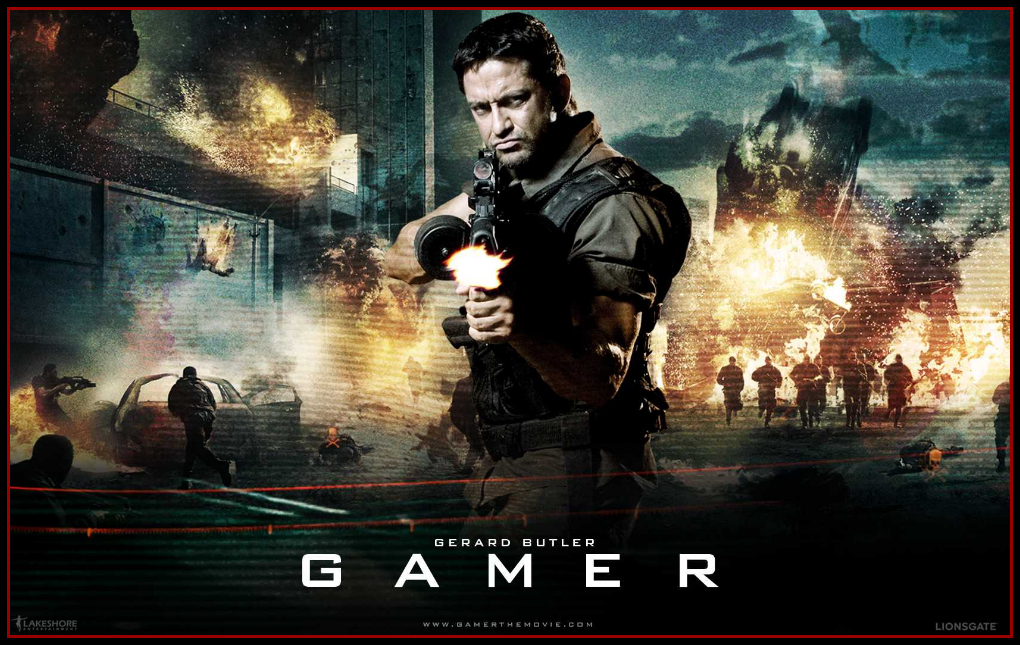
Review: Gamer (dir. by Neveldine/Taylor)


No one will ever mistake the writer-director duo of Neveldine/Taylor (Mark Neveldine and Brian Taylor) as the next Coen Brothers, but they definitely have made their mark in creating entertaining films which some have called exploitative, pandering to the lowest common denominator and exercises in excess. Maybe these critics are right, but they also seem to view the films by these two filmmakers through the narrow-minded lens of their elistist and so-called cineaste sensibilities. They won’t be the next Coen Brothers but they’re way ahead of other so-called filmmaker duos such as The Spierig Brothers (Undead and the pretentious and awful Daybreakers) or The Strause Brothers (AvP: Requiem and the awful Skyline). They came onto the scene with their cult classic action thrillers Crank and it’s sequel, Crank: High Voltage.

Their third film took the gaming influences so inherent in their first two films (which for all intents and purpose were video games that happened to be film) and went the next step. Gamer is all about a near-future world where two games with on-line social media foundations have become the rage of the entertainment world. One is a game called “Society” that looks to be the nightmare evolution of privacy advocates everywhere to the on-line virtual world Second Life and The Sims. It is the other game in this film which makes up the foundation of the film’s plot. “Slayers” takes the ultra-popular multiplayer on-line experiences of games such as Call of Duty and HALO to the next level by allowing gamers to actually control real people (inmates sentenced to death) to act as their avatars in a real-life battlefield arena with real weapons and real deaths.

These games which have become the obsession of hundreds of millions of people worldwide are the brainchild of the film’s antagonist. Michael C. Hall plays the creator of these games and his performance looks to combine the sociopathic charm of his Dexter character with that of Steve Jobs is the latter was openly honest about his douchebag tendencies. Playing his opposite is the character of Kable who happens to be the reigning champion of the game Slayers and who knows a secret that could tear down the billion-dollar empire created by Castle. Gerard Butler plays the desperate but very capable inmate Kable who just wants to survive past the final match and earn his freedom thus return to his wife and young daughter on the outside.

Gamer posits the question of how far are we willing to go to experience realism in our games and entertainment. With the game Society people pay to be able to control other people in a social setting (albeit in a controlled area). These so-called avatars will do anything and everything their real-life controllers tell them to do. In the film these avatars get paid to become virtual slaves and with most people signing up for the job being the socially desperate. Their situation is not so dissimilar from the condemned inmates who populate the game Slayers. The film hits the audience with a sledgehammer that these virtual entertainments have become popular worldwide because people have stopped looking at these “volunteers” as real people. Morality has been replaced by the need for instant gratification by way of these virtual on-line systems.

The film doesn’t make any apologies for the heavyhanded delivery of it’s message and also doesn’t skimp on the entertainment side of the equation. Neveldine/Taylor have shown that they have a certain flair for creating visual chaos and action on the screen. Their unique visual style does look like something out of a video game especially those from hyperrealistic shooters such as Call of Duty and its ilk. The filmmakers have always accomplished the high-quality visual look of their films despite the low to modest budget given to them by the studios they’re working for. Gamer is no exception and the film benefits from the decision by these two filmmakers to continue working with the Red One digital cameras thus allowing them to add in the visual effects right into the shot scenes the very same day of shooting.

It’s this very style of hi-tech guerrilla filmmaking which makes Neveldine/Taylor this current era’s Cormans. Unlike most low-budget filmmakers they don’t use the size of their budget to dictate how their films turn out visually, aurally and narratively. The first two this film succeeds in ways that makes an audience think the film was higher budgeted than it really was. The third would depend on the viewer whether the film succeeds or not. For those who seem intent on viewing every film as if they were made to be worthy of high awards and accolades would probably dismiss and hate this piece of exploitation cinema. Gamer succeeds in a narrative sense because it delivers on the promise of telling a story about a world where free will has been seconded to control in the need of a population in search of a the next virtual playground. It’s a heady premise that has been explored in past films such as the Matrix Trilogy and another film similar to this one which came out weeks later in Surrogates.

Gamer doesn’t have the philosophical and existential sermoning in combination with futuristic action sequences as the Wachowski Brothers’ trilogy, but it does have the same visceral action DNa as those three films and also more entertaining than the Bruce Willis vehicle Surrogates. This film will appeal to the very people who it condemns as sheep to the rising tide of on-line control in entertainment, but then that’s what all exploitation films tend to do best. Cater to the very people it uses as examples of what’s wrong in society and build an entertaining film around them and what they represent.

The film’s cast revolves around Gerard Butler and Michael C. Hall and the roles they play. Whether its Amber Valletta playing Kable’s desperate wife who has sold herself to become a controllable avatar in Society to try and earn enough to get her young daughter back or to Logan Lerman playing the role of Simon the gamer who controls Kable during the Slayer matches. They all do enough with their roles to keep their characters from becoming less than one-notes. Again, for some having a film with characters that are quite basic and one-note might make for a bad film, but when put into context of the story being told they’re quite good and needed to become motivators for Butler’s character.

In the end, Neveldine/Taylor have made a modern day exploitation and grindhouse film in Gamer without having to resort to the visual tricks used in the Rodriguez/Tarantino grindhouse homage film Grindhouse. A film doesn’t need to have film scratches, overexposed film stock, scratchy audio track or missing film reels to be grindhouse. It just have to espouse the very nature of the films which made up the kind of films which became prime example of grindhouse/exploitation cinema. Gamer won’t win any awards, but I suspect that more people who saw it were entertained by it’s blatant, in-your-face entertainment than would normally admit to it. It’s a film that has cult status and guilty pleasure written all over it.

Plus, this film is definitely worth at least a curiosity viewing if just to see the musical number performed by Michael C. Hall at the climactic sequence near the end of the film. I don’t think any film has ever combined gratuitous violence, musical dance numbers using bloodied death row inmates and Michael C. Hall singing Frank Sinatra’s “Ive Got You Under My Skin“. That sequence alone is worth a rental or Netflix Instant streaming.