A Quickie With Lisa Marie: Melancholia (dir. by Lars Von Trier)


Let us take a moment to consider the career of film director Lars Von Trier.  Is Von Trier a visionary?  Is he a genius?  Is he an artist who forces us to look at the world in a different way?  Is he one of the major voices working in the world of cinema today?  Or is he just full of crap?  This is the debate that always seems to come up whenever one talks about Lars Von Trier and a pretty good case can be made that the man is both a genius and an idiot, an artist and a charlatan.  How, we ask ourselves, do we reconcile the fact that this man who has directed so many memorable films is also the same man who goes to Cannes and hints that he might be sympathetic to Hitler.  As a result, Von Trier’s films seem to act as both aesthetic statements and as evidence in the never-ending trial to determine whether or not Lars Von Trier is worth all the trouble.  Melancholia — which is currently both playing at theaters and available OnDemand — is the latest exhibit in a long trial.

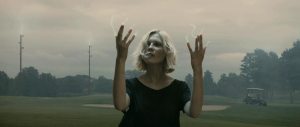
Melancholia is both the story of the relationship of two sisters (played by Charlotte Gainsbourg and Kirsten Dunst, who deservedly won best actress at Cannes for her performance here) and the story of what happens when a new planet called Melancholia appears in the sky and then promptly starts to move closer to the Earth.

The film is divided into two parts.  The first part takes place over the course of one long night.  Justine (Dunst) and her new husband Michael (Alexander Skarsgard who looks so amazing in a tux) attend a wedding reception at a mansion owned by Justine sister Clare (Gainsbourg) and Clare’s well-meaning but condescending husband John (Kiefer Sutherland).  While Justine and Michael, at first, appear to be the perfect couple, it slowly becomes apparent that the truth is far more complex.  The first part of the film takes its time establishing the characters and how they relate to each other but it never drags, largely because of the chemistry between Dunst and Skarsgard but also because Von Trier proves himself to be far more subtle director here than he’s usually given credit for being.  The first half of the film is full of details — some small and some not — that make us believe that these very familiar actors actually are the characters that they are portraying.  While Von Trier never explicitly show us what’s at the heart of Skarsgard and Dunst’s trouble relationship, he includes enough details that we, as the viewer, can figure it out.  Under Von Trier’s skilled direction, even such little things as Dunst’s constant struggle to keep her dress up take on an added and poignant significance.

In the second half of the film, a depressed Dunst is now living in the mansion with Gainsbourgh and Sutherland.  Despite the fact that Dunst is nearly catatonic, Sutherland has little sympathy for her and makes no secret of the fact that he’s not happy to have her living in his home.  However, things change rather quickly once it is learned that the new planet Melancholia is on a collision course with Earth.  While Sutherland insists that the two planets will not actually collide and Gainsbourgh panics, Dunst starts to find herself oddly rejuvenated by the prospect that the world might end…

If you were dismissive of Von Trier before this movie came out, I doubt watching Melancholia will change your mind.  In many ways, this film epitomizes everything that people tend to hate about his movies.  However, I loved Melancholia.  Visually, it’s beautiful and the film student in me loved the film simply for the many homages to Last Year at Marienbad.  Von Trier gets excellent performance from the entire cast but really, this is Kristen Dunst’s film and she proves that she’s capable of a lot more than just being a Manic Pixie Dream Girl.  Speaking of someone who has battled depression all of her life, I have to say that Dunst gets it right, capturing not only the pain of permanent sadness but also the odd moments of clarity that seem to come with it.  Finally, this is a unique film and it’s unique because Von Trier is a director that’s not afraid to be an egocentric asshole when it comes to telling the story that he wants to tell. 

I could spend hours debating what exactly Melancholia means and I’d probably change my mind several times during the conversation.  However, one thing is for sure: Melancholia is one of the best of films of 2011.

The LAFCA Honors Terrence Malick, Michael Fassbender, and …. The Descendants?


For those of you who love to follow the Oscar race, today is a big day.  Several groups announced their picks for the best of 2011 today.  The most important of these groups would be the Los Angeles Film Critics Association.  Though the LAFCA has a pretty iffy record when it comes to predicting the actual Oscar winners, their picks still tend to influence the nominations. 

Here are the LAFCA winners, along with a little commentary from yours truly.

Best Musical Score: Hanna (runner-up: Drive)

There was a lot I liked about the LAFCA awards but this is the one that truly made me go: “Yay!”  Hanna was a great film that deserves a lot more attention than its been given.

Best Cinematography: The Tree of Life (Runner-up: The City of Life and Death)

Best Production Design: Hugo (runner-up: Tinker, Tailor, Solider, Spy)

Best Supporting Actress: Jessica Chastain for Coriolanus, The Debt, The Help, Take Shelter, Texas Killing Fields, and The Tree of Life (runner-up: Janet McTeer for Albert Nobbs)

Considering that she has next to no range as an actress, Jessica Chastain is having a pretty good year.  I have a feeling she’ll win an Oscar in February and then eventually end up joining the cast of Law & Order: SVU.

Best Supporting Actor: Christopher Plummer in Beginners (runner-up: Patton Oswalt in Young Adult)

As good as Plummer was in Beginners, think about how much more exciting it would have been if Oswalt had won.

Best Screenplay: A Seperation. (runner-up: The Descendants)

Best Documentary: The Cave of Forgotten Dreams (runner-up: The Arbor)

Again, let us consider that Werner Herzog’s masterpiece wasn’t even a semi-finalist as far as the Academy is concerned.

Best Independent/Experimental Film: Spark of Being

Best Actress: Yun Jung-hee in Poetry (runner-up: Kirsten Dunst in Melancholia)

Yay!  I am so bored with Meryl Streep.

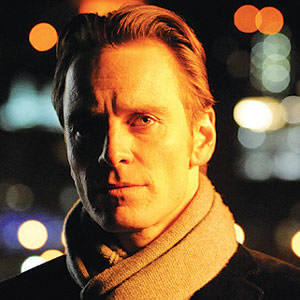
Best Actor: Michael Fassbender for Shame, A Dangerous Method, X-Men: First Class, and Jane Eyre. (runner-up: Michael Shannon in Take Shelter)

Yay!  For both the winner and the runner-up. 

Best Director: Terrence Malick for The Tree of Life (runner-up: Martin Scorsese for Hugo)

I was on twitter when this result was announced and Oh. My. God.  My timeline like totally exploded with people getting all excited and hopeful.  And then, quite a few minutes later, all that excitement turned to rage as the next award was announced–

Best Picture: The Descendants (runner-up: The Tree of Life)

That’s right.  After going out on a limb with best actress and (debatably) best director and going out of their way to honor the unfairly neglected, the LAFCA gave best picture to one of the most overrated films of 2011 — The Descendants.  This despite the fact that The Descendants hadn’t won a single other award and was a runner-up in only one category.  That must have really loved that 2nd place screenplay.  This choice reeks of compromise, as if a group of critics decided to all unite and vote for their 2nd or 3rd choice in order to keep a more controversial films like The Tree of Life from winning.

That said, my pick for the best of 2011 remains Hanna.

Best Foreign Language Film: The City of Life and Death (runner-up: A Separation)

So, A Separation has a better screenplay than the best film of 2011, yet it’s not as good a film as The City of Life and Death.

New Generation award: Martha Marcy May Marlene

To recap, the three major critics groups have now spoken and each one has named a different film for best picture.  The National Board of Review went for Hugo, the New Yorkers went for The Artist, and the LAFCA went for The Descendants.

In fact, the Artist was totally ignored by Los Angeles and I’ve noticed that there seems to be a backlash developing against this film.  The Artist won’t be opening here until Dec. 21st so I can’t judge it but I would say that if you’re upset about about a French film like The Artist getting so much attention, don’t worry.  Maybe David Fincher will remake it with American actors next year.

The Winners At Cannes


The winners of this year’s Cannes Film Festival have been announced and it’s good news for Kirsten Dunst and Terrence Malick, the director of Palme d’Or winner Tree of Life..  I’ve seen the Tree of Life trailer about a thousand times at the Plano Angelika and to be honest, I haven’t been very enthused about it.  On the one hand, Terrence Malick is a legendary director and the film looks visually quite stunning.  On the other hand, the trailer also features a kid with a heavy country accent (and I’m not hating here, I’ve got quite a twang myself) going “Mother, Father, always you fight within me,” and when I hear dialogue like that, I’m just kinda like, “Uh-oh.”  The trailer itself features a lot of quite interesting and tense family scenes mixed in with a lot of scenes that seem rather New Agey.  I’d go into my feelings about new agey films but I don’t want to upset our readers in Vermont.

Kirsten Dunst (who may be on the verge of a comeback of sorts and good for her) won for a film directed by Lars Von Trier and I wonder if the award was, in any way, meant to protest Von Trier being previously declared a “non-person” at Cannes because of a press conference where he may or may not (I haven’t been following the story closely enough to take a side) have said he was a Nazi.  (While I can’t say whether or not Von Trier is a Nazi, I can say that I loved Dancer in the Dark, Breaking the Waves, and Zentropa and I hated Dogville and I’m scared to see AntiChrist.)

Anyway, here’s the winners:

  • Palme d’Or: The Tree of Life (Terrence Malick)
  • Grand Prix(a tie): Le Gaumin au Velo (Dardennes brothers) & Once Upon a Time in Anataolia (Nuri Bilge Ceylan)
  • Best Director: Nicholas Winding Refn (Drive)
  • Best Actor: Jean Dujardin (The Artist)
  • Best Actress: Kirsten Dunst (Melancholia)
  • Prix du Jury: Polisse (Maïwenn)
  • Prix du scènario / Best Screenplay: Hearat Shulayim (Joseph Cedar)
  • Camera d’Or (Best First Film): Las Acacias (Pablo Giorgelli)
  • Un Certain Regard : Prix Spécial du Jury / Special Jury Prize : Elena (Andrey Zvyagintsev)
  • Best Short Film: Cross Country

Just a heads up, Arleigh — next year, I’m going to get down on my knees and crawl all the way over to California just so I can beg you to send me to Cannes. 🙂

Lisa Marie Discovers All Good Things (dir. by Andrew Jarecki)


I’ll admit right now that I’m a true crime junkie.  Maybe it’s because I work for a lawyer or maybe I’m just morbid-minded but, for whatever reason, I am fascinated by this stuff.  And while we all love to watch a good mystery and see if we can solve it before everyone else, it’s the mysteries without a solution that hold a special grip on my imagination.  That’s why I was really looking forward to seeing the film All Good Things.  Directed by Andrew Jarecki and starring Ryan Gosling, All Good Things is based on not one true crime case but three!  (And two of those crimes remain unsolved to this day.)

All Good Things is based on the life of Andrew Durst, who was born into a wealthy New York family just to eventually find himself accused — at one time or another — of two murders and actually put on trial for a third.  Oh, and did I mention that in-between being accused of killing people, Durst also found the time to drop out of high New York society and, despite being a very wealthy man, wandering around the country like a homeless transient?  And, would you also believe that when Durst eventually ended up moving down to Galveston, Texas, he apparently also became a transvestite?  And once Durst was in Galveston, he ended up living in a run-down boarding house with another transient who Durst eventually ended up decapitating?  Of course, all of this happened long after the mysterious disappearance of his first wife and the execution-style shooting his best friend (who also happened to be the daughter of a Las Vegas mob boss).  Durst, it should be noted, has only been put on trial once and, in that case, was acquitted.  (For a better account of the various unproven allegations against Robert Durst, click here.)

Yes, Robert Durst is a man who has found himself at the middle of several very intriguing mysteries and All Good Things pretty much sticks to the facts of the case, recreating all the scenes that we Durst watchers are familiar with while leaving the ultimate question of Durst’s guilt or innocence ambiguous.  For legal reasons, the names are changed but that’s about it.  The film even begins with a title card telling us that the film is based on the Durst case even if Ryan Gosling is technically playing a character named David Marks.  We watch as David meets and romances sweet but lower class Katie (Kirsten Dunst) despite the disapproval of his wealthy father.  (David’s father is a real estate mogul who owes his fortunes to the peep shows and grindhouses on 42nd Street.)  Once David and Katie have married, we watch the marriage turn into a nightmare as David grows increasingly abusive and Katie starts to abuse drugs.  We meet all the familiar characters that we know about from reading about the case, especially David’s devoted friend Deborah (Lilly Rabe).  We see the way that Deborah fanatically defends David after Katie mysteriously vanishes and eventually, we see David in Galveston, a blank-faced recluse who has lost the ability (if he ever had it) to exist in reality.   Yes, it’s an interesting story but does the film do it justice? 

Frustratingly, the answer is yes and no.

There’s a great movie to be found in the life of Robert Durst and unfortunately, director Andew Jarecki doesn’t find that great movie with All Good Things.  Despite telling a fictionalized version of a true story, Jarecki still approaches the material as if he’s making another documentary.  By simply concentrating on the public record of the Durst case (and, for the most part, declining to engage in any poetic license while telling the story), he keeps his distance from the characters and their world and, as a result, you watch fascinated because the story is so bizarre but not because you have any emotional investment in anything happening onscreen.   Like a good documentarian, Jarecki concentrates on providing the evidence and leaving the ultimate verdict to the audience.  If this film was a documentary about Robert Durst, this would be commendable.  However, All Good Things is a movie about a vaguely sinister guy named David Marks who remains a cipher throughout the entire film.

However, this is not the fault of the cast who manage to redeem this movie with several carefully conceived character turns.  In a frustrating and vague role, Ryan Gosling gives a far better performance than anyone would really have the right to expect.  He plays the role with a vague sense of blank desperation, creating a portrait of a man who wants to fit in with reality but just doesn’t know how to do it.  When we first meet see David wandering around 42nd street and struggling to maintain a facade of normalcy, it’s hard not to feel sorry for him.  He looks like a lot child and your natural reaction is to want to protect him and help him find his place in the world.  Add that vulnerability to the fact that he looks like Ryan Gosling and you can believe that Kirsten Dunst’s character would find him attractive and would eventually marry him, despite his quirks.  Its only once David is married (and, in theory, no longer has to worry about losing Dunst) that he starts to show his true face.  Any woman who has ever been in an abusive relationship will know the type of person that David Marks is.  As played by Gosling, he becomes every boyfriend or husband who has ever transformed into a different person once we’ve made the mistake of falling in love with him.  He’s every man we’ve ever been happy to have out of our life even as we wondered if we were to blame for whatever went wrong.  Gosling’s strongest moments come when David simply stares at his own reflection, the look on his face indicating that he’s just as confused by himself as we are.  Kirsten Dunst is sympathetic as his wife and there’s excellent character turns from Frank Langella, Philip Baker Hall, Diane Venora, and Lilly Rabe.

So, what I recommend All Good Things?  I would.  It makes for a good introduction to the Durst case and, if nothing else, it’s worth seeing for Gosling’s performance.  The definitive version of Durst’s case hasn’t been told yet but All Good Things is, at the very least, a start.

Film Review: Eternal Sunshine of the Spotless Mind (dir. by Michel Gondry)


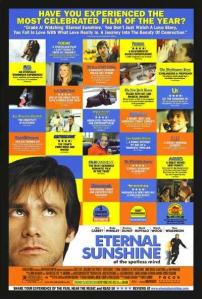
Last week, I started a poll to determine which film I should watch on Sunday and review on Monday.  Well, a lot of votes were cast and you, the readers of Through The Shattered Lens, proved to me once again that you are the greatest readers ever by picking one of my favorite films of all time.  From 2004, it’s the Charlie Kaufman-scripted, Michel Gondry-directed Eternal Sunshine of the Spotless Mind.

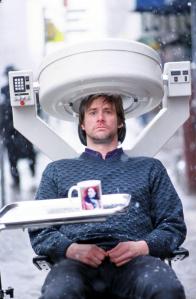
The plot plays out like something from a Philip K. Dick story.  I don’t want to reveal too much because I don’t want to ruin the film for anyone who hasn’t seen this film.  Eternal Sunshine is one of those rare films that carries with it the joy of discovery.  Depressed Joel (played by Jim Carrey) discovers that his ex-girlfriend Clementine (Kate Winslet) has hired Lacuna Inc. to totally erase all memories of him from her mind.  Embittered, Joel decides to go through the same process.  The Lacuna technicians (Elijah Wood and Mark Ruffalo) comes to Joel’s apartment in the middle of the night and start the process of erasing his memories of Clementine.  However, as Joel is losing his past, he realizes that he doesn’t want to lose his time with Clementine.  Hence, Joel finds himself running through his rapidly fading memories of Clementine, trying to save at least some scrap of her memory from being erased.  Meanwhile, as Joel fights to save his identity, Ruffalo entertains himself by inviting his girlfriend (Kirsten Dunst) over to Joel’s apartment while Elijah Wood sneaks off so he can meet his new girlfriend — who is none other than Clementine.

The genius of this Charlie Kaufman’s screenplay is that it takes an idea that seems very much “out there” and uses it to explore emotions that we’ve all felt.  Who doesn’t have someone that they wish they could wipe from their mind?  Me, I wish I could forget the exchange student from Keele University who broke up with me via e-mail.  I’d love to obliterate all memory of the frat boy who told me I was “white trash” or the former love of my life who managed to break my nose and my heart with just one movement of his hand.  We all have those people in our lives and what we forget is that by wiping out all the bad memories, we lose all the good ones as well.  Yes, Paul Walsh may have made me cry with his e-mail but, for two months before that, he held me while I cried and I can’t remember what I was crying about but I do remember feeling like I had never been held like that before.  And Dane may have hurt me terribly but now, every time I doubt myself, I simply remember that I’ve already survived the worst that could happen.  As for that frat boy who called me “white trash” — well, fuck him.  Yeah, there’s really no downside to erasing him from my mind.  In fact, I’ve already started because, to be honest, I can’t remember his name for the life of me.

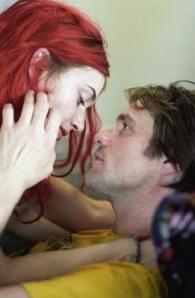
Ironically enough considering the title, there’s very little sunshine to be found in this film.  Not only is every scene drenched in melancholy but, quite literally, director Michel Gondry appears to have exclusively filmed on overcast days.  For such a deliriously romantic film — one that celebrates the idea of enduring love — Eternal Sunshine of the Spotless Mind is almost totally told in tones of gray and darkness.  In fact, as I watched the film last night, I was struck by the fact that often times, the only color in the film was provided by the Clementine’s ever-changing hair.  (Interestingly enough, Joel mentions Clementine’s hair as one of the things that he especially wants to forget about her.)  That the film works as both a dark comedy and a love story despite the grim images is a testament to the talents of both screenwriter Charlie Kaufman and director Michel Gondry.  (On the basis of the director’s later films — the latest being the enjoyable but shallow Green Hornet — I kind of suspect that Kaufman perhaps deserves a little bit more credit that Gondry.)

I think it’s also a testament to the talents of the film’s cast, all of whom gel into a perfect ensemble and allow the audience to believe in the film no matter how odd the film’s events may seem.  As I watched them last night, I found myself thinking about how much I truly love to watch good acting.  As long as a film has one or two good performance, it can be out-of-focus, choppily edited, and an hour or two too long.  By the same token, I find nothing more offensive than a million-dollar film full of expensive technology and boring performances. (Hello, Avatar.  How are you, Battle L.A?)  When I find a film, like Eternal Sunshine, that is actually both well-made and well-acted, I’m pretty much in love.

As the two lovers, Jim Carrey and Kate Winslet have a very surprising and very real chemistry together.  Watching them, you believed in their love and then you just as strongly believed in their hate.  This is one of those odd love stories where you not only believed that the two of them would actually get together but you also completely understood how and why Joel eventually drove Clementine away.  Carrey makes Joel’s depression believable without allowing it to get tedious or repetitive while Kate Winslet — well, where to begin?  Kate Winslet is probably one of the best actresses ever and this is one of her best performances.  I’ve always had a bit of a girlcrush on Winslet — there’s an honesty to her performances that few other actresses can match.  When she’s onscreen, the audience is with her.  She never puts up the whole “film star” barrier and, as a result, she inhabits her characters completely and brings them to life with both their strengths and their flaws.  And Clementine has got her share of flaws.  (I remember that when my mom saw this movie, she absolutely hated Clementine and the ever-changing color of her hair.)  Winslet doesn’t shy away from making Clementine human and, as a result, I think she elevated everyone else in the film as well.

As good as Carrey and Winslet are, the supporting roles are well-played as well and, as in all great movies, they give the impression of a world that existed before the movie started and one that will continue after the end credits.  I especially loved the performances of the Lacuna Staff, from Tom Wilkinson’s bland yet intimidating doctor to the creepy geekiness of Elijah Wood.  Mark Ruffalo and Kisten Dunst have a few great scenes where they’re partying the night away in Joel’s apartment while Joel’s memory is slowly erased.  The sight of a very hairy Ruffalo and a very giggly Dunst dancing in their matching panties pretty much epitomizes “geek love” for me.  I know that some people have complained that the scenes with Ruffalo and Dunst seemed out-of-place when compared to the ones between Carrey and Winslet but actually, I love the chemistry between Ruffalo and Dunst.  Even playing one of the nerdiest characters ever, Mark Ruffalo is still hot.  As for Dunst, she’s basically playing the same character that she always plays.  (As my friend Jeff recently put it, “Kirsten Dunst In Her Underwear” is as much of a film genre as drama, comedy, and science fiction.)  But I’ve always thought that she’s a likable enough actress (plus, by going red for Spiderman, she also indirectly helped this redhead’s social life) and she actually provides a nice (if surprising) moral center for Eternal Sunshine.

(Also, I’ll admit right now that if my boyfriend had a job that allowed him to hang out into a different stranger’s apartment every night, I’d probably sneak over and dance around in my underwear as well.)

It took me a while and a handful of viewings to really appreciate Eternal Sunshine of the Spotless Mind.  When I first saw it, I thought it was a strange film.  I liked it but I never expected that it would become one of my favorite movies.  However, with each viewing, I find myself relating to and loving this film just a little bit more.  So, thank you to everyone who voted in my poll and who gave me a chance to fall in love with this film all over again.

Love ya. 🙂

Poll: Lisa Marie Submits To Your Will


Last year, I gave up control to the reader of the site and you know what?  I kinda liked it in a sneaky, dirty little way.  So I figured, why not do it again?

Of course, I’m sure you’ve already guessed that I’m referring to my What Movie Should Lisa Marie Review poll.  This is the poll that led to me reviewing Anatomy of a Murder. 

Here’s how it works.  Earlier today, I put on a blindfold and then I randomly groped through my DVD collection until I had managed to pull out ten movies.  I then promptly stubbed my big toe on the coffee table, fell down to the floor, and spent about 15 minutes cursing and crying.  Because, seriously, it hurt!  Anyway, I then took off the blindfold and looked over the 10 movies I had randomly selected.  Two of them — Dracula A.D. 1972 and A Blade in the Dark — were movies that I had already reviewed on this site.  So I put them back and I replaced them with two movies of my own choosing — in this case, Eternal Sunshine of the Spotless Mind and The Unbearable Lightness of Being.

Between now and next Sunday (March 27th), people will hopefully vote in this poll.  On Sunday, I will watch and review whichever movie has received the most votes.  Even if that movie turns out to be Incubus. *shudder*  (Have I mentioned how much I love Eternal Sunshine of the Spotless Mind?)

Now, of course, there’s always the possibility that no one will vote in this poll and I’ll end up looking silly.  Those are the risks you take when you set up an online poll.  However, I have a backup plan.  If nobody votes, I will just spend every day next week shopping for purses at Northpark Mall and then blogging about it.  And by that, I mean blogging every single little detail.  So, it’s a win-win for me.

Anyway, here’s the list of the 10 films:

1) Barbarella — From 1968, Jane Fonda plays Barbarella who flies around space while getting molested by …. well, everyone.  Directed by Roger Vadim.

2) Barry Lyndon — From 1975, this best picture nominee is director Stanley Kubrick’s legendary recreation of 18th-century Europe and the rogues who live there.

3) Caligula — Yes, that Caligula.  From 1979, it’s time for decadence, blood, and nudity in the Roman Empire.  Starring Malcolm McDowell, Helen Mirren, Peter O’Toole, John Gielgud, John Steiner, and Theresa Ann Savoy.

4) Eternal Sunshine of the Spotless Mind — Oh my God, I love this movie.  Jim Carrey breaks up with Kate Winslet and deals with the pain by getting his mind erased by Tom Wilkinson, Mark Ruffalo, Kirsten Dunst, and an amazingly creepy Elijah Wood.

5) Incubus — From 1969, this low-budget supernatural thriller not only stars a young William Shatner but it also features the entire cast speaking in Esperanto.  For.  The.  Entire.  Movie.

6) Inland Empire — If you want to give Lisa nightmares, you can vote for David Lynch’s disturbing 3-hour film about lost identity, sexual repression, human trafficking, and talking rabbits.

7) Kiss Me Deadly — From 1955, this Robert Aldrich-directed cult classic features hard-boiled P.I. Mike Hammer and a host of others chasing after a mysterious glowing box and accidentally destroying the world in the process.

8 ) Mandingo — From 1975, this infamous little film is a look at slavery, incest, and rheumatism in the pre-Civil War South.  Starring James Mason, Ken Norton, Perry King, and Susan George.  Supposedly a really offensive movie, one I haven’t sat down and watched yet.

9) Sunset Boulevard — From 1950, hack screenwriter William Holden ends up the kept man of psychotic former screen goddess Gloria Swanson.  Directed by Billy Wilder.

10) The Unbearable Lightness of Being — From 1988, Philip L. Kaufman’s adaptation of Milan Kundera’s classic novel (one of my favorite books, by the way) features Daniel Day-Lewis, Juliette Binoche, and Lena Olin having sex and dealing with ennui.  After I first saw this movie, I insisted on wearing a hat just like Lena Olin did.

Everyone, except for me, is eligible to vote.  Vote as often as you want.  The poll is now open until Sunday, March 27th.

(Edit: Voting is now closed but check below for the results! — Lisa)