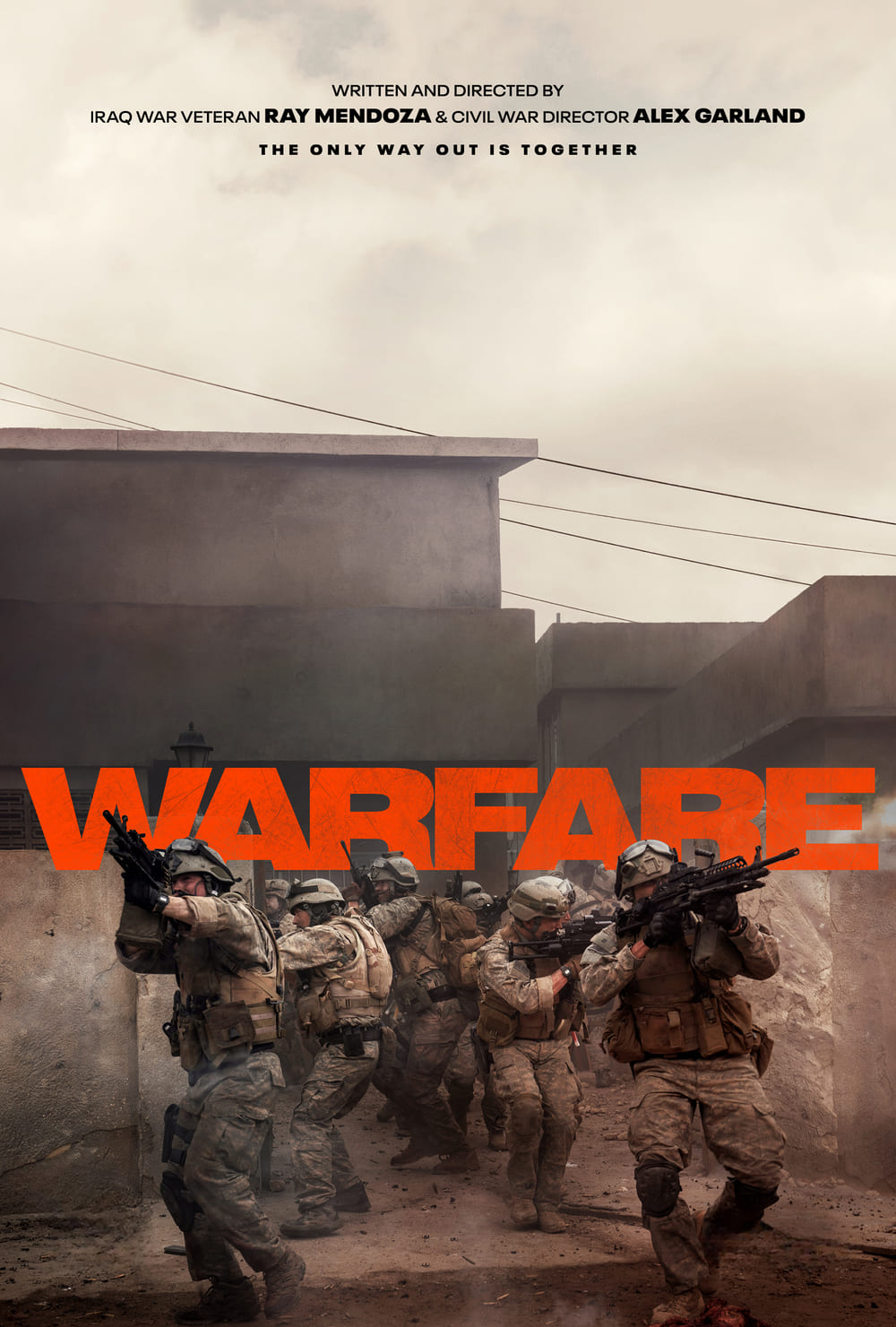
Film Review: Warfare (dir. by Ray Mendoza & Alex Garland)


“Just hang in there. You’re not alone, man.” — Mac

In Warfare, staying alive is a full-time job, and nobody gets a moment off. Ray Mendoza and Alex Garland’s 2025 film builds its tension around that exhausting reality, stripping away most of the familiar comforts of a Hollywood war movie. There are no reassuring pauses for personal revelations, no grand speeches that suddenly make the suffering meaningful, and little room to admire the action from a safe emotional distance. Instead, the film concentrates on the relentless effort of getting through one disastrous situation. It is gripping, frequently overwhelming, and much more interested in the cost of survival than the excitement of combat.

The story follows members of two American Navy SEAL teams during a 2006 operation in Ramadi, Iraq. After occupying a civilian home and establishing surveillance positions, the men come under attack and find themselves struggling to evacuate their wounded. Mendoza participated in the actual incident, and his collaboration with Garland gives the film a tightly restricted perspective. Rather than explaining the war or constructing an elaborate military adventure, Warfare recreates what these men experienced and endured in real time. The assignment, the attack, and the effort to get out become almost the entire world of the movie.

That narrow focus takes some getting used to. The early scenes offer little of the character-building shorthand audiences might expect: nobody needs to display a family photograph or explain what brought him into the military. Instead, the men reveal themselves through routines, exchanges, and the way they work together. It can initially be difficult to tell everyone apart, which is both a deliberate feature and a genuine drawback. The film wants us to understand a functioning unit before we understand its individual members. That makes sense for its approach, although it occasionally keeps the characters at arm’s length.

What comes through clearly, however, is how much effort goes into simply maintaining control. Watching a street, monitoring a window, listening to instructions, and staying ready all become sources of tension. The quieter passages are not empty space before the “real movie” begins. They establish the concentration required before anything has visibly gone wrong. Garland and Mendoza make waiting feel active without constantly forcing suspense through obvious tricks. You start scanning the frame because the soldiers are scanning their surroundings, and the longer that continues, the more you realize that being prepared is not the same thing as being safe.

Once the attack begins, the film makes that distinction brutally clear. Training gives the men ways to respond, but it does not protect them from confusion, injury, or the limits of their own bodies. Plans become harder to carry out, information becomes difficult to process, and ordinary movements demand frightening amounts of effort. There is very little of the satisfying clarity that turns a complicated action sequence into an impressive display of competence. Here, competence matters precisely because everything is becoming unmanageable. The soldiers keep working, but the movie never suggests that doing everything correctly guarantees a good outcome.

The staging gives those struggles a physical weight. Rooms that seemed useful become cramped holding areas; doorways become dangerous thresholds; short stretches of exposed ground become enormous obstacles. The audience gradually learns enough about the location to appreciate why moving an injured person is not a simple matter of picking him up and running. Every action depends on other actions happening first. Someone has to communicate, someone has to provide cover, and someone has to make a decision with incomplete information. Survival becomes collective labor, and the film is strongest when it shows just how difficult that labor can be.

Sound does much of the heavy lifting. Gunfire, explosions, radio chatter, strained voices, and cries of pain create an atmosphere that feels crowded even when the image itself is relatively contained. Without a conventional musical score guiding every emotional shift, the audience has to sit with those sounds rather than receive an easy cue about how to process them. The wounded soldiers’ suffering is particularly hard to hear because it does not conveniently disappear between dramatic beats. Pain remains present while other people issue instructions and try to solve practical problems. That persistence makes the violence feel consequential rather than decorative.

The performances support this approach. D’Pharaoh Woon-A-Tai, playing Mendoza, provides an important point of connection without turning the film into a one-man showcase. Cosmo Jarvis, Will Poulter, Charles Melton, and the rest of the ensemble fit into the same collective rhythm. Their best moments often involve listening, struggling to respond, or concentrating on something that has suddenly become terribly difficult. The actors make cooperation believable without leaning on speeches about loyalty. Concern shows up in what the men do for each other, particularly when helping somebody requires them to stay focused through fear and distress.

The Iraqi family whose home becomes the soldiers’ position adds another layer of unease. For the Americans, the building is a place from which to carry out an assignment. For the family, it is their living space, now occupied by armed men and exposed to violence. The film does not need to step away from the central incident to make that distinction register. Their frightened presence changes how we see the rooms and the activity inside them. Although they remain less developed than the soldiers, they prevent the location from feeling like an anonymous battlefield built only to contain American suffering.

The same restraint applies to the wider political circumstances. Explaining the Iraq War is not what Warfare sets out to do, and treating that absence as a failure would mean judging it against a different film. Its purpose is to reconstruct the teams’ experience as it unfolds, not interrupt it with hindsight or historical explanation. The more useful question is whether that reconstruction feels coherent and immediate. For the most part, it does. The restricted perspective keeps us alongside the men as their options narrow, making the next instruction, movement, or decision more urgent than anything outside the moment.

Even with some emotional distance between the audience and individual characters, Warfare is an impressive piece of filmmaking. Its precision, ensemble performances, and punishing sound design make survival feel like something achieved through exhausting, imperfect effort rather than heroic inevitability. The lack of conventional backstories sometimes limits our attachment, but the men’s dependence on one another gives the film its emotional center. Mendoza and Garland refuse the easy satisfaction of turning endurance into triumph. When the fighting finally loosens its grip, the film leaves behind no comfortable sense that anyone has won. Getting out alive is the ending, not the happy ending.
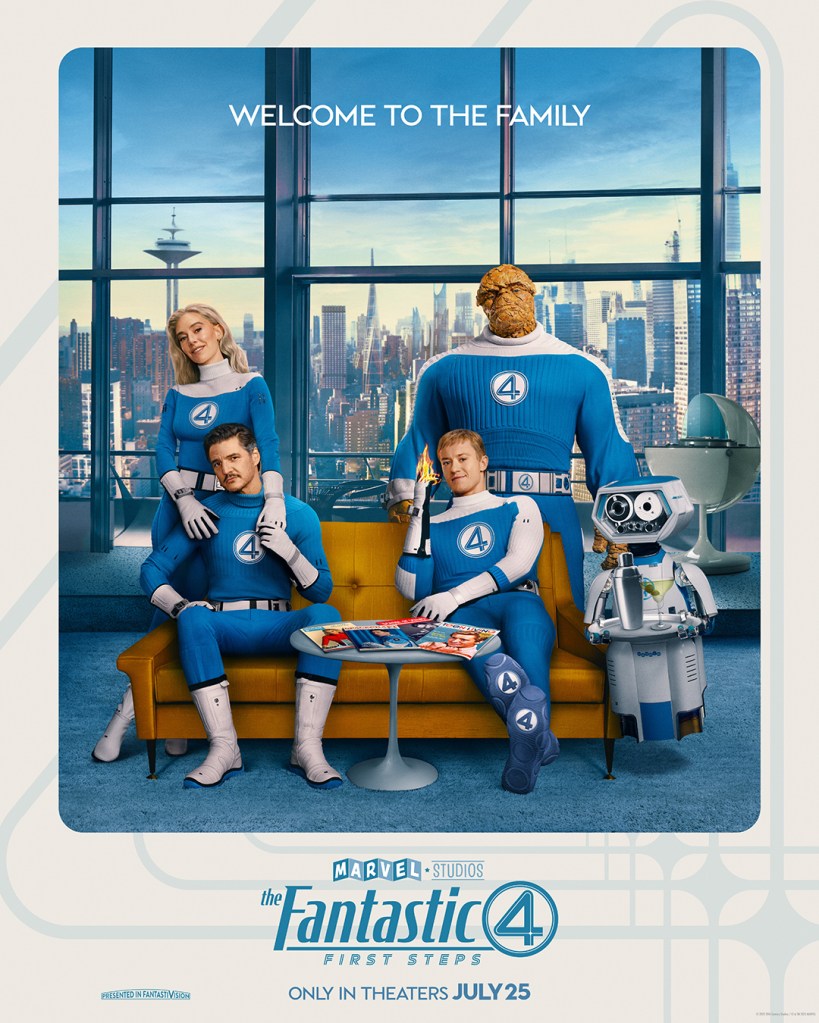
Catching Up With The Films of 2025: The Fantastic Four: First Steps (dir by Matt Shankman)


I have to admit that I groaned when Marvel’s The Fantastic Four: First Steps opened with a title card informing me that it was taking place on “Earth-828.”

You have to understand that all of the multiverse nonsense is the one of the main things that led to me losing interest in both the Marvel and the DC films.  The idea that there are multiple Earths out there and they’ve all got different versions of the same heroes and villains just feels incredibly lazy to me.  It’s like a get out of jail free card.  If you make a bad movie, you can just claim that it was took place on another Earth.  If a character dies on one Earth, it doesn’t really matter because there’s another version out there.  What are the actual stakes when there’s a million different Earths to choose from?  For that matter, if I’m presumably living on Earth-1, why should I care about Earth-828?  Earth-828 has nothing to do with me.

Imagine my surprise, then, when one of the best things about the film was that it turned out to be that it was taking place on an alternate Earth, one that mixes the culture of the 1960s with advanced technology and a retro-futuristic style.  This is a rare Marvel film that is enjoyable just to look at.  The production design is top-notch, mixing the past with the future in a very playful way.  As much as I dislike the whole multiverse thing, Earth-828 does seem like it would be a fun place to visit.

Earth-828 has advanced technology because of its only team of super heroes, the Fantastic Four.  Fortunately, Marvel seems to understand that 1) origin stories tend to be bland in general and 2) viewers have already had to sit through two disappointing and presumably unrelated Fantastic Four films that centered around them getting their powers.  So, First Steps opens with the team having already taken their trip into space, the one that led to them returning with altered DNA.  Reed Richards (Pedro Pascal) can stretch himself.  His wife, Susan Storm Richards (Vanessa Kirby), can turn invisible and knock things around with …. invisibility rays, I guess.  Susan’s brother, Johnny (Joseph Quinn), can burst into flame and fly.  (Wow, DNA is amazing!)  And their friend, Ben Grimm (Ebon Moss-Bachrach), has skin that has been transformed into a layer of orange rock.  Ben can knock holes in walls but he can’t seem to get the world to understand that there is an intelligent and kind-hearted soul underneath the fearsome exterior.  The citizens of Earth-828 are worshipful of the Fantastic Four and the team has ushered in an era of peace.

When a naked silver woman on a surfboard (Julia Garner) appears in Times Square, she announces that Earth has been selected as the latest feast for Galactus (Ralph Ineson), a giant creature who is so powerful that he must consume planets in order to satisfy his appetite.  Galactus offers to spare Earth but only if he is given Reed and Susan’s baby, Franklin.  Galactus says that Franklin possesses the “power cosmic,” which is something that I assume we’re going to be hearing a lot about over the next few MCU films.

As far as later phase Marvel productions are concerned, The Fantastic Four: First Steps is an entertaining-enough film.  Vanessa Kirby is a bit on the dull side as Sue but it should be noted that, in all of the various film versions of The Fantastic Four, Sue has always been the least interesting member of the group.  Pascal is likable as Reed, even if his stretchy superpower feels a bit silly.  Ebon Moss-Bachrach and Joseph Quinn both give strong performances, with Quinn especially bringing some depth to a character who, in lesser hands, could come across as being shallow.  Ralph Ineson is a properly intimidating villain and Julia Garner has just the right amount of sad-eyed intensity for the role of the morally ambiguous Silver Surfer.  The film looks great, the retro style holds the viewer’s attention, and there are a few moments of genuine wit that harken back to the best moments of the 1st phase of the MCU.  That said, it’s hard to ignore that this is yet another Marvel movie where the whole thing ends with a fairly predictable battle and a healthy dose of Dues Ex Machina.  The film is entertaining but it definitely sticks to the established MCU formula.

The film ends with a mid-credits scene and a promise that the story will continue in Avengers: Doomsday.  I wonder what Earth that one will take place on.

The Films Of 2025: Warfare (dir by Alex Garland and Ray Mendoza)


It’s been said that it’s next to impossible to make a true anti-war film because war itself is so cinematic that even the most harrowing portrayals of combat ultimately make it look exciting and, for those who survive, cool.

Now, I don’t quite believe that myself.  Stanley Kubrick made three of the most effective anti-war movies ever made, Paths of Glory, Dr. Strangelove, and Full Metal Jacket, though it should be noted that the first two of those films were more critical of the incompetence of those running the war than war itself.  Both Lewis Milestone and Edward Berger made strong anti-war statements by adapting All Quiet On The Western Front.  Both films featured battle scenes that were devoid of the personal heroics that tend to crop up in other war films.  (Platoon may have been firmly against the Vietnam War but it’s still hard not to cheer when a crazed Charlie Sheen takes on the entire VC on his own.)  Robert Altman’s M*A*S*H made an effective anti-war statement by focusing on what comes after the battle.  The scene where a geyser of blood suddenly erupts from a soldier’s neck shocks, terrifies, and ultimately outrages us.  That said, it is true that an effective battle scene, especially one that leaves the viewer feeling as if they are actually in the middle of combat themselves, does tend to get the heart pumping and the adrenaline surging, regardless of the politics of the person watching.  We tend to look up to those who have been tested by combat, those who have come under fire and who have survived.  One can be anti-war while still understanding why war itself has been a popular cinematic topic since the silent era.

I’m thinking about this because of the online reaction to Warfare, a film that came out in April of this year.  Based on actual skirmish that occurred in Iraq in 2007, the film plays out largely in real time and follows a platoon of Navy SEALs as they set up operations in a two-story house and then later try to escape when they come under fire from insurgents.  The film was written and co-directed by Ray Mendoza, who was one of the SEALs involved in the actual incident.  In the film, Mendoza is played by D’Pharaoh Woon-A-Tai while other SEALs are played by actors like Will Poulter, Michael Gandolfini, and Charles Melton.  The film itself doesn’t tell us much about the individual SEALs.  We don’t get any heart-breaking stories about anyone’s homelife.  No one takes the time to pull out a picture of their girlfriend back home or any of the other usual stuff that happens in war movies.  There’s really not time for that.  For over an hour, Warfare puts the viewers directly in the middle of the battle and it does a good job of it.  The bullets, the explosions, all of them seem far too real as we watch.

The online reaction to Warfare has definitely been a bit mixed.  There are quite a few people who are convinced that Warfare is a pro-war, “imperialist” film.  “Why did Alex Garland make this!?” cries one of the top reviews over on Letterboxd.  Myself, I disagree.  It’s not a political film.  It’s neither pro- nor anti-war.  Instead, it’s a film about a group of men who are fighting to survive.  And to me, it is an effective anti-war film because it shows exactly how much damage a bullet and a grenade can do to a human being.  When one of the SEALs is seriously wounded, there’s no glamour to it.  Instead, you feel his pain and you realize that it’s not even that clear what the mission was in the first place.  Warfare is a tough and gritty film.  It’s a combat film that makes me happy that I’ll probably never come under fire while also respecting the men who refused to leave anyone behind.

If peace could be achieved by didactic speeches and heavy-handed moralizing, it would have happened long before now.  Warfare presents what happened and leave it to the viewer to draw their own conclusion.

Fantastic Four: First Steps (Official Trailer)


Since Iron Man first hit theaters in the summer of 2008, especially with the post-credits scene of Nick Fury asking Tony Stark if he knew anything about the Avengers Initiative, comic book fans have always been hoping that all the Marvel Comics properties would soon interact with each other. X-Men and Fantastic Four characters were controlled by 20th Century Fox.

This began to change in 2011 with the massive hack of Sony servers which gave the public behind-the-scenes info on Sony execs worried about the Spider-Man film franchise and how it was lagging behind Disney’s Marvel Cinematic Universe under the control of uber-producer Kevin Feige. In just a few years after this hack rumors of Spider-Man being loaned out to become part of the MCU became fact.

The next major shift in fans wanting all of Marvel properties becoming part of the MCU was Disney’s purchase and merger with 20th Century Fox in 2017 and completed in 2019. With just a few small restrictions here and there (Universal still hold the rights to the Incredible Hulk character but allowed Disney to the character), the MCU was now pretty much complete.

The first thing fans wanted was a new take on Marvel Comics’ first family: The Fantastic Four.

There’s been several attempts to put the Fantastic Four on the big-screen. From the 1994 unreleased Roger Corman low-budget film to the three films when 20th Century Fox was still a separate studio, fans never really bought into those iterations. But now that the first family was back under Marvel Studios control, especially with Kevin Feige as producer, fans were once again hopeful.

The first official trailer is now out and it looks like it will lean heavily on the Fantastic Four’s 1960’s origins right down to the retro-futuristic design and theme. How the film will explain where the team has been during the MCU timeline will be a narrative that a team of screenwriters and director Matt Shankman will have to navigate.

Fantastic Four: First Steps arrives in theaters on July 25, 2025.

The Fantastic Four take their First Steps in a Teaser Trailer!


There was a cute live event leading up to the launch of The Fantastic Four: First Steps teaser trailer. The main cast were on hand – Pedro Pascal as Reed Richards, Vanessa Kirby as Sue Storm, Ebon Moss-Bachrach as Ben Grimm (a.k.a. The Thing) and Joseph Quinn as Johnny Storm. It looks like they’re off to an interesting start.

Enjoy!

A new fighter enters the Arena in Ridley Scott’s Gladiator II trailer!


I don’t know how or why we have a sequel to Ridley Scott’s Academy Award Winner Gladiator, but here it is in all its glory. It looks quite interesting, I have to say. In my opinion, Ridley’s films are a coin flip. This can go either way. And who knows? Maybe if we’re lucky, we’ll get a Kingdom of Heaven follow up. One can only hope.

Gladiator II looks like it’s expanding on the first film, at least in terms of the fighting arena. We have naval battles in the Colesseum now. Despite the fall of Commodus in the first film (Joaquin Phoenix), Rome still has issues. A young gladiator (Paul Mescal, All of Us Strangers) seems to have an issue with General Marcus Acacius, played by Wonder Woman 84 and The Last of Us’ Pedro Pascal. Ridley’s also reunited with American Gangster‘s Denzel Washington, as well as Gladiator‘s Connie Nielsen and Derek Jacobi. Also on hand are Joseph Quinn (A Quiet Place: Day One), Rory McCann (Jumanji: The Next Level), May Calamawy (Marvel’s Moon Knight) and Peter Mensah (300).

Harry Gregson-Williams (Man on Fire, Kingdom of Heaven) will be scoring the film, taking over for Hans Zimmer.

Gladiator II will be in theatres this November.