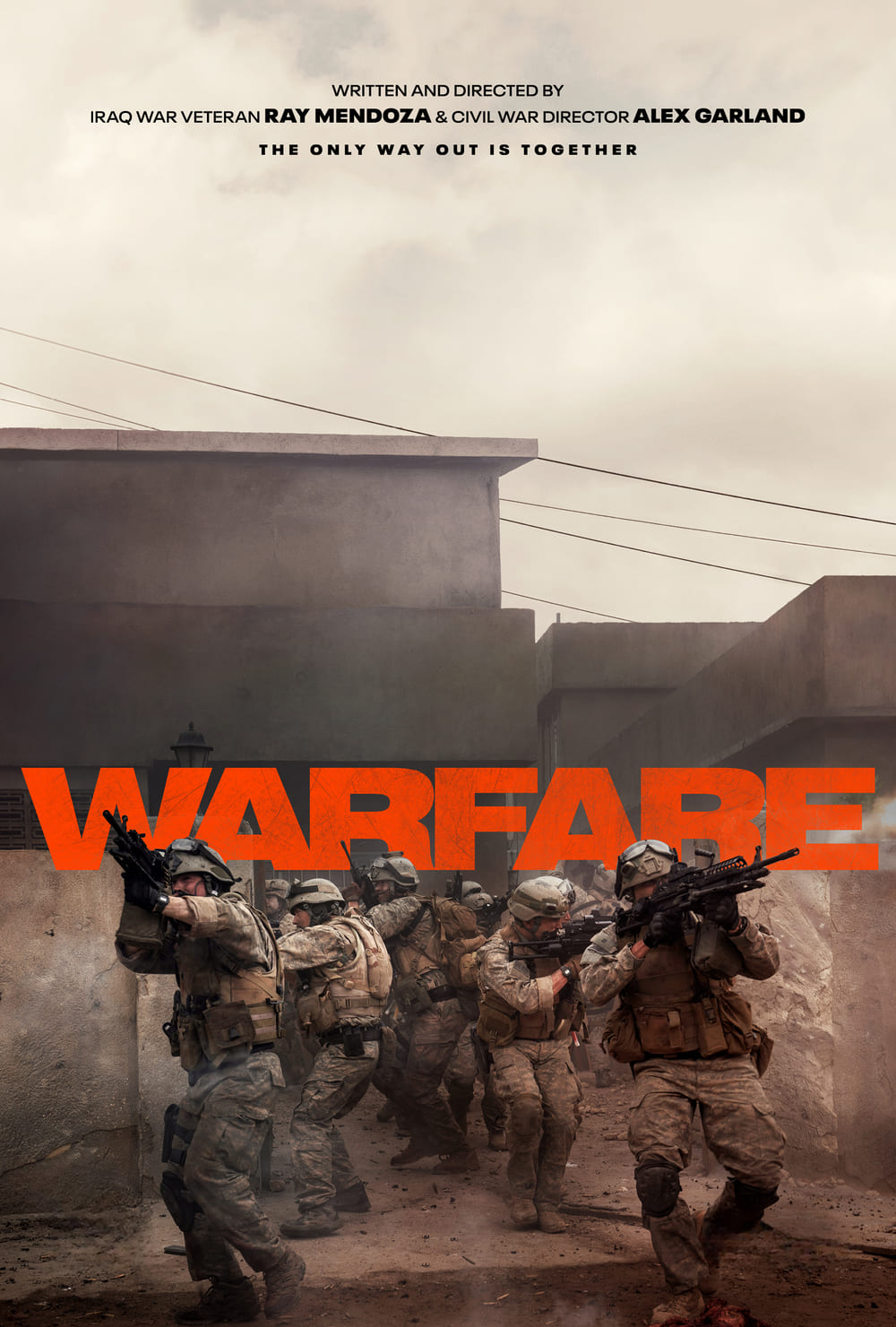
“Just hang in there. You’re not alone, man.” — Mac
In Warfare, staying alive is a full-time job, and nobody gets a moment off. Ray Mendoza and Alex Garland’s 2025 film builds its tension around that exhausting reality, stripping away most of the familiar comforts of a Hollywood war movie. There are no reassuring pauses for personal revelations, no grand speeches that suddenly make the suffering meaningful, and little room to admire the action from a safe emotional distance. Instead, the film concentrates on the relentless effort of getting through one disastrous situation. It is gripping, frequently overwhelming, and much more interested in the cost of survival than the excitement of combat.
The story follows members of two American Navy SEAL teams during a 2006 operation in Ramadi, Iraq. After occupying a civilian home and establishing surveillance positions, the men come under attack and find themselves struggling to evacuate their wounded. Mendoza participated in the actual incident, and his collaboration with Garland gives the film a tightly restricted perspective. Rather than explaining the war or constructing an elaborate military adventure, Warfare recreates what these men experienced and endured in real time. The assignment, the attack, and the effort to get out become almost the entire world of the movie.
That narrow focus takes some getting used to. The early scenes offer little of the character-building shorthand audiences might expect: nobody needs to display a family photograph or explain what brought him into the military. Instead, the men reveal themselves through routines, exchanges, and the way they work together. It can initially be difficult to tell everyone apart, which is both a deliberate feature and a genuine drawback. The film wants us to understand a functioning unit before we understand its individual members. That makes sense for its approach, although it occasionally keeps the characters at arm’s length.
What comes through clearly, however, is how much effort goes into simply maintaining control. Watching a street, monitoring a window, listening to instructions, and staying ready all become sources of tension. The quieter passages are not empty space before the “real movie” begins. They establish the concentration required before anything has visibly gone wrong. Garland and Mendoza make waiting feel active without constantly forcing suspense through obvious tricks. You start scanning the frame because the soldiers are scanning their surroundings, and the longer that continues, the more you realize that being prepared is not the same thing as being safe.
Once the attack begins, the film makes that distinction brutally clear. Training gives the men ways to respond, but it does not protect them from confusion, injury, or the limits of their own bodies. Plans become harder to carry out, information becomes difficult to process, and ordinary movements demand frightening amounts of effort. There is very little of the satisfying clarity that turns a complicated action sequence into an impressive display of competence. Here, competence matters precisely because everything is becoming unmanageable. The soldiers keep working, but the movie never suggests that doing everything correctly guarantees a good outcome.
The staging gives those struggles a physical weight. Rooms that seemed useful become cramped holding areas; doorways become dangerous thresholds; short stretches of exposed ground become enormous obstacles. The audience gradually learns enough about the location to appreciate why moving an injured person is not a simple matter of picking him up and running. Every action depends on other actions happening first. Someone has to communicate, someone has to provide cover, and someone has to make a decision with incomplete information. Survival becomes collective labor, and the film is strongest when it shows just how difficult that labor can be.
Sound does much of the heavy lifting. Gunfire, explosions, radio chatter, strained voices, and cries of pain create an atmosphere that feels crowded even when the image itself is relatively contained. Without a conventional musical score guiding every emotional shift, the audience has to sit with those sounds rather than receive an easy cue about how to process them. The wounded soldiers’ suffering is particularly hard to hear because it does not conveniently disappear between dramatic beats. Pain remains present while other people issue instructions and try to solve practical problems. That persistence makes the violence feel consequential rather than decorative.
The performances support this approach. D’Pharaoh Woon-A-Tai, playing Mendoza, provides an important point of connection without turning the film into a one-man showcase. Cosmo Jarvis, Will Poulter, Charles Melton, and the rest of the ensemble fit into the same collective rhythm. Their best moments often involve listening, struggling to respond, or concentrating on something that has suddenly become terribly difficult. The actors make cooperation believable without leaning on speeches about loyalty. Concern shows up in what the men do for each other, particularly when helping somebody requires them to stay focused through fear and distress.
The Iraqi family whose home becomes the soldiers’ position adds another layer of unease. For the Americans, the building is a place from which to carry out an assignment. For the family, it is their living space, now occupied by armed men and exposed to violence. The film does not need to step away from the central incident to make that distinction register. Their frightened presence changes how we see the rooms and the activity inside them. Although they remain less developed than the soldiers, they prevent the location from feeling like an anonymous battlefield built only to contain American suffering.
The same restraint applies to the wider political circumstances. Explaining the Iraq War is not what Warfare sets out to do, and treating that absence as a failure would mean judging it against a different film. Its purpose is to reconstruct the teams’ experience as it unfolds, not interrupt it with hindsight or historical explanation. The more useful question is whether that reconstruction feels coherent and immediate. For the most part, it does. The restricted perspective keeps us alongside the men as their options narrow, making the next instruction, movement, or decision more urgent than anything outside the moment.
Even with some emotional distance between the audience and individual characters, Warfare is an impressive piece of filmmaking. Its precision, ensemble performances, and punishing sound design make survival feel like something achieved through exhausting, imperfect effort rather than heroic inevitability. The lack of conventional backstories sometimes limits our attachment, but the men’s dependence on one another gives the film its emotional center. Mendoza and Garland refuse the easy satisfaction of turning endurance into triumph. When the fighting finally loosens its grip, the film leaves behind no comfortable sense that anyone has won. Getting out alive is the ending, not the happy ending.

