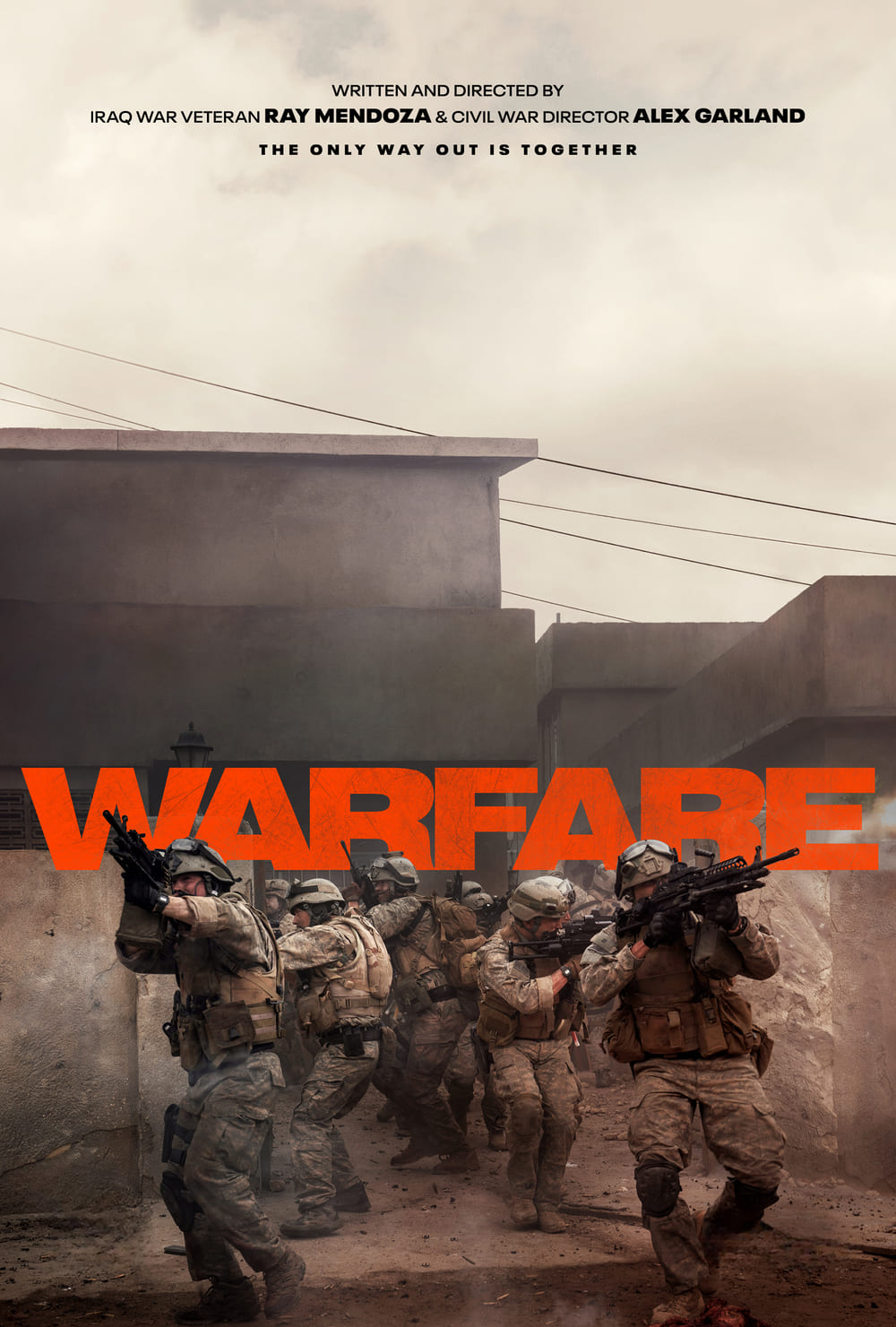
Film Review: Warfare (dir. by Ray Mendoza & Alex Garland)


“Just hang in there. You’re not alone, man.” — Mac

In Warfare, staying alive is a full-time job, and nobody gets a moment off. Ray Mendoza and Alex Garland’s 2025 film builds its tension around that exhausting reality, stripping away most of the familiar comforts of a Hollywood war movie. There are no reassuring pauses for personal revelations, no grand speeches that suddenly make the suffering meaningful, and little room to admire the action from a safe emotional distance. Instead, the film concentrates on the relentless effort of getting through one disastrous situation. It is gripping, frequently overwhelming, and much more interested in the cost of survival than the excitement of combat.

The story follows members of two American Navy SEAL teams during a 2006 operation in Ramadi, Iraq. After occupying a civilian home and establishing surveillance positions, the men come under attack and find themselves struggling to evacuate their wounded. Mendoza participated in the actual incident, and his collaboration with Garland gives the film a tightly restricted perspective. Rather than explaining the war or constructing an elaborate military adventure, Warfare recreates what these men experienced and endured in real time. The assignment, the attack, and the effort to get out become almost the entire world of the movie.

That narrow focus takes some getting used to. The early scenes offer little of the character-building shorthand audiences might expect: nobody needs to display a family photograph or explain what brought him into the military. Instead, the men reveal themselves through routines, exchanges, and the way they work together. It can initially be difficult to tell everyone apart, which is both a deliberate feature and a genuine drawback. The film wants us to understand a functioning unit before we understand its individual members. That makes sense for its approach, although it occasionally keeps the characters at arm’s length.

What comes through clearly, however, is how much effort goes into simply maintaining control. Watching a street, monitoring a window, listening to instructions, and staying ready all become sources of tension. The quieter passages are not empty space before the “real movie” begins. They establish the concentration required before anything has visibly gone wrong. Garland and Mendoza make waiting feel active without constantly forcing suspense through obvious tricks. You start scanning the frame because the soldiers are scanning their surroundings, and the longer that continues, the more you realize that being prepared is not the same thing as being safe.

Once the attack begins, the film makes that distinction brutally clear. Training gives the men ways to respond, but it does not protect them from confusion, injury, or the limits of their own bodies. Plans become harder to carry out, information becomes difficult to process, and ordinary movements demand frightening amounts of effort. There is very little of the satisfying clarity that turns a complicated action sequence into an impressive display of competence. Here, competence matters precisely because everything is becoming unmanageable. The soldiers keep working, but the movie never suggests that doing everything correctly guarantees a good outcome.

The staging gives those struggles a physical weight. Rooms that seemed useful become cramped holding areas; doorways become dangerous thresholds; short stretches of exposed ground become enormous obstacles. The audience gradually learns enough about the location to appreciate why moving an injured person is not a simple matter of picking him up and running. Every action depends on other actions happening first. Someone has to communicate, someone has to provide cover, and someone has to make a decision with incomplete information. Survival becomes collective labor, and the film is strongest when it shows just how difficult that labor can be.

Sound does much of the heavy lifting. Gunfire, explosions, radio chatter, strained voices, and cries of pain create an atmosphere that feels crowded even when the image itself is relatively contained. Without a conventional musical score guiding every emotional shift, the audience has to sit with those sounds rather than receive an easy cue about how to process them. The wounded soldiers’ suffering is particularly hard to hear because it does not conveniently disappear between dramatic beats. Pain remains present while other people issue instructions and try to solve practical problems. That persistence makes the violence feel consequential rather than decorative.

The performances support this approach. D’Pharaoh Woon-A-Tai, playing Mendoza, provides an important point of connection without turning the film into a one-man showcase. Cosmo Jarvis, Will Poulter, Charles Melton, and the rest of the ensemble fit into the same collective rhythm. Their best moments often involve listening, struggling to respond, or concentrating on something that has suddenly become terribly difficult. The actors make cooperation believable without leaning on speeches about loyalty. Concern shows up in what the men do for each other, particularly when helping somebody requires them to stay focused through fear and distress.

The Iraqi family whose home becomes the soldiers’ position adds another layer of unease. For the Americans, the building is a place from which to carry out an assignment. For the family, it is their living space, now occupied by armed men and exposed to violence. The film does not need to step away from the central incident to make that distinction register. Their frightened presence changes how we see the rooms and the activity inside them. Although they remain less developed than the soldiers, they prevent the location from feeling like an anonymous battlefield built only to contain American suffering.

The same restraint applies to the wider political circumstances. Explaining the Iraq War is not what Warfare sets out to do, and treating that absence as a failure would mean judging it against a different film. Its purpose is to reconstruct the teams’ experience as it unfolds, not interrupt it with hindsight or historical explanation. The more useful question is whether that reconstruction feels coherent and immediate. For the most part, it does. The restricted perspective keeps us alongside the men as their options narrow, making the next instruction, movement, or decision more urgent than anything outside the moment.

Even with some emotional distance between the audience and individual characters, Warfare is an impressive piece of filmmaking. Its precision, ensemble performances, and punishing sound design make survival feel like something achieved through exhausting, imperfect effort rather than heroic inevitability. The lack of conventional backstories sometimes limits our attachment, but the men’s dependence on one another gives the film its emotional center. Mendoza and Garland refuse the easy satisfaction of turning endurance into triumph. When the fighting finally loosens its grip, the film leaves behind no comfortable sense that anyone has won. Getting out alive is the ending, not the happy ending.

Spring Break on the Lens: You Get Me (dir by Brent Bonacorso)


Ah, the beach.

The beach is a beautiful and fun place and the perfect location to celebrate a spring or summer break.  But beware of getting carried away with your youthful revelries because it can lead to complications that will follow you into the fall.  And those complications can be deadly….

BLEH!

Okay, sorry for all the drama.  I’m just trying to make myself feel some sort of enthusiasm for reviewing the 2017 Netflix film, You Get Me.  You Get Me is technically not a spring break movie but it does take place on the beach and it does feature a moderate amount of drinking, drug-taking, and partying so, it’s close enough.  It also features a cast of 20-something actors cast as high school students.  Some are more believable than others.

Basically, dumb and dull teenager Tyler (Taylor John Smith) is having the best summer of his life because he has a girlfriend named Ali (Halston Sage), who he is totally in love with.  (Ali could probably do better but whatever.  Everyone makes mistakes in high school.)  Tyler is also frustrated because Ali wants to wait before having sex with him and she also doesn’t understand why Tyler has been so hesitant to introduce her to his dysfunctional family.  When Tyler goes to a party and runs into a guy from Ali’s past, he learns that Ali used to be much wilder.  Angry that Ali hasn’t been honest with him, big dumb Tyler gets drunk and runs off with Holly (Bella Throne), a girl who he has only known for an hour.  They go dancing.  Holly offers Tyler a pill.  Tyler isn’t sure he’s ready for that.  “You swallow, I swallow,” Holly tells him.  Tyler and Holly spend a passionate weekend together but, afterwards, Tyler and Ali get back together, with Ali promising that she’ll tell Tyler everything about her past.  “No more secrets,” Tyler agrees, despite the fact that he’s now keeping a secret of his own.

Fortunately, Holly was only visiting for the summer and it’s not like Tyler will ever see her again so …. OH MY GOODNESS, LOOK WHO JUST SHOWED UP AT TYLER’S HIGH SCHOOL!  Holly now goes to the same school as Tyler and her new best friend is Ali!  Tyler asks Holly not to tell Ali anything about their weekend together.  Holly, however, has stopped taking her meds (seriously, that’s a plot point) and has decided that if she can’t have Tyler, no one will.  Soon, Holly is claiming to be pregnant and serving peanut-laced smoothies to people with food allergies.  Have you ever noticed how people in movies like this always have a best friend who suffers from a food allergy?

I’m probably making You Get Me sound more fun than it actually is.  It’s actually an extremely bland movie and a surprisingly tame one.  At her best, Bella Thorne is less an actress and more an agent of chaos.  She gets a few opportunities to be enjoyably evil in You Get Me but the script, for whatever reason, often seems to be more concerned with boring old Tyler.  Perhaps if Taylor John Smith and Halston Sage had at least a little bit of romantic chemistry, we would care about what happens to Tyler and Ali but they don’t.  Since they don’t really seem to be that into each other, it’s a little bit hard to get upset when Holly comes between them.

The beach, I will say, looked lovely.  And I really liked Holly’s house.  And, as I mentioned earlier, there were a few moments when Bella Thorne’s demented performance brought some life to the anemic proceedings.  But, for the most part, You Get Me is forgettable.  It did not get me.

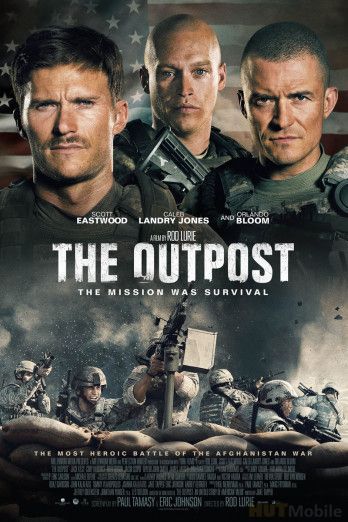
The Films of 2020: The Outpost (dir by Rod Lurie)


The Outpost, which is currently streaming on Netflix and which deserves far more attention than it’s been given, is a film that left me breathless.  Seriously, as the film came to its conclusion, I realized that I was so emotionally overwhelmed by what I had just seen that I actually had to stop for a few minutes and catch my breath.  Once I was breathing again, I started to cry.  I cried all the way through the end credits.  That’s the sign of a powerful film.

Based on a true story, The Outpost takes place in 2009.  PRT Kamdesh is an American military outpost in Northern Afghanistan.  The post is located in a valley.  The mountains, which rise high up into the sky, are not only beautiful but they also provide the perfect cover for the Taliban.  The outpost is attacked on a nearly daily basis.  At the start of the film, we’re told that one military strategist said that the base should have been named after George Custer because it was impossible to defend and that, should a big attack ever truly come, all 53 of the man on the base would essentially be sitting ducks.

The Outpost follows those 53 men as they go about their daily lives on the base.  Commanders die and are replaced.  The soldiers try to hold onto their sanity, even though they know that the “big attack” is inevitable.  Though more than a few of the men have families back home, they try not to think about them.  They can’t risk the distractions.  Even the act of adopting a dog is seen as being a potentially dangerous move.  The humor is dark, to the extent that the base’s theme song is “Everybody Dies.”  While dealing with daily attacks, the base’s commanders try to win the support of the local villagers.  One of the local elders asks if the Americans are the same invaders who have been in Afghanistan for the last 40 years.  “No,” the flummoxed commander tries to explain, “those were the Russians.”  It quickly becomes apparent that the soldiers and the villagers have at least one thing in common: no one is quite sure why the Americans are there or if they’ll ever able to leave.  Orders are sent down by faceless generals and the men of PRT Kamdesh wait for the attacks that they all know are coming,

When the attack does come, it leads to one of the most visceral battle scenes that I’ve ever seen.  There’s nothing glamorous about the way that The Outpost portrays war.  Instead, it’s a confusing, loud, and terrifying nightmare.  The Outpost establishes early on that anyone can die, an important lesson when you consider how many action movies have been made about heroes who are mythically impervious to even the slightest of injuries.

For roughly the final hour of the film, The Outpost puts us into the middle of the Battle of Kamdesh.  The film pays tribute to the soldiers who fought in the battle, showcasing their bravery and the quick thinking that kept the battle from being even more of a disaster than it was.  At the same time, it also reminds us that war is not fun and that the scars of combat are not just physical.  When a soldier breaks down into tears while trying to talk about the battle, the film treats his feelings with the respect that they deserve.  It’s been said that few people are as anti-war as the people who have actually experienced combat and The Outpost shows us why that is.

The Outpost is an important film.  It’s especially important now that we have a new president and the national media is probably going to go back to ignoring whatever happens in Afghanistan for at least the next four years.  For far too many people, it’s become the forgotten war, even though it’s still ongoing.  The Outpost is a film that reminds us that no war and no soldier should ever be forgotten.

I’ve been pretty critical of director Rod Lurie in the past but, with The Outpost, he’s given us one of the best films of 2020.