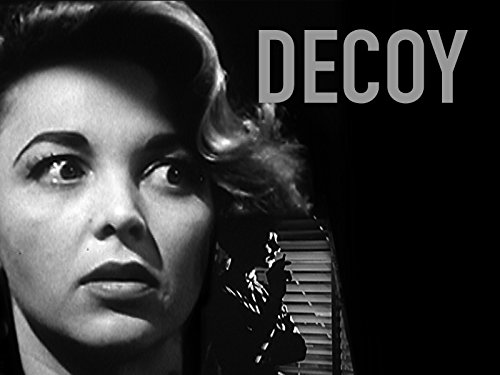
Retro Television Review: Decoy 1.13 “My Brother’s Killer”


Welcome to Retro Television Reviews, a feature where we review some of our favorite and least favorite shows of the past!  On Thursdays, I will be reviewing Decoy, which aired in Syndication in 1957 and 1958.  The show can be viewed on Tubi!

Episode 1.13 “My Brother’s Killer”

(Dir by Stuart Rosenberg, originally aired on January 6th, 1958)

Anne (Barbara Barrie) goes to the police because her boyfriend, Victor Bernard (Bernard Kates), has been acting strangely and refuses to let her into his apartment.  At first, the police point out that there’s nothing they can do about this but then Casey, in what can only be described as a miraculous feat of deductive reasoning, guesses that Victor Bernard’s last name might have originally been Bernardino and he might be the brother of wanted robber, Frank Bernardino.

A look at a picture of Victor reveals that he does look a lot like Frank.  However, as Casey discovers when she goes over to Victor’s apartment, Frank is dead.  But his partner, Hal Bishop (Sy Travers), is still alive.  Hal promptly takes Casey and Victor hostage and heads for the Canadian border.

Once you accept that Casey’s miracle hunch (and, seriously, it takes some effort), this is an intense episode.  I’m not really a fan of shows in which people are held hostage — the confined narrative tends to get tedious pretty quickly — but this episode featured a typically good performance from Beverly Garland and an absolutely terrifying one from Sy Travers.  It also features what seems like a surprising amount of violence for a 1950s television show.  Imagine gathering the family in front of the television in 1958 and being immediately confronted by Sy Travers as Hal Bishop pointing a gun at an innocent man’s head and pulling the trigger.  A lot of people get shot over the course of this episode, including Hal Bishop himself.  Casey survives but there are no smiles or celebrations.  There’s just the weary look of someone who has been confronted with the worst that humanity has to offer.

Late Night Retro Television Review: Pacific Blue 3.1 “Inside Straight”


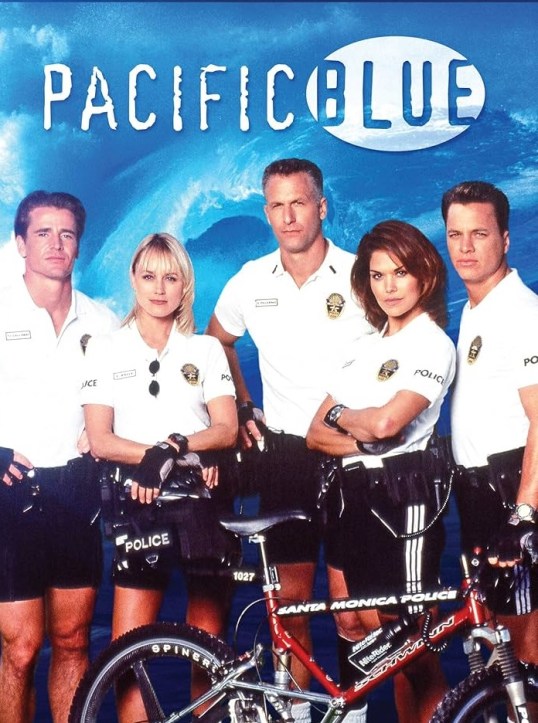
Welcome to Late Night Retro Television Reviews, a feature where we review some of our favorite and least favorite shows of the past! On Tuesdays, I will be reviewing Pacific Blue, a cop show that aired from 1996 to 2000 on the USA Network!  It’s currently streaming everywhere, though I’m watching it on Tubi.

Everyone’s book for another season of bicycles and law-breaking.

Episode 3.1 “Inside Straight”

(Dir by Michael Levine, originally aired on August 3rd, 19997)

One night, while on a date with Chris, TC spots a man holding a gun.  TC draws his own gun and yells at the man to drop his weapon.  The man turns around.  He fires so TC shoots and the man goes down.  It turns out that the man was an undercover narcotics detective with a spotless record.

TC is suspended and the bike patrol basically stops doing their job and instead proceed to harass the dead man’s wife and his partner until they discover that the wife and the partner were having an affair and, conveniently, the cop was actually shot by someone who happened to be standing behind TC.  It seems like simple forensic evidence (like the amount of bullets on the scene) should have proven that without the bike patrol even getting involved but I guess the cops in Malibu or wherever this show takes place are extremely incompetent.

Meanwhile, the poker game of mobster Joseph Tataglia (Joseph Campanella) gets held up,  The thief is a degenerate gambler who tries to frame TC’s older brother, Teddy (Andy Buckley — how, it’s David Wallace from The Office!).  The real thief is easily exposed and captured.  I’m not really sure what the point of this story was.  Tataglia last appeared during the first season but this episode acts as if he’s been a continual presence in the show for the past two seasons.  I imagine viewers were confused as to who he was or why he had so much pull with Palermo.

There’s a scene where TC is subjected to an intense interrogation from Internal Affairs and I have to admit that it made me laugh because TC and Palermo were wearing their dorky bicycle cop uniforms while being yelled at by someone in a suit.

Another scene features Victor and Cory telling Chris and TC that there’s a huge crowd waiting to see the movie that they want to see.  Victor says TC might have to flash his badge to get tickets.  Police arrogance is annoying in general but it’s even worse coming from people who ride bicycles.

It appears that nothing had changed with the start of a new season.

Guilty Pleasure No. 83: Meteor (dir by Ronald Neame)


1979’s Meteor is about a big rock that is tumbling through space.  Earth is directly in its path and, if it hits the planet, it could be an extinction-level event.  Unfortunately, little bits of the rock keep breaking off and crashing into Earth, destroying cities and fleeing extras.  Goodbye, Hong Kong.  Goodbye, Switzerland, which is destroyed via stock footage lifted from Avalanche.  Goodbye, New York, which blows up in such spectacular fashion that the scene was later re-used in The Day After.

It might seem like the planet is doomed.  The meteor is unstoppable.  Bruce Willis hasn’t become a star yet.  But fear not!  Some of the brightest faces of the 70s have been recruited to stop the meteor.  Natalie Wood, in one of her final films, plays a translator and gets covered in muddy river water.  Sean Connery wears a turtleneck and curses in that Scottish way of his.  Karl Malden wears a hat and tells people to calm down while he calls the President.  Brian Keith plays a Russian with all the grace and skill of a cat trying to rip open a bag of treats.  Martin Landau is the military official who doesn’t think that the scientist know what they’re talking about.  Henry Fonda is the president.  That’s a lot of balding men for one movie and it’s hard not to notice that both Malden and Keith often seem to be wearing a hat whenever they share a scene with Connery.  My personal theory is that the production, having spent all of their money on blowing up New York, couldn’t afford more than two toupees so everyone had to take turns wearing them.  (The few scenes where Malden is hatless while in Connery’s presence are often oddly filmed, with either Connery on Malden standing with their back to the camera, almost as if the scenes were actually done with a stand-in.)

We’re supposed to breathe a sigh of relief when we see that Henry Fonda is playing the President but I’ve seen Fail Safe and I remember him allowing the Russian to nuke New York City.  Interestingly enough, New York gets destroyed in this film too.  Why didn’t President Fonda care about New York City?  Of course, the scientists and the military folks are all located in a control center that’s located under the city.  Malden mentions that they’re right next to the Hudson River.  It doesn’t seem to occur to anyone that this is a bad idea but, then again, they also elected Henry Fonda president again.

My late friend and colleague Gary Loggins described Meteor as being a “crashing bore.”  I have to admit that this is one of the few times that I have ever disagreed with Gary.  Meteor is a tremendous amount of fun, as long as you’re watching it with a group of people and nobody takes it seriously.  (The first time I saw it was at one in the morning while I was in college.  Jeff and I watched it in the lounge of one of the dorms.  We may be the only two people to have romantic memories of Meteor.)  Meteor features a cast of champion scenery chewers.  Karl Malden, Sean Connery, Martin Landau, Brian Keith, none of them were exactly subtle actors and giving them an excuse to argue about how to deal with a meteor allows for a lot of very enjoyable overacting.  As well, the special effects are so cheap and obviously fake that it’s hard not to laugh out loud whenever the film cuts to that shot of the meteor rolling through space or the incredibly shiny American and Russian missiles slowly heading towards it.

Meteor’s a lot of fun, even if it is one of those movies where no one points out that our heroes inevitably seem to make every situation worse with their own stupidity.  It’s very much at the tail-end of the 70s disaster boom.  Watch it for the stars.  Watch it for the rock.  And watch it for the hairpieces.

Previous Guilty Pleasures

  1. Half-Baked
  2. Save The Last Dance
  3. Every Rose Has Its Thorns
  4. The Jeremy Kyle Show
  5. Invasion USA
  6. The Golden Child
  7. Final Destination 2
  8. Paparazzi
  9. The Principal
  10. The Substitute
  11. Terror In The Family
  12. Pandorum
  13. Lambada
  14. Fear
  15. Cocktail
  16. Keep Off The Grass
  17. Girls, Girls, Girls
  18. Class
  19. Tart
  20. King Kong vs. Godzilla
  21. Hawk the Slayer
  22. Battle Beyond the Stars
  23. Meridian
  24. Walk of Shame
  25. From Justin To Kelly
  26. Project Greenlight
  27. Sex Decoy: Love Stings
  28. Swimfan
  29. On the Line
  30. Wolfen
  31. Hail Caesar!
  32. It’s So Cold In The D
  33. In the Mix
  34. Healed By Grace
  35. Valley of the Dolls
  36. The Legend of Billie Jean
  37. Death Wish
  38. Shipping Wars
  39. Ghost Whisperer
  40. Parking Wars
  41. The Dead Are After Me
  42. Harper’s Island
  43. The Resurrection of Gavin Stone
  44. Paranormal State
  45. Utopia
  46. Bar Rescue
  47. The Powers of Matthew Star
  48. Spiker
  49. Heavenly Bodies
  50. Maid in Manhattan
  51. Rage and Honor
  52. Saved By The Bell 3. 21 “No Hope With Dope”
  53. Happy Gilmore
  54. Solarbabies
  55. The Dawn of Correction
  56. Once You Understand
  57. The Voyeurs 
  58. Robot Jox
  59. Teen Wolf
  60. The Running Man
  61. Double Dragon
  62. Backtrack
  63. Julie and Jack
  64. Karate Warrior
  65. Invaders From Mars
  66. Cloverfield
  67. Aerobicide 
  68. Blood Harvest
  69. Shocking Dark
  70. Face The Truth
  71. Submerged
  72. The Canyons
  73. Days of Thunder
  74. Van Helsing
  75. The Night Comes for Us
  76. Code of Silence
  77. Captain Ron
  78. Armageddon
  79. Kate’s Secret
  80. Point Break
  81. The Replacements
  82. The Shadow

Late Night Retro Television Review: Pacific Blue 1.9 “Moving Target”


Welcome to Late Night Retro Television Reviews, a feature where we review some of our favorite and least favorite shows of the past! On Tuesdays, I will be reviewing Pacific Blue, a cop show that aired from 1996 to 2000 on the USA Network!  It’s currently streaming everywhere, though I’m watching it on Tubi.

Eh, who cares?

Episode 1.9 “Moving Target”

(Dir by Mickey Dolenz. originally aired on April 27th, 1996)

When TC’s former lover, ex-model Rebecca Reynard (Jacqueline Collen), is nearly shot by a mysterious gunman, TC takes it upon himself to serve as her bodyguard.  Chris rolls her eyes because that’s how Chris reacts to every situation.  We’re nine episodes in and Chris still doesn’t really have a personality beyond being perpetually annoyed.  To the surprise of no one, Rebecca turns out to be hiding some deadly secrets of her own and TC comes to realize that his former and current lover is actually a stone cold sociopath.  This is one of those traumatic developments that will probably never be mentioned again.

(I thought TC had a girlfriend.  She was present in the pilot but has never been heard from since.)

Meanwhile, former boxer Victor returns to the ring to help Palermo win a bet against a smarmy lifeguard.  The boxing storyline — which features Victor facing off against the one opponent who beat him during his previous pugilist career — was actually interesting.  Too bad the show ended without actually revealing who won the big fight.  I think we were supposed to be satisfied with the fact that Victor found the confidence necessary to step back into the ring.  No, Pacific Blue.  You haven’t earned the right to end on a note of ambiguity.  Not yet.

This episode was directed by former Monkee Mickey Dolenz.  Unfortunately, not even a Monkee can make cops on bikes look cool.

SHANE (The TV Series) – Episode 6: Killer in the Valley (originally aired October 15th, 1966)


Episode 6 begins with Shane (David Carradine) and Marian Starett (Jill Ireland) riding their horses out on the far reaches of the ranch. While enjoying the beauty of the land, they come across a very sick man in a wagon. He seems to be running a high fever. As they check into the situation, they find out that the man’s wife is in the back of the wagon dead. Shane realizes that it’s more than likely that the couple has a deadly disease. The man dies shortly after, so they bury them and burn the wagons. 

After returning back to the house, Marian starts coming down with a fever of her own. Shane sends Tom Starett (Tom Tully) to Sam’s general store to get quidine, the medicine they will need to treat Marian. Unfortunately, Sam is all out of quidine, so they’ll have to wait until  Barney the medicine drummer (Joseph Campanella) gets to town the next day. Tom takes a room in Sam’s hotel to wait. When local cattle rancher, Rufe Ryker (Burt Freed), gets wind of the fact that the Starett’s are needing quidine, he starts asking questions and finds out that Marian is sick. He decides he needs the quidine for his own farm just in case there’s an outbreak in the valley. When Barney the medicine drummer finally arrives in town, he immediately smells money and decides to hold out to the highest bidder, which means the wealthy Ryker will get the supply, leaving the Starett’s and everyone else out in the cold. When Tom reports this to Shane, and with Marian getting worse by the second, Shane decides he’s got to do something to get the medicine Marian needs, even kill if he has to. To hell with Ryker or anyone else who tries to stop him! 

This episode of SHANE reminded me of two very specific times in my life when I actually witnessed my fellow man either taking advantage of a terrible situation or panicking in a way that shows complete disregard for their friends and neighbors. The first time was the Arkansas ice storm of 2000. Beginning on Christmas Day of 2000, this once in a century ice storm descended upon our state, resulting in mass electrical outages in our community. I lived in town so my electricity was restored after three long days. I remember hearing of houses “out in the county” that did without electricity for weeks. There was a local business who had an inventory of generators. They promptly doubled the price of their generators and took advantage of their neighbors who were in a critical situation. The second time was when I lived through the COVID epidemic and witnessed people taking every roll of toilet paper and every drop of water they could find from the local grocery stores. Unfortunately the combination of fear, panic, greed and selfishness can bring out the very worst sides of our human nature!

The bad reminders aside, I enjoyed Episode 6 of SHANE. It was nice to see Shane and Marian away from the ranch together just enjoying the afternoon and talking. It was unfortunate that they were interrupted by the plague. It’s also in this episode that we get to see Shane and Marian kiss for the first time. Of course she was delirious with the fever and thinking she was talking to her dead husband Joe, but it was still Shane that she kissed and that counts for something! It was also nice seeing Shane go to town, kick some ass, and reveal the medicine drummer for the greedy coward that he is. And just for good measure, Ryker decided to kick his ass too. I liked that. I’d even go as far as saying that Episode 6 is one of the best episodes of SHANE yet. I’m still enjoying the series and look forward to episode 7! 

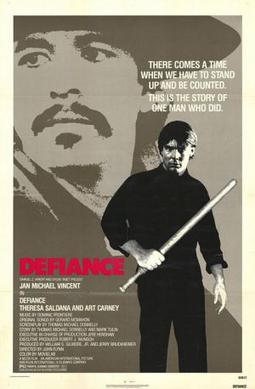
Defiance (1980, directed by John Flynn)


Serving out a six-month suspension, Merchant Seaman Tommy Campbell (Jan-Michael Vincent) rents an apartment on New York’s Lower East Side and passes the time painting and trying to learn Spanish in hope of getting assigned to a ship that is heading to Panama.

Tommy just wants to be left alone but he finds himself being drawn into the close-knit neighborhood.  He becomes friends with Carmine (Danny Aiello) and more than friends with his upstairs neighbor (Theresa Saldana).  He becomes a mentor to a street kid (Fernando Lopez) who lives with a punch-drunk boxer named called Whacko (Lenny Montana).  Abe (Art Carney), who owns the local bodega, agrees to let Tommy use his phone.

Tommy also finds himself drawing the attention of Angel Cruz (Rudy Ramos), head of the local street gang.  Tommy doesn’t want to get involved in any trouble.  He just wants to serve his suspension and sail to Panama.  But with Angel and his gang terrorizing the neighborhood and even robbing a church bingo game, Tommy and his friends finally stand up to the gang.

Defiance is more intelligent and realistic than many of the other urban vigilante movies that came out in the 70s and 80s.  Tommy never becomes a cold-blooded killer, like Charles Bronson did in the Death Wish films.  Instead, he spends most of the film trying to stay out of trouble and, when he does stand up for himself and the neighborhood, he does so realistically.  He fights the gang members but he doesn’t set out to the kill them.  About as deliberately destructive as he and Carmine get is that they destroy Angel’s car.  Rather than being a typical vigilante movie, Defiance is a portrait of a neighborhood where everyone takes care of everyone else.  Angel and his gang mistake the neighborhood’s kindness for weakness.  The neighborhood proves them wrong.

Defiance stars two actors who never quite got their due.  Theresa Saldana’s promising career was derailed when she was attacked and nearly killed by a deranged stalker in 1982.  Though she recovered and went on to do a lot of television, she never became the star that she should have.  Jan-Michael Vincent did become a star in the 70s and 80s but he later became better-known for his struggles with drugs and alcohol.  Both of them are very good in Defiance and leave you thinking about the careers that they could have had if things had just gone differently.

The TSL’s Grindhouse: Steele Justice (dir by Robert Boris)


“You don’t recruit him!  You unleash him!”

That’s what they say about John Steele, the man who Martin Kove plays in 1987’s Steele Justice.  John Steele served in Vietnam and he was one of the best and most fearless members of the special forces.  On the final day of the war, he was on the verge of arresting the corrupt General Kwan (Soon-Tek Oh) until Kwan suddenly announced that the war was over and the Americans were leaving.  Steele laughed, shrugged, and turned his back on Kwan and started to walk away.  Was Steele planning on just walking back to America?  Well, regardless, Kwan shot Steele and his friend in the back.  Fortunately, Steele survived.  Steele may be stupid but he’s strong.

Years later, both Steele and Kwan are now living in California.  Kwan is a prominent businessman who is also the secret leader of the Vietnamese mafia.  Naturally, his main henchman is played by Al Leong.  If Al Leong’s not working for you, are you even evil?  John Steele has not been quite as successful.  He was a cop until he got kicked off the force.  Then he got a job transporting horses across California.  Despite his cool guy name, John Steele doesn’t seem to be that good at anything that doesn’t involve killing people.

But then Kwan murders Steele’s best friend and former partner, Lee (Robert Kim).  In fact, Kawn not only murders Lee but he also kills Lee’s entire family.  The only survivor is Lee’s daughter, Cami (Jan Gan Boyd), a piano prodigy who is supposed to be 14 years old even though she’s being played by someone who is in her 20s.  Steele and Lee’s former boss, Bennett (Ronny Cox), gives Steele permission to track down the people responsible for Lee’s death.

John Steele sets out to destroy Kwan.  The film gives us a lot of reasons to be on Steele’s side but it’s hard not to notice that a lot of innocent people end up getting killed as a result of Steele’s vendetta.  Any time that Steele goes anywhere, Kwan’s people attack and a bunch of innocent bystanders get caught in the crossfire.  For example, Steele’s ex, Tracy (Sela Ward), agrees to look after Cami.  It turns out that Tracy is a music video director and, of course, she takes Cami to work with her.  The video shoot turns into a bloodbath, with even the members of the band getting gunned down.  And yet, not even Tracy seems to be particularly disturbed by that.  One might think that Tracy would at least sarcastically say something like, “Hey, John, thanks for getting the band killed before I got paid,” but no.  Tracy just kind of laughs it all off.  At no point does Steele or Bennett or really anyone seem to feel bad about all of the people who get killed as a result of the decision to unleash John Steele.  Those people had hopes and dreams too, you know.

I really like Martin Kove on Cobra Kai.  I love how his portrayal of the over-the-hill and burned-out John Kreese manages to be both intimidating and pathetic at the same time.  I’ve also seen a number of interviews with Kove, in which he’s discussed his career as an exploitation mainstay and he always comes across as being well-spoken and intelligent.  That said, Martin Kove appears to be totally lost in Steele Justice, unsure if he should be playing John Steele as a grim-faced avenger or as a quick-with-a-quip action hero.  Whenever Steele is angry, Kove looks like he’s on the verge of tears.  Whenever Steele makes a joke, Kove smiles like an overage frat boy who, while cleaning out his old storage unit, has just discovered his long lost copy of Bumfights.  It’s a confused performance but, to be honest, no one really comes out of Steele Justice looking good.  This is a film that features a lot of talented actors looking completely and totally clueless as to why they’re there.

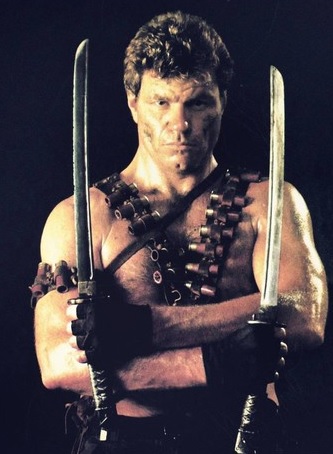
On the plus side, Steele Justice did give this world this totally intimidating shot of Martin Kove, preparing to be get and give justice.  Recruit him?  No, just unleash him!

Hit Lady (1974, directed by Tracy Keenan Wynn)


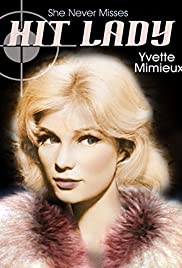
Beautiful blonde Angela de Vries (Yvette Mimieux) shows up at a Texas barbecue and starts to chat up over-the-hill but very wealthy cowboy Buddy McCormick (Keenan Wynn).  Buddy thinks that he has hit the jackpot and when Angela suggests that they go off together for some alone time, he doesn’t turn her down.  Unfortunately for Buddy, the only reason Angela was talking to him was so she could get him alone and kill him with no witnesses!

(Buddy is played by Keenan Wynn because his son, screenwriter Tracy Keenan Wynn, directed this made-for-TV movie.  Angela is played by Yvette Mimieux because she got tired of only being cast in bland roles so she wrote a script with a juicy lead role for herself.)

Angela is a contract killer but she wants to get out of the business so that she can settle down with her seemingly oblivious boyfriend, a photographer named Doug (Dack Rambo).  Angela’s boss, Roarke (Clu Gulager), insists that Angela carry out one last hit.  He wants her to take down labor leader Jeffrey Baine (Joseph Campanella).  Angela really needs the money so she eventually accepts the job.  Roarke wants Baine’s death to look like an accident so that means Angela is going to have to learn everything that she can about Baine and his life.  When she learns that Baine loves Mozart, she decides to arrange an “accidental” meeting with him at a concert.  Is Angela the only contract killer in Los Angeles?  Couldn’t Roarke have found someone willing to do the job without so many preconditions?

Angela does meet Baine and, of course, the two of them start to fall in love.  Is Angela willing to both betray her boss and her boyfriend or will she carry out the hit?

Hit Lady is very much a product of the 70s, with one scene actually taking place at a disco.  Mimieux gives a good performance in a part that she wrote for herself and I’m sure many viewers will appreciate the lengthy amount of time she spends wearing just a bikini.  Mimieux gets to do most of the action movie things that, at the time, only men were usually allowed to do and she looks both good and convincing doing them.  Unfortunately, the love story with Jeffrey Baine does not work because the rough-hewn Campanella is not convincing as a Mozart-loving romantic lead and he and Mimieux never seem as if they really have any deep feelings for each other.  It’s easier to understand why Campanella would be attracted to Mimieux but than why she would be attracted to him.  That storyline probably would have worked better if Campanella had switched roles with Clu Gulager.  Hit Lady ends with an obvious twist but fans of 70s cheese and Yvette Mimieux should enjoy it.

An Offer You Can’t Refuse #18: The St. Valentine’s Day Massacre (dir by Roger Corman)


On February 14th, 1929, seven men were murdered in a garage in Chicago, Illinois.  Five of the seven men were known to be associates of gangster George “Bugs” Moran.  The other two men were considered to be innocent bystanders, a mechanic and a dry cleaner who just happened to enjoy hanging out with gangsters.  Though no one was ever convicted of the crime, it was well-known that the murders were carried out on the orders of Al Capone.

In many ways, the St. Valentine’s Day Massacre was a turning point in America’s relationship with organized crime.  Before the massacre, Capone had become a bit of a folk hero.  He knew how to talk to the press and he was viewed as merely breaking a law (in this case, prohibition) that most people opposed in the first place.  However, after the murders, public opinion soured on Capone.

Some of it was the brutality of the crime.  It’s been said that over five hundred bullets were fired in that garage, all to kill seven defenseless men who were lined up against a wall.  Grisly pictures of the victims were released to the press.  Perhaps if the seven men had been carrying weapons and had been involved in a shootout with their murderers, the public’s reaction would have been different.  But this was a cold-blooded execution.

Personally, I think the fact that the killers disguised themselves as cops also played a role in the public’s outrage.  It was a very calculated move on the part of the killers and it highlighted just how much planning went into the St. Valentine’s Day Massacre.  As well, it undoubtedly made people paranoid.  If a bunch of killer could dress up like cops, who knew who else they could dress up as?

Finally, I think that Capone’s biggest mistake was carrying out the crime on Valentine’s Day.  You don’t murder people on a holiday.  Anyone should know that.  If Capone had waited until February 20th, he probably could have gotten away with it.

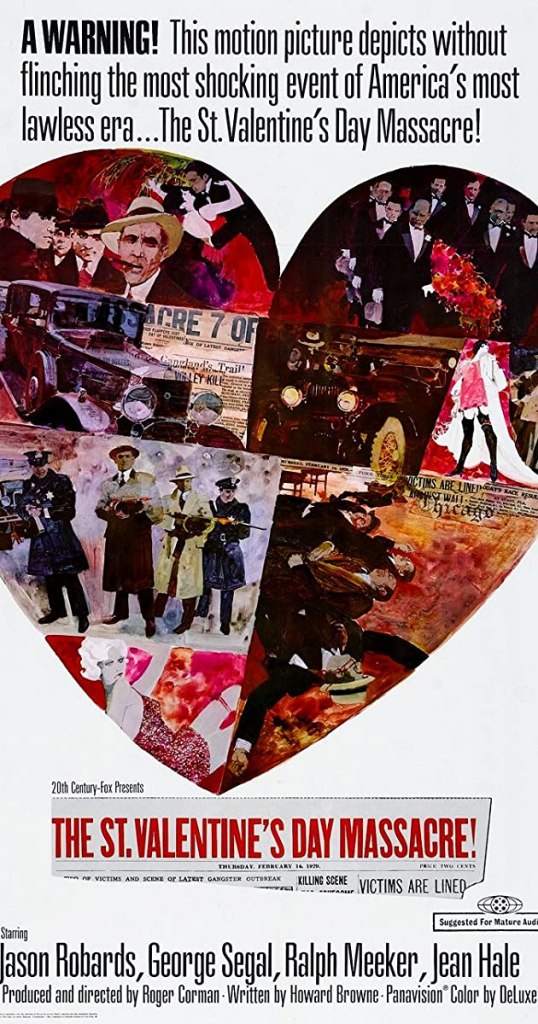
The 1967 film, The St. Valentine’s Day Massacre, details the rivalry between Capone and Moran, starting with them fighting for control over the Chicago rackets and ending with the title event.  Moran is played by Ralph Meeker while Jason Robards plays Capone.

Now I know what you’re probably thinking.  Perennial WASP Jason Robards as Al Capone?  That may sound like odd casting and, let’s just be honest here, it is.  However, it actually kind of works.  Robards may not be convincingly Italian but he is convincingly ruthless.  Add to that, one of the major subplots of the St. Valentine’s Day Massacre is that, even as the head of the Chicago Outfit, Capone still feels like an outsider in the world of organized crime because, while he is Italian, he isn’t Sicilian.  Capone feels as if Lucky Luciano and all of the major New York crime bosses look down on him and one reason why he’s so ruthless about taking over Chicago is that wants to show Luciano that he can be just as effective a crime lord as any Sicilian.  Capone feeling out of place in the Mafia is reflected by Robards initially seeming to be out of place in a gangster film.  By the end of the movie, of course, Capone has proven himself and so has Jason Robards.

Robards isn’t the only familiar face to be found in The St. Valentine’s Day Massacre.  Though this film was released by 20th Century Fox, it was directed by Roger Corman and Corman fills the production with members of his stock company.  Dick Miller, Jonathan Haze, and Jack Nicholson all have small roles as gunmen.  Bruce Dern plays the unlucky mechanic who enjoys hanging out with gangsters.  Buck Taylor, Leo Gordon, and Joe Turkel all have small roles.  John Agar plays Dion O’Bannon and is gunned down in his flower store.  Though not members of the Corman stock company, George Segal and David Canary plays brothers who work for Moran.  There’s a lot of characters wandering through this film but Corman makes sure that everyone gets a chance to make an impression.

It’s a good gangster film.  Though he was working with a larger budget than usual, Corman still brought his exploitation film aesthetic to the material and the end result is a violent, melodramatic gangster film that looks really impressive.  The film’s recreation of 1920s Chicago is a visual delight and looking at the well-dressed and stylish gangsters walking and driving down the vibrant city streets, you can understand why organized crime would have such a draw for some people.

The St. Valentine’s Day Massacre is a classic gangster film and a classic Corman film.  It’s an offer you can’t refuse.

Previous Offers You Can’t (or Can) Refuse:

  1. The Public Enemy
  2. Scarface
  3. The Purple Gang
  4. The Gang That Could’t Shoot Straight
  5. The Happening
  6. King of the Roaring Twenties: The Story of Arnold Rothstein 
  7. The Roaring Twenties
  8. Force of Evil
  9. Rob the Mob
  10. Gambling House
  11. Race Street
  12. Racket Girls
  13. Hoffa
  14. Contraband
  15. Bugsy Malone
  16. Love Me or Leave Me
  17. Murder, Inc.


TV Review: Night Gallery 2.1 “The Boy Who Predicted Earthquakes/Miss Lovecraft Sent Me/The Hand of Borgus Weems/Phantom of What Opera?”


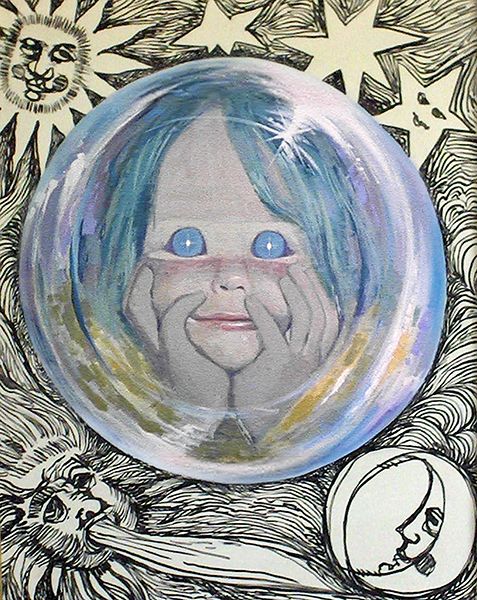
The second season of Night Gallery premiered on September 15th, 1971.  Once again, Rod Serling led viewers through a darkened museum, inviting them to look upon macabre paintings and imagine the story behind image.

The first episode had four — that’s right, four! — different stories!  Apparently, the show’s producers demanded that, for the 2nd season, each episode feature shorter stories along with some light-heated segments.  From what I’ve read, Rod Serling was not particularly happy with the directive and it’s perhaps significant that, after writing every story featured in Night Gallery‘s first season, he only wrote one of the stories featured in the second season premiere.
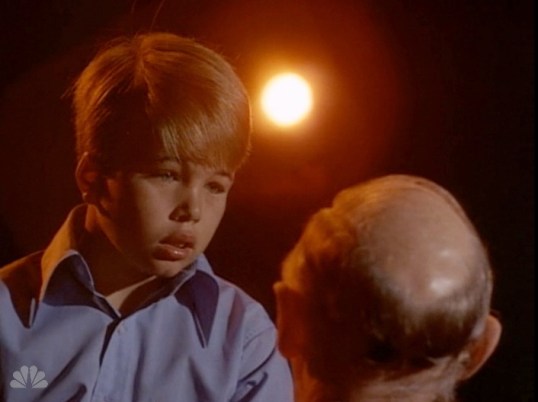
The Boy Who Predicted Earthquakes (dir by John Badham, written by Rod Serling)

Herbie (played by 12 year-old Clint Howard, younger brother of Ron) is a little boy with a very special gift.  He can see the future.  He seems like a normal child, the type who rambles about random subjects except that, at random, he’ll suddenly stop and ominously predict the future.  After Herbie correctly predicts both the rescue of a missing girl and an earthquake, Herbie is given his own TV show.  For a year, Herbie makes predictions, all of which come true.  Then, suddenly, Herbie refuses to shares his latest prediction and says that he doesn’t want to do the show anymore.  What has Herbie seen and is it a good thing or a bad thing?

The Boy Who Predicted Earthquakes gets the second season of Night Gallery off to a good start.  Centered by a natural performance from Clint Howard, The Boy Who Predicted Earthquakes is an intelligently written and thought-provoking story.  Not only does it examine the burden of being able to see the future but it’s also a provocative look at how society exploits the gifted.  With the exception of Herbie’s grandfather (William Hansen), the people around Herbie are less concerned with what he predicts than that people keep watching.  The segment ends on an appropriately dark note, one that will keep the viewer thinking.

Miss Lovecraft Sent Me (dir by Gene Kearney, written by Jack Laird)

A gum-chewing babysitter (Sue Lyon) show up for her latest job.  It’s at a castle!  And the owner of the castle (played by Joseph Campanella) has gray skin, is wearing a cape, and has a Transylvanian accent!  What could it all mean?

This is a short comedic segment.  Apparently, the producer of Night Gallery, Jack Laird, had the idea to liven things up with sketches like this one.  Serling was apparently not a fan of the idea but Miss Lovecraft Sent Me isn’t that bad.  It’s silly and insubstantial because Joseph Campanella and Sue Lyon handled their roles well.  It’s impossible not to laugh when the babysitter reads aloud the names of the books that Campanella has sitting on his bookshelf.
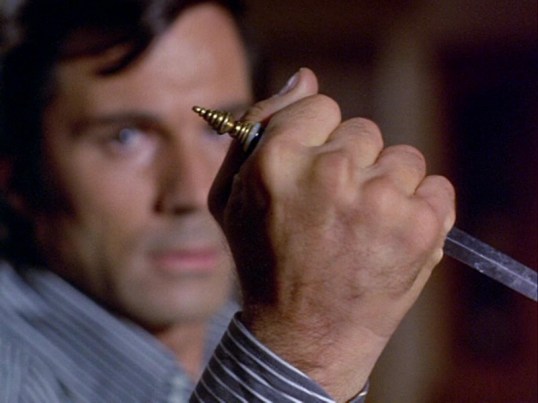
The Hand of Borgus Weems (dir by John M. Lucas, written by Alvin Sapinsley)

Peter Lacland (George Maharis) sits in a doctor’s office and asks Dr. Ravadon (Ray Milland) to remoe his right hand.  Peter explains that his right hand has a mind of its own and that it keeps trying to kill everyone who Peter comes into contact with.  Peter explains that his hand has been possessed!

There’s a surprisingly large number of stories out there about possessed hands.  The Hand of Borgus Weems doesn’t necessarily bring anything new to the genre and it gets a bit bogged down with its flashback structure but it’s still an enjoyably creepy little segment, featuring good performances from George Maharis and Ray Milland.  Possessed hands are also creepy, no matter what.  Like The Boy Who Predicted Earthquakes, it also has an effective ending, which is quite a contrast to the often insubstantial conclusions of Night Gallery’s first season.
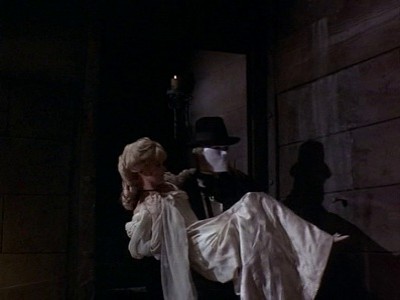
Phantom Of What Opera?  (written and dir by Gene Kearney)

This is a short, 4-minute comedic story — a skit really — featuring Leslie Nielsen as the Phantom of the Opera and Mary Ann Beck as Christine. This version starts out like a typical Phantom segment, with the Phantom kidnapping Christine, taking her down to the dungeon, and telling her never to remove his mask.  Christine, of course, removes his mask while he’s playing the organ just for him to then discover that she’s also wearing a mask.  It all leads to love and a happy ending!  It’s kind of a sweet segment, actually.
So the 2nd season of Night Gallery got off to a pretty good start!  Would future episodes continue the trend?  We’ll find out soon as I continue to watch Night Gallery.

Previous Night Gallery Reviews:

  1. The Pilot
  2. The Dead Man/The Housekeeper
  3. Room With A View/The Little Black Bag/The Nature of the Enemy
  4. The House/Certain Shadows on the Wall
  5. Make Me Laugh/Clean Kills And Other Trophies
  6. Pamela’s Voice/Lone Survivor/The Doll
  7. They’re Tearing Down Tim Riley’s Bar/The Last Laurel