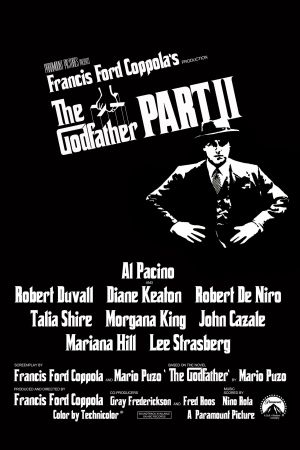
Well, the clock has now struck midnight on the West Coast and that officially means that it is 2026 in the United States! What better way to start things off than by sharing a scene that I love from one of the greatest and most important films of all time, 1974’s The Godfather Part II?
The scene below takes place on New Year’s Eve. The scene starts in 1958 and it ends in 1959. Michael Corleone (Al Pacino) and his brother Fredo (John Cazale) are in Havana at the invitation of Hyman Roth (Lee Strasberg). Roth know that Cuba could be a gold mine for the American mob but Michael, from the start, realizes that the country’s corrupt government is on the verge of collapse and that it’s about to be replaced by something even worse. (Admittedly, that’s my opinion. Director Francis Ford Coppola had a much higher opinion of Castro and the communists than I did.) Tragically, it’s also in Havana that Michael realizes that Fredo betrayed him to his enemies. On December 31st, 1958, as the new year is celebrated in Havana, the rebels ride into the city. While the President of Cuba prepares to announce that he will be fleeing the country, Michael confronts his brother and tells him that he knows the truth. Later, as they both attempt to flee the country, Michael and Fredo see each other on the streets. Fredo runs from Michael, refusing his offer to help. Though Fredo would eventually return to the family, the film’s ending revealed Fredo’s first instinct was the correct one.
Here’s a scene that I love, featuring great work from both Al Pacino and the brilliant John Cazale:
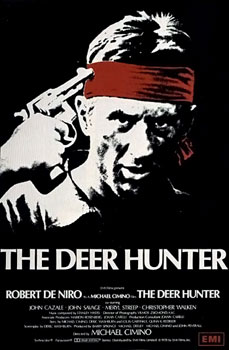
The Deer Hunter, which won the 1978 Oscar for Best Picture Of The Year, opens in a Pennsylvania steel mill.
Mike (Robert De Niro), Steve (John Savage), Nick (Chistopher Walken), Stan (John Cazale), and Axel (Chuck Aspegren, a real-life steel worker who was cast in this film after De Niro met him while doing research for his role) leave work and head straight to the local bar, where they are greeted by the bartender, John (George Dzundza). It’s obvious that these men have been friends for their entire lives. They’re like family. Everyone gives Stan a hard time but deep down, they love him. Axel is the prankster who keeps everyone in a good mood. Nick is the sensitive one who settles disputes. Steve is perhaps the most innocent, henpecked by his mother (Shirley Stoler) and engaged to marry the pregnant Angela (Rutanya Alda), even though Steve knows that he’s not actually the father. And Mike is their leader, a charismatic if sometimes overbearing father figure who lives his life by his own code of honor. The men are held together by their traditions. They hunt nearly every weekend. Mike says that it’s important to only use one shot to kill a deer. Nick, at one point, confesses that he doesn’t really understand why that’s important to Mike.
Steve and Angela get married at a raucous ceremony that is attended by the entire population of their small town. The community is proud that Nick, Steve, and Mike will all soon be shipping out to Vietnam. Nick asks his girlfriend, Linda (Meryl Streep), to marry him when he “gets back.” At the reception, Mike gets into a fight with a recently returned soldier who refuses to speak about his experiences overseas. Mike ends up running naked down a street while Nick chases him.
The Deer Hunter is a three-hour film, with the entirety of the first hour taken up with introducing us to the men and the tight-knit community that produced them. At times, that first hour can seem almost plotless. As much time is spent with those who aren’t going to Vietnam as with those who are. But, as the film progresses, we start to understand why the film’s director, Michael Cimino, spent so much time immersing the viewer in that community of steel workers. To understand who Nick, Mike, and Steve are going to become, it’s important to know where they came from. Only by spending time with that community can we understand what it’s like to lose the security of knowing where you belong.
If the first hour of the film plays out in an almost cinema verité manner, the next two hours feel like an increasingly surreal nightmare. (Indeed, there was a part of me that suspected that everything that happened after the wedding was just Michael’s drunken dream as he lay passed out in the middle of the street.) The film abruptly cuts from the beautiful mountains of Pennsylvania to the violent horror of Vietnam. A Viet Cong soldier blows up a group of hiding women and children. Michael appears out of nowhere to set the man on fire with a flame thrower. An army helicopter lands and, in a coincidence that strains credibility, Nick and Steve just happen to get out. Somehow, the three friends randomly meet each other again in Vietnam. Unfortunately, they are soon captured by the VC.
They are held prisoner in submerged bamboo cages. Occasionally, they are released and forced to play Russian Roulette. Mike once again becomes the leader, telling Steve and Nick to stay strong. Eventually, the three men do manage to escape but Steve loses his leg in the process and a traumatized Nick disappears in Saigon. Only Mike returns home.
The community seems to have changed in Mike’s absence. The once boisterous town is now quiet and cold. The banner reading “Welcome Home, Mike” almost seems to be mocking the fact that Mike no longer feels at home in his old world. Stan, Axel, and John try to pretend like nothing has changed. Mike falls in love with Linda while continuing to feel guilty for having abandoned Nick in Saigon. Steve, meanwhile, struggles to come to terms with being in a wheelchair and Nick is still playing Russian Roulette in seedy nightclubs. Crowds love to watch the blank-faced Nick risk his life.
Eventually, Mike realizes that Nick is still alive. Somehow, Mike ends up back in Saigon, just as the government is falling. Oddly, we don’t learn how Mike was able to return to Saigon. He’s just suddenly there. It’s the type of dream logic that dominates The Deer Hunter but somehow, it works. Mike searches for Nick but will he be able to save his friend?
The Deer Hunter was one of the first major films to take place in Vietnam. Among the pictures that The Deer Hunter defeated for Bet Picture was Coming Home, which was also about Vietnam but which took a far more conventional approach to its story than The Deer Hunter. Indeed, while Coming Home is rather predictable in its anti-war posture, The DeerHunter largely ignores the politics of Vietnam. Mike, Nick, and Steve are all traumatized by what they see in Vietnam. Mike is destroyed emotionally, Steve is destroyed physically, and Nick is destroyed mentally. At the same time, the VC are portrayed as being so cruel and sadistic that it’s hard not to feel that the film is suggesting that, even if we did ultimately lose the war, the Americans were on the correct side and trying to do the right thing. (Many critics of The Deer Hunter have pointed out that there are no records of American POWs being forced to play Russian Roulette. That’s true. There are however records of American POWs being forced to undergo savage torture that was just as potentially life-threatening. Regardless of what one thinks of America’s involvement in Vietnam, there’s no need to idealize the VC.) Released just a few years after the Fall of Saigon, The Deer Hunter was a controversial film and winner. (Of course, in retrospect, the film is actually quite brilliant in the way it appeals to both anti-war and pro-war viewers without actually taking a firm position itself.)
In the end, though, The Deer Hunter isn’t really about the reality of the war or the politics behind it. Instead, it’s a film about discovering that the world is far more complicated that you originally believed it to be. De Niro is a bit too old to be playing such a naive character but still, he does a good job of portraying Mike’s newfound sense of alienation from his former home. In Vietnam, everything he believed in was challenged and he returns home unsure of where he stands. While John, Axel, and Stan can continue to hunt as if nothing happened, Mike finds that he can no longer buy into his own philosophical BS about the importance of only using one shot. Everything that he once believed no longer seems important.
It’s a good film and a worthy winner, even if it does sometimes feel more like a happy accident than an actual cohesive work of art. The plot is often implausible but then again, the film takes place in a world gone mad so even the plot holes feel appropriate to the story being told. Christopher Walken won an Oscar for his haunting performance as Nick and John Savage should have been nominated alongside of him. This was Meryl Streep’s first major role and she gives a surprisingly naturalistic performance. During filming, Streep was living with John Cazale and she largely did the film to be near him. Cazale was dying of lung cancer and he is noticeably frail in this film. (I cringed whenever Mike hit Stan because Cazale was obviously not well in those scenes.) Cazale, one of the great character actors of the 70s, died shortly after filming wrapped. Cazale only appeared in five films and all of them were nominated for Best Picture. Three of them — The first two Godfathers and The Deer Hunter — won.
The Deer Hunter is a long, exhausting, overwhelming, and ultimately very moving film. Whatever flaws it may have, it earns its emotional finale. Though one can argue that some of the best films of 1978 were not even nominated (Days of Heaven comes to mind, as do more populist-minded films like Superman and Animal House), The Deer Hunter deserved its Oscar.
The great character actor Lance Henriksen is 84 years old today!
Ever since he made his film debut in 1970, the legendary Henriksen has played a collection of villains, bikers, police officers, soldiers, and even the occasional android. One of his earliest appearance was in 1975’s Dog Day Afternoon. His role is small but he definitely makes an impression. His faux friendly suggestions that Sal point his gun upwards is the line that sets off the film’s haunting ending. For viewers today, of course, we know that Sal and Sonny are screwed as soon as Lance Henriksen shows up outside of the bank.
In today’s scene that I love, Lance Henriksen does what only a great character actor can do. In less than a minute, he created a truly unforgettable character.
Today, the Shattered Lens wishes a happy birthday to the great Al Pacino.
Today’s scene that I love comes from 1972’s The Godfather, in which Al Pacino plays Michael Corleone. In this scene, Michael, having just taken over the Corleone family, pays a visit to Vegas. He meets his brother Fredo (John Cazale), who has certainly changed from being the meek person that he was in New York. He meets the singer Johnny Fontana (Al Martino), who owes a favor to the Corleones. And he meets Moe Greene (Alex Rocco), who soon discovers that the Corleones cannot be intimidated. Most importantly, Michael proves that he is now in charge of the family. At the end of the scene, Michael gives Fredo an important warning and sets up the tragic ending of the The Godfather Part II.
Ah, the 70s. The decade started with the collapse of the studio system and the rise of the so-called movie brats. For the first half of the decade, Hollywood was producing the type of challenging films on which they would never again be willing to take the risk. The 70s were indeed a second cinematic golden age, full of anti-heroes and dark endings. Then, in 1977, Star Wars changed all of that and ushered in the era of the blockbuster. The 1970s gave the world disco, The Godfather, and some of the best Oscar winners ever. It also gave us more than a few snubs.
1971: Dirty Harry Is Totally Ignored
Dirty Harry may be one of the most influential films ever made but the Academy totally snubbed it. My guess is that, with The French Connection coming out that same year, the Academy only had room for one morally amibiguous cop film in its heart. Still, Dirty Harry has certainly held up better than the nominated Nicholas and Alexandra. Both Clint Eastwood and Andrew Robinson gave performances that were award-worthy as well. Say what you will about Eastwood’s range, I defy anyone not to smile at the way Harry snarls when he discovers that the man he’s talking to teaches a constitutional law course at Berkley.
1971: Gimme Shelter Is Not Nominated For Best Documentary Feature
Considering that Woodstock won the Documentary Oscar the previous year, it only seems appropriate the Gimme Shelter should have won the following year. In the end, the Academy decided to celebrate the best of the 60s while snubbing the worst of it.
1972: Burt Reynolds Is Not Nominated For Deliverance
If you’ve ever seen Deliverance, you know how important a character Lewis Medlock (played by Burt Reynolds) was. Not only was he the one who persuaded everyone to spend the weekend risking their lives on a canoeing trip but he also set the standard for “manlinness” that the rest of his friends tried to live up to. When Lewis ends up getting a compound fracture and is forced to spend the rest of the film deliriously lying in a canoe, it’s a reminder that nature and fate don’t care how confident or outspoken you are. Reynolds was perfectly cast. 1972 was a strong year with a lot of worthwhile nominations and, to be honest, there’s really not a bad or an unworthy performance to be found among the acting nominees. Still, it’s hard not to feel that the Academy should have found some room for Burt Reynolds.
1974: John Huston Is Not Nominated For Chinatown
In the role of Chinatown‘s Noah Cross, John Huston gave one of the great villainous performances. Cross represented pure avarice and moral decay, a man who committed terrible crimes but who, the film suggested, was also responsible for creating not only modern Los Angeles but also providing a home for Hollywood. Admittedly, there were a lot of good performances to choose from and I certainly can’t complain that the Academy awarded the Oscar for Best Supporting Actor to Robert De Niro, who deserved it. Still, in retrospect, John Huston’s evil turn was at least as strong as Fred Astaire’s likable (and nominated) turn in The Towering Inferno.
1974 and 1975: John Cazale Is Not Nominated For Best Supporting Actor
John Cazale had a brief but legendary career. A noted stage actor, Cazale made his film debut in 1972 with The Godfather. He played Fredo, the Corleone son who couldn’t get any respect. He final film, released after his early death from cancer, was 1978’s The Deer Hunter. Cazale appeared in a total of five films, every one of which was nominated for Best Picture. That this talented actor was never nominated for an Oscar just doesn’t seem right. But for which film should he have been nominated?
Godfather Part II received three nominations for Best Supporting Actor: Robert De Niro, Lee Strasberg, and Michael V. Gazzo. Personally, I would probably replace Gazzo with Cazale. Cazale’s performance as Fredo was one of the strongest parts of Godfather Part II. Who can forget Fredo’s legendary meltdown about always being overlooked? I would also say that Cazale deserved a nomination for his performance in Dog Day Afternoon, in which he played Sal and provided the film with some of its saddest and funniest moments. Neither Fredo nor Sal survive their films and, in both cases, it’s impossible not to feel that they deserved better than the world gave them.
1975: Steven Spielberg Is Not Nominated For Jaws
Seriously, what the Heck? Jaws totally reinvented the movies. It received a deserved nomination for Best Picture but the true star of the film, Steven Spielberg, was somehow not nominated.
1976: Martin Scorsese is Not Nominates For Taxi Driver
Seriously, what the Heck? Taxi Driver totally reinvented the movies. It received a deserved nomination for Best Picture but the true star of the film, Martin Scorsese, was somehow not nominated.
1977: Harrison Ford Is Not Nominates For Star Wars
Harrison Ford, despite having had the type of career for which most actors would sacrifice their soul, has never had much success with the Oscars. He’s been nominated exactly once, for Witness. That he’s never won an Oscar just feels wrong. The fact that he wasn’t even nominated for playing either Han Solo or Indiana Jones feels even more wrong. In the role of Solo, Ford bring some much needed cynicism to Star Wars. His decision to return and help the Rebels destroy the Death Star is one of the best moments in the film.
1978: National Lampoon’s Animal House Is Totally Ignored
This film deserved a nomination just for the scene in which John Belushi destroyed that annoying folk singer’s guitar. Seriously, though, this is another film that, more or less, defined an era. I’m not saying it deserved to win but it at least deserved a few nominations.
1979: Dawn of the Dead Is Not Nominated For Best Picture
Considering the Academy’s general resistance to honoring horror, it’s not really a shock that Dawn of the Dead was not nominated for Best Picture but still, it would have been nice if it had happened.
Agree? Disagree? Do you have an Oscar snub that you think is even worse than the 10 listed here? Let us know in the comments!
Well, the clock has now struck midnight on the West Coast and that officially means that it is 2022 in the United States! It’s a new year, which means that we have another chance to get things right or, at the very least, not repeat the mistakes of the previous year.
I’m looking forward to 2022 for a number of reasons. We’ve got a lot planned here at Through the Shattered Lens. So, what better way to start things off than by sharing a scene that I love from one of the greatest and most important films of all time, 1974’s The Godfather Part II?
The scene below takes place on New Year’s Eve. The scene starts in 1958 and it ends in 1959. Michael Corleone (Al Pacino) and his brother Fredo (John Cazale) are in Havana at the invitation of Hyman Roth (Lee Strasberg). Roth know that Cuba could be a gold mine for the American mob but Michael, from the start, realizes that the country’s corrupt government is on the verge of collapse. Tragically, it’s also in Havana that Michael realizes that Fredo betrayed him to his enemies.
On December 31st, 1958, as the corrupt and wealthy celebrate a new year in Havana, the communist rebels ride into the city. While the President of Cuba prepares to announce that he will be fleeing the country, Michael confronts his brother and tells him that he knows the truth. Later, as they both attempt to flee the country, Michael and Fredo see each other on the streets. Fredo runs from Michael, refusing his offer to help. Though Fredo would eventually return to the family, the film’s ending revealed Fredo’s first instinct was the correct one.
Much of the scene below is based on fact. The Cuban government did fall on New Year’s Eve and Fidel Castro and his rebels did triumphantly ride into Havana on January 1st. Before Castro came to power, the Mafia did have a major stake in Cuba and reportedly quite a few mobsters were in Havana when Castro took over. Meyer Lansky (on whom the film’s Hyman Roth was based) was one of the many mob officials who were rumored to have caught the last flight off of the island. Seeking to be the only mob boss in his country, Castro did force the Mafia out of Cuba, which led to an alliance between organized crime and the CIA to try to overthrow Castro. At the time that The Godfather Part II was released, the details of the CIA and the Mafia’s attempts to assassinate Castro were just starting to be revealed to the public. As powerful as the scene below is today, it probably resonated even more with audiences in 1974. In 1974, this was all still recent history and it undoubtedly brought to mind the still-fresh national trauma of the assassination of the Kennedy brothers.
Beyond the historical significance of the scene below, it also features brilliant work from two actors who will forever be linked together, Al Pacino and the late John Cazale. Cazale and Pacino first met while they were both working off-Broadway, years before Mario Puzo even started writing the novel that would become The Godfather. They were close friends and, along with co-starring in The Godfather films, they also played bank-robbing partners in Dog Day Afternoon. Tragically, John Cazale died of cancer at the age of 42. He only appeared in five films, every one of which was nominated for Best Picture and one could argue that the Academy’s failure to nominate Cazale for either Dog Day Afternoon or Godfather Part II is one of the most unforgivable oversights in Oscar history.
That said, it’s a new year. Save the arguing for later. Here’s a scene that I love:
Along with being one of the greatest actors who ever lived, the late Peter O’Toole had another, far more dubious achievement. He holds the record for being nominated the most times for Best Actor without actually winning. Over the course of his long career, Peter O’Toole was nominated 8 times without winning.
But, at least O’Toole was nominated!
Below are 16 excellent actors who have NEVER been nominated for an Oscar. 10 of these actors still have a chance to get that first nomination. For the rest, the opportunity has sadly past.
Kevin Bacon
Is there anyone out there who doesn’t like Kevin Bacon? Amazingly, despite several decades of good performances in good films, Kevin Bacon has yet to be nominated. That said, he seems destined to be nominated some day. If nothing else, he deserved some sort of award for being the most successful cast member of the original Friday the 13th. (As well, 40 years after the fact, his cry of “All is well!” from Animal Househas become one of the most popular memes around.)
2. Brendan Gleeson
This brilliant Irish actor deserved a nomination (and probably the win) for his brave performance in Calvary. But, even if you ignore Calvary, his filmography is full of award-worthy performances. From The General to Gangs of New York to 28 Days Later to In Bruges to The Guard, Gleeson is overdue for some recognition.
3. John Goodman
John Goodman deserved to be nominated this year, for his performance in 10 Cloverfield Lane. He brought warmth to both Argo and Inside Llewyn Davis. And he was absolutely terrifying in Barton Fink. John Goodman is one of the most underrated actors working today.
4. Malcolm McDowell
It’s obviously been a while since Malcolm McDowell had a truly great role. But who could forget his amazing performance in A Clockwork Orange? For that matter, I liked his sweetly gentle performance in Time After Time. Someone give this man the great role that he deserves!
5. Ewan McGregor
Ewan McGregor is an actor who is oddly taken for granted. His performance in Trainspotting remains his best known work. But, really, he’s been consistently giving wonderful performances for twenty years now. Sometimes — as in the case of the Star Wars prequels — the films have not been worthy of his talent but McGregor has always been an engaging and compelling screen presence. When it comes to playing someone who is falling in love, few actors are as convincing as Ewan McGregor.
6) Franco Nero
Franco! If for nothing else, he deserved a nomination for playing not only Lancelot in Camelot and not only the originalDjango but also for playing Intergalactic Space Jesus in The Visitor. I also loved his work in a little-known Italian thriller called Hitchhike. Nero is still active — look for him in John Wick 2 — and hopefully, he’ll get at least one more truly great role in his lifetime.
7) Sam Rockwell
Let’s just get this out of the way. In a perfect world, Sam Rockwell would already have an Oscar. He would have won for his performance in 2009’s Moon. He also would have received nominations for The Way, Way Back and Seven Psychopaths. Sadly, Sam’s still waiting for his first nomination. Again, the problem may be that he’s such a natural that he just makes it look easy.
8) Andy Serkis
Andy Serkis has never been nominated, despite giving some of the best performances of this century. He should have been nominated for Lord of the Rings: The Return of the King. He should have won for Rise of the Planet of the Apes.
9) Harry Dean Stanton
Harry Dean Stanton has been around forever and he’ll probably outlive everyone else on the planet. He often seems to be indestructible. Harry Dean is the epitome of a great character actor. He’s a modern-day John Carradine. And, just as John Carradine was never nominated, Harry Dean seems to destined to suffer the same fate. Oscar may have forgotten him but film lovers never will.
10) Donald Sutherland
It’s hard to believe that Donald Sutherland has never been nominated for an Oscar but it’s true. He probably should have been nominated for his work in Ordinary People and JFK. Even his work in The Hunger Games franchise was an absolute delight to watch. I imagine that Sutherland will be nominated someday.
Finally, here are 6 actors who sadly were never honored by the Academy and who are no longer with us:
John Carradine
I mentioned John Carradine earlier. Carradine was a favorite of many directors and he brought his considerable (and rather eccentric) talents to a countless number of films. Among his best performances: Stagecoach and The Man Who Shot Liberty Valance.
2. John Cazale
Before his untimely death, John Cazale acted in 5 films: The Godfather, Godfather Part II, The Conversation, Dog Day Afternoon, and The Deer Hunter. All five of them were nominated for best picture. 12 years after his death, archival footage of him was used in The Godfather Part III. It was also nominated for Best Picture. Not only is Cazale alone in having spent his entire career in films nominated for best picture but, in each film, Cazale gave a performance that, arguably, deserved to be considered for a Best Supporting Actor nomination. Cazale was an amazing actor and it’s a shame that he wasn’t able to give us more great performances.
3. Oliver Reed
Oliver Reed was a legendary drinker but he was also an amazingly entertaining actor. I’m not a huge fan of Gladiator but his final performance was more than worthy of a posthumous nomination.
4. Alan Rickman
When it comes to the late Alan Rickman, it’s not a question of whether he should have been nominated. It’s a question of for which film. I know a lot of people would say Rickman deserved a nomination for redefining cinematic villainy in Die Hard. Personally, I loved his performance in Sense and Sensibility. And, of course, you can’t overlook any of the times that he played Snape.
5. Edward G. Robinson
Edward G. Robinson was never nominated for an Oscar!? Not even for Double Indemnity? Or his final performance in Soylent Green? Horrors!
6) Anton Yelchin
It’s debatable whether or not Anton Yelchin ever got a chance to give a truly award-worthy performance during his lifetime. I would argue that his work in both Green Room and Like Crazy were pretty close. But, if Yelchnin had lived, I’m confident he would have eventually been nominated. We lost a wonderful talent when we lost him.
Believe it or not, The Trial of Billy Jackwas not the only lengthy sequel to be released in 1974. Francis Ford Coppola’s The Godfather Part II was released as well and it went on to become the first sequel to win an Oscar for best picture. (It was also the first, and so far, only sequel to a best picture winner to also win best picture.) Among the films that The Godfather, Part II beat: Chinatown, Coppola’s The Conversation, and The Towering Inferno. 1974 was a good year.
Whenever I think about The Godfather, Part II, I find myself wondering what the film would have been like if Richard Castellano hadn’t demanded too much money and had actually returned in the role of Clemenza, as was originally intended. In the first Godfather, Clemenza and Tessio (Abe Vigoda) were Don Corleone’s two lieutenants. Tessio was the one who betrayed Michael and was killed as a result. Meanwhile, Clemenza was the one who taught Michael how to fire a gun and who got to say, “Leave the gun. Take the cannoli.”
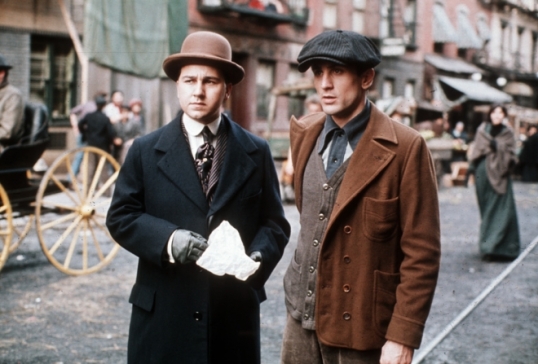
Though Castellano did not return to the role, Clemenza is present in The Godfather, Part II. The Godfather, Part II tells two separate stories: during one half of the film, young Vito Corleone comes to America, grows up to be Robert De Niro and then eventually becomes the Godfather. In the other half of the film, Vito’s successor, Michael (Al Pacino), tries to keep the family strong in the 1950s and ultimately either loses, alienates, or kills everyone that he loves.
During Vito’s half of the film, we learn how Vito first met Clemenza (played by Bruno Kirby) and Tessio (John Aprea). However, during Michael’s half of the story, Clemenza is nowhere to be seen. Instead, we’re told that Clemenza died off-screen and his successor is Frankie Pentangeli (Michael V. Gazzo). All of the characters talk about Frankie as if he’s an old friend but, as a matter of fact, Frankie was nowhere to be seen during the first film. Nor is he present in Vito’s flashbacks. This is because originally, Frankie was going to be Clemenza. But Richard Castellano demanded too much money and, as a result, he was written out of the script.
And really, it doesn’t matter. Gazzo does fine as Frankie and it’s a great film. But, once you know that Frankie was originally meant to be Clemenza, it’s impossible to watch The Godfather Part II without thinking about how perfectly it would have worked out.
If Clemenza had been around for Michael’s scenes, he would have provided a direct link between Vito’s story and Michael’s story. When Clemenza (as opposed to Frankie) betrayed Michael and went into protective custody, it would have reminded us of how much things had changed for the Corleones (and, by extension, America itself). When Tom Hagen (Robert Duvall) talked Clemenza (as opposed to Frankie) into committing suicide, it truly would have shown that the old, “honorable” Mafia no longer existed. It’s also interesting to note that, before Tessio was taken away and killed, the last person he talked to was Tom Hagen. If Castellano had returned, it once again would have fallen to Tom to let another one of his adopted father’s friends know that it was time to go.
Famously, the Godfather, Part II ends with a flashback to the day after Pearl Harbor. We watch as a young and idealistic Michael tells his family that he’s joined the army. With the exception of Michael and Tom Hagen, every character seen in the flashback has been killed over the course of the previous two films. We see Sonny (James Caan), Carlo (Gianni Russo), Fredo (John Cazale), and even Tessio (Abe Vigoda). Not present: Clemenza. (Vito doesn’t appear in the flashback either but everyone’s talking about him so he might as well be there. Poor Clemenza doesn’t even get mentioned.)
If only Richard Castellano had been willing to return.
Clemenza and Vito
But he didn’t and you know what? You really only miss him if you know that he was originally meant to be in the film. With or without Richard Castellano, The Godfather, Part II is a great film, probably one of the greatest of all time. When it comes to reviewing The Godfather, Part II, the only real question is whether it’s better than the first Godfather.
Which Godfather you prefer really depends on what you’re looking for from a movie. Even with that door getting closed in Kay’s face, the first Godfather was and is a crowd pleaser. In the first Godfather, the Corleones may have been bad but everyone else was worse. You couldn’t help but cheer them on.
The Godfather Part II is far different. In the “modern” scenes, we discover that the playful and idealistic Michael of part one is gone. Micheal is now cold and ruthless, a man who willingly orders a hit on his older brother and who has no trouble threatening Tom Hagen. If Michael spent the first film surrounded by family, he spends the second film talking to professional killers, like Al Neri (Richard Bright) and Rocco Lampone (Tom Rosqui). Whereas the first film ended with someone else closing the door on Kay, the second film features Michael doing it himself. By the end of the film, Michael Corleone is alone in his compound, a tyrant isolated in his castle.
Michael’s story provides a sharp contrast to Vito’s story. Vito’s half of the film is vibrant and colorful and fun in a way that Michael’s half is not and could never be. But every time that you’re tempted to cheer a bit too easily for Vito, the film moves forward in time and it reminds you of what the future holds for the Corleones.
So, which of the first two Godfathers do I prefer? I love them both. If I need to be entertained, I’ll watch The Godfather. If I want to watch a movie that will truly make me think and make me question all of my beliefs about morality, I’ll watch Part Two.
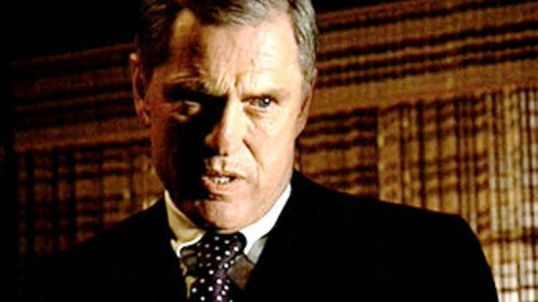
Finally, I can’t end this review without talking about G.D. Spradlin, the actor who plays the role of U.S. Sen. Pat Geary. The Godfather Part II is full of great acting. De Niro won an Oscar. Pacino, Gazzo, Lee Strasberg, and Talia Shire were all nominated. Diane Keaton, Robert Duvall, and John Cazale all deserved nominations. Even Joe Spinell shows up and brilliantly delivers the line, “Yeah, we had lots of buffers.” But, with each viewing of Godfather, Part II, I find myself more and more impressed with G.D. Spradlin.
Sen. Pat Geary doesn’t have a lot of time on-screen. He attends a birthday party at the Corleone Family compound, where he praises Michael in public and then condescendingly insults him in private. Later, he shows up in Cuba, where he watches a sex show with obvious interest. And, when Michael is called before a Senate committee, Geary gives a speech defending the honor of all Italian-Americans.
G.D. Spradlin as Sen. Pat Geary
But the scene that we all remember is the one where Tom Hagen meets Sen. Geary in a brothel. As Geary talks about how he passed out earlier, the camera briefly catches the sight of a dead prostitute lying on the bed behind him. What’s especially disturbing about this scene is that neither Hagen nor Geary seem to acknowledge her presence. She’s been reduced to a prop in the Corleone Family’s scheme to blackmail Sen. Geary. His voice shaken, Geary says that he doesn’t know what happened and we see the weakness and the cowardice behind his almost all-American facade.
It’s a disturbing scene that’s well-acted by both Duvall and Spradlin. Of course, what is obvious (even if it’s never explicitly stated) is that Sen. Geary has been set up and that nameless prostitute was killed by the Corleones. It’s a scene that makes us reconsider everything that we previously believed about the heroes of the Godfather.
For forcing us to reconsider and shaking us out of our complacency, The Godfather, Part II is a great film.
(Yes, it’s even better than The Trial of Billy Jack.)
“I got something for your mother and Sonny and a tie for Freddy and Tom Hagen got the Reynolds Pen…” — Kay Adams (Diane Keaton) in The Godfather (1972)
It probably seems strange that when talking about The Godfather, a film that it is generally acknowledged as being one of the best and most influential of all time, I would start with an innocuous quote about getting Tom Hagen a pen.
(And it better have been a hell of a pen because, judging from the scene where Sollozzo stops him in the street, it looked like Tom was going all out as far as gifts were concerned…)
After all, The Godfather is a film that is full of memorable quotes. “Leave the gun. Take the cannoli.” “I’m going to make him an offer he can’t refuse.” “It’s strictly business.” “I believe in America….” “That’s my family, Kay. That’s not me.”
But I went with the quote about the Reynolds pen because, quite frankly, I find an excuse to repeat it every Christmas. Every holiday season, whenever I hear friends or family talking about presents, I remind them that Tom Hagen is getting the Reynolds pen. Doubt me? Check out these tweets from the past!
But all that love also makes The Godfather a difficult film to review. What do you say about a film that everyone already knows is great?
Do you praise it by saying that Al Pacino, Robert Duvall, James Caan, Diane Keaton, Marlon Brando, John Cazale, Richard Castellano, Abe Vigoda, Alex Rocco, and Talia Shire all gave excellent performances? You can do that but everyone already knows that.
Do you talk about how well director Francis Ford Coppola told this operatic, sprawling story of crime, family, and politics? You can do that but everyone already knows that.
Maybe you can talk about how beautiful Gordon Willis’s dark and shadowy cinematography looks, regardless of whether you’re seeing it in a theater or on TV. Because it certainly does but everyone knows that.
Maybe you can mention the haunting beauty of Nina Rota’s score but again…
Well, you get the idea.
Now, if you somehow have never seen the film before, allow me to try to tell you what happens in The Godfather. I say try because The Godfather is a true epic. Because it’s also an intimate family drama and features such a dominating lead performance from Al Pacino, it’s sometimes to easy to forget just how much is actually going on in The Godfather.
The Godfather tells the story of the Corleone Family. Patriarch Vito Corleone (Marlon Brando) has done very well for himself in America, making himself into a rich and influential man. Of course, Vito is also known as both Don Corleone and the Godfather and he’s made his fortune through less-than-legal means. He may be rich and he may be influential but when his daughter gets married, the FBI shows up outside the reception and takes pictures of all the cars in the parking lot. Vito Corleone knows judges and congressmen but none of them are willing to be seen in public with him. Vito is the establishment that nobody wants to acknowledge and sometimes, this very powerful man wonders if there will ever be a “Governor Corleone” or a “Senator Corleone.”
Vito is the proud father of three children and the adopted father of one more. His oldest son, and probable successor, is Sonny (James Caan). Sonny, however, has a temper and absolutely no impulse control. While his wife is bragging about him to the other women at the wedding, Sonny is upstairs screwing a bridesmaid. When the enemies of the Corleone Family declare war, Sonny declares war back and forgets the first rule of organized crime: “It’s not personal. It’s strictly business.”
After Sonny, there’s Fredo (John Cazale). Poor, pathetic Fredo. In many ways, it’s impossible not to feel sorry for Fredo. He’s the one who ends up getting exiled to Vegas, where he lives under the protection of the crude Moe Greene (Alex Rocco). One of the film’s best moments is when a bejeweled Fredo shows up at a Vegas hotel with an entourage of prostitutes and other hangers-on. In these scenes, Fred is trying so hard but when you take one look at his shifty eyes, it’s obvious that he’s still the same guy who we first saw stumbling around drunk at his sister’s wedding.
(And, of course, it’s impossible to watch Fredo in this film without thinking about both what will happen to the character in the Godfather, Part II and how John Cazale, who brought the character to such vibrant life, would die just 6 years later.)
As a female, daughter Connie (Talia Shire) is — for the first film, at least — excluded from the family business. Instead, she marries Sonny’s friend Carlo Rizzi (Gianni Russo). And, to put it gently, it’s not a match made in heaven.
And finally, there’s Michael (Al Pacino). Michael is the son who, at the start of the film, declares that he wants nothing to do with the family business. He’s the one who wants to break with family tradition by marrying Kay Adams (Diane Keaton), who is most definitely not Italian. He’s the one who was decorated in World War II and who comes to his sister’s wedding still dressed in his uniform. (In the second Godfather film, we learn that Vito thought Michael was foolish to join the army, which makes it all the more clear that, by wearing the uniform to the wedding, Michael is attempting to declare his own identity outside of the family.) To paraphrase the third Godfather film, Michael is the one who says he wants to get out but who keeps getting dragged back in.
And finally, the adopted son is Tom Hagen (Robert Duvall). Tom is the Don’s lawyer and one reason why Tom is one of my favorite characters is because, behind his usual stone-faced facade, Tom is actually very snarky. He just hides it well.
Early on, we get a hint that Tom is more amused than he lets on when he has dinner with the crude Jack Woltz (John Marley), a film producer who doesn’t want to use Johnny Fontane (Al Martino) in a movie When Woltz shouts insults at him, Tom calmly finishes his dinner and thanks him for a lovely evening. And he does it with just the hint of a little smirk and you can practically see him thinking, “Somebody’s going to wake up with a horse tomorrow….”
However, my favorite Tom Hagen moment comes when Kay, who is searching for Michael, drops by the family compound. Tom greets her at the gate. When Kay spots a car that’s riddled with bullet holes, she asks what happened. Tom smiles and says, “Oh, that was an accident. But luckily no one was hurt!” Duvall delivers the line with just the right attitude of “That’s my story and I’m sticking to it!” How can you not kind of love Tom after that?
And, of course, the film is full of other memorable characters, all of whom are scheming and plotting. There’s Clemenza (Richard S. Catellano) and Tessio (Abe Vigoda), the two Corleone lieutenants who may or may not be plotting to betray the Don. There’s fearsome Luca Brasi (Lenny Montana), who spends an eternity practicing what he wants to say at Connie’s wedding and yet still manages to screw it up. And, of course, there’s Sollozzo (Al Lettieri, playing a role originally offered to Franco Nero), the drug dealer who reacts angrily to Vito’s refusal to help him out. Meanwhile, Capt. McCluskey (Sterling Hayden) is busy beating up young punks and Al Neri (Richard Bright) is gunning people down in front of the courthouse. And, of course, there’s poor, innocent, ill-fated Appollonia (Simonetta Stefanelli)…
The Godfather is a great Italian-American epic, one that works as both a gangster film and a family drama. Perhaps the genius of the Godfather trilogy is that the Corleone family serves as an ink blot in a cinematic rorschach test. Audiences can look at them and see whatever they want. If you want them and their crimes to serve as a metaphor for capitalism, you need only listen to Tom and Michael repeatedly state that it’s only business. If you want to see them as heroic businessmen, just consider that their enemies essentially want to regulate the Corleones out of existence. If you want the Corleones to serve as symbols of the patriarchy, you need only watch as the door to Michael’s office is shut in Kay’s face. If you want to see the Corleones as heroes, you need only consider that they — and they alone — seem to operate with any sort of honorable criminal code. (This, of course, would change over the course of the two sequels.)
And, if you’re trying to fit a review of The Godfather into a series about political films, you only have to consider that Vito is regularly spoken of as being a man who carries politicians around in his pocket. We may not see any elected officials in the first Godfather film but their presence is felt. Above all else, it’s Vito’s political influence that sets in motion all of the events that unfold over the course of the film.
The Godfather, of course, won the Oscar for best picture of 1972. And while it’s rare that I openly agree with the Academy, I’m proud to say that this one time is a definite exception.
As a result of my continuing effort to see every single film ever nominated for best picture, I’ve been lucky enough to both discover and rediscover a handful of excellent films that, for whatever reason, have ended up forgotten and neglected in the years since they scored their nominations. One of the more recent of these films was Francis Ford Coppola’s masterpiece of a paranoia, the 1974 Best Picture nominee The Conversation.*
The Conversation tells the story of Harry Caul (played by Gene Hackman), a surveillance expert who, along with his colleague Stan (played by the great John Cazale), is hired by a businessman (Robert Duvall) to bug a conversation between Duvall’s much younger wife (played by Cindy Williams) and a man who might be her lover (played by Fredric Forrest). Harry, we quickly discover, is a man who values his privacy and who manages to find a balance between his unsavory job and his devout religious faith by maintaining an impenetrable shield of detachment from the rest of humanity. He is a man who hides from the world inside of his apartment, only allowing himself to show the slightest hint of emotion when playing his saxophone. In one of the film’s best scenes, Harry finds himself awkwardly socializing with a far more sleazy acquaintance (played by Alan Garfield, one of the great character actors of the 70s) and it becomes apparent that Harry may be the best in the business but he’s still the ultimate outsider.
However, Harry is forced to confront the contradictions of his own lifestyle when he listens to the conversation between Forrest and Williams and believes that he might have found evidence that both Forrest and Williams are in fear for their lives. With Duvall’s operatives demanding the surveillance tapes, Harry Caul soon finds himself becoming more and more paranoid and unstable as he finds it more and more difficult to justify his detachment. Harry finds himself obsessively listening to the conversation over and over again, going over every possible nuance and emphasis to try to figure out what’s actually being said. Of course, by the end of the film, it’s obvious to both Harry and the audience that nothing is as simple as it sounds.
Compared to the Godfather films and Apocalypse Now, the Conversation is a surprisingly low-key and rather muted film. A lot of this is because, as opposed to the Corleones and Martin Sheen’s Captain Willard, Gene Hackman’s Harry Caul is a complete and total introvert, a man who makes his living by observing a world that he refuses to be a part of. Though the film works quite well as a thriller, it works best when viewed as a sympathetic character study of a paranoid and anti-social human being. Hackman full inhabits the role, bringing Harry — with all of his frustrating contradictions and conflicted actions — to oddly vibrant life. The film ultimately serves as a sad-eyed look at how a good person can justify doing bad things and how the inevitable consequences of those bad things can only be delayed for so long.
On a final note, an impossibly young Harrison Ford shows up here as Duvall’s sinister assistant. He plays the role with just the right amount of prissy arrogance and he has a great scene where he asks Harry is he wants to try a homemade cookie. “They’re good,” Ford assures him.
So is The Conversation.
—–
* Of course, another Coppola film — The Godfather, Part II — beat the Conversation for best picture. However, The Conversation did win the Palme D’Or at Cannes that year. It was a good year to be Francis Ford Coppola.





 Through the Shattered Lens