Retro Television Review: Miami Vice 5.1 “Hostile Takeover”


Welcome to Retro Television Reviews, a feature where we review some of our favorite and least favorite shows of the past!  On Mondays, I will be reviewing Miami Vice, which ran on NBC from 1984 to 1989.  The entire show can be purchased on Prime!

This week, we start the fifth and final season of Miami Vice.

Episode 5.1 “Hostile Takeover”

(Dir by Don Johnson, originally aired on November 4th, 1988)

The fifth and final season of Miami Vice gets off to a good start with this episode.  After opening with some appropriately glitzy scenes of the drug-fueled Miami nightlife, the episode then shows us that Sonny Crockett is still convinced that he’s Sonny Burnett.  He has now returned to Miami and, along with Cliff King (Matt Frewer), he is one of the key advisors to drug lord Oscar Carrera (Joe Santos).

Carrera is at war with El Gato (Jon Polito), the brother of Sonny Burnett’s former employer, Miguel Manolo.  El Gato, who wears gold lamé, cries over the body of one of his henchmen, and flinches when forced to deal with direct sunlight, is a flamboyant figure.  In fact, he’s so flamboyant that it’s initially easy to overlook how determined he is to get revenge for the death of his brother.  That means taking down the Carreras family and Sonny Burnett as well.

The Vice Squad knows that Sonny is moving up in the drug underworld but Castillo is firm when asked what they should do about it.  Sonny has an active warrant out for murdering a corrupt cop.  “Sonny’s not Sonny anymore,” Tubbs says at one point and Castillo seems to agree.

Tubbs goes undercover, making contact with the Carreras cartel.  When Sonny meets Tubbs, Tubbs introduces himself as “Ricardo Cooper” and starts speaking in his terribly unconvincing Jamaican accent and that was when I said, “Miami Vice is back!”  Sonny doesn’t trust Cooper from the start.  “Maybe you’re a cop,” Sonny says.  “Not I, mon,” Tubbs replies.

People are dying and, while Sonny doesn’t have a problem with that, the show is also careful to show that Sonny only shoots in self-defense.  (It appears the most of the cold-blooded murders are farmed out to Cliff King.)  When Oscar Carreras dies, it’s because his poofy-haired son (Anthony Crivello) accidentally shot him when Oscar discovered him with his stepmother.  When the son dies, it’s because he was about to shoot Sonny after he caught Sonny with …. his stepmother, again.  The Carreras family is so dysfunctional that it shouldn’t come as a surprise that Sonny steps up to take it over.

After promising Castillo that he’ll take out Sonny if necessary, Tubbs meets up with Sonny at beach-side tower.  Tubbs looks at Sonny and suddenly says, “Sonny, it’s me, Rico.”  Sonny stare at Tubbs.  “Do you remember me?” Tubbs asks.

“Sure,” Sonny suddenly says, “You’re Tubbs.”

Three gunshots ring out as the episode ends.

OH MY GOD, DID SONNY KILLS TUBBS!?

We’ll find out next week.  For now, I’ll say that — after a disappointing fourth season — this was exactly how Miami Vice needed to start things off for Season 5.  Seriously, if you’re going to have Sonny get hit with amnesia, you might as well just go for it and take things to their logical extreme.

Next week …. is Tubbs dead?  I hope not, mon.
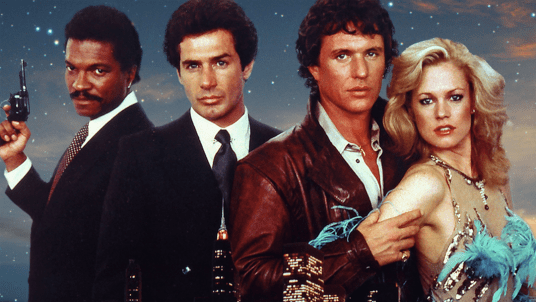
 

The TSL Horror Grindhouse: Fear City (dir by Abel Ferrara)


Welcome to Manhattan in the mid-80s!

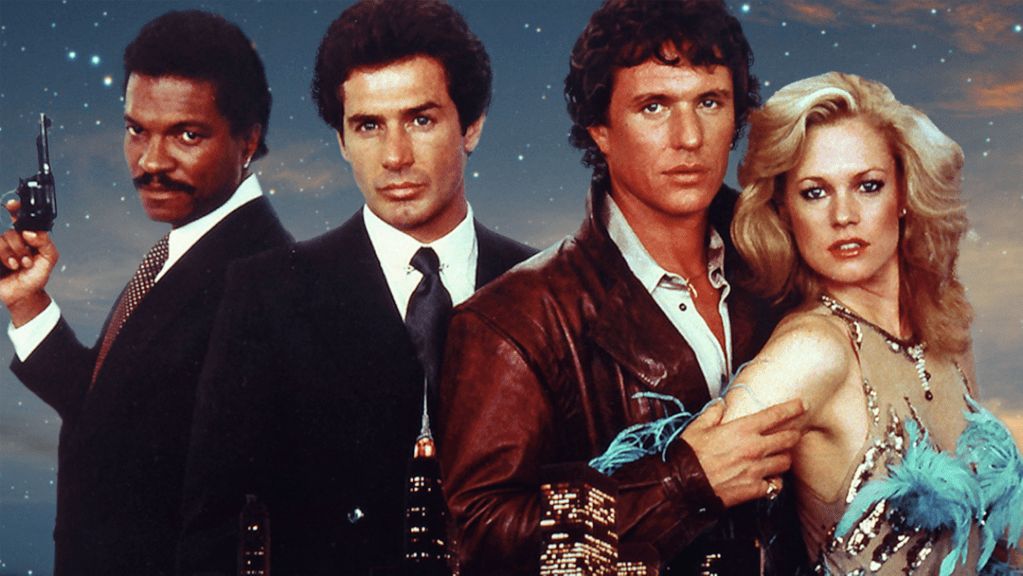
While self-righteous vice cop Al Wheeler (Billy Dee Williams) patrols the streets with the fury of an Old Testament prophet, men flock to seedy bars to watch women like Loretta (Melanie Griffith) dance and strip.  Mobsters like Carmine (Rossano Brazzi) control the streets while club owners like Mike (Michael V. Gazzo) and Frank (Joe Santos) try to do business and make enough money to keep things open.  Bookers like Nicky Parzeno (Jack Scalia) and Lou Goldstein (Jan Murray) compete to see who can place their girls in the most clubs.  Nicky’s best friend and business partner, Matt Rossi (Tom Berenger), is haunted by his violent past as a boxer and his failed relationship with the drug-addicted Loretta.

Meanwhile, a nameless man (John Foster) practices nude tai chai in his warehouse apartment and writes feverishly in his journals.  At night, he stalks the streets with a blade in his hand.  He targets strippers, attacking them as they try to get home from the club.  Honey (Ola Ray) is attacked on a subway platform.  Loretta’s girlfriend, Leila (Rae Dawn Chong), is attacked on the streets.  Obsessed with Loretta’s safety, Matt struggles with his own inner demons as he prepares for a final confrontation with the killer….

1985’s Fear City is another one of director Abel Ferrara’s heavily stylized fever dreams.  In typical Ferrara fashion, the plot is so sordid that one might be tempted to think that the film is meant to be a self-parody and the dialogue mixes profane insults with bizarrely philosophical asides.  As played by Billy Dee Williams, Al Wheeler is not just a cop who wants to clean up New York and Times Square.  Instead, he’s a seething soldier to traditional morality and one who is so intense that it’s something of a shock that he doesn’t just walk around New York shooting people for jaywalking.  Meanwhile, Tom Berenger’s Matt is a hulking brute who is haunted by the time he killed a man in the ring.  He knows what he’s capable of and it scares him but, in order to save Loretta and his business, he’s going to have to become that deadly boxer once again.  “I hate Matt Rossi because he’s arrogant,” Al Wheeler says through gritted teeth.  Meanwhile, Matt deals with his own issues by trashing his office and then leaving the mess for someone else to clean up.  I’m not sure what that was supposed to accomplish but it’s apparently something that Matt just has to do.

Abel Ferrara directed this film five years before King of New York and, in some ways, Fear City feels like a dry run for King of New York.  Both films are highly stylized and both present New York as being a neon-lit Hell where the rich and the poor come together in mutual self-loathing and where the criminals often have more of a code of honor than the cops who are trying to stop them.  Of course, King of New York had Christopher Walken’s magnetic performance as Frank White holding the film and its many storylines together.  Fear City doesn’t really have that.  Billy Dee Williams, Tom Berenger, Jack Scalia, and Melanie Griffith all give strong performance but none of their characters are really quite compelling or grounded enough to keep the film from spinning off into delirious excess.

In other words, Fear City is a mess but it’s one of those over-the-top, shamelessly sordid messes that you really can’t look away from.  There’s enough philosophical dialogue to confirm that, as with King of New York, Ferrara was shooting at something more than just a typical exploitation film.  Unlike King of New York, Ferrara doesn’t quite succeed in saying anything particularly deep about the human condition in Fear City.  But that’s okay.  It’s an entertainingly sordid film.

#MondayMuggers – Why FEAR CITY (1984)?


Every Monday night at 9:00 Central Time, my wife Sierra and I host a “Live Movie Tweet” event on X using the hashtag #MondayMuggers. We rotate movie picks each week, and our tastes are quite different. Tonight, Monday January 27th, we’re watching FEAR CITY starring Tom Berenger, Billy Dee Williams, Jack Scalia and Melanie Griffith.

So why did I pick FEAR CITY, you might ask?

  1. I’m a huge fan of Tom Berenger. SOMEONE TO WATCH OVER ME (1987 with Mimi Rogers), SHOOT TO KILL (1988 with Sidney Poitier), MAJOR LEAGUE (1989 with Charlie Sheen), and LAST OF THE DOGMEN (1995 with Barbara Hershey) are some of my very favorite films. He’s an outstanding actor and screen presence. Tom Berenger is one of those actors who I always enjoy seeing on screen.
  2. FEAR CITY is directed by Abel Ferrara. Abel Ferrara is one of those directors who makes movies about the very worst in society. His films MS. 45 (1981), KING OF NEW YORK (1990), and BAD LIEUTENANT (1992) are all movies that intrigued me greatly as I was trying to discover who I was growing up in the 80’s and early 90’s. 
  3. The sleaze is off the charts in FEAR CITY, with so many big-time stars, and set in New York City of the 1980’s. From everything I’ve read, this a time capsule of a place that no longer exists. If I ever make it to New York City, I’ll be greeted with a place that’s designed more like Disney World. I think it’s interesting to see the city as presented here!
  4. I also think it will be interesting to see what it’s like to experience a movie like FEAR CITY as part of a group. I discovered this film as a teenager in the 80’s. I remember being a little embarrassed as I watched the film, especially with its large serving of nudity (from big stars) and graphic violence. I’ve watched films in groups with the most extreme graphic violence imaginable and no one batted an eye. I’m looking forward to seeing how this plays out.

So join us tonight to for #MondayMuggers and watch FEAR CITY! It’s on Amazon Prime.

Film Review: The Don Is Dead (dir by Richard Fleischer)


“The Don is Dead!” shouts the title of this 1973 film and it’s not lying.

After the powerful and respect leader of the Regalbuto crime family dies, the Mafia’s governing body meets in Las Vegas to debate who should be allowed to take over the family’s operations.  Frank Regalbuto (a smoldering Robert Forster) wants to take over the family but it’s agreed that he’s still too young and hot-headed.  Instead, control of the family is given Don Angelo DiMorra (Anthony Quinn), an old school Mafia chieftain who everyone agrees is a man of respect.  Don DiMorra will serve as a mentor to Frank while Frank’s main enforcers, The Fargo Brothers, will be allowed to operate independently with the understanding that they will still respond if the mob needs them to do a job.  Tony Fargo (Forrest) wants to get out of the rackets all together while his older brother, Vince (Al Lettieri), remains loyal to the old ways of doing things.

Frank is not happy with the arrangement but he has other things to worry about.  He knows that there’s a traitor in his family.  While he and the Fargo brothers work to uncover the man’s identity so that they can take their revenge, Don Angelo falls in love with a Vegas showgirl named Ruby Dunne (Angel Tompkins).  However, Ruby is engaged to marry Frank and, when Frank returns from taking care of the traitor, he is tipped off as to what has been happening in his absence.  Frank goes crazy, nearly beating Ruby to death.  Don Angelo declares war on Frank and the Fargo brothers are forced to decide which side they’ll serve.

In the 1970s, almost every crime film was either a rip-off of The French Connection or The Godfather.  The Don Is Dead is unique in that it attempts to rip off both of them at the same time.  The film opens French Connection-style with a couple of hoods trying to double-cross Frank during a drug deal, leading to shoot-out.  (Keep an eye out for Sid Haig as one of Frank’s men.)   The film is full of scenes that are meant to duplicate the gritty feel of The French Connection though, needless to say, none of them are directed with the cinema verité intensity that William Friedkin brought to that classic film.  Meanwhile, Anthony Quinn plays a character who is very much reminiscent of Don Vito Corleone, even pausing at one point to tell Frank that “drugs are a dirty business.”  The Godfather‘s Abe Vigoda and Al Lettieri show up in supporting roles and Robert Forster gives a performance that owes more than a little to James Caan’s Oscar-nominated turn as Sonny Corleone.  (Interestingly enough, both Quinn and Forster were among the many actors considered for roles in The Godfather.)

Unfortunately, the film itself is slowly-paced and never really draws us into the plot.  Director Richard Fleischer, who directed a lot of films without ever developing a signature style, brings none of the intensity that William Friedkin brough to The French Connection nor can he duplicate Francis Ford Coppola’s operatic grandeur.  The Don is Dead plays out like a particularly violent made-for-TV movie.  There’s a lot of talented people in the cast but they’re defeated by thinly drawn characters.  Robert Evans often said that Coppola was hired to direct The Godfather because, as an Italian-American, he would bring an authenticity to the material that a non-Italian director would not be able to do.  The Don Is Dead would seem to indicate that Evans knew what he was talking about.

Holiday Film Review: The Last Boy Scout (dir by Tony Scott)


My God, what a violent holiday season!

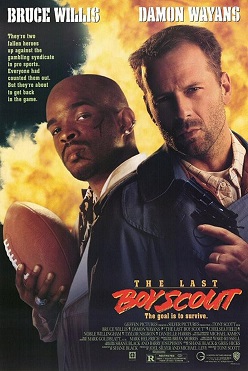
Like the majority of the films that have been written and/or directed by Shane Black, The Last Boy Scout takes place in December.  It’s not quite as Christmas-y as some of Black’s other films.  I think that I may have spotted a few decorations in the background of some of the scenes.  And there’s a scene where private investigator Joe Hallenbeck (Bruce Willis) discovers that his daughter (played by a very young Danielle Harris) has been drawing pictures of “Satan Claus.”  Otherwise, there’s not a lot of Christmas to be found in this December-set film and perhaps that’s for the best.  Seriously, this movie is violent!  Not even the comedic relief characters are safe from getting a bullet to the head.  This is a film that actually begins with a football player shooting three other players during a game and then saying, “Ain’t life a bitch,” before shooting himself in the head.

The film’s plot isn’t always easy to follow.  Joe is a private investigator who drinks too much and whose partner has just been blown up in front of his house.  (His partner was also sleeping with Joe’s wife so guess who is now a suspect!)  Joe is also hired to act as a bodyguard for a stripper named Cory (Halle Berry).  Cory is dating Jimmy Dix (Damon Wayans), a former quarterback who used to be Joe’s hero.  Then Jimmy got kicked out of the league for gambling and Joe stopped watching football.  Cory says that she has a tape recording that will get Joe back into the NFL.  But then, Cory is brutally gunned down in the middle of the street and the tape is accidentally destroyed by Joe’s crappy tape player.  It’s time for Jimmy and Joe to team up, trade one liners, and uncover the conspiracy.

It all links back to the efforts of football team owner Shelley Marcuse (Noble Willingham) to legalize gambling.  Senator Calvin Baynard (Chelcie Ross) is standing in Marcuse’s way because Marcuse didn’t offer him a big enough bribe.  Marcuse is planning to assassinate the senator and he’s going to frame Joe for the crime because, in an amazing coincidence, Joe used to be a secret service agent until he caught Senator Baynard torturing a sex worker.  Of course, the actual assassination will be carried out by Marcuse’s chief henchman, Milo (Taylor Negron, who is absolutely chilling in the role).  Milo rarely shows emotion and always refers to everyone by their formal name.  (Joe is called Joseph.  Jimmy is called James.)  Milo is also a total sociopath, one who will shoot anyone in the head without a second thought.

Shane Black, who is a genius regardless of what I may think of this particular film, has said that he wrote The Last Boy Scout after he broke up with a longtime girlfriend and he was suffering from depression.  Disillusionment hangs over almost every frame of the movie.  Joe did the right thing and lost his career.  Jimmy lost his family on the same night that he played the best game of his career.  The Senator is opposed to Marcuse’s scheme solely because he’s not getting enough of a cut.  Marcuse is a respected businessman who thinks little of killing strangers.  Jimmy and Joe are heroes not because they’re particularly good but because everyone else around them is just so bad.  This is also very much a movie about guys doing guy things.  I watched it with my brother-in-law and I have to say that I think he got a bit more out of the film than I did.  Then again, I also think my sister Megan also got more out of it than I did so maybe I just wasn’t in the mood to watch so many people get shot in the head.  It happens.

The Last Boy Scout was directed by Tony Scott so, no matter what else you might want to say about it, the movie looks great.  Willis seems a bit bored with the film and Wayans sometimes struggles with the more dramatic moments.  In many ways, the film feels like a precursor to Shane Black’s The New Guys, though Willis and Wayans never have the same chemistry as Russell Crowe and Ryan Gosling did in that underrated film.  However, The Last Boy Scout’s action moves quickly and the screen is always full of neon lights.  It’s a well-made action movie though, unlike Lethal Weapon, Die Hard, and The Nice Guys, it’s not one that really sticks around in your head after the end credits roll.  Personally, I think it needed a little more holiday spirit.

Blue Thunder (1983, directed by John Badham)


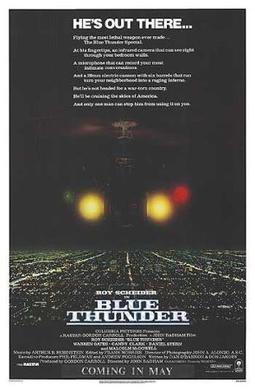
Frank Murphy (Roy Scheider) is a Vietnam vet-turned-cop who pilots a police helicopter for the LAPD.  Every night, he and his partner, Richard Lymangood (Daniel Stern) fly over Los Angeles, helping to keep the peace and peeping on anyone undressing in a high-rise apartment.

Murphy is selected to serve as the test pilot for what is described as being the world’s most advanced military helicopter, Blue Thunder.  Blue Thunder is so advanced that the pilot can control the gun turrets just by turning his head and it’s also been supplied with the latest state of the art surveillance equipment.  The pilot of a Blue Thunder can literally spy on anyone while listening to and recording their conversations.  With the Olympics coming up, the city of Los Angeles wants to test out the Blue Thunder as a way to control the crowds and prevent crime during the Games.

Murphy may be impressed by the helicopter but he has his reservations about the program.  He immediately sees that Blue Thunder could be a dangerous tool in the wrong hands.  Those wrong hands would belong to Col. Cochrane (Malcolm McDowell), who was Blue Thunder’s first pilot and also Murphy’s commanding officer during Vietnam.  Murphy is still haunted by the atrocities that he saw committed by Cochrane during the war.

When it turns out that Murphy was right to be suspicious of Cochrane’s intentions, the movie turns into an exciting aerial chase above Los Angeles, with Murphy in Blue Thunder, trying to outrun F-16s, heat-seeking missiles, and eventually Cochrane, who enters the chase in a Blue Thunder of his own.

I’m always surprised that Blue Thunder doesn’t have a bigger following than it does.  It’s an action classic, with a gritty performance from Roy Scheider, a villainous performance from Malcolm McDowell, and comedic relief from the always reliable Daniel Stern.  Even Warren Oates is in the movie, playing Murphy’s LAPD commander!  The script actually does have something relevant to say about the militarization of America’s police forces (and it feels downright prophetic today) and the chase scenes are all the more exciting because they were filmed in the era before CGI and have an authenticity to them that is missing from most modern action films.

Blue Thunder is a perfect example of the “don’t do this really cool thing” style of action film.  The Blue Thunder helicopter is described as being a danger to everyone in the country and the movie even ends with a note saying that real-life Blue Thunders are currently being designed.  But I don’t think anyone who has ever watched this film has thought, “I hope they stopped making those helicopters.”  Instead, this movie makes you want to have a Blue Thunder of your very own.  They’re so cool, who wouldn’t want to fly one of those things?

Film Review: The Panic In The Needle Park (dir by Jerry Schatzberg)


The 1971 The Panic in Needle Park tells the story of two young lover in New York City.

Helen (Kitty Winn) is an innocent runaway from Indiana who, when we first meet her, has just had a back alley abortion.  Her boyfriend, Marco (Raul Julia), doesn’t seem to be too concerned about her or anyone else for that matter.  Instead, it’s Marco’s dealer, Bobby (Al Pacino), who checks in on Helen and who visits her when she eventually ends up in the hospital.  It’s also Bobby who gives her a place to stay after she gets out of the hospital.

Bobby is a small-time dealer.  He’s not book smart but he knows how to survive on the streets and it’s hard not to be charmed by him.  He literally never stop talking.  As he explains it to Helen, he’s been in jail 8 times but he’s not a bad guy.  His brother, Hank (Richard Bright, who also co-starred with Pacino in The Godfather films), is a burglar and he legitimately is a bad guy but he and Bobby seem to have a close relationship.  Bobby also swears that he’s not a drug addict.  He just occasionally indulges.  It doesn’t take long to discover that Bobby isn’t being completely honest with either Helen or himself.

Together, Bobby and Helen ….

Well, they don’t solve crimes.  In fact, they really don’t do much of anything.  That’s kind of the problem with movies about drug addicts.  For the most part, drug addicts are boring people and there’s only so many times that you can watch someone shoot up before you lose interest.  Heroin may make the addicts feel alive but, with a few notable exception (Trainspotting comes to mind), it’s always been a bit of a cinematic dead end.  The film takes a documentary approach to Bobby and Helen’s descent into addiction and it’s not exactly the most thrilling thing to watch.

Bobby and Helen live in an area of New York that’s known as needle park, largely due to the fact that it’s full of addicts.  It’s a place where people sit on street corners and nod off and where everyone’s life is apparently fueled by petty crime.  An unlikable narcotics detective (Alan Vint) occasionally walks through the area and tries to talk everyone into betraying everyone else.  It turns out that being a drug addict is not like being in the mafia.  Everyone expects you to betray everyone else.

As I said, it’s a bit of a drag to watch but you do end up caring about Bobby and Helen.  They come across as being two essentially decent people who have gotten caught up in a terrible situation.  Even when they piss you off, you still feel badly for them because you know that they’ve surrendered control of their lives to their addictions.  It helps that they’re played by two very appealing actors.  This was only Al Pacino’s second film and his first starring role but he commands the screen like a junkie James Cagney.  Meanwhile, making her film debut, Kitty Winn gives a sympathetic and likable performance as Helen.  You watch Winn’s vulnerably sincere performance and you understand why Helen would have looked for safety with undeserving losers like Marco and Bobby and, as a result, you don’t hold it against her that she seems to be addicted not just to heroin but also to falling for the wrong men.  Helen does a lot of stupid things but you keep hoping that she’ll somehow manage to survive living in needle park.

Pacino, of course, followed-up The Panic In Needle Park with The Godfather.  As for Kitty Win, she won best actress at Cannes but the role didn’t lead to the stardom that it probably should have.  Her best-known role remains playing the nanny in The Exorcist.

Insomnia File #42: Revenge (dir by Tony Scott)


What’s an Insomnia File? You know how some times you just can’t get any sleep and, at about three in the morning, you’ll find yourself watching whatever you can find on cable? This feature is all about those insomnia-inspired discoveries!

Earlier today, If you were having trouble getting to sleep around one in the morning, you could have turned over to TCM and watched the 1990 action film, Revenge.

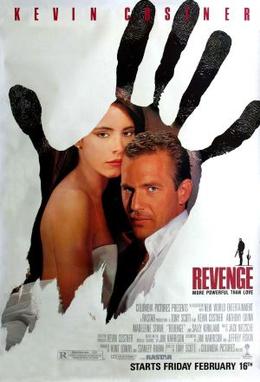
Revenge is an almost absurdly masculine film about two men who are in love with the same woman and who, as a result, end up trying to kill each other and a lot of other people.

Jay Cochran (Kevin Costner) is a U.S. Navy aviator who, when we first see him, is doing the whole Top Gun thing of flying in a fast jet and making jokes while his navigator worries about dying.  Interestingly enough, Top Gun and Revenge were both directed by Tony Scott so perhaps this opening scene was meant to be a self-reference.  Well, regardless of intent, it’s a scene that goes on forever.  This is Jay’s last flight, as he’s due to retire.  We go through an extended retirement party, where everyone has a beer and Jay gives one of those bullshit sentimental speeches that men always give in films like this.

Jay has been invited to estate of Tibbey (Anthony Quinn), who is a Mexican gangster.  Tibbey and Jay are apparently old friends, though it’s never quite explained how the youngish Jay knows the not-very-youngish Tibbey.  Tibbey is one of those gangster who is incapable of doing anything without first talking about what an amazing journey it’s been, going from poverty to becoming one of the most powerful men in Mexico.

Tibbey apparently wants to play tennis with Jay and take him hunting.  Jay decides that he’d rather have an affair with Tibbey’s much younger wife, Miryea (Madeleine Stowe).  Miryea is upset that Tibbey doesn’t want to have children because he feels that pregnancy would ruin her body.  When Tibbey finds out about the affair, he sends Miryea to a brothel and Jay to the middle of the desert.  That’s Tibbey’s revenge!

Except, of course, Jay doesn’t die because he’s Kevin Costner and if he died, the movie would end too quickly.  So, Jay fights his way back from the desert, intent on not only finding Miryea but getting his own revenge on Tibbey!

(It’s hard to take a bad guy named Tibbey seriously, even if he is played by Anthony Quinn.)

Revenge goes on for way too long and neither Tibbey nor Jay are really sympathetic enough to be compelling characters.  You never really believe in Tibbey and Jay’s friendship, so the whole betrayal and revenge aspect of the film just falls flat.  On the plus side, youngish Kevin Costner is not half as annoying as cranky old man Costner.  Anthony Quinn was one of the actors who was considered for the role of Don Corleone in The Godfather and, watching him here, you can kind of see him in the role.  He would have been a bit of a crude Corleone but Quinn had an undeniably powerful and magnetic screen presence.  In Revenge, Quinn chews up and spits out all of the scenery and is not subtle at all but it’s entertaining to watch him because he’s Anthony Quinn.

Anyway, Revenge ends with a tragedy, as these things often do.  Anthony Quinn never says, “Revenge is a dish best served cold,” and that, to me, is a true missed opportunity.

Previous Insomnia Files:

  1. Story of Mankind
  2. Stag
  3. Love Is A Gun
  4. Nina Takes A Lover
  5. Black Ice
  6. Frogs For Snakes
  7. Fair Game
  8. From The Hip
  9. Born Killers
  10. Eye For An Eye
  11. Summer Catch
  12. Beyond the Law
  13. Spring Broke
  14. Promise
  15. George Wallace
  16. Kill The Messenger
  17. The Suburbans
  18. Only The Strong
  19. Great Expectations
  20. Casual Sex?
  21. Truth
  22. Insomina
  23. Death Do Us Part
  24. A Star is Born
  25. The Winning Season
  26. Rabbit Run
  27. Remember My Name
  28. The Arrangement
  29. Day of the Animals
  30. Still of The Night
  31. Arsenal
  32. Smooth Talk
  33. The Comedian
  34. The Minus Man
  35. Donnie Brasco
  36. Punchline
  37. Evita
  38. Six: The Mark Unleashed
  39. Disclosure
  40. The Spanish Prisoner
  41. Elektra