Insomnia Film #67: Why (dir by Victor Stoloff)


What’s an Insomnia File? You know how some times you just can’t get any sleep and, at about three in the morning, you’ll find yourself watching whatever you can find on cable or streaming? This feature is all about those insomnia-inspired discoveries!
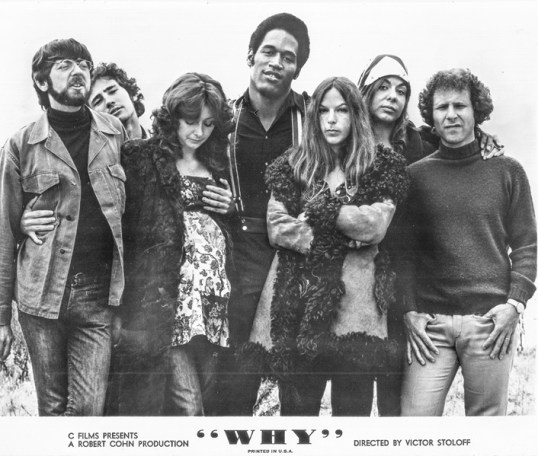
If you’re having trouble getting to sleep tonight, you can always go over to either YouTube or Tubi and pull up Why, an obscure film from 1973 that has a semi-interesting cast.

The plot of Why is simple.  Six people gather at their psychiatrist’s mansion for group therapy.  Dr. Peter Carlson (played by Herb Goldberg, an actual psychiatrist) asks the members of the group questions and asks them to do things like try to imagine a moment that made them truly happy.  The members of the group discuss their problems and …. well, that’s pretty much it.

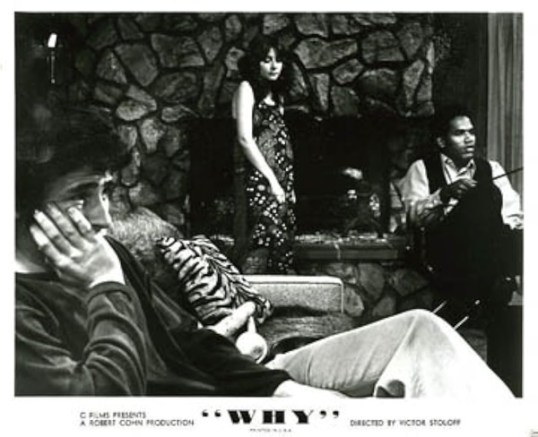
Who is in the group?  Jeannie Berlin plays Gail, a single mother who has been rejected by her family because she had an out-of-wedlock child with a black man.  Cathy Bleich plays Jennifer, who claims to be a teacher but who is also a pathological liar.  Linda Gillen is Christine, a rich teenager who is two-months pregnant and who is implied to be addicted to heroin.  Danny Goldman plays Bill, a suicidal gay man.  Musician Tim Buckley plays musician Glenn, who can’t get over his band breaking up.  And, playing a professional athlete named Bud, is O.J. Simpson.  “I smoke dope,” Bud says at one point before going on to explain why he thinks its important to be a good role model.

Why is an odd film.  It starts out with a lengthy animated sequence (complete with a hippie-style song) and then settles into being a stagey film that feels more like an extended acting exercise than an actual narrative.  It’s a talky film and some of the monologues work while others fall flat.  The best performances are given by Danny Goldman, Tim Buckley, and Linda Gillen but I imagine most people who watch this film will be giving most of their attention to O.J. Simpson, who talks about resenting the pressure to always be perfect.  In the end, there are no real break-throughs and one could argue that makes this the most realistic depiction of therapy ever filmed.

Reportedly, the film start out as a short film starring O.J. Simpson and Tim Buckley that was commissioned by Technicolor to see if video could be transferred to film.  The decision was made to expand the short into a feature.  The actors improvised during rehearsal and those improvs served as the basis for the script.  Again, this will probably be most interesting to people looking for hints into what it was like inside of O.J. Simpson’s head.  (O.J.’s character comes across as being friendly but guarded and quick to get angry about women in general.)

Again, it’s a talky film.  At times, it’s a rather boring film.  Many of the monologues start out strong but they tend to go on and on. Why might cure you of your insomnia.  That said, the film is interesting from a historical point of view.  It’s all very 70s, revealing a group of people trying to navigate a world that was still trying to figure out where they stood in the years immediately following the turmoil of 60s.  The characters have a brand new world ahead of them and none of them know if that’s a good thing or a bad thing.  Some things never change.
Previous Insomnia Files:

  1. Story of Mankind
  2. Stag
  3. Love Is A Gun
  4. Nina Takes A Lover
  5. Black Ice
  6. Frogs For Snakes
  7. Fair Game
  8. From The Hip
  9. Born Killers
  10. Eye For An Eye
  11. Summer Catch
  12. Beyond the Law
  13. Spring Broke
  14. Promise
  15. George Wallace
  16. Kill The Messenger
  17. The Suburbans
  18. Only The Strong
  19. Great Expectations
  20. Casual Sex?
  21. Truth
  22. Insomina
  23. Death Do Us Part
  24. A Star is Born
  25. The Winning Season
  26. Rabbit Run
  27. Remember My Name
  28. The Arrangement
  29. Day of the Animals
  30. Still of The Night
  31. Arsenal
  32. Smooth Talk
  33. The Comedian
  34. The Minus Man
  35. Donnie Brasco
  36. Punchline
  37. Evita
  38. Six: The Mark Unleashed
  39. Disclosure
  40. The Spanish Prisoner
  41. Elektra
  42. Revenge
  43. Legend
  44. Cat Run
  45. The Pyramid
  46. Enter the Ninja
  47. Downhill
  48. Malice
  49. Mystery Date
  50. Zola
  51. Ira & Abby
  52. The Next Karate Kid
  53. A Nightmare on Drug Street
  54. Jud
  55. FTA
  56. Exterminators of the Year 3000
  57. Boris Karloff: The Man Behind The Monster
  58. The Haunting of Helen Walker
  59. True Spirit
  60. Project Kill
  61. Replica
  62. Rollergator
  63. Hillbillys In A Haunted House
  64. Once Upon A Midnight Scary
  65. Girl Lost
  66. Ghosts Can’t Do It

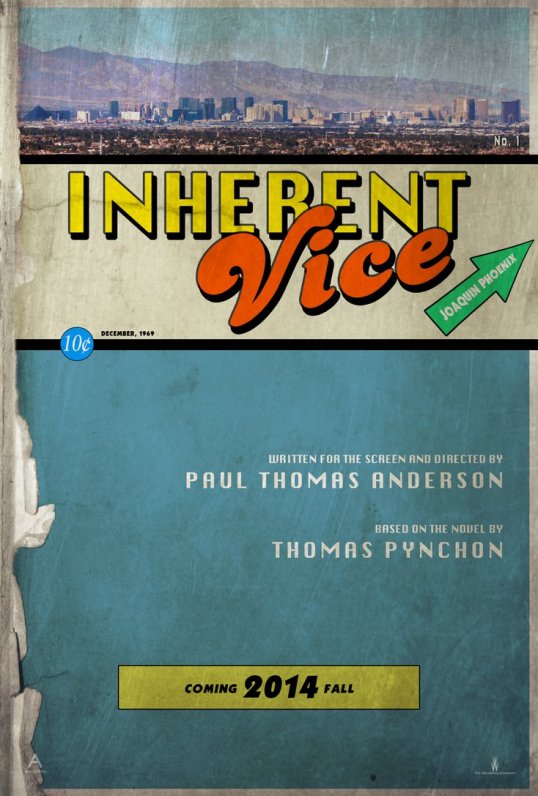
Film Review: Inherent Vice (dir by Paul Thomas Anderson)


Inherent-Vice-poster

One of the best things about Paul Thomas Anderson’s latest film, Inherent Vice, is that Doc Sportello, the private detective played by Joaquin Phoenix, is a real stoner.  He’s not one of those weekend smokers, who gets high on Saturday, brags about it on Sunday, and then spends the rest of the week interning at Vox.  For the entire 2 hour and 20 minute running time of Inherent Vice, Doc is stoned.  From the minute we first meet him to the end of the film, there is never one moment where Doc is not stoned.  Most stoner comedies feature a scene where the main character shocks everyone by turning down a hit because he’s dealing with something so important that he has to “keep his mind straight.”

Not so with Doc!

And, in Doc’s case, it definitely helps him out.  Inherent Vice tells a story that is so full of paranoia, conspiracy, and random connections that only a true stoner could follow it.  Much like Doc, the film often seems to be moving in a haze but occasionally, out of nowhere, it will come up with a scene or a line of dialogue or a detail that is so sharp and precise that it will force you to reconsider everything that you had previously assumed.

To be honest, if you are one of the people who watched Inherent Vice this weekend and could actually follow the film’s plot, then you’ve got a leg up on me.  (That said, I’ve still got pretty good legs so it all evens out.)  But, that’s not necessarily a complaint.  As befits a film based on a novel by Thomas Pynchon and directed by one of the most idiosyncratic filmmakers around, the twists and turns of Inherent Vice are deliberately meant to be obscure and confusing.  Characters appear and then vanish.  Clues are discovered and then forgotten.  Connections are hinted at but then never confirmed.  Inherent Vice ultimately serves a tribute to stoner’s paranoia and, as a result, the plot’s incoherence leads to a certain contact high.

The film takes place in California in the 1970s.  Doc is both a hippie and a private detective. His current girlfriend (Reese Witherspoon) works for the district attorney’s office and doesn’t seem to like him much.  His ex-girlfriend, Shasta (Katherine Waterston), reenters his life and asks him to help protect her new boyfriend, real estate developer Mickey Wolfman (Eric Roberts).  Mickey has disappeared.  Shasta disappears.  As Doc investigates, he wanders through a psychedelic Los Angeles and deals with an ever growing collection of eccentrics.

For instance, there’s Hope Harlingen (Jena Malone), a former heroin addict who now runs a group that aims to promote “responsible drug use” among children.  She believes that her husband, Coy (Owen Wilson), is dead but actually Coy is a government informant who keeps popping up in the strangest places.

There’s Rudy Blatnoyd (Martin Short), a decadent dentist who may or may not be responsible for all of the heroin entering California.

There’s Sauncho Smilax (Benicio Del Toro), Doc’s lawyer who specializes in maritime law.

There are Nazi bikers, new age doctors, a formerly blacklisted actor turned right-wing spokesman, a black revolutionary whose best friend was a member of the Aryan brotherhood, three FBI agents who keep picking their noses, the decadent rich, and, of course, the endlessly clean-cut and bullying officers of the LAPD.

And then there’s Detective “Big Foot” Bjornsen (Josh Brolin), a celebrity cop and occasional television extra who seems to admire Doc, except for when he’s trying to frame Doc for everything from murder to drug smuggling.  Bjornsen is probably the most interesting character in the entire film and Brolin plays the character perfectly.  His scenes with Phoenix crackle with a comedic energy that bring the film to life.

As for the movie itself, it’s not for everyone.  A lot of very smart people are going to dislike it, much as many of them did with The Master.  In some ways, Inherent Vice truly is an endurance test.  Speaking as someone who enjoyed the film, even I occasionally found myself saying, “Okay, does everyone have to have a silly name?”  Inherent Vice is a long, rambling, and occasionally frustrating film but, for me, it still worked because of the strong cast and Anderson’s attention to detail.

Unbroken is a film that seems to take place in an entirely different world from Inherent Vice but these two films do have one big thing in common.  Both of them have been victims of the expectation game.  Many of the same people who thought Unbroken would be a surefire Oscar nominee also assumed, sight unseen, that Inherent Vice would be right there with it.  Much as how Unbroken has suffered for merely being good as opposed to great, Inherent Vice is also suffering for failing to live up to the expectations that were thrust upon it.  Inherent Vice is not an awards movie.  Instead, it’s a fascinatingly idiosyncratic film that was made by a director who has never shown much concern with playing up to the audience.  While Unbroken is enough of a crowd pleaser to still have a shot at some Oscar glory, Inherent Vice is the type of film that will probably never get nominated.  (I do have some hope that Brolin will get a supporting actor nomination but, even there, it appears likely that Brolin’s spot will be given to The Judge‘s Robert Duvall.)

Well, no matter!  Flaws and all, Inherent Vice will be a film that people will still be debating and watching years from now.

Boston Demands To Be Heard


The Los Angeles film critics weren’t the only ones to vote on their favorites of 2011 today.  The Boston Society of Film Critics voted today as well.  Now, as I’ve stated quite a few times on this site, I’m a Southern girl and I have a feeling that if I ever went up to Boston, everyone up there would ignore the fact that I’m an Irish Catholic and would probably just make fun of my accent.  Eventually, the conversation would turn to politics and I would let slip the fact that not only am I not a Democrat but I didn’t even vote for Barack Obama in 2008.  A big fight would follow and I imagine we wouldn’t even get around to talking about our favorite movies…

Sorry, I lost my train of thought there.  Anyway, the BSFC voted and here’s what they came up with:

Best Picture: “The Artist”

     Runners-up: “Hugo” and “Margaret”

Best Director: Martin Scorsese, “Hugo”

     Runner-up: Michel Hazanavicius, “The Artist”

Best Actor: Brad Pitt, “Moneyball”

     Runners-up: George Clooney, “The Descendants” and Michael Fassbender, “Shame”

Best Actress: Michelle Williams, “My Week With Marilyn”

     Runner-up: Meryl Streep, “The Iron Lady”

Best Supporting Actor: Albert Brooks, “Drive”

     Runner-up: Max Von Sydow, “Extremely Loud and Incredibly Close”

Best Supporting Actress: Melissa McCarthy, “Bridesmaids”

     Runner-up: Jeannie Berlin, “Margaret”

Best Screenplay: Steven Zaillian, Aaron Sorkin and Stan Chervin, “Moneyball”

     Runner-up: Kenneth Lonergan, “Margaret”

(If I was writing for AwardsDaily.com, I guess this is where I would say, NO MOVIE HAD A BETTER SCREENPLAY THAN THE SOCIAL NETWORK)

Best Cinematography: Emmanuel Lubezki, “The Tree of Life”

     Runner-up: Robert Richardson, “Hugo”

Best Documentary: “Project Nim”

     Runner-up: “Bill Cunningham New York”

Best Foreign-Language Film: “Incendies”

     Runners-up: “A Separation” and “Poetry”

Best Animated Film: “Rango”

Best Film Editing:  Christian Marclay, “The Clock”

     Runner-up: Thelma Schoonmaker, “Hugo”

Best New Filmmaker: Sean Durkin, “Martha Marcy May Marlene”

     Runner-up: J.C. Chandor, “Margin Call”

Best Ensemble Cast: “Carnage”

     Runner-up: “Margaret”

Best Use of Music in a Film: (tie) “Drive” and “The Artist”

     Runner-up: “The Descendants”

Special Commendations:

Ben Fowlie, Sara Archambault and Sean Flynn of DocYard

The Museum of Fine Arts for “The Clock”

The Brattle Film Foundation

Best Rediscoveries:

“The Shooting” at the Harvard Film Achive

“The Makota Sisters” at the Museum of Fine Arts

“Deep End” at the HFA

“Days and Nights in the Forest” at the HFA

“Children of Hiroshima” at the HFA

Obviously, the Boston Film Critics were big fans of Kenneth Lonergan’s film MargaretMargaret was actually filmed in 2007 but, because of various lawsuits between Longergan and the film’s producers, it was not actually released until September of this year.  Unfortunately, it only played down here for about a week and I didn’t get a chance to see it but hopefully, I will in the future.  If nothing else, I want to see it so I can have something other than politics to talk about if I ever go up to Boston.