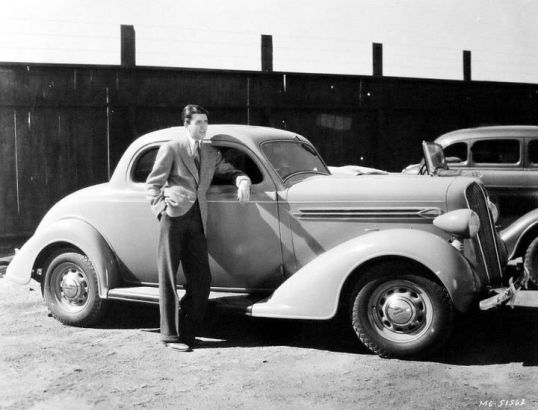
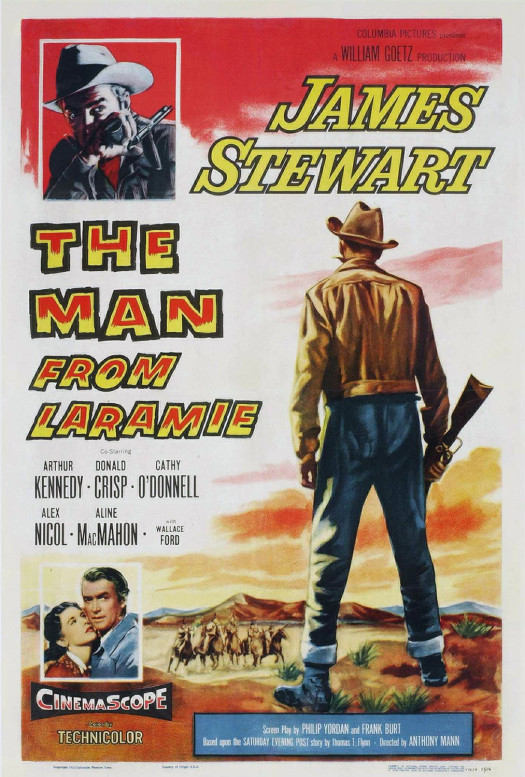
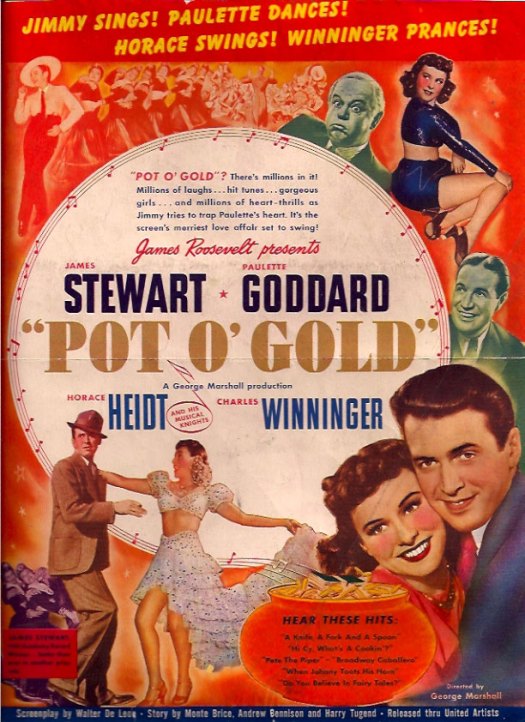
POT O’GOLD Is a fun little comedy-musical starring Jimmy Stewart, who goes to work for his music hating uncle after his music store closes, and gets involved in a feud with a clan of Irish musicians. Jimmy falls in love with the pretty daughter Molly – and since she’s played by Paulette Goddard, who can blame him! Directed by comedy vet George Marshall and featuring Charles Winninger and Horace Heidt’s Orchestra, enjoy POT O’GOLD!:
Continuing our look at good films that were not nominated for best picture, here are 6 films from the 1950s.
The Third Man (1950, dir by Carol Reed)
Now, it should be noted that The Third Man was not ignored by the Academy. It won the Oscar for Best Cinematography and it was nominated for both editing and Carol Reed’s direction. But, even with that in mind, it’s somewhat amazing to consider all of the nominations that it didn’t get. The screenplay went unnominated. So did the famous zither score. No nominations for Joseph Cotten, Alida Valli, Trevor Howard, or even Orson Welles! And finally, no Best Picture nomination. 1950 was a good year for the movies so competition was tight but still, it’s hard to believe that the Academy found room to nominate King Solomon’s Mines but not The Third Man.
Rear Window (1954, dir by Alfred Hitchcock)
Alfred Hitchcock directed some of his best films in the 50s, though few of them really got the recognition that they deserved upon their initial release. Vertigo is often described as being Hitchcock’s masterpiece but, to be honest, I actually prefer Rear Window. This film finds the master of suspense at his most playful and, at the same time, at his most subversive. Casting Jimmy Stewart as a voyeur was a brilliant decision. This film features one of my favorite Grace Kelly performances. Meanwhile, Raymond Burr is the perfect schlubby murderer. Like The Third Man, Rear Window was not ignored by the academy. Hitchcock was nominated and the film also picked up nods for its screenplay, cinematography, and sound design. However, it was not nominated for best picture.
Rebel Without A Cause (1955, dir by Nicholas Ray)
Nicholas Ray’s classic film changed the way that teenagers were portrayed on film and it still remains influential today. James Dean is still pretty much the standard to which most young, male actors are held. Dean was not nominated for his performance here. (He was, however, nominated for East of Eden that same year.) Instead, nominations went to Sal Mineo, Natalie Wood, and the film’s screenplay. Amazingly, in the same year that the forgettable Love Is A Many-Splendored Thing was nominated for best picture, this popular and influential film was not.
Kiss Me Deadly (1955, dir by Robert Aldrich)
It’s unfortunate but not surprising that Kiss Me Deadly was totally ignored by the Academy. In the mid-to-late 50s, the Academy tended to embrace big productions. There was no way they were going to nominate a satirical film noir that featured a psychotic hero and ended with the end of the world. That’s a shame, of course, because Kiss Me Deadly has proven itself to be more memorable and influential than many of the films that were nominated in its place.
Touch of Evil (1958, dir by Orson Welles)
Speaking of underappreciated film noirs, Orson Welles’s Touch of Evil is one of the craftiest and most brilliant films ever made. So, of course, no one appreciated it when it was originally released. This cheerfully sordid film features Welles at his best. Starting with a memorable (and oft-imitated) tracking shot, the film proceeds to take the audience into the darkest and most eccentric corners of a small border town. Everyone in the cast, from the stars to the bit players, is memorably odd. Even the much mocked casting of Charlton Heston as a Mexican pays off wonderfully in the end.
The 400 Blows (1959, dir by Francois Truffaut)
Francois Truffaut’s autobiographical directorial debut was released in the United States in 1959 and it was Oscar-eligible. Unfortunately, it only picked up a screenplay nomination. Of course, in the late 50s, the last thing that the Academy was going to embrace was a French art film from a leftist director. However, The 400 Blows didn’t need a best picture nomination to inspire a generation of new filmmakers.
Up next, in an hour or so, we continue on to the 60s!
Listen, there’s a lot of things that can be said about the 1952 Best Picture winner, The Greatest Show on Earth. Not only was it one of three Cecil B, DeMille films to be nominated for best picture (along with 1934’s Cleopatra and 1956’s The Ten Commandments) but it was also the only one to win. It brought Cecil B. DeMille his first and only nomination for best director. (DeMille lost that directing Oscar to John Ford but he still took home an award, as the producer of The Greatest Show On Earth.) The Greatest Show on Earth not only featured Charlton Heston in his first starring role but, with a finale that featured everyone involved in the same spectacular train crash, it also set the standard for the countless disaster movies that would follow.
But, with all of that in mind, the main thing that you’ll remember about this movie is that Jimmy Stewart was Buttons the Clown.
Buttons is a beloved member of the Ringling Bros. and Barnum & Bailey’s Circus. He travels with the circus across the country, entertaining children and generally helping out wherever he can. Everyone loves Buttons, despite the fact that no one has ever seen him without his makeup. (That said, you only have to hear him speak to immediately recognize him as being played by Jimmy Stewart.) Not even the circus’s no-nonsense manager, Brad Braden (Charlton Heston, naturally), knows what Buttons actually looks like. Everyone assumes that Buttons is just a dedicated performer, a method clown.
However, it turns out that Buttons has a secret. Of course, nearly everyone at the circus has a secret but Buttons’s secret is a little bit more serious than just a love triangle or a case of professional jealousy. There’s a reason why Buttons is surprisingly good at providing first aid to the members of the circus. Before he was a clown, Buttons was a doctor. And, while he was a doctor, he killed his wife.
NO! NOT JIMMY STEWART!
In Buttons’s defense, it was a mercy killing and he feels really bad about it. That, of course, doesn’t matter to the FBI agent (Henry WIlcoxon) who suspects that the doctor may be hiding among the circus performers. At first, Buttons views that train crash as the perfect opportunity to escape but then he finds out that many of his fellow performers have been seriously injured. A doctor is needed. Perhaps even a doctor in clown makeup….
Even under all that makeup, Jimmy Stewart does a great job of bringing Buttons to life. Sometimes, we associate Stewart so much with his famous way of speaking that we overlook just what a good actor Jimmy Stewart actually was. Even before you discover why Buttons is running from the cops, Stewart does a good job of capturing the sadness and the regret that lies at the heart of Button. He’s truly a tragic clown.
Buttons’s status as a fugitive is just one of the many subplots to be found in The Greatest Show On Earth. There’s a lot of drama (not to mention parades and performances) to get through before that train crashes. Brad, for instance, is struggling to keep the circus from going bankrupt. Meanwhile, his girlfriend, Holly (Betty Hutton), is torn between him and the arrogant but charming Great Sebastian (Cornel Wilde). In fact, every woman in the circus — including Gloria Grahame and Dorothy Lamour — is in love with the Great Sebastian. Sebastian is a bit self-centered but he’s famous enough to ensure that the circus won’t have to be closed. Or, at least, he is until he’s injured in a trapeze accident. Will Sebastian ever perform again? Meanwhile, there’s a jealous elephant trainer named Klaus (Lyle Bettinger) and a crooked concessionaire named Harry (John Kellog). A local gangster, Mr. Henderson (Lawrence Tierney), is trying to muscle his way into the circus’s business. Is it any surprise that Brad always seems to be in something of a bad mood? He’s got a lot to deal with!
And yes, it’s all a bit overblown and a bit silly. And yes, the film really does feel like it was meant to be a commercial for Ringling Bros. And yet, in its way, the film definitely works. There’s a sincerity at the heart of the film, one that’s epitomized by Cecil B. DeMille’s opening narration. “”A fierce, primitive fighting force that smashes relentlessly forward against impossible odds: That is the circus — and this is the story of the biggest of the Big Tops — and of the men and women who fight to make it — The Greatest Show On Earth!” DeMille was 71 years old when he made The Greatest Show On Earth and he was coming to the end of a legendary filmmaking career. DeMille was one of the founders of the American film industry and you can argue that, if not for some of his silent spectacles, Hollywood would have always remained just a neglected suburb of Los Angeles. If anyone understood that importance of that old saying, “The show must go on!,” it was Cecil B. DeMille. And really, that’s what The Greatest Show On Earth is all about. It’s a tribute to the performers who refuse to give up. Love triangles? Fugitive clowns? Injured acrobats? Lawrence Tierney? No matter what, the show must go on!
The Greatest Show On Earth is often described as being one of the worst films to win the Academy Award for Best Picture. That has more to do with the quality of the films that it beat — High Noon, The Quiet Man, Moulin Rouge, and Ivanhoe — than the film itself. The Greatest Show On Earth is old-fashioned and a bit silly but it’s still entertaining. Should it have beaten High Noon? That would be a definite no. But it’s still better than Crash.
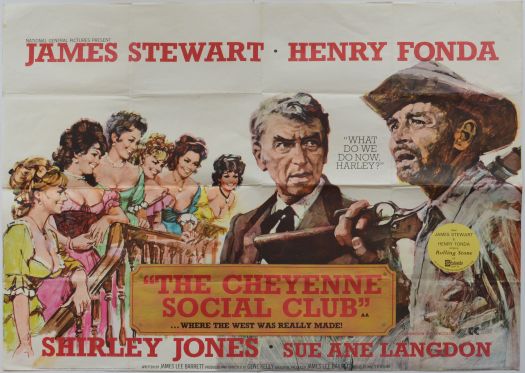
THE CHEYENNE SOCIAL CLUB isn’t a great movie, but it’s not a bad one, either. It couldn’t be; not with all that talent in front of and behind the cameras. You’ve got two legendary leads, James Stewart and Henry Fonda , Oscar winner Shirley Jones, Gene Kelly in the director’s chair, and John Wayne’s favorite cinematographer William Clothier . Still, the film, while amusing, should’ve been so much better.
The story’s fairy simple: two old Texas cowhands, John O’Hanlon (Stewart) and Harley Sullivan (Fonda) are plying their trade when John receives a letter. Seems John’s brother has died and left him an inheritance – The Cheyenne Social Club in Cheyenne, Wyoming. John and his old pal head north, and it turns out The Cheyenne Social Club is a cathouse, run by Madame Jenny (Jones), and she and the girls warmly greet the perplexed duo. Uptight John, who’s always wanted to…
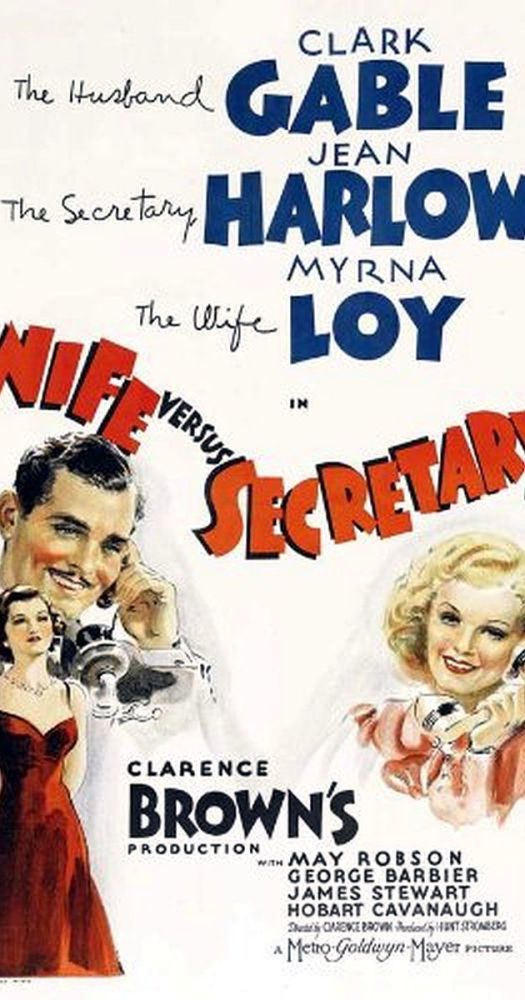
Gable’s back and Harlow’s got him , but so does Myrna Loy , with Jimmy Stewart along for the ride in WIFE VS SECRETARY. MGM boasted it had “more stars than there are in Heaven”, and this film is the very definition of “star vehicle”, a harmless soufflé of comedy, drama, and romance all wrapped up in a neat little package by veteran studio director Clarence Brown.
Publicity still for ‘Wife vs Secretary’
The plot’s as thin as Gable’s moustache: He’s a hard-driven publisher, and Loy’s his trusting, faithful wife. Harlow plays his loyal secretary and trusted aide-de-camp. She’s also quite beautiful (obviously, since she’s Jean Harlow!) and Gable’s mother tells Myrna she should get rid of her. Myrna laughs it off, but the seed of doubt has been planted. Jimmy plays Jean’s fiancé, who’s not too happy about being constantly cast aside by Jean’s work demands (and who can…
BEND OF THE RIVER, the second of the James Stewart/Anthony Mann Westerns, isn’t quite as good as the first, WINCHESTER ’73 . That’s not to say it isn’t a good film; it’s just hard to top that bona fide sagebrush classic. Stewart continues his post-war, harder edged characterizations as a man determined to change his ways, and is supported by a strong cast that includes a villainous turn by the underrated Arthur Kennedy .
Jimmy plays Glyn McLyntock, an ex-outlaw now riding as trail boss for a group of farmers heading to Oregon to begin a new life. He encounters Kennedy as Emerson Cole, a horse thief about to be hanged, and enlists his help on the trail west. Both men know each other’s reputations; they were both once raiders along the Missouri/Kansas border. The wagons are attacked at night by Shoshone, an arrow piercing young Laura Baile, daughter of…
(With the Oscars scheduled to be awarded on March 4th, I have decided to review at least one Oscar-nominated film a day. These films could be nominees or they could be winners. They could be from this year’s Oscars or they could be a previous year’s nominee! We’ll see how things play out. Today, I take a look at the 1938 best picture winner, You Can’t Take It With You!)
“You can’t take it with you.”
If there’s any one belief that defines the worldview of Martin Vanderhof (Lionel Barrymore), it’s this. It doesn’t matter how much money you make in your life. It doesn’t matter how successful you are at business or anything else. The fact of the matter is that, when your time is up, you won’t be able to take any of that stuff with you. Instead, Grandpa Vanderhof (as he’s called by his large family) believes that the most important thing to do during your lifetime is to make friends and pursue what you’re truly interested in.
Vanderhof has another belief, one that particularly appealed to be me. He has never paid income tax. He doesn’t see the point of giving money to the government when he doesn’t feel that they’ll make good use of it. When an outraged IRS agent (Charles Lane) stops by Vanderhof’s sprawling house and demands that Vanderhof pay his taxes, Vanderhof refuses. When the IRS man argues that the income tax is necessary to pay for the Presidency, the Congress, and the Supreme Court, Vanderhof offers to give him five dollars. “Hell yeah!” I shouted at the TV. With an attitude like that, Vanderhof should have moved down here to Texas. We would have elected him governor.
Grandpa Vanderhof is the head of a large and cheerfully eccentric family, all of whom live together under the same roof. Penny (Spring Byington) writes novels because, years ago, a typewriter was accidentally delivered to the house. Her husband, Paul (Samuel S. Hinds), has a basement full of fireworks. Essie (Ann Miller) loves to dance and spends almost the entire movie twirling from room to room. Her husband, Ed (Dub Taylor), is a xylophone player.
Of course, it’s not just family living in the Vanderhof House. There’s also Potap Kolenkhov (Mischa Auer), a Russian who is “teaching” Essie how to dance. There’s Rheba the maid (Lillian Yarbo) and Donald (Eddie Anderson) the handyman. Actually, the house appears to be open to just about anyone who wants to stay.
And then there’s Penny’s daughter, Alice (Jean Arthur). Alice is the most “normal” member of the family. She has just become engaged to Tony Kirby (James Stewart) and she is still trying to figure out how to introduce Tony’s stuffy parents (Edward Arnold and Mary Forbes) to her eccentric family. What she and Tony don’t know is that Mr. Kirby is currently trying to buy up all the houses that are near a competitor’s factory. Only one homeowner has refused to sell. The name of that homeowner? Martin “Grandpa” Vanderhof.
It all leads, of course, to one chaotic dinner party, one lively night in jail, and a huge fireworks display. It also leads to true love, which is nice. Jimmy Stewart and Jean Arthur are even more adorable here than they were in Mr. Smith Goes To Washington.
Based on a Pulitzer-winning play by George S. Kaufman, You Can’t Take It With You was the second comedy to win the Oscar for Best Picture. The first comedy to win was 1934’s It Happened One Night. It’s probably not coincidence that both of these films were directed by Frank Capra.
Seen today, You Can’t Take It With You seems a bit slight for an Oscar winner. Grandpa Vanerhof is a lovable eccentric. Tony’s father is a stuffy businessman. Hmmm … I wonder whose philosophy is going to be victorious at the end of the movie? Still, predictability aside, it’s a delightfully enjoyable film. While it never quite escape its stage origins, it features wonderful performances from all the usual members of the Capra stock company. James Stewart and Jean Arthur are a charming couple while Lionel Barrymore gives a performance that is so warmly likable that it’s hard to imagine that, just 9 years later, he would be so perfectly cast as the heartless Mr. Potter in It’s A Wonderful Life. Of course, my favorite member of the member was Essie, mostly because I also like to dance from room to room. While it’s hard to justify awarding it Best Picture over The Adventures of Robin Hood and Grand Illusion, You Can’t Take It With You is still a wonderfully fun movie.
It’ll make you smile and laugh. Who can’t appreciate that?
(With the Oscars scheduled to be awarded on March 4th, I have decided to review at least one Oscar-nominated film a day. These films could be nominees or they could be winners. They could be from this year’s Oscars or they could be a previous year’s nominee! We’ll see how things play out. Today, I take a look at the 1963 best picture nominee, How The West Was Won!)
How was the west won?
According to this film, the west was won by the brave men and women who set out in search of a better life. Some of them were mountain men. Some of them worked for the railroads. Some of them rode in wagons. Some of them gambled. Some of them sang songs. Some shot guns. Some died in the Civil War. The thing they all had in common was that they won the west and everyone had a familiar face. How The West Was Won is the history of the west, told through the eyes of a collection of character actors and aging stars from Hollywood’s Golden Age.
In many ways, How The West Was Won was the Avatar of the early 60s. It was a big, long, epic film that was designed to make viewers feel as if they were in the middle of the action. Avatar used 3D while How The West Was Won used Cinerama. Each scene was shot with three synchronized cameras and, when the film was projected onto a curved Cinerama screen, it was meant to create a truly immersive experience. The film is full of tracking shots and, while watching it on TCM last night, I tried to imagine what it must have been like to see it in 1963 and to feel as if I was plunging straight into the world of the old west. The film’s visuals were undoubtedly diminished by being viewed on a flat screen and yet, there were still a few breath-taking shots of the western landscape.
The other thing that How The West Was Won had in common with Avatarwas a predictable storyline and some truly unfortunate dialogue. I can understand why How The West Was Won was awarded two technical Oscars (for editing and sound) but, somehow, it also picked up the award for Best Writing, Screenplay or Story. How The West Was Won is made up of five different parts, each one of which feels like a condensed version of a typical western B-movie. There’s the mountain man helping the settlers get down the river story. There’s the Civil War story. There’s the railroad story and the outlaw story and, of course, the gold rush story. None of it’s particularly original and the film is so poorly paced that some sections of the film feel rushed while others seem to go on forever.
Some of the film’s uneven consistency was undoubtedly due to the fact that it was directed by four different directors. Henry Hathaway handled three sections while John Ford took care of the Civil War, George Marshall deal with the coming of the railroad, and an uncredited Richard Thorpe apparently shot a bunch of minor connecting scenes.
And yet, it’s hard not to like How The West Was Won. Like a lot of the epic Hollywood films of the late 50s and early 60s, it has its own goofy charm. The film is just so eager to please and remind the audience that they’re watching a story that could only be told on the big screen. Every minute of the film feels like a raised middle finger to the threat of television. “You’re not going to see this on your little idiot box!” the film seems to shout at every moment. “Think you’re going to get Cinerama on NBC!? THINK AGAIN!”
Then there’s the huge cast. As opposed to Avatar, the cast of How The West Was Won is actually fun to watch. Admittedly, a lot of them are either miscast or appear to simply be taking advantage of a quick payday but still, it’s interesting to see just how many iconic actors wander through this film.
For instance, the film starts and, within minutes, you’re like, “Hey! That’s Jimmy Stewart playing a mountain man who is only supposed to be in his 20s!”
There’s Debbie Reynolds as a showgirl who inherits a gold claim!
Is that Gregory Peck as a cynical gambler? And there’s Henry Fonda as a world-weary buffalo hunter! And Richard Widmark as a tyrannical railroad employee and Lee J. Cobb as a town marshal and Eli Wallach as an outlaw!
See that stern-faced settler over there? It’s Karl Malden!
What’s that? The Civil War’s broken out? Don’t worry, General John Wayne is here to save the day. And there’s George Peppard fighting for the Union and Russ Tamblyn fighting for the Confederacy! And there’s Agnes Moorehead and Thelma Ritter and Robert Preston and … wait a minute? Is that Spencer Tracy providing narration?
When Eli Wallach’s gang shows up, keep an eye out for a 36 year-old Harry Dean Stanton. And, earlier, when Walter Brennan’s family of river pirates menaces Karl Malden, be sure to look for an evil-looking pirate who, for about twenty seconds, stares straight at the camera. When you see him, be sure to say, “Hey, it’s Lee Van Cleef!”
How The West Was Won is a big, long, thoroughly silly movie but, if you’re a fan of classic film stars, it’s worth watching. It was a huge box office success and picked up 8 Oscar nominations. It lost best picture to Tom Jones.
(By the way, in my ideal fantasy world, From Russia With Love secured a 1963 U.S. release, as opposed to having to wait until 1964, and became the first spy thriller to win the Oscar for Best Picture.)
James Stewart and Anthony Mann’s fourth Western together, 1955’s THE FAR COUNTRY, takes them due North to the Klondike during the Gold Rush of 1896. It’s a bit more formulaic than other Stewart/Mann collaborations, but a strong cast and some gorgeous Technicolor photography by William H. Daniels more than make up for it. The film is definitely worth watching for Western fans, but I’d rank it lowest on the Stewart/Mann totem pole.
Jimmy is Jeff Webster, a headstrong cattleman who drives his herd from Wyoming to Seattle to ship up north to the beef-starved gold miners for a huge profit. Webster killed two men along the way who tried to desert the drive, and barely escapes Seattle before arriving in Skagway, Alaska. There, he unintentionally interrupts a hanging being conducted by crooked town boss ‘Judge’ Gannon, who confiscates Webster’s herd as a fine for spoiling his fun. Webster and his two…