Retro Television Review: Miami Vice 2.6 “Buddies”


Welcome to Retro Television Reviews, a feature where we review some of our favorite and least favorite shows of the past!  On Mondays, I will be reviewing Miami Vice, which ran on NBC from 1984 to 1989.  The entire show can be purchased on Prime!

This week, Crockett discovers that one of his oldest friends has a secret.

Episode 2.6 “Buddies”

(Dir by Henry Mastrogeorge, originally aired on November 1st, 1985)

When sleazy stand-up comedian Morty Price (a youngish Nathan Lane) attempts to sexually assault a cocktail waitress named Dorothy (Eszter Balint), he ends up getting fatally stabbed with a steak knife.  Dorothy flees from the crime scene, taking her baby and grabbing a bunch of random papers that, unknown to her, prove that Morty Price was placing illegal bets with mobster Frank Doss (Frankie Valli).  This information could keep Doss from being able to get a casino license in Florida.

Because Doss and his partner, Johnny Cannata (Tom Signorelli), are mob-connected, Castillo and Vice take over the investigation of Price’s murder.  Sonny and Tubbs learn, from an informant (Karla Tamburrelli), that Price took Dorothy up to his room before he was murdered.  While Crockett and Tubbs search for Dorothy to find out what happened with Price, Doss and Cannata send their men to track down Dorothy and keep the papers from reaching the police.

During the investigation, Sonny is stunned to come across security footage of one of his oldest friends, Robbie Cann (James Remar), meeting with Doss and Cannata.  Robbie not only served in Vietnam with Sonny but he has also recently asked Sonny to be his son’s godfather.  Robbie has just opened up a club and, as he explains to Sonny, he finally feels like he’s something more than just a loser.  When Sonny confronts Robbie about meeting with the gangsters, Robbie admits that he borrowed money from them to start the club but he insists that he doesn’t have any other type of relationship with them.  However, when Sonny attends the christening of Robbie’s son, he discovers that Robbie’s name is actually Robert Cannata.  He is Johnny Cannata’s son!  Robbie insists that he has nothing to do with his father’s business but Sonny is forced to ask just how much he can trust one of his closest friends.

This episode is a bit of a mess.  On the plus side, fans of character actors will enjoy this episode.  James Remar’s nervy performance keeps you guessing and it’s undeniably interesting to see Nathan Lane playing someone that sleazy.  Frankie Valli and Tom Signorelli make for convincing gangsters.  It’s also the first episode of the series to really feature Sonny talking about what it was like to serve in Vietnam and it deserves some credit for attempting to explore the difficulty that many veterans face when trying to adjust back to civilian life.  Robbie has not had an easy life after returning to the U.S. but now, he finally has a wife, a child, and a business.  Sonny may feel betrayed by Robbie but he’s also aware that his investigation is going to potentially ruin Robbie’s life.

On the other hand, the episode attempts to take on so much that it stretches itself a bit then.  It requires a real suspension of disbelief to accept that Sonny would just happen to be assigned to an investigation that would involve his best friend.  I mean, what are the chances?  The episode also can’t seem to decide if it wants to focus on Robbie or if it wants to focus on Dorothy and her child.  As a result, neither story really feels as if it gets all of the attention that it deserves.

Next week, the Vice Squad investigates jazz legend Miles Davis!

The Unnominated: The Long Riders (Dir by Walter Hill)


Though the Academy of Motion Picture Arts and Sciences claim that the Oscars honor the best of the year, we all know that there are always worthy films and performances that end up getting overlooked.  Sometimes, it’s because the competition too fierce.  Sometimes, it’s because the film itself was too controversial.  Often, it’s just a case of a film’s quality not being fully recognized until years after its initial released.  This series of reviews takes a look at the films and performances that should have been nominated but were, for whatever reason, overlooked.  These are the Unnominated.

First released in 1980, The Long Riders is one of the many films to tell the story of the James/Younger Gang.

A group of former Confederate guerillas who became some of the most notorious bank robbers to roam post-Civil War America and who were based in Missouri, the brothers who made up the James/Younger Gang were hunted by the Pinkertons and beloved by the citizens who viewed them as being 19th Century Robin Hoods.  Following a disastrous attempt to rob a bank in Northfield, Minnesota, the Younger brothers were captured by the government while Jesse and Frank James made it back to Missouri.  Jesse was shot in the back by Bob Ford while Frank subsequently surrendered to authorities and made a good living on the lecture circuit.

The Long Riders tells the story of the gang, from their first encounter with the heavy-handed Pinkertons to the Northfield raid to Frank’s eventual surrender.  Director Walter Hill both celebrates the legend of the James/Younger Gang while also emphasizing that all the members of the gang were also individual humans who had their strengths and their flaws.  Hill emphasizes the idea of the gang being a group of post-war rebels, still fighting a war against a government that is more interested in protecting banks than looking after people.  The Long Riders deconstructs the legend while also celebrating it.

The main thing that sets The Long Riders apart from other films about the James/Younger Gang is the fact that the brothers are played by actual brothers.  David, Keith, and Robert Carradine plays the Youngers.  Randy Quaid plays Clell Miller while Dennis Quaid assumes the role of the cowardly Ed Miller.  Nicholas and Christopher Guest make a memorably creepy impression as Charley and Bob Ford.  And finally, Jesse and Frank James are played by James and Stacy Keach.  (The Keaches also worked on the film’s script).  And while Stacy is definitely the more charismatic of the Keach brothers, the film makes good use of James’s rather stoic screen presence.  While the rest of the gang enjoys the outlaw life, James Keach’s Jesse is rigid, serious, and ultimately too stubborn and obsessive for his own good.

Now, the casting might sound like a gimmick but it works wonderfully.  When Clell chooses the gang over Ed, it carries an emotional weight because we’re watching real brothers reject each other.  The comradery between the Carradines carries over to the comradery between the Youngers and it also informs their occasional rivalry with the better known James brothers.  While it is Stacy Keach and David Carradine who ultimately dominate the film, every brother in the cast makes a strong impression.  Also giving a memorable performance is Pamela Reed as a defiantly independent Belle Starr, who loves David Carradine’s Cole Younger but marries Sam Starr (James Remar).  The knife fight between Carradine and Remar is one of the film’s highlights, as is the violent and disastrous attempt to rob the bank in Northfield.

The Long Riders is an exciting and ultimately poignant western but sadly, it received not a single Oscar nomination, not even for the stunning cinematography or Ry Cooder’s elegiac score.  Fortunately, just like the legend of the James/Younger Gang, The Long Riders lives on.

Previous entries in The Unnominated:

  1. Auto Focus 
  2. Star 80
  3. Monty Python and The Holy Grail
  4. Johnny Got His Gun
  5. Saint Jack
  6. Office Space
  7. Play Misty For Me

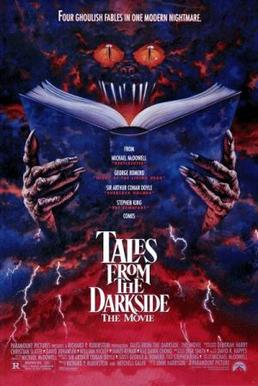
Horror Film Review: Tales From The Darkside: The Movie (dir by John Harrison)


First released in 1990 and based on a horror-themed television series that was created by the one-and-only George Romero, Tales From The Darkside: The Movie is an anthology film.  Usually, I can’t stand anthology films because it seems like the viewer only gets one good story and has to sit through two or three mediocre stories to get to the worthwhile stuff.  However, I have to say that I really enjoyed all of the stories featured in Tales From The Darkside: The Movie.

The film opens with a wrap-around story, featuring Timmy (Matthew Lawrence), a young boy who is chained up in a pantry and who a local witch named Betty (Debbie Harry) is planning on cooking for a dinner party.  Timmy tries to distract Betty from her kitchen duties by telling her three stories.

The first story features Steve Buscemi as a nerdy college student named Edward Bellingham.  On the verge of getting a much-needed scholarship, Edward is framed for theft by two of his classmates (one of whom is played by Julianne Moore) and loses the scholarship.  Edward responds by doing what anyone would do.  He unrolls an ancient parchment and brings to life a mummy who kills his rivals.  A very preppy Christian Slater plays Andy, the smug brother of one of the victims who seeks revenge against Bellingham.  In a surprise twist, Bellingham is able to get some vengeance of his own.

The second story features William Hickey as Drogan, an annoying old man who is convinced that he is being stalked by an evil black cat.  Drogan hires a hitman (David Johansen) to kill the cat but, as we all know, black cats are far more clever than anyone realizes.  The story ends on a notably grisly note because cats rule!

Finally, the third story features James Remar as a struggling artist who, one night, discovers that the stone gargoyle that sits atop of his apartment building is actually alive.  After witnessing the gargoyle kill someone, the artist promises never to reveal that the gargoyle exists.  “Cross your heart?” the gargoyle asks before flying away.  Later, the artist meets a mysterious woman (Rae Dawn Chong) who helps him to become a success on the art scene.  However, even after he marries the woman and they start a family, Remar is still haunted by his memories of the gargoyle.

As I said at the start of this review, I’m not a huge fan of anthology films but I really liked Tales From The Darkside: The Movie.  All three of the stories are equally good and there’s really not a slow spot to be found.  This is a horror anthology that manages to balance scares and laughs without becoming too silly or forgetting that the movie is meant to be a horror story.  Steve Buscemi, Christian Slater, and James Remar are stand-outs amongst the cast.  Even the wrap-around story had a good ending!

If you’re going to watch an anthology film for Halloween, allow me to recommend Tales From The Darkside: The Movie!

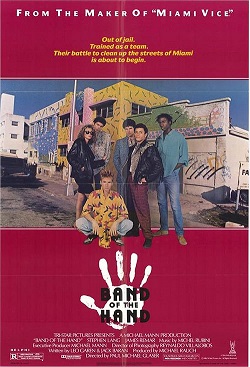
Band of the Hand (1986, directed by Paul Michael Glaser)


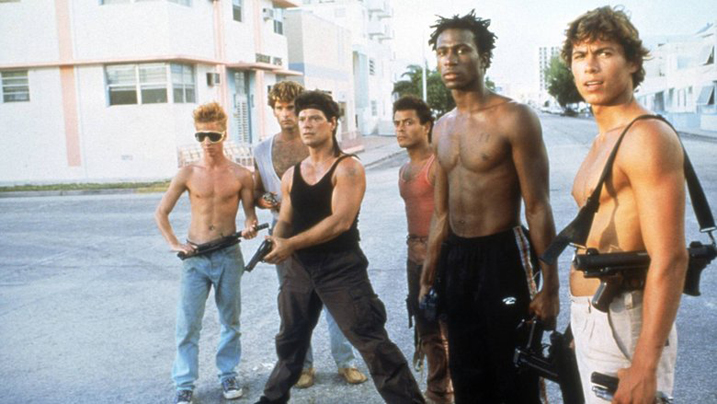
This place is Florida.  The time is the 80s.  Five juvenile delinquents have been given a chance to earn their freedom.  All they have to do is go down to the Everglades and train with Indian Joe (Stephen Lang), a no-nonsense Vietnam veteran who is determined to teach them not only survival sills but also how to work together as a team.  But Joe is interested in more than just reforming a group of youthful troublemakers.  He wants to turn them into a crime-fighting team who can help clean up the most dangerous neighborhood in Miami.  When Joe and delinquents move into and refurbish a previously condemned building, they get the attention of both the local drug kingpin (James Remar) and his main enforcer (Laurence Fishburne).

Band of the Hand is very much a film of its time, not only in its fashion and music choices but also in its full-on embrace of the war on drugs and the idea that the best way to clean up the streets is for vigilantes to do it on their own.  The film was produced by Michael Mann and, as directed by former Starsky and Hutch star Paul Michael Glaser, the film has the look of an episode of Miami Vice.  That might be because the film itself was originally meant to be a pilot for a television show.  When the networks passed on it, it was released to theaters instead and advertised as being “from the maker of Miami Vice.”    The movie never escapes its television origins.  Things start strong in the Everglades, with Lang proving himself to be a master of glowering and the young delinquents struggling to not only survive Lang’s training but also resist the temptation to kill each other.  It’s less interesting once the action moves to Miami and it becomes Death Wish 3 without the blood or Charles Bronson.  The scenes with the young men goofing around are an awkward fit with the scenes of Remar and Fishburne terrorizing the neighborhood.

Band of the Hand is still worth watching if you want to see some familiar faces early in their careers.  John Cameron Mitchell and Leon both score early roles as two of the delinquents-turned-crime fighters and Lauren Holly plays the romantic interest who is inevitably ends up with the bag guys.  James Remar was always a good villain and Laurence Fishburne channels both his previous performance in Death Wish II and his future performance in King of New York.  It’s a good cast, even if no one really breaks free from the production’s television origins.

The idea of creating a show about a special unit of young crime fighters who battle drug pushers was one that Mann didn’t abandon.  The final episode of Miami Vice was essentially an unsold pilot that followed many of the same plot beats as Band Of the Hand.  (It also didn’t lead to a television series, though some might argue that 21 Jump Street took the same idea and ran with it.)  As for director Paul Michael Glaser, he would later do a much better job with The Running Man.

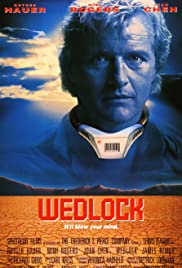
Wedlock (1991, directed by Lewis Teague)


This HBO film opens with a shot of an urban skyline and a title card that reads “somewhere in the future.”  However, the city looks like a present-day city and the cars don’t fly and all of the clothing is 90s fashionable and the people in the movie use pay phones.  Since Wedlock was made in 1991, I guess the movie takes place in … 1992?  Maybe 1993.

Frank (Rutger Hauer), Noelle (John Chen), and Sam (James Remar) are professional thieves who have just managed to make a big score.  They’ve stolen several million dollars worth of diamonds.  Unfortunately, Sam tripped an alarm during the theft so Frank had to make off with the diamonds.  After he hides them, Frank goes to the rendezvous point to meet up with Sam and Noelle.  His partners betray him, shooting Frank and, after discovering that he doesn’t have the diamonds him, leaving him for dead.

However, Frank survives.  He ends up getting sent to Camp Holliday, a prison run by Warden Holliday (Stephen Tobolowsky, who you’ll recognize as Ned Ryerson from Groundhog Day). The Warden explains that his prison is more progressive than most.  Not only is the prison co-ed but prisoners are allowed more freedom to move around.  The only catch is that all the prisoners wear an explosive dog collar.  Each prisoner has a randomly selected mate, someone to whom they are wedlocked, if you will.  Move more than 100 yards away from your partner and boom!  Both collars go off and two prisoners end up losing their heads.

The Warden wants to know where the diamonds are hidden so he sets about torturing Frank (who has been given the prison name of Magneta) but he soon discovers that it won’t be easy to break Frank Warren.  Even after Frank gets locked in a sensory deprivation tank, he just laughs and says the diamonds are with Santa at the North Pole.  Another prisoner, Ivory (Mimi Rogers) approaches Frank and says that she’s figured out that she’s his partner.  She wants to escape and she needs Frank to come with her.  But can Frank trust her and, if she’s wrong, won’t both of their heads explode?  Then again, who in the near future of the 1990s would turn down a chance to run off with Mimi Rogers?  Meanwhile, Frank’s partners are waiting for him to escape from the prison so that they can follow him to wherever the diamonds are located.

Though the plot may be ludicrous, Wedlock works because it has a good cast (even Danny Trejo has a small role) and it was directed by Lewis Teague, who started his directorial career under Roger Corman and who has always understood how to put together a good B-movie.  The prison scenes are more interesting than the scenes that take place in the outside world but the exploding head effects are cool and Rutger Hauer, James Remar, and Mimi Rogers are always enjoyable to watch no matter what they’re doing.

Fatal Instinct (1993, directed by Carl Reiner)


Ned Ravine (Armand Assante) is a cop who is also a lawyer.  His shtick is to make an arrest and then defend that person in court.  He’s married to Lana (Kate Nelligan), who is having an affair with a mechanic named Frank (Christopher McDonald).  Lana has taken out a life insurance policy on Ned, one that has a triple indemnity clause.  If he’s shot on a northbound train and then falls off and drowns in a nearby stream, Lana and Frank will make a lot of money.  However, Lana and Frank are not the only people who want to kill Ned Ravine.  One of Ned’s former clients, Max Shady (James Remar), has just been released from prison and is seeking revenge.  The main reason why Ned hasn’t figured out that everyone is trying to kill him is because he’s been distracted by the seductive Lola (Sean Young), a client who asked him to look over some legal papers and who has an improbable connection to Lana.

As you might guess by the plot and Carl Reiner’s directorial credit, Fatal Instinct is a spoof of detective movies, with the majority of the jokes being inspired by Basic Instinct, the remake of Cape Fear, Double Indemnity, and Body Heat.  How much you laugh will depend on how well you know those films.  There’s a scene in Ned’s office where Ned notices that Lola isn’t wearing panties.  He helpfully produces a pair from inside his desk and hand them to her.  In 1994, that scene was funny because Basic Instinct and whether or not Sharon Stone was aware of how her famous interrogation scene was being filmed were still a huge part of the pop cultural conversation.  Today, it might just seem weird.

Carl Reiner has always been an uneven filmmaker and that trend continues in Fatal Instinct, where he tries to do to erotic thrillers what Mel Brooks did to westerns and Airplane! did to disaster films.  Unfortunately, Reiner often gets bogged down by the film’s plot, which should really be the last thing anyone should be worried about when it comes to a spoof like this.  Some of the jokes are funny and some of them aren’t but, because Reiner doesn’t duplicate the joke-every-minute style of a film like Airplane!, there’s a lot more time to think about the jokes that fall flat.

Fatal Instinct does have a good cast, featuring a lot of actors who probably should have become bigger stars than they did.  I especially liked Kate Nelligan’s and Christopher McDonald’s performances as the two triple indemnity conspirators.  Sherilyn Fenn plays Ned’s loyal secretary and seeing her give such a fresh and likable performance in this otherwise uneven film makes me regret even more that, outside of Twin Peaks, she never really got the roles that she deserved.

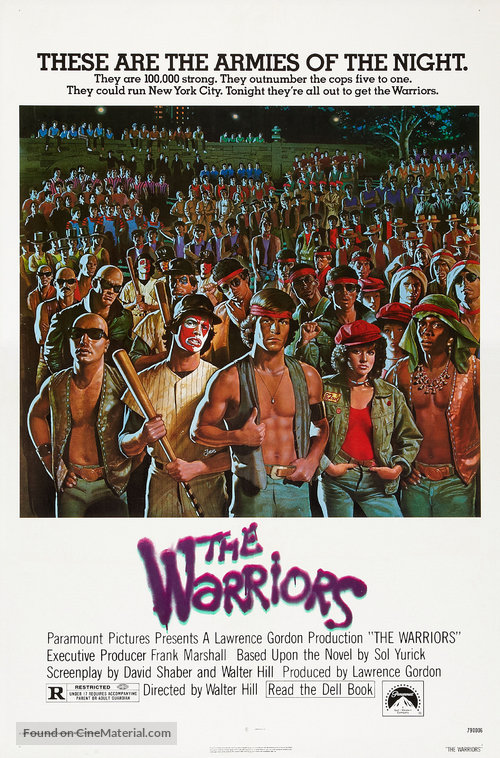
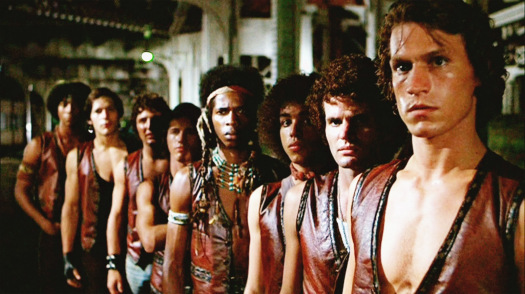
In The City: THE WARRIORS (Paramount 1979)


gary loggins's avatarcracked rear viewer


Back in the 70’s, the crowd I hung out with didn’t give a rat’s ass about STAR WARS … THE WARRIORS was THE movie to see! The film reportedly resulted in outbreaks of violence, vandalism, and even three deaths  – including one up in Boston! – and Paramount Pictures pulled all its advertising, because that’s what adults do! Didn’t matter to us, though… everyone already knew about THE WARRIORS and it’s glorification of violence, and all the neighborhood cool kids just had to catch it (including a certain long-haired wiseass who used to amuse his street corner friends with his “useless knowledge” of old movies).

The myriad street gangs of New York City have declared a truce and gathered together for a big meet called by Cyrus, leader of The Riffs. The charismatic Cyrus whips ’em into a frenzy proposing they all organize into one huge gang to control The…

View original post 937 more words

Van Damme Directs: The Quest (1996, directed by Jean-Claude Van Damme)


In the 1920s, New York pickpocket Christoper DuBois (Jean-Claude Van Damme) flees both the police and the mob by stowing away on a boat.  Before he leaves, he promises a group of orphans that he will return to them.  Thay promise is easier made than kept because DuBois is captured by pirates, rescued by Lord Dobbs (Roger Moore), and then sold into slavery on an island off the coast of Siam.

Apparently, Siamese slavery means being taught in the ways of Muay Thai boxing because, when Dobbs eventually returns, DuBois is a champion fighter.  Not holding a grudge about the whole slavery thing, DuBois requests that Dobbs and his partner, Harri (Jack McGee), accompany him to the Lost City of Tibet so that DuBois can represent the United States in a martial arts tournament.  The winner receives a statue made entirely out of the gold, the legendary Golden Dragon.  Wanting the dragon for themselves, Dobbs and Harri go with DuBois to Tibet.  Also accompanying them is a reporter (Janet Gunn) and Max Devine (James Remar), the boxer was supposed to represent the United States but who dropped out when he realized that DuBois was the better fighter.

In the Lost City, DuBois survives several elimination rounds against the best fighters from across the world.  While DuBois always shows mercy to his opponents, his main rival, Khan (Abdel Quissi), indiscriminately kills anyone who gets in the ring with him.  Meanwhile, Dobbs and Harri make plans to steal the golden dragon for themselves.

When it comes to the second-tier action heroes of 1990s, Jean-Claude Van Damme was never as good an actor as Dolph Lundgren but he was still more likable than Steven Seagal.  Van Damme’s appeal was that, in real life, he could actually do all of the things that he did in the movies.  For action audiences, there was never any doubt about who would win if Van Damme and Steven Seagal ever went at in real life.   Movies like The Quest never impressed the critics but they did give Van Damme’s fans exactly what they wanted out of a Van Damme film.

The Quest was unique because it was Van Damme’s debut as a director.  Unlike a lot of actors-turned-director, Van Damme mostly resists the temptation to get too self-indulgent.  There is one scene where Van Damme wears old age makeup and another where he wanders through the slums of New York while dressed as a clown but Van Damme is smart enough to leave most of the heavy acting to capable professionals like Roger Moore and James Remar.  While Moore and Remar ham it up and keep things entertaining, Van Damme concentrates on fighting and trying to return to the orphans.  The fight scenes are sometimes too short but at least Van Damme makes a point of showcasing each competitor’s different style.  There aren’t many films that include both sumo wrestling and capoeira.

The Quest is basically Bloodsport in the 1920s but, as they used to say in the 90s, it’s still damme entertaining.

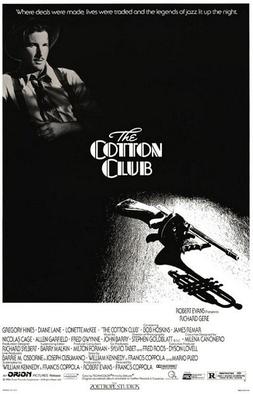
A Movie A Day #264: The Cotton Club (1984, directed by Francis Ford Coppola)


The time is the 1930s and the place is New York City.  Everyone wants to get into the Cotton Club.  Owned by British gangster Owney Madden (Bob Hoskins), the Cotton Club is a place where the stage is exclusively reserved for black performers and the audience is exclusively rich and white.  Everyone from gangsters to film stars comes to the Cotton Club.
It is at the Cotton Club that Dixie Dwyer (Richard Gere) meets everyone from Dutch Shultz (James Remar) to Gloria Swanson (Diane Venora).  Shultz hires Dixie to look after his girlfriend, Vera (Diane Lane).  Swanson arranges for Dixie to become a movie star.  Meanwhile, Dixie’s crazy brother, Vincent (Nicolas Cage), rises up through the New York underworld.  Meanwhile, dancing brothers Sandman and Clay Williams (played by real-life brothers Gregory and Maurice Hines) are stars on stage but face discrimination off, at least until Harlem gangster Bumpy Rhodes (Laurence Fishburne) comes to their aid.

The Cotton Club was a dream project of the legendary producer, Robert Evans, who was looking to make a comeback after being famously charged with cocaine trafficking in 1980.  Having commissioned a screenplay by his former Godfather collaborators, Mario Puzo and Francis Ford Coppola, Evans originally planned to direct the film himself.  At the last minute, Evans changes his mind and asked Coppola to direct the film.  After working with him on The Godfather, Coppola had sworn that he would never work with Evans again. (When he won an Oscar for The Godfather‘s screenplay, Coppola pointedly thanked everyone but Robert Evans.)  However, by 1984, a series of box office flops had damaged Coppola’s standing in Hollywood.  Needing the money, Coppola agreed to direct The Cotton Club.

Evans raised the film’s $58 million budget from a number of investors, including Roy Radin.  Roy Radin was best known for putting together Vaudeville reunions in the 70s and being accused of raping an actress in 1980.  Radin and Evans were introduced to each other by a drug dealer named Lanie Jacobs, who was hoping to remake herself as a film producer.  During the production of The Cotton Club, Radin was murdered by a contract killer who was hired by Jacobs, who apparently felt that Radin was trying to muscle her out of the film production.

While all of this was going on, Coppola fell into his familiar pattern of going overbudget and falling behind schedule.  This led to another investor filing a lawsuit against Orion Pictures and two other investors, claiming fraud and breach of contract.  When the film was finally released, it received mixed reviews, struggled at the box office, and only received two Oscar nominations.

With all of the murder and drama that was occurring offscreen, it is not surprising that the film itself was overshadowed.  The Cotton Club is a disjointed mix of gangster drama and big production numbers.  As always with post-Apocalypse Now Coppola, there are flashes of brilliance in The Cotton Club.  Some of the production numbers are impressive and visually, this movie has got style to burn.   However, among the leads, neither Richard Gere nor Diane Lane seem to be invested in their characters while the talented Hines brothers are underused.  The supporting cast is full of good character actors who are all in a search of a better script.  A few do manage to make an impression: James Remar, Bob Hoskins and Fred Gwynne as veteran gangsters, Nicolas Cage as the film’s stand-in for Mad Dog Coll, and Joe Dallesandro as Lucky Luciano.  The Cotton Club is sometimes boring and sometimes exciting but the onscreen story is never as interesting as what happened behind the scenes.


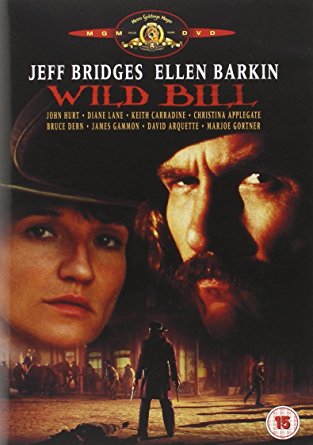
A Movie A Day #219: Wild Bill (1995, directed by Walter Hill)


The year is 1876 and the legendary Wild Bill Hickok (Jeff Bridges) sits in a saloon in Deadwood and thinks about his life (most of which is seen in high-resolution, black-and-white flashbacks).  Hickok was a renowned lawman and a sure shot, a man whose exploits made him famous across the west.  Thanks to his friend, Buffalo Bill Cody (Keith Carradine), he even appeared on the New York stage and reenacted some of his greatest gun battles.  Now, Hickok is aging.  He is 39 years old, an old man by the standards of his profession.  Though men like Charlie Prince (John Hurt) and California Joe (James Gammon) continue to spread his legend, Hickok is going blind and spends most of his time in a haze of opium and regret.

Hickok only has one true friend in Deadwood, Calamity Jane (Ellen Barkin).  He also has one true enemy, an aspiring gunslinger named Jack McCall (David Arquette).  McCall approaches Hickok and announces that he is going to kill him because of the way that Hickok treated his mother (played, in flashback, by Diane Lane).  Hickok does not do much to dissuade him.

Based on both a book and a play, Wild Bill is a talky and idiosyncratic Western from Walter Hill.  Hill is less interested in Hickok as a gunfighter than Hickok as an early celebrity.  There are gunfights but they only happen because, much like John Wayne in The Shootist, Hickok has become so famous that he cannot go anywhere without someone taking a shot at him.  Almost the entire final half of Wild Bill is set in that saloon, with Hickok and a gallery of character actors talking about the past and wondering about the future.

At times, Wild Bill gets bogged down with all the dialogue and philosophizing.  (To quote The Good, The Bad, and the Ugly: “When you have to shoot, shoot.  Don’t talk.”)  Luckily, the film is saved by an intriguing cast, led by Jeff Bridges.  In many ways, his performance was Wild Bill feels like an audition for his later performance in True Grit.  David Arquette is intensely weird as the jumpy Jack McCall and Ellen Barkin brings the film’s only underwritten role, Calamity Jane, to life.  Smaller roles are played by everyone from Bruce Dern to James Remar to Marjoe Gortner.

United Artist made the mistake of trying to sell Wild Bill as being a straight western, which led to confused audiences and a resounding flop at the box office.  Ironically, years after the release of Wild Bill, Walter Hill won an Emmy for directing the first episode of HBO’s Deadwood, an episode the featured Wild Bill cast member Keith Carradine in the role of Hickok.