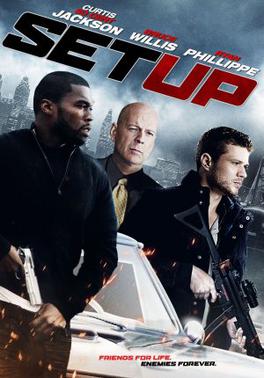
Well, anyway, Sonny (5o Cent) is a career criminal who also happens to be a really nice guy. When his partner-in-crime, Vincent (Ryan Phillippe), worries about the survival of his imprisoned father (James Remar), Sonny is sympathetic. When his other partner-in-crime, Dave (Brent Granstaff), won’t shut up about how much he loves his wife and his life in the suburbs, Sonny is genuinely happy for him. Sonny may be a criminal but he’s not violent. He’s not a killer.
Understandably, Sonny is upset when Vincent kills a guard during their latest diamond heist. However, that’s nothing compared to how angry Sonny becomes when Vincent betrays both him and Dave, shooting them and leaving them for dead. Dave dies but Sonny survives. Seeking revenge, Sonny teams up with a gangster named Biggs (Bruce Willis). Biggs demands that Sonny retrieve some money for him. It really shouldn’t be that difficult except for the fact that every criminal in Detroit is soon revealed to be an absolute idiot.
At this point, I’ll admit that 2011’s Setup has more than a little in common with Gun. Like that film, it takes place in Detroit and it centers on the drama that takes place in the shadows of the underworld. 50 Cent plays a criminal in both films. James Remar has a small role in both films. Both films feature multiple betrayals and both of them contrast the criminals on the street with the bosses behind-the-scenes. Both films were also produced by Randall Emmett. Indeed, this was one of the first films that Bruce Willis did with Emmett. Emmett would go on to produce several of Willis’s final films and there’s definitely some controversy as to whether or not those films exploited Willis at a time when he was particularly vulnerable.
That said, I actually kind of liked Setup. It’s definitely a low-budget B-flick but it still has its ambitions and it actually achieves some of them. 50 Cent is far more convincing as the well-intentioned but somewhat dumb Sonny in Setup than he was in Gun and he actually does pretty well as the film progresses and Sonny becomes more conflicted about whether or not he actually wants his legacy to be one of vengeance. Ryan Phillippe is well-cast as Vincent and I liked the performances of Jay Karnes and Jenna Dewan, both playing low-level criminals who find themselves in over their heads. The film did a good job of examining all of the different levels of crime in Detroit, from the wealthy Biggs all the way down to the idiots who continually screw up the simplest of plans. Randy Courtere does an especially good job as Petey, the moron who thinks playing with a loaded gun is a good idea.
As for Bruce Willis, his role here is small and it’s a role that probably could have been played by any tough guy actor of a certain age. But, Willis still brings his cocky charm to the role. (Seeing Willis here really drives home just how different he was in the final films that he did for Emmett.) Willis plays Biggs with a sense of humor and it’s just what the movie needed.
To say a movie is better than expected can sound like a backhanded compliment but it’s a compliment nonetheless. Setup was definitely better than I expected.
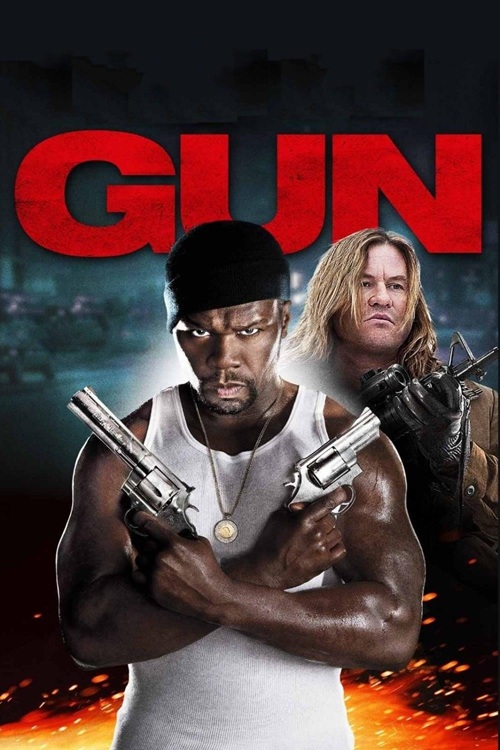
Angel (Val Kilmer) has just been released from prison and he’s returned to the hard streets of Detroit. Hooking up with his old friend Rich (50 Cent), Angel gets involved in a gun-running operation.
Unfortunately, it’s no longer easy or safe to sell guns in Detroit. The police are cracking down. Rival gun dealers are trying to take out a competition. A raid at a club leaves a dealer dead and a huge power void in Detroit’s criminal underworld. When it becomes obvious that the police have a snitch in Rich’s crew, Rich’s girlfriend (AnnaLynne McCord) suspects that it’s Angel. Can Rich find the snitch without having to betray his best friend? And does Angel have secrets of his own?
First released in 201o, Gun was the third film that Val Kilmer made with 50 Cent and it’s apparently their only collaboration that Kilmer didn’t mention in his autobiography. It probably should be noted that Val Kilmer doesn’t look particularly happy in the movie but that actually works for his character. Angel has just gotten out of prison, he’s mourning his wife, and he’s found himself right in the middle of the type of violent situation that could lead to him going back to prison. In many ways, Angel feels like he could be a version of Heat’s Chris Shiherlis. It’d easy to imagine that maybe Chris changed his name after escaping Los Angeles. He became Angel and he found a new partner in the form of Rich. Unfortunately, Detroit is a lot uglier than Los Angeles, Rich is no Neil McCauley, and Michael Mann’s not directing. Kilmer’s performance is not bad. Even in a low-budget movie like this, he still did his best.
That said, the film is centered around 50 Cent. 50 Cent plays Rich. 50 Cent provides the music. 50 Cent produced the film, along with Randall Emmett, a producer who largely made a career out of getting faded stars to appear in B-movies. (He’s best-known for producing the many of Bruce Willis’s final films.) As Rich, 50 Cent gives a rather stiff performance. It’s not so much that he’s not convincing as a street smart gun dealer as he’s just not very interesting to watch. There’s a predictability to his performance, one that is reflected in the songs that appear on the film’s soundtrack. How many rap songs about making money and shooting people can one listen to before admitting that it all gets boring after a while?
In the end, the most interesting thing about Gun is the number of familiar faces who appear in small roles. James Remar plays a cop. Paul Calderon, the bartender from Pulp Fiction and the traitor from King of New York, plays a detective. John Larroquette and, somewhat inevitably, Danny Trejo both make appearances. Perhaps most oddly, Mike “Boogie” Malin, the winner of Big Brother All-Stars, plays an ATF agent. I should mention that, in real life, Boogie Mike and Dr. Will Kirby (winner of Big Brother 2) had a friendship that widely mirrored the friendship between Rich and Angel. I doubt that factored into his casting. That would be giving Gun to much credit.
Gun was not a particularly compelling film, though it did win some authenticity points by actually being shot on location in Michigan. That said, Val Kilmer gave a better performance than perhaps the material deserved. Val is definitely missed.
“This ain’t no god damn way to start a partnership.” – Reggie Hammond
48 Hrs. bursts onto the screen with a gritty prison breakout that sets the stage for chaos in the foggy streets of San Francisco, where a pair of ruthless killers slip away after gunning down a cop’s partner in cold blood. Jack Cates, the surviving detective, is left battered and furious, piecing together a case that points to a slick convict named Reggie Hammond holding the key to the crooks’ whereabouts—and a stash of stolen cash. With time ticking down, Jack pulls strings to get Reggie out on a 48-hour pass, thrusting these two polar opposites into a reluctant alliance that turns the city into their personal battlefield of bullets, banter, and bad blood.
From the jump, Jack comes across as the ultimate rough-around-the-edges cop, nursing a flask under his trench coat, snapping at colleagues, and charging headfirst into danger like a man who’s got nothing left to lose. His apartment is a mess of empty bottles and regret, and his rocky relationship with his girlfriend underscores how the job has chewed him up and spit him out, leaving him more beast than man. Reggie, by contrast, rolls in with street-honed swagger, his prison jumpsuit barely containing the energy of a guy who’s survived by being quicker on his feet and sharper with his mouth than anyone around him. He’s got a girlfriend waiting with that hidden money, and no intention of playing nice with a cop who’s eyeing him like fresh meat.
The beauty of their pairing lies in how the film lets their friction spark from the very first shared car ride, where Jack’s growled commands clash against Reggie’s nonstop ribbing, turning a simple stakeout into a verbal demolition derby. Picture them peeling out after a lead goes south, tires screeching through narrow alleys while Reggie gripes about the beat-up car and Jack slams the dash in frustration—it’s these raw, unscripted-feeling moments that make the movie breathe. As they hit up seedy bars, chase informants through strip joints, and dodge ambushes, the script peels back layers: Jack’s not just a bully, he’s haunted by close calls; Reggie’s bravado masks real fear of ending up dead or broke.
One standout sequence drops them into a hillbilly roadhouse packed with hostile locals, where Reggie grabs the mic for an impromptu takedown that flips the room from menace to mayhem, buying them time while Jack backs him up with sheer firepower. It’s tense, hilarious, and perfectly timed, showing how their skills complement each other—Jack’s brute force meeting Reggie’s silver tongue—in ways neither saw coming. The villains, led by a stone-cold Luther and his trigger-happy sidekick, keep the heat cranked high, popping up for savage hits that leave bodies in the gutter and force the duo to improvise on the fly, like hot-wiring rides or shaking down lowlifes for scraps of intel.
Walter Hill’s direction keeps it all taut and visceral, with handheld cameras capturing the sweat and grime of every punch thrown or shot fired, no glossy filters to soften the blows. The San Francisco backdrop shines through rain-slicked hills, neon-lit dives, and shadowy piers, giving the action a grounded, almost documentary edge that amps up the stakes. Sound design punches too—the roar of engines, the crack of gunfire, the thud of fists—layered over a pulsing ’80s score that shifts from funky grooves during chases to ominous drones in quieter beats, mirroring the push-pull between comedy and threat.
Diving deeper into the characters, Jack’s arc feels earned through small touches: a hesitant phone call to his ex, a flicker of respect when Reggie saves his skin, moments that humanize the hardass without forcing redemption. Reggie evolves too, his initial scam-artist vibe giving way to flashes of loyalty, like when he risks his neck to protect that cash not just for himself, but to build something real outside the walls. Supporting roles flesh out the world—the precinct captain barking orders, the sultry singer tangled with the bad guys, Reggie’s tough-as-nails woman who won’t take guff—but they never overshadow the core duo, serving as sparks for conflict or comic relief.
Pacing-wise, the film rarely pauses for breath, clocking in under two hours yet packing in a full meal of twists, from double-crosses at motels to a frantic foot chase across rooftops that leaves you winded. The 48-hour ticking clock adds urgency without gimmicks, every dead end ramping tension as dawn breaks on their deadline. Humor lands organically too, not from slapstick but from character-driven zingers—Reggie calling out Jack’s outdated tough-guy schtick, Jack grumbling about Reggie’s flashy clothes—keeping the tone light even as blood spills.
Of course, watching through modern eyes, the dialogue packs some era-specific punches, with raw language around race, cops, and crooks that reflects ’80s attitudes head-on, for better or worse. It’s unapologetic, mirroring the film’s macho pulse, but adds texture to the time capsule feel, making replays fascinating for how boldly it leaned into taboos. The women, while fierce in spots, often play second fiddle to the bromance brewing, a hallmark of the genre that 48 Hrs. helped cement before it evolved.
What elevates this beyond standard action fare is how it nails the buddy dynamic’s slow burn: no instant high-fives, just gradual thaw from shared survival, culminating in a dockside finale where alliances solidify amid explosions and last stands. The editing zips between high-octane set pieces and downtime breather scenes, like a roadside diner heart-to-heart that reveals backstories without halting momentum. Cinematography plays with shadows and neon to heighten paranoia, turning everyday spots into pressure cookers.
Influence-wise, you can trace lines straight to later hits—the grizzled vet and smooth-talking newbie formula got refined here, blending Lethal Weapon grit with Beverly Hills Cop wit years ahead of schedule. Performances anchor it all: the leads’ chemistry crackles, carrying weaker beats on sheer charisma, while Hill’s lean style ensures every frame earns its keep. Runtime flies because it’s efficient, no fat, just muscle.
Final stretch ramps to operatic violence on those windswept docks, bullets flying as personal scores settle, leaving our heroes bloodied but bonded in a way that feels hard-won. 48 Hrs. endures as a rowdy blueprint for the genre, blending laughs, thrills, and toughness into a package that’s addictive on first watch and rewarding on revisit. It’s got heart under the bruises, edge in the jokes, and a vibe that’s pure ’80s adrenaline—grab it for a night of no-holds-barred entertainment that still packs a wallop over four decades later.
Claire (Michelle Pfeiffer) is a former cellist who is still struggling to recover from a serious car accident and who has been at loose ends ever since her daughter left for college. Claire’s husband, Norman (Harrison Ford), is a scientist and a college lecturer. After their neighbor, Mary (Miranda Otto), disappears, Claire becomes convinced that Mary’s husband (James Remar) did something to her. Claire also becomes convinced that Mary’s ghost is trying to contact her, by appearing in the lake and filling the bathtub up with water whenever Claire isn’t looking. Norman tells Claire that she’s imagining things and pushes her to see a therapist. As Claire investigates, she discovers that Norman knows more than he’s letting on.
What Lies Beneath is a long and drawn-out ghost story that Robert Zemeckis made because he had time to kill while the filming of Cast Away was on hiatus so Tom Hanks could lose weight and grow a beard. That this movie was not a personal project for Zemeckis is reflected in his direction, which is surprisingly impersonal for a Zemeckis film. The film is a showcase for Michelle Pfeiffer, who gives a good performance as the emotionally fragile Claire and holds the film’s many disparate elements together. Harrison Ford sometimes seems disinterested but his casting still pays off when Norman gets to say and do some things that you normally would never expect Harrison Ford to do.
I remember seeing this in a theater in 2000 and being surprised by the ending. Looking back on it today, I just can’t believe that I sat through the entire movie.
Since Sunday is a day of rest for a lot of people, I present #SundayShorts, a weekly mini review of a movie I’ve recently watched.
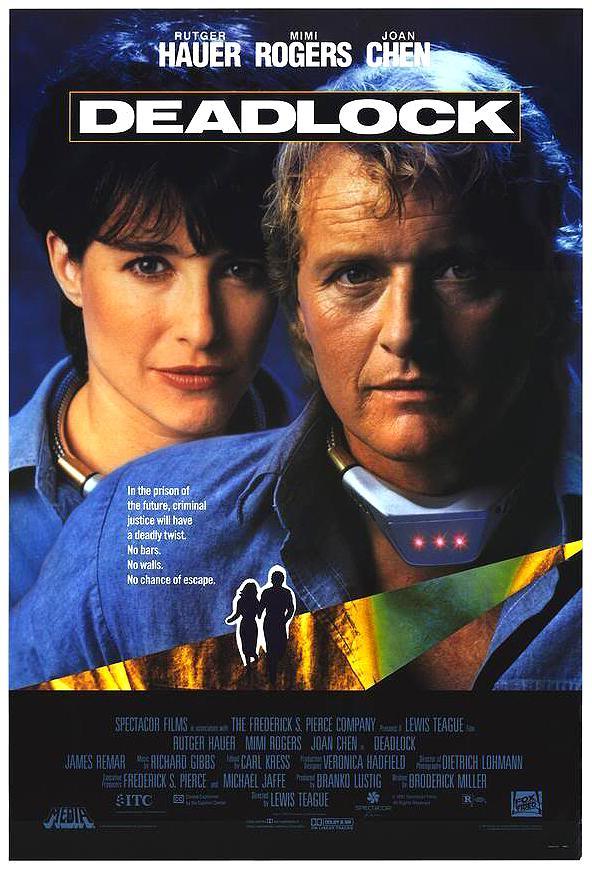
Master diamond thief Frank Warren (Rutger Hauer) pulls off a big job with the help of his fiancé Noelle (Joan Chen) and his best friend Sam (James Remar). Unfortunately, after the job is finished, Noelle unceremoniously ends her courtship with Frank when she shoots him multiple times because she’s now hooked up with Sam. The next time we see Frank, who somehow survived the close-range shootings, he’s on a bus to a prison called Camp Holliday, which is run by Warden Holliday (Stephen Tobolowsky). Camp Holliday is a high-tech prison where each inmate is gifted a collar containing an explosive device that also happens to be electronically connected to another inmate. As long as the two prisoners are within 100 yards from each other, it’s all good. If they are separated by more than 100 yards, their collars will explode leaving a bloody nub where their head used to be. And since nobody knows who their “wedlock partner” is, trying to escape is not a strong option. One day fellow prisoner Tracy Riggs (Mimi Rogers) comes to Frank and tells him that she’s his wedlock partner. Through a variety of circumstances, the two are able to escape, but they still must maintain their 100-yard proximity as the authorities try to track them down. Meanwhile, Sam and Noelle, and even Warden Holliday, have all teamed up to try to find where Frank stashed the diamonds prior to heading to prison. And what about Tracy, who’s side is she really on?
I didn’t have the Home Box Office channel when I was growing up, so I wasn’t aware of this film until it premiered on home video as “DEADLOCK.” Of course, being a huge fan of Rutger Hauer, I rented it as soon as possible. The key to lower budget, made-for TV movies working will always be tied to three things: an entertaining premise, a game cast, and a director who can put the movie together. I’m happy to report that WEDLOCK has each of these things. Even though we had seen exploding neck collars in prison before in THE RUNNING MAN (1987), I like the way this film ties one prisoner’s fate to another’s. That extra dimension makes for some exciting moments in the film. Rutger Hauer is especially good in WEDLOCK. If any other actor was in the lead, I honestly doubt I would have enjoyed it as much, but with him it becomes a fun movie. And the fact that he’s tied to the beautiful Mimi Rogers for most of the movie makes it that much more fun. The remainder of the cast goes pretty far over the top, but that’s okay because subtle character portrayals are not part of the equation in these types of movies. James Remar and Joan Chen are fun as the initial betrayers and current pursuers, Basil Wallace is effectively evil as a bully and fellow inmate, and Stephen Tobolowsky is his usual fun self as Warden Holliday. Director Lewis Teague has a pretty nice resume of interesting films leading up to WEDLOCK, including ALLIGATOR (1980), FIGHTING BACK (1982), CUJO (1983), CAT’S EYE (1985), and NAVY SEALS (1990). He does a fine job here, as the movie has many well executed scenes that play out at a nice pace. Overall, I’ve always been a fan of low budget action movies that are done well. This one fits the bill for me.
Five Fast Facts:
Rutger Hauer and Joan Chen worked on 3 films together, including WEDLOCK. I have a soft spot in my heart for their film THE BLOOD OF HEROES (1989) and recommend it. I thought their other movie, PRECIOUS FIND (1996) was pretty bad. I watched it one time in the 90’s and haven’t watched it since.
WEDLOCK received a Primetime Emmy nomination for “Outstanding Individual Achievement in Sound Editing for a Miniseries or a Special.”
Even though WEDLOCK was set “in the future,” early in the film we see a movie theater marquee showing the Steven Seagal movie MARKED FOR DEATH (1990). I found that interesting considering that Basil Wallace is a bad guy in WEDLOCK, and he played twin brother bad guys in MARKED FOR DEATH. Danny Trejo also has small parts in both WEDLOCK and MARKED FOR DEATH.
Mimi Rogers starred in another film in 1991 called THE RAPTURE. It’s a thought-provoking film that some people love, and some people hate. I personally found it intriguing, and it features a really strong performance from Rogers.
In 1995, the film DEADLOCK 2 was released. It’s not a sequel as it doesn’t build on the events of the first film or bring back any of the characters, but it is set in a world of exploding prison collars. The film stars Esai Morales and Nia Peeples.
When I rented the film in the early 90’s, it was called DEADLOCK. I’m sure I owned it on VHS at one point in my life.
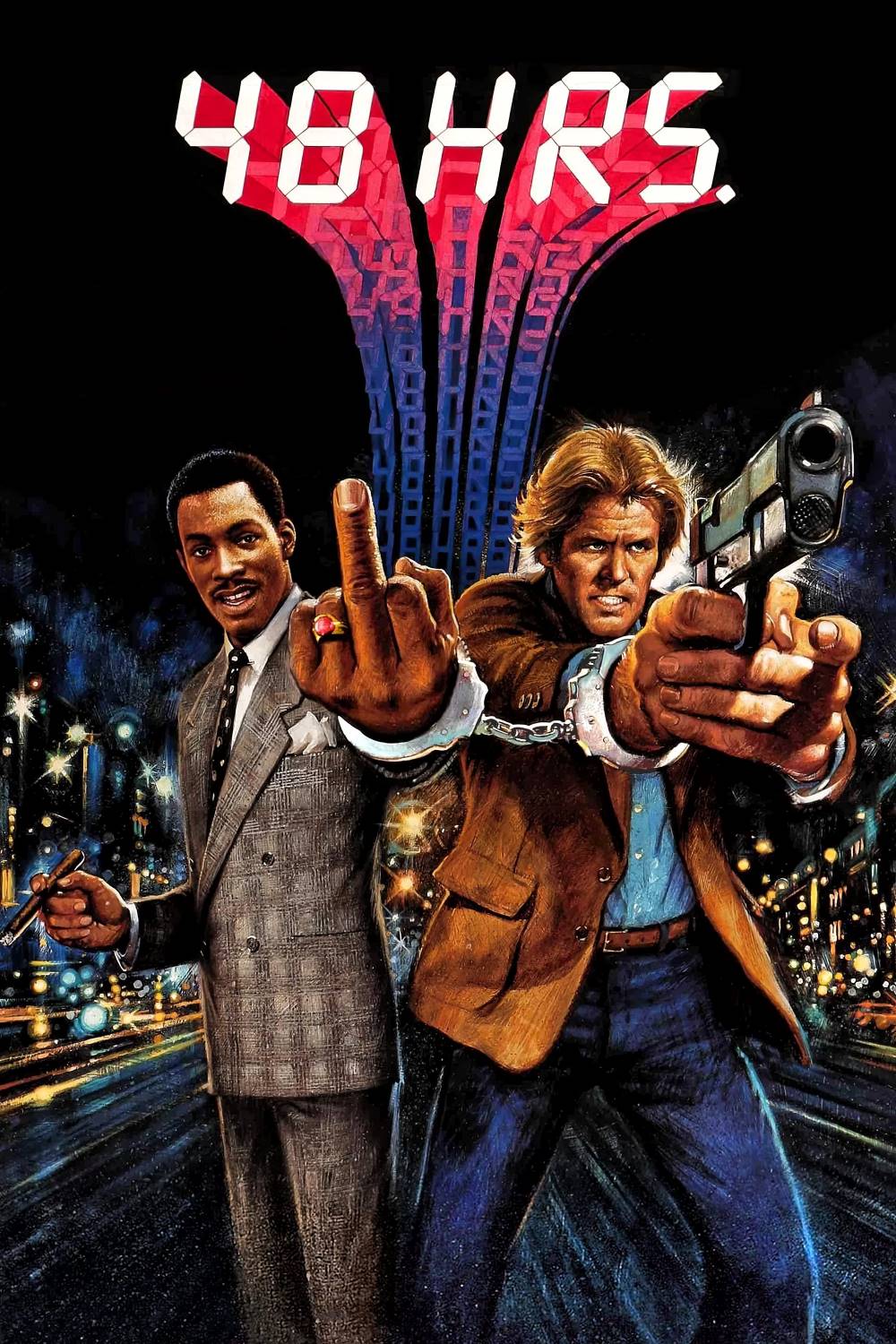
48 Hrs. begins with a violent and bloody jailbreak. The fearsome Billy Bear (Sonny Landham) helps his criminal associate, Albert Ganz (James Remar), escape from a chain gang and kills several guards in the process. Billy and Ganz then head to San Francisco, where they start killing their former associates while searching for Luther (David Patrick Kelly). Another bloody shootout leaves several detectives dead and SFPD Detective Jack Cates (Nick Nolte) looking for revenge.
That’s not the way you might expect one of the most famous comedies of the 80s to begin. It’s not until Jack arranges for another associate of of Ganz’s to be released from prison for 48 hours that anything humorous happens in the film. However, because Reggie Hammond is played by Eddie Murphy, 48 Hrs. quickly becomes very funny.
Murphy was appearing on Saturday Night Live when he was cast in 48 Hrs, in a role that was written with Richard Pryor in mind. One of the first things that Murphy requested was that the character’s name be changed from Willie Biggs to Reggie Hammond. Murphy made the role his own and watching him, it’s hard to believe that he was only 21 and also that 48 Hrs was his first film. Murphy performs with the confidence of a natural movie star. He’s good in the film’s most famous scene, where he pretends to be a cop and talks down an entire bar full of rednecks. (I can’t repeat his most famous line but everyone knows it.) But Murphy is even better in the scenes where he’s just reacting to Nolte’s slovenly cop.
The comedy in 48 Hrs comes from the mismatched partnership and initially hostile chemistry of Jack Cates and Reggie Hammond. Cates has a job to do while Reggie, understandably, wants to enjoy as much freedom as he can before he gets sent back to prison. The humor is so effective because it’s almost entirely character-based. There are no gags but there are two well-written characters with differing ways of looking at the world who have to learn how to work with each other. The two of them start out disliking and distrusting each other but ultimately become best friends, even if Jack does punch Reggie and Reggie does keep trying to steal Jack’s lighter. Because this is a Walter Hill movie, there’s still a lot of action. Nolte and Murphy may make you laugh but there’s nothing funny about full-on psycho performances of James Remar and Sonny Landham. 48 Hrs. not only allows Murphy and Nolte to show off their comedic ability but it also allows them to be true action heroes.
Popular with critics and audiences, 48 Hrs. was the most commercially successful film of 1982. It set the standard for most buddy-cop movies to this day and it introduced the world to Eddie Murphy.
It’s hard to know where to really start with Megalopolis.
Directed, written, produced, and financed by Francis Ford Coppola, Megalopolis takes place in an alternate version of the United States of America. In this alternative world, New York is called New Rome and it is dominated by a handful of wealthy families. Former District Attorney Franklyn Cicero (Giancarlo Esposito) has been elected mayor. Everyone seems to hate Cicero and the character tends to come across as being a bit whiny so you really do have to wonder how he got elected in the first place.
Cicero is obsessed with the powerful Crassus-Catallina family, which is headed by banker Hamilton Crassus III (Jon Voight). Hamilton’s nephew is Cesar Catallina (Adam Driver), a brilliant architect who won a Nobel Prize for inventing a type of invisible material. Ever since Cesar’s wife vanished under mysterious circumstances, a cloud of scandal has hung over Cesar’s name and with that scandal has come popularity with both the masses and the tabloid press. When Cesar was tried for murder, the prosecutor was Franklin Cicero. Cesar was acquitted but he now spends his time drinking and mourning his wife. Cesar also has the power to stop time for everyone but him. Why he has this power and how he came to possess it is never made clear, though Cesar compares it to the way that a great painter or writer can capture one moment for eternity.
Cesar is driven through the rainy streets of New York by his chauffeur, Fundi Romaine (Laurence Fishburne). Fundi also serves as the film’s narrator, ruminating about how the Roman Empire eventually became a victim of its own decadence. Just in case the viewer somehow doesn’t pick up on the fact that the movie is comparing modern America to ancient Rome, Fundi informs us of this fact. Thanks, Fundi!
After Cesar publicly denounces Cicero’s plans to turn New Rome into a casino, Cicero’s daughter Julia (Nathalie Emmanuel) decides to take a break from decadent partying to follow Cesar around and try to discover whether or not he actually murdered his wife. Julia discovers that Cesar is not only still mourning his wife but she also witnesses him stopping time. Soon, Julia is working for Cesar’s design firm. At some point, she and Cesar become lovers.
Meanwhile, Cesar’s former lover, Wow Platinum (Aubrey Plaza), has married Crassus and is plotting to take control of his bank. Working with Wow is Cesar’s buffoonish cousin, Clodio Pulcher (Shia LaBeouf), who organizes the angry citizens of New Rome into a mob that threatens the safety and power of both Cicero and Cesar. “Make Rome Great Again,” a sign reads at one of Clodio’s rallies, just in case anyone was missing Coppola’s point.
Clodio is obsessed with destroying Cesar. First, he frames Cesar for deflowering New Rome’s vestal virgin, the singer Vesta Sweetwater (Grace VanderWaal). Then, he sends a 12 year-old assassin after Cesar. Cesar fears that he’s lost his ability to stop time. Julia falls more and more in love with him. Cicero gets booed everywhere he goes and, after his fixer (Dustin Hoffman) is mysteriously killed, he finds himself helpless against Clodio’s mob. Can Cesar be convinced to abandon his self-pity long enough to stand up to Clodio?
And what about the Russian spy satellite that just crashed into New Rome? Who will rebuild the city?
And …. well, let’s just say that there’s a lot going on in New Rome.
Francis Ford Coppola originally came up with the idea for Megalopolis in 1977 and he spent decades trying to bring the film to the big screen. Eventually, Coppola ended up producing and financing the film himself. From 2023 to the the day of the film’s Cannes premiere, the trade papers were full of stories about how difficult the production had been, with the underlying theme being that everything was Francis Ford Coppola’s fault and that the movie would be an unmitigated disaster. (In the coverage found in both Variety and The Hollywood Reporter, there seemed to be a good deal of hostility directed at Coppola’s decision to work outside of the Hollywood system.) Disgruntled members of the crew complained that Coppola was an undisciplined director who spent most of the production high. A half-baked attempt to generate a #MeToo scandal around the film made it obvious that Coppola had burned a lot of bridges with both Hollywood and the media. The film was released to critical derision and poor box office returns. Coppola is 85 years old and it’s entirely possible that Megalopolis will be his final film.
Critics be damned, I liked the majority of Megalopolis. Though the film may be thematically and narratively incoherent, it is a feast for the eyes and it’s hard not to respect the fact that, in this age of overwhelming conformity, Coppola brought his own unique vision to the screen. There are a few moments of genuinely macabre beauty to be found in the film. When the Russian satellite crashes into New York, we don’t see the impact but, on the city walls, we do see the shadows of people screaming in fear. When a drunk Cesar is driven through New Rome, he sees gigantic statues stepping off of their bases and slumping to the ground, exhausted with being on display. Coppola films New Rome like a beautiful, open-air prison. It’s an amazing view but don’t even think about trying to escape. The scenes in New Rome’s Coliseum are filled with an epic yet seedy grandeur. At times, the film’s scenes seem to be almost randomly assembled, leaving us to wonder if we’re seeing the past, the present, or maybe just something that Cesar is imagining in his head.
What is the film actually about? It’s not always easy to say. Even in his best films, Coppola has had a tendency to be self-indulgent. Sometimes, that self-indulgence pays off. Though few would admit it now, The Godfather Part II is one of the most self-indulgent films ever made. But it’s also brilliant so it doesn’t matter. However, with Megalopolis, it’s hard not to feel that this film was such a passion project for Coppola that he didn’t stop to consider whether or not he really had anything new to say. Megalopolis is hardly the first film to compare the supposed decline of America to the fall of the Roman Empire. As much as I enjoyed the film’s visuals, I cringed at the film’s ending. One can only imagine how a past Coppola collaborator like John Milius would have reacted to a bunch of children reciting a pledge to take care of the “one Earth.”
It’s a random film, one in which plot points are raised and often quickly abandoned. At one point, Cesar starts to recite Hamlet’s famous “to be or not to be” soliloquy. The cast is huge and everyone seems to be acting in a different movie. Surprisingly enough, neither Esposito nor Adam Driver are particularly believable in their roles, though I think that has more to do with the film’s loose narrative structure than anything else. Shia LaBeouf is convincingly feral as Clodio while Jon Voight seems to be having fun as the wealthy and crude Crassus. The best performance in the film comes from Aubrey Plaza, who plays her role like a vampish femme fatale who has somehow found herself in a science fiction story. Plaza holds nothing back with her performance and she actually manages to bring some genuine human emotion to Coppola’s surreal epic.
Megalopolis is a monument to self-indulgence but it’s always watchable. Coppola may not know what he’s trying to say but he captures the surreal beauty that comes from getting trapped in one’s own imagination. Megalopolis is not a film for everyone but I’m glad it exists. At a time when artistic freedom seems to be under constant attack, it’s hard not to be happy that Coppola did things his way.
Welcome to Retro Television Reviews, a feature where we review some of our favorite and least favorite shows of the past! On Mondays, I will be reviewing Miami Vice, which ran on NBC from 1984 to 1989. The entire show can be purchased on Prime!
This week, Crockett discovers that one of his oldest friends has a secret.
Episode 2.6 “Buddies”
(Dir by Henry Mastrogeorge, originally aired on November 1st, 1985)
When sleazy stand-up comedian Morty Price (a youngish Nathan Lane) attempts to sexually assault a cocktail waitress named Dorothy (Eszter Balint), he ends up getting fatally stabbed with a steak knife. Dorothy flees from the crime scene, taking her baby and grabbing a bunch of random papers that, unknown to her, prove that Morty Price was placing illegal bets with mobster Frank Doss (Frankie Valli). This information could keep Doss from being able to get a casino license in Florida.
Because Doss and his partner, Johnny Cannata (Tom Signorelli), are mob-connected, Castillo and Vice take over the investigation of Price’s murder. Sonny and Tubbs learn, from an informant (Karla Tamburrelli), that Price took Dorothy up to his room before he was murdered. While Crockett and Tubbs search for Dorothy to find out what happened with Price, Doss and Cannata send their men to track down Dorothy and keep the papers from reaching the police.
During the investigation, Sonny is stunned to come across security footage of one of his oldest friends, Robbie Cann (James Remar), meeting with Doss and Cannata. Robbie not only served in Vietnam with Sonny but he has also recently asked Sonny to be his son’s godfather. Robbie has just opened up a club and, as he explains to Sonny, he finally feels like he’s something more than just a loser. When Sonny confronts Robbie about meeting with the gangsters, Robbie admits that he borrowed money from them to start the club but he insists that he doesn’t have any other type of relationship with them. However, when Sonny attends the christening of Robbie’s son, he discovers that Robbie’s name is actually Robert Cannata. He is Johnny Cannata’s son! Robbie insists that he has nothing to do with his father’s business but Sonny is forced to ask just how much he can trust one of his closest friends.
This episode is a bit of a mess. On the plus side, fans of character actors will enjoy this episode. James Remar’s nervy performance keeps you guessing and it’s undeniably interesting to see Nathan Lane playing someone that sleazy. Frankie Valli and Tom Signorelli make for convincing gangsters. It’s also the first episode of the series to really feature Sonny talking about what it was like to serve in Vietnam and it deserves some credit for attempting to explore the difficulty that many veterans face when trying to adjust back to civilian life. Robbie has not had an easy life after returning to the U.S. but now, he finally has a wife, a child, and a business. Sonny may feel betrayed by Robbie but he’s also aware that his investigation is going to potentially ruin Robbie’s life.
On the other hand, the episode attempts to take on so much that it stretches itself a bit then. It requires a real suspension of disbelief to accept that Sonny would just happen to be assigned to an investigation that would involve his best friend. I mean, what are the chances? The episode also can’t seem to decide if it wants to focus on Robbie or if it wants to focus on Dorothy and her child. As a result, neither story really feels as if it gets all of the attention that it deserves.
Next week, the Vice Squad investigates jazz legend Miles Davis!
Though the Academy of Motion Picture Arts and Sciences claim that the Oscars honor the best of the year, we all know that there are always worthy films and performances that end up getting overlooked. Sometimes, it’s because the competition too fierce. Sometimes, it’s because the film itself was too controversial. Often, it’s just a case of a film’s quality not being fully recognized until years after its initial released. This series of reviews takes a look at the films and performances that should have been nominated but were, for whatever reason, overlooked. These are the Unnominated.
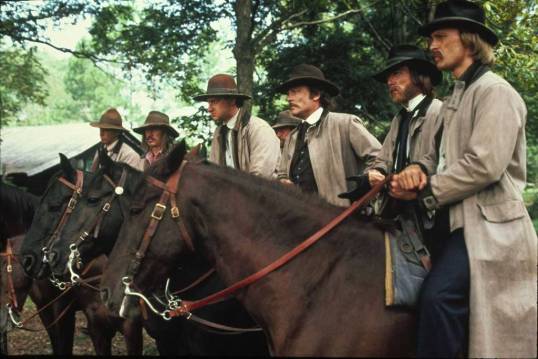
First released in 1980, The Long Riders is one of the many films to tell the story of the James/Younger Gang.
A group of former Confederate guerillas who became some of the most notorious bank robbers to roam post-Civil War America and who were based in Missouri, the brothers who made up the James/Younger Gang were hunted by the Pinkertons and beloved by the citizens who viewed them as being 19th Century Robin Hoods. Following a disastrous attempt to rob a bank in Northfield, Minnesota, the Younger brothers were captured by the government while Jesse and Frank James made it back to Missouri. Jesse was shot in the back by Bob Ford while Frank subsequently surrendered to authorities and made a good living on the lecture circuit.
The Long Riders tells the story of the gang, from their first encounter with the heavy-handed Pinkertons to the Northfield raid to Frank’s eventual surrender. Director Walter Hill both celebrates the legend of the James/Younger Gang while also emphasizing that all the members of the gang were also individual humans who had their strengths and their flaws. Hill emphasizes the idea of the gang being a group of post-war rebels, still fighting a war against a government that is more interested in protecting banks than looking after people. The Long Riders deconstructs the legend while also celebrating it.
The main thing that sets The Long Riders apart from other films about the James/Younger Gang is the fact that the brothers are played by actual brothers. David, Keith, and Robert Carradine plays the Youngers. Randy Quaid plays Clell Miller while Dennis Quaid assumes the role of the cowardly Ed Miller. Nicholas and Christopher Guest make a memorably creepy impression as Charley and Bob Ford. And finally, Jesse and Frank James are played by James and Stacy Keach. (The Keaches also worked on the film’s script). And while Stacy is definitely the more charismatic of the Keach brothers, the film makes good use of James’s rather stoic screen presence. While the rest of the gang enjoys the outlaw life, James Keach’s Jesse is rigid, serious, and ultimately too stubborn and obsessive for his own good.
Now, the casting might sound like a gimmick but it works wonderfully. When Clell chooses the gang over Ed, it carries an emotional weight because we’re watching real brothers reject each other. The comradery between the Carradines carries over to the comradery between the Youngers and it also informs their occasional rivalry with the better known James brothers. While it is Stacy Keach and David Carradine who ultimately dominate the film, every brother in the cast makes a strong impression. Also giving a memorable performance is Pamela Reed as a defiantly independent Belle Starr, who loves David Carradine’s Cole Younger but marries Sam Starr (James Remar). The knife fight between Carradine and Remar is one of the film’s highlights, as is the violent and disastrous attempt to rob the bank in Northfield.
The Long Riders is an exciting and ultimately poignant western but sadly, it received not a single Oscar nomination, not even for the stunning cinematography or Ry Cooder’s elegiac score. Fortunately, just like the legend of the James/Younger Gang, The Long Riders lives on.
First released in 1990 and based on a horror-themed television series that was created by the one-and-only George Romero, Tales From The Darkside: The Movie is an anthology film. Usually, I can’t stand anthology films because it seems like the viewer only gets one good story and has to sit through two or three mediocre stories to get to the worthwhile stuff. However, I have to say that I really enjoyed all of the stories featured in Tales From The Darkside: The Movie.
The film opens with a wrap-around story, featuring Timmy (Matthew Lawrence), a young boy who is chained up in a pantry and who a local witch named Betty (Debbie Harry) is planning on cooking for a dinner party. Timmy tries to distract Betty from her kitchen duties by telling her three stories.
The first story features Steve Buscemi as a nerdy college student named Edward Bellingham. On the verge of getting a much-needed scholarship, Edward is framed for theft by two of his classmates (one of whom is played by Julianne Moore) and loses the scholarship. Edward responds by doing what anyone would do. He unrolls an ancient parchment and brings to life a mummy who kills his rivals. A very preppy Christian Slater plays Andy, the smug brother of one of the victims who seeks revenge against Bellingham. In a surprise twist, Bellingham is able to get some vengeance of his own.
The second story features William Hickey as Drogan, an annoying old man who is convinced that he is being stalked by an evil black cat. Drogan hires a hitman (David Johansen) to kill the cat but, as we all know, black cats are far more clever than anyone realizes. The story ends on a notably grisly note because cats rule!
Finally, the third story features James Remar as a struggling artist who, one night, discovers that the stone gargoyle that sits atop of his apartment building is actually alive. After witnessing the gargoyle kill someone, the artist promises never to reveal that the gargoyle exists. “Cross your heart?” the gargoyle asks before flying away. Later, the artist meets a mysterious woman (Rae Dawn Chong) who helps him to become a success on the art scene. However, even after he marries the woman and they start a family, Remar is still haunted by his memories of the gargoyle.
As I said at the start of this review, I’m not a huge fan of anthology films but I really liked Tales From The Darkside: The Movie. All three of the stories are equally good and there’s really not a slow spot to be found. This is a horror anthology that manages to balance scares and laughs without becoming too silly or forgetting that the movie is meant to be a horror story. Steve Buscemi, Christian Slater, and James Remar are stand-outs amongst the cast. Even the wrap-around story had a good ending!
If you’re going to watch an anthology film for Halloween, allow me to recommend Tales From The Darkside: The Movie!





 Through the Shattered Lens